Estefânia Martins DIAS1, Maria Isabel Barreiro RIBEIRO2 and Marina Maria Pedrosa Meca Ferreira de CASTRO2
1Instituto Politécnico de Bragança, Campus de Santa Apolónia, Bragança, Portugal
2CIMO, LA SusTEC, Instituto Politécnico de Bragança, Campus de Santa Apolónia, Bragança, Portugal
Volume 2025,
Article ID 877386,
Research in Agriculture and Agronomy,
13 pages,
DOI: 10.5171/2025.877386
Received date: 7 May 2025; Accepted date: 16 July 2025; Published date: 2 October 2025
Cite this Article as:
Estefânia Martins DIAS, Maria Isabel Barreiro RIBEIRO and Marina Maria Pedrosa Meca Ferreira de CASTRO (2025), “Perceptions and Challenges of Silvopastoralism in Trás-os-Montes: Insights from the Agricultural Sector”, Research in Agriculture and Agronomy, Vol. 2025 (2025), Article ID 877386, DOI: 10.5171/2025.877386
Silvopastoralism is a traditional land-use practice that integrates extensive livestock farming with forestry, generating both economic and environmental advantages. Over time, however, it has declined in relevance and the number of practitioners threatening its continuity and the ecosystem services it provides.
This study aims to explore the perceptions of farmers and agricultural stakeholders in the Trás-os-Montes region concerning silvopastoral practices, while identifying the main barriers to their implementation and ways to encourage their adoption. A total of 60 anonymous surveys were carried out for this purpose. The results indicate that respondents see silvopastoralism as highly valuable in terms of wildfire prevention, biodiversity conservation, and sustainable natural resource management. It is particularly regarded as suitable for implementation in mature forest areas and regions with high levels of biomass.
Nevertheless, several challenges hinder its adoption, including the lack of technical assistance, low economic returns, and limited awareness of existing research projects in this field. Another significant point raised by this research is the importance of preserving autochthonous livestock breeds, which are deeply connected to silvopastoral practices but increasingly at risk due to their decline.
The study also emphasizes the urgent need to rethink rural land management models—especially by developing support mechanisms for producers who engage in silvopastoralism. The future of this practice in Trás-os-Montes will rely not only on the ability of farmers to adapt to modern-day challenges, but also on the broader societal recognition of its environmental benefits and the political will to strengthen and promote it.
Agroforestry refers to land use that combines trees or other perennial woody plants with agricultural and/or livestock production in the same area (Nair, 1991). The three main elements, organized in different spatial and/or temporal arrangements, include trees and woody plants, herbaceous plants, and animals (Fernández & Castro, 2016). These systems are, in general, highly efficient ways of using resources such as light, water, and nutrients, which makes them attractive from economic, environmental, and social perspectives. Its efficiency, combined with product diversification, has resulted in its implementation over the centuries in areas with difficult ecological conditions, such as Mediterranean and mountainous regions. Currently, they are also being adopted in other regions, with the aim of promoting environmental and economic stability (Rigueiro-Rodriguez et al., 2009). Among agroforestry systems, silvopastoral systems, the combination of trees or other woody plants with animal production and/or pasture (Nair, 1991), are widely used in the Iberian Peninsula. Jose and Dillinger (2019) highlight that silvopastoral systems provide better resource management and can generate more stable and sustainable sources of income, especially in areas where traditional agriculture is limited by climatic or soil conditions. Montagnini and Nair (2004) also argue that silvopastoralism enhances biodiversity by creating more diverse habitats for both plant and animal species, thereby supporting ecosystem services such as pollination and natural pest control. Sibbald et al. (2001) emphasize that silvopastoralism can benefit rural communities by offering employment opportunities and preserving traditional cultural practices related to soil management and animal husbandry.
In the Iberian Peninsula, agroforestry and silvopastoral practices have long-standing historical significance. In Portugal, the most notable examples are found in the mountainous regions of the North and the drier landscapes of the South (Castro et al, 2025). The northern systems are commonly described in the literature as forest grazing systems, where livestock graze within forested or woodland areas. In contrast, the southern systems correspond to open forest landscapes, known as Montados, which are classified as open forest systems (Mosquera-Losada et al., 2025).
In Trás-os-Montes, silvopastoralism has a long tradition, this being a region characterized by its mountainous landscape and microclimatic diversity. This practice was essential for the subsistence of rural communities, which depended on the combination of pastures and trees, such as chestnut and oak, to feed livestock and provide wood and fruit (Castro, 2009). In the 20th century, with the modernization of agriculture and the rural exodus, the practice of silvopastoralism has declined in Trás-os-Montes, as in other regions with the same characteristics. Pereira and Fonseca (2003) explain that changes in the land structure, the reduction of rural labor, and the abandonment of land contributed to the decline of silvopastoralism in the region, resulting in denser forests that are more susceptible to fires. In recent years, there has been a renewed interest in silvopastoralism, especially in mountainous areas and areas with a more arid climate, that is, in regions with difficult soil and climate conditions, both for agricultural and forestry production. This renewed interest results mainly from the associated ecological benefits and their role in preventing forest fires (Castro, 2004). Alves et al. (2019) highlight that the rising incidence of forest fires in Portugal has led to the revaluation of silvopastoral systems as a sustainable strategy to manage fuel accumulated in the soil and improve the resilience of the region’s mountainous landscapes.
This work, part of the SILFORE project, has the general objective of contributing to the promotion of silvopastoralism in the Trás-os-Montes region. The specific objectives were: (i) to identify the current perception of silvopastoral practices in the agricultural sector of Trás-os-Montes; (ii) to identify advantages and disadvantages of silvopastoral practices in social, environmental, and economic terms.
Literature Review
At a global level, the challenges arising from the growing demand for food of animal origin and forest products, the impacts of climate change, the reduction of natural capital and the search for sustainable development solutions highlight the relevance of agroforestry systems (Fernández & Castro, 2016). Agroforestry Use (AU) was designated in the 1970s to describe ancient and common agricultural practices used in several regions of the world, namely in tropical and Mediterranean regions (Nair, 1991). Currently, AF is considered one of the most promising agricultural systems due to several reasons: (i) it combines productivity, sustainability and adaptability to climate change (Jose, 2009); (ii) it is recognized as fundamental to ensuring food security, reducing poverty and increasing ecosystem resilience for thousands of small farmers in tropical regions (Sanchez, 1995); and (iii) it is an alternative approach to less diversified and intensive agricultural systems, by associating the production of tangible goods with ecosystem services, environmental benefits and economic products as part of a multifunctional working landscape (Jose, 2009).
Agroforestry systems (AS) are integrated land management models that sequester carbon, conserve biodiversity, contribute to improving air and water quality, reduce pressure from crop pests and diseases, and reduce poverty by increasing global food production and conserving the productive potential of the soil (Jose, 2009). According to Leakey (2017), the International Council for Research in Agroforestry (ICRAF) defines agroforestry systems as the collective name for land use systems and practices in which perennial woody plants are deliberately integrated with crops and/or animals on the same land management unit. Integration may occur in either a spatial combination or a temporal sequence.
Silvopastoralism focuses on the production of livestock and tree products in an integrated pasture system (Fernández & Castro, 2016). In these systems, woody crops are combined with animals in the same area and can provide production and performance benefits and a greater diversity of ecosystem services resulting from ecological, environmental, and economic interactions between the components. They are environmentally, economically, and socially sustainable land use systems that have the potential to build resilience to predicted impacts of climate change (McAdam, 2023). Silvopastoral Systems are an important source of income in rural areas, as they produce a wide variety of products, such as cork, honey, nuts, bark, resins, medicinal plants, mushrooms, truffles, meat, milk, hunting, and tourism. They combine long-term production (wood and firewood) with different annual production (hay, meat, milk, eggs, etc.) (Fernández & Castro, 2016). The description of interactions between the components of the Silvopastoral System over time is crucial to understanding the evolutionary production of the system (Bergez et al., 1999).
Corsi and Goulart (2006) highlighted the relevance of environmental safety in the production process, highlighting aspects such as animal welfare, conservation of water and soil resources, reduction of greenhouse gas emissions, carbon sequestration, and provision of environmental services in pasture areas. In Silvopastoral Systems, tree, forage, and livestock production inhabit the same area and, often, at the same time, which can be beneficial for more efficient use of resources. Likewise, this system also reduces economic risk since it produces multiple products, most of which have an established market (Devendra & Ibrahim, 2004).
The various social and economic factors and strategies poorly adapted to the agroforestry sector contributed to the progressive abandonment of pastoral activity. These factors, related to constraints, particularly of a political nature, condition development and territorial cohesion, contribute to the destructuring of the rural environment that characterizes them and to their impoverishment (Bento-Gonçalves, 2021). The reasons associated with abandoning pastoralism are varied and multidimensional. The complexity of animal production systems in mountain areas reveals an economic organization that does not fit the market economy model (Alves & Teixeira, 2006), generating challenges that are difficult to overcome for the sector. Furthermore, the historical stigma attached to the figure of the shepherd puts the continuity of the activity at risk in the long term (Pinto et al., 2021). Thus, silvopastoralism is appreciated as a fuel management tool and a privileged means of monitoring rural territories. The revitalization of extensive pastoralism could respond to new needs that are not exclusively productive, which include the protection of forest areas (Moreira & Coelho, 2008).
Research Methodology
This descriptive research was based on the application, in the northern region of Portugal, of the interview survey “Technical barriers to the implementation of silvopastoralism” developed by the NEIKER team within the scope of the SILFORE project. The work began with the translation of the questionnaire into Portuguese and its adaptation to the regional context, in terms of land use and cultural practices. Initially, the survey was planned to be administered exclusively online, but, given the lack of responses, it was necessary to conduct it in person. The survey includes 79 questions distributed in 9 sections, namely: (1) personal data, (2) professional and/or complementary activity, (3) type of plantation and/or livestock, (4) origin of silvopastoralism, (5) usefulness of silvopastoralism, (6) livestock species, (7) evolution of silvopastoralism, (8) statements about silvopastoralism, and (9) experience with silvopastoralism.
Subsequently, key actors were identified, i.e., potential elements/people to be researched, distributed into 4 groups: Group 1 – Nature Conservation; Group 2 – Producers and/or Agricultural Production Technicians; Group 3 – Producers and/or Forestry Technicians; and Group 4 – Others (other forest users and/or people/entities that carry out activities related to agroforestry systems). 60 surveys were carried out, in order to obtain at least 15 elements from each group, distributed throughout the territory of Trás-os-Montes, with particular emphasis on the Northeast. The research was carried out in 15 municipalities in the Trás-os-Montes region. According to data from the 2019 Agricultural Census (INE, 2021), Trás-os-Montes is the region with the largest number of specialized farms (82.2% of farms in the region) and the highest concentration of individual producers (23%). It is also the region with the largest number of farms of very small economic size, managed by individual producers, with around 29% of farms using Organic Production Method. In 2019, of the 450,702 hectares of agricultural land used, around 88,830 hectares were arable land, 4,957 hectares were family gardens, 222,821 hectares were permanent crops, and 134,094 hectares were permanent pastures. In the region, individual rural producers are mostly men (64%), are on average 65 years old, 47.3% have only completed the first level of primary education, and 55.1% have exclusively practical agricultural training.
The sample is classified as non-probabilistic for convenience. Data collection took place between February and June 2024 using the interview technique. After obtaining the previously established number of responses, the data were edited and processed, and the results analyzed. Statistical software suitable for social sciences and data processing was used to edit and process the data collected. Absolute and relative frequencies were calculated for nominal qualitative variables and ordinal qualitative variables. For the ordinal qualitative variables, measures of central tendency and dispersion were also calculated, namely, mean and standard deviation.
As part of this research, all relevant ethical guidelines for conducting academic studies were followed. The survey was anonymous, ensuring that no information collected allowed the identification of participants. Furthermore, interviewees were informed about the objectives of the research, the voluntary nature of their participation, and the exclusive use of the data for academic purposes. Additionally, all data were treated confidentially, ensuring compliance with ethical standards and respect for the rights of participants.
Results and Discussion
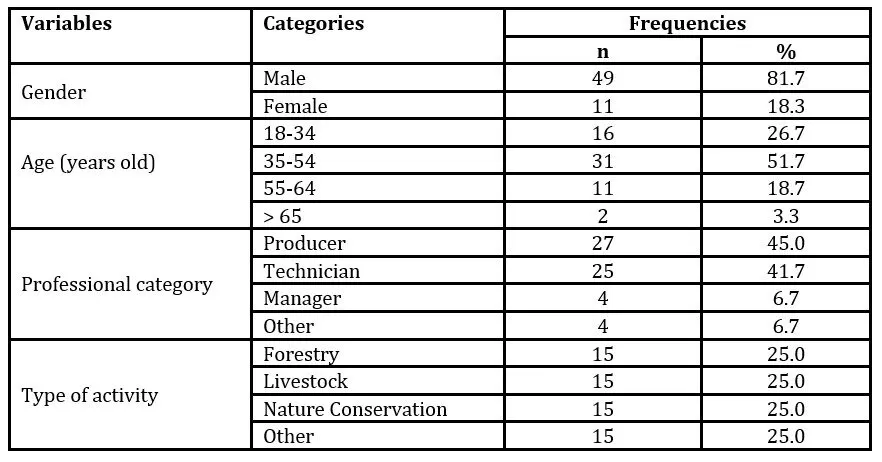
The vast majority of interviewees, around 81.7%, are male, and only 18.3% are female (Table 1). This result was expected, given the data from the 2019 Agricultural Census (INE, 2019), which highlights that more than half of the individual producers in the region, around 64%, are male. In the sample of interviewees, this trend is even greater. The majority of respondents, around 51.7%, are between 35 and 54 years old (Table 1).
As shown in Table 1, the majority of interviewees were producers (45.0%) or sector technicians (41.7%). In relation to the sector of activity, the interviewees were equally distributed across the sectors, forestry (25.0%), livestock (25.0%), nature conservation (25.0%) and other (25.0%), including the latter, activities such as beekeeping, hunting, professional education and inspection, the first two being the most practiced, with percentages of 46.7% and 26.7%, respectively.
Table 1: Socioeconomic data of respondents (N = 60)
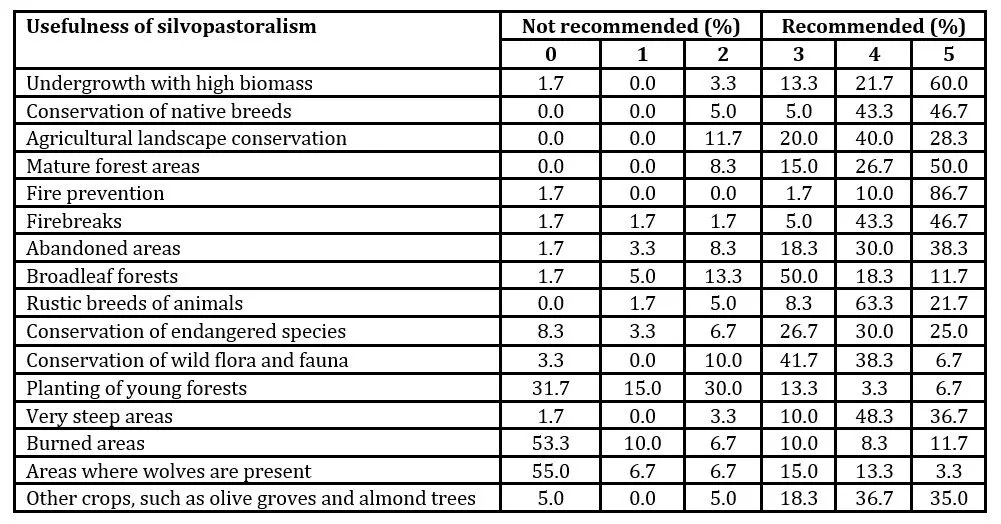
According to the results, the practice of silvopasture is very useful and therefore highly recommended in preventing fires (86.7%), in understory with a lot of biomass (60%), and in areas of mature forest (50%). This practice was also considered recommended, with response percentages equal to or greater than 40%, in the preservation of rustic breeds of animals (63.3%), in very steep areas (48.3%), in the maintenance of native breeds (43.3%), in firebreaks (43.3%) and in the conservation of the agricultural landscape (40%) (Table 2). However, this practice is less recommended in burnt areas (53.3%) and areas where there are wolves (55%).
Silvopastoral systems are an example of multifunctional land use as they improve the efficiency of resource use across spatial and temporal dimensions, which in turn generates a range of environmental, economic, and social benefits (Mosquera-Losada et al., 2005). By integrating trees, fodder, and livestock on the same land, these systems optimize the use of natural resources, contribute to landscape resilience, and support diversified rural livelihoods.
Table 2: Perception of the usefulness of silvopastoralism (N = 60)
Legend: 0: Very inadvisable; 1: Slightly inadvisable; 2: Inadvisable; 3: Slightly inadvisable; 4: Advisable; 5: Very inadvisable.
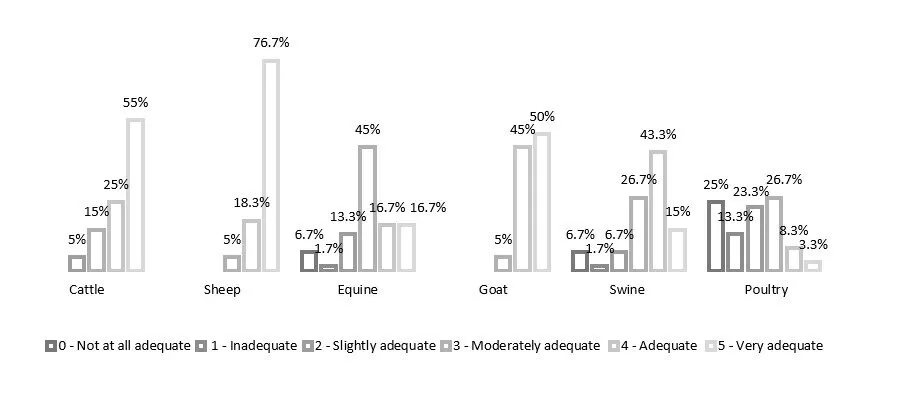
In relation to the animal species considered the most suitable for silvopastoral use, the results show that 76.7% of those interviewed consider sheep to be very suitable, followed by cattle (55.0%) and goats (50.0%). In contrast, poultry farming was considered not at all suitable (25%) (Figure 1). Furthermore, the interviewees identified, within each animal species, the most suitable breeds. For example, in the case of cattle, Maronesa, Barrosã and Mirandesa were the preferred breeds. For sheep, the most considered breeds were the Churra da Terra Quente, the Churra Galega Bragançana, the Churra Galega Mirandesa, and the Churra Badana. In the case of goats, Cabra Serrana, Bravia, and Preta de Montesinho were considered the most appropriate. In the case of horses and donkeys, the Garrano, Sorraia and Burro de Miranda were the most popular breeds. In the case of pigs, the Bísaro breed was highlighted as the most suitable.
Among the poultry, the Branca, Preta, Pedrês, and Amarela Chickens were identified. These results highlight the interviewees’ concern with preserving and promoting native breeds, recognizing their important functional and cultural roles. This emphasis suggests that such practices may be critical for the long-term conservation of these genetic resources.
Fig 1. Classification of animal species in relation to their suitability for silvopastoralism
The following section presents respondents’ perceptions regarding the evolution of silvopastoral practices, specifically whether they believe there has been an increase in the number of farms adopting these systems.
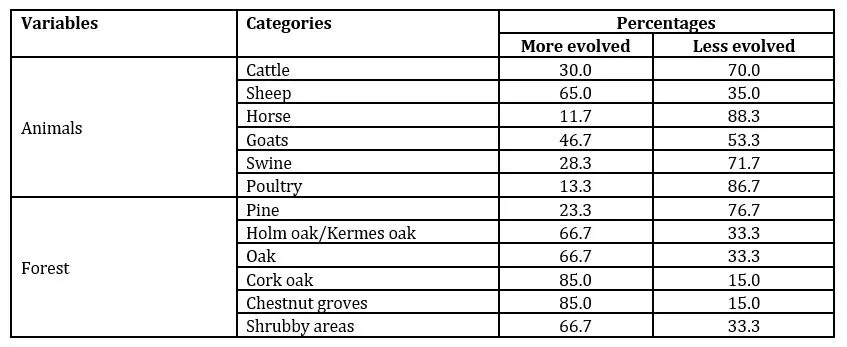
Regarding the type of forest, the interviewees consider that the holm oak, the oak, the cork oak, the chestnut groves, and the shrubby areas are more developed compared to the past (Table 3). For the pine species, 76.7% of those interviewed considered that the practice of silvopastoralism is less developed, being the only forest species that they consider to have weak development.
Table 3: Characterization of the evolution/adherence to silvopastoralism (N = 60)
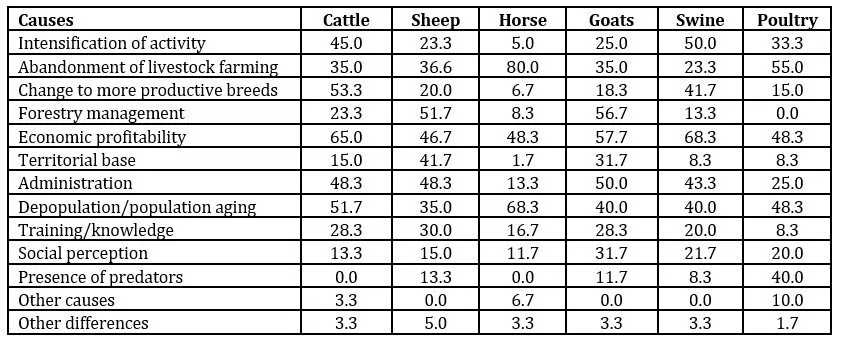
Regarding the current scenery of silvopasture and the possible causes of the differences that currently exist, a consequence of the evolution over the last 20 years, concerning animal species, in the opinion of the interviewees, economic profitability is the main reason that justifies the transformations. According to those interviewed, one of the main reasons for the decline in silvopastoralism is its reduced profitability in relation to less extensive productions (Table 4). In the European Union, most regions have a reduced extent of silvopastoral use, which may be associated with high anthropogenic pressure (intensive agriculture) or abandonment (Mosquera-Losada et al., 2022). Although agroforestry practices are widely used in tropical countries, in temperate areas of Europe, they are quite limited (Den Herder et al., 2017), due to the intensification of agricultural systems and the absence of adequate policies to promote agroforestry practices (Mosquera-Losada et al., 2018). Other reasons given were administration (standards, economic support, among others), depopulation, and population aging. In this context, Pinto et al. (2023) highlight the need to develop policies that value and recognize the role of the shepherd, as well as strategies that increase the profitability of pastoralism (Table 4).
According to the literature, the abandonment of this activity contributes to the decline of the local socioeconomic fabric, the loss of biodiversity, and the increased risk of large-scale fires. The increasing loss of importance of traditional pastoralism, associated with the demographic decline of rural areas and the undervalued status of the pastor, threatens the production of quality traditional products, which can be fundamental for rural development, especially in the most disadvantaged regions. In the past, in some more sensitive areas, due to a lack of management or correct social framework, silvopastoralism was often marginalized, being seen as a threat to forest heritage or nature conservation. However, when recognized as an efficient tool to reduce the fuel loads and enhance local incomes, this activity can represent a valuable opportunity, as long as it is managed appropriately and supported by policies with balanced stimuli and incentives (Moreira & Coelho, 2008).
Table 4: Causes for the current silvopastoral scenario for different animal species (%)
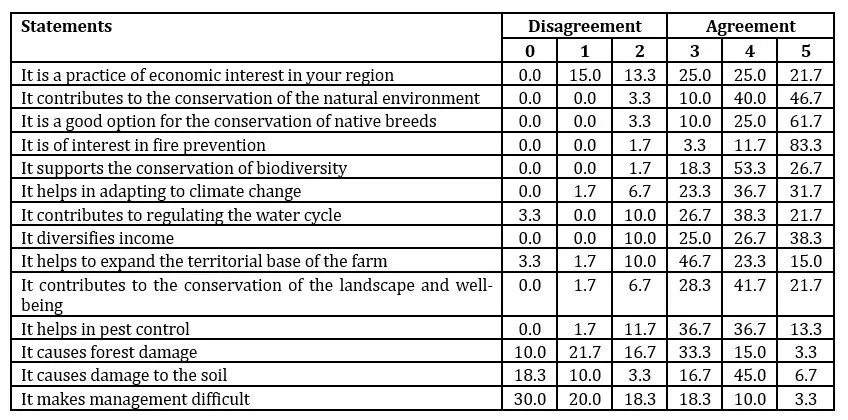
Analyzing Table 5, it can be seen that less than 25.0% of those interviewed strongly agree that silvopasture is a practice of economic interest in the region. However, the majority agree or strongly agree that silvopastoralism contributes to the conservation of the natural environment, is a good choice for the conservation of native breeds, is of great interest for fire prevention, and supports biodiversity.
Opinions on the role of silvopastoral systems in adapting to climate change are mixed, yet overall perceptions remain positive, with 36.5% of respondents agreeing and 31.7% strongly agreeing. A similar trend is observed regarding their contribution to regulating the water cycle (38.3% agree, 21.7% strongly agree), diversifying farm income (26.7% agree, 38.3% strongly agree), expanding the territorial base of the farm (46.7% moderately agree, 23.3% agree), and enhancing landscape quality and well-being (41.7% agree, 21.7% strongly agree).
On the issue of forest damage, a significant proportion of respondents moderately agreed (33.3%). Concerning the production of soil damage, a high percentage of respondents agreed (45%) or strongly agreed (6.7%). Regarding management difficulties, most of the responses are centred on the disagreement level, around 50% (Table 5).
Table 5: Classification of agreement with statements about silvopastoralism (%)
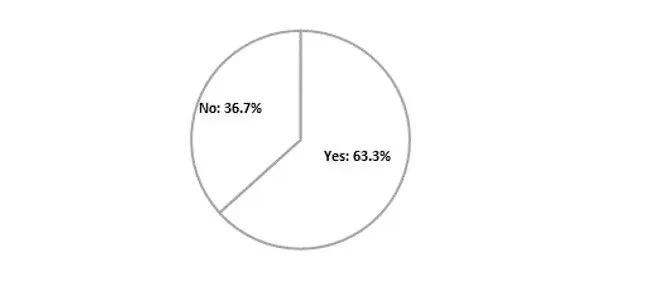
In general, the majority of interviewees stated that they felt difficulties in implementing silvopastoralism (63.3%), as shown in Figure 2.
Fig 2. Difficulty in carrying out silvopastoral activities
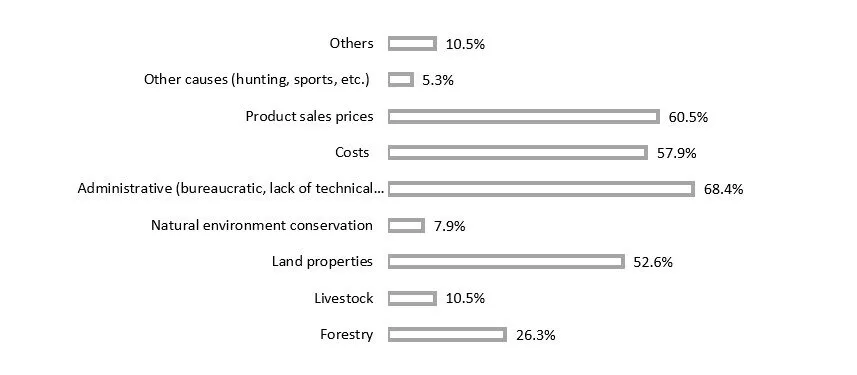
Respondents most frequently reported difficulties such as product sales prices (60.5%), costs (57.9%), land ownership (52.6%), and administrative difficulties (bureaucratic, lack of technical knowledge, among others) (68.4%) (Figure 3). Additionally, the lack of working conditions, the lack of special support for products originating from silvopastoralism, and the lack of resources such as water for livestock, especially in periods of drought, and fences were identified.
Fig 3. Type of difficulties
Respondents suggested a range of measures to promote the adoption and development of silvopastoralism in a more integrated and effective way. Among these were the creation of a compensation system for herders who use livestock in ecosystem management, with criteria linked to appropriate stocking rates, and the establishment of a network of herders capable of managing areas such as highway verges and slopes, using animals instead of machinery to reduce environmental impacts. They also highlighted the importance of promoting wool and regional cheese production, supported by the creation of processing facilities such as mobile slaughter units and cutting rooms. The installation of fencing across large areas by common land associations was also suggested, allowing livestock to graze safely without the constant threat of predators. Additionally, respondents emphasized the need to enhance the value of final products, such as meat and milk, through cost reduction and increased investment support.
Further recommendations included the development of initiatives focused on the promotion of native breeds and the conservation of landscapes and ecosystems shaped by silvopastoral practices. Training programs and awareness-raising activities were also seen as essential to equip herders with improved management skills and to communicate the benefits of silvopastoralism to a wider audience. The establishment of communication channels between livestock farmers and forestry stakeholders was proposed to encourage the exchange of knowledge and experience. Finally, expanding financial support and subsidies for silvopastoral projects and for the valorisation of their products was considered a key step toward strengthening and scaling up this multifunctional land use system.
Conclusion
Throughout this research, it was possible to confirm the importance of silvopastoralism as a relevant practice in the agricultural sector in the North of Portugal, especially in the Trás-os-Montes region, where it has a long tradition. However, the perceptions conveyed through the results suggest that, despite the numerous ecological and social benefits of silvopastoralism, this practice has been abandoned in recent years, due to the intensification of agricultural activity, in areas that are more productive, rural depopulation, and population aging. Participants highlight the interest of silvopastoralism in preventing fires, conserving biodiversity, and promoting sustainable management of natural resources. Its application in areas of adult forest, high biomass zones, and mountainous regions is widely recognized, since these areas are considered the most suitable for its implementation. Furthermore, factors such as lack of technical support, low economic profitability, and lack of knowledge of research projects in the area have contributed to its reduced use. A further notable finding is the recognition of native livestock breeds, which are closely associated with silvopastoral systems. The decline of these practices poses a threat to the conservation of such breeds, underscoring the need for integrated policy measures that support both silvopastoralism and the preservation of local genetic resources, thereby ensuring the continuity of a productive and sustainable land-use system.
Thus, it is clear that the revitalization of silvopasture depends on an integrated approach, which involves effective public policies and increased awareness of its benefits. The Common Agricultural Policy has a fundamental role in promoting agroforestry practices, but, as this study suggests, it is crucial that the measures implemented are adapted to regional specificities and that there is a greater effort in training and qualifying local agents.
The results of this work also highlight the need for a transformation in the management model of rural territories, with regard to the creation of means of support for producers who practice silvopastoralism. Promoting silvopastoralism as a tool for sustainable development, combined with the preservation of cultural practices and the resilience of ecosystems, can contribute to mitigating some of today’s most pressing challenges, such as climate change, rural depopulation, and the risk of forest fires. The future of silvopastoralism in Trás-os-Montes, as in most of the Mediterranean mountains of Southern Europe, will depend not only on the sector’s capacity to adapt to contemporary challenges—particularly by producers—but also on the broader societal recognition of its ecosystem services and the political commitment to support and promote its development. It is important to highlight the limitations that conditioned this research. One of the main limitations was that the sample was non-probabilistic and, in addition, small in size, which could restrict the generalization of the results.
This research paves the way for several future research projects that can contribute to deepening the knowledge and appreciation of silvopastoralism. An important aspect to be explored is the evaluation of the effectiveness of public policies in promoting silvopastoralism, namely, through an in-depth study on the impact of Common Agricultural Policy measures on the adoption of this practice, focusing on how these policies can be adjusted to regional specificities. Another relevant line of research involves the development of technical and economic support strategies, with the aim of increasing the economic profitability of silvopastoralism and providing more support to local producers. Finally, studying the adaptation of silvopastoral practices to the effects of climate change is essential; investigating how these systems can be adjusted to face the challenges associated with climate change, while promoting management practices that reinforce the resilience of ecosystems and rural communities.
Acknowledgments
This work was supported by national funds through FCT/MCTES (PIDDAC): CIMO, UIDB/00690/2020 (DOI: 10.54499/UIDB/00690/2020) and UIDP/00690/2020 (DOI: 10.54499/UIDP/00690/2020); and SusTEC, LA/P/0007/2020 (DOI: 10.54499/LA/P/0007/2020). It was also funded by the European Union through the LIFE Programme, under the project SILFORE — Towards the conservation and management of resilient agroforestry systems through silvopastoralism (Project 101074445 — LIFE21-CCA-ES-LIFE SILFORE).
References
Alves, P., Castro, M., & Nunes, A. (2019). Silvopastoral systems as a tool to reduce wildfire hazard in mountain areas of Portugal. Forest Ecology and Management, 436, 214-222.
Alves, V., & Teixeira, P. (2006). Raça Bovina Maronesa. Caderno Técnico Voz da Terra, 46, 11-20.
Bento-Gonçalves, A. (2021). Os incêndios florestais em Portugal. Fundação Francisco Manuel dos Santos, Lisboa.
Bergez, J. E., Etienne, M., & Balandier, P. (1999). Always: A plot-based silvopastoral system model. Ecological Modelling, 115, 1-17.
Castro M. (2009). Silvopastoral systems in Portugal: current status and future prospects. In: Rigueiro-Rodríguez A., McAdam J., Mosquera-Losada, M.R. (Eds.), Agroforestry in Europe: Current Status and Future Prospects. Springer, Spain. pp. 111-126.
Castro, M. (Coord.), Ferraz-de-Oliveira, M.I., Carita, T., Potes, J.M., Sales-Baptista, E. (2025). Pastoreio em Floresta – Oportunidade de produção diferenciada e ferramenta de gestão. Em Tomé, M., Lima, T.L.F. (Eds.), Os Produtos Florestais Não Lenhosos de Portugal Continental (unpublished). ISAPress.
Corsi, M., & Goulart, R. (2006). O sistema de produção de carne e as exigências da sociedade moderna. Anais do Simpósio Sobre Manejo da Pastagem, 23, Piracicaba, Brasil.
Den Herder, M., Moreno, G., Mosquera-Losada, M. R., Palma, J. H. N., Sidiropoulou, A., Santiago-Freijanes, J. J., Crous-Duran, J., … & Burgess, P. J. (2017). Current extent and stratification of agroforestry in the European Union. Agriculture, Ecosystems & Environment, 241, 121-132.
Devendra, C., & Ibrahim, M. (2004). Silvopastoral systems as a strategy for diversification and productivity enhancement from livestock in the tropics. Proceedings of the 2nd International Symposium on Silvopastoral Systems (pp. 10). Mérida: Autonomous University of Yucatán.
Fernández-Núñez, E., & Castro, M. (2016). Management of agroforestry systems: Ecological, social and economic approaches. Instituto Politécnico de Bragança.
Instituto Nacional de Estatística (2021). Recenseamento Agrícola: Análise dos principais resultados: 2019. Instituto Nacional de Estatística, Lisboa.
Jose, S. (2009). Agroforestry for ecosystem services and environmental benefits: An overview. Agroforestry Systems, 76 (1), 1-10.
Jose, S., & Dillingier, J. (2019). Silvopasture: A sustainable livestock production system. Agroforestry Systems, 93 (1), 1-9.
Leakey, R.R.B. (2017). Definition of agroforestry revisited. In Leakey R.R.B. (Ed.), Multifunctional Agriculture – Achieving Sustainable Development in Africa (pp. 5–6). Academic Press, San Diego, California, USA.
McAdam, J. (2023). Silvopasture as a sustainable sheep production system option. Animal – Science Proceedings. 14 (2), 367-367.
Montagnini, F., & Nair, P.K.R. (2004). Carbon sequestration: An underexploited environmental benefit of agroforestry systems. Agroforestry Systems, 61 (1), 281-295.
Moreira, F., Queiroz, A.I., & Aronson, J. (2001). Restoration principles applied to cultural landscapes. Journal of Nature Conservation, 9 (3), 205-212.
Mosquera-Losada, M. R., Rigueiro-Rodríguez, A., & McAdam, J. (2005). Declaration for silvopastoralism. Silvopastoralism and sustainable land management: Proceedings of an international congress on silvopastoralism and sustainable management, Lugo, Spain.
Mosquera-Losada, M. R., Rodríguez-Rigueiro, F. J., Santiago-Freijanes, J. J., Rigueiro-Rodríguez, A., Silva-Losada, P., Pantera, A., … & Ferreiro-Domínguez, N. (2022). European agroforestry policy promotion in arable Mediterranean areas. Land Use Policy, 120, 106274.
Mosquera-Losada, M. R., Santiago-Freijanes, J. J., Rois-Díaz, M., Moreno, G., den Herder, M., Aldrey-Vázquez, J. A., … & Rigueiro-Rodríguez, A. (2018). Agroforestry in Europe: A land management policy tool to combat climate change. Land Use Policy, 78, 603-613.
Nair, P. K. R. (1991). State-of-the-art of agroforestry systems. In: Jarris, P.G. (Ed.), Agroforestry: Principles and practices (pp. 5-29). Elsevier.
Pereira, J.S., & Fonseca, T.F. (2003). Forest and forest fires in Portugal: Current situation and future scenarios. In Forest Fires: Global Climate Change and Wildlife Management, 1-16.
Pinto, R., Castro, M., Torres, F., & Sa Rego, J. (2021). A pastorícia em territórios de montanha em Portugal: Tradição com futuro? XI Congresso Internacional Silvipastoril e I Congresso da Rede Global de Sistemas Silvipastoris, 627-641, 3-5 de novembro, México.
Pinto, R., Castro, M., Torres-Manso, F., & Rainha, M. (2023). A pastorícia no desenvolvimento dos territórios de montanha em Portugal: Uma análise multidimensional aos desafios e oportunidades. Revista Portuguesa de Estudos Regionais, 63, 65-74.
Pinto-Correia, T., & Vos, W. (2004). Multifunctionality in Mediterranean landscapes—past and future. The New Dimensions of the European Landscapes, 4, 135-164.
Rigueiro-Rodríguez, A., Fernández-Núñez, E., González-Hernández, P., McAdam, J.H., Mosquera-Losada, M.R. (2009). Agroforestry Systems in Europe: Productive, Ecological and Social Perspectives. In: Rigueiro-Rodróguez, A., McAdam, J., Mosquera-Losada, M.R. (eds) Agroforestry in Europe. Advances in Agroforestry, vol 6. Springer, Dordrecht.
Sanchez, P.A. (1995). Science in agroforestry. Agroforestry Systems, 30, 5-55.
Shibu, J. (2009). Agroforestry for ecosystem services and environmental benefits: An overview. Agroforestry Systems, 76 (1), 1-10.
Sibbald, A.R., Eason, W.R., & Davidson, D.A. (2001). The effects of silvopastoral practices on rural communities. Agroforestry Systems, 53 (2), 171-183.