Faculty of Economics and Business, University of Zagreb, Zagreb, Croatia
Volume 2025,
Article ID 233921,
IBIMA Business Review,
8 pages,
DOI: https://doi.org/10.5171/2025.233921
Published date: 5 November 2025
Cite this Article as:
Maja DARABOŠ LONGIN (2025)," Navigating Dynamic Environments in Search for Sustainable Growth “, IBIMA Business Review, Vol. 2025 (2025), Article ID 233921, https://doi.org/10.5171/2025.233921
Action aggressiveness reflects how a firm reacts to temporary competitive advantages. By responding promptly to market demands, firms strengthen their market position and create advantages. Those that can act even faster secure an even stronger competitive position and greater market power. However, there is no guarantee that a competitive advantage gained today will last in the long run. The focus is on the firm’s readiness to take an action, meaning how willing the firm is to engage with competitors and respond quickly. Competitive dynamics is becoming more noticeable across various markets, even those that once seemed stable. From a theoretical perspective, a company’s performance is influenced not just by its own strategy, but also by its competitors’ actions and their interactions. The main goal of this study is to explore the link between a company’s strategic path and its ability to achieve sustainable growth in rapidly changing environments. Past research often looked at how competitive dynamics impact a company’s financial performance, but this paper aims to broaden that perspective. Specifically, this research aims to define and analyze the connection between a firm’s behavior in a turbulent market and its competitive advantage, using both financial metrics and performance indicators relative to its main rival. The findings suggest a positive correlation between a company’s agility, strategic innovation, and profitability. Essentially, traits like firm agility and strategic innovation are vital for companies to survive, succeed, and maintain their competitive edge in dynamic business environments.
Competitive dynamics is becoming more noticeable in many industries, even in those that used to be considered relatively stable. When responding to competitive challenges, firms must act aggressively by implementing a large number of rapid actions. Action aggressiveness reflects how a firm responds to the emergence of temporary competitive advantages. Firms’ advantages are increasingly short-lived due to various disruptions in the business environment, as competitor activity becomes more frequent, requiring firms to continuously develop new strengths and consistently monitor market dynamics and rival moves (Singh, Dey, Sahay, 2020; Wiggins and Ruefli, 2005; Chen, 2009). Firms capable of quickly responding to market demand increase their market position and gain advantages; but those capable of even faster responses, will generate even greater market influence and outperform their competitors. However, it cannot be assured that the competitive advantage gained today will endure in the long term (Baron, R. A., 2007; Ozgen, E. and Baron, R. A., 2007). Therefore, aggressiveness in taking actions represents the most significant characteristic of competitive advantage in hypercompetitive environments (Chen et al., 2010). The focus is on how prepared the firm is to take an action, i.e. the extent to which the firm is willing to engage with competitors and respond quickly in the involvement and participation.
Existing research on achieving competitive advantage under hypercompetitive conditions presents various approaches to analyzing and studying the mentioned field. This paper presents conceptual framework of strategic behavior, i.e. specific strategies firms may adopt to achieve competitive advantage in dynamic industries. Therefore, the research problem arises from an insufficient understanding of key determinants of the firm’s strategic behavior and proposes a new research approach for examining how competitive advantage can be achieved in hypercompetitive industries, including its practical implications. The given approach includes structured and well-defined firm behaviors, organized within a newly developed strategic taxonomy of strategy patterns and supported by an empirical study of the strategic path of firms in Croatia.
Description of the conceptual model of desired organizational traits
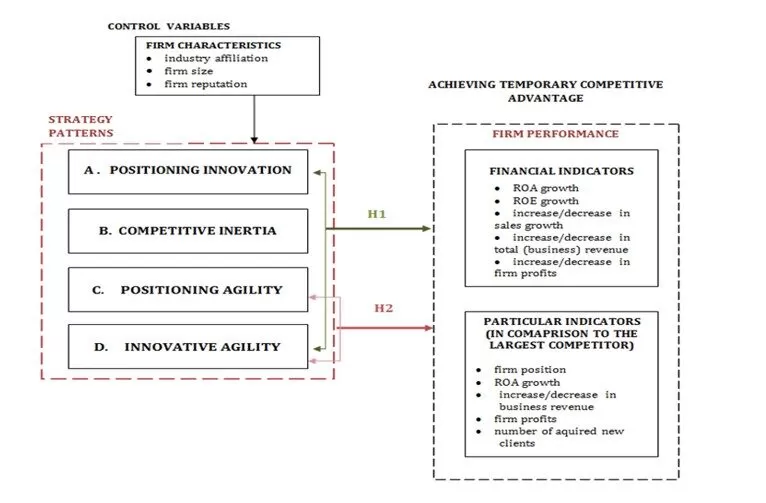
Existing research on achieving competitive advantage under hypercompetitive conditions presents various approaches to analyzing and studying the mentioned field. However, a conceptual framework of strategic behavior, i.e. the potential strategies firms may adopt in order to achieve competitive advantage in the hypercompetition, has not yet been proposed. Therefore, the research problem arises from an insufficient understanding of key determinants of the firm’s strategic behavior and proposes a new research approach for examining how competitive advantage can be achieved in hypercompetitive industries, including its practical implications. Daraboš (2014) proposed a model that illustrates the relationship between proposed strategic patterns and competitive advantage in hypercompetitive environments (Fig 2). There are a lot of previous research efforts that have partially explored certain features of firm strategic actions and their impact on firm performance (Ferrier, 2001; Chen, Smith, Grimm, 1992; Chen, MacMillan, 1992; Smith, Grimm, Gannon, 1992).
To examine the extent to which specific firm behavior affects firm performance under hypercompetitive conditions, various firm behaviors were first identified and structured, and then organized within the newly developed strategic taxonomy of strategy patterns. Firms’ strategic patterns were defined by two key variables, i.e. constructs that define and influence the firm behavior in hypercompetition: (1) firm agility and (2) firm strategic innovation (Darabos, 2014).
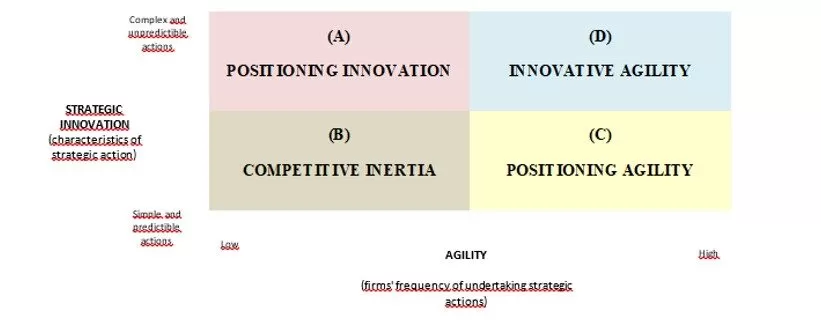
Based on the level of each variable within the firm, potential strategic patterns of specific firm behavior have been theoretically developed. Strategic patterns of the firm represent conceptual frameworks that are recognized and defined using a limited number of variables (firm agility and firm strategic innovation). These frameworks make it possible to distinguish different types of strategic behavior that firms adopt in hypercompetitive environments (Darabos, 2014). Based on the proposed taxonomy, four distinct strategic groups can be identified, representing different approaches firms may adopt: (A) Positioning Innovation, (B) Competitive Inertia, (C) Positioning Agility, and (D) Innovative Agility (Fig.1) (Darabos, 2014; Darabos Longin, 2018; Daraboš Longin, 2023). This classification was developed using dichotomous definitions and serves as the foundational basis for the research.
Once the taxonomy of strategic patterns was developed, it became important to outline and explain the key factors that set apart different firm strategies. The first factor that determines firm behavior is firm agility. It is a complex variable calculated as the average of two defined measures that explain the strategic actions taken by the firm. The first measure is the frequency of undertaking specific types of strategic actions, and it looks at how often the firm engages in specific types of strategic actions compared to its direct competitors. The second measure assesses the firm’s reaction speed, showing how well it can recognize, respond to, and anticipate strategic opportunities and challenges in the environment relative to its competitors. It is assumed that firms with higher agility, or those that take more frequent strategic actions, are more likely to achieve a temporary competitive advantage (Darabos, 2015).
The second factor, firm strategic innovation, is measured by the average complexity and unpredictability of a firm’s actions, along with the characteristics of those actions. It is defined by two key variables: general and specific strategic innovation. General strategic innovation shows how a firm displays innovative behavior in comparison to its industry competitors. This is shown through introducing new products or services, using new production technologies, and applying new organizational solutions and management techniques. On the other hand, specific strategic innovation is described using three auxiliary variables. These are the level of unpredictability, the level of complexity and the specific level of innovation. The first variable, the level of unpredictability, explains the sequence of actions taken by the firm. It also describes how these actions change based on the type of action compared to direct competitors. The level of complexity, second auxiliary variable, refers to the time needed to prepare and initiate specific type of firm action in relation to direct competitors. As a result, actions can be categorized as either simple or complex. Specific strategic innovation is the final auxiliary variable in the strategic innovation model, illustrating the significance of the undertaken actions for the firm or industry relative to direct competitors. Lower level of strategic innovation, characterized by undertaking simple and predictable strategic actions, can enhance firm performance through rapid implementation; however, it also increases the likelihood that competitors may respond quickly, potentially suppressing the performance gains of the firm that acted first. On the other hand, complex and unpredictable actions may reduce the speed of implementation, resulting in a delayed response from competitors due to difficulty of anticipating such actions, while simultaneously increasing the potential of improving firm performance (Ferrier, 2001). Therefore, it is important to examine dynamic interaction among competitors by analyzing sequences of competitive actions and the corresponding reactions of rivals.
A special measure was constructed for every individual key variable through an examination of the attitudes of Top Management Team members (TMT) by using a Likert measurement scale of five degrees of intensity, forming the level of agility, i.e. the level of strategic innovation for each firm from the sample. In the model, the agility levels, as well as firm strategic innovation levels, equal to 3.00 or greater are defined as a high level of the variable, while the mean values below 3.00 indicate a low level of the variable. The values of 3.00 or above indicate significant market activity compared to direct competitors, whereas values below 3.00 reflect lower market activity relative to the most important competitors. Considering the limited amount of previous research in this area, the “low-high” dichotomous division point was determined based on the assumption that the set measuring scale adequately corresponds to the anticipated taxonomy.
Fig 1. Taxonomy of strategy patterns
The high level of firm agility encompasses two strategic patterns within the model: positioning agility and innovative agility. Both represent a frequent undertaking of actions by the firm, indicating a constant presence in the market and high level of competitive activity. Highly agile firms are characterized by a strong competitive orientation and a continuous focus on enhancing and improving their business in every aspect. If the firm constantly outperforms others or leads the industry, and strategically leverages its strengths to further enhance its reputation and expand its market share, it can successfully overcome its competitors. The assumption is that the higher the level of firm agility, i.e. higher frequency of undertaking action, the greater the likelihood that the firm will achieve a temporary competitive advantage and consequently improve its performance. (Darabos Longin, 2016). On the other hand, higher level of firm strategic innovation includes two strategic patterns within the developed model: positioning innovation and innovative agility. These patterns are distinguished by firm agility, or by the frequency of undertaking actions (Daraboš Longin, 2018). However, both represent undertaking of complex and unpredictable actions by the firm, which are assumed to enhance firm performance, as such actions are more difficult for competitors to anticipate and, consequently, competitors are less likely to respond quickly enough (Darabos Longin, 2023). This is expected to result in an extended duration of competitive advantage for the firm that achieves it through the corresponding strategic action (Darabos, 2014).
The hypotheses that will be tested in order to test the validity of the proposed model are:
H1. The firm performance in a dynamic environment will be better for the firms with higher level of firm agility.
H2. The firm performance in a dynamic environment will be better for the firms with higher level of firm strategic innovation.
Fig 2. Proposed model of relationship between strategy patterns and competitive advantage in a dynamic environment
Empirical Research Results
The research focused on large and medium-sized Croatian firms operating in the mobile telecommunications, cosmetics, printing and retail industries that were in preliminary research defined as hypercompetitive. Primary data were gathered through a poll survey, and the final sample for this research was 61 different companies (out of 104 in selected industries), representing a response rate of 58.65 %. This response rate is considered appropriate due to the sensitivity of the analyzed phenomena and the complexity of analysis (only one completed questionnaire from a Top Management Team member of each firm in the sample – the firm’s strategy was analyzed).
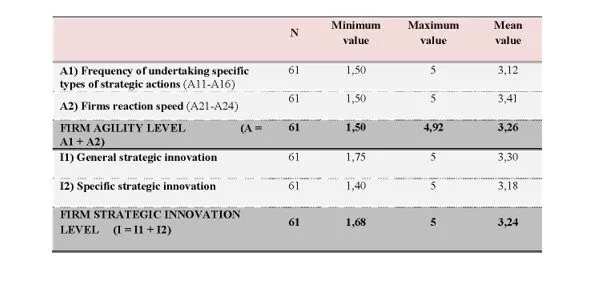
The first step in testing the hypotheses was to define the level of each construct for every firm in the sample. This step is necessary for the distribution of firms into theoretically defined strategy patterns. Based on the research results, the average frequency of undertaking strategic actions (the level of agility) is 3.26, whereas the mean level of strategic innovation among the sampled firms is 3.24 (Fig 3).
Fig 3. Mean values of key constructs in strategy pattern model for firms in the sample
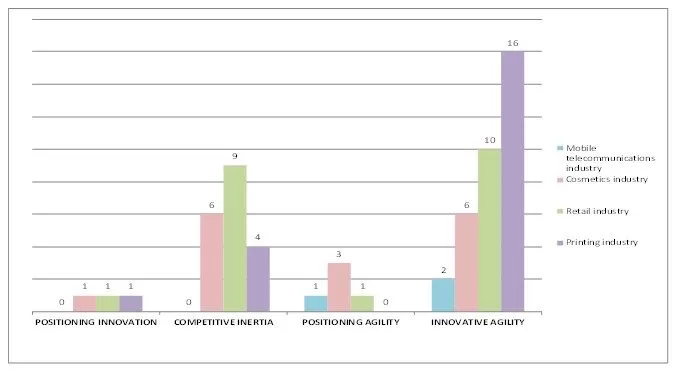
Additionally, using the calculated values and the obtained results, strategic patterns for all firms from the sample have been identified. (Fig 4.).
Fig 4. Distribution of firms in the sample by defined strategy pattern and industry
Calculated values were used to identify strategic patterns for all firms. The strategic pattern of Positioning Innovation is observed in a total of three firms from the sample, while Competitive Inertia is assigned to 19 firms. The Positioning Agility pattern, characterized by high level of agility and low level of firm strategic innovation, includes five firms from the sample. Firms that have extremely high level of competitive activity, that is both high level of agility and strategic innovation, are classified under the Innovative Agility pattern, encompassing a total of 34 firms.
In most studies of this type, researchers typically use market performance indicators as a measure of firm performance. Given that Croatia, similar to many developing countries, has underdeveloped and illiquid capital market, it is considered that capital market indicators alone are insufficient to accurately represent firm performance. Therefore, various “non-market” firm performance indicators were applied in this empirical study. Financial data were gathered over the three-year period. Firstly, data on total and business revenues were used to calculate the growth or decline in their values over one-year, two-year and three-year periods. Secondly, indicators measuring firm profitability were also calculated, including changes in return on sales (ROS), return on equity (ROE), and return on assets (ROA). These indicators were used to calculate their growth or decline in value, following the same procedure as for total and business revenue. One of the reasons firm performance measures were evaluated based on three-year growth is that the economic crisis and recession in the domestic economy peaked in 2010.
Within this study, in addition to the previously mentioned financial indicators of firm performance, further measures were gathered through the subjective assessments of respondents (TMT members) covering the past three years. These specific indicators include: (1) the firm’s position compared to its largest direct competitor, (2) growth in ROA compared to that of the largest direct competitor, (3) changes in firm revenue in relation to the largest competitor, (4) firm profits relative to the profit level of the largest direct competitor, and (5) the number of new clients acquired compared to the number acquired by the largest competitor. The first hypothesis suggests that higher levels of agility are associated with improved firm performance in a dynamic environment. The results of the regression analysis indicate that firm agility is a statistically significant predictor of the firm’s likelihood of achieving growth in profitability. In this study, both financial and firm performance indicators were examined over the past three years, along with their relationship to the level of firm agility. The analysis confirmed a statistically significant correlation between both financial indicators and indicators of firm performance (three-year growth of the total and business revenue) and the level of firm agility at 10% significance level (sig=.069; sig=.090). The results also indicate a significant positive effect of the level of agility on the specific indicators of firm performance, i.e. the firm’s market position and ROA growth relative to the largest competitor at 1% significance level (sig=.000), and on the remaining three specific indicators at slightly lower, yet still below 1% significance level (sig = .006). The observed relationship shows a positive direction, indicating that a higher level of firm agility, i.e. higher frequency of undertaking action, is more likely to enable a firm to achieve temporary competitive advantage and, consequently, improve its performance. Regression analyses for the second hypothesis support the assumption that a positive relationship exists between the level of firm strategic innovation and firm performance in hypercompetitive industries. In this analysis, financial and specific indicators of firm performance and their relationship with the firm strategic innovation were also observed. The results show a positive statistically significant relationship; at 10% level of significance; between some financial indicators of firm performance, i.e. the three-year growth in total revenues (sig=.092) and a three-year growth in business revenues (sig=.072), and the level of firm strategic innovation. Positive results were obtained also for the specific indicators of performance, at 1% level of significance for firm market position (sig=.000), as well as for revenues growth, firm profits growth and new clients growth compared to the largest rival (sig=.007). Furthermore, the results indicate a significant positive influence of the level of strategic innovation and ROA growth indicator compared to the largest competitor at 5% level of significance (sig=.021). The presented results show that the firms with a higher level of strategic innovation, i.e. the ones undertaking more complex actions, will more likely lead the firm to succeed in achieving a temporary competitive advantage; in other words, the firm will improve its firm performance.
Conclusion
Based on this research, it can be stated that both the level of firm agility and strategic innovation are significant predictors of a firm’s likelihood to achieve superior profitability in hypercompetitive conditions. This relationship was statistically strong and positive for both the financial and market indicators of the performance. This indicates that the firm aiming to outperform its competitors should undertake a large number of actions very fast and that those actions should be more complex so that the competitors would find it more difficult to predict them and that the advantages from these actions last longer. Likewise, the firms that are more agile and innovative in taking the actions will more likely have better market positions than their competitors and, overall, they will be more competitive in comparison to other players in the industry. In other words, these characteristics should be seen as crucial characteristics of firms’ behavior in the dynamic environments for the firms to survive, prosper and maintain their competitive advantage. This research contributes to the field research by offering new insights into the strategic behavior of firms in hypercompetition, particularly through the development of new taxonomy of strategy patterns and analysis of firm specific behavior to these patterns.
In conclusion, the research findings offer empirical evidence that contributes to a better understanding of the factors influencing corporate behavior in hypercompetitive environments. Recognizing the key factors, processes and dynamics that affect the achievement of competitive advantages, along with clarifying relationships between the strategic behavior and variations in firm performance, are crucial for determining how firms could gain sustainable growth in navigating dynamic environments.
References
Baron, R. A. (2007) Behavioral and Cognitive Factors in Entrepreneurship: Entrepreneurs as the Active Element in New Venture Creation, Strategic Entrepreneurship Journal, 1 (1-2), pp. 167-182
Chen, M. J. i MacMillan, I. C. (1992) Nonresponse and Delayed Response to Competitive Moves: The Roles of Competitor Dependence and Action Irreversibility, Academy of Management Journal, 35 (3), pp. 539–570
Chen, M. J., Lin, H. C. and Michel, J. G. (2010) Navigating in a Hypercompetitive Environment: The Roles of Action Aggressiveness and TMT Integration, StrategicManagement Journal, 31 (13), pp. 1410-1430
Chen, M. J., Smith, K. G. i Grimm, C. M. (1992) Action Characteristics as Predictors of Competitive Responses, Management Science, 38 (3), pp. 439–455
Chen, M. J. (2009) Competitive Dynamics Research: An Insider’s Odyssey, Asia Pacific Journal of Management, 26 (1), pp. 5-25
Darabos, M. (2014) Strategic patterns and competitive advantage in hypercompetition. PhD Dissertation. Faculty of Economics and Business Zagreb. (in Croatian)
Darabos, M. (2014) Top Management Team Cohesiveness and Firm Agility, in the book „Rethinking Corporate Governance“ (Tipurić, D., Vrdoljak Raguž, I. i Podrug, N., ur.), Harlow, England: Pearson Education, pp. 154-165
Darabos, M., Prester, J. and Tipurić, D. (2015) Entrepreneurial Spirit of Top Management Team: Is there any Influence on Strategic Innovation?, in the book „Dynamics of organizational change: Beyond identity and reputation“ (Tipurić, D., Vrdoljak Raguž, I. i Daraboš, M., ur.), Harlow: Pearson Education Limited, pp. 35-46
Darabos, M. (2015) Evolution of competitive advantage: In search for success in hypercompetition. Zagreb: Naklada Ljevak. (in Croatian)
Darabos Longin, M. (2016) Firm strategic behaviour in hypercompetition: Is there a link with sustainable competitive advantage?, International Journal of Arts and Sciences, 9 (2), str. 667-675.
Daraboš Longin, M. (2018) Strategy patterns and corporate competitive advantage in hypercompetition, Ekonomski pregled, 69 (3), str. 229-250.
Daraboš Longin, M. (2023) Strategic Behavior of Companies for Prosperity in Dynamic Environments: An Empirical Study, Proceedings of the 41st International Business Information Management Association Conference, Granada, Spain, June 2023 pp.1339-1345.
Ferrier, W. J. (2001) Navigating the Competitive Landscape: The Drivers and Consequences of Competitive Aggressiveness, Academy of Management Journal, 44 (4), pp. 858-877
Grimm, C. M., Lee, H. and Smith, K. G. (2006) Strategy as Action: Competitive Dynamics and Competitive Advantage. New York: Oxford University Press.
Ozgen, E. and Baron, R. A. (2007) Social Sources of Information in Opportunity Recognition: Effects of Mentors, Industry Networks, and Professional Forums, Journal of Business Venturing, 22 (2), pp. 174-192