Jhaquelin M. MENDOZA CASTAÑEDA, Saraí N. SAMÁN CHINGAY, Marcelo C. LUDEÑA PALACIOS and Miguel A. ROJAS LARA
Universidad privada Del Norte, Cajamarca, Perú
Volume 2025,
Article ID 607344,
IBIMA Business Review,
7 pages,
DOI: 10.5171/2025.607344
Received date: 1 July 2024; Accepted date: 5 March 2025; Published date: 5 November 2025
Academic Editor: José Carlos Rodríguez
Cite this Article as:
Jhaquelin M. MENDOZA CASTAÑEDA, Saraí N. SAMÁN CHINGAY, Marcelo C. LUDEÑA PALACIOS and Miguel A. ROJAS LARA (2025)," The Role of ICTs in International Negotiations of Non-profit Organizations in Lima, Peru “, IBIMA Business Review, Vol. 2025 (2025), Article ID 607344, https://doi.org/10.5171/2025.607344
The development and implementation of Information and Communication Technologies (ICTs) are becoming increasingly important in human activities. Their adoption has expanded across organizational sectors, particularly those seeking innovative solutions and high-impact ideas in international business. This research aims to explore the relationship between ICT and international negotiations within a non-profit organization in Lima. The study utilizes a non-experimental, quantitative, cross-sectional approach with a descriptive correlational design. The data were collected through a questionnaire distributed to a sample of 30 direct collaborators from a non-profit organization in Lima, Peru, regarding the relevant variables. The results revealed a strong positive and significant correlation of 0.985, with a significance level of 0.000, which is less than 0.05. This demonstrates a direct relationship between ICT and international negotiations in the non-profit sector in Lima. The findings suggest that greater interaction with and application of ICT lead to more efficient international negotiations. In conclusion, ICT plays a crucial role in improving the effectiveness of non-profit organizations in Lima. It is recommended that organizations adopt these tools to support decision-making and enhance the efficiency, dynamics, and effectiveness of international negotiations.
Keywords: ICT, international negotiations, Non-Profit Organizations.
Introduction
The use and development of Information and Communication Technologies (ICTs) are increasingly relevant in everyday life; their diffusion has spread across all spheres, whether business or organizational sectors, which are expanding new alternatives from the standpoint of social, economic, or commercial impact. Organizations need to anticipate and react in a timely manner while maintaining their effectiveness, because they are immersed in an evolving and complex environment and therefore subject to prevailing trends. Two key factors for organizational success are the capacity to adapt and the speed of response.
Today, there is an abundance of technology, information, and real-time communication that makes it possible to learn about other countries’ cultures, consumers’ lifestyles, ways of thinking and acting, as well as their needs regarding the variety of services and products offered globally. In this sense, organizations and their global environment allow relatively easy access to these innovations and technological advances, enabling them to obtain optimal transactions, results, and benefits. Consequently, since the life cycle of technological tools is increasingly short and there is a need to innovate quickly, organizations must develop capabilities to integrate new communication and interaction procedures available in their environment. In this context, new technological tools such as software, networks, devices, or computers are essential to seize opportunities and increase responsiveness, ensuring efficient performance in transactions and operations and becoming a standard for organizations committed to continuous improvement, seeking gains in productivity and competitiveness.
In Peru, there are organizations that face limitations in their negotiation structures based on the use of technologies, which affects both the internal and external development of an organization and results in low decision-making capacity. Currently, information and communication technology tools are fundamental worldwide. They have sparked a revolution in organizations in the realm of commercial and cultural productivity for storing, transmitting, retrieving, or manipulating data and are frequently used in the business and organizational sector to efficiently pursue objectives. However, managers are not always aware of the impact that optimal management of information technologies can generate to foster assertive communication, performance, and improved organizational positioning. It is therefore essential to understand the contribution these tools make to organizational performance, enabling increases in productivity and efficiency.
Regarding the type of organization for this study, we consider a non-governmental organization (NGO) dedicated to clinical, biomedical, and public health research on health and human development issues related to HIV/AIDS and other sexually transmitted infections. Associated with major research networks, it not only works intensively at the scientific level but also supports the creation of new clinics and the strengthening of community-based organizations. However, its negotiation strategies and commercial channels are currently deficient; as a result, they do not provide the speed and ease required for receiving imported supplies from foreign countries such as the USA for the manufacture of its pharmaceuticals.
It should be noted that the research is based on the relationship between ICTs and international negotiations in terms of the procedures that can be employed to obtain a benefit for the organization. We also highlight that this tool is complex in its adaptation process, considering that it is innovative and interactive; in this way, it has been perfected globally over the years. In the transactional commercial sphere, it helps set objectives for trade agreements; consequently, not applying ICTs may lead to problems in administrative, logistical, and financial management. As a result, time shortages arise, organizational difficulties occur, and communication among staff is deficient for carrying out tasks. Therefore, ICTs in international business are fundamental and evolutionary; thus, they become a resource for generating value in commercial, cultural, and social knowledge with the aim of achieving success and performance.
Slusarczyk (2019) states that Information and Communication Technologies are an economic revolution rooted in the intensive use of the Internet and other technologies; as a result, their development and application in organizations have increased with the aim of internationalizing and improving relations with other nations. This entails a social, economic, and political transformation that offers new prospects to the global environment.
Organizations have now adopted these new technological tools as a competitive advantage, to the point that they have become fundamental elements in the business world, creating new business opportunities; attracting new partners; improving employee communication; connecting to new markets; automating production processes; enhancing the effectiveness of value chains; creating labor flexibility; and providing access to information to learn about potential competitors.
Regarding international negotiations, according to Llamazares (2015), they involve international buying-and-selling relationships that honor agreements on deadlines, prices, and delivery locations; the methods or terms for paying for goods; the channels through which the product will be distributed; transportation; among others. To achieve a successful negotiation, it is necessary to understand the cultural environment globally, the differences between international and domestic markets, and to know your partners and allies in the international arena, including competitive and cooperative countries.
The Andalusian Trade Manual defines international negotiation as a relationship process involving two parties seeking to reach an agreement that provides the basis for specific judgments that meet needs and aims for the satisfaction of both actors in order to achieve a commercial objective—as well as success and effectiveness in the negotiation. It is worth noting the importance of knowledge and information about the organizations involved in international negotiation, where cultural respect must also be applied. According to Cue (2015), to better understand an international business, it is essential to take into account the social, economic, political, legal, historical, and cultural differences that define a country and, thus, a business, company, or organization.
It is understood that the organization under study carries out international transactions, one of which is the importation of its products. According to Vergara (2012), imports are goods and services produced by a nation outside our borders and introduced by a foreign company or organization into the destination country. According to the Royal Spanish Academy, importation is the act of purchasing goods or services from another country. Imports, like exports, are the basis of international trade.
Another transaction is exportation. For Daniels et al. (2013), it is the trade of goods or services produced by a company in one country to be sent to customers residing in another. In other words, this process occurs when a given country trades its goods and/or services with another destination country. Likewise, Vergara (2012) holds that exportation is the production or acquisition of goods by a company and their subsequent shipment abroad.
Currently, many organizations have, over time, developed and implemented various strategies for recognition, success, and effectiveness in their negotiations in order to achieve efficiency and competitive optimism with respect to organizational objectives and goals. Such is the case of the organization under study, which over time has implemented and developed a series of methods and strategies for its international negotiations. Nevertheless, as with any organization, there are shortcomings due to control, management, or activities in different areas; proactive, efficient, and corrective measures must be taken. Hence the importance of Information and Communication Technologies in their proper management, application, and process development in relation to international negotiations, applying new innovative tools both for importing resources—thereby generating significant value for future market research, negotiations, and transactions—and for fostering efficient organizational competitiveness.
Accordingly, the following research question has been formulated: What relationship exists between ICTs and International Negotiations in a non-profit organization in Lima, Peru? And the general objective: To determine the relationship between ICTs and International Negotiations in a non-profit organization in Lima, Peru. The first specific objective is: To establish the relationship between the Use of ICTs and international negotiations in a non-profit organization in Lima, Peru; and the second specific objective: To establish the relationship between ICT training and international negotiations in a non-profit organization in Lima, Peru.
This study is practically justified by revealing the situation of the organization under study, so that decisions or actions can be taken to aid differentiation, strengthening, and competitiveness as an organization. As a social benefit, it will be based on generating organizational-level knowledge regarding commercial transactions, as well as the importance and relevance of short-, medium-, and long-term projects for the well-being, trust, and improvement of society, ultimately seeking solutions to diseases caused by the human immunodeficiency virus.
Methodology
In this study, a quantitative approach was adopted. According to Baptista et al. (2014), this entails collecting data based on numerical measurement and statistical analysis in order to test theories. The research design is non-experimental. As Agudelo et al. (2008) state, the researcher cannot manipulate or directly control the variables; in this sense, for this study the variables are ICTs and International Negotiations.
Likewise, the study has a cross-sectional cut, which is used to provide knowledge, characteristics, qualities, analyses, and properties of a real-world phenomenon at a specific point in time (Carrasco, 2013).
This research has a correlational scope. As Baptista et al. (2014) explain, it focuses on concepts or variables that are associated, allowing predictions to be made and relationships between concepts or variables to be quantified for a given population. Therefore, this study is correlational, as it examined the influence and relationship between the two variables—ICTs and International Negotiations—within an NGO, thus obtaining the corresponding results.
Population
To select the population, we considered a direct relationship with the variables, since they are aligned with the research topic. Accordingly, this study selected the principal staff members of the IMPACTA NGO in the city of Lima. This was designated a finite population, so the exact number was taken for the study.
Sample
To determine the study sample, a non-probabilistic method was applied; in other words, certain members of the population had the opportunity to participate in the study. In this case—given the small sample primarily involved with ICTs and international negotiations—a subjective judgment was used to select 30 staff members, specifically those holding positions in international logistics and import operations.
Technique and Instrument
A survey was used as the data-collection technique, enabling systematic data gathering. The instrument was a questionnaire, coherently and structurally designed to obtain quantifiable information, with the aim of comparing the information and data obtained in the research.
Accordingly, an online questionnaire was administered using Google Forms, aligned with the study variables—ICTs and international negotiations—employing a Likert scale, where 1 represented the lowest rating and 5 the highest. The instrument comprised a total of 30 questions covering the two variables.
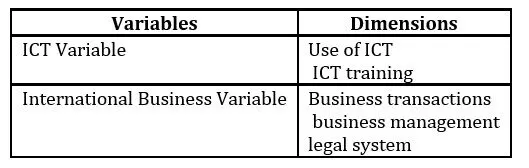
The dimensions estimated for each variable were as follows:
Table 1. Dimensions of the Variables
Since the study is quantitative in nature, data collection was processed, tabulated, and analyzed using the SPSS statistical software. According to Rivadeneira, De la Hoz Suárez, and Barrera (2020) [19], this software is used across most branches of science to meet the statistical computation needs of research, generating and transforming data and providing statistical analyses with precise results.
Results
A. General Objective: To determine the relationship between ICTs and International Negotiations in a non-profit organization in Lima.
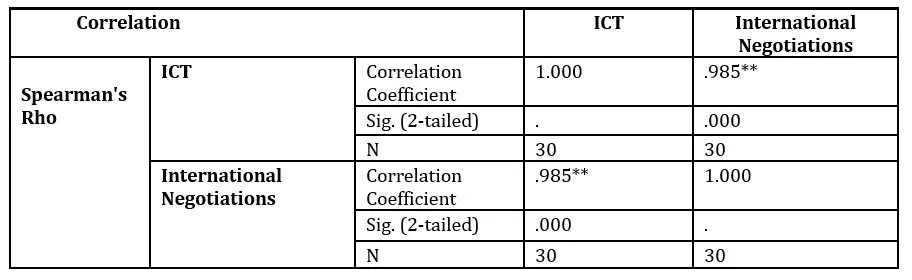
Table 2. Relationship between ICTs and International Negotiations in a Non-Profit Organization, Lima
From Table 2, there is a significant direct relationship (p < 0.01) between the two variables—ICTs and International Negotiations—with a very strong (near-perfect) positive correlation, Spearman’s rho = 0.985. This indicates that ICTs influence International Negotiations.
Specific Objective 1: To determine the relationship between the use of ICT and International Negotiations in a non-profit organization in Lima.
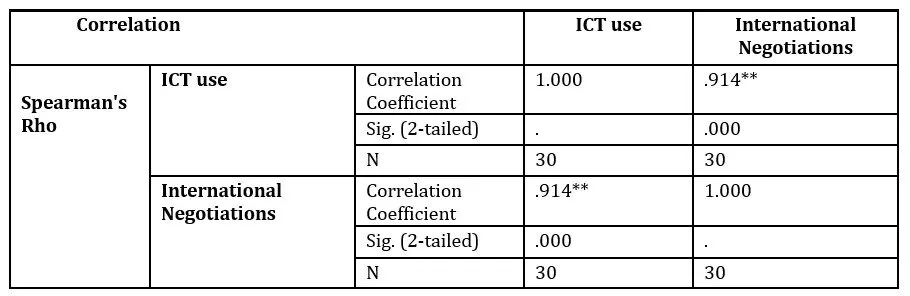
Table 3. Relationship between the Use of ICT and International Negotiations in a Non-Profit Organization, Lima
With respect to Table 3, the ICT Use dimension and the International Negotiations variable show a significant direct relationship (p < 0.01), with a very strong (near-perfect) positive correlation, Spearman’s rho = 0.914. This indicates that greater use of ICT improves international negotiations within the organization.
Specific Objective 2: To determine the relationship between ICT training and International Negotiations in a non-profit organization in Lima.
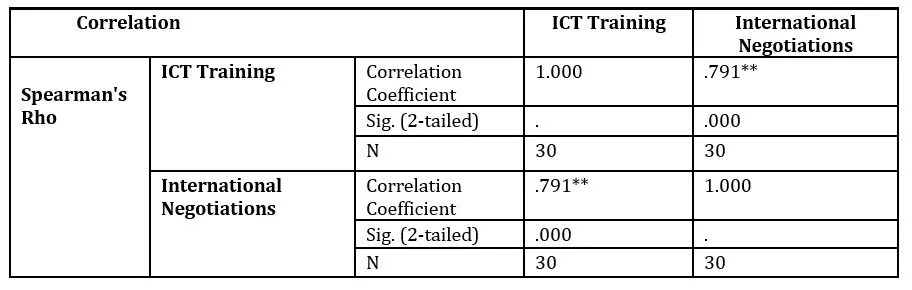
Table 4. Relationship between ICT Training and International Negotiations in a Non-Profit Organization, Lima.
In Table 4, the ICT Training dimension and the International Negotiations variable exhibit a significant direct relationship (p < 0.01), with Spearman’s rho = 0.791, indicating a very strong positive correlation. This highlights that greater ICT training is associated with better international negotiations within the organization.
DISCUSSION AND CONCLUSIONS
Discussion
In this study, the general objective was to determine the relationship between ICTs and International Negotiations in a non-profit organization in Lima. A near-perfect positive correlation was found between ICTs and International Negotiations, with Spearman’s rho = 0.985. In effect, the greater the deployment of ICTs, the better the decisions and tools available for international negotiations. Cano and Baena (2018), in their study “Appropriating ICT for International Business Negotiations Performance: A Case Study of the Pacific Alliance,” examined the performance of international negotiations through the application of ICTs and reported improvements in negotiation outcomes attributable to this tool. This suggests that the more ICTs are promoted and applied, the greater the advantages and options in international negotiation processes; their results likewise showed a positive and highly significant correlation between the two variables, consistent with the present study. In sum, ICTs positively influence international negotiations.
The first specific objective was to determine the relationship between ICT use and international negotiations in a non-profit organization in Lima. The findings reveal a near-perfect positive correlation between ICT use and international negotiations, underscoring that using this tool improves negotiation processes. In their publication “Use and Performance of ICT for International Negotiation” (Cano & Baena, 2016), the international negotiation process was analyzed based on ICT use, and organizations reported that using ICT in international negotiations is highly consistent and substantial for buy–sell procedures, time savings, cost reductions, and performance visibility in international markets. Hence, it is important for firms engaged in international negotiations to adopt ICTs to obtain relevant and effective benefits and to optimize negotiation processes through ICT use.
The second specific objective was to determine the relationship between ICT training and international negotiations in a non-profit organization in Lima. The study found a very strong positive correlation between ICT training and international negotiations, indicating that more frequent trainings have greater impact on negotiation processes and commercial transactions. Similarly, Cano and Baena (2018) highlight the significant relationship of ICT training in international trade organizations, showing performance improvements, greater technological competence, increased use of business resources, and enhanced skills. ICT training is thus important and influential for achieving objectives in organizations and countries engaged in international negotiations. Furthermore, Cano and Baena (2015) note that ICT, at the commercial level, corresponds to an information system that enables outcomes in terms of investment; therefore, ease of access to and use of this tool depends on each organization as it faces future international negotiations.
Conclusions
It is concluded that Information and Communication Technologies (ICTs) have a major impact on organizations and their negotiations; their use increases productivity and efficiency in commercial transactions. The general objective demonstrates a near-perfect positive correlation between ICTs and international negotiations in a non-profit organization in Lima. These results were verified with Spearman’s rho = 0.985 and a significance level of 0.000 (< 0.05), thus supporting the general hypothesis that the variables are related. There is, therefore, effectiveness and a clear relationship between ICTs and international negotiations.
Regarding the specific objectives, there is a near-perfect positive correlation between ICT use and international negotiations in a non-profit organization in Lima, confirmed by Spearman’s rho = 0.914 and a two-tailed significance of 0.000 (< 0.05). This supports the alternative hypothesis that ICT use and international negotiations are related and that using ICT enables sound international negotiations.
For the second specific objective, there is a very strong positive correlation between ICT training and international negotiations in a non-profit organization in Lima, confirmed by Spearman’s rho = 0.791 and a two-tailed significance of 0.000 (< 0.05). This supports the alternative hypothesis that ICT training fosters greater tools, awareness, capability, and attitude in international negotiations.
Overall, implementing ICTs has a positive effect on companies, organizations, and their negotiations and is a useful tool for commercial transactions—both for the import and export of inputs or products—while streamlining development and purchasing processes. In the case of a non-profit organization, beyond the foregoing, ICTs also add value and efficiency to social projects, serving as an ideal means to reach local, national, and international audiences.
Finally, this study underscores the importance of the relationship between ICTs and international negotiations in a non-profit organization and can inform future research, encouraging new approaches and perspectives.
References
García, Gianmarco; Lescano, Galia; Quiñones, Aura y Morales, Waldo (2022). Nuevas tecnologías y organizaciones del sector público en Perú.
Kossaï, M., y Piget, P. (2014). Adoption of information and communication technology and firm profitability: Empirical evidence from Tunisian The Journal of High Technology Management Research, 25(1), 9-20
Alvarez, I., Zamanillo, I., y Cilleruelo, E. (2016), Have information technologies evolved towards accommodation of knowledge management needs in Basque SMEs? Technology in Society, 46, 126-131.
Jasso, S., Sánchez, M., y Abrego, D. (2014). La calidad de los sistemas de información en el desempeño financiero. Investigación Administrativa, (115), 7-23.
Panuera, Yessica; Mendoza, Daniel; Achahui, Heidy (2016). Tecnologías de información y comunicación en las Empresas 2015.
García, Gianmarco; Lescano, Galia; Quiñones, Aura y Morales, Waldo (2022). Nuevas tecnologías y organizaciones del sector público en Perú. Revista Venezolana de Gerencia.
Cano Arenas, J. A. y Baena Rojas, J. J. (2013). Retos en la implementación de las TICS para el proceso de negociación internacional. Cuadernos de Administración, 29 (50), 153-163.
Slusarczyk Antosz, M. (2019). TIC en las pymes. La Caracola Editores.
Llamazares García Lomas, O. (2015). Negociación Internacional. Madrid – España: Global Marteking Strategies SL.
El manual del comercio de Andalucía (2012) Manual de Comercio Internacional.
Cue Mancera, A. (2015). Economía Internacional. México. Editorial Patria.
Vergara, N. (2012). Marketing y Comercialización Internacional. ECOE Ediciones.
Real Academia Española (2022) Diccionario de la Lengua Española- Vigésima segunda edición de Real Academia Española.
Daniels, J., Radebaugh, L., y Sullivan, D. (2013). Negocios Internacionales. México: Pearson.
Vergara, N. (2012). Marketing y Comercialización Internacional. ECOE Ediciones.
Carrasco, S. (2013). Metodología de la investigación científica. Lima Editorial San Marcos. ISBN: 9972-34-242-5
Rivadeneira Pacheco, J.L., Barrera Argüello, M.V. y De La Hoz Suárez, A.I. (2020). Análisis general del spss y su utilidad en la estadística, 2(4).
Cano, J.A. y Baena, J.J (2018). “Appropriating ICT for international business negotiations performance: A case study of the pacific alliance.” 15(1), 102-112.
Cano, J.A. y Baena, J.J (2016). “Use and performance of ICT for international negotiation”. 37(35), 08.
Cano, J.A. y Baena, J.J (2015). “Trends in the use of information and communication technologies for international negotiation”. 31(136), 335-346.