Juan Romelio Mendoza Sànchez, Blanca Flor Mendoza Sànchez and Mario Mendoza Sànchez
Universidad Nacional de Cajamarca, Perú
Volume 2025,
Article ID 644200,
IBIMA Business Review,
9 pages,
DOI: 10.5171/2025.644200
Received date: 22 April 2025; Accepted date: 3 July 2025; Published date: 23 September 2025
Cite this Article as:
Juan Romelio Mendoza Sànchez, Blanca Flor Mendoza Sànchez and Mario Mendoza Sànchez (2025)," Management Strategies for the Improvement of Management and Teaching Leadership in the Cajamarca Region, 2023 “, IBIMA Business Review, Vol. 2025 (2025), Article ID 644200, https://doi.org/10.5171/2025.644200
The management and leadership of an educational institution must respond to a planned idea guided by the mission and vision of the organization, which is why the formulation of plans and strategies locate the actions of managers in Cajamarca. This formulation helps to achieve institutional objectives and fulfill its social mission. The proposal of this work is made up of four strategies to improve the management culture of the leadership of directors and teachers in the institution. In this sense, the problem is described based on the existence of managers lacking the capacity to prioritize adequate pedagogical and institutional management.
However, this research found that interpersonal relationships between the manager and the teaching staff are not fluid within the institution due to the presence of certain authoritarian characteristics. Furthermore, regarding the research methodology, the study sample is composed of 35 participants, of which 3 are managers (1 general director, 2 coordinators) and 32 are teachers from the educational institution. The type of research is descriptive, propositional, non-experimental, and correlational. Finally, the theories on which this work is based are Ramses-Likert’s leadership theory; Ramses-Likert’s management systems theory; Robert House’s path-goal leadership theory; Stephen Anderson’s educational leadership; and Burns and Bass’s transformational leadership.
This article is part of one of the most significant and common problems in educational institutions, which is what managerial and teaching leadership comes from, which is conceived as the abilities, capacities and skills that few possess, but which can be developed through various situations and needs of the context since it is the key to the development and improvement of educational institutions and therefore for the students who make up these institutions with which the managers interact.
For this reason, UNESCO (2020) states that “as long as the directors continue focusing on administrative procedures, absorbing a large part of time in these tasks, it will be difficult for them to institutionalize the improvement processes required by educational institutions that aspire to develop effective leadership”.
UNESCO (2020) also emphasizes, “that, for directors to become authentic leaders, the development of managerial leadership tools and strategies is essential”.; In that sense, education cannot be understood apart from the advancement of science in various fields, reflecting, criticizing and responding to social questions, in the search for the greatest possible happiness. Reality requires that teachers, as those directly responsible for the educational process, generate alternatives and responses to society’s problems.
In Peru, education has been in crisis for many years, which is manifested, essentially, in the final product of the teaching process of students, directly those who attend public educational institutions, located in popular urban areas, such as rural areas of the Andean part and the Amazon.
With some limitations, the increase in enrollment in the educational area and the permanence in the classroom of students in educational institutions has not gone hand in hand with the achievement of lifelong learning, which places girls, boys, and adolescents in the optimal conditions to function effectively, efficiently, and satisfactorily in their environment and in other contexts.
The absence or lack of adequate infrastructure, furniture and equipment, the premature supply of teaching materials, the lack of relevance of teaching resources, the limited pedagogical skills exhibited by teachers who practice their profession in educational institutions, the absence of pedagogical leadership on the part of directors, among others, are some indicators that show that “the quality, equity and relevance of education in our country” is still lacking.
Faced with this problem, the State has made and is making important efforts to reverse the crisis, which, despite having made significant progress, are still insufficient and much remains to be done. The Peruvian educational system has focused its actions.
According to Rodríguez (2016), “in the training of efficient leaders who know how to renew their management for the sake of educational quality, business leadership has become more important today, since it allows promoting dialogue and the search for consensus, he says that studying it means reaching the core of institutional life”. Furthermore, they originate their conflicts, revealing their constitutive foundation, their sets of interests, and the way in which power is nurtured under the umbrella of regulations and fades away. Of their protagonists.
With respect to what was observed in teachers, it can be said that there is not a high degree of correlation between the director’s leadership style and teaching performance.; The predominant manager style is anarchic and authoritarian., There have been no significant innovations in management style, as there is evidence that traditional management styles have continued.
According to Rodríguez (2016), there is a low “level of teaching performance because it is influenced by the leadership style of the director. He tells himself that the teacher shows disinterest in the student’s participation, indifference to difficult situations that the student is going through” or is rigid according to Rodríguez (2016), in that sense, he makes “the difference in his treatment with the student, he is inattentive, maintains poor communication, imposes his criteria or way of thinking and permanently insists on the students’ errors.”
Therefore, we have considered antecedents related to the study such as: Martínez (2019), in his phenomenological research on “the pedagogical leadership practices of the directors of the city of Guayaquil, presenting as an objective to know the skills and occupations of the director as a leading pedagogue”, concluding that the directors are more concerned with administrative management” than with pedagogical management, entrusting the latter to a coordinator.
Villa Sánchez (2019), in his study carried out in Spain, on Leadership as key to innovation and educational change, concluded that leadership is not personal, but is shared, it helps the management team and pedagogical leadership is reborn with strength to promote, ensure and evaluate student learning, which is the key in the education and leadership training of management teams (p. 89).
At the national level, we have Quispe (2019), the author who suggests a second special program in educational management and leadership development for UGEL Huamanga directors. Its objective was to show how a second technical program influences school management and its effects on the director’s educational management. The author concludes that this program has a relevant impact on the development of educational leadership of directors. (p. 56).
Cárdenas (2018), the author mentions, proposes methodological strategies for the principal’s pedagogical leadership based on quality theories and the pedagogical leadership approach to improve teaching performance in a school in the San Martín region. This research is proactive descriptive., A survey was applied to a sample of 38 teachers and 5 managers. The author concludes that the level of teaching performance is lacking, which shows the lack of pedagogical leadership of the director and consequently the low level of disposition of the educational teaching process.
At the regional level we have: Rojas (2018), with his research on the design of a management program to improve leadership in I.E. N ° 161 6 “José Carlos Mariátegui”, district of Sallique, province of Jaén; whose proposal was to institutionalize and optimize teamwork, promoting the constant training of educational agents. “The proposal calls for the implementation of a type of managerial leadership in accordance with the insufficiencies of education” (p. 90).
Vásquez (2016) conducted a study of management skills in an institution in Chota. The author concludes with the implementation of a leadership coaching program, which shows that the leadership skills of the study participants have increased significantly (p. 45).
Theoretical contributions related to institutional management strategies and the work environment, such as Ramses Likert’s leadership theory; Ramses Likert’s management systems theory; Robert House’s path-goal leadership theory; Stephen Anderson’s instructional leadership; and Burns and Bass’s transformational leadership, are directly related to management systems based on an organization’s or institution’s leadership characteristics and styles. These include obligatory authoritarianism, benevolent authoritarianism, participative authoritarianism, and consultative authoritarianism.
As time has passed and new theories about leadership have emerged, Likert’s suggestion has not lost its usefulness. According to Likert, people do not work in organizations; rather, “the people are the organization.”
Regarding the conceptual bases we consider: Management strategies
According to the author Gabaldón (2019), it can be understood as the formulation, execution and evaluation of operations that will facilitate the achievement of organizational objectives. It involves an objective action approach that allows for the organization and use of qualitative and quantitative information, for decision-making in uncertain contexts. This variable is made up of the dimensions: Technical skills, personal skills.
Management and teaching leadership
Cuevas and Díaz (2001) state that certainty “indicates that effective principals foster and create an organizational climate of support for academic activities; promote common goals; incorporate teachers in decision-making, plan and supervise pedagogical work.” It is known that a teacher’s performance is influenced by multiple factors, including economic, social, personal and collective, but, within the latter, the literature highlights the leadership of managers along with the organizational climate. This variable integrates the following dimensions: Leader profile and personal development.
Methodology
The methodological aspect of the study is based on the perspective of the socio-cognitive paradigm framed in a qualitative approach, with the intention of understanding and deepening the phenomena from the perspective of the participants in their natural context. The problem posed in this work is as follows:
How do management strategies based on Ramses Likert’s leadership theory; and Ramses Likert’s management system theory contribute to the improvement of managerial and teaching leadership in the Cajamarca region?.The object of study considered was the management process in relation to managerial and teaching leadership. for the collection of information, data processing, review of theoretical and methodological aspects, etc.
The general objective is: Design a management strategy plan based on Ramses Likert’s leadership theory; Ramses Likert’s theory of the administration system for the improvement of management and teaching leadership in Cajamarca.
The hypothesis to defend consists of: Management strategies based on Ramses Likert’s leadership theory and Ramses Likert’s management system theory. A non-experimental, Transsectional design was used, relying on descriptive research. The sample was made up of 35 regular basic level teachers, corresponding to the year 2020.
To collect data on the variables, the survey technique and document analysis were applied, and the questionnaire and document analysis guide were used as an instrument for data collection. Regarding the statistical analysis carried out, descriptive statistics techniques were taken into account, in addition, the contingency table was used to visualize the distribution of the data according to the levels.
Results
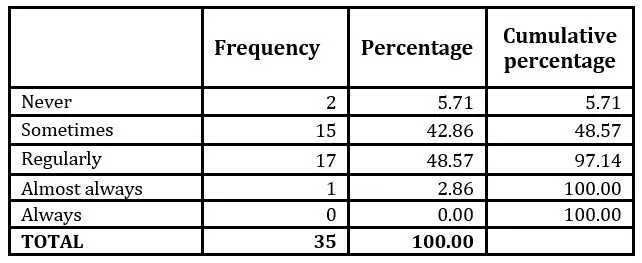
Table 1: Opinions on school organization
From table 1, the following can be seen: Teachers, regarding their opinions on the school organization, 48.57% affirm that they regularly perceive that the organization is appropriate to the interests of the teachers, the students and the educational service provided to the community.
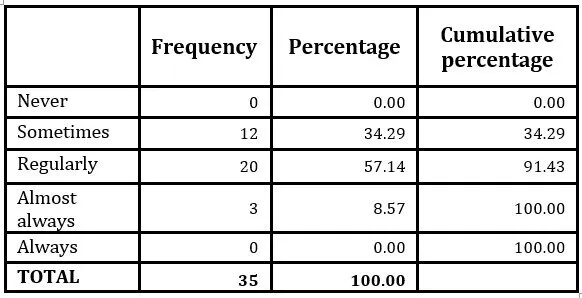
Table 2: Mission and institutional vision
From table 2, the following can be seen: “Teachers, regarding the indicator corresponding to the institutional mission and vision,; 57.14% state that, regularly, it is perceived that teachers are unaware of the aspects;, there is no communication and promotion of both among teachers by management.
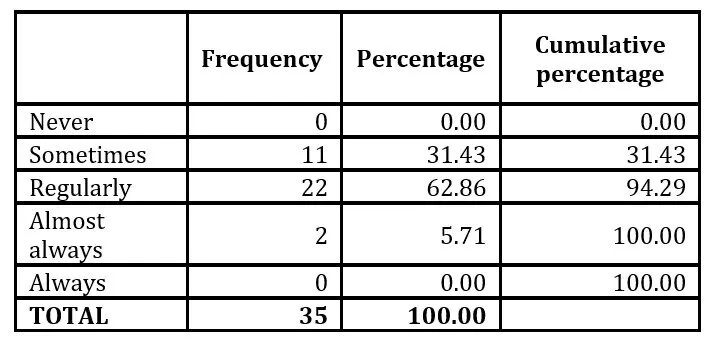
Table 3: Teachers’ sense of belonging
From table 3, the following can be seen: 62.86% of the teachers state that they do not feel identified with their institution,. The sense of belonging on the part of the teachers is deficient. They assume that there is a lack of a motivational policy that leads teachers to develop a stronger institutional identity and conviction.
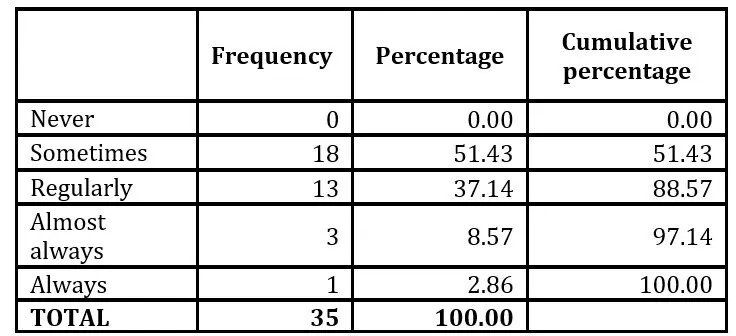
Table 4: Teacher job satisfaction
From table 4, the following can be seen: Regarding job satisfaction, 51.43% of teachers state that sometimes the existence of adequate management is perceived in favor of teachers’ job satisfaction, but in general they perceive deficiencies in the management of the institution and lack of knowledge of what it means to promote motivation and job satisfaction among the teaching staff.
Table 5: Pedagogical leadership
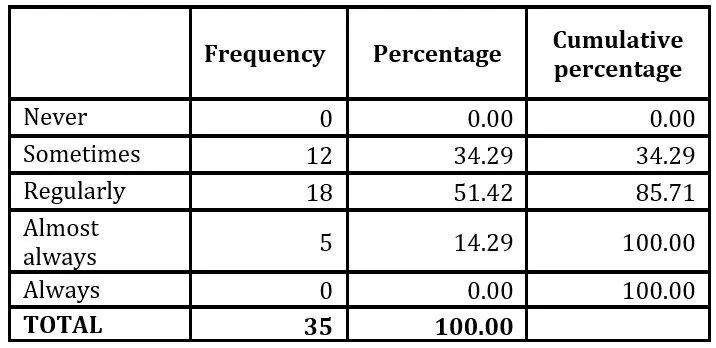
From table 5, the following can be seen: Regarding leadership for teaching and learning of students, 51.43% of teachers state that it is regularly perceived that said leadership is non-existent, since the administrative aspect is what predominates most in management. There is unilateralism in the management and at the same time a divorce with its true ones.
Table 6: Participation in the management of the educational institution
linked to the community
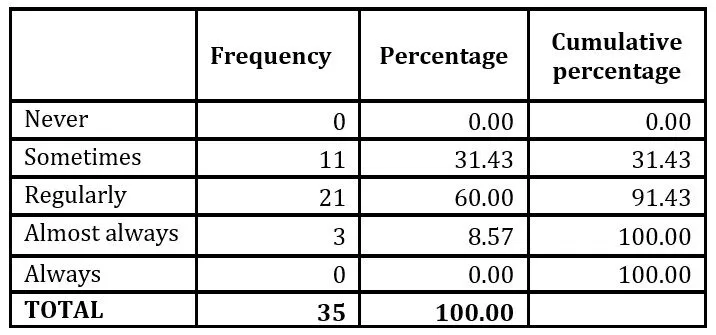
From table 6, the following can be seen: Teachers, regarding the indicator corresponding to participation in the management of the educational institution, 60.00% state that a divorce is regularly perceived between the authority with the teachers and the administrative staff of the institution. There is a decontextualized management of reality. Added to this is the lack of interpersonal communication with the personnel who work in the institution.
Discussion
In this research, the stated objectives have been precisely verified, establishing management strategies to improve managerial and teaching work, taking into consideration that education has as its fundamental social function the training of citizens useful to their society. In that sense, education cannot be understood apart from the advancement of science in various fields, reflecting, criticizing and responding to social questions, in the search for the greatest possible happiness. The reality of the country requires that teachers, as those directly responsible for the educational process, generate alternatives and responses to society’s problems. Thus, it was also evident that, currently, the activity of teaching and learning is a task that has to be linked to the development of thought. For this, it was possible to discuss each antecedent, agreeing with Castillo (2017), who says that “One of the dimensions in the exercise of the functions of the directors of educational organizations is to exercise administrative and pedagogical leadership towards achieving the vision of the institution, the director of schools, as an administrative leader, must have the knowledge, skills and attributes to understand and improve the organization, implement operational plans, manage fiscal resources and apply decentralized administrative processes.”
On the other hand, for Goberna (2016), leadership is a factor in forming competent principals and producing school change, since there is the ability to create and build a future with meaning and commitment; it assumes that the essence of leadership is the ability to build the future.
Consequently, Gimeno (2017) states that directive leadership is, therefore, related to the culture, values, mission and vision in the educational institution. Gimeno expresses that the director, from the perspective of educational leadership (p. 98), stands as the representative of the organizational culture. Thus verifying that management strategies based on Ramses Likert’s leadership theory, the theory of the administration system, contribute to improving the management culture of the directive and teaching leadership of the Educational Institution in our field of study.
Conclusions
1.- In relation to the general objective, we conclude that this research managed to design a management strategy plan based on Ramses Likert’s leadership theory and Ramses Likert’s theory of the administration system for the improvement of managerial and teaching leadership based on identifying that in said institution there is a disinterest in institutional activities and in interpersonal relationships.
2.- In relation to specific objective one, we conclude that through the research it was possible to identify the characteristics of the management and teaching leadership of Cajamarca, identifying that an anarchic and authoritarian management style predominates in said institution.
3.- In relation to specific objective two, we conclude that the scientific theories of Ramses Likert leadership theory and Ramses Likert’s management system theory effectively support the management strategy plan linking institution and community, and they also allow for encouraging and disseminating the management culture of the management and teaching leadership of Cajamarca.
4.- In relation to specific objective three, we conclude that the effectiveness of the management strategy plan based on Ramses Likert’s leadership theory and Ramses Likert’s management system theory managed to improve management and teaching leadership in Cajamarca.
References
Alvarado, O. (2000). Elementos de administración general. Lima: Editorial Udegraf.
Anderson, Stephen (1997). Liderazgo, administración y organizaciones. El liderazgo en educación, 25-46. Madrid: UNED.
Bolívar, A. (2001). Liderazgo y reestructuración escolar. Granada (España): Universidad de Granada.
Castillo Ortiz, A (2005) Liderazgo administrativo: Reto para el director de escuelas del siglo XXI. Cuaderno de Investigación en la Educación
Cuevas, M. & Díaz, F. (2001). El liderazgo educativo en centros de secundaria. Un estudio en el contexto multicultural de Ceuta. Ceuta (España): Universidad de Granada.
Castillo Ortiz (2005); “Liderazgo administrativo: Reto para el director de escuelas del siglo XXI”.
Gago, F. (2004). La dirección pedagógica de los institutos de educación secundaria. Un estudio sobre el liderazgo educacional. En Ministerio de Ciencia y Cultura, Premios nacionales de investigación educativa. Madrid: CIDE N° 170, colección Investigación, 395-422. 74
García, I. (2006). La formación del clima sicológico y su relación con los estilos de liderazgo. Granada (España): Universidad de Granada, tesis doctoral. Gil, M. & Giner, F. (2007). Cómo crear y hacer funcionar una empresa (7ª Ed.). Madrid: ESIC Editorial.
Gimeno, J. (coord.) (1995). La dirección de centros: análisis de tareas. Madrid: Ministerio de Educación y Ciencia, CIDE.
Goberna, R. (2001). Aprender a liderar equipos. Barcelona (España): Ediciones Paidós.
Grados, J. (2007). Liderazgo, dinámicas de competencia y cooperación. Barcelona: Trillas.
Guédez, V (2001) Gerencia, Cultura y Educación. Caracas: Fondo editorial Tropycos.
Gaspar, G. (2006). Bases del liderazgo en educación. Santiago (Chile): OREALC/UNESCO.
Hellriegel, D. & Slocum, J. (2004). Comportamiento organizacional (10ª Ed.). México, D.F.: Thomson editores.
Hernández, S. (2006). Introducción a la administración. Teoría general administrativa: origen, evolución y vanguardia (4ª Ed.). México, D. F.: McGraw Hill Interamericana.
Herrera, Y. (2006) Estrategias Gerenciales dirigidas al personal docente como promotor social de los Proyectos Educativos Integrales Comunitarios de Educación Básica del Municipio Simón Planas del estado
Juárez, R. (2010). Estilos de liderazgo de directores de instituciones educativas según percepción de docentes de la red nº 2 distrito Ventanilla -Callao. Lima, Universidad San Ignacio de Loyola, tesis de maestría.
Lupano, M. & Castro, A. (2006). Estudios sobre el liderazgo. Teorías y evaluación. Revista Psicodebate Psicología, cultura y sociedad, 107-121.
Lussier, R. & Achua, C. (2002). Teoría, Aplicación y Desarrollo de Habilidades. México, D.F.: Internacional
Likert, Ramses (2005). Sistemas de administración. México: Thomson Editores.
Likert, Ramses (2005). Clima organizacional. editorial Tropycos. México.
Maureira, O. (2004). El liderazgo factor de eficacia escolar, hacia un modelo causal. REICE – Revista Electrónica Iberoamericana sobre Calidad, Eficacia y Cambio en Educación,
Maureira, O. (2006). Dirección y eficacia escolar, una relación fundamental. REICE. Revista Electrónica Iberoamericana sobre Calidad, Eficacia y Cambio en Educación,
Mendoza, M. & Ortiz, C. (2006). El liderazgo transformacional, dimensiones e impacto en la cultura organizacional y eficacia de las empresas. Investigación y Reflexión. XIV (1), 118-134.
Miranda, C. & Andrade, J. (1998). Influencia del liderazgo directivo en el rendimiento escolar de los estudiantes del segundo año de secundaria en la comunidad de Santiago. Santiago de Chile: Pontificia Universidad Católica de Chile, tesis.
Murillo, F. (2006). Una dirección escolar para el cambio: del liderazgo transformacional al liderazgo distribuido. REICE – Revista Electrónica Iberoamericana sobre Calidad, Eficacia y Cambio en Educación,
Nube, S. y Sánchez, M. (2006). La gerencia de la calidad educativa: Liderazgo – Calidad – Planificación. Parte Barquisimeto: Candidus.
Ollarves Levison, Y (2006) Claves para la gestión de organizaciones educativas innovadoras. Laurus, 12(22), 191-207
Pareja, J. (2007). Conflicto, comunicación y liderazgo escolar: los vértices de un triángulo equilátero. Profesorado. Revista de currículum y formación del profesorado,
Pareja, J. (2009). Liderazgo y conflicto en las organizaciones educativas. Educación y educadores, 12 (1), 137-152.
Restrepo y Tabares (2005) Efectividad del desempeño docente. Una reseña de la literatura internacional y su relevancia para mejorar la educación en América Latina. Santiago (Chile): PREAL, Editorial San Marino.
Robbins, S. & Coulter, M. (2010). Administración (10ª Ed.). México, D.F.: Pearson Educación.
Salazar, M. (2006). El liderazgo transformacional ¿modelo para organizaciones educativas que aprenden? UNIrevista,
Sorados (2010) “Estrategias Gerenciales dirigidas al personal docente como Promotor Social de los Proyectos Educativos Integrales Comunitarios” Editorial San Marino.
Valencia, P. (2008). Estilos gerenciales y satisfacción laboral. Lima: Universidad Nacional Mayor de San Marcos, tesis de maestría.