Jesus Fernando BEJARANO AUQUI, Maria Fernanda ROMAN HUANAY, Franklin Noe TACANAHUI CONDORI and Elffy Consuelo REYNA MALLQUI
Universidad Peruana Unión, Lima, Perú
Volume 2025,
Article ID 933761,
IBIMA Business Review,
12 pages,
DOI: 10.5171/2025.933761
Received date: 11 April 2025; Accepted date: 17 July 2025; Published date: 29 September 2025
Academic Editor: Laura Elena Zapata Jiménez
Cite this Article as:
Jesus Fernando BEJARANO AUQUI, Maria Fernanda ROMAN HUANAY, Franklin Noe TACANAHUI CONDORI and Elffy Consuelo REYNA MALLQUI (2025)," Impact of Endomarketing Strategies on Employee Engagement and Job Performance in SME Sector Companies in Latin American Contexts “, IBIMA Business Review, Vol. 2025 (2025), Article ID 933761, https://doi.org/10.5171/2025.933761
This study examines the relationship between endomarketing strategies and employee commitment in small and medium-sized enterprises (SMEs) of the Ceres Owners Association in Vitarte-Lima. Using a quantitative, descriptive, and correlational approach, an extensive literature review was conducted to establish a theoretical foundation, supplemented by empirical data collected through surveys of 298 workers, selected via stratified random sampling from a total population of 1,320 employees. The measurement tool consisted of a validated questionnaire that assessed the variables of endomarketing and organizational commitment. The results show that endomarketing strategies, including participatory decision-making, flexible work environments, and continuous training, significantly influence employees’ commitment levels. Additionally, statistical analysis reveals positive correlations between endomarketing practices and job satisfaction, affective commitment, and organizational loyalty. The research emphasizes the importance of implementing specific actions that strengthen internal communication, foster motivating environments, and develop ongoing training programs to improve employee engagement and performance. In conclusion, the study contributes to understanding how endomarketing strategies impact work commitment, offering practical recommendations aimed at optimizing talent management in similar contexts and thereby enhancing the competitiveness and sustainability of small and medium-sized organizations in emerging markets.
Keywords: Endomarketing, engagement, business competitiveness and organizational performance
Introduction
In a constantly evolving business world, the role of collaborators within an organization has become an essential factor for the success and sustainability of any institution. The ability of a company or entity to keep its team engaged, motivated, and connected to the values and objectives of the organization has become a primary challenge in the pursuit of organizational excellence. In this context, the concept of “endomarketing” arises, a strategy that seeks to captivate external consumers and focuses on cultivating the satisfaction and commitment of internal collaborators (Araque et al., 2017; Reis et al., 2018).
In an environment where talent retention and stimulating employee productivity are essential for organizational success, it is recognized that human resources represent the company’s most valuable intangible asset. Likewise, the importance of guaranteeing that work improves employees’ quality of work life, promoting their satisfaction, and developing skills is highlighted (Garrido et al., 2011). Maintaining employees’ motivation is a determining factor in achieving business objectives (Payares et al., 2020). Lack of engagement can result in decreased productivity and high employee turnover rates, ultimately negatively impacting business competitiveness and continuity (Salas, 2021).Therefore, it is essential to retain the personnel who have been trained and developed by the organization itself, as their experience and alignment with the company’s culture add significant value to long-term performance.
In the context of SMEs in Lima, this problem becomes more accentuated. These companies face additional obstacles to managing employee engagement due to their size and limited resources, such as resource scarcity, lack of training, lack of effective human resource management policies and practices, as well as challenges in culture and communication that complicate the task of managing employee commitment (Qiu et al., 2022). According to Dlačić et al. (2018), it is observed that the lack of resources, the absence of support, a work environment that does not promote the physical, emotional, and interpersonal well-being of employees, and the limited application of personnel management strategies can have a negative impact on collaborators’ commitment. Accordingly, decreased engagement among employees may manifest when they experience low social interaction in the work environment, have limited autonomy in decision-making, and perceive their work as unimportant. As a result, if employees feel disconnected, they are likely to withdraw cognitively and emotionally, which could lead to increased employee turnover, counterproductive behaviors, and disengagement in the workplace (Črnjar et al., 2020). The lack of effective endomarketing approaches can also lead to a low level of engagement, directly affecting talent retention and significantly impacting the ability of SMEs to compete in the market, achieve their objectives, and maintain a competitive position (Galvis & Marin, 2020).
Given this situation, the following research question arises: What is the influence between Endomarketing and the Engagement of the collaborators of the SMEs in the Ceres Owners Association, Vitarte-Lima, 2023? Therefore, this research aims to analyze to what extent Endomarketing influences the Engagement of collaborators in the SMEs of Ceres Mega Plaza Owners Association, Vitarte-Lima. The importance of this study lies in the fact that obtaining solid results will provide SMEs with the necessary security to adopt endomarketing strategies with confidence. This, in turn, will significantly improve organizational commitment, job satisfaction, and employee productivity, which will contribute to these organizations’ sustainable growth and success.
Literature Review
Endomarketing
Given the intense competition in the business environment, companies are looking for competitive options to stand out in an increasingly contested market. It has been observed that many organizations have recognized the imperative need to focus their efforts on internal customer satisfaction and commitment, considering it a fundamental requirement to effectively reach external customers (Reis et al., 2018). In this context, endomarketing arises, which defines strategic marketing practices aimed at internal personnel to improve collaborators’ satisfaction, motivation, and loyalty, positively impacting the perception and experience of external customers (Payares et al., 2020). The initial idea of internal marketing originated in service management, viewing collaborators as internal customers, that is, as the clientele within the organization itself (Črnjar et al., 2020). From this perspective, employees’ physical and mental effort and dedication are conceived as the price they pay for their work, comparable to the product the organization offers them. In addition, internal marketing actions are considered promotional strategies (De Bruin et al., 2015). According to Qiu et al. (2022), internal marketing is a management philosophy that treats employees as internal customers and designs jobs as products to satisfy and motivate employees to provide high-quality service, which can lead to more significant commitment, productivity, labor satisfaction, and profitability for the company.
For Arıkan & Öztührk (2022), internal marketing is considered an effective tool to improve service quality, corporate identity formation, competitiveness, job satisfaction, organizational commitment, organizational citizenship, and customer satisfaction. Sohail and Jang (2017) indicated that internal marketing uses marketing principles and practices to motivate employees, focusing on cultivating a work environment that meets their needs and supports the efficient execution of business strategies, intending to strengthen the organizational relationship with collaborators, which positively impact customer satisfaction and improve business performance. Indeed, according to the research by Arıkan & Öztürk (2022) and Rodrigues et al. (2023), internal marketing aims to improve service quality and customer satisfaction by focusing on employee satisfaction and commitment. Internal marketing practices drive customer satisfaction (Kadic et al., 2018), an especially crucial aspect of business (Črnjar et al., 2020).
Dimensions of Endomarketing
There is disagreement between authors regarding the dimensions included in internal marketing, amplifying the diversity of definitions in this field. Following Bohnenberger (2005), internal marketing in organizations is based on implementing actions in four essential dimensions: development, employee hiring, job adaptation, and internal communication. The development dimension focuses on actions related to training and skills development, customer orientation, and the acquisition of new knowledge by employees. In other words, it is about empowering employees and encouraging their professional growth, which improves the organization’s performance. Organizations must have suitable personnel to carry out the assigned tasks, adapt to the organizational culture, and contribute to its strengthening.
Additionally, it is essential to recognize employees’ work and achievements fairly, motivating their engagement and retention in the company. These aspects are addressed in the employee hiring dimension, where the recruitment, selection, and hiring processes must be efficient and focused on finding the right personnel (Zegarra, 2014). On the other hand, the dimension of job fit involves the organization’s actions to align each employee’s motivations and abilities with the functions and roles they perform. This includes empowering them in their positions and formally or informally recognizing their achievements and contributions. This dimension is crucial to employee satisfaction and commitment (Bohnenberger, 2005; Zegarra, 2014). Finally, internal communication refers to the organization’s actions to share relevant information with collaborators at all levels. This information covers aspects related to organizational objectives and goals, results achieved, values, and corporate culture, as well as changes that may occur both internally and externally.
Effective internal communication is essential to keep all organization members informed and aligned with common objectives (Bohnenberger, 2005; Zegarra, 2014). In their research, Akroush et al. (2013) identified that internal marketing involves dimensions such as staff motivation, recruitment, internal communication, training, staff retention, and job security. They concluded that hiring, training, and internal communication have a significant positive impact on staff motivation, which, in turn, directly affects job security and staff retention. Various additional studies (Braimah, 2016; Tsai and Tang, 2008; Ching and Hsin, 2007) suggest supplementary dimensions of internal marketing, such as identification, attraction, and development.
Artificial Intelligence in Endomarketing
Artificial intelligence (AI) has become a strategic resource for strengthening endomarketing within organizations. Its ability to analyze large volumes of data enables the personalization of the employee experience, the optimization of internal communication, and the adaptation of professional development programs to individual needs (Shanmugam et al., 2023). Additionally, AI facilitates the automation of administrative processes, emotional analysis of the work environment, and continuous feedback collection, contributing to a deeper understanding of the internal context (Uribe, 2021; Silva et al., 2022; Mackay et al., 2023). On the other hand, AI plays a crucial role in the profiling and selection of talents, allowing profiles to be analyzed in real-time, offering objective suggestions, carrying out continuous tests throughout a person’s working life, evaluating through simulations of real situations, and storing information to identify development opportunities (Uribe, 2021). Together, these capabilities provide deeper, more personalized candidate assessment, making it easier for companies to identify and select high-impact talent efficiently. At the same time, integrating AI and endomarketing promotes more satisfactory and productive work environments, thus boosting employee commitment and loyalty toward the organization (Delgado, 2021; Montenegro, 2020).
Engagement
Engagement, also known as commitment, in the workplace implies individuals’ deep connection and active participation in their responsibilities and organizational goals, playing a crucial role in achieving success and job satisfaction.
According to Meyer and Alien (1991), organizational commitment is a state of psychological well-being that reflects the individual’s connection and identification with the organization, thus influencing the decision to continue or leave it.
According to Heredia and Sullca (2022), employee commitment’s importance in business management is defined as the level of emotional and intellectual connection that employees maintain with their work responsibilities and the organization to which they belong. Organizational commitment refers to the conviction and recognition of employees regarding the organization’s objectives and values, showing their willingness to make full efforts in favor of it (Ismail and Sheriff, 2017). For Bosch et al. (2021), it is employees’ commitment to the organization and the work itself. In addition, Treviño and López (2022) highlight that sustainable employee engagement is based on three fundamental elements: the willingness of employees to dedicate additional efforts to their jobs, the provision of tools, resources, and support, and the creation of a work environment that effectively supports physical, emotional, and interpersonal well-being.
Dimensions of Engagement
The evaluation of Engagement is based on the framework outlined by Agurto et al. (2020) and Schaufeli and Salanova (2007), who highlight the three key dimensions:
First. Vigor
This dimension is characterized by high energy levels and the employee’s ability to recover mentally during work. It manifests through a willingness to invest more effort, even in adverse situations, demonstrating notable resilience and enthusiasm.
Second. Dedication
In this dimension, the strong involvement of the worker in their work is observed. It is manifested through a deep sense of identification, motivation, enthusiasm, pride, and the constant desire to face the challenges associated with the activity carried out. This commitment goes beyond routine tasks and reflects a meaningful connection to the work.
Third. Absorption
This dimension is experienced when the employee is wholly immersed in the task being performed, achieving a feeling of flow in which time seems to pass quickly. This total immersion generates significant enjoyment for the worker, which, in turn, increases their desire to remain with the organization. Absorption reflects a state of concentration and deep commitment to the work, creating a rewarding experience.
The dimensions of work engagement, which include vigor, dedication, and total absorption in work, offer a comprehensive view of the work experience. This multidimensional approach is crucial to developing effective talent management strategies and promoting well-being in the work environment.
AI as a Driving Factor for Engagement
Artificial Intelligence (AI) stands out as a catalyst for work engagement by transforming interaction dynamics between companies and their employees. By freeing workers from repetitive tasks, AI allows them to focus on strategic aspects such as campaign personalization, content optimization, and email campaign management (Shanmugam et al., 2023). In fact, according to Benitez (2020), AI acts as a personal mentor, providing personalized guidance for career development.
In addition, it optimizes workflows, encourages collaboration, and creates an intelligent work environment tailored to individual needs. Motivation and productivity flourish in this context, driving individual and collective success. It is important to highlight that AI is not intended to replace workers but to complement and enhance their skills, allowing them to achieve higher levels of satisfaction and work fulfillment (López and Peña, 2023). Despite the apparent benefits, AI may also raise employee concerns about potential technological replacements, underscoring the need to address these challenges to maximize the benefits of workplace engagement with AI (Román, 2024).
Methodology
Organizations, regardless of their size, age, or sector, are currently faced with the continuous challenge of improving their endomarketing strategies to respond effectively to the changing needs of their collaborators. In particular, SMEs strive to align organizational goals with the activities of their teams (Freije et al., 2022). To achieve this, they seek to develop competitive strategies based on endomarketing, as highlighted in research by Almaslukh et al. (2022). These strategies aim to improve the work environment and enhance the satisfaction of internal and external customers.
Given the need to thoroughly address the specific scope of the research, we begin with an exhaustive review of the literature to establish a solid theoretical framework. State-of-the-art techniques will be used based on the specific variables of the study. The methodological choice is oriented towards a descriptive, quantitative, and correlational approach. The justification for the descriptive nature is based on collecting objective and observable data to describe the phenomenon under study accurately. Quantification will be done using tools designed to measure the variables identified in the questionnaire. Furthermore, a correlational approach is adopted to analyze and describe the statistical relationships between the Endomarketing and Engagement variables. This approach will facilitate a deeper understanding of the essence of the reason for the study, supported by the literature (Hernández et al., 2014).
The population of interest includes a total of 1,320 workers belonging to the SMEs affiliated with the Ceres Owners Association. A stratified random sampling technique will be employed to select the sample of 298 employees. This technique ensures that subgroups, such as those working in different sectors (footwear, textile, commerce, and services, among others), are proportionally represented in the sample. The selected sample will have a confidence level of 95% and a margin of error of 5%. It is important to note that owners of SMEs from the Ceres Owners Association, Vitarte-Lima, will be excluded from the sample.
Data Collection
A survey plan was designed for the collaborators of the Ceres Owners Association, who were surveyed with their prior consent accepted in September. The measurement instrument was printed and each participant was surveyed for 20 minutes. In addition, information was collected from articles registered in scientific databases such as Scopus and published in the highest quartiles Q1, Q2, Q3 and Q4 that provided scientific information for the research.
Instrument
The tool used for endomarketing is the one of Bohnenberger (2005), which considers 25 items. The items use a Likert-type format with 5 response points where 1 represents strongly disagree and 5 strongly agree. Cronbach’s alpha is 0.840. Moreover, for engagement, the instrument (Schaufeli and Salanova, 2007) considers 19 items and uses the 5-point Likert-type scale where 1 represents strongly disagree, and 5 represents strongly agree. Cronbach’s alpha for the reliability of this instrument is 0.899.
Statistically, the “R” software in version 4.3.1 was used for the study variables; the mean, standard deviation, skewness, and kurtosis were obtained, and, at the inferential level, the correlation tables and the regression coefficient were acquired, including the results of the assumptions of heteroskedasticity and autocorrelation of errors.
Results
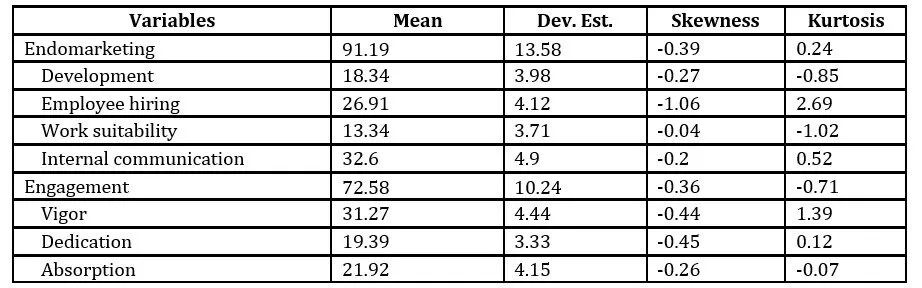
Table 1 shows that the skewness and kurtosis scores of the variables are within the range of +/-2, indicating a normal distribution of the data. Regarding Endomarketing, the mean of 91.19 suggests a high general level, with a symmetrical distribution (skewness of -0.39) and moderately pointed (kurtosis of 0.24). Regarding engagement, the average of 72.58 indicates a high level, with a symmetrical distribution (asymmetry of -0.36) and slightly flattened (kurtosis of -0.71). Consequently, parametric tests are used for the corresponding statistical analyses.
Table 1: Analysis of adjustment to the standard curve of the study variables
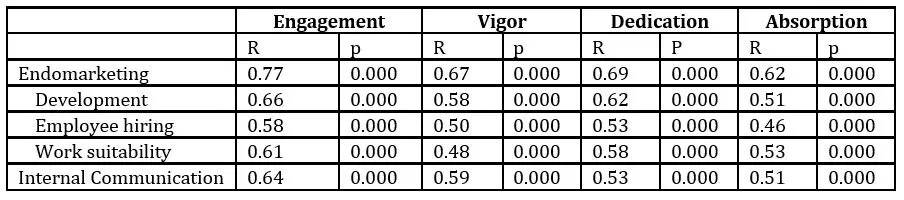
Table 2 shows that there is a highly significant, positive, and robust correlation (R = 0.77, p < 0.001) between Endomarketing and Engagement. Likewise, highly significant, positive, and robust correlations are observed between the Development dimensions and Engagement (R = 0.66; p < 0.001), Development and Vigor (R = 0.58; p < 0.001), Development and Dedication (R = 0.62; p < 0.001) and Development and Absorption (R = 0.51; p < 0.001). Likewise, with the dimensions Employee Hiring and Engagement (R = 0.58; p < 0.001), Employee Hiring and Vigor (R = 0.50; p < 0.001), Employee Hiring and Dedication (R = 0.53; p < 0.001) and Employee Hiring and Absorption (R = 0.46; p < 0.001). Similarly, with the dimensions Work Fit and Engagement (R = 0.61; p < 0.001), Work Fit and Vigor (R = 0.48; p < 0.001), Work Fit and Dedication (R = 0.58; p < 0.001) and Suitability to work and Absorption (R = 0.53; p < 0.001).
Finally, with the dimensions of Internal Communication and Engagement (R = 0.64; p < 0.001), Internal Communication and Vigor (R = 0.59; p < 0.001), Internal Communication and Dedication (R = 0.53; p < 0.001) and Internal Communication and Absorption (R = 0.51; p < 0.001). These findings indicate a consistent and substantial connection between the variables examined, supporting the importance of Endomarketing and other dimensions such as Development, Employee Hiring, Job Fit, and Internal Communication in promoting Engagement and its associated aspects in the work context.
Table 2: Correlation Analysis between Endomarketing and Engagement
The regression analysis, shown in Table 3, reveals a significant regression coefficient of 0.58. This finding acquires statistical relevance due to the high t-value of 20.54 and the p-value < 0.001, which suggests that the influence of Endomarketing on Engagement is highly robust and unlikely to be a product of chance. Furthermore, the standardized coefficient (β) of 0.58 suggests a powerful positive influence between Endomarketing and Engagement. The coefficient of determination (R2) of 0.588 highlights that approximately 58.8% of the variability in Engagement can be explained by the variations in Endomarketing. This substantially high value reveals a highly significant influence between these variables. In this context, it follows that, as the level of Endomarketing increases, a corresponding increase in Engagement is expected. These results highlight the crucial importance of Endomarketing in the organizational commitment of the collaborators of the SMEs of Vitarte-Lima. These results have substantial practical implications for SMEs in the area, suggesting that strengthening Endomarketing strategies could lead to notable improvements in the commitment of their collaborators.
Table 3: Regression Analysis of Endomarketing on Engagement
Once the study is developed, it is summarized by highlighting the impact of the research, which offers a more detailed understanding of how endomarketing (internal marketing tactics aimed at employees) influences employee engagement.
This study, focused on SMEs, provides evidence of the effectiveness of specific endomarketing strategies, such as internal communication, incentives, wellness programs, and organizational culture, in increasing employee engagement, a topic that has so far been less researched in this context. In turn, the key elements that reflect its scientific relevance are highlighted.
Contribution to the Theory of Endomarketing
This study is conducted within endomarketing, a growing marketing process that has been essential since companies need to create a positive work environment and promote employee loyalty and commitment. This manuscript expands the understanding of how internal marketing methods affect not only productivity but also employee engagement in the context of SMEs. The research will help delve deeper into the dimensions of endomarketing, relating specific practices (internal communication, motivation, organizational culture development, among others) to engagement levels in a particularly important market segment: SMEs. By studying this relationship, the study becomes the main source for enriching the theoretical framework of endomarketing, especially in the local and regional context of Lima.
Contribution to SME Management
The sustainability and competitiveness of SMEs are the result of their individual challenges. Employee engagement is a crucial factor in boosting productivity, reducing staff turnover, and resulting in greater profitability for organizations. The authors further explore how internal marketing can be a strategic tool for increasing employee engagement in SMEs, leading to greater operational efficiency, innovation, and organizational performance. Furthermore, this research has the potential to act as a practical guide for SME managers at the Ceres Mega Plaza Owners Association and other similar contexts, helping them implement effective internal marketing policies that foster closer relationships between the company and its employees.
Applicability to the Latin American Context
This research focuses on a particular area, Vitarte (Lima), and analyzes the sociocultural and economic factors that shape human capital management in Latin American societies. This approach not only complements the literature on human capital management in other regions but also emphasizes the details of labor and business markets in the area, making the manuscript applicable and beneficial to local entrepreneurs, consultants, and academics.
Practical Implications for Organizations
The scientific impact of this study is also evident in the valuable practical implications it presents. By identifying the direct influence of internal marketing strategies on employee engagement, SMEs can make better decisions regarding investment in wellness, training, development, and internal communication programs. Furthermore, this analysis provides readers with useful tools to optimize their efforts and create a more motivating and productive work environment, which is essential for strengthening the competitiveness of small and medium-sized enterprises.
Relevance for Conference Participants and Journal Readers
The manuscript is highly relevant to different market segments, as it enriches the theoretical framework of internal marketing and organizational behavior. By analyzing the impact of internal marketing strategies on employee engagement in SMEs, this research provides new empirical findings on the application of internal marketing practices in small businesses, a field still under exploration. By offering innovative insights, it lays the groundwork for future studies and expands research opportunities in emerging markets, thus contributing to a better understanding of how internal dynamics can influence employee engagement in various contexts.
Innovation in Contextual Analysis
This manuscript presents an innovative approach by applying the concept of endomarketing in the context of a specific business community. This contribution is valuable for the study of labor dynamics in geographical areas that have been underexplored in the scientific literature. Through this contextualized approach, the study establishes a foundation for future research in other sectors and regions, thus broadening the scope of the impact of internal marketing strategies.
Discussion
In today’s business scenario, internal marketing strategies, to increase employee engagement and customer satisfaction, have become increasingly important. Recent studies, such as those of Huang et al. (2019), highlight the fundamental relationship between employee commitment and satisfaction and external customer loyalty and satisfaction. Although numerous previous studies have investigated the positive relationship between internal marketing and work engagement in various sectors (Araque et al., 2017; Dlačić et al., 2018), there is a lack of research examining these practices’ impact on SMEs. This study focused on analyzing the relationship between internal marketing and employee engagement in the SMEs of the Ceres Owners Association, Vitarte-Lima. The results support the idea that a significant relationship exists between endomarketing and engagement (r = 0.77; R2 = 0.588), confirming previous findings (Dlačić et al., 2018; Yi et al., 2023). Furthermore, according to the results of Almaslukh et al. (2022), it was observed that elements such as participatory and supportive leadership, development through training, adequate selection and appointment, as well as effective internal communication, generate positive and significant impacts on the job satisfaction of workers in the banking sector, influencing favorably not only employee commitment but also their willingness to remain with the organization. In summary, the findings of this study highlight the importance of endomarketing as an effective strategy to enhance employee engagement, which directly impacts customer satisfaction and employee retention in companies in various sectors. These results highlight the relevance of implementing internal marketing practices in the SMEs associated with the Ceres Mega Plaza Owners Association, offering valuable guidance to strengthen connections with employees, the company, and customers.
Conclusion
In conclusion, this study has shed light on the vital connection between endomarketing and employee engagement in the SMEs of the Ceres Owners Association, Vitarte-Lima. The results have shown a significant relationship (r = 0.77, R2 = 0.588) between the effective implementation of endomarketing and higher levels of engagement, underscoring the strategic importance of these internal practices in the context of micro and small businesses.
The detailed analysis reveals a substantial relationship (R = 0.66; p < 0.001) between development initiatives and employee engagement in SMEs. Endomarketing's support for growth and learning opportunities has proven to be a key factor in driving employee engagement and emotional connection to the organization. Research indicates that how the hiring process is carried out directly influences engagement (R = 0.58; p < 0.001). Aligning new employees with the organizational culture through endomarketing contributes significantly to the willingness of employees to commit to the company's objectives and values. The findings suggest that job fit, facilitated by endomarketing strategies, positively impacts engagement (R = 0.61; p < 0.001). Creating work environments that meet the individual needs of employees contributes to more remarkable dedication and connection to the work performed. The positive relationship (R = 0.64; p < 0.001) between internal communication and engagement highlights the importance of clear and effective communication supported by endomarketing. Transparency in information and promoting organizational values strengthen employees' emotional connection, driving higher engagement levels.
In summary, this study has not only met the established objectives. However, it has also provided valuable evidence on the critical relevance of endomarketing in promoting engagement in SMEs. It offers practical perspectives for effectively developing internal strategies in smaller-scale business environments.
Principio del formulario
Recommendations
Promote a Positive Organizational Culture
Implementing tactics that promote a positive organizational culture is essential to reinforce the endomarketing of the collaborators of the SMEs of the Ceres Owners Association, Vitarte-Lima. This initiative involves harmonizing corporate values with employees’ individual and collective objectives. Establishing an environment where identification and commitment to the company mission are notable will contribute significantly to employee engagement.
Clear and Continuous Communication
Establishing effective internal communication channels plays a key role in keeping employees informed and promoting transparency among SMEs employees in the Ceres Owners Association, Vitarte-Lima. Constant communication about changes, achievements, and business goals creates a climate of trust and reinforces the sense of belonging, which are essential elements to boost employee commitment.
Recognition and Incentives
The design of programs aimed at recognition and reward is presented as an opportunity to value the effort and dedication of the collaborators of the SMEs of the Ceres Owners Association, Vitarte-Lima. Recognizing individual and collective achievements strengthens the emotional bond of employees with the company, generating a positive impact on their levels of commitment and motivation.
Professional and Personal Development
Providing opportunities for professional and personal development is an effective strategy to strengthen the commitment of employees of the SMEs of the Ceres Owners Association, Vitarte-Lima. When employees perceive that the company invests in their individual growth, a stronger and more lasting bond is created, contributing to long-term commitment and loyalty.
Active Participation in Decisions
Including workers in the relevant decision-making process is essential to strengthen the commitment of the collaborators of the SMEs of the Ceres Owners Association, Vitarte-Lima. When employees feel that their opinions are valued and considered, an environment of trust and active participation is created that positively impacts their connection with the company.
Flexible and Motivating work Environments
Designing work environments that promote flexibility, well-being, and motivation contributes significantly to the engagement of the employees of the SMEs of the Ceres Owners Association, Vitarte-Lima. Considering ergonomics, lighting, and comfort creates an environment that enhances employee satisfaction, thus strengthening their commitment and emotional connection with the company.
Continuous Training
Providing continuous training programs is crucial to improve engagement among the employees of the SMEs of the Ceres Owners Association, Vitarte-Lima. The possibility of acquiring new skills and knowledge not only improves job performance but also stimulates employees’ personal development, positively impacting their level of commitment and connection with the company.
References
Agurto, K.P., Magollon, F.S. and Castillo, L.B. (2020) ‘El papel del engagement ocupacional como alternativa para mejorar la satisfaccion laboral de los colaboradores’, Revista Universidad y Sociedad, 12(4), pp. 112–119. Available at: https://orcid.org/0000-0002-3983-8068.
Akroush, M.N., Abu, A., Samawi G. and Odetallah, A. (2013) ‘Marketing interno y calidad de servicio en restaurantes’, Inteligencia de Marketing y Planificación, 31(4), pp. 304–336.
Almaslukh, F. M. O., Khalid, H. and Sahi, A.M. (2022) ‘The Impact of Internal Marketing Practices on Employees’ Job Satisfaction during the COVID-19 Pandemic: The Case of the Saudi Arabian Banking Sector’, Sustainability , 14(9301). doi:10.3390/su14159301.
Araque, D.L., Sánchez, J.M. and Uribe, A.F. (2017) ‘Connection between internal marketing and organizational commitment in Colombian Technological Development Centers’, Estudios Gerenciales, 33, pp. 95–101. doi:10.1016/j.estger.2016.12.005.
Arıkan, Ö.U. and Öztürk, E. (2022) ‘CARRYING THE BURDEN OF THE PANDEMIC: THE RELATIONSHIP BETWEEN INTERNAL MARKETING, BURNOUT, AND JOB SATISFACTION IN COURIER SERVICE INDUSTRY’, Logforum, 18(2), pp. 173–183. doi:10.17270/J.LOG.2022.715–183. doi:10.17270/J.LOG.2022.715.
Benitez, R M. (2020) ‘El impacto de la digitalización en las Relaciones Laborales. Retos emergentes para la Dirección de Recursos Humanos’, Revista Iberoamericana de Relaciones Laborales, 38, pp. 182–193
Garrido, Johanna, Uribe, A. and Blanch, J. (2011) ‘RIESGOS PSICOSOCIALES DESDE LA PERSPECTIVA DE LA CALIDAD DE VIDA LABORAL’, Acta colombiana de Psicología, 14(2), pp. 27–34.
Bohnenberger, M.C. (2005) Marketing interno: la actuación conjunta entre recursos humanos y marketing en busca del compromiso organizacional. UNIVERSITAT DE LES ILLES BALEARS
Bosch, M.J., Riumallo, M. and Morgado, M. (2021) ENGAGEMENT LABORAL: EL COMPROMISO COMO RECURSO GUÍA PRÁCTICA.
Braimah, M. (2016) Internal marketing and employee commitment in the hospitality industry, African Journal of Hospitality, Tourism and Leisure. Available at: http//:www.ajhtl.com.
De Bruin, L., Roberts, M. and De Meyer, C. (2015) ‘THE TRADITIONAL INTERNAL MARKETING MIX AND ITS PERCEIVED INFLUENCE ON GRADUATE EMPLOYEE SATISFACTION IN AN EMERGING ECONOMY’, The Journal of Global Business and Technology, 11(1), pp. 24-38. Available at: www.gbata.org.
Ching, C. and Hsin, C. (2007) Effects of Internal Marketing on Nurse Job Satisfaction and Organizational Commitment: Example of Medical Centers in Southern Taiwan’, Journal of Nursing Research, 15(4), pp. 265-274. Available at: http://journals.lww.com/jnr-twna.
Črnjar, K., Dlačić, J. and Milfelner, B. (2020) ‘Analysing the relationship between hotels’ internal marketing and employee engagement dimensions’, Market-Trziste, 32(Special Issue), pp. 49–65. doi:10.22598/mt/2020.32.spec-issue.49.
Delgado, K. (2021) ‘Beneficios de la implementación de la inteligencia artificial en las pequeñas y medianas empresas’. Universidad de Pamplona
Dlačić, J., Črnjar, K. and Lazarić, M. (2018) ‘VINCULACIÓN DEL MARKETING INTERNO Y LA COMPROMISO DE LOS EMPLEADOS EN LA INDUSTRIA HOSTELERÍA’ Proceedings of the 7th SIMPOSIO CIENTÍFICO INTERNACIONAL ECONOMÍA DE CROACIA ORIENTAL – VISIÓN Y CRECIMIENTO, ISSN 1848-9559, 24-26 Mayo 2018, Croacia.
Freije, I., de la Calle, A. and Ugarte, J. V. (2022) ‘Role of supply chain integration in the product innovation capability of servitized manufacturing companies’, Technovation, 118. doi:10.1016/j.technovation.2020.102216.
Galvis, V. and Marin, V. (2020) ‘Influencia de los programas de endomarketing en la retención de talento de la generación Millennial en pequeñas y medianas empresas de Medellín’, Universidad EAFIT.
Heredia, V.S. and Sullca, P.J. (2022) ‘Communication, teamwork, and organizational commitment in public universities’, Revista Venezolana de Gerencia, 27(8), pp. 926–938. doi:10.52080/rvgluz.27.8.13.
Hernández, R., Fernández, C. and Baptista, M. del P. (2014) Metodologia de la investigacion, Mc Graw Hill Education, Mexico.
Huang, Y.-T., Rundle-Thiele, S. and Chen, Y.-H. (2019) ‘Extending understanding of the internal marketing practice and employee satisfaction relationship: A budget Chinese airline empirical examination’, Journal of Vacation Marketing, 25(1), pp. 88–98. doi:10.1177/1356766718757270.
Ismail, W. and Sheriff, N.M. (2017) ‘EL EFECTO DEL MARKETING INTERNO SOBRE EL COMPROMISO ORGANIZACIONAL: UN ESTUDIO EMPÍRICO EN EL SECTOR BANCARIO EN YEMEN’, Polish Journal of Management Studies, 15(1), pp. 88–98. doi:10.17512/pjms.2017.15.1.09.
Kadic, S., Boso, N. and Micevski, M. (2018) ‘How internal marketing drive customer satisfaction in matured and maturing European markets?’, Journal of Business Research, 86, pp. 291–299. doi:10.1016/j.jbusres.2017.09.024.
López, A.M. and Peña, L. (2023) ‘Inteligencia Artificial: el futuro del empleo’, Revista Lecciones Vitales, p. lv0103. doi:10.18046/rlv.2023.6118.
Mackay, C., Muñoz, IL., Medrano, EL. And Mackay, RA. (2023) ‘La inteligencia artificial como nueva alternativa para el marketing’, 593 Digital Publisher CEIT, 8(6), pp. 660–670. doi:10.33386/593dp.2023.6.2099.
Meyer, J.P. and Alien, N.J. (1991) ‘A three-component conceptualization of organizational commitment’, Human Resource Management Review, 1(1), pp. 61–89. doi:10.1016/1053-4822(91)90011-Z.
Montenegro, K. (2020) Implementación de la inteligencia artificial en las pymes colombianas., Universidad Militar Nueva Granada.
Payares, KM., Parra, MA., Navarro, EJ. and Naranjo, O. (2020) ‘Mercadeo interno en las pequeñas y medianas empresas del sector salud de Barranquilla (Colombia)’, Información tecnológica, 31(1), pp. 123–132. doi:10.4067/S0718-07642020000100123.
Qiu, J., Boukis, A. and Storey, C. (2022) ‘Internal Marketing: A Systematic Review’, Journal of Marketing Theory and Practice, 30(1), pp. 53–67. doi:10.1080/10696679.2021.1886588.
Reis, TA., Reis, T., Sevilha, I., Graziano, G. and Cirera, Y. (2018) ‘Endomarketing, leadership and communication: Reflections in the organization | Endomarketing, liderança e comunicação: Reflexos na organização’, Revista Brasileira de Marketing, 17(1), pp. 128–138. doi:10.5585/remark.v17i1.3773.
Rodrigues, AP., Barrera, M., Rui, C. and Vieira, I. (2023) ‘The impact of internal marketing on employee attitudes and behaviours in local public secto organisations’, Tourism and Management Studies, 19(3), pp. 41–57. Doi:10.18089/tms.2023.190303.
Román, C.A. (2024) ‘Talento humano e inteligencia artificial en el desempeño laboral en un Gobierno Regional de Perú’, Revista de Climatología, 24, pp. 1322–1348. Doi:10.59427/rcli/2024/v24cs.1322-1348.
Salas, H. (2021) ‘Internal Marketing: A tool for the effective Human Capital Management’, Revista Internacional de Investigación en Ciencias Sociales, 17(1), pp. 126–142. doi:10.18004/riics.2021.junio.126.
Schaufeli, W.B. and Salanova, M. (2007) ‘Efficacy or inefficacy, that’s the question: Burnout and work engagement, and their relationships with efficacy beliefs’, Anxiety, Stress and Coping, pp. 177–196. doi:10.1080/10615800701217878.
Shanmugam, G., Rajendran, D., Thanarajan, T., Sendil, S. and Rajendran, S. (2023) ‘Artificial Intelligence as a Catalyst in Digital Marketing: Enhancing Profitability and Market Potential’, Ingenierie des Systemes d’Information, 28(6), pp. 1627–1636. doi:10.18280/isi.280620.
Silva, A., Ferrão, C., Oliveira, C. and Dias, J. (2022) INTELIGÊNCIA ARTIFICIAL APLICADA A GESTÃO DE PESSOAS: PROJETO CHATBOT, Universidade Fundação Dom Cabral de Minas Gerais.
Sohail, S. and Jang, J. (2017) ‘Comprender las relaciones entre las prácticas de marketing interno, la satisfacción laboral, la calidad del servicio y la satisfacción del cliente: una investigación empírica de los empleados de servicios de Arabia Saudita.’, Revista Internacional de Ciencias del Turismo , 2, pp. 67–85.
Treviño, R. and López, J. (2022) ‘The impact of empowerment on job satisfaction, organizational commitment and burnout in teachers in Mexico’, Contaduria y Administracion, 67(3), pp. 309–337. doi:10.22201/fca.24488410e.2022.3173.
Tsai, Y. and Tang, T.-W. (2008) ‘Cómo mejorar la calidad del servicio: el marketing interno como factor determinante’, Gestión de la calidad total y excelencia empresarial, 19(11), pp. 1117–1126.
Uribe, M. (2021) Propuesta de una plataforma para perfilar y seleccionar talentos mediante inteligencia artificial, Universidad EIA Ingeniería Industrial Envigado.
Yi, H.T., Cho, Y. and Amenuvor, F.E. (2023) ‘Internal marketing and salespeople’s out-of-role behaviour: The mediating role of job satisfaction’, European Research on Management and Business Economics, 29(2). doi:10.1016/j.iedeen.2023.100216.
Zegarra, F. (2014) Relacion entre marketing interno y compromiso organizacional en el personal de salud del hospital de San Juan de Lurigancho, Universidad Nacional Mayor de San Marcos.