Luis Miguel OLORTEGUI ALCALDE, Rossmery ALBARRAN TAYPE and Maria Olivia PACHAS FUENTES
Universidad Privada del Norte, Lima, Perú
Volume 2025,
Article ID 990179,
IBIMA Business Review,
14 pages,
DOI: https://doi.org/10.5171/2025.990179
Received date: 6 March 2025; Accepted date: 5 June 2025; Published date: 15 July 2025
Academic Editor: Hugo Gonzalez Aguilar
Cite this Article as:
Luis Miguel OLORTEGUI ALCALDE, Rossmery ALBARRAN TAYPE and Maria Olivia PACHAS FUENTES (2025)," Unlocking Academic Success through Student Satisfaction: The Role of Motivation, Confidence, and Psychological Capital", IBIMA Business Review, Vol. 2025 (2025), Article ID 990179, https://doi.org/10.5171/2025.990179
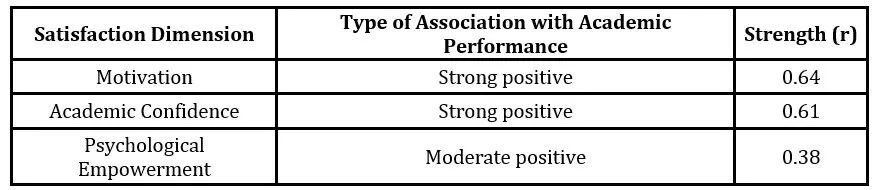
This study explores the critical role of student satisfaction in promoting academic success within higher education, emphasizing its relationship with motivation, academic confidence, and psychological capital. While prior research has addressed student satisfaction, few studies have analyzed its multidimensional influence alongside psychoeducational variables, particularly within Latin American university settings. To address this gap, a concurrent mixed-methods design was employed. The quantitative component consisted of a structured survey administered to 106 final-year Business Administration students at a private university in Lima, Peru. Simultaneously, a qualitative focus group was conducted with six faculty members from the same academic program to provide complementary insights. Quantitative results revealed strong positive correlations between student satisfaction and motivation (r = 0.64), academic confidence (r = 0.61), and a moderate correlation with psychological empowerment (r = 0.38). Qualitative findings indicated that students with higher levels of satisfaction demonstrated stronger engagement in the classroom, greater participation in academic activities, and deeper identification with their institution. The study concludes that student satisfaction functions as a multidimensional driver of academic performance, extending beyond teaching quality to encompass emotional, motivational, and psychological dimensions. These findings underscore the need for pedagogical strategies that enhance student motivation, foster academic self-confidence, and strengthen psychological resilience to improve academic achievement and promote overall well-being in university environments.
In the context of higher education, academic performance and student satisfaction have emerged as critical variables to assess the quality of the formative process and institutional success. Several studies have highlighted that a higher level of satisfaction in students not only improves their emotional well-being, but also directly impacts their academic performance (Razinkina et al., 2018; Marcano et al., 2022). In an increasingly competitive educational environment, universities are faced with the need to implement innovative strategies that ensure student satisfaction and enhance their performance.
Likewise, student satisfaction is closely related to factors such as the quality of educational infrastructure, teaching performance and academic support, as pointed out by Surdez et al. (2018) and Zhao & Wang (2019).
On the other hand, personal factors also play a determining role in academic performance. Salazar et al. (2019) mention that problem-solving skills and emotional competencies allow students to face academic challenges more effectively. Similarly, academic resilience is considered an essential component to overcome adversities, promoting sustained performance despite challenging contexts (Hannah et al., 2018).
Student satisfaction is a determining factor in the field of higher education, since it directly influences the academic performance of university students. Several studies have shown that dissatisfaction can lead to demotivation and low self-esteem, negatively affecting academic performance (Mireles Vázquez & García García, 2022). On the contrary, a satisfied student is in optimal conditions to achieve his or her educational goals, which highlights the importance of investigating this link.
At the international level, organizations such as UNESCO have highlighted the relevance of educational quality in the achievement of the Sustainable Development Goals, particularly goal 4, which seeks to ensure inclusive and equitable quality education (UNESCO, 2015). Likewise, global assessments such as the OECD’s Programme for International Student Assessment (PISA), 2019, highlight the need for continuous improvements in education systems to raise students’ academic performance.
At the local level, the National Institute of Statistics and Informatics (INEI) has reported that, although private universities in Metropolitan Lima show concern for student satisfaction, there is a significant percentage of students who would like changes in the curricular plan to improve their educational experience (INEI, 2015). This situation reflects the need to address aspects such as teacher-student interaction and the adequacy of virtual platforms used in teaching.
This article aims to analyze the relationship between student satisfaction and academic performance among university students, considering motivational, psychological, and academic dimensions. The main hypothesis posits that higher student satisfaction positively influences academic performance, highlighting the need to implement educational strategies focused on enhancing the student experience within the university context.
Likewise, this study allows addressing the needs of students from an integral perspective, aligning educational quality with the student experience.
Literature Review
University Academic Performance
Academic performance is defined as the achievement of educational goals measured through indicators such as grades, quality of learning and development of competencies (Chung et al., 2022). Various factors, such as motivation, organization and academic environment, contribute to this performance (Credé & Kuncel, 2008). University academic performance refers to the level of achievement attained by students in their educational process, reflecting both their learning and their performance in evaluative activities. This concept has been consolidated as a key indicator for evaluating the quality of educational programs and the institutions that deliver them (Campillo et al., 2021). In addition, it makes it possible to identify the factors that contribute to academic success and to establish strategies to optimize it (Cheng et al., 2023).
Participation in curricular activities, time dedicated to study and the organization of didactic resources are essential determinants of academic performance (García & López, 2021). Each of these subcategories is explored below.
Curricular Activities
Active participation in curricular activities refers to the degree to which students engage in proposed academic tasks, including class attendance, interaction in discussions, and collaboration in projects. Academic activities, such as debates, teamwork and presentations, foster critical, collaborative and practical skills, essential elements for the integral development of the student (Salazar et al., 2019). According to Rodríguez and Fernández (2020), these activities promote active learning, facilitating the application of theoretical concepts to practical scenarios.
Muzaki et al. (2020) point out that group dynamics within the classroom not only strengthen social interaction, but also increase student satisfaction, which in turn positively impacts academic performance. Research has shown that greater involvement in curricular activities is positively correlated with better academic performance.
For example, Ribeiro et al. (2023) found that participation in extracurricular activities is associated with better adaptation and academic success in college students. This study underscores the importance of active participation in academic life for the achievement of better educational outcomes.
Dedication to Study
The time students devote to study is a determining factor in their academic performance. Magolda & Ebben (2006) explore the relationship between time management and academic performance in university students, finding a significant assessment between both variables. However, according to Nayak, 2019, the intensity of this relationship is not high, suggesting that, in addition to the amount of time devoted to study, the quality of time management strategies employed by students is crucial to their academic success.
Dedication to study, measured in hours and quality of the strategies applied, is one of the main predictors of academic performance. Students who dedicate more time to autonomous study tend to obtain better results, which is explained by a greater depth in the content and a better mastery of the skills assessed (Cheng et al., 2023).
Cordis & Pierce (2017) observed that students with structured schedules show greater engagement and superior academic outcomes. Shi & Qu (2022) complement this perspective by identifying that well-planned study strategies, such as summaries and concept maps, facilitate the organization and comprehension of information.
In addition, Brady, Wolters & Yu (2022) highlight the relevance of self-discipline and time management in academic success. Students with time management skills are less likely to procrastinate and have higher overall performance on their assessments.
Organization of Learning Resources
Access to and organization of learning resources are fundamental to optimize the learning process. According to Pradana (2023), quality resources, such as virtual platforms, updated reading materials and access to digital libraries, are indispensable to improve academic performance.
Bravo et al. (2016) demonstrated that libraries with flexible schedules and accessible resources facilitate autonomous learning, increasing the time spent studying and the quality of academic performance. Yu et al. (2022) add that digital technologies, efficiently integrated into classrooms, allow greater interaction and adaptability to students’ needs.
Luthans et al. (2021) emphasize that teacher training in the use of didactic resources is crucial to maximize their effectiveness in the classroom. In addition, Rodriguez and Fernandez (2020) conclude that intuitive and dynamic platforms improve the educational experience by reducing technological and motivational barriers.
Student Satisfaction
Student satisfaction is a multidimensional construct that assesses how students’ educational and extracurricular experiences meet or exceed their initial expectations. This concept encompasses factors related to the quality of teaching, infrastructure, academic resources, and social interactions at the institution (Garcia et al., 2021). Globally, student satisfaction has been considered a key indicator of educational quality, student engagement and academic retention (Yu et al., 2022).
Student satisfaction is defined as students’ subjective perception of the effectiveness and quality of their educational experience (Núñez et al., 2019). This indicator is fundamental to evaluate institutional success, as it influences aspects such as academic performance, institutional recommendation and students’ intention to remain (Vergara et al., 2024). Student satisfaction reflects the well-being and satisfaction of students in relation to their educational experience (Marcano et al., 2022). Variables such as teaching quality, infrastructure and interpersonal relationships directly influence this indicator (Dioses et al., 2021).
Student Motivation
Student motivation is defined as the internal or external drive that directs and sustains students’ behavior toward the achievement of academic goals. It is classified into intrinsic motivation, which arises from genuine interest in learning, and extrinsic motivation, which is driven by external rewards such as grades (Núñez, 2020). According to Ryan & Deci (2000), intrinsic motivation, which arises from personal interest and satisfaction, is positively linked to greater academic engagement and satisfaction. In their study, conducted with 13,939 students from Europe and Latin America, they found that intrinsic motives, such as pleasure in studying, were significantly correlated with student satisfaction. In addition, the study highlights that extrinsic motives, such as external rewards, have less impact on overall satisfaction. On the other hand, Froment, De-Besa & Gil (2023) conclude that autonomy support perceived by students, promoted by teachers, increases both intrinsic motivation and academic engagement. This factor is a determinant in improving the academic experience and, therefore, student satisfaction.
Academic Confidence
Academic confidence, or self-efficacy, is students’ perception of their ability to perform academic tasks successfully. This construct directly influences student satisfaction and their commitment to learning (Cochachi, 2021). That is, it is the student’s belief in his or her ability to organize and execute the actions necessary to achieve specific academic goals. Bandura (1997) postulates that high self-efficacy influences the choice of activities, effort and persistence in the face of challenges. Froment et al. (2023) argue that a higher level of academic confidence, fostered by teacher support, contributes directly to increased student satisfaction.
Psychological Capital
Psychological capital is composed of internal resources such as resilience, optimism, hope, and self-efficacy. This component is key to student satisfaction, as it allows students to manage stress and academic challenges effectively. According to Rodriguez & Fernandez (2020), psychological capital is positively related to intrinsic motivation and academic performance, these being fundamental aspects for student satisfaction. The authors also highlight that intervention programs aimed at developing psychological capital can improve both student well-being and satisfaction.
Likewise, both Luthans et al. (2021) and Vergara et al. (2024) highlighted that students with high levels of psychological capital experience greater satisfaction and well-being, indicating that collaborative educational environments strengthen psychological capital, promoting a more positive academic experience.
Methodology
The present research was developed under a mixed methodological approach of concurrent design, which allows the integration of quantitative and qualitative data to obtain a comprehensive understanding of the phenomenon under investigation. According to Meyer & Dykes (2019), this approach is characterized by collecting, analyzing and reporting data of both types simultaneously and interrelatedly, ensuring that the findings complement each other and are consolidated in the final interpretation. The population are 7th and 8th cycle administration students of a private university in Lima, because they have greater academic knowledge and have greater experience in terms of academic performance and satisfaction (for the quantitative analysis) and 06 teachers of the same career who teach courses in the 7th and 8th cycles of a private university in Lima (for the qualitative analysis).
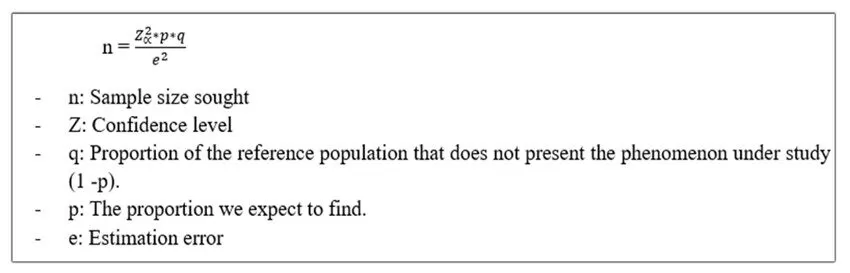
For the quantitative analysis, according to the sampling theory, having a population difficult to identify, we proceed to apply simple random sampling (Otzen and Manterola, 2017), the infinite population formula, which is based on the standard normal distribution and is expressed as follows, from where the infinite population formula, which is based on the standard normal distribution and is expressed as follows, from where:
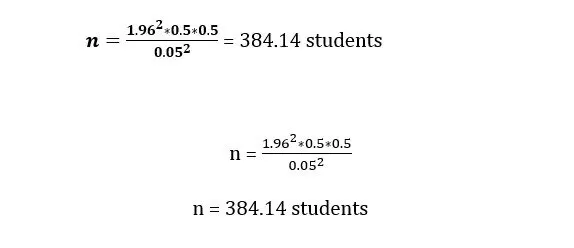
Fig. 1. Formula for the simple random sample Taken from Albarran & Pachas (2025)
From this formula, a sample size of 385 participants was obtained. However, in order to guarantee the validity and relevance of the data, inclusion and exclusion criteria were determined, which adjusted the final sample to 106 participants, considering the following:
Inclusion criteria: older students, enrolled in the 7th and 8th academic cycle, because they already have more academic experience, of the Management career, with availability to participate in the survey.
Exclusion criteria: Students under 18 years of age, from cycles other than those selected, who did not meet the specific characteristics of the study.
After applying the aforementioned criteria, the survey was administered to 106 Management students at a private university in Lima. Data collection was carried out virtually using online forms. This process allowed us to work with a more focused and representative sample of the study objectives, prioritizing the quality of the data over the quantity of respondents.
For the qualitative analysis, a structured interview was applied to 06 teachers from a private university in Lima, who teach in the 7th and 8th cycles.
Instrument and Data Collection
A survey was conducted with the objective of diagnosing the current state of university academic performance and evaluating the influence of student satisfaction on it, through the development of a structured questionnaire with 20 items, based on the RAU Scale of University Academic Performance. This instrument was divided into three dimensions: Contribution in academic activities, dedication to study and organization of didactic resources.
In addition, as part of the mixed analysis, the focus group was used, which is a qualitative technique widely used in social and educational research. According to Krueger and Casey (2015), this technique allows data collection from group interactions, where participants share experiences and opinions, providing a deep understanding of complex social phenomena. This methodology is particularly useful for exploring perceptions, attitudes and behaviors in a specific context.
In the context of the research, the focus group was applied to deepen the teachers’ perception of how student satisfaction impacts university academic performance. According to Hamui & Varela (1998), the focus group is effective in capturing the social and emotional context of the responses, generating insights that will not be possible through other techniques. Accordingly, the instrument of open-ended questions was used, which in a focus group is supported by qualitative theory, which emphasizes the flexibility and richness of the data collected (Patton, 2002). Open-ended questions allow participants to express their ideas in their own terms, encouraging the generation of rich and diverse data that are essential for in-depth analysis.
The instrument design is based on the principles of qualitative data collection proposed by Lincoln & Guba (1985), who emphasize the importance of questions that facilitate the exploration of unique experiences and perspectives. In this case, the hypotheses focused on:
A higher level of student satisfaction is associated with better academic performance.
The implementation of motivational strategies positively influences students’ academic performance.
Data collection and analysis: Data collection was conducted virtually using online forms, and, in relation to the analysis, the data obtained were processed using descriptive and inferential statistics, validating the internal consistency of the instrument through Cronbach’s Alpha coefficient (with a value of 0.953, indicating high reliability).
In the case of the focus group, virtual sessions were conducted using digital platforms to facilitate interaction and the recording of responses, which were coded and categorized using thematic content analysis, identifying emerging patterns related to satisfaction and academic performance.
Results
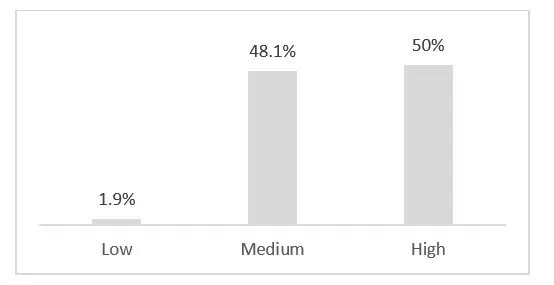
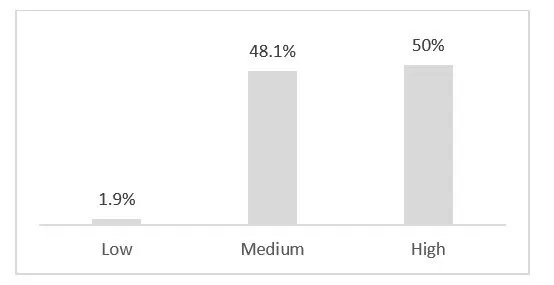
In this part, we will show the quantitative and qualitative results, which were integrated during the interpretation phase to contrast the findings obtained in both techniques. This process allowed us to corroborate how the statistical data reflect general trends in academic performance, while the focus group provided a deeper and more contextual perspective on motivational strategies and their relationship with student satisfaction. According to Figure 2, in terms of input in academic activities (Factor 1), it is observed that, of the 106 students surveyed, 1.9% report having a low level of input, 48.1% are at a medium level, and 50% indicate having a high level. This reflects that, although half of the students perceive a high level of participation, almost the other half are at a medium level, suggesting that this factor still presents areas for improvement to be considered.
Fig. 2. Contributions to academic activities
Figure 3 shows that, of the 106 students surveyed, 3.8% consider that they have a low level of dedication to study (Factor 2), 34.9% are at a medium level, and 61.3% report a high level of dedication. This indicates a predominantly favorable behavior, since the majority of students are at the high level. However, it is important to note that more than one third remain in the medium level and that there is still a small proportion in the low level, which points to areas of attention for improvement.
Fig. 3. Level of commitment to study
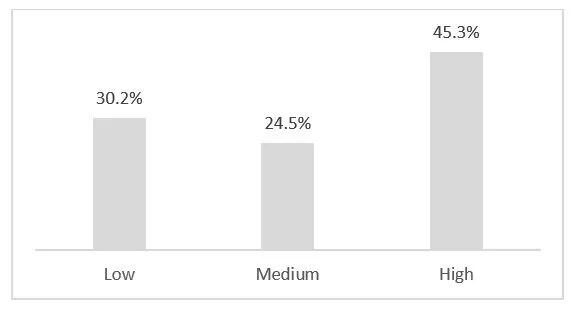
Figure 4 reveals that 45.3% of the 106 students surveyed present a high level of lack of organization of didactic resources (Factor 3), while 30.2% have a low level and 24.5% a medium level. This suggests that lack of organization is one of the weakest factors in academic performance, evidencing a predominantly passive student profile in resource management.
Fig. 4. Level of organization of teaching resources
To complement the descriptive analysis of the quantitative data, Table 1 presents the strength of association between the main satisfaction dimensions and academic performance. Motivation and academic confidence show strong positive correlations with student performance, while psychological empowerment presents a moderate but relevant association. These results reinforce the hypothesis that student satisfaction influences academic outcomes through multiple affective and behavioral channels.
Table 1. Association between Satisfaction Dimensions and Academic Performance
Note: All associations statistically significant at p < 0.01.
With respect to the qualitative results, based on the application of the focus group with teachers, two main nuclei related to student satisfaction and its impact on university academic performance were identified.
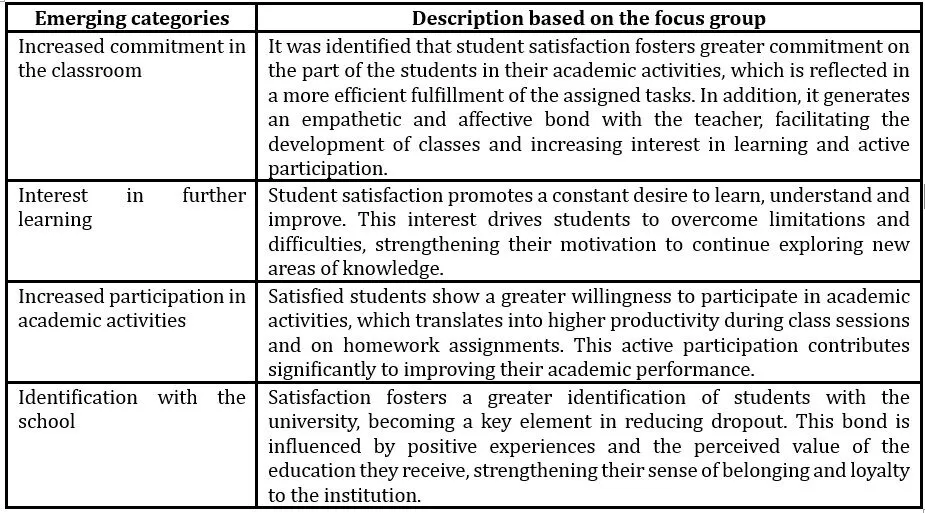
Core 1: Influence of satisfaction on university academic performance, from which the emerging categories were identified, as shown in Table 2.
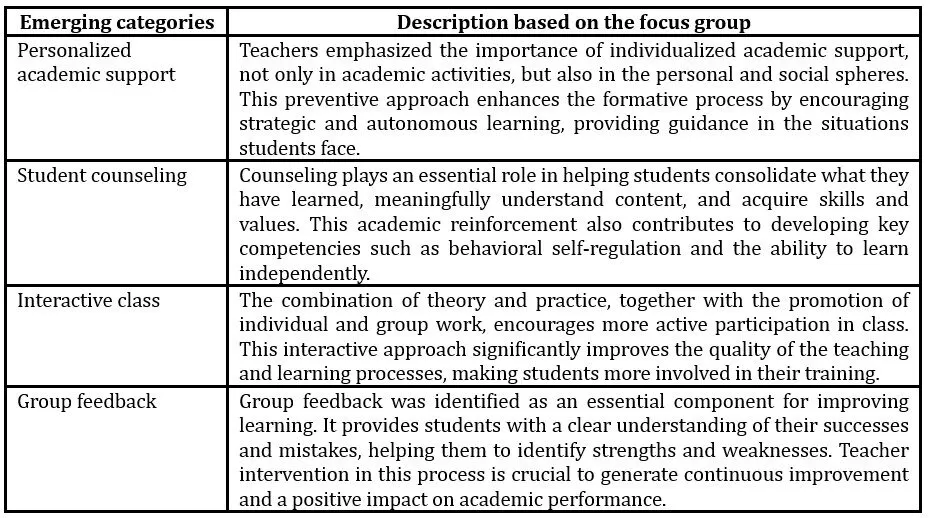
Core 2: Motivational strategies to improve university academic performance, from which the emerging categories were identified, as shown in Table 3.
Table 2. Influence of satisfaction on university academic performance
Table 3. Motivational strategies to improve university academic performance
From the application of the questionnaire based on the RAU University Academic Performance Scale and the focus group with teachers, key elements such as academic motivation and psychological capital, which play a crucial role in student performance, were identified. Likewise, essential concepts such as contribution in academic activities, dedication to study, organization of didactic resources, creative self-efficacy, motivation for self-learning, self-confidence and psychological empowerment were highlighted. These findings provide a deeper understanding of the impact of student satisfaction on academic achievement in the context of a private university in Lima, providing a solid basis for future educational interventions.
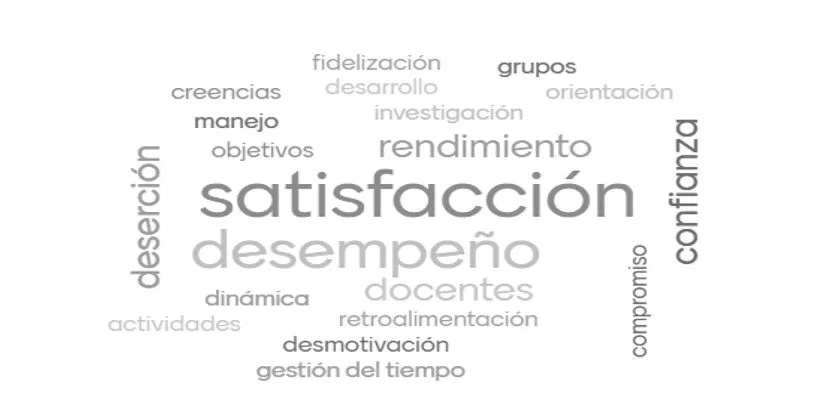
In addition to the emerging categories identified in the main cores, a word cloud was developed that highlights the terms most frequently mentioned by teachers during the focus group. This visual representation evidences the importance of key concepts such as satisfaction, performance, trust, teachers, and loyalty, among others, as shown in Figure 5.
Fig. 5. Terms most frequently mentioned by teachers in the Focus Group
Discussion and Conclusions
The present research focused on analyzing how student satisfaction influences university academic performance, focusing on motivation, academic confidence and psychological capital. Quantitative results are then discussed, which indicate that factors such as dedication to study and participation in academic activities are positively correlated with academic performance. However, a critical deficiency was identified in the organization of teaching resources. These findings are consistent with previous research highlighting the importance of effective time management and organizational strategies in college learning (Cheng, Wang, & Zhang, 2023). In addition, qualitative data obtained from focus groups with teachers highlight the relevance of students’ engagement and identification with their institution. Higher student satisfaction promotes active and sustained learning, which is consistent with studies that identify satisfaction as a key mediator of academic success and student retention (Yu, Zhang, & Wei, 2022).
Qualitative analysis based on the focus groups provided a deeper understanding of teachers’ perceptions of the impact of student satisfaction on academic achievement. Findings highlighted that, in relation to classroom engagement, teachers indicated that students who feel satisfied with their educational experience show a greater willingness to participate in classes and take on academic challenges. This aligns with the findings of Hua et al. (2022), who identified that engagement is intrinsically related to academic achievement and motivation. Also, in terms of feedback and accompaniment, the importance of personalized feedback and continuous follow-up to foster self-confidence and self-learning was highlighted. These findings are consistent with studies such as that of McCann, Brown and Smith (2023), which indicate that supportive academic environments have a significant positive impact on student satisfaction and achievement. Finally, in identification with the institution, teachers mentioned that satisfied students tend to identify more with their university, which reinforces their commitment and permanence. This coincides with the results of Naheen et al. (2021), who concluded that strong student-university identification improves participation and citizenship behavior.
The integration of quantitative and qualitative findings provided a comprehensive understanding of the relationship between student satisfaction and academic performance. Quantitative results showed that 50% of students reported a high level of participation in academic activities, and 61.3% indicated a high level of dedication to study. These outcomes were strongly supported by the qualitative data, in which teachers observed that satisfied students demonstrate greater engagement in class, stronger institutional identification, and a consistent willingness to learn. Additionally, while 45.3% of students reported high levels of disorganization in the use of teaching resources—highlighting a critical area for improvement, teachers noted that students with higher satisfaction levels tend to develop greater psychological capital and self-regulation, which may help overcome such organizational challenges. This triangulated analysis confirms that the motivational and psychological aspects emphasized in the qualitative data not only complement but also explain the behavioral patterns revealed through quantitative analysis. Therefore, the convergence of both data sources strengthens the central hypothesis, demonstrating that student satisfaction operates as a multidimensional determinant of academic performance and engagement in higher education.
The results also confirm the general hypothesis proposed at the beginning of this study: that higher student satisfaction positively influences academic performance. This conclusion emerges from the consistent convergence of both quantitative and qualitative findings, which reveal that satisfaction impacts not only study dedication and classroom participation, but also deeper constructs such as motivation, academic confidence, and psychological capital. These multidimensional effects highlight satisfaction as a central factor in academic engagement and achievement, reinforcing its strategic importance for educational policy and institutional practice in higher education.
In terms of specific hypothesis 1: Student motivation, as a component of satisfaction, has a positive impact on the dedication to study of university students; the results confirmed this hypothesis. It was observed that students with higher levels of intrinsic motivation showed a significantly higher dedication to study (61.3% at high level). This supports the approaches of Núñez et al. (2019), who emphasize that intrinsic motivation fosters greater concentration and commitment.
Regarding specific hypothesis 2: Academic confidence, promoted through strategies such as group feedback and teacher accompaniment, positively influences students’ active participation in academic activities; the results obtained support this hypothesis. Fifty percent of the students reported a high level of participation in academic activities, correlating with the group feedback initiatives mentioned by teachers during the focus groups. Hua et al. (2022) also identified that academic confidence is linked to higher levels of active participation. It is important to work on this due to the fact that more than 45% of students indicated a high level of disorganization. This underlines the need to strengthen interventions in this dimension, aligned with strategies of psychological empowerment and creative self-efficacy (Rodriguez & Fernandez, 2020), revealing the need to strengthen teacher accompaniment and personalization of learning. These aspects have been identified in international research as essential to foster student satisfaction and achievement (McCann et al., 2023).
Despite the progress achieved, the study has some limitations, such as the small size of the qualitative sample and the concentration in a single university institution. Longitudinal and multicenter studies are recommended to validate the findings and broaden their generalization. On the other hand, the mixed methodological approach proved to be a useful tool for integrating quantitative and qualitative perspectives, allowing a deeper understanding of the factors that influence academic performance. Future research could explore how these strategies impact different demographic groups and areas of study.
The results of this research confirm the importance of student satisfaction as a key determinant of college academic performance. Specifically, intrinsic motivation and academic confidence were identified as playing a crucial role in active participation and dedication to study, while psychological empowerment remains an area with opportunities for improvement.
Finally, it highlights the importance of close collaboration between teachers, students and educational managers to implement innovative strategies that not only address immediate needs, but also prepare students to face the challenges of the academic and professional future. The validation and adaptation of this model in other educational contexts will be crucial to expand its applicability and effectiveness.
Mireles Vázquez, M. G., y García García, J. A. (2022). Satisfacción estudiantil en universitarios: una revisión sistemática de la literatura. Revista Electrónica Educare, 26(2), 610-626. Recuperado de https://www.redalyc.org/journal/440/44070055025/
Campillo, M., García, A. & Soto, J., 2021. Rendimiento académico y factores asociados en estudiantes universitarios. Journal of Educational Research, 35(4), pp.45-67.
Cheng, Z., Wang, L. & Zhang, Y., 2023. Impact of study dedication on university performance. Higher Education Research, 48(3), pp.112-124.
García-Arroyo, R. & López, A., 2021. Collaborative learning strategies and academic performance. Educational Advances Journal, 23(2), pp.233-246.
Salazar, L., Martínez, P. & Gómez, M., 2019. Estrategias de enseñanza y motivación en educación superior. Revista de Psicología Educativa, 35(1), pp.45-58.
Rodríguez, M. & Fernández, R., 2020. Aprendizaje colaborativo en contextos universitarios. International Journal of Educational Research, 40(2), pp.98-115.
Bravo, J., Pérez, A. & Ramos, T., 2016. Impact of flexible library resources on academic achievement. Educational Resources Journal, 10(3), pp.45-67.
Yu, C., Zhang, X. & Wei, H., 2022. Student satisfaction and its impact on educational outcomes. International Journal of Educational Development, 54(6), pp.78-93.
Luthans, F., Avey, J.B. & Patera, J.L., 2021. Capital psicológico y rendimiento estudiantil. Journal of Positive Psychology, 16(5), pp.345-357.
Cochachi, C.L., 2021. Satisfacción académica y autoeficacia académica en estudiantes de educación superior. Revista de Investigación en Psicología, 24(2), pp.89-102.
García, A., Pérez, M. y López, R., 2021. Satisfacción estudiantil en universitarios: una revisión sistemática. Revista Electrónica Educare, 25(2), pp.1-20.
Hua, X., Zhang, Y., & Liu, L. (2022). How university experiences impact learning outcomes: Perspectives from Chinese students. Educational Development Quarterly, 29(4), 210-228.
McCann, A., Brown, C., & Smith, J. (2023). The role of academic support environments in enhancing student satisfaction and performance. Journal of Higher Education, 34(1), 45-61.
Naheen, R., Liu, H., & Zhang, Y. (2021). You are what you communicate: On the relations between university brand personality, identification, and student engagement. Journal of Marketing for Higher Education, 31(2), 145-165. https://www.tandfonline.com/doi/full/10.1080/08841241.2021.1992814
Marcano-Molano, P., & Uribe-Veintimilla, AM (2022). Satisfacción estudiantil como un indicador de la calidad educativa . Revista Ciencias Pedagógicas E Innovación, 10(1), 79–84. DOI/enlace: https://doi.org/10.26423/rcpi.v10i1.520
Krueger RA, Casey MA. Grupos focales: una guía práctica para la investigación aplicada. ª ed. Thousand Oaks, CA: Sage Publications; 2015
Hamui-Sutton, Alicia., & Varela-Ruiz, Margarita. (2013), “La técnica de grupos focales.” Investigación en Educación Médica, Vol.., núm.5, pp.55-60 [Consultado: 3 de marzo de 2025]. ISSN: 2007-865X. Disponible en : https://www.redalyc.org/articulo.oa?id=349733230009
Patton MQ. Métodos de investigación y evaluación cualitativos. ª ed. Thousand Oaks, CA: Sage Publications; 2002.
Lincoln YS, Guba EG. Investigación naturalista. Beverly Hills, CA: Sage Publications; 1985.