Sally ABBAS1, Abdelfatah HEGAZY2 and Shereen MORSI1
1Department of Business Information Systems, College of Management & Technology, Arab Academy for Science,Technology & Maritime Transport, Cairo, Egypt
2Department of Computer Science, College of Computing and Information Technology, Arab Academy for Science, Technology & Maritime Transport, Cairo, Egypt
Volume 2026,
Article ID 262216,
IBIMA Business Review,
24 pages,
DOI: https://doi.org/10.5171/2026.262216
Received date: 7 October 2025; Accepted date: 24 December 2025; Published date: 23 January 2026
Academic Editor: Rasha Abd El Aziz
Cite this Article as:
Sally ABBAS, Abdelfatah HEGAZY and Shereen MORSI (2026)," Understanding Students’ Continuance Intention toward Generative AI Tools in Higher Education: An Integrated ECM and D&M IS Framework “, IBIMA Business Review, Vol. 2026 (2026), Article ID 262216, https://doi.org/10.5171/2026.262216
The rapid expansion of generative artificial intelligence (GenAI) tools in higher education has transformed students’ academic practices, shifting attention from initial adoption to sustained use. Despite this growth, empirical research examining the determinants of students’ continuance intention toward GenAI remains limited, particularly within Arab and African higher education contexts, where institutional conditions and digital transformation trajectories differ from those in developed economies. To address this gap, this study develops and empirically tests an integrated post-adoption framework that combines the D&M IS Model with the ECM Model, while extending these perspectives through the inclusion of trust, perceived risk, and price value. Data were collected through a web-based survey administered to 594 undergraduate and postgraduate students with prior experience using GenAI tools for academic purposes. Partial least squares structural equation modelling (PLS-SEM) was used to evaluate the proposed model. The results show that satisfaction is the most powerful predictor of the continuance intention of the students and next is the price value and this shows that perceived benefits are more important than costs of usage. Conversely, the performance expectancy is not found to have a significant direct impact on the continued use of GenAI. Moreover, system quality, information quality and service quality are important in increasing student trust and satisfaction. Confirmation has a positive impact on satisfaction and performance expectancy, and perceived risk is positively correlated with trust in GenAI tools. This study contributes to the existing knowledge about GenAI post-adoption behavior in Arab and African higher education and offers practical implications towards establishing sustainable, trustful, and value-driven application of generative AI in higher education.
The swift advancements in GenAI tools including, ChatGPT, Gemini, and DALL-E, are transforming the higher education landscape for students, opening new avenues for students in higher education. GenAI tools offer personalized learning experiences, personalized feedback, writing support, brainstorming, and research for higher education students (Chan & Hu, 2023; Nikolopoulou, 2024). GenAI is a series of artificial intelligence algorithms where new content is generated based on existing information, including text, audio files, and images (Epstein et al., 2023). GenAI tools, specifically large language models (LLMs) such as ChatGPT, Claude, and GPT-4, could change the learning process throughout the educational environment (Pesovski et al., 2024). GenAI tools can create pertinent content, support creative activities, and supply personalized feedback based on natural language processing and predictive models to offer personalized learning experiences and other learning practices (Yusuf et al., 2024). GenAI tools may also support students by demonstrating knowledge gaps and building the foundational knowledge to progress future coursework and support the student’s goals (Li, 2024). As an illustration, GenAI tools like ChatGPT and Claude were able to assist students’ learning by giving them feedback and fostering active and adaptive learning (Wang et al., 2024).
Even though there is growing integration of GenAI tools and technologies in higher education, there are very few studies that address the factors impacting students’ continued intention to use them, particularly within the Arab region. Previous studies have focused on the intention to use and accept GenAI tools in higher education (Lai et al., 2024; Tian et al., 2024; Ivanov et al., 2024; Balaskas et al., 2025). Other studies have investigated the actual use of GenAI tools in higher education (Duong et al., 2023; Habibi et al., 2023). As reported by Duong et al. (2024) and Qi et al. (2025), students’ intention to continue using such tools after their initial acceptance and adoption seems to be an underexplored area. This study used the ECM model to examine the factors underlying the continued use of GenAI tools by university students, merging it with the D&M IS Model to analyze the impact of trust-satisfaction continuum on information, system, and service quality. This research used the ECM model to understand the factors impacting students’ continued use of GenAI tools and integrated the D&M IS Model to analyze how the dimensions of information, system, and service quality foster trust and satisfaction in students. The synthesis of these frameworks provides a solid base for understanding the factors that underpin the students’ continued use of GenAI tools in higher education contexts.
Literature Review
Generative AI Tools in Higher Education
The emergence of GenAI tools has fundamentally reshaped educational practices within universities through innovative content creation capabilities, customized learning experiences, and enhanced scholarly assistance. Students, faculty members, and academic researchers have progressively adopted GenAI tools, including ChatGPT, Grammarly, and QuillBot, to facilitate written communication support, idea development, analytical research processes, and provision of automated responses (Chan & Hu, 2023). Despite the benefits GenAI tools offer in higher education, students face notable concerns and challenges. Particularly, concerns with academic integrity and plagiarism which require a careful management (Farrelly & Baker, 2023). Research emphasizes the importance of implementing ethical, open, and learner-focused strategies to mitigate issues including academic integrity, bias inherent in AI-generated content, and appropriate utilization of GenAI tools in response to identified obstacles and apprehensions (Chan, 2023; Holmes et al., 2022). The development of overarching ethical constraints and institutional policies could significantly increase students’ trust and intention for using GenAI tools while enhancing the longevity of these technologies’ use in higher educational contexts (Chan, 2023; Yusuf et al., 2024).
To investigate the impact of the UTAUT dimensions on the trust, attitudes, and intentions to continue using ChatGPT to learn the educational activities, Duong (2024) adopted the stimulus-organism-response (SOR) model. The study, according to the survey data of 392 tertiary Vietnamese students, has found that positive attitudes to ChatGPT and trust in its outputs were appropriate predictors of the sustained intention of students to use the system. Tan et al. (2024) applied the UTAUT3 model and the information system success (ISS) model to identify determinants of student satisfaction and continuance intention of using ChatGPT and incorporated an aspect of conversational quality of the ISS model. Web-based questionnaires were used to collect data on 388 students in a Malaysian university that is privately owned and analyzed using PLS-SEM. Findings showed that hedonic motivation, habitual use and facilitating conditions are positive predictors of student continuing adoption intentions of ChatGPT, whereas system, information, service, and conversational quality dimensions are positive predictors of student satisfaction with the tool.
Balaskas et al. (2025) examined potential variables that could affect the intention of students to adopt ChatGPT by adopting the technology acceptance model (TAM) to incorporate the perceived trust and perceived risk constructs. Questionnaire data on the perceived ease of use, perceived intelligence, perceived trust and perceived risk of 435 higher-education students were analyzed in a structural equation modelling, which showed that perceived ease of use, perceived intelligence, perceived trust, and perceived risk have significant impacts on adoption intention. The authors also proved that perceived risk is a complete mediator of the association between perceived usefulness and adoption intention, and perceived trust has a limited mediating effect.
Lai et al. (2024) studied how undergraduates are influenced in their intention to use ChatGPT to complete assessment-related tasks. Using a structural equation modelling method, the paper expanded the UTAUT model and gathered information through an online questionnaire of 483 higher education students in Hong Kong. The results indicated that moral obligation and perceived risk have a strong impact on the acceptability of ChatGPT among students and that the intentions to use the system in evaluative tasks are boosted considerably by performance expectancy and effort expectancy. Tian et al. (2024) studied the utilization and acceptance of the generative AI chatbots by the Chinese university students based on the UTAUT and the expectation-confirmation model (ECM). The responses of 373 students in different universities in China were analyzed through the structural equation modelling. The results revealed that ECM-based constructs are related to a superior explanation of student attitudes and behavioral intentions than UTAUT variables, and that personal innovativeness is a significant factor that can or cannot make students willing to use generative-AI chatbots in their studies.
Duong et al. (2023) used the UTAUT model to test how effort expectancy correlates with performance expectancy among the students of the university. Survey data of 1,461 Vietnamese university students were used to assess the effects of both effort expectancy and performance expectancy using both the methods of the polynomial regression and the response-surface analysis, which demonstrated that both expectancy variables have significant positive influence on the intentions of the students to use ChatGPT. Habibi et al. (2023) examined the aspects of ChatGPT adoption in Indonesian institutions of higher education. Based on the UTAUT2 framework and using PLS-SEM and importance-performance map analysis (IPMA) to the answers of 1,117 students, the authors found that the facilitating conditions were the main predictor of the behavioral intention of students towards the use of ChatGPT. Furthermore, the behavioral intention became the most effective predictor of the actual utilization of ChatGPT.
Previous investigations into adoption and sustained use of digital technologies within universities’ contexts have predominantly utilized either the Expectation-Confirmation Model (ECM) or the DeLone and McLean IS Success Model (D&M IS) as separate frameworks. Although ECM effectively demonstrates how expectation and confirmation mechanisms drive user satisfaction and continuance intention, this model lacks comprehensive coverage of system quality, information quality, and service quality aspects which are important to consider for assessing digital technologies such as Generative AI tools. Conversely, the D&M IS model provides an explanation for all three system related success factors, however, it provides little explanation of post-adoption psychological mechanisms including confirmation and expectations. By integrating ECM with the D&M IS frameworks, this study bridges these two perspectives, providing a more comprehensive explanation of students’ continuance intention. This is novel integration in terms of generative AI in higher education, as it is both addressing users’ cognitive evaluations (confirmation, satisfaction, trust, risk, and value) and system success components (system, information, and service quality). Moreover, according to the researcher’s knowledge, a few studies have examined the continuance intention of GenAI tools in higher education context. Therefore, filling the gap in literature, as they are rarely combined to explain the continuance intention toward emerging technologies in educational settings.
Theoretical Foundation
Expectation-Confirmation Model of IS Continuance
ECM was first introduced by Bhattacherjee in the year of 2001 (Bhattacherjee, 2001). As an extension of the ECT Model, Bhattacherjee proposed the ECM for Information Systems, shifting attention from initial adoption to continued use (Cheng, 2019). The ECM is significant in post-adoption studies, as it provides sufficient theoretical framework for the analysis of user perception to abandon or continue technology use (Tam et al., 2020). As for GenAI in higher education, the ECM model provides a deeper perspective of analysis on the factors underpinning students’ sustained engagement with such innovative tools. As cited in Ngo et al. (2024), expectation confirmation was proven to significantly impact the perceived usefulness and satisfaction of ChatGPT. Moreover, in the ECM based study by Tian et al. (2024), a significant relationship of performance expectancy was established. This study also established a positive correlation between students’ satisfaction and expectation confirmation with AI chatbots. This in turn, fosters their academic engagement with AI chatbots.
DeLone and McLean Information Systems Success Model (D&M IS Model)
The DeLone and McLean Information Systems Success Model by Delone & Mclean (2003) outlines the following three primary dimensions of quality: system quality, information quality, and the quality of service. User perceptions and, therefore, user satisfaction and intended use, as well as the benefits that the information system is able to provide, could be tied to the D&M IS Model’s quality dimensions (Gao & Waechter, 2017; Isaac et al., 2019). Such a model illustrates a continual-level of flexibility and durability, which is corroborated in the majority of literature devised to assess the model’s quality characteristics to technologies in the domains of e-governance, mobile payments and educational technology (Gao & Waechter, 2017; Isaac et al., 2019). The D&M IS Model could provide a framework to analyze the antecedents of continuous engagement with GenAI tools in academic contexts. The model’s flexibility to accommodate emergent technologies and changing expectations is an advantage in educational settings (Aldholay et al., 2020). Therefore, the integration of D&M IS Model and ECM Model could enrich the understanding of what motivates students in higher education to persist in their use of GenAI tools.
Theory Integration
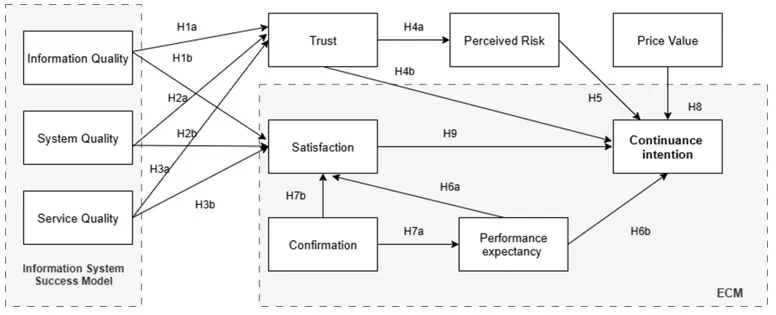
This study converges Bhattacherjee (2001) with Delone & Mclean (2003) to explain within a single framework students’ intention to continue using generative AI tools in higher education. The D&M model states that system use satisfaction and trust are contingent on the system evaluation along the dimensions of system, information, and service. High trust and satisfaction are more likely to occur if the system’s components are rated positively. Trust is the belief in the system’s reliability and usefulness and is foundational to the acceptance of a system’s positive attitudes toward continued use. Within this context, the ECM addresses the confirmation of expectations’ satisfaction and their influence on behavioral outcomes’ post adoption. Bhattacherjee (2001) argues that if the technology meets or exceeds the expectations, the level of satisfaction augments and that enhances the intention to use it more. In an integrated approach, the present study posits that the D&M model quality dimensions are the factors which enhance users’ trust and satisfaction, which are foundational in the ECM framework, and lead to continuance intention. This integration yields a level of understanding about the determinants of students’ sustained use of generative AI tools which are more sophisticated and nuanced than in previous studies.
Figure 1: The proposed model
Research Hypotheses
Effect of Information Quality on Trust and Satisfaction
Information quality is defined as the degree to which an information system produces output content with a level of accuracy, timeliness, organization, and completeness (Delone & Mclean, 2016). Prior studies have found significant relationships between information quality, trust, and satisfaction, so we argue that GenAI tools’ high-quality outputs generate student trust and satisfaction (Ding et al., 2023; Qi et al., 2025). In the Tan et al. (2024) study, they emphasized the positive relation of ChatGPT-generated information and students’ satisfaction. Therefore, this study investigates information quality through the considerations of accuracy, timeliness, and relevance of GenAI tool outputs. Accordingly, the following hypotheses are proposed:
H1a: Higher information quality enhances students’ trust in GenAI tools.
H1b: Higher information quality enhances students’ satisfaction with GenAI tools.
Effect of System Quality on Trust and Satisfaction
System quality is defined along the dimensions: reliability, ease of use, response time, and performance (Al-Obthani et al. 2019). These dimensions help determine users’ satisfaction and trust within technological contexts. Daher & Hussein (2024) identified that students experienced greater satisfaction related to the interactivity and responsiveness of the GenAI tools that they utilized, which suggests system quality is important for developing trust for users that are more tech savvy. Tan et al. (2024) have also indicated the importance of system quality in students’ satisfaction of the continued use of ChatGPT in higher education. In this study, system quality means the reliability, user-friendly, and responsiveness of GenAI tools. Thus, the following hypotheses are suggested:
H2a: Higher system quality enhances students’ trust in GenAI tools.
H2b: Higher system quality enhances students’ satisfaction with GenAI tools.
Effect of Service Quality on Trust and Satisfaction
Service quality is the extent to which the information system assists its users (Petter & McLean, 2009). It also encompasses accessibility, multimedia tools, and real-time feedback (Aldholay et al., 2018). Such factors are elementary in building users’ trust and satisfaction. A recent study by Lisana & Handarkho (2023) on mobile payment adoption in Indonesia, for instance, noted that, of all the factors considered, service quality had the highest impact on user trust. Service quality, as shown in Tan et al. (2024), is also one of the major predictors of students’ satisfaction in the utilization of ChatGPT for higher education. Consistent with the previous research, the study’s aim proposes the following hypotheses:
H3a: Higher service quality enhances students’ trust in GenAI tools.
H3b: Higher service quality enhances students’ satisfaction with GenAI tools.
Effect of Trust on Perceived Risk and Continuous Intention
Trust has become an essential factor in the willingness of higher education students to continue adopting generative AI tools. Jung & Jo (2025) showed that trust is associated with initial adoption and continued use of generative AI tools. Chatterjee & Bhattacharjee (2020) further argue that learners’ confidence in the reliability and transparency of information generated by AI affects how they intend to continue using AI powered writing and tutoring systems which are a measure of persistence. Trust also mediates students’ perceptions of the risks associated with their academic work and their intention to continue using GenAI tools. Ding et al. (2023) state that learners are more likely to integrate tools into their study routines when they consider those tools to be accurate and reliable—like ChatGPT. Luo (2024) uncovered that students’ assignment of their reliance with GenAI tools and the corresponding absence of transparency regarding the grading and assessment criteria promotes a culture of low trust. This research defines trust as students’ confidence in GenAI tools’ reliability and credibility for academic support purposes. Therefore, the following hypotheses are advanced:
H4a: Higher trust reduces students’ perceptions of perceived risk when using GenAI tools.
H4b: Higher trust enhances students’ continuous intention to use GenAI tools.
Effect of Perceived Risk on Continuous Intention
Risk perception continues to be regarded as a primary barrier to the students’ ongoing access to GenAI tools. Previous research by Al-Emran et al. (2025) and Oc et al. (2024) has shown that privacy, bias, and misinformation issues act as formidable barriers to GenAI tool use in student populations. Furthermore, research demonstrates that students’ perceptions of risk also concern issues of academic dishonesty and ethical concerns. Research shows that a considerable proportion of students do not use GenAI tools and technologies primarily because of the fear of being “detected” or falsely accused of academic misconduct. For example, Golding et al. (2025) explain that a great majority of students consider the use of GenAI for assignment production as cheating even though they understand that it can be used for studying and brainstorming. This ambiguity breeds confusion and worry, which leads students to shy away from the use of GenAI tools because of concerns about academic integrity (Song, 2024). This study views risk perception as concerns regarding academic integrity and privacy risk. Based on the arguments which have been put forward, the study proposes the following hypothesis:
H5: Higher perceived risk reduces students’ continuous intention to use GenAI tools.
Effect of Performance Expectancy on Satisfaction and Continuance Intention
Performance expectancy refers to individuals’ beliefs about to what degree using a system will help improve job performance (Venkatesh et al., 2003). Studies have shown performance expectancy affects students’ satisfaction and behavioral intentions to keep using GenAI tools. Ngo et al. (2024) found that the perceived usefulness of ChatGPT significantly influences higher education students’ intention to continue ChatGPT use. Similarly, Tian et al. (2024) had a similar finding as they found that performance expectancy positively correlates with satisfaction towards the use of AI Chatbots. Meta-analytical studies also found performance expectancy is the strongest predictor of students’ behavioral intentions and continued engagement towards GenAI, emphasizing the need to align students’ expectations with the capabilities of generative AI tools (Diao et al., 2024; Wu et al., 2025). From these findings, the following hypotheses are formed:
H6b: Higher performance expectancy enhances students’ continuous intention to use GenAI tools.
Effect of Confirmation on Performance Expectancy and Satisfaction
“The users’ level of the appropriateness between their actual performance and expectation of the usage of information systems and services” characterizes confirmation (Hsu & Lin, 2015). Existing research has established connections linking confirmation with performance expectancy, demonstrating that satisfaction emerges and continuance intentions develop when students’ GenAI tool expectations achieve confirmation. Research by Tian et al. (2024) and Ngo et al. (2024) revealed that confirmation of student expectations substantially affects their continued usage intentions for ChatGPT and AI chatbots, showing positive associations with both satisfaction and performance expectancy within higher education settings. Accordingly, the following hypotheses are formulated:
Price value refers to users’ evaluation of whether the technological benefits—including performance, usefulness, convenience, and more provided benefits—are worth the monetary costs and any other losses required for the use of the technology (Venkatesh et al., 2012). In the literature, a direct connection has been established between the perceptions of high price value and increased user intention towards using the GenAI tool. Thus, Sergeeva et al. (2025) stated that intentions of students in higher education concerning the behavioral use of GenAI technology are influenced by price value in a positive manner. In another research by Ni & Cheung (2023) about the value of price in the use of AI intelligent tutoring systems in learning English, price value was found to have a direct positive impact on the students’ continuance intention of using the technology. Based on the reviewed literature, the following hypothesis is presented.
H8: Higher price value enhances students’ continuous intention to use GenAI tools.
Effect of Satisfaction on Continuance Intention
Satisfaction at technology adoption is “the result of a comparison between what a user desires and expects from a technology and what is experienced at the point of adoption” (Liu & Khalifa, 2003). In studies of generative AI tools in education, satisfaction has consistently been shown to play a critical role in shaping students’ continued use. For example, Tian et al. (2024) reported a strong positive relationship between graduate students’ satisfaction and their intention to keep using AI chatbots. Tan et al. (2024) also found a similar impact among undergraduates using ChatGPT for academic purposes. More recently, Qi et al. (2025) highlighted the mediating effect of satisfaction, showing that perceptions of information quality influenced students’ long-term engagement with GenAI tools primarily through their satisfaction with the technology. Thus, we propose the following hypothesis:
H9: Higher satisfaction enhances students’ continuous intention to use GenAI tools.
Research Methodology
A quantitative survey methodology was adopted in this study to investigate the factors affecting higher education students’ intentions to continue using generative AI tools. Partial Least Squares Structural Equation Modeling (PLS-SEM) was used as the analytical method due to its ability to test complicated relationships between constructs while simultaneously estimating the structural model and measurement model components (Hair et al., 2019). The analysis was carried out in a specific sequence. Among the first steps is the presentation of demographic profiles of respondents. Next, the reliability and validity of the constructs were upheld, then came descriptive statistics of the constructs and path coefficients which assessed the hypothesized relationships and the correlation among the constructs. Finally, the confirmation of the structural model assessment explained its utility and gauged the extent to which the theoretical framework outlined the students’ continuance intentions.
Measurement Development
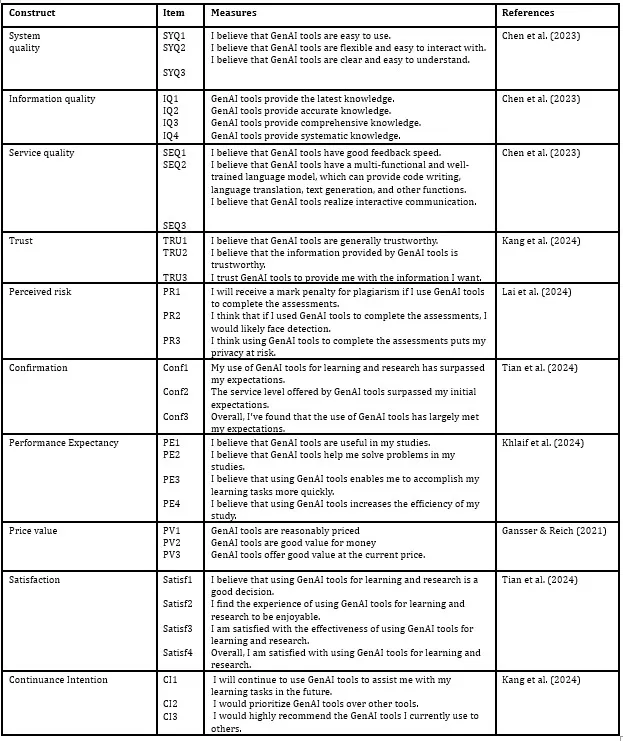
Using a survey tool, GenAI tool demographic and background data pertaining to higher education students were gathered. The factor that the research question sought to understand was students’ intentions to continue using the technologies for academic purposes. The survey tool was created through the modification of validated instrument items to align with the specific purposes of the research study. The constructs names: Information quality (IQ), System quality (SYQ), and Service quality (SEQ) adapted from (Chen et al., 2023). Trust (TRU) and Continuance Intention from (Kang et al., 2024), Confirmation (Conf) and Satisfaction (Satisf) from (Tian et al., 2024), Performance expectancy (PE) from (Khlaif et al., 2024), Perceived risk (PR) from (Lai et al., 2024), and Price value (PV) from (Gansser & Reich, 2021). All measurement items employed a seven-point Likert scale with responses spanning from 1 (“strongly disagree”) to 7 (“strongly agree”).
Data Collection and Sample Size
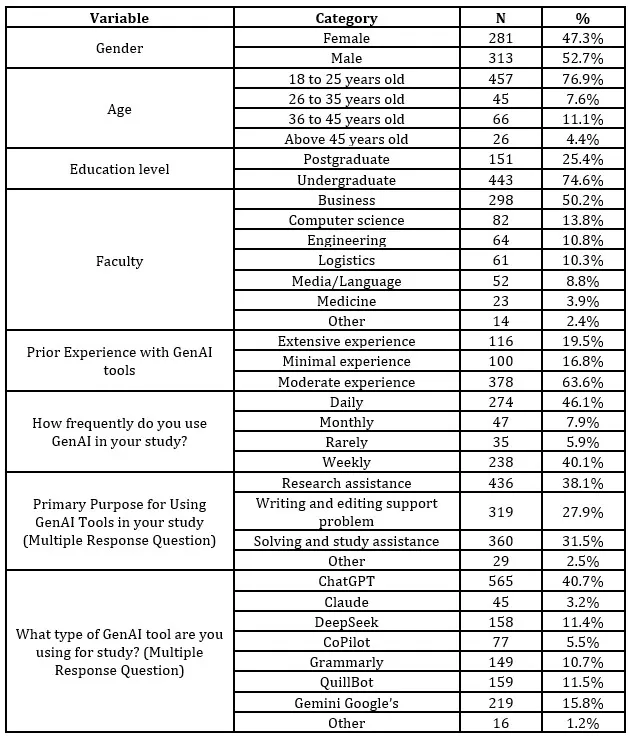
The questionnaire was completed and subsequently distributed through the Zoom Survey platform to students in higher education institutes in Egypt. Participants were recruited through non-probability convenience sampling using university mailing lists, student groups and various social media platforms. This sampling technique was chosen because the GenAI tools in education are still in the emerging stage, which means the target population should have had a certain level of interaction with such tools. The sample consisted of 734 undergraduates and postgraduates in higher education from four reputable private universities in Egypt. 140 responses were considered invalid as either the responses were incomplete, or the participants had never used GenAI tools. Therefore, 594 responses were used for further analysis.
Data Analysis
Table 1: Demographic analysis
Measurement Model Assessment
Measurement Model Assessment is a crucial part of PLS-SEM Analysis as it evaluates the validity and reliability of the constructs prior to structural relationship assessments. Measurement Model Assessment includes three key components of assessment: convergent validity, internal consistency reliability, and discriminant validity (Hair et al., 2019). Assessing the measurement model provides assurance that indicators are a good representation of the constructs they measure for each indicator; further, that the constructs themselves are distinguishable and separate from one another. Therefore, an assessment of the measurement model will provide the researcher with greater confidence in the results obtained when assessing the structural model and testing hypotheses.
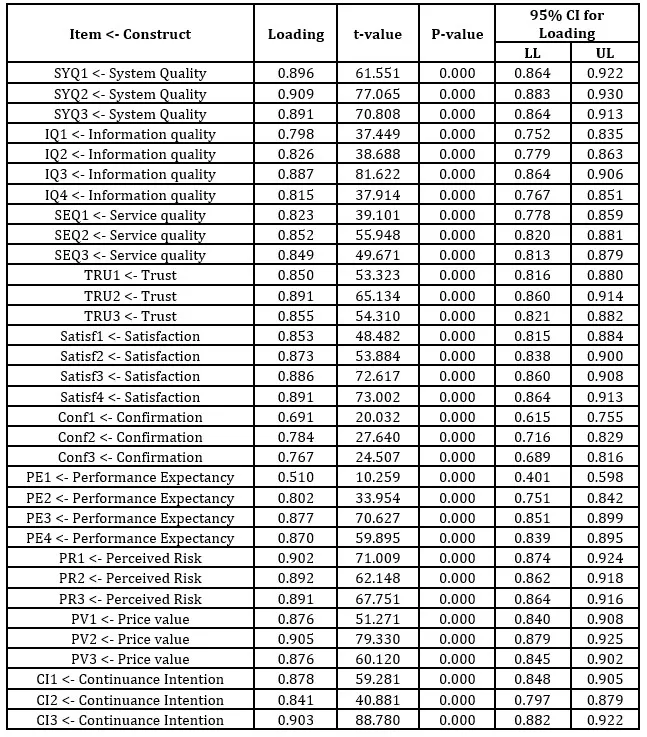
Table 2: Item Loadings
The results provide significant evidence of the convergent validity of the indicators in measuring the constructs they were designed to measure. Each factor loading exceeded .40, which is a minimum recommended value for a valid indicator; factor loadings ranged from 0.510 to 0.909. Each factor loading had a t-value greater than 1.96 and a p-value of 0.000, thus confirming that all loadings are statistically significant and providing significant evidence of convergent validity. The 95% confidence interval around each factor loading further supports this finding as none of the intervals included “zero” and therefore demonstrated sufficient precision around the estimated parameters.
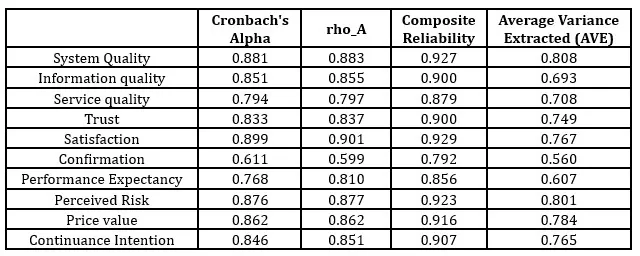
Table 3: Reliability and convergent validity
The Average Variance Extracted (AVE) scores for most constructs provide additional evidence for convergent validity for the models. All constructs achieve AVE scores above the 0.50 mark which indicates that these constructs account for more than 50% of the variance in their respective indicators (Fornell & Larcker, 1981). The internal consistency evaluation demonstrates that AVE is more than 0.5 which indicates strong internal consistency. Cronbach alpha scores between 0.611 and 0.899 are recorded, whereby most constructs surpass the benchmark threshold of 0.70 (Nunnally & Bernstein, 1995). The rho-A values, as an alternative and more robust indicator of internal consistency which is less impacted by the number of items, confirm these observations by yielding values between 0. 599 and 0.901, reinforcing the evidence concerning model reliability. Every construct, on the other hand, as PLS-SEM evidence composite reliability values lower than PLS-SEM thresholds of 0.793, surpasses the 0.70 standard benchmark set (Hair et al., 2019).
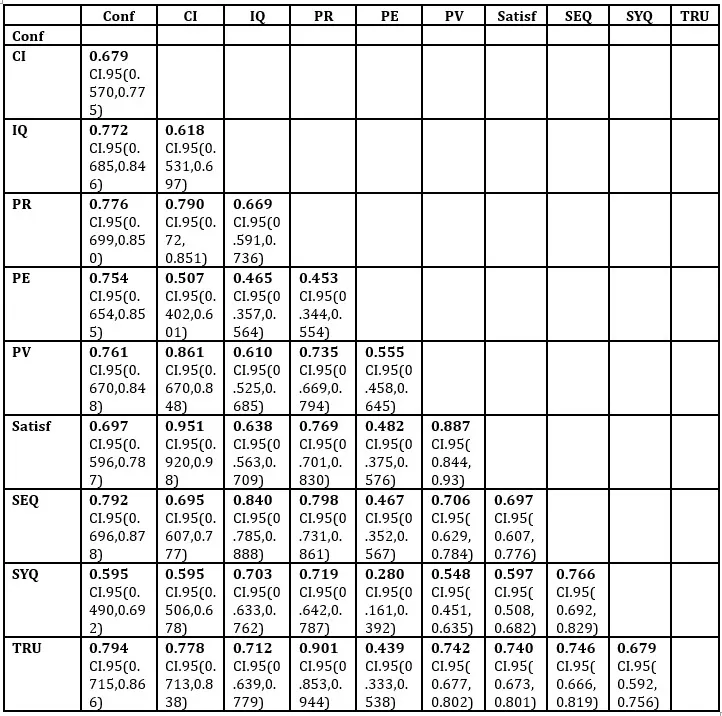
Table 4: Heterotrait-Monotrait Ratio (HTMT)
Note: “Confirmation (Conf), Continuous intention (CI), Information Quality (IQ), Perceived Risk (PR), Performance expectancy (PE), Price Value (PV), Satisfaction (Satisf), Service Quality (SEQ), System Quality (SYQ), Trust (TRU)
The assessment of the Heterotrait-Monotrait (HTMT) criterion ensures there is adequate discriminant validity for all construct pairs. Most HTMT values remain below the conservative threshold of 0.90 for related constructs; the highest value of 0.951 is the one obtained for Satisfaction and Continuance Intention (Henseler et al., 2015). The 95% confidence intervals for HTMT ratios also lend support, as all intervals remain less than 1.0, showing the constructs are indeed distinct. This is a significant finding due to the expected theoretical relations between these constructs, as it has been shown they are related, while still representing different conceptual domains. The results of discriminant validity as a whole show that every construct contains variance that is not explained by other constructs in the model, which supports the theoretical distinctiveness of the constructs, and confirms the measurement model is appropriate for the subsequent structural analysis.
Structural Model Assessment
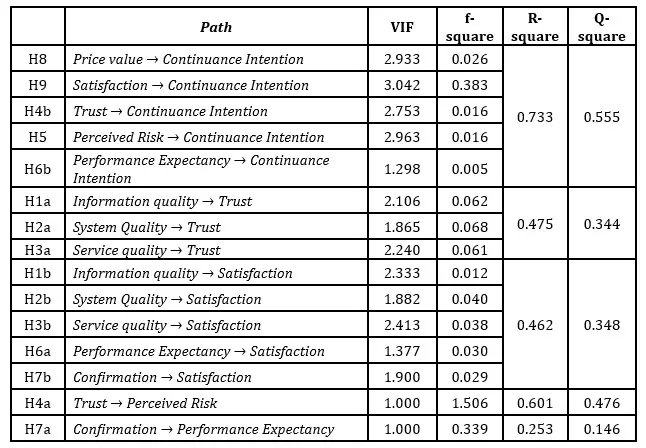
The structural model exhibits good collinearity properties as all variance inflation factor values are significantly below the critical limit of 5.0. VIF values vary within the interval of 1.0 to 3.042, hence, multicollinearity is not a concern with regards to the model, its validity or the understanding of path coefficients. The greatest VIF of 3.042 is seen with the satisfaction to continuance intention relationship, and even this figure is VIF, satisfaction and intention, theoretical overlap, not analytically weak value within satisfactory considerate bounds, and it does not overreach the boundaries of value analytical strength. The strong R² and Q² values, combined with acceptable collinearity indicators, support the model’s validity and practical utility for guiding educational technology implementation strategies. The common method bias does not significantly undermine the validity of the findings. Harman’s single factor test which uncovered, to the extent of 44.6%, the total variance, in disguise, is a way of showing how it is only weakly above the baseline requirement, or, 50%, and therefore, it disproves the assertion made by (Podsakoff et al., 2003). Furthermore, the collinearity diagnosis showed that the highest VIF value calculated in the model was 3.042, which is well below the typical cut off value of 5.0. (Hair et al., 2019). These findings indicate that method bias is not an issue in the dataset, which allows the dataset to be considered reliable for the analysis that follows and its interpretations.
Table 5: Structural Model Assessment
Hypothesis Testing
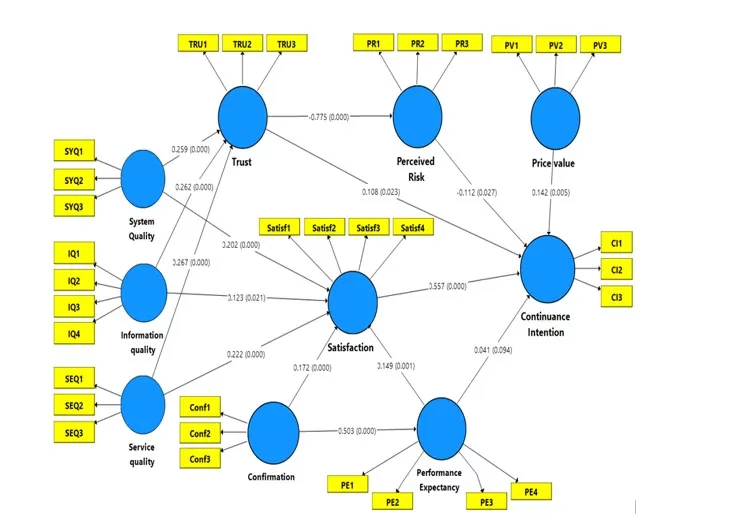
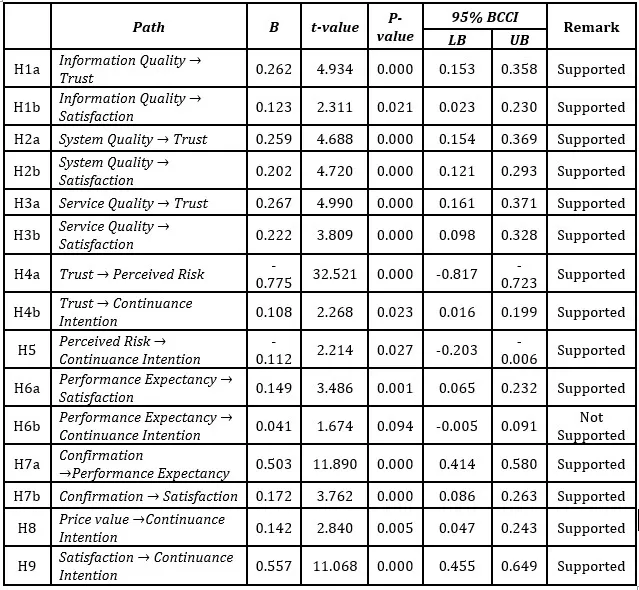
Path coefficient estimation constitutes the central analytic procedure in structural equation modeling, substantiating the hypothesized interrelationships in the proposed measurement framework. The strength and direction of relationships between latent variables are measured through path coefficients, taking on values between -1 and +1, such that greater absolute magnitudes denote stronger effects (Hair et al., 2019). The empirical significance of these coefficients is evaluated via t-statistics and p-statistics obtained through bootstrapping resampling, where t-statistics that exceed 1.96 and corresponding p-statistics that fall below 0.05 signal significance at the 95% confidence threshold. The bias-corrected confidence intervals (BCCI) provide additional robustness to the significance testing by accounting for potential sampling bias in the bootstrap distribution. All hypotheses were supported. Conversely, Performance Expectancy → Continuance Intention (β = 0.041, t = 1.674, p = 0.094) presents insignificant relationships. Therefore, hypothesis H6b was not supported.
Figure 2: Path Coefficients with Corresponding P-values
Table 6: Path coefficients and hypothesis testing
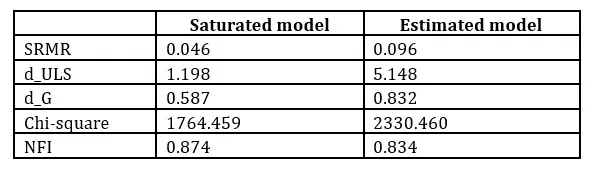
Model-Fit
The saturated model was found to have a perfect fit with a SRMR equal to 0.046, whereas the estimated model had a SRMR equal to 0.096, which is within the generally accepted maximum limit of 0.10 when using PLS-SEM, meaning that there is no significant model misspecification. Even though traditional covariance-based SEM guidelines suggest using a more stringent cut-off (e.g., SRMR < 0.08) (Hu & Bentler, 1999), the evaluation of PLS-SEM models is more focused on predictive accuracy and explanatory ability than on global goodness-of-fit measurements (Hair et al., 2019; Henseler et al., 2014). In that regard, the predictive relevance of the model also supports its sufficiency, with the Q2 values (0.146-0.555) indicating a significant predictive idea out of the samples, and the R2 of the continuance intention (0.733) showing strong explanatory power. Altogether, the fit values of the saturated and estimated models along with the previously determined reliability, validity, and predictive relevance prove that the proposed structural model is strong and can be used to explain and predict the perceptions and continuance intentions of students toward GenAI tools in higher education.
Table 7: Model-Fit
Discussion
Results from H1a and H1b demonstrate that information quality significantly impacts trust as well as satisfaction levels. Students’ emphasis on the dependability and functionality of Generative AI tools is evident from the substantial relationship between system quality and satisfaction. Such findings align with the proposition established in the D&M IS model, which identifies system quality as an essential predictor of user satisfaction, and extends it to the context of AI in higher education. Moreover, Chan & Hu (2023) validated this result, arguing that any doubts students harbor regarding the accuracy and reliability of the output produced by GenAI tools may substantially lower the basic trust necessary for positive engagement.
The analysis for hypotheses H2a and H2b has an affirmative and powerful effect of system quality on students’ trust and satisfaction. This indicates that effective and user-friendly system could raise students’ trust and satisfaction with GenAI tools. This is also further supplemented by Daher & Hussein (2024), who state that students are more satisfied with the interactivity and ability of generative AI tools, where system quality is basic in creating user trust in highly advanced technical capabilities. Tan et al. (2024) also ascertained the system quality of ChatGPT and the students’ satisfaction with it.
The results concerning H3a and H3b show that perceived service quality materially increases the students’ trust in GenAI tools and their overall satisfaction. This means that the quality of feedback and the multiservice features have a favorable effect on the students’ trust in the system and overall satisfaction with the experience. The findings are in accord with the study of Tan et al. (2024) on the specific domain of ChatGPT post adoption in higher education, which emphasizes system quality with respect to students’ satisfaction in the context of their use experience of ChatGPT.
Furthermore, trust presents the greatest level of negative association with perceived risk (H4a), which clearly indicates that the higher the users’ confidence in a tool, the lower their concern about fraudulence on academic grounds, data protection, and the probability of being detected. In addition, trust shows positive correlation with continuance intention (H4b), which provides additional support for the trust-based adoption theories; however, the magnitude of trust is comparatively subdued relative to other antecedents. These results are corroborated by the studies of Ding et al. (2023) and Luo (2024), who highlighted that trust mitigates risk perception and fosters sustained use.
The results also demonstrate that continuance intention is undermined by risk perception and diminished by the strongest negative effect (H5) as aligned to the works of Al-Emran et al. (2025), Bhaskar et al. (2024) and Oc et al. (2024), who all regarded risk perception as a hurdle in the use of technology. These findings highlight the need to address risk perception more broadly within higher education through evidence-based and clearly framed policy settings, alongside trust-focused scaffolding designed to support the user in adopting GenAI tools.
The findings indicate that performance expectancy still retains a considerable positive association with user satisfaction (H6a), which affirms the original claim that users gain the most positive experiences from a system that they expect to work optimally and efficiently. This is consistent with Baig & Yadegaridehkordi (2025), who showed that effort expectancy is a central architect in the usage of GenAI tools and central in the user’s decision process. Conversely, performance expectancy did not have a significant direct effect on continuance intention toward GenAI tools (H6b), making it the only unsupported relationship in the proposed model. This finding suggests that the effect of performance expectancy on continuance intention is more likely to be indirect and mediated through satisfaction rather than direct. This interpretation is consistent with Expectation-Confirmation Theory, which posits that perceived usefulness plays a more central role in shaping continuance intention through satisfaction rather than exerting a direct influence.
Findings pertaining to H7a and H7b show a strong positive relationship between confirmation of expectations with performance expectancy and satisfaction, respectively, which supports the foundational proposition of expectation-confirmation theory whereby expectations that are confirmed or exceeded improve perceived usefulness and user satisfaction. These findings are consistent with Diao et al. (2024), Wu et al. (2025) and Qi et al. (2025), who found that higher levels of confirmation increased user satisfaction and improved the intention to continue using GenAI tools.
Price value has a positive and significant impact on continuance intention (H8), signifying that perceived favorable costs and benefits lead to the intention to use it continuously. This is also supported by Ni & Cheung (2023), where it was shown that price value is a significant determinant to students’ continuance intention towards AI powered intelligent tutoring systems, as well as the study by Sergeeva et al. (2025) on GenAI technologies to higher education students.
H9 indicated that satisfaction is the most powerful predecessor of continuance intention, suggesting that positive user experiences are central drivers of GenAI tools’ post-adoption. These findings provide significant support for expectancy-confirmation theory and emphasize the relevance of positive user experiences for sustained technology adoption. These findings are aligned with earlier results by Tian et al. (2024), who confirmed the strong correlation between satisfaction and continuance intention use of AI chatbots among graduate students.
Theoretical Implication
To date, empirical research has not integrated the Expectation-Confirmation Model (ECM) and DeLone and McLean Information Systems (D&M IS) frameworks for the analysis of the initial adoption or continued use of GenAI tools. Studies using Continuous Adoption models for the analysis of tool adoption, especially the ECM, are done primarily using ECM models in isolation or in combination with the UTAUT model. This research aims to fill the gap by combining ECM and D&M IS Models in addition to trust and perceived risk, and perceived price value, to form a solid explanatory groundwork for assessing students’ intentions to continue using GenAI pedagogical tools. Integrating ECM with D&M IS framework enhances the analysis by including system quality, information quality and service quality, as predictors of trust and satisfaction. These frameworks emphasize the cognitive and evaluative engagement of students along with their technical skills, outlining the multifaceted influences on students’ post adoption use of GenAI tools in higher education pedagogy.
Practical Implications
This study is particularly useful for higher educational institutions, policymakers, and technology developers interested in cultivating students’ attitudes toward GenAI tools in education. For higher education administrators, efforts should, therefore, be directed at educational policies and support frameworks that optimally develop students’ AI related competencies and capabilities to assist ethical GenAI tool use. It is important to set up policies and guidance that encourage ethical use and address students’ concerns about fairness, bias, and academic integrity. Providing training, technical support, and clear instructions can make it easier for students to use these tools confidently. Improving service quality, ensuring accurate and relevant information, and making tools accessible, affordable, and equally available to all students are key factors in boosting satisfaction and the intention to continue using GenAI, as in Egypt and many developing countries, economic constraints are stronger, therefore students are often sensitive to cost and price value and many of them rely on free or low-cost digital tools because not everyone can afford subscriptions. Technology developers should provide GenAI tools that could align with students’ academic tasks and their learning objectives. At the same time, enhancing student satisfaction and the continued use of such technology tools can directly result from providing robust and effective support and assistance to users of GenAI tools. GenAI tools’ developers should also focus on the accuracy and reliability of information, since students’ concerns about inaccuracies and bias information might result negatively in their students’ satisfaction and intentions to continue using them. Therefore, developing appropriate safety and security measures that address their privacy concerns could foster students’ trust and satisfaction. Additionally, demonstrating how GenAI tools provide value to students when compared to cost or price will aid in the long-term retention of GenAI tools as a part of students’ ongoing educational process; flexible pricing plans or even free access could help students from different economic backgrounds to continue using them. Collectively, technology developers, policymakers, and higher education institutions can foster an educational environment that enables students to have seamless and continuous integration of GenAI tools throughout their learning processes.
Limitations and Future Directions
Several constraints within this research present opportunities for subsequent investigations. The utilization of cross-sectional survey methodology represents the initial limitation, which inhibits the observation of how students’ attitudes and behaviors evolve over time. As technologies such as GenAI tools are continuously evolving, further research could employ longitudinal studies to obtain more accurate results. Additionally, the research employed quantitative survey approaches for gathering data from university students. Therefore, implementing mixed-method designs incorporating surveys alongside interviews or experimental procedures could yield more comprehensive understanding regarding supplementary variables influencing students’ continuance intentions while strengthening result validity. Furthermore, this study was conducted among higher education students in Egypt, which may limit the generalizability of the findings to other cultural contexts. Future research could conduct cross-cultural comparisons (e.g. Egyptian and Middel East students, or Egyptian and European students) to examine whether factors such as trust, perceived risk, or price value differ across countries or regions. Such comparisons would provide deeper insights into how cultural and educational contexts influence students’ continuance intention to use Generative AI tools. Finally, further research could examine how GenAI tools affect ethics and society in higher education settings, as concerns about academic integrity, data privacy, and equitable access could reduce students’ satisfaction and trust and, in turn, their sustained usage of GenAI tools in their learning process.
Conclusion
A comprehensive theoretical framework was developed to identify factors that drive students’ continuous intention to use GenAI tools in higher education contexts. A combination of the D&M IS Success Model and Expectation Confirmation Theory was utilized, and constructs for trust, perceived risk, and price value were added to the theoretical framework. Responses from 594 students at universities and colleges were analyzed using survey data, indicating high validity and reliability, providing evidence of the theoretical framework’s capability to provide strong predictions. Satisfaction was the most influential factor in students’ continued usage of GenAI tools in an educational context. All quality dimensions demonstrate positive relationships with trust and satisfaction with Gen AI Tools. Confirmation was found to have large positive relationships with performance expectancy and satisfaction with GenAI tools.
References
Aldholay, A., Abdullah, Z., Isaac, O., & Mutahar, A. M. (2020). Perspective of Yemeni students on use of online learning: Extending the information systems success model with transformational leadership and compatibility. Information Technology and People, 33(1), 106–128. https://doi.org/10.1108/ITP-02-2018-0095
Aldholay, A. H., Isaac, O., Abdullah, Z., & Ramayah, T. (2018). The role of transformational leadership as a mediating variable in DeLone and McLean information system success model: The context of online learning usage in Yemen. Telematics and Informatics, 35(5), 1421–1437. https://doi.org/10.1016/j.tele.2018.03.012
Al-Emran, M., Al-Qaysi, N., Al-Sharafi, M. A., Khoshkam, M., Foroughi, B., & Ghobakhloo, M. (2025). Role of perceived threats and knowledge management in shaping generative AI use in education and its impact on social sustainability. International Journal of Management Education, 23(1). https://doi.org/10.1016/j.ijme.2024.101105
Al-Obthani, F., & Ameen, A. (2019). Influence of Overall Quality and Innovativeness on Actual Usage of Smart Government: An Empirical Study on the UAE Public Sector. International Journal on Emerging Technologies, 10(1a), 141–146. https://www.researchgate.net/publication/335600583
Baig, M. I., & Yadegaridehkordi, E. (2025). Factors influencing academic staff satisfaction and continuous usage of generative artificial intelligence (GenAI) in higher education. International Journal of Educational Technology in Higher Education, 22(1). https://doi.org/10.1186/s41239-025-00506-4
Balaskas, S., Tsiantos, V., Chatzifotiou, S., & Rigou, M. (2025). Determinants of ChatGPT Adoption Intention in Higher Education: Expanding on TAM with the Mediating Roles of Trust and Risk. Information (Switzerland), 16(2). https://doi.org/10.3390/info16020082
Bhaskar, P., Misra, P., & Chopra, G. (2024). Shall I use ChatGPT? A study on perceived trust and perceived risk towards ChatGPT usage by teachers at higher education institutions. International Journal of Information and Learning Technology, 41(4), 428–447. https://doi.org/10.1108/IJILT-11-2023-0220
Bhattacherjee, A. (2001). Bhattacherjee/lnformation Systems Continuance MIS Qarterjy UNDERSTANDING INFORMATION SYSTEMS CONTINUANCE: AN EXPECTATION-CONFIRMATION MODEL1 Motivation for the Study (Vol. 25, Issue 3).
Chan, C. K. Y. (2023). A comprehensive AI policy education framework for university teaching and learning. International Journal of Educational Technology in Higher Education, 20(1). https://doi.org/10.1186/s41239-023-00408-3
Chan, C. K. Y., & Hu, W. (2023). Students’ voices on generative AI: perceptions, benefits, and challenges in higher education. International Journal of Educational Technology in Higher Education, 20(1). https://doi.org/10.1186/s41239-023-00411-8
Chatterjee, S., & Bhattacharjee, K. K. (2020). Adoption of artificial intelligence in higher education: a quantitative analysis using structural equation modelling. Education and Information Technologies, 25(5), 3443–3463. https://doi.org/10.1007/s10639-020-10159-7
Chen, J., Zhuo, Z., & Lin, J. (2023). Does ChatGPT Play a Double-Edged Sword Role in the Field of Higher Education? An In-Depth Exploration of the Factors Affecting Student Performance. Sustainability (Switzerland), 15(24). https://doi.org/10.3390/su152416928
Cheng, Y. M. (2019). How does task-technology fit influence cloud-based e-learning continuance and impact? Education and Training, 61(4), 480–499. https://doi.org/10.1108/ET-09-2018-0203
Daher, W., & Hussein, A. (2024). Higher Education Students’ Perceptions of GenAI Tools for Learning. Information (Switzerland), 15(7). https://doi.org/10.3390/info15070416
Delone, W. H., & Mclean, E. R. (2003). The DeLone and McLean Model of Information Systems Success: A Ten-Year Update. In Information Systems Research, Journal of Management Information Systems (Vol. 19, Issue 4).
Delone, W. H., & Mclean, E. R. (2016). The DeLone and McLean Model of Information Systems Success: A Ten-Year Update. In Source: Journal of Management Information Systems (Vol. 19, Issue 4).
Diao, Y., Li, Z., Zhou, J., Gao, W., & Gong, X. (2024). A Meta-analysis of College Students’ Intention to Use Generative Artificial Intelligence. http://arxiv.org/abs/2409.06712
Ding, L., Li, T., Jiang, S., & Gapud, A. (2023). Students’ perceptions of using ChatGPT in a physics class as a virtual tutor. International Journal of Educational Technology in Higher Education, 20(1). https://doi.org/10.1186/s41239-023-00434-1
Duong, C. D. (2024). Modeling the determinants of HEI students’ continuance intention to use ChatGPT for learning: a stimulus–organism–response approach. Journal of Research in Innovative Teaching and Learning, 17(2), 391–407. https://doi.org/10.1108/JRIT-01-2024-0006
Duong, C. D., Bui, D. T., Pham, H. T., Vu, A. T., & Nguyen, V. H. (2024). How effort expectancy and performance expectancy interact to trigger higher education students’ uses of ChatGPT for learning. Interactive Technology and Smart Education, 21(3), 356–380. https://doi.org/10.1108/ITSE-05-2023-0096
Duong, C. D., Vu, T. N., & Ngo, T. V. N. (2023). Applying a modified technology acceptance model to explain higher education students’ usage of ChatGPT: A serial multiple mediation model with knowledge sharing as a moderator. International Journal of Management Education, 21(3). https://doi.org/10.1016/j.ijme.2023.100883
Farrelly, T., & Baker, N. (2023). Generative Artificial Intelligence: Implications and Considerations for Higher Education Practice. In Education Sciences (Vol. 13, Issue 11). Multidisciplinary Digital Publishing Institute (MDPI). https://doi.org/10.3390/educsci13111109
Fornell, C., & Larcker, D. F. (1981). Evaluating Structural Equation Models with Unobservable Variables and Measurement Error. In Source: Journal of Marketing Research (Vol. 18, Issue 1).
Gansser, O. A., & Reich, C. S. (2021). A new acceptance model for artificial intelligence with extensions to UTAUT2: An empirical study in three segments of application. Technology in Society, 65. https://doi.org/10.1016/j.techsoc.2021.101535
Gao, L., & Waechter, K. A. (2017). Examining the role of initial trust in user adoption of mobile payment services: an empirical investigation. Information Systems Frontiers, 19(3), 525–548. https://doi.org/10.1007/s10796-015-9611-0
Golding, J. M., Lippert, A., Neuschatz, J. S., Salomon, I., & Burke, K. (2025). Generative AI and College Students: Use and Perceptions. Teaching of Psychology, 52(3), 369–380. https://doi.org/10.1177/00986283241280350
Habibi, A., Muhaimin, M., Danibao, B. K., Wibowo, Y. G., Wahyuni, S., & Octavia, A. (2023). ChatGPT in higher education learning: Acceptance and use. Computers and Education: Artificial Intelligence, 5. https://doi.org/10.1016/j.caeai.2023.100190
Hair, J. F., Risher, J. J., Sarstedt, M., & Ringle, C. M. (2019). When to use and how to report the results of PLS-SEM. In European Business Review (Vol. 31, Issue 1, pp. 2–24). Emerald Group Publishing Ltd. https://doi.org/10.1108/EBR-11-2018-0203
Henseler, J., Dijkstra, T. K., Sarstedt, M., Ringle, C. M., Diamantopoulos, A., Straub, D. W., Ketchen, D. J., Hair, J. F., Hult, G. T. M., & Calantone, R. J. (2014). Common Beliefs and Reality About PLS: Comments on Rönkkö and Evermann (2013). Organizational Research Methods, 17(2), 182–209. https://doi.org/10.1177/1094428114526928
Henseler, J., Ringle, C. M., & Sarstedt, M. (2015). A new criterion for assessing discriminant validity in variance-based structural equation modeling. Journal of the Academy of Marketing Science, 43(1), 115–135. https://doi.org/10.1007/s11747-014-0403-8
Holmes, W., Porayska-Pomsta, K., Holstein, K., Sutherland, E., Baker, T., Shum, S. B., Santos, O. C., Rodrigo, M. T., Cukurova, M., Bittencourt, I. I., & Koedinger, K. R. (2022). Ethics of AI in Education: Towards a Community-Wide Framework. International Journal of Artificial Intelligence in Education, 32(3), 504–526. https://doi.org/10.1007/s40593-021-00239-1
Hsu, C. L., & Lin, J. C. C. (2015). What drives purchase intention for paid mobile apps?-An expectation confirmation model with perceived value. Electronic Commerce Research and Applications, 14(1), 46–57. https://doi.org/10.1016/j.elerap.2014.11.003
Hu, L. T., & Bentler, P. M. (1999). Cutoff criteria for fit indexes in covariance structure analysis: Conventional criteria versus new alternatives. Structural Equation Modeling, 6(1), 1–55. https://doi.org/10.1080/10705519909540118
Isaac, O., Aldholay, A., Abdullah, Z., & Ramayah, T. (2019). Online learning usage within Yemeni higher education: The role of compatibility and task-technology fit as mediating variables in the IS success model. Computers and Education, 136, 113–129. https://doi.org/10.1016/j.compedu.2019.02.012
Ivanov, S., Soliman, M., Tuomi, A., Alkathiri, N. A., & Al-Alawi, A. N. (2024). Drivers of generative AI adoption in higher education through the lens of the Theory of Planned Behaviour. Technology in Society, 77. https://doi.org/10.1016/j.techsoc.2024.102521
Jung, Y. M., & Jo, H. (2025). Understanding Continuance Intention of Generative AI in Education: An ECM-Based Study for Sustainable Learning Engagement. Sustainability, 17(13), 6082. https://doi.org/10.3390/su17136082
Kang, S., Choi, Y., & Kim, B. (2024). Impact of Motivation Factors for Using Generative AI Services on Continuous Use Intention: Mediating Trust and Acceptance Attitude. Social Sciences, 13(9), 475. https://doi.org/10.3390/socsci13090475
Khlaif, Z. N., Ayyoub, A., Hamamra, B., Bensalem, E., Mitwally, M. A. A., Ayyoub, A., Hattab, M. K., & Shadid, F. (2024). University Teachers’ Views on the Adoption and Integration of Generative AI Tools for Student Assessment in Higher Education. Education Sciences, 14(10). https://doi.org/10.3390/educsci14101090
Lai, C. Y., Cheung, K. Y., Chan, C. S., & Law, K. K. (2024a). Integrating the adapted UTAUT model with moral obligation, trust and perceived risk to predict ChatGPT adoption for assessment support: A survey with students. Computers and Education: Artificial Intelligence, 6. https://doi.org/10.1016/j.caeai.2024.100246
Lai, C. Y., Cheung, K. Y., Chan, C. S., & Law, K. K. (2024b). Integrating the adapted UTAUT model with moral obligation, trust and perceived risk to predict ChatGPT adoption for assessment support: A survey with students. Computers and Education: Artificial Intelligence, 6. https://doi.org/10.1016/j.caeai.2024.100246
Li, M. (2024). The Impact of ChatGPT on Teaching and Learning in Higher Education (pp. 1–20). https://doi.org/10.4018/978-1-6684-7366-5.ch079
Lisana, & Handarkho, Y. D. (2023). Social aspect versus service quality in trust formation toward mobile payment adoption: a case study of Indonesia. Asia Pacific Journal of Marketing and Logistics, 35(6), 1349–1365. https://doi.org/10.1108/APJML-10-2021-0774
Liu, V., & Khalifa, M. (2003). Determinants of Satisfaction at Different Adoption Stages of Internet-Based Services. Journal of the Association for Information Systems, 4(1), 206–233. https://doi.org/10.17705/1jais.00039
Luo, J. (2024). How does GenAI affect trust in teacher-student relationships? Insights from students’ assessment experiences. Teaching in Higher Education. https://doi.org/10.1080/13562517.2024.2341005
Ngo, T. T. A., An, G. K., Nguyen, P. T., & Tran, T. T. (2024). UNLOCKING EDUCATIONAL POTENTIAL: EXPLORING STUDENTS’ SATISFACTION AND SUSTAINABLE ENGAGEMENT WITH CHATGPT USING THE ECM MODEL. Journal of Information Technology Education: Research, 23. https://doi.org/10.28945/5344
Ni, A., & Cheung, A. (2023). Understanding secondary students’ continuance intention to adopt AI-powered intelligent tutoring system for English learning. Education and Information Technologies, 28(3), 3191–3216. https://doi.org/10.1007/s10639-022-11305-z
Nikolopoulou, K. (2024). Generative Artificial Intelligence in Higher Education: Exploring Ways of Harnessing Pedagogical Practices with the Assistance of ChatGPT. International Journal of Changes in Education, 1(2), 103–111. https://doi.org/10.47852/bonviewijce42022489
Nunnally, J., & Bernstein, I. (1995). Psychometric Theory (3rd ed.).
Oc, Y., Gonsalves, C., & Quamina, L. T. (2024). Generative AI in Higher Education Assessments: Examining Risk and Tech-Savviness on Student’s Adoption. Journal of Marketing Education. https://doi.org/10.1177/02734753241302459
Pesovski, I., Santos, R., Henriques, R., & Trajkovik, V. (2024). Generative AI for Customizable Learning Experiences. Sustainability (Switzerland) , 16(7). https://doi.org/10.3390/su16073034
Petter, S., & McLean, E. R. (2009). A meta-analytic assessment of the DeLone and McLean IS success model: An examination of IS success at the individual level. Information and Management, 46(3), 159–166. https://doi.org/10.1016/j.im.2008.12.006
Podsakoff, P. M., MacKenzie, S. B., Lee, J. Y., & Podsakoff, N. P. (2003). Common Method Biases in Behavioral Research: A Critical Review of the Literature and Recommended Remedies. In Journal of Applied Psychology (Vol. 88, Issue 5, pp. 879–903). American Psychological Association Inc. https://doi.org/10.1037/0021-9010.88.5.879
Qi, J., Liu, J., & Xu, Y. (2025). The Role of Individual Capabilities in Maximizing the Benefits for Students Using GenAI Tools in Higher Education. Behavioral Sciences, 15(3). https://doi.org/10.3390/bs15030328
Sergeeva, O. V., Zheltukhina, M. R., Shoustikova, T., Tukhvatullina, L. R., Dobrokhotov, D. A., & Kondrashev, S. V. (2025). Understanding higher education students’ adoption of generative AI technologies: An empirical investigation using UTAUT2. Contemporary Educational Technology, 17(2). https://doi.org/10.30935/cedtech/16039
Song, N. Y. (2024). Higher education crisis: Academic misconduct with generative AI. Journal of Contingencies and Crisis Management, 32(1). https://doi.org/10.1111/1468-5973.12532
Tam, C., Santos, D., & Oliveira, T. (2020). Exploring the influential factors of continuance intention to use mobile Apps: Extending the expectation confirmation model. Information Systems Frontiers, 22(1), 243–257. https://doi.org/10.1007/s10796-018-9864-5
Tan, C. N. L., Tee, M., & Koay, K. Y. (2024). Discovering students’ continuous intentions to use ChatGPT in higher education: a tale of two theories. Asian Education and Development Studies, 13(4), 356–372. https://doi.org/10.1108/AEDS-04-2024-0096
Tian, W., Ge, J., Zhao, Y., & Zheng, X. (2024a). AI Chatbots in Chinese higher education: adoption, perception, and influence among graduate students—an integrated analysis utilizing UTAUT and ECM models. Frontiers in Psychology, 15. https://doi.org/10.3389/fpsyg.2024.1268549
Tian, W., Ge, J., Zhao, Y., & Zheng, X. (2024b). AI Chatbots in Chinese higher education: adoption, perception, and influence among graduate students—an integrated analysis utilizing UTAUT and ECM models. Frontiers in Psychology, 15. https://doi.org/10.3389/fpsyg.2024.1268549
Venkatesh, V., Morris, M. G., Davis, G. B., & Davis, F. D. (2003). User acceptance of information technology: Toward a unified view. MIS Quarterly: Management Information Systems, 27(3), 425–478. https://doi.org/10.2307/30036540
Venkatesh, V., Walton, S. M., & Thong, J. Y. L. (n.d.). Quarterly Consumer Acceptance and Use of Information Technology: Extending the Unified Theory of Acceptance and Use of Technology1. http://about.jstor.org/terms
Wang, K., Ruan, Q., Zhang, X., Fu, C., & Duan, B. (2024). Pre-Service Teachers’ GenAI Anxiety, Technology Self-Efficacy, and TPACK: Their Structural Relations with Behavioral Intention to Design GenAI-Assisted Teaching. Behavioral Sciences, 14(5). https://doi.org/10.3390/bs14050373
Wu, Q., Tian, J., & Liu, Z. (2025). Exploring the usage behavior of generative artificial intelligence: a case study of ChatGPT with insights into the moderating effects of habit and personal innovativeness. Current Psychology, 44(9), 8190–8203. https://doi.org/10.1007/s12144-024-07193-w
Yilmaz, R., & Karaoglan Yilmaz, F. G. (2023). The effect of generative artificial intelligence (AI)-based tool use on students’ computational thinking skills, programming self-efficacy and motivation. Computers and Education: Artificial Intelligence, 4. https://doi.org/10.1016/j.caeai.2023.100147
Yusuf, A., Pervin, N., & Román-González, M. (2024). Generative AI and the future of higher education: a threat to academic integrity or reformation? Evidence from multicultural perspectives. International Journal of Educational Technology in Higher Education, 21(1). https://doi.org/10.1186/s41239-024-00453-6