Frank VOGGENREITER1, Margarida M. PINHEIRO2 and Rui Pedro Figueiredo MARQUES3
1University of Aveiro, Aveiro, Portugal
2CIDTFF, ISCA-UA, University of Aveiro, Aveiro, Portugal
3ISCA-UA & GOVCOPP, University of Aveiro, Aveiro, Portugal
Volume 2026,
Article ID 883467,
IBIMA Business Review,
22 pages,
DOI: https://doi.org/10.5171/2026.883467
Received date: 27 March 2025; Accepted date: 8 January 2026; Published date: 9 February 2026
Academic Editor: Paulo Pinto-Moreira
Cite this Article as:
Frank VOGGENREITER, Margarida M. PINHEIRO and Rui Pedro Figueiredo MARQUES (2026)," A Bus iness-Oriented Readiness for Change Model: Conceptual Foundations and Empirical Validation “, IBIMA Business Review, Vol. 2026 (2026), Article ID 883467, https://doi.org/10.5171/2026.883467
Research Motivation: Readiness for Change (RfC) is a key success factor for navigating organizational transformation. However, most existing models either focus exclusively on organizational or individual levels, lack empirical grounding, or fail to provide business-relevant decision support. This study addresses these limitations by developing and empirically validating an integrated, business-oriented framework for assessing RfC. Methodology: A structured questionnaire was designed based on 19 antecedents identified through systematic literature review. A total of 118 professionals across various industries evaluated the relevance, influence, and effectiveness of these antecedents. The analysis included internal consistency checks (Cronbach’s alpha), exploratory factor analysis (EFA), and one-way ANOVA and Welch’s ANOVA to test group differences. Findings: EFA confirmed a three-factor structure: Relational and Cultural Readiness, Contextual and External Readiness, and Psychological Readiness. Internal consistency was excellent (α = 0.946). While ANOVA results showed no significant differences in RfC across company size or change experience (p>0.05), medium-sized firms showed a descriptive trend toward higher readiness. Practitioner feedback identified leadership, communication, and motivation as the most critical and controllable antecedents. Implications: This study delivers a practical and empirically supported RfC measurement model applicable across industries. It enables businesses to systematically assess change readiness, identify specific gaps, and implement targeted interventions. As such, the tool contributes to more informed decision-making and strengthens organizational agility and resilience in dynamic markets.
In an era of digital disruption and global competition, Readiness for Change (RfC) is pivotal for organizations to remain agile and competitive. Organizations increasingly encounter the challenge of navigating rapid and complex change processes, making RfC a critical factor in successful transformation initiatives. Effective management of organizational change relies on accurately assessing and proactively fostering RfC at both individual and organizational levels. Previous research, including a systematic literature review (Voggenreiter et al., 2024), has extensively mapped antecedents influencing RfC, providing a structured categorization of the existing theoretical landscape. However, despite this comprehensive review, a clear conceptual integration of these antecedents into a practically applicable framework remains a significant gap in the literature.
Building upon prior research (Voggenreiter et al., 2025) which critically evaluated existing measurement tools and identified limitations in capturing the individual dimension of RfC, this paper seeks to propose a conceptual framework designed to bridge theory and managerial practice. Specifically, this framework integrates organizational and individual antecedents into a cohesive theoretical model, addressing previously highlighted shortcomings such as fragmented theoretical constructs, limited applicability to business contexts, and insufficient guidance for practical management interventions.
This paper pursues several interlinked goals with direct relevance for organizational practice. First, it distils and structures core factors influencing RfC based on existing academic literature. Second, it brings together organizational-level and individual-level perspectives into a unified and practically applicable model. Third, it identifies those antecedents of RfC that are not only theoretically grounded but also of high strategic importance for companies, i.e., factors that organizations can actively shape. Fourth, it develops a measurement approach that delivers concrete insights to support leadership, human resources (HR), and change management in planning and steering transformation processes. Finally, the study grounds these conceptual elements in empirical evidence by analyzing survey data from professionals across various industries.
The paper is structured accordingly: it begins with the theoretical background, outlines the empirical methodology, presents the integrated RfC model informed by business feedback, and discusses how the findings can guide organizational action. The paper concludes with implications for practice and directions for further refinement.
Theoretical Foundation & Literature Review
This section aims to establish a robust theoretical foundation by critically examining existing RfC models and conceptually integrating key antecedents identified in literature and recent evaluation of measurement tools.
Existing RfC models, such as ADKAR (Hiatt, 2006), Organizational Readiness for Implementing Change (ORIC) (Weiner et al., 2008), Resistance to Change Scale (RTC) (Oreg et al., 2011), Readiness for Organizational Change (ROC) (Holt et al., 2007) and Acceptance for Change Measure (ACM) (Wanberg and Banas, 2000) predominantly focus either on individual or organizational readiness, yet rarely achieve an effective integration of these two dimensions. Limitations frequently highlighted in the literature include fragmented theoretical constructs, limited practical applicability, and insufficient consideration of contemporary organizational contexts, particularly in relation to digital transformation (Voggenreiter et al., 2024; Voggenreiter et al., 2025).
Drawing on insights from previous literature reviews, several dimensions emerge as critical for developing a comprehensive conceptual framework for RfC. Leadership and communication, for instance, are widely recognized for their significant impact on employee perceptions, acceptance of change initiatives, and overall organizational readiness (Kotter, 1995; Armenakis and Harris, 2009). Effective communication is particularly essential for clarifying expectations and reducing uncertainty throughout the change process (Rafferty et al., 2013).
Furthermore, psychological resilience and adaptability constitute essential individual-level antecedents, facilitating an individual’s ability to cope effectively with stress and uncertainty, thus promoting a smoother acceptance and integration of change (Oreg et al., 2011; Albrecht et al., 2020). In line with the Job Demands–Resources theory, psychological resilience and motivation function as key personal resources that enable individuals to respond effectively to change. Bakker and Demerouti (2017) and Bakker and Demerouti (2024) argue that employee engagement is strengthened when individuals perceive adequate psychological and structural support – an insight highly relevant for designing readiness interventions at the individual level.
Additionally, a supportive organizational culture and high employee engagement have been identified as crucial for fostering commitment and openness to change within organizational contexts (Madsen et al., 2005; Albrecht et al., 2020). In the contemporary organizational landscape, readiness for digital transformation emerges as a vital dimension, enabling organizations to remain agile and responsive to rapidly evolving technological environments, a capability particularly relevant to businesses facing digitalization and market volatility (Alnoor, 2020). Recent research emphasizes that digital transformation not only demands technological readiness but also challenges organizational structures and routines. Vial (2019) highlights that successful transformation requires alignment between digital strategy and structural adaptability, reinforcing the importance of including technological capability and innovation orientation in RfC assessments.
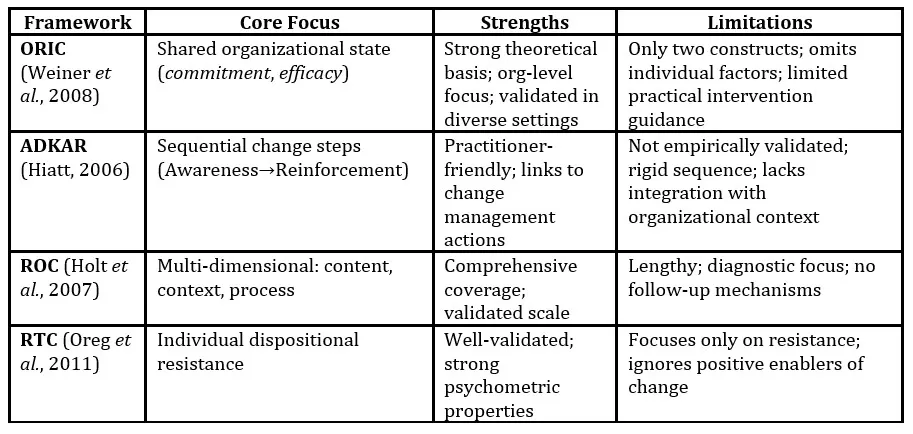
Moreover, an organization’s historical experiences with change significantly influence both organizational routines and individual expectations concerning future change initiatives, underscoring the importance of considering change history and prior experiences as integral to understanding RfC (Choi, 2011; Rafferty et al., 2013). The literature clearly illustrates the necessity for an integrated RfC framework that cohesively combines both organizational and individual dimensions. This conceptual integration promises significant theoretical advancements by offering a holistic understanding of readiness, enhancing managerial insights, and addressing the limitations observed in existing fragmented models (Rafferty et al., 2013; Voggenreiter et al., 2025). In Table 1, the existing RfC models used for measuring RfC are listed with its core focus, strengths and limitations. To illustrate how the proposed model advances prior work, Table 1 systematically compares major RfC frameworks ORIC, ADKAR, ROC, and RTC highlighting their theoretical focus, practical strengths, and key limitations that the present study seeks to address.
Table 1: Comparison of existing RfC Models
As the comparison shows, existing frameworks either emphasize organizational or individual dimensions but rarely integrate both within a business-relevant structure. The present study addresses this gap by developing and empirically validating an integrated model that unites these perspectives.
While ORIC, ADKAR, ROC, and RTC each provide valuable perspectives, they have limitations in scope, adaptability, and capacity for re-measurement. These limitations can be summarized across four main dimensions:
Level of analysis – Models such as ORIC and ROC focus on organizational-level constructs, while RTC addresses only individual dispositions. Few tools integrate both perspectives to capture the full readiness profile.
Scope of antecedents – Many frameworks measure a narrow range of factors (e.g., ORIC’s two constructs, RTC’s resistance focus), omitting other empirically supported antecedents relevant to successful change.
Practical application and adaptability – ADKAR provides actionable guidance but lacks empirical validation and flexibility across contexts. Conversely, ROC is empirically grounded but too lengthy for agile use.
Measurement continuity – Most tools are designed for a single-point diagnosis, offering limited mechanisms for re-measurement to track progress over time.These gaps underline the need for research that systematically identifies and validates high-impact antecedents across both organizational and individual levels. Such an approach ensures a more complete and actionable measurement of RfC, enabling both accurate diagnosis and the development of targeted interventions.
In conclusion, the theoretical examination presented here highlights the importance of systematically integrating identified antecedents into a coherent conceptual framework. The next section outlines the methodological approach used to develop this integrated conceptual model, designed to enhance both theoretical clarity and practical utility in managing organizational change.
Methodology: Gathering Business Insights for Conceptualization
Understanding the factors that contribute to an organization’s RfC is crucial for developing an effective, usable measurement tool. This section outlines the methodological approach used to identify and assess key antecedents influencing RfC in business environments. The study employs a structured questionnaire-based approach to collect empirical data, ensuring the measurement tool is both business-relevant and applicable across industries. The development and validation processes ensure the instrument accurately captures the critical dimensions of RfC, providing a foundation for its practical application in corporate settings.
Research Design & Approach
The methodological approach for this study was carefully designed to ensure the development of a business-relevant RfC measurement tool that is both theoretically grounded and practically applicable. The primary objective was to identify and validate the most influential antecedents of change readiness within business environments. Given the need for empirical validation, a quantitative survey-based methodology was chosen, focusing on structured data collection across various industries.
A questionnaire-based approach offers several advantages in measuring RfC. First, it allows for systematic quantification of key antecedents, enabling comparative analysis across different organizational contexts. Second, standardized survey items facilitate replicability and scalability, making it possible to adapt the tool to various industries and business environments and support future research. Third, this approach aligns with prior research methodologies in change management and organizational psychology (Holt et al., 2007; Weiner et al., 2008) ensuring compatibility with existing frameworks while addressing their limitations in business applications.
Alternative methodologies, such as interviews or case studies, were considered but ultimately excluded for this phase of development. While qualitative approaches provide rich contextual insights, they are inherently limited in generalizability and do not offer the statistical robustness required for broad application. Furthermore, previous studies have highlighted the importance of structured assessments in measuring readiness (A. A. Armenakis et al., 1993; Oreg et al., 2011), reinforcing the need for a quantitative tool that can systematically assess business-relevant antecedents.
The study’s research design incorporated consultation with business leaders and change management experts to ensure that the questionnaire captured the most pertinent factors influencing RfC. These stakeholders provided valuable feedback on the practical application of antecedents originally identified in Voggenreiter et al. (2024), helping refine the focus of the survey.
Development of the Questionnaire
The questionnaire was systematically developed to assess the relative importance of 19 key antecedents identified in Voggenreiter et al. (2024). The goal was to ensure a holistic and business-relevant approach to measuring RfC, integrating organizational, psychological, and structural dimensions. The survey was deployed on the University’s LimeSurvey instance. Participation was voluntary, anonymous, and based on informed consent. No sensitive personal data were collected. Data access was restricted to the research team, stored on institutional servers. Institutional Data Protection Officer confirmed compliance with data protection obligations. The survey was available online from April to May 2025 and disseminated via LinkedIn and XING professional groups and targeted email invitations to business specialists, leaders, and managers with practical experience in organizational change. A convenience sampling approach was used, with participants self-selecting based on professional relevance. This method was considered appropriate for the exploratory aim of identifying high-impact antecedents of RfC at both individual and organizational levels. Using an official institutional platform supports compliance, data integrity, and participant trust (Regmi et al., 2016).
The survey was structured into three sections. Section one of the questionnaire contained mandatory screening and contextual questions to ensure participants met the inclusion criteria and to capture key organizational characteristics. Respondents were required to confirm direct professional involvement in change management, organizational development, or a related field relevant to RfC, and to provide their official job title. Additional items recorded company size, industry sector, and whether the organization had undergone a major change in the previous three years (e.g., digital transformation, restructuring, merger or acquisition, new leadership). Participants who indicated no direct involvement in organizational change were advised not to proceed with the survey but not technically stopped to proceed. The following overview summarizes the demographic and organizational characteristics of the sample.
In the second part, the 19 antecedents were first defined and then their business relevance, impact on business, and effectiveness on individual change were rated via a five-point Likert scale. Third, the participants selected which of the 19 antecedents they considered the most difficult to influence as an organisation, the ones the organisation had most control over, and the three they considered the most critical for RfC.
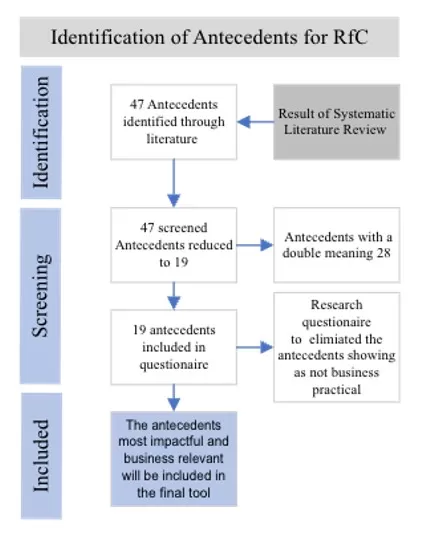
The first step was to identify the antecedents of RfC from the literature, then check their business applicability and eliminate duplicates with identical meanings, which eliminated 21 antecedents. The 19 remaining antecedents were selected for further evaluation in the questionnaire as shown in Figure 1.
Figure 1: Identification of Antecedents
Each antecedent was evaluated based on three key criteria: its relevance for organizational change readiness, determining how critical the factor is in shaping an organization’s ability to implement change successfully; the degree of influence the company has over the factor, assessing how actively organizations can manage and leverage it in their change strategies; and its effectiveness in enhancing employees’ individual change readiness, measuring the extent to which the factor supports employees in adapting to change across different business contexts.
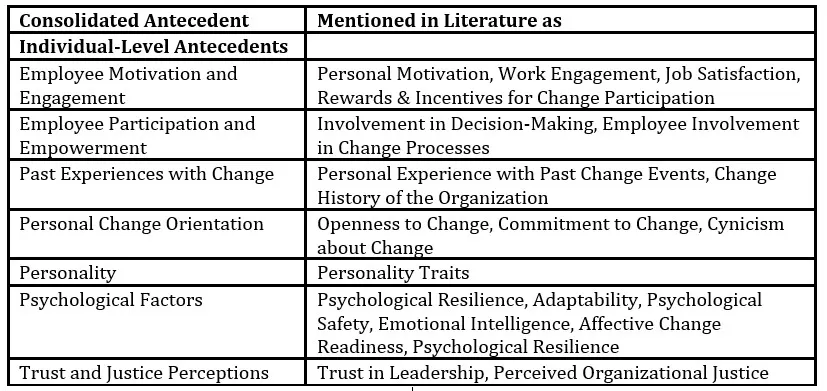
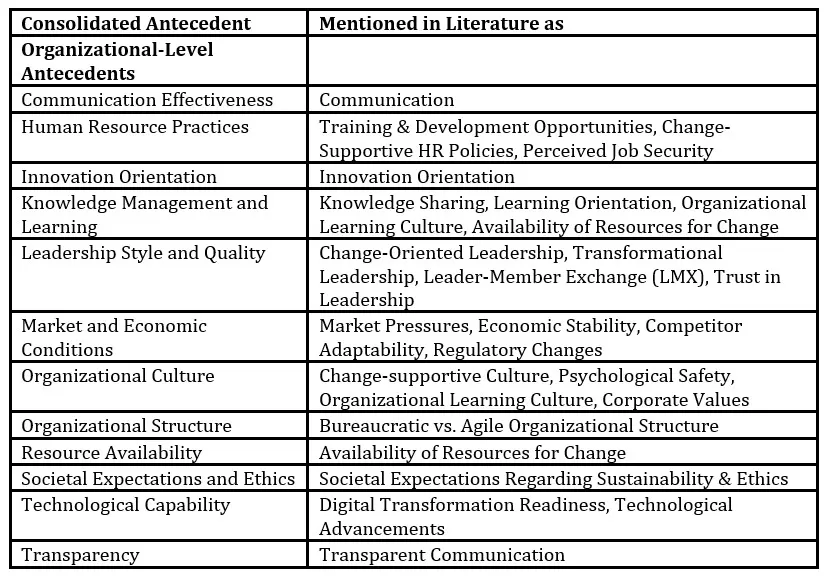
As Table 2 and 3 illustrate, the antecedents of RfC include both individual-level and organizational-level factors. Individual antecedents reflect personal characteristics, psychological traits, and employee behaviours that influence RfC. For instance, Personal Change Orientation captures openness and commitment to change, while Psychological Factors such as resilience, emotional intelligence, and psychological safety, affect an individual’s adaptability. Employee Motivation and Engagement, as well as Participation and Empowerment, determine the extent to which personnel are willing and able to contribute to change initiatives. Additionally, Trust and Justice Perceptions shape employees’ confidence in leadership and the fairness of change processes. Organizational antecedents, on the other hand, focus on structural, cultural, and strategic elements that shape an organization’s ability to implement and sustain change. Leadership Style and Quality play a crucial role in setting the direction for change, while Communication Effectiveness ensures that change-related messages are clear, consistent, and transparent. Knowledge Management and Learning support organizational adaptability by fostering a culture of continuous learning and information sharing. Organizational Culture, Human Resource Practices, and Organizational Structure define how receptive an organization is to transformation, whereas Resource Availability, Technological Capability, and Market and Economic Conditions determine the external and internal constraints affecting change efforts. By evaluating both individual and organizational factors, the questionnaire provides a comprehensive perspective on the key antecedents influencing change readiness, ensuring that organizations can identify both people-related and structural enablers of successful change implementation.
Table 2: Individual-Level Antecedents used for Questionnaire
Table 3: Organizational-Level Antecedents used for Questionnaire
Ensuring Validity & Reliability
To ensure the validity and reliability of the questionnaire, a multistage validation process was conducted. This process encompassed an expert review and pilot testing, as recommended by Sheatsley (1983) and Sudman (1983), and statistical reliability analysis was performed to confirm that the instrument accurately measured the intended constructs. During the expert review, business professionals specializing in organizational change, human resources, and business transformation evaluated the clarity, wording, and relevance of each item. Their feedback played a crucial role in refining the questionnaire, ensuring it captured the most critical dimensions of RfC without redundancy or ambiguity. To assess construct validity, internal consistency analysis was performed using Cronbach’s alpha, verifying that items designed to measure the same antecedent were statistically reliable and aligned with theoretical expectations. This approach is consistent with methodologies established in previous RfC research (Holt et al., 2007; Rafferty et al., 2013), which emphasize the importance of ensuring that measurement items accurately reflect the underlying constructs.
The collected data were analyzed using SPSS to empirically examine the structure and reliability of the proposed RfC framework. Specifically, exploratory factor analysis (EFA) was employed to identify latent dimensions, while reliability analysis (Cronbach’s alpha) assessed the internal consistency of the measurement scales. Additionally, one-way ANOVA was conducted to explore potential group-level differences based on company characteristics and change experience.The analysis enabled a prioritization of the 19 identified antecedents by examining their perceived relevance, influence, and effectiveness. This ranking provides valuable insights into which factors are considered most critical within business contexts, thus supporting organizations in aligning their change strategies with the elements most likely to enhance readiness for transformation. The empirical results serve as a foundation for the continued development of a business-centered RfC measurement tool that balances theoretical rigor with practical relevance.
The validated questionnaire presented in this study also serves as the foundation for the future development of a comprehensive RfC measurement tool. While the present paper focuses on the empirical identification and prioritization of high-impact antecedents, subsequent research will extend these findings into a standardized assessment instrument that integrates both individual and organizational dimensions of RfC.
Research Data Analysis
To assess the internal consistency of the collected data, a reliability analysis of the developed questionnaire was conducted as an initial step. The data were gathered using a custom-designed online questionnaire, implemented through the LimeSurvey platform. To reach a targeted audience with relevant expertise, the survey link was shared across several LinkedIn professional groups focused on change management, organizational development, and human resources.
Upon completion of the survey, the raw data were exported from LimeSurvey into SPSS for comprehensive statistical analysis. The first stage involved examining the internal consistency of the instrument to evaluate the reliability of the constructed scales. Cronbach’s alpha was calculated as the standard indicator for psychometric reliability. Furthermore, an item-level reliability check (“Alpha if item deleted”) was performed to assess each item’s contribution to the overall consistency.
The results demonstrated a consistently high level of internal reliability across all items, indicating a coherent and well-constructed scale. No item showed evidence of redundancy or misalignment with the overall construct, and therefore, no modifications were required based on the reliability outcomes. The instrument can thus be considered a robust measure of RfC. The subsequent sections describe in detail the statistical analyses carried out to explore the structure, distribution, and explanatory dimensions of the collected data.
Descriptive Data Analyses
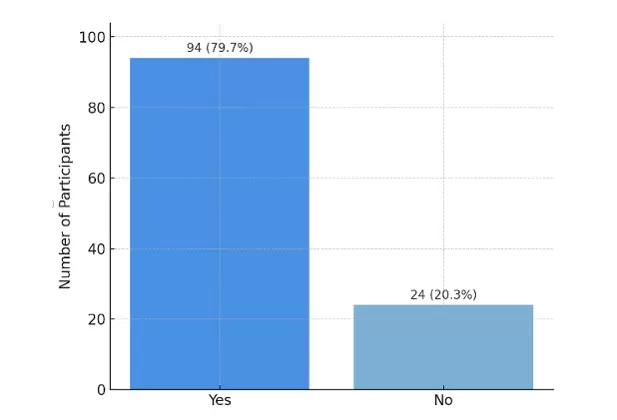
To ensure the validity and contextual relevance of the collected data, participants were initially asked whether they were directly involved in change management, organizational development, or a related field that offers professional insight into RfC. A total of 118 valid responses were analysed. Among these, 94 participants (79.7%) confirmed direct involvement in change-related roles, while 24 participants (20.3%) indicated no direct engagement in such areas. Although the questionnaire instructed participants without direct involvement in change processes not to proceed, the survey platform did not technically restrict continuation. As a result, 24 respondents who indicated no direct engagement nonetheless completed the questionnaire. Since their responses were complete, consistent, and provided useful comparative insights, they were retained in the final dataset for analysis.
Sample characteristics: Respondents represented organizations of varying sizes – 24.6% micro, 23.7% small, 11.0% medium, and 40.7% large enterprises. Furthermore, 79.7% of participants reported that their organization had undergone a major change (e.g., restructuring, digital transformation, or leadership transition) within the previous three years, while 20.3% had not. This distinction clarifies that some participants were personally less involved in change processes but still worked within organizations that had recently experienced transformation, thereby broadening the contextual perspective of the sample.
The total sample comprised 118 participants who fully or partially completed the questionnaire. For the reliability analysis (Cronbach’s alpha) and exploratory factor analysis (EFA), all 118 cases were included, as no missing data were present in Section B (57 Likert-scale items). However, for the group comparisons via one-way ANOVA, listwise deletion was applied to ensure the integrity of between-group variance tests. As a result, the sample size was reduced to N = 114 for the company size analysis due to 4 missing values in the “A3_Size” variable, and to N = 116 for the change experience comparison due to 2 missing values in the “ChangeExperience_num” variable. These minor reductions did not meaningfully affect the robustness of the results. All statistical analyses were conducted using IBM SPSS Statistics (Version 30), and assumptions (e.g., normality, homogeneity) were tested accordingly. The high proportion of informed participants strengthens the internal validity of the results, as the responses largely reflect practical insights from individuals engaged in implementing and managing change.
Figure 2: Respondents directly involved in managing change
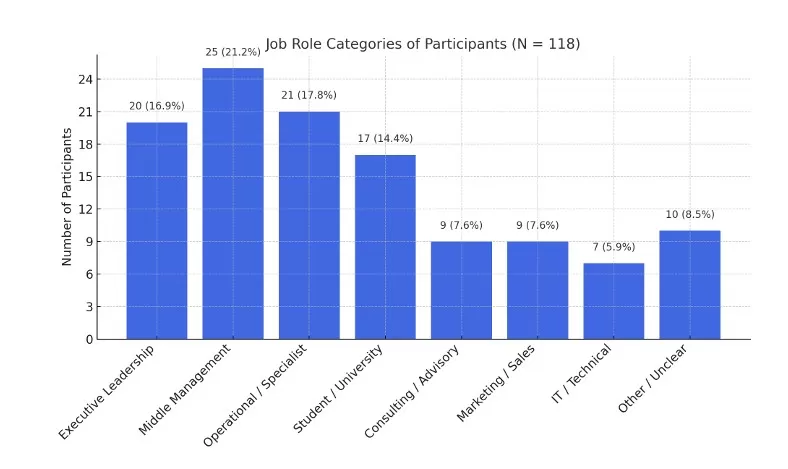
To assess the professional backgrounds of participants, respondents were asked to report their current job title (Question 1.2). A total of 118 valid responses were collected. Since job titles were entered as free-text, the dataset required comprehensive cleaning and standardization. This included normalization of spelling and capitalization, translation of foreign-language terms, and consolidation of synonymous roles. Additionally, clearly erroneous or ambiguous entries were grouped under “Unclear / Invalid”. Following this cleaning process, job titles were categorized into functional role groups using a rule-based classification scheme. These included leadership, management, technical, HR-related, academic, and other professional domains. One missing entry was also explicitly added to the “Unclear / Invalid” group to preserve the complete response base of N = 118.
The distribution of job title categories is presented in Figure 3. The most frequently represented category was Leadership / Executive, followed by general management and human resources roles. This composition highlights the professional relevance of the sample, with the majority of participants holding positions that are directly or strategically connected to change management processes.
Figure 3: Distribution of Participants by Professional Role (N=118)
Cronbach alpha
To evaluate the internal consistency of the RfC questionnaire, Cronbach’s alpha was calculated using IBM SPSS Statistics Version 30. The analysis included all 57 Likert-scale items from Section B, which assessed 19 antecedents across the dimensions of Relevance, Influence, and Effectiveness.
The procedure followed Analyze → Scale → Reliability Analysis, selecting all 57 items (variables q02_01 to q02_57). The analysis was configured to use the “Alpha” model, and the following output options were activated: Item, Scale, Scale if Item Deleted, and Inter-item Correlations.
The analysis was based on 118 valid cases, with no missing data in the item responses. A sample size of 100–150 is generally adequate for reliable estimation of Cronbach’s alpha in psychometric instruments, especially when internal consistency is high (Bujang et al., 2018). Given the high number of items (57) and the excellent internal consistency observed, the sample size is sufficient to ensure robust and generalizable reliability estimates.
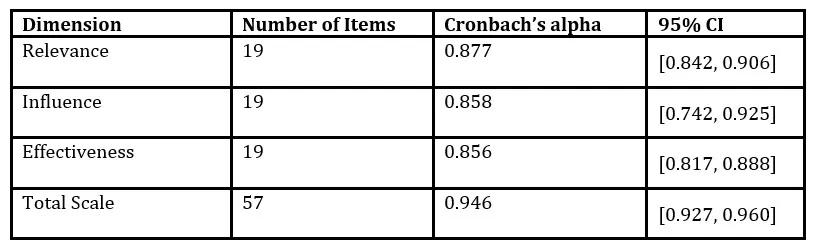
All 57 items, coded on a 5-point Likert scale (1 = Not relevant/No influence/No impact to 5 = Highly relevant/High influence/Strong impact), were selected, with output options including Item, Scale, Scale if Item Deleted, and Inter-item Correlations to evaluate reliability comprehensively. The overall reliability for the 57-item scale was α = 0.946, 95% CI [0.927, 0.960], indicating excellent internal consistency.
Subscale analyses further confirmed high reliability, with the Relevance dimension (19 items) achieving α = 0.877, 95% CI [0.842, 0.906], Influence (19 items) α = 0.858, 95% CI [0.742, 0.925], and Effectiveness (19 items) α = 0.856, 95% CI [0.817, 0.888] (see Table 4). These values exceed the conventional threshold of 0.70 for acceptable reliability (Tavakol and Dennick, 2011), suggesting that all subscales reliably measure key dimensions of the RfC framework in organizational contexts.
Item-level diagnostics conducted in SPSS (Analyze > Scale > Reliability Analysis > Statistics > Item, Scale if Item Deleted) confirmed that all 57 Likert-scale items contributed positively to the overall reliability of the scale. Corrected item-total correlations ranged from 0.269 (Effectiveness of Organizational Structure, Effectiveness of Personality) to 0.641, with the lowest values observed for items such as Effectiveness of Organizational Structure (0.269) and Influence of Market and Economic Conditions (0.285), both above the minimally acceptable threshold of 0.25–0.30 for exploratory constructs. The item Effectiveness of Personality flagged in the instructional example demonstrated a corrected item-total correlation of 0.519 and a Cronbach’s α of 0.945 if deleted, suggesting adequate alignment with the overall scale. Therefore, no item showed statistical evidence of redundancy or misfit warranting removal. The overall internal consistency remained excellent (α = 0.946, 95% CI [0.927, 0.960]) for the full 57-item instrument.
Table 4: Cronbach’s alpha Values
Descriptive Analysis of Change Readiness Antecedents
To establish a foundational understanding of how respondents perceive various antecedents to Organizational Change Readiness (OCR), we conducted descriptive analyses on 57 Likert-scale items (N = 118), grouped into thematic constructs such as leadership, communication, and psychological orientation. The analysis focused on three evaluation dimensions: perceived relevance, influence, and effectiveness. Among the antecedents rated highest in perceived relevance were Employee Motivation & Engagement (M = 3.75, SD = 1.19), Leadership Style and Quality (M = 3.74, SD = 1.30), and Communication Effectiveness (M = 3.67, SD = 1.15). These findings highlight the critical importance attributed to leadership and communication mechanisms within organizations undergoing change.
In terms of perceived influence, the top factors included Transparency (M = 3.70, SD = 1.18), Communication Effectiveness (M = 3.64, SD = 1.07), and Employee Motivation & Engagement (M = 3.60, SD = 1.10). Similarly, for perceived effectiveness, Communication Effectiveness (M = 3.69, SD = 1.08), Employee Motivation & Engagement (M = 3.61, SD = 1.16), and Transparency (M = 3.51, SD = 0.99) were among the most positively evaluated antecedents.
Conversely, external and macro-level factors such as Market and Economic Conditions (Influence: M = 2.86, SD = 1.27), Societal Expectations and Ethics (Influence: M = 2.95, SD = 1.18), and Personality (Influence: M = 2.92, SD = 1.31) were rated as less influential. These trends suggest a prevailing emphasis on interpersonal and organizationally controllable factors over external constraints when assessing RFC.
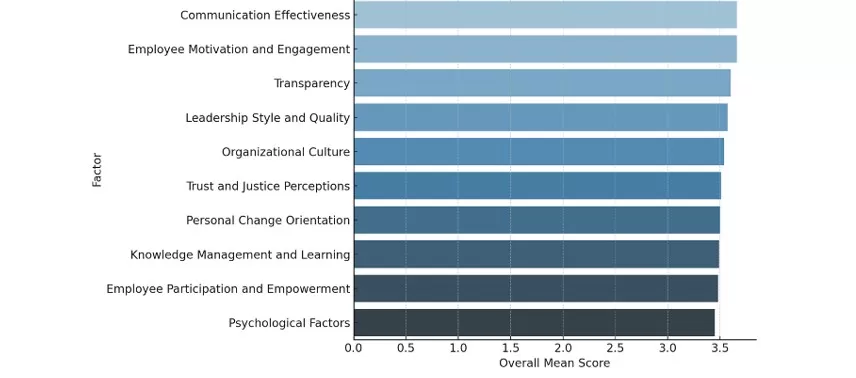
Figure 4 visualizes the top 10 antecedents based on overall mean scores across all three evaluation dimensions. It underscores the perceived importance of human-centered factors such as communication, motivation, and leadership in shaping organizational RfC. These findings reinforce the descriptive results reported earlier and confirm a consistent prioritization of relational and cultural antecedents.
Figure 4: Top 10 Combined Change Readiness Factors by Mean Score
Exploratory Factor Structure
To uncover the latent structure of the 57-item RfC questionnaire, an exploratory factor analysis (EFA) was conducted using Principal Axis Factoring (PAF) with Varimax rotation (N = 114, due to listwise deletion of cases with missing data on company size). This method was chosen based on its appropriateness for identifying underlying constructs rather than maximizing explained variance, as with PCA (Costello and Osborne, 2005).
Sampling Adequacy and Suitability
The Kaiser-Meyer-Olkin (KMO) measure confirmed sampling adequacy (KMO = 0.763), indicating a good common variance, (0.7 – 0.8; (Field, 2024)). Bartlett’s test of sphericity was highly significant (χ²(1596) = 3962.648, p < 0.001), confirming that the correlation matrix was factorable (Bartlett, 1954; Kaiser, 1974).
Factor Extraction and Structure
A total of 15 factors had eigenvalues > 1, explaining 70.19% of the total variance. However, based on theoretical expectations and the scree plot (which revealed a clear elbow at the third factor), and the absence of access to parallel analysis tools (e.g., R software), a three-factor solution was retained. This solution accounted for 37.59% of the total variance (based on initial eigenvalues) and 35.6% after extraction. The rotation converged in six iterations.
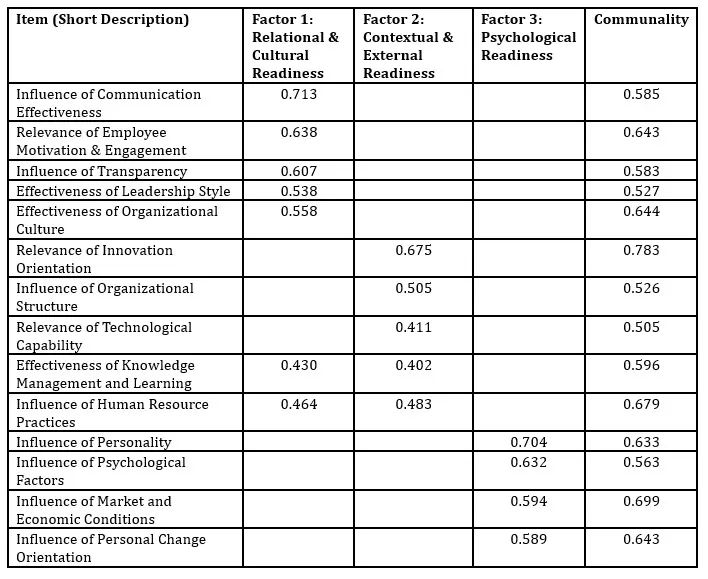
Each factor consisted of items with strong loadings (≥ 0.40), and items with cross-loadings (loadings ≥ 0.40 on multiple factors with differences <0.2) or low communalities (<0.3) were excluded from interpretation to ensure clarity. The three factors were labelled based on empirical item loadings as Relational & Cultural Readiness (reflecting interpersonal and value-driven capacities, e.g., communication effectiveness, leadership style, organizational culture), Contextual & External Readiness (emphasizing dispositional and environmental influences, e.g., societal expectations, market conditions), and Psychological Readiness (capturing individual emotional and cognitive preparedness for change, e.g., psychological factors, personal change orientation), partially deviating from the theoretical dimensions (Relevance, Influence, Effectiveness).
Factor 1: Relational and Cultural Readiness
This factor included high loadings from items on communication effectiveness, leadership style, organizational culture, knowledge management, employee motivation, empowerment, and transparency. This factor reflects interpersonal and value-driven capacities for change.
Factor 2: Contextual and External Readiness
This factor captured loadings related to societal expectations, personality, and market and economic conditions. This dimension reflects the organization’s responsiveness to external pressures and dispositional variables.
Factor 3: Psychological Readiness
This factor grouped items related to psychological factors, personal change orientation, and trust/justice perceptions. This factor reflects the emotional, cognitive, and motivational readiness of individuals to engage with change.
Table 5 presents a selection of key representative items from the exploratory factor analysis (EFA), illustrating their primary loadings (≥ 0.40) across the three extracted dimensions (factors) of organizational change readiness. Each item loads most strongly on one dominant factor, indicating its conceptual alignment with a specific readiness dimension. Items related to communication effectiveness, leadership, employee motivation, and transparency clustered under Relational & Cultural Readiness. Contextual & External Readiness was primarily defined by items reflecting organizational infrastructure, human resource systems, innovation orientation, and technological capability. Psychological Readiness captured items tied to psychological traits, individual disposition, and external context, including market conditions and personal change orientation. This representation enhances clarity by focusing on the clearest and most theoretically meaningful loadings, while excluding items with low communalities or significant cross-loadings.
Several items were excluded from Table 5 based on standard exploratory factor analysis (EFA) criteria. Specifically, items were removed if they showed low communalities (< 0.30), indicating weak shared variance with other items, or if they demonstrated substantial cross-loadings (i.e., loadings ≥ 0.40 on two or more factors with differences < 0.20), which complicates interpretability. Effectiveness of Societal Expectations and Ethics failed to load meaningfully on any single factor and exhibited a communality below the acceptable threshold. Similarly, Relevance of Personality and Influence of Trust and Justice Perceptions were excluded due to conceptual misalignment and weak or ambiguous loadings. These exclusions ensured that only robust, clearly interpretable items were retained for factor interpretation and further discussion.
Table 5: Rotated Factor Matrix
The relatively low variance explained by the three-factor solution (35.6% after extraction) is typical for exploratory factor analyses involving multifaceted psychological constructs and a broad conceptual coverage, especially with 57 diverse items. The sample size (N=118) meets the minimum threshold for EFA but is below the recommended 171 – 285 participants (3-5 per item for 57 items; Costello & Osborne, 2005). Future validation with larger samples is recommended to confirm stability and cross-cultural replicability.
Comparative Readiness Scores across Organizations
To examine whether perceived RfC differed across organizational characteristics, two one-way analyses of variance (ANOVA) were conducted in IBM SPSS Statistics (Version 30), using the total readiness score (Total_RFC_2) as the dependent variable. This score represents the arithmetic mean across 57 Likert-scale items covering relevance, influence, and effectiveness of 19 antecedents. Missing data were handled via listwise deletion, resulting in N=114 for company size (4 cases missing) and N=116 for change experience (2 cases missing). Independence was assumed by the study design, as responses were collected independently from each participant (Field, 2024).
Company Size Differences
For company size (N=114), Shapiro-Wilk tests indicate approximate normality for Micro (p = .477), Small (p = .564), and Medium (p = .461) groups, but a significant deviation for Large (p < .001). Levene’s test for homogeneity of variances was significant (p = .043), indicating unequal group variances. As a result, the more robust Welch ANOVA was used.
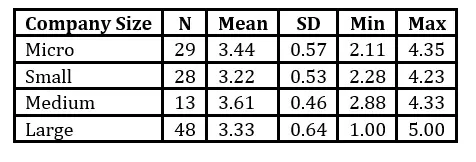
Welch’s ANOVA indicated no statistically significant difference in perceived readiness across the four company size categories (Micro, Small, Medium, Large): F(3, 46.30) = 2.036, p = 0.122, η² = 0.117. As the global test was non-significant, no post-hoc analyses were conducted. Medium-sized organizations had the highest RfC score (M = 3.61, SD = 0.46), while Small enterprises scored the lowest (M = 3.22, SD = 0.53) (see Table 6). These descriptive trends suggest potential for further exploration in larger samples, but no inferential differences were detected. The presence of unequal group sizes (e.g., N = 13 for Medium vs. N = 48 for Large) and moderate variability in responses may have further limited statistical power to detect differences.
Table 6 RfC Scores by Company Size (N=114)
Change Experience
A Welch’s ANOVA compared RfC scores between participants (N=116) with and without prior change experience. Shapiro-Wilk tests confirmed the assumption of normality for both groups (Yes: p = .200; No: p = .200). However, Levene’s test indicated a violation of the homogeneity of variances assumption (p = .043), so Welch’s correction was applied. The analysis revealed no statistically significant difference: F(1, 28.107) = 0.538, p = 0.469, η² ≈ 0.008. Participants with prior change experience reported a slightly higher mean RfC score (M = 3.39, SD = 0.52) than those without experience (M = 3.26, SD = 0.80) (see Table 7), but this difference was not statistically meaningful.
Table 7 RfC Scores by Change Experience (N=116)
The findings from the ANOVA analyses suggest that neither organizational size nor individual change experience significantly affects how RfC is perceived among participants. These results underscore the importance of looking beyond structural characteristics and instead focusing on internal mechanisms, such as leadership behavior, communication effectiveness, and organizational culture, to better understand and actively foster RfC (Rafferty et al., 2013).
Practitioner Priorities: Insights from Section C
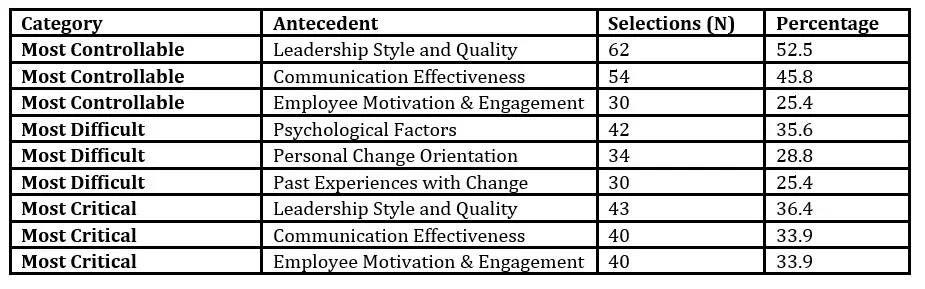
To complement the quantitative analysis of readiness antecedents, Section C of the questionnaire captured qualitative insights from practitioners regarding the perceived controllability, difficulty, and criticality of each factor for successful change implementation. For Section C, all 118 participants provided valid responses to the control, difficulty, and criticality items. Each respondent (N = 118) selected up to three antecedents per category (C1: Controllability, C2: Difficulty, C3: Criticality) from a predefined list of 19. The results are described below and summarized in Table 8.
Most Controllable Antecedents (C1)
When asked which antecedents they believed their organizations had the most control over, respondents most frequently selected:
Leadership Style and Quality (52.5%, n=62), Section B mean: 3.74
Communication Effectiveness (45.8%, n=54), Section B mean: 3.673. Employee Motivation and Engagement (25.4%, n=30), Section B mean: 3.75These results confirm that practitioners consider leadership, communication, and motivation as both influential and controllable aspects of organizational change. The high Section B means further support their perceived strength as readiness drivers, aligning with organizational domains commonly managed internally.Most Difficult to Influence (C2)
For the most difficult antecedents to influence, the top responses were:
1. Psychological Factors (35.6%, n=42), Section B mean: 3.31 2. Personal Change Orientation (28.8%, n=34), Section B mean: 3.10 3. Past Experiences with Change (25.4%, n=30), Section B mean: 3.21
These responses emphasize that individual dispositions and historical experiences are perceived as relatively intractable. This reinforces the notion that while readiness can be facilitated structurally, certain psychological dynamics remain resistant to top-down influence, requiring more nuanced or long-term interventions. Their moderate Section B scores suggests that although these factors are not viewed as irrelevant, they are harder to influence directly through organizational mechanisms.
Most Critical to Readiness (C3)
Participants identified the following as the most critical antecedents for successful change:
Leadership Style and Quality (36.4%, n=43), Section B mean: 3.742. Communication Effectiveness (33.9%, n=40), Section B mean: 3.673. Employee Motivation and Engagement (33.9%, n=40), Section B mean: 3.75
These selections correspond closely with the highest-scoring antecedents in Section B. Specifically, Leadership Style and Quality achieved a combined Section B mean of 3.58, Communication Effectiveness scored 3.67, and Employee Motivation and Engagement scored 3.75. In Section C3 (criticality), the overall mean rating was 3.74, compared to 3.67 in Section C1 (control). The close alignment between the perceived criticality of these antecedents and their consistently high Section B ratings highlights them both as subjectively important and empirically validated through participant responses. Their prominence reinforces the conceptual model’s emphasis on leadership, communication, and engagement as foundational elements of change readiness.
Table 8: Top 3 Antecedents by Category (N=118)
Antecedents were ranked by percentage, with no ties observed as differences exceeded 5%. These findings highlight actionable priorities (e.g., Communication) and barriers (e.g., Psychological Factors), cross-validating Section B’s high ratings for Leadership and Communication. The sample size (N = 118) was adequate for frequency analysis (Bujang et al., 2018), but marginal, and selecting only three antecedents may oversimplify priorities. Future studies should validate with larger samples.
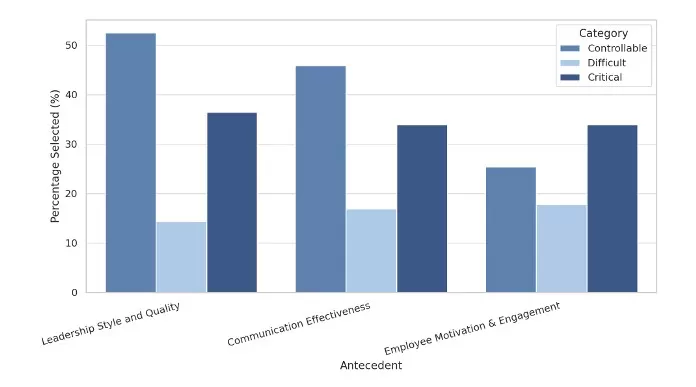
As illustrated in Figure 5, the most frequently selected antecedents across all categories confirm the centrality of leadership, communication, and motivation in shaping organizational readiness perceptions. The figure visually highlights the comparative prioritization of these factors across perceived controllability, difficulty, and criticality.
Figure 5: Top 3 Antecedents by Practitioner Perception
These insights validate the conceptual model’s emphasis on leadership and communication as high-impact antecedents. Moreover, they show that practitioners do not only recognize the importance of these factors, but also believe they can be actively influenced, creating a clear target for strategic action. Conversely, psychological factors and individuals’ past experiences with change, while impactful, may require more individualized and long-term development approaches.
Synthesis: Recommended Antecedents for a Business-Oriented RfC Tool
This section synthesizes the empirical findings. The selection of antecedents is grounded in the integrated results of this study, combining quantitative statistical validation with practitioner-based prioritization. Specifically, the recommendation is based on:
High internal consistency, as shown by Cronbach’s alpha;
Thematic clustering, validated through exploratory factor analysis (EFA);
Perceived impact and controllability, as derived from both mean ratings and frequency analyses in Section C (N ==118) ranked by percentage with no ties due to differences exceeding 5%.
Additionally, ANOVA analyses revealed no significant differences in RfC scores across company size or change experience (p > .05), suggesting that readiness perceptions are driven more by internal mechanisms than structural characteristics.
High-Impact and Actionable Core Antecedents
These six antecedents consistently showed strong internal coherence, high mean scores across evaluation dimensions, and clear empirical factor loadings (Factor 1: Relational and Cultural Readiness). Moreover, they were frequently identified by practitioners as both critical and controllable:
Leadership Style and Quality
Communication Effectiveness
Employee Motivation and Engagement
Transparency
Organizational Culture
Employee Participation and Empowerment
Strategic Structural Drivers
This group includes five antecedents that represent key organizational systems and capabilities. They clustered in Factor 2 (Structural and Technical Readiness) and received strong relevance and effectiveness ratings from participants:
Human Resource Practices
Knowledge Management and Learning
Innovation Orientation
Organizational Structure
Technological Capability
Psychological and Contextual Influences
Although more difficult to influence directly, these antecedents were consistently rated as critical for readiness and loaded together in Factor 3 (Psychological Readiness). They reflect individual dispositions and experiential background:
Personal Change Orientation
Psychological Factors
Trust and Justice Perceptions
Past Experiences with Change
Together, these 15 antecedents reflect a rigorously validated foundation for the design of a future RfC measurement tool. Notably, they include a balanced integration of both organizational-level (e.g., leadership, culture, structure) and individual-level antecedents (e.g., motivation, psychological readiness, trust). This dual-level coverage was defined as a critical requirement in the conceptual phase of this research (Voggenreiter et al., 2025), ensuring that the instrument will be capable of capturing both systemic and person-centered dimensions of change readiness.
In summary, this synthesis confirms that the most relevant and practical antecedents are not only empirically robust, but also managerially actionable. They serve as the conceptual and empirical blueprint for constructing a reliable, scalable, and business-aligned RfC assessment instrument.
Conceptualizing the RfC Measurement Tool and Its Practical Applications
The empirical findings of this study not only validate a set of 15 high-impact antecedents for RfC but also provide a direct foundation for developing a comprehensive RfC measurement
tool. This tool is envisioned as a standardized, repeatable assessment instrument designed for application across industries, capable of integrating both individual-level and organizational-level readiness factors into a single, actionable framework.
From empirical study to applied tool
The questionnaire tested in this study has already been applied to evaluate the perceived relevance, influence, and effectiveness of each antecedent. Building on this validated structure, the next stage will involve configuring the instrument into a fully operational tool. This will include clear scoring algorithms, automated analysis, and dual-level reporting:
Individual RfC reports – summarizing personal readiness profiles, highlighting strengths and areas for development, and providing actionable recommendations. Research shows that individualized feedback can improve motivation, adaptability, and performance during change processes (Gnepp et al., 2020; Maunder et al., 2023).
Aggregated organizational reports – consolidating individual scores to produce department-, business unit-, or organization-wide readiness profiles. Aggregated data have been shown to reliably represent organizational readiness and inform targeted strategic interventions (Weiner et al., 2008; Shea et al., 2014).
Continuous improvement and longitudinal tracking
A core design feature of the tool will be the ability to re-administer the questionnaire after a defined period (e.g., six months) to measure the impact of targeted interventions and track changes in readiness. This longitudinal feedback loop supports continuous improvement, enabling organizations to adapt strategies in response to evolving readiness profiles. The approach aligns with the PDCA (Plan–Do–Check–Act) cycle, providing a structured mechanism for diagnosing readiness, implementing changes, evaluating outcomes, and refining approaches (Taylor et al., 2014; Robertson et al., 2021).
Practical implications across organizational levels At the individual level, the tool supports self-awareness and accountability by helping employees understand their readiness profile and identify specific actions to improve adaptability.
At the team level, aggregated data reveal readiness strengths and gaps within groups, guiding interventions to improve collaboration, communication, and cohesion (Rafferty et al., 2013).
At the organizational level, readiness assessments inform leaders about systemic enablers and barriers to change, ensuring that strategy, culture, and operational processes are aligned with transformation objectives.
Implementation considerations
While offering clear benefits, successful adoption of the tool will require careful integration into existing change management practices. Key enablers include leadership commitment, adequate resource allocation, and transparent communication of the tool’s purpose and benefits. Potential challenges such as resistance to measurement, resource constraints, and sustaining engagement over time can be mitigated through early stakeholder involvement, clear communication, and embedding the tool within broader organizational development and change initiatives.
Summary
By linking the validated antecedents from this study with a practical assessment mechanism, the RfC measurement tool has the potential to provide organizations with a precise, actionable understanding of their RfC. It combines theoretically grounded constructs with empirical validation and practical usability, offering value for both research and business application. While the current paper presents the empirical groundwork, future research will focus on finalizing the tool, validating it across diverse contexts, and testing its longitudinal utility in guiding successful organizational change.
Conclusion and Future Research Directions
This paper presented and empirically supported a comprehensive conceptual framework for assessing and enhancing RfC at both the individual and organizational levels. By integrating theoretically grounded antecedents into a business-relevant, measurable structure, the study bridges the gap between academic theory and practical application. The framework offers organizations a structured approach to diagnose readiness levels, prioritize strategic interventions, and foster adaptability in rapidly changing environments.
Through reliability testing, exploratory factor analysis, (identifying Relational and Cultural Readiness, Contextual and External Readiness, and Psychological Readiness), and practitioner insights, the proposed RfC model demonstrated strong internal consistency and conceptual coherence. While group comparisons did not yield statistically significant differences (p > .05), medium-sized firms showed a trend toward higher readiness, suggesting potential for further exploration. Respondents clearly prioritized leadership, communication, and employee engagement as both critical and actionable levers for improving readiness. These findings confirm the framework’s relevance and provide a solid foundation for its practical implementation.
This research represents a critical intermediate step in the systematic development of a robust, business-oriented RfC measurement tool. By empirically validating and prioritizing high-impact antecedents across both organizational and individual levels, the study delivers the conceptual and statistical foundation needed for a reliable, multi-dimensional instrument. This contribution advances the field by moving beyond purely theoretical models or unvalidated checklists, providing an evidence-based framework that is directly translatable into an operational tool for practice. The next stage will involve integrating these validated antecedents into a finalized version of the instrument, complete with scoring guidelines, reporting templates, and digital deployment capability.
However, several limitations must be acknowledged. The current validation is based on a cross-sectional, self-reported dataset, which may limit generalizability and be subject to response biases. Moreover, cultural and contextual differences between organizations were not explicitly addressed, and longitudinal effects remain unexplored. Importantly, this study does not present a finalized RfC measurement instrument. Rather, it represents a critical interim step in the systematic development of such a tool. The primary aim was to empirically identify and prioritize antecedents that are both impactful and influenceable, thus defining the conceptual scope of a future, fully validated instrument. This phase lays the groundwork for targeted tool construction and psychometric refinement.
While the present study provides a validated set of high-impact antecedents for RfC, the findings are based on a sample without specific differentiation by cultural background or industry sector. This limits the immediate generalizability of the model to diverse organizational contexts, as cultural norms, sector-specific dynamics, and regulatory environments can significantly influence readiness perceptions and change adoption strategies (Hofstede, 2001; Burnes, 2017). Future research should therefore validate the RfC measurement tool across multiple cultural settings and industry domains to ensure its external validity. Cross-cultural studies could examine how leadership style, communication practices, and employee engagement, identified here as core antecedents, vary in their relative importance across cultural value systems, while sector-specific investigations could assess whether certain antecedents require adaptation for industries with distinct operational or regulatory environments (By et al., 2021). Such work would refine the tool’s applicability and enable its use as a globally relevant diagnostic instrument.
Future research should therefore focus on:
Longitudinal validation to track changes in RfC over time;
Cross-cultural testing to refine the model’s applicability in diverse organizational settings;
Comparative analyses with existing RfC tools to evaluate relative strengths;
And potential integration of AI-based analytics to enhance predictive precision and user feedback.
For practitioners, successful implementation depends on leadership buy-in, transparent communication, adequate training, and regular reassessment. Embedding the tool within a continuous improvement cycle can substantially enhance strategic agility and organizational resilience. In summary, the proposed framework provides both a conceptual contribution and a validated foundation for the next step: developing a robust, scalable RfC measurement tool. When actively applied and empirically refined, it offers the potential to build long-term readiness and secure competitive advantage in dynamic business environments.
References
Albrecht, S. L., Connaughton, S., Foster, K., Furlong, S. and Yeow, C. J. L. (2020) ‘Change Engagement, Change Resources, and Change Demands: A Model for Positive Employee Orientations to Organizational Change’, Frontiers in Psychology, 11, pp. 31944-31944.
Alnoor, A. (2020) ‘Human capital dimensions and firm performance, mediating role of knowledge management’, International Journal of Business Excellence, 20(2), pp. 149-168.
Armenakis and Harris, S. (2009) ‘Reflections: our Journey in Organizational Change Research and Practice’, Journal of Change Management, 9(2), pp. 127-142.
Armenakis, A. A., Harris, S. G. and Mossholder, K. W. (1993) ‘Creating Readiness for Organizational Change’, Human Relations, 46(6), pp. 681-703.
Bakker, A. B. and Demerouti, E. (2017) ‘Job demands–resources theory: Taking stock and looking forward’, Journal of occupational health psychology, 22(3), p. 273.
Bakker, A. B. and Demerouti, E. (2024) ‘Job demands–resources theory: Frequently asked questions’, Journal of Occupational Health Psychology, 29(3), p. 188.
Bartlett, M. S. (1954) ‘A Note on the Multiplying Factors for Various χ2 Approximations’, Journal of the Royal Statistical Society: Series B (Methodological), 16(2), pp. 296-298.
Bujang, M. A., Omar, E. D. and Baharum, N. A. (2018) ‘A review on sample size determination for Cronbach’s alpha test: a simple guide for researchers’, The Malaysian journal of medical sciences: MJMS, 25(6), p. 85.
Burnes, B. (2017) Managing Change. Harlow, UK: Pearson Education.
By, R. T., Kuipers, B. S. and Procter, S. (2021) ‘Understanding teams in order to understand organizational change: The OTIC model of organizational change’, Journal of Change Management, 21(1), pp. 1-23.
Choi, M. (2011) ‘Employees’ Attitudes towards Organizational Change: A Literature Review’, Human Resource Management, 50(4), pp. 479-500.
Costello, A. B. and Osborne, J. (2005) ‘Best practices in exploratory factor analysis: Four recommendations for getting the most from your analysis’, Practical assessment, research, and evaluation, 10(1).
Field, A. (2024) Discovering Statistics Using IBM SPSS Statistics. SAGE Publications.
Gnepp, J., Klayman, J., Williamson, I. O. and Barlas, S. (2020) ‘The future of feedback: Motivating performance improvement through future-focused feedback’, PloS one, 15(6), p. e0234444.
Hiatt, J. (2006) ADKAR: A Model for Change in Business, Government, and Our Community. Prosci Learning Center Publications.
Hofstede, G. (2001) Culture’s Consequences: Comparing Values, Behaviors, Institutions, and Organizations Across Nations. Thousand Oaks, CA: Sage.
Holt, D. T., Armenakis, A. A., Harris, S. G. and Feild, H. S. (2007) ‘Toward a Comprehensive Definition of Readiness for Change: A Review of Research and Instrumentation’, in Pasmore, W. A. and Woodman, R. W. (eds.) Research in Organizational Change and Development. Emerald Group Publishing Limited, 289-336.
Kaiser, H. F. (1974) ‘An Index of Factorial Simplicity’, Psychometrika, 39(1), pp. 31-36.
Kotter, J. P. (1995) ‘Leading Change – Why Transformation Efforts Fail ‘, Harvard Business Review, 73(2), pp. 59-67.
Madsen, S. R., Miller, D. and John, C. R. (2005) ‘Readiness for organizational change: Do organizational commitment and social relationships in the workplace make a difference?’, Human Resource Development Quarterly, 16(2), pp. 213-234.
Maunder, R. G., Kiss, A., Heeney, N., Wallwork, E., Hunter, J. J., Johnstone, J., Wiesenfeld, L., Jeffs, L., McGeer, A. and Lee, K. (2023) ‘Randomized trial of personalized psychological feedback from a longitudinal online survey and simultaneous evaluation of randomized stepped wedge availability of in-person peer support for hospital staff during the COVID-19 pandemic’, General Hospital Psychiatry, 84, pp. 31-38.
Oreg, S., Vakola, M. and Armenakis, A. (2011) ‘Change Recipients’ Reactions to Organizational Change’, The Journal of Applied Behavioral Science, 47(4), pp. 461-524.
Rafferty, A. E., Jimmieson, N. L. and Armenakis, A. A. (2013) ‘Change Readiness: A Multilevel Review’, Journal of Management, 39(1), pp. 110-135.
Regmi, P. R., Waithaka, E., Paudyal, A., Simkhada, P. and Van Teijlingen, E. (2016) ‘Guide to the design and application of online questionnaire surveys’, Nepal journal of epidemiology, 6(4), p. 640.
Robertson, M. M., Tubbs, D., Henning, R. A., Nobrega, S., Calvo, A. and Murphy, L. A. (2021) ‘Assessment of organizational readiness for participatory occupational safety, health and well-being programs’, Work, 69(4), pp. 1317-1342.
Shea, C. M., Jacobs, S. R., Esserman, D. A., Bruce, K. and Weiner, B. J. (2014) ‘Organizational readiness for implementing change: a psychometric assessment of a new measure’, Implementation Science, 9(1), p. 7.
Sheatsley, P. B. (1983) ‘Chapter 6 – Questionnaire Construction and Item Writing’, in Rossi, P. H., Wright, J. D. and Anderson, A. B. (eds.) Handbook of Survey Research. Academic Press, 195-230.
Sudman, S. (1983) ‘Chapter 5 – Applied Sampling’, in Rossi, P. H., Wright, J. D. and Anderson, A. B. (eds.) Handbook of Survey Research. Academic Press, 145-194.
Tavakol, M. and Dennick, R. (2011) ‘Making sense of Cronbach’s alpha’, International journal of medical education, 2, p. 53.
Taylor, M. J., McNicholas, C., Nicolay, C., Darzi, A., Bell, D. and Reed, J. E. (2014) ‘Systematic review of the application of the plan–do–study–act method to improve quality in healthcare’, BMJ quality & safety, 23(4), pp. 290-298.
Vial, G. (2019) ‘Understanding digital transformation: A review and a research agenda’, The Journal of Strategic Information Systems, 28(2), pp. 118-144.
Voggenreiter, F., Pinheiro, M. M. and Marques, R. P. (2024) ‘A Systematic Literature Review on Readiness for Change in Business Contexts’, Journal of Eastern Europe Research in Business and Economics, 2024.
Voggenreiter, F., Pinheiro, M. M. and Marques, R. P. (2025) ‘Measuring individual readiness for change in the business environment: A comprehensive framework.’, INTED 2025. Valencia, Spain. not yet published: IATED Digital, pp. 5078-5085. doi: https://doi.org/10.21125/inted.2025.1265.
Wanberg, C. R. and Banas, J. T. (2000) ‘Predictors and outcomes of openness to changes in a reorganizing workplace’, Journal of Applied Psychology, 85(1), pp. 132-142.
Weiner, B. J., Amick, H. and Lee, S. Y. D. (2008) ‘Conceptualization and measurement of organizational readiness for change – A review of the literature in health services research and other fields’, Medical Care Research and Review, 65(4), pp. 379-436.