Volume 2025,
Article ID 419851,
Journal of Eastern Europe Research in Business and Economics,
9 pages,
DOI: 10.5171/2025.419851
Received date: 24 March 2025; Accepted date: 24 August 2025; Published date: 23 September 2025
Cite this Article as:
Wojciech POLAN (2025)," Designing Human-to-AI Negotiation Strategies through the Lens of Negorealism ", Journal of Eastern Europe Research in Business and Economics Vol. 2025 (2025), Article ID 419851, https://doi.org/10.5171/2025.419851
This article introduces Negorealism—a conceptual framework grounded in business realism and inspired by geopolitical theory—as a strategic lens for understanding the rise of automated negotiations in Human-to-AI (H2AI) environments. Developed within the AINA (Artificial Intelligence Negotiation Algorithms) project, the concept addresses how AI systems are transforming negotiation dynamics in retail, particularly between Key Account Managers (KAMs) and Category Managers (CMs).
By integrating elements of pragmatism, competitive positioning, and strategic adaptability, Negorealism offers a model for AI-supported negotiation practices that balance efficiency with relationship sustainability. The study draws on a conceptual-heuristic methodology, combining theoretical synthesis with practical insights from algorithmic design and negotiation training.
Key findings highlight nine principles of Negorealism, including strategic manipulation, data-driven decision-making, and simulated partnership building. These rules serve as a bridge between traditional human negotiation values and the logic of algorithmic systems.
The paper emphasizes the growing need to align negotiation philosophy with emerging AI realities. It proposes Negorealism not only as a tool for business strategy but as a framework for evaluating the ethical and practical boundaries of automation in decision-making. Future research directions include testing AINA-based negotiation tools in real-world B2B settings and exploring cognitive limits of human acceptance of AI-optimized outcomes.
Keywords: neorealism, H2AI negotiation, AI-driven decision-making, business realism, algorithmic negotiation
Introduction
The rapid advancement of artificial intelligence (AI) technologies is transforming the nature of business negotiations, particularly in the retail sector, where efficiency, data-driven strategies, and automation are becoming dominant. Traditional human-to-human (H2H) negotiation models are increasingly supplemented or replaced by Human-to-AI (H2AI) systems, which introduce new dynamics, expectations, and challenges into the negotiation process.
In response to this shift, this paper introduces the concept of Negorealism, a theoretical framework that integrates principles of geopolitical and business realism into the context of AI-augmented negotiations. Rooted in pragmatic thinking, Negorealism emphasizes the pursuit of competitive advantage, operational efficiency, and rational decision-making, while maintaining ethical boundaries and long-term relationship goals.
The motivation for this study arises from the observable evolution of buyer-seller interactions, where negotiation strategies increasingly involve algorithmic support, behavioral automation, and emotional control. As Key Account Managers (KAMs) and Category Managers (CMs) navigate this changing environment, there is a growing need for conceptual models that reflect the realities of AI-enhanced negotiation practices. Negorealism addresses this need by providing a structured lens through which negotiation behavior, decision-making frameworks, and AI integration can be understood and strategically applied.
By bridging the gap between theory and practice, the concept of Negorealism responds to contemporary challenges in business negotiations and aims to contribute to the design of more effective, resilient, and ethically grounded H2AI negotiation systems.
From H2H to H2AI Relationship
Human to Human (H2H) approach is a concept in business and communications that emphasizes authentic, face-to-face human relationships instead of traditional B2B (business-to-business) or B2C (business-to-consumer) models. H2H emphasizes that whether communication is business-to-business or business-to-consumer, it always involves people on both sides of the interaction (Kowalska-Drozd, 2024).
The H2H approach is based on several key values that make it unique. Authenticity means rejecting rigid corporate messages in favor of sincere, human language, building trust. Empathy allows for an understanding of the other party’s needs, challenges and emotions, putting companies in a better perspective of their customers or partners. Personalization, on the other hand, makes communications and offers tailored to specific individuals, not just market segments. The value of H2H is also two-way interaction – the company doesn’t just broadcast messages, but listens to customers, engaging them in dialogue. The simplicity of the message, free of jargon and complicated terms, makes the information understandable and easily digestible. In the age of digitization, when face-to-face interactions are increasingly being replaced by technology, the H2H approach is gaining importance because it preserves the human dimension of interaction.
Assuming that in the future human communication with artificial intelligence (H2AI) will become an everyday occurrence, including in negotiations, people should get used to this new model of interaction. On what principles will it take place? Today it is still difficult to clearly answer this.
The key rules of H2AI should be trust and transparency – users must have confidence that AI is operating in an understandable, predictable and fair manner. Additionally, security and privacy are fundamental aspects that must give users confidence that their data are and will be protected. Ethical values and accountability are equally important, as algorithms must avoid bias, act fairly and consider the welfare of users. With personalization, AI is already able to adapt to individual needs, taking into account context and emotional responses, and, while AI does not have emotions, through machine learning, it can be programmed to recognize and respond to human emotions, which will promote naturalness in interactions. The development of natural language processing (NLP) enables fluent and close-to-human communication. The H2AI model also assumes that AI does not replace humans, but complements their actions by offering analysis and decision support, which increases work efficiency. In negotiations, H2AI can be useful in analyzing data and predicting behavior, but the effectiveness of this model requires developing both technological and interpersonal skills to more fully utilize AI’s capabilities.
Realism in Everyday Life and Politics
Colloquially, realism is an approach that focuses on accepting and evaluating reality as it is, without embellishment, idealization or exaggeration. People with a realist approach tend to be guided by pragmatism, common sense and an awareness of the limitations that can be encountered in the real world. In the context of decision-making and analysis, realism involves assessing situations based on facts and probable outcomes, rather than being influenced by wishful thinking, excessive optimism, or emotion. Realism can be found in philosophy as well as in various fields such as politics, art, negotiation or science, where it emphasizes the need to face facts and find solutions based on reality, not just theoretical assumptions.
In negotiations, it will be a firm footing, responsibility, moving away from emotions, art, playing towards arguments and rationality. Focusing more on how things are and not how they appear to be. Focusing on the facts, resources and capabilities of the parties, rather than on emotions, idealized notions or the game of appearances. A negotiation realist assesses the situation based on real interests and constraints, and seeks to avoid manipulation and overly emotional involvement. He strives to build arguments that are logical and supported by evidence, instead of using techniques that can introduce uncertainty or appeal to emotions. At the same time, both sides are also aware of the laws of manipulation and the professionalism of training the other side’s negotiation techniques. They also recognize that manipulation, persuasion, salesmanship, and clout are fundamental components of interpersonal relationships. In negotiations, these tools are often used to maximize personal gain (Kirschner, 2008). However, with accountability, the negotiation realist becomes more resilient and less susceptible to such influences.
Geopolitical realism, which has been developing since the 1940s, represents one of the key approaches to understanding international affairs. It encompasses various strands, including classical realism, offensive realism, defensive realism, structural realism, and neorealism. This perspective distinctly differs from other theories such as liberalism or globalism (Wolfowitz, 2009). From this viewpoint, international relations are perceived as a game of interests and power, where nations and states compete for influence, dominance, and the imposition of their own rules. In this context, the state of relations between countries can be described as a continuous process of preparing for conflict, engaging in warfare, or rebuilding after war (Morgenthau, 2010).
Offensive realism in international politics places a strong emphasis on separating ethics and morality from political actions, advocating for the establishment of a distinct ethical framework for the political sphere. In this context, there are no “good” or “bad” states; all can be viewed as billiard balls of different sizes that interact with one another in a complex game. Offensive realism assumes that objective laws exist, allowing for the prediction of state behavior, with reason and experience serving as tools to verify theories such as the balance of power theory. Effectiveness becomes the sole criterion for evaluating political actions, while state interests remain dynamic and evolve over time. Although individuals may strive for higher values, political leaders cannot risk the survival of the state or nation. In offensive realism, key factors include interests, power, the pursuit of dominance, and raison d’état, which encompass resources, assets, and hegemony. Furthermore, politics is considered autonomous from economics, with economic aspects subordinated to political objectives. At its core, offensive realism is a state-centric approach, focusing on dominance and power within the international balance of forces (Mearsheimer, 2001).
In this paradigm, geopolitics is based on the principles of realpolitik, with the realist paradigm serving as the foundation of this field of political thought. The driving force behind politics is the eternal desire for power, while the primary goal of geopolitics is survival and the attainment of superiority (Beer & Hariman, 1996). In geopolitics, the distinction between war and peace is merely a terminological convention, as the struggle for dominance is continuous, and military action is only one of the instruments in this competition. Politics is the art of realizing what is possible, with effectiveness being its most crucial characteristic. Morality and ethics do not play a decisive role; only concrete interests and tangible achievements determine the position of each power center. In geopolitics, words and treaties have no intrinsic value—what matters is power, understood as the ability to shape the international environment according to the will of a given entity. Success is never final, and failure is never absolute. Geopolitical rivalry is rooted in the art of deception, where the highest achievement is the realization of political objectives without the use of military force. Allies should be sought nearby, while enemies should be kept at a distance. In geopolitics, there are no eternal friendships or hostilities—only allies and adversaries. Specific values and interests cannot be regarded as universal, and power is the sum of potential and the ability to use it effectively. The competition for material resources is secondary, as the ultimate goal of geopolitics is dominance over the noosphere—the sphere of societal consciousness (Sykulski, 2014).
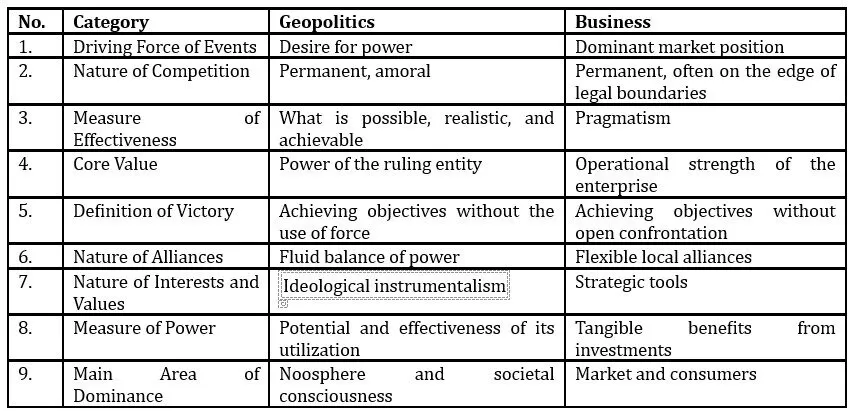
Table 1. Geopolitical Realism and Business Realism. Key Categories of Analysis
Source: Author’s own elaboration.
The Foundations of Business Realism
Geopolitical realism, which is based on rigid principles of competition between states, also finds its reflection in the international business environment (see Table 1). The modern business world, much like geopolitics, is characterized by a continuous struggle for survival, expansion, and dominance in the geo-economic space (Haliżak, 2012). This requires businesses to adopt pragmatic and realistic strategies that reject sentimentality and prioritize operational efficiency (Krause, 2004). Business realism is rooted in a pragmatic approach that recognizes the fundamental objective of economic activity: maximizing long-term value for owners through the sale of goods or services. Ethical conduct does not imply deviating from this goal but rather achieving it in an honest and fair manner. This means adhering to core principles such as integrity, avoiding coercion, and respecting property rights-elements that foster the trust essential for a company’s sustainable growth. Business realism is critical of approaches such as Corporate Social Responsibility (CSR) and the Stakeholder Doctrine, arguing that they divert attention from a company’s primary objective toward external, often vague, social goals. Instead, the realist approach emphasizes internal fairness, ensuring that rewards and compensation are distributed based on individual contributions to achieving organizational objectives. This perspective promotes long-term growth by focusing on creating enduring value rather than short-term profits, thereby ensuring a company’s stability and sustainable development (Sternberg, 2010).
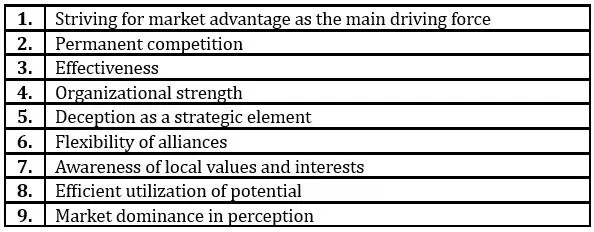
Table 2. Fundamentals of Business Realism in Geo-economics
Source: Author’s own elaboration.
Table 2 presents the fundamental principles that businesses can adopt as a pragmatic foundation for effective competition in the international arena. This framework encompasses a strategic approach to competition, efficient resource management, and market perception dominance, forming the core tenets of business realism.
Just as the driving force in geopolitics is the pursuit of power, in business, it is the relentless ambition to achieve market dominance. The primary objectives are survival in a highly competitive environment and securing a sustainable advantage over rivals. In business, there is no state of permanent “peace”—competition is continuous and unrelenting. The battle for market share, innovation, and resources takes place daily, with firms constantly engaging in strategic actions to gain a competitive edge.
A defining characteristic of a realist business approach is pragmatism. Firms must set attainable goals and undertake actions that are both efficient and aligned with real market opportunities. Success is measured by tangible outcomes rather than by reputation or ethical considerations alone. Moreover, as in geopolitics, in business, it is not declarations but operational strength—understood as the ability to shape market dynamics—that determines a firm’s standing. Business strength comprises resource availability, innovation capacity, and the ability to impose one’s competitive position on others. Additionally, the highest form of success in business is achieving strategic objectives without direct confrontation. Negotiation, sales, marketing, and public relations strategies can leverage ambiguity and divert competitors’ attention from a company’s actual activities (Gagliardi & Sun, 2005).
In business, there are no permanent alliances—strategic partners can become competitors, while rivals may emerge as allies when mutual interests align. The principle of “the enemy of my enemy is my ally” is equally applicable in strategic business partnerships. Corporate values, therefore, are not necessarily universal; rather, they serve as strategic instruments that should be adapted to the specific market context. What proves effective in one market may require modifications in another. The key lies in aligning corporate values with the nuances and competitive landscape of the target market.
Similar to geopolitical power, a firm’s market position is determined not only by the magnitude of its resources but also by its ability to deploy them effectively. Investments in development must be strategically sound and yield measurable business benefits. If a firm possesses leverage in a particular domain, it must seek ways to extend its influence into new competitive arenas.
Ultimately, the goal of business realism extends beyond resource acquisition or market expansion—it is about achieving dominance in consumer perception. Becoming the market leader in the minds of customers and cultivating a strong brand presence provides a competitive advantage that transcends purely financial or operational factors.
Characteristics of Modern Buyer Negotiations
In today’s world of buyer negotiations (Ochmański & Polan, 2022; Prościak, 2024), we observe a significant shift away from traditional, relationship-based methods toward increasingly automated processes that leverage various techniques and tools (Polan et al., 2024). This transformation encompasses multiple aspects, including the application of algorithms, persuasion techniques, neurolinguistic programming (NLP), as well as behavior automation and emotional control.
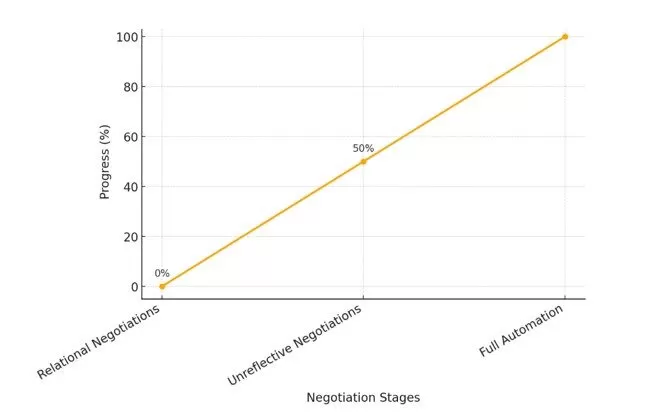
The evolution of the negotiation process (Thompson & Leonardelli, 2004) appears to follow a trajectory from relational negotiation, through a reflexive approach, toward fully automated negotiations. A model of this progression is illustrated in figure 1.
Fig 1. Evolution of negotiation from relational to full automation
It appears that we are currently transitioning from unreflective negotiations to those increasingly based on automation. The art of dispute resolution (Schopenhauer, 2022) and conscious control of body language are no longer sufficient (Navarro & Karlins, 2008). Negotiators are increasingly relying on frameworks, algorithms, and techniques designed to enhance the efficiency of negotiation processes (Mayer, 2018). Recognizing that all negotiations involve conflict, professionals incorporate conflict resolution methods into their responses (Fisher et al., 2011), including those employed by intelligence agencies in particularly challenging negotiation scenarios (Voss & Raz, 2016).
The use of manipulation techniques (Hartley & Karinach, 2011), persuasion strategies (Goldstein et al., 2008), and principles of neurolinguistic programming (NLP) (Raudner, 2012) allows for a deeper understanding of the counterpart’s needs while improving the effectiveness of argumentation (Brdulak & Brdulak, 2000). Professionals also study advanced problem-solving (Shoblom & Pate, 2018) and dispute resolution techniques (Rusk & Miller, 1993), linguistic communication (Bednarski, 2024), principles of social engineering (Hadnagy & Wilson, 2012), active listening skills (Carnegie & Associates, 2019), and the art of questioning (Miller, 2004). Training further includes strategies for managing situations where emotions and internal dialogue might disrupt the negotiation process (Goleman, 2013).
However, the education of professional negotiators does not stop there. Increasingly, subconscious-level programming techniques are being applied (Murphy, 2007), and discussions about neurohacking as a modern method of rewiring the brain and nervous system to achieve mental and emotional software upgrades are gaining traction (Wyszomirski, 2022).
Within sales and buyer negotiation training, there is a growing emphasis on developing skills that minimize the influence of emotions and sensory perceptions, leading to more rational decision-making. This approach aims to reduce subjective reactions and promote a more objective perspective on negotiation scenarios. However, excessive automation of responses and the mechanical application of techniques without deeper emotional awareness may yield unintended consequences.
Reflecting on whether people are becoming “negotiation robots,” several key aspects come to light. On the one hand, the ability to control emotions and automate behaviors can enhance negotiation efficiency. On the other, it may lead to a loss of authenticity and empathy, which are fundamental to human relationships. Negotiations that focus solely on techniques (Szewczak, 2020) and strategic execution risk losing the essence of cooperation that defines the relational negotiation model.
The key to effective negotiations in the future may lie in striking a balance between automation and a relational approach. While techniques, algorithms, and automation can enhance negotiation processes, the human aspect of these interactions must not be overlooked. The development of emotional intelligence skills—such as empathy and active listening—is as crucial as technical preparation for negotiations. Notably, even today, H2AI empathetic communication has reached a level where artificial intelligence tools rival human capabilities in this domain.
As technology becomes more integrated into negotiations, finding the right balance between efficiency and authenticity will be critical. Otherwise, there is a risk that negotiators will become overly automated in their behaviors, losing the ability to establish genuine connections—connections that are the foundation of any successful negotiation.
Mental reprogramming, negotiation conditioning, and reaction automation—most negotiation trainers dream of their students, as practitioners, no longer having to consciously recall learned techniques, reactions, or principles. Instead, these elements should become automatic habits, almost instinctive reflexes. Such automation is nothing more than operating according to an algorithm. But does this not lead us to the next step—full automation of the negotiation process and, in the future, entrusting negotiations to AI-driven automated negotiators? If so, will H2AI-level negotiations still leave room for business realism?
Rules of Negotiation Realism in Buyer Negotiations
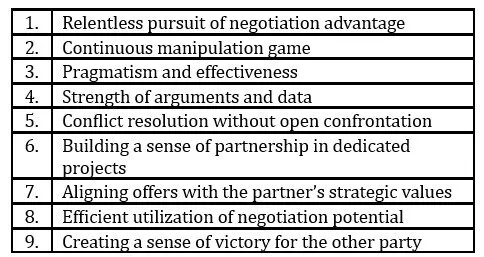
For a Key Account Manager (KAM) and Category Manager (CM) to effectively collaborate and negotiate within business relationships, they can rely on a set of negotiation realism principles. These principles are grounded in a pragmatic approach, mutual understanding of interests, and efficient relationship management, in alignment with the rules of business realism (corresponding to the categories outlined in table 3).
Table 3. Fundamentals of Negorealism
Source: Author’s own elaboration.
The principles of negorealism in buyer negotiations are rooted in business realism, emphasizing pragmatic relationship management and the pursuit of a balanced alignment of interests. In the Key Account Manager (KAM) – Category Manager (CM) dynamic, negotiations evolve into a process that demands data-driven decision-making and strategic application of negotiation techniques to secure a competitive advantage in high-stakes environments.
A realist approach to negotiations highlights the continuous interplay of manipulation and persuasion, while remaining focused on achieving effective, pragmatic outcomes. The strength of arguments and data, increasingly supported by AI-driven analytics, serves as the foundation for constructing compelling and objective proposals, thereby minimizing open conflicts. Mirroring geopolitical realism, where power and effectiveness take precedence, negorealism assumes that the value of partnership in dedicated projects lies in adapting offers to the strategic values and objectives of the counterpart, while simultaneously securing mutual benefits. A key function of negorealism is the efficient utilization of negotiation potential, leveraging both process automation and structured frameworks designed to give the counterpart a perceived victory, while reinforcing one’s own negotiation position. This approach fosters long-term relationships and stable outcomes, aligning with the future trajectory of H2AI-driven business interactions. In a landscape where negotiations are increasingly supported by AI, the principles of negorealism underscore the importance of balancing pragmatism and efficiency with the principle of partnership. This equilibrium enhances the sustainability and effectiveness of business engagements in an evolving market environment.
The principles of negotiation realism for the relationship between Key Account Managers (KAMs) and Category Managers (CMs) reflect a pragmatic approach to collaboration and negotiations. Each party aims to maximize financial benefits for their respective organizations while maintaining a long-term relationship. KAMs focus on increasing the value of their offer, whereas CMs strive to optimize pricing and profitability to gain a competitive edge in the market. Although both sides continuously negotiate for the most favorable terms, their cooperation aligns with shared objectives, such as high sales volume and product turnover. As representatives of suppliers, KAMs must recognize that negotiations with CMs are an ongoing process, requiring flexibility in adapting their offer to the dynamically evolving market conditions. Conversely, CMs base their decisions on realistic sales targets, only committing to actions that yield measurable financial benefits. Both parties build their strategies on hard data, including sales forecasts, profit margins, and competitive analysis. This data-driven approach ensures that decisions are grounded in facts rather than emotions, allowing both KAMs and CMs to assess opportunities and organizational needs realistically.
Negorealism in KAM-CM relations implies the effective management of negotiation potential while avoiding open confrontation. KAMs should develop resilience against manipulative techniques employed by CMs, leveraging tools such as pricing flexibility and promotional strategies to achieve their objectives while maintaining positive relationships. On the other hand, CMs utilize a comprehensive range of influence techniques, enabling them to negotiate pragmatically while fostering stable supplier relationships. Strategic adaptability is essential in the dynamic landscape of commercial negotiations, as trade alliances frequently shift, necessitating flexibility to secure mutual benefits. Both KAMs and CMs must demonstrate a readiness to adjust their strategies in response to changing market conditions. A KAM’s offer should align with the strategic values of the retail chain, facilitating the development of a competitive advantage and ensuring alignment with market dynamics and consumer needs. The effective utilization of resources is fundamental to achieving market leadership. KAMs, by managing product availability and promotional activities, must deliver value to both the retail network and their own organization. CMs, in turn, maximize the efficiency of shelf space by introducing high-potential products. Ultimately, both parties must ensure that the brand and its products are perceived favorably by the network’s consumers. Strengthening brand positioning through joint marketing initiatives and investments in quality and recognition generates mutual benefits, fostering long-term consumer loyalty.
Conclusion
The article highlights the importance of negotiation realism as a foundation for effective negotiations in the era of automated systems. Negorealism, by integrating ethics, pragmatism, and efficiency, provides a strong framework for negotiations in which AI plays an increasingly significant role. Adopting this approach enables a balance between automation and authenticity, enhancing efficiency and the stability of long-term business relationships. The article concludes with a reflection on the future of H2AI negotiations, where the key challenge will be maintaining the human element in automated processes while preserving the values and objectives of business realism.
Acknowledgment
This article is part of the author’s independent research project titled AINA – Artificial Intelligence Negotiation Algorithms, which explores the integration of AI in business negotiation systems. The research presented in this paper was supported by a research grant from Cracow University of Economics (UEK) under the Support for Academic Staff program (WAK). The author gratefully acknowledges this financial support.
References
Bednarski, A. (2024). Słowa mocy. Tajniki komunikacji językowej w handlu i negocjacjach. Tres Gatos.
Beer, F., & Hariman, R. (Red.). (1996). Post-Realism: The Rhetorical Turn in International Relations. Michigan State University Press. http://www.jstor.org/stable/10.14321/j.ctt7zt5q8
Brdulak, H., & Brdulak, J. (2000). Negocjacje handlowe. Polskie Wydawnictwo Ekonomiczne.
Camp, J. (2005). Zacznij od nie. Techniki negocjacji, których profesjonaliści nie chcą zdradzić.
Carnegie, D., & & Associates. (2019). Listen!: The Art of Effective Communication: The Art of Effective Communication. G&D Media.
Dawson, R. (2010). Secrets of power negotiating for salespeople. Red Wheel/Weiser. https://books.google.pl/books?hl=pl&lr=&id=C91EDwAAQBAJ&oi=fnd&pg=PT8&dq=Roger+Dawson+Power+Negotiation&ots=gk8FQivmP3&sig=wpG7BSw41K76XlG0tiFeb-eUS8w&redir_esc=y#v=onepage&q=Roger%20Dawson%20Power%20Negotiation&f=false
Fisher, R., Ury, W., & Patton, B. (2011). Getting to Yes: Negotiating Agreement Without Giving In. Penguin Books.
Gagliardi, G., & Sun, T. (2005). Sztuka wojny. Sztuka marketingu.
Goldstein, N., Martin, S., & Cialdini, R. (2008). Yes!: 50 scientifically proven ways to be persuasive. Simon and Schuster.
Goleman, D. (2013). Focus: The Hidden Driver of Excellence. Harper.
Hadnagy, C., & Wilson, R. (2012). Socjotechnika: Sztuka zdobywania władzy nad umysłami. Helion.
Haliżak, E. (2012). Pojęcie i istota przestrzeni geoekonomicznej. W Geoekonomia (s. 30–42). Scholar.
Hartley, G., & Karinach, M. (2011). Podręcznik manipulacji. Bellona.
Kirschner, J. (2008). 8 dogmatów wywierania wpływu. Helion.
Kowalska-Drozd, S. (2024, październik 31). Biznes na Nowych Zasadach: Dlaczego Warto Postawić na H2H? Rzeka Zmian. https://www.linkedin.com/pulse/biznes-na-nowych-zasadach-dlaczego-warto-postawi%C4%87-h2h-kowalska-drozd-txyyf/
Krause, D. (2004). Sztuka wojny w biznesie. Helion.
Mayer, R. (2018). Jak wygrać każde negocjacje. Nie podnosząc głosu, nie tracąc zimnej krwi i nie wybuchając gniewem. MT Biznes.
Miller, J. (2004). QBQ! The Question Behind the Question: Practicing Personal Accountability at Work and in Life.
Morgenthau, H. (2010). Polityka między narodami: Walka o potęgę i pokój.
Murphy, J. (2007). The Power of Your Subconscious Mind. BN Publishing.
Navarro, J., & Karlins, M. (2008). What Every Body Is Saying: An Ex-FBI Agent’s Guide to Speed-Reading People. William Morrow Paperbacks.
Ochmański, M., & Polan, W. (2022). Ja kupiec ja sprzedawca. Rideró.
Polan, W. (2024, listopad 1). AINA Position Defence Algorithm 29082024 testing. https://wpconsult.blogspot.com/2024/08/aina-position-defence-algorithm.html
Polan, W., Świerczyńska, J., & Odrobina, A. (2024). Artificial Intelligence Negotiation Algorithms: Pioneer-ing AI Negotiation Algorithms for Business.
Prościak, A. (2024). Kupiec alfa. Przewodnik po efektywnych zakupach i negocjacjach. Helion.
Raudner, J. (2012). NLP wg Dantego. Jak zgodnie z własnymi wartościami rozwiązywać problemy w życiu prywatnym i zawodowym. Złote Myśli.
Rusk, T., & Miller, P. (1993). The Power of Ethical Persuasion: From Conflict to Partnership at Work and in Private Life.
Schopenhauer, A. (2022). Sztuka prowadzenia sporów. SBM.
Shoblom, T., & Pate, L. (2018). ACE Your Decisions: ACES and the Angry Employee. CreateSpace Independent Publishing Platform.
Sternberg, E. (2010). The Need for Realism in Business Ethics.
Sykulski, L. (2014). Geopolityka: Skrypt dla początkujących. Wydawnictwo Naukowe Grategia.
Szewczak, K. (2020). Techniki i praktyki negocjacyjne. Zbiór 65 najskuteczniejszych metod, a także sposobów obrony przed manipulacją w negocjacjach.
Thompson, L., & Leonardelli, G. (2004). The Big Bang: The Evolution of Negotiation Research. 113–117.
Voss, C., & Raz, T. (2016). Never Split the Difference: Negotiating as if Your Life Depended on It. Harper Business.
Wolfowitz, P. (2009). Realism. 174, 66–68. JSTOR.
Wyszomirski, K. (2022). Neurohacking. Purple Book.