Edita Carmen BOKOR, Alina SAVA, Manuel Victoraș Stănilă and Madlena Nen
The Bucharest University of Economic Studies, Romania
Volume 2025,
Article ID 690611,
Journal of Eastern Europe Research in Business and Economics,
9 pages,
DOI: 10.5171/2025.690611
Received date: 4 April 2025; Accepted date: 22 July 2025; Published date: 16 September 2025
Academic Editor: Alina Badulescu
Cite this Article as:
Edita Carmen BOKOR, Alina SAVA, Manuel Victoraș Stănilă and Madlena Nen (2025)," Tourism, Accessibility and 112 Calls: Constanța County Case Study", Journal of Eastern Europe Research in Business and Economics Vol. 2025 (2025), Article ID 690611, https://doi.org/10.5171/2025.690611
Tourism creates unique pressures on emergency services, particularly in high-season destinations. This study examines the relationship between seasonal tourist influx and 112 emergency call volumes in Constanța County, Romania, between 2018 and 2024. Using a quantitative design, the research analyzes official datasets from the Special Telecommunications Service (STS) and national statistics to assess correlations between tourist numbers and agency-specific emergency calls. The findings reveal strong positive associations between tourist presence and call to the police (r = 0.944), ISU-SMURD (r = 0.963), and the gendarmerie (r = 0.952) during August, the peak tourist month. By contrast, ambulance calls showed no statistically significant variation linked to tourism. Regression analysis confirmed that nearly 89% of the variation in police call volume is explained by tourist presence in August. Beyond these statistical patterns, the study reflects on accessibility challenges in emergency communication, highlighting the contribution of digital tools such as SMS113 and the Apel 112 app in supporting both tourists and persons with disabilities. The results underscore the importance of multilingual support, strategic resource planning, and inclusive communication during high-demand periods. Overall, this case study provides relevant insights for emergency services management in tourist-heavy regions and calls for broader national and European-level research to strengthen resilience, equity, and responsiveness in emergency call systems.
Facing an emergency is always a challenge but experiencing one while away from home can be even more difficult. In many regions, the influx of tourists corresponds with an increase in emergency incidents. Tourism significantly impacts both society and the economy, offering opportunities as well as challenges—especially for public safety services. One area requiring increased attention is how seasonal tourism affects emergency response systems. During peak travel periods, the demand for emergency interventions rises, potentially impacting the accessibility and efficiency of services. Effective emergency management and wise resource allocation depend on understanding these seasonal dynamics.
In popular tourist destinations, such as coastal regions, the number of visitors can directly influence the volume of emergency calls. Giglio et al. (2023) emphasize that the correlation between increased tourist activity and emergency medical incidents is particularly strong during the summer. Heat-related illnesses such as exhaustion and stroke tend to surge under extreme weather conditions. In the Apulia region of Italy, Giglio et al. note a notable rise in emergency medical calls due to these health complications during tourist peaks. Similarly, Solis et al. (2022) observed significant changes in emergency call patterns linked to seasonal tourism, underlining the need for adaptive resource planning. Day et al. (2021) further suggest that environmental hazards—like heatwaves and severe storms—can amplify this effect. Cugliari et al. (2022) argue that local authorities in high-tourism zones must adopt proactive strategies to cope with seasonal surges in emergency demand.
Another key factor is tourist behavior and risk perception. Visitors unfamiliar with their surroundings—beaches, mountains, caves—may unknowingly expose themselves to danger. Cui et al. (2023) note that limited awareness of local hazards heightens vulnerability and leads to more emergency incidents. For instance, lack of understanding about aquatic conditions can increase the risk of drowning and prompt more search and rescue operations during summer months. Gabor et al. (2023) highlight a trend toward experiential tourism—medical, adventure, and ecotourism—which can trigger new types of emergencies and demand flexible public safety systems.
Despite the growing interest in the relationship between tourism and emergency demand, there is a noticeable lack of research on accessibility for tourists with disabilities. Hanganu et al. (2022) acknowledge the strain on health services during peak tourism, but little data exists on how these services accommodate accessibility needs. Voda et al. (2022) emphasize that tourists’ risk perceptions further influence emergency behavior, while Surugiu et al. (2022) advocate for resilient emergency systems that are inclusive. However, accessibility planning remains underdeveloped in many regions.
Based on this context, the present study seeks to answer the following research question: What is the impact of seasonal tourism on the volume and distribution of 112 emergency calls in Constanța County, Romania, and how is this related to the accessibility of emergency services for tourists?
Drawing on both prior research and empirical data, the study proposes two hypotheses: H1: The volume of 112 emergency calls in Constanța County significantly increases during the peak summer tourism month (August), compared to off-season months like January. H2: The distribution of emergency calls varies by incident type, with a higher frequency of health-related, ambulance, and police calls during peak tourist season.
Understanding the relationship between tourism and emergency call patterns is essential for improving emergency response logistics. These insights can help public authorities, emergency agencies, and tourism stakeholders collaborate in designing safer, more accessible environments for all travelers.
Methodology
This study examines how seasonal tourism affects the volume and distribution of 112 emergency calls in Constanța County, Romania, using official statistics from 2018–2024. Data were obtained from the Special Telecommunications Service (STS) and the National Institute of Statistics, covering total annual validated calls, January–August monthly volumes, agency-specific distributions (ambulance, police, ISU-SMURD, gendarmerie, other), and August tourist counts based on hotel overnight stays. Only validated emergency calls were included; prank, accidental, and non-emergency calls were excluded. Because the tourism series reflects hotel stays only, it likely underestimates true tourist presence and may attenuate correlations.
The analysis followed a quantitative design combining descriptive statistics, correlation tests, and ordinary least squares regression to assess whether tourism predicts agency-specific call volumes during peak season. Data cleaning, tables, and primary inference were completed in JASP, with results independently reproduced in the R console for transparency and diagnostics (normality checks, residual plots, and robustness tests) using custom scripts (JASP Team, 2023; R Core Team, 2024). Finally, the discussion considers accessibility implications—multilingual support and alternative channels such as SMS113 and the Apel 112 app—for equitable service delivery during high-demand periods.
Results and Discussion
Annual and Seasonal Trends in Emergency Calls
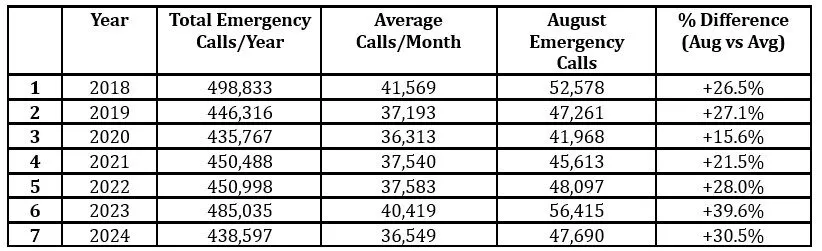
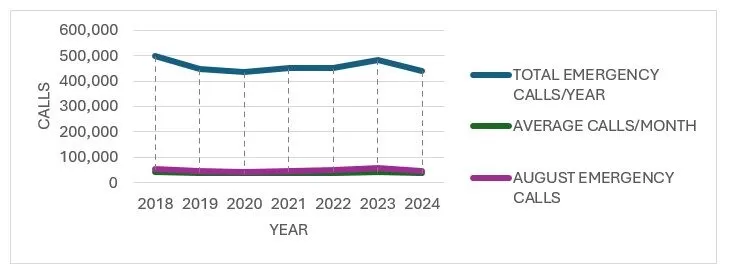
The results presented in Table 1 and Figure 1 show that, although the annual number of emergencies calls in Constanța County remained relatively steady between 2018 and 2024, August consistently registered a notable escalation in demand. Relative to monthly averages, August call volumes increased by 15.6 percent in 2020 and by almost 40 percent in 2023, illustrating the pronounced seasonal influence of tourism. These recurrent surges underscore the intensified operational burden placed on emergency services during peak summer months, with 2023 recording the most substantial deviation.
Table 1: Annual 112 Emergency Calls and Seasonal Variation in Constanța County (2018–2024)
Source: Authors’ calculation based on Special Telecommunications Service (STS, 2024)
Table 1 provides the numerical evidence of annual call volumes and seasonal variation, while Figure 1 visually illustrates these trends over time. Taken together, they show not only the relative stability of yearly totals but also the recurring spikes in August, which stand out clearly in the graphical representation.
Fig 1: Trends in Total, Monthly Average, and August 112 Emergency Calls in Constanța County (2018–2024
Source: Source: Data compiled by the author based on Special Telecommunications Service (STS) (2024), Statistici apeluri 112, [Online]. Available at: https://sts.ro/ro/statistici-apeluri-112/ (Accessed: 15 March 2025).
Overall, the data highlight a relatively stable call volume over time, with August consistently showing seasonal surges that place additional pressure on emergency services in Constanța County. Building on this trend, the following section examines how call distribution varies across specific agencies.
Emergency Calls by Agency
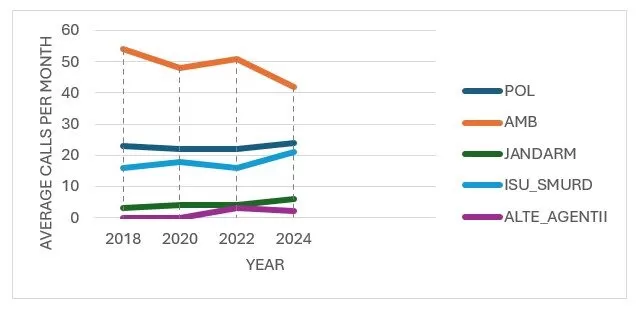
Figure 2 provides a comparative analysis of emergency call volumes across different agencies for the years 2018, 2020, 2022, and 2024, in Constanța County. The findings reveal an overall increase in the number of emergency calls received by the police, gendarmerie (Jandarmeria), and ISU-SMURD. In contrast, ambulance service calls have experienced a slight decline, while calls directed to other agencies have shown a marginal increase.
Fig. 2. Distribution of Emergency Calls by Agency, Constanța County (2018-2024)
Source: Source: Data compiled by the author based on Special Telecommunications Service (STS) (2024), Statistici apeluri 112, [Online]. Available at: https://sts.ro/ro/statistici-apeluri-112/ (Accessed: 15 March 2025).
Seasonal Variations in Police Calls
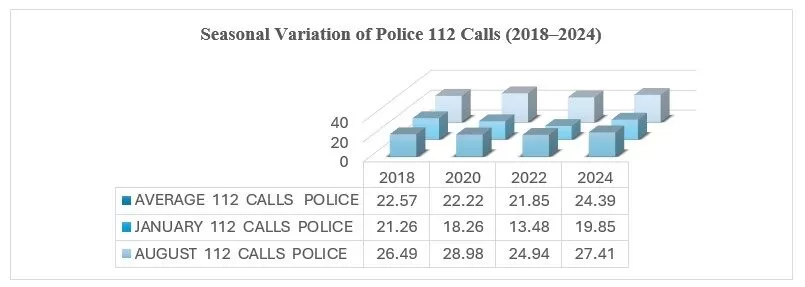
Based on Table 2 and Figure 3, a comparative analysis was carried out to assess seasonal differences in police-related emergency calls across selected years, using January as a low-tourism reference point. The variation between the two months was calculated with the percentage difference formula, (August Volume − January Volume) / January Volume × 100. The results show that, on average, police calls were 38.5 percent higher in August than in January, underscoring the pronounced seasonal effect of tourism on emergency demand patterns.
Table 2. Seasonal Variation in Police Calls
Source: Data compiled by the author based on Special Telecommunications Service (STS) (2024), Statistici apeluri 112, [Online]. Available at: https://sts.ro/ro/statistici-apeluri-112/ (Accessed: 15 March 2025).
Table 1 summarizes the annual totals and seasonal differences, whereas Figure 1 offers a graphical view of the same data, clearly highlighting the peaks in August compared with the monthly average.
Fig. 3. Seasonal Variation in Police Calls
Source: Data compiled by the author based on Special Telecommunications Service (STS) (2024), Statistici apeluri 112, [Online]. Available at: https://sts.ro/ro/statistici-apeluri-112/ (Accessed: 15 March 2025).
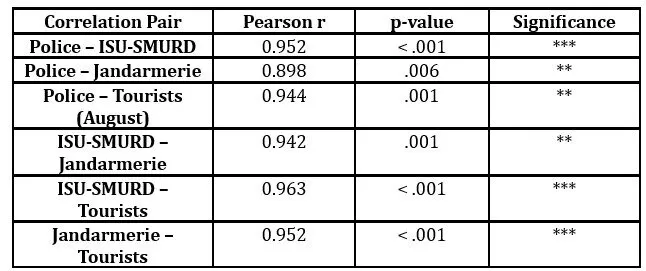
Following the descriptive analysis presented in Figure 3 on the seasonal variation of police calls, the next step was to examine whether these patterns are statistically associated with call volumes across other agencies and external factors, such as tourism. To capture these relationships, we performed correlation analyses using three methods—Pearson, Spearman, and Kendall. Table 3 reports the correlation coefficients, providing insights into both linear and non-linear associations between emergency call volumes and the number of tourists recorded in August.
Table 3 Pearson, Spearman, and Kendall Correlation
* p < .05, ** p < .01, *** p < .001 † Vovk-Sellke Maximum p-Ratio: Based on the p-value, the maximum possible odds in favour of H₁ over H₀ equals 1/(-e p log(p)) for p ≤ .37 (Sellke, Bayarri, & Berger, 2001).
Source: Author’s own calculation based on data from the Special Telecommunications Service (STS) and Romanian National Institute of Statistics (INSSE), August data (2018–2024).
Strong and Significant Correlations
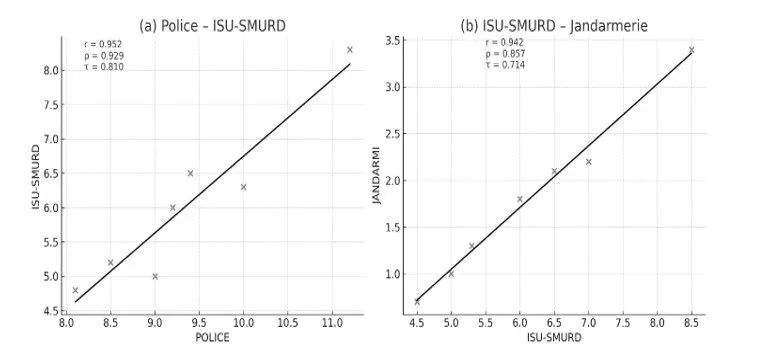
The analysis revealed strong and statistically significant relationships. Police and ISU-SMURD (emergency rescue) calls were highly correlated (Pearson r = 0.952, p < .001; Spearman ρ = 0.929, p = .007; Kendall τ = 0.810, p = .011), indicating that an increase in police calls was consistently associated with higher ISU-SMURD demand.
Tourism also showed a marked influence on emergency activity. Police calls were strongly linked to the number of tourists in August (r = 0.944, p = .001; ρ = 0.964, p = .003; τ = 0.905, p = .003), with Spearman’s rank correlation highlighting a robust monotonic relationship. A similar pattern emerged for ISU-SMURD, where tourist presence strongly predicted emergency rescue calls (r = 0.963, p < .001; ρ = 0.964, p = .003; τ = 0.905, p = .003).
Inter-agency coordination was also evident: ISU-SMURD and the gendarmerie showed strong correlations (r = 0.942, p = .001; ρ = 0.857, p = .024; τ = 0.714, p = .030), suggesting frequent co-involvement in incident response. Finally, gendarmerie calls increased with tourist numbers (r = 0.952, p < .001), although nonparametric measures were weaker (ρ = 0.714, p = .088; τ = 0.619, p = .069), indicating that while tourism elevates gendarmerie activity overall, the trend is less consistent.
Weak or Non-Significant Correlations
In contrast, ambulance calls showed no statistically significant associations with other emergency agencies (Pearson r = 0.286–0.468, all p > .05). Likewise, calls to other agencies were not significantly related to tourism (r = 0.399, p = .375; ρ = –0.036, p = .963; τ = –0.143, p = .773), indicating that these services were not so influenced by seasonal tourist inflows. Figure 4 illustrates these findings, emphasizing the strong link between tourism and calls to the police, ISU-SMURD, and gendarmerie, which reflects the heightened demand for public safety and rescue operations during peak tourist seasons.
Fig. 4: Scatter Plots
Source: Author’s own calculation based on data from the Special Telecommunications Service (STS) and Romanian National Institute of Statistics (INSSE), August data (2018–2024).
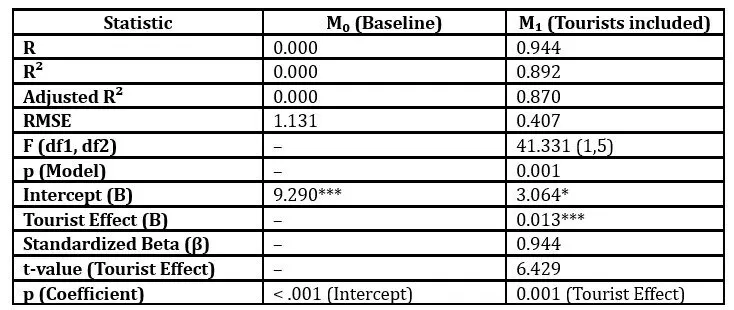
We conducted a linear regression to assess the impact of the number of tourists in August on police emergency calls. The model shows a strong explanatory power, with R² = 0.892 (89.2% of the variance explained) and Adjusted R² = 0.870, which remains close to the original R², confirming model robustness. The RMSE = 0.407 indicates good predictive accuracy.
Model fit was statistically significant (F(1,5) = 41.331, p = 0.001), demonstrating that the number of tourists in August has a substantial effect on police calls. The regression coefficients further support this: the intercept was 3.064 (p = 0.026), while the tourist effect was 0.013 (p = 0.001, standardized β = 0.944), meaning that for every additional tourist, police emergency calls increase by 0.013 units on average.
Note. M₀ = baseline model (intercept only); M₁ = model including Number of Tourists (August). Source: Author’s own calculation based on STS and INSSE data (2018–2024).
Source: Author’s own calculation based on data from the Special Telecommunications Service (STS) and the Romanian National Institute of Statistics (INSSE), August data (2018–2024).
Conclusion
This article examined the seasonal impact of tourism on 112 emergency call volumes in Constanța County, Romania, focusing on demand patterns and accessibility of emergency services. Using data from 2018–2024, the study employed quantitative methods to evaluate how tourist influx during peak months affects the distribution of emergency calls across agencies.
H1: The volume of 112 emergency calls in Constanța County significantly increases during peak summer tourism months compared to off-season periods.
The analysis supports Hypothesis 1. Regression results (see Table 4) confirm that the number of tourists in August strongly predicts the volume of police calls (R² = 0.892, p = 0.001). Correlation tests also show highly significant relationships for ISU-SMURD (r = 0.963) and gendarmerie (r = 0.952). These findings highlight that tourism peaks place additional pressure on emergency services and reinforce the need for seasonal resource planning.
H2: The distribution of emergency calls varies based on the nature of incidents, with a higher frequency of health-related and accident-related calls during peak tourist season.
Hypothesis 2 is not supported. Ambulance-related calls did not show statistically significant correlations with tourism, suggesting that ambulance demand is shaped more by local population health dynamics than by seasonal tourism.
Key Insights
The results emphasize an important level of inter-agency coordination, particularly between police and ISU-SMURD (r = 0.952) and between ISU-SMURD and the gendarmerie. These strong associations reflect the collaborative nature of Romania’s emergency response system during complex, multi-agency incidents. While ambulance services appear less impacted by tourism surges, their role remains crucial in maintaining year-round healthcare coverage.
Romania has taken steps to improve accessibility in emergency communication. The Apel 112 app offers location sharing and multilingual support, while SMS113 provides a dedicated channel for citizens with hearing or speech impairments. However, SMS113 remains limited to Romanian citizens and requires prior registration, which reduces its utility for international tourists. Expanding inclusive and multilingual communication tools will be essential to ensure that all individuals—regardless of nationality or ability—can access emergency services when needed.
Limitations and Future Research
The study focuses on Constanța County, which may limit the generalizability of findings to other regions. Additionally, the analysis is based on call volume alone and does not account for response times, call outcomes, or the profiles of callers. These factors merit further investigation to better understand how accessibility and efficiency intersect in emergency service delivery.
Environmental factors, such as heat waves or severe weather, also influence emergency demand and tourist flows. Future research could examine how climate, infrastructure capacity, and event-based tourism affect emergency response dynamics. Moreover, investigating how emerging technologies—such as AI-driven triage and real-time analytics—can enhance resource allocation may offer valuable solutions for managing high-demand periods.
To build a more inclusive emergency system, additional efforts should focus on collecting anonymized data related to user accessibility needs, strengthening multilingual support, and promoting awareness of alternative communication platforms. Romania’s continued investment in digital tools and inter-agency coordination positions its emergency services to serve both residents and tourists with greater responsiveness, fairness, and accessibility.
Acknowledgement
This paper is the result of research conducted within the Doctoral School of Management at The Bucharest University of Economic Studies, Romania.
References
Bokor, E., Lățea, C., Sava, A., & Nen, M. (2024). When every second counts. Proceedings of the International Conference on Business and Economics (ICBE 2024), Bucharest University of Economic Studies, Romania, 429-444. https://doi.org/10.24818/IMC/2024/04.07
Cugliari, L., Cerase, A., & Amato, A. (2022). Tsunami risk perception, a state-of-the-art review with a focus in the neam region. Frontiers in Earth Science, 10. https://doi.org/10.3389/feart.2022.995536
Cui, A., Fountain, J., & Espiner, S. (2023). Communicating natural hazard risks to chinese visitors: a case study from new zealand. Frontiers in Sustainable Tourism, 2. https://doi.org/10.3389/frsut.2023.1192124
Day, J., Chin, N., Sydnor, S., Widhalm, M., Shah, K., & Dorworth, L. (2021). Implications of climate change for tourism and outdoor recreation: an Indiana, USA, case study. Climatic Change, 169(3-4). https://doi.org/10.1007/s10584-021-03284-w
Gabor, M., Oltean, F., & Coca, A. (2023). Innovative tourism products as sustainable solutions for emerging economies. Economics, 11(1), 69-83. https://doi.org/10.2478/eoik-2023-0007
Giglio, O., Triggiano, F., Apollonio, F., Buonavoglia, C., Capozzi, L., Camero, M., … & Montagna, M. (2023). The safe return of face-to-face teaching in the post-covid-19 era at a university in southern Italy: surface monitoring as an early warning system. Applied Sciences, 13(24), 13214. https://doi.org/10.3390/app132413214
Hanganu, B., Iorga, M., Pop, L., & Ioan, B. (2022). Socio-demographic, professional and institutional characteristics that make romanian doctors more prone to malpractice complaints. Medicina, 58(2), 287. https://doi.org/10.3390/medicina58020287
JASP Team (2023). JASP (Version 0.18.1) [Computer software]. University of Amsterdam. Available at: https://jasp-stats.org/
National Institute of Statistics (INSSE) (2024), Statistici de turism, [Online]. INSSE. [Accessed: 15 March 2025]. Available at: https://insse.ro
Solis, A., Asgary, A., Khan, N., Wimaladasa, J., & Sabet, M. (2022). Emergency calls in the city of Vaughan (Canada) during the covid-19 pandemic: a spatiotemporal analysis., 1-8. https://doi.org/10.4995/carma2022.2022.15087
Surugiu, M., Vasile, V., Mazilescu, R., Surugiu, C., & Vasile, R. (2022). Determinants of resilience building in tourism: a case study on Romania in the context of the pandemic crises. Journal of Tourism Management Research, 10(1), 15-31. https://doi.org/10.18488/31.v10i1.3237
Special Telecommunications Service (STS) (2024), Statistici apeluri 112, [Online]. STS. [Accessed:15 March 2025]. Available at: https://sts.ro/ro/statistici-apeluri-112/
Sellke, T., Bayarri, M. J., & Berger, J. O. (2001). Calibration of p values for testing precise null hypotheses. The American Statistician, 55(1), 62–71. https://doi.org/10.1198/000313001300339950
Velea, L., Gallo, A., Bojariu, R., Irimescu, A., Crăciunescu, V., & Puiu, S. (2022). Holiday climate index: urban application for urban and rural areas in Romania. Atmosphere, 13(9), 1519. https://doi.org/10.3390/atmos13091519
Voda, M., Dumitrache, N., Negru, R., Du, Q., & Gan, C. (2022). Rural geosystems’ future in the smartphone world: the inception of romanian tourist sites. Sustainability, 14(15), 9652. https://doi.org/10.3390/su14159652