Wroclaw University of Economics and Business, Wroclaw, Poland
Volume 2026,
Article ID 421813,
Journal of Eastern Europe Research in Business and Economics,
10 pages,
DOI: doi.org/10.5171/2026.421813
Received date: 23 January 2026; Accepted date: 24 January 2026; Published date: 12 March 2026
Cite this Article as:
Malgorzata ROGOWSKA-SAWICZ (2026)," Remodelling Local Development Based on Just Transition Funds: Case Study of Polish Post-Coal Subregion", Journal of Eastern Europe Research in Business and Economics Vol. 2026 (2026), Article ID 421813, https://doi.org/10.5171/2026.421813
Wałbrzych Subregion was based on the coal industry until 1991 when the last mine was closed. The area still faced the consequences of unfinished transformation: a low level of social-economic development, infrastructure degradation and a small endogenic potential insufficient to support long-term development. Negative effects of transformation can be observed in social and economic indicators. Just Transition Mechanism of European Union leads toward new possibilities for small local units with post-coal legacy. The aim of this paper is to analyse undertaken action towards new local development activators in Wałbrzyski Subregion based on Just Transition Mechanism. Poland originally drafted Territorial Just Transition Plans for seven subregions: Eastern Wielkopolska, Upper Silesia, Lublin Voivodeship, Łódź Voivodeship (the Bełchatów region), Western Małopolska, the Zgorzelec and Wałbrzych regions (both Lower Silesia). However, only five plans were formally submitted to the European Commission: Eastern Wielkopolska, Upper Silesia, Łódź (for Bełchatów), Lower Silesia (for Wałbrzych) and Western Małopolska. The main research methods were statistical methods and comparative methods. The undertaken research consisted of three stages. To evaluate the social and economic situation, Eurostat and Local Data Bank data were used. In further steps, the analysis of both Territorial Just Transition Plan for Lower Silesia and Social Plan for Just Transition for Wałbrzyski subregion was the basis study. In some areas, the Wałbrzyski subregion was compared to other Coal Subregions accepted for financing from Just Transition Mechanism of the European Union. The last step was the analysis of ongoing projects as well as the ones submitted for further financing from the European Fund for Lower Silesia 2021-2027 and interviews with local authorities.
Keywords: local development, coal regions, just transition
Introduction
In areas with a strong tradition of economic monoculture such as coal regions, we can observe a long process of transformation and the search for a new path of development. Despite the closure of hard coal mines, the issues of socio-economic development and searching for new endogenic factors for development in these units are still an unfinished process. Thereby, the phasing out of coal mining and coal-fired energy generation is understood as a multilevel, multi-actor, multi-domain and long-term process with significant social, environmental and economic impacts (Loorbach, 2017).
The Just Transition Mechanism is a regional development programme announced by the European Commission in January 2020. Its purpose is to provide targeted support to regions in the EU that are likely to be disproportionately impacted by the transition to a carbon neutral economy under the European Green Deal. The mechanism rests on three separate pillars. The first is the Just Transition Fund, the second is a dedicated just transition scheme under the InvestEU programme, and the third is a new public sector loan facility financed with EU grants and loans from the European Investment Bank (European Commission). Overall, the targeted support provided by the Just Transition Mechanism has led to the mobilisation of around 55 billion euro in private and public investments (European Commission).
EU Member States were required to negotiate Territorial Just Transition Plans for regions identified as likely to suffer negative social and economic impacts from the transition to a carbon-neutral economy. This process lasted from the launch of the Just Transition Fund Regulation in June 2021 until the European Commission’s approval of the plans, which had to be completed by 31 December 2022 (2022).
Beyond what was decided on the European Union level, climate objectives for Poland were outlined in the document National Energy and Climate Plan for the years 2021-2030, accepted in 2019, recently in the process of actualization (2019). Another document is Poland’s Energy Policy until 2040, which was based on 3 pillars: a just transition, a zero-emission energy system and good air quality. According to the strategy, in 2040, zero-emission sources will constitute more than half of the installed capacity, especially the Polish offshore wind power system and the nuclear power plant. The Ministry of Climate also added that the transformation also requires increasing the use of renewable energy technologies in heat generation and increasing the use of alternative fuels in transport (2021).
Lower Silesia region (west-south part of Poland) is one of the Polish post-coal regions accepted by the European Commission for Just Transition Mechanism. Poland originally drafted Territorial Just Transition Plans for seven subregions: Eastern Wielkopolska, Upper Silesia, Lublin Voivodeship, Łódź Voivodeship (the Bełchatów region), Western Małopolska, the Zgorzelec and Wałbrzych regions (both Lower Silesia). However, only five plans were formally submitted to the European Commission: Eastern Wielkopolska, Upper Silesia, Łódź (for Bełchatów), Lower Silesia (for Wałbrzych) and Western Małopolska. The funds allocated for the four regions are as follows: 2.128 billion euro for Upper Silesia (including the partial allocation for Western Małopolska), 581.5 million euro for Lower Silesia (Wałbrzych), 415 million euro for Eastern Wielkopolska and 370 million euro for Łódź (Bełchatów) (Ministry of Climate…, 2025).
The activities planned for implementation under the Territorial Just Transition Plan for Lower Silesia. Wałbrzyski Subregion for 2021-2030 is consistent with the assumptions of the sectoral regional strategy: Lower Silesia Energy Strategy – directions of support for the energy sector, adopted in October 2022. The overarching vision of this document is Lower Silesia 2050 – a climate-neutral region. The mail objectives to achieve are connected with: (2022):
reduced CO2 emissions in an economy based on innovation and competitiveness,
high energy efficiency achieved (of equipment, buildings, transport and settlement systems),
developed distributed energy system based on RES, using interconnected smart energy infrastructure systems,
respecting natural resources and the environment based on the principles of sustainable development policy,
ensuring high quality of life for residents and citizens’ participation in the functioning of energy systems.
In the Wałbrzych Subregion, understood as the NUTS 3 area, territory includes the area of 6 counties: Dzierżoniów, Kłodzko, Świdnica, Wałbrzych, the City of Wałbrzych, and Ząbkowice Śląskie.
Methodology
The undertaken research consisted of three stages. The first stage assumed a review of literature and program documents concerning Just Transition Mechanism in Poland and Lower Silesia. Then, three research questions were formulated:
What is the socio-economic situation of the Wałbrzych Subregion? What kind of problems can one point out in social, economic and spatial aspects on the background of regional and national tendency?
How the approved plans from Lower Silesia intend to address the EU’s climate targets? How do Wałbrzyski Subregion intend to transition according to the Territorial Just Transition Plans?
What kind of projects/activities are pointed as key-projects in Wałbrzyski Subregion? How do they correspond with projects submitted for financing?
The main research methods were statistical methods and comparative methods. To evaluate the social and economic situation, Eurostat and Local Data Bank data were used. In further steps, the analysis of both Territorial Just Transition Plan for Lower Silesia and Social Plan for Just Transition for Wałbrzyski subregion was the basis study. In some areas, the Wałbrzyski subregion was compared to other Coal Subregions accepted for financing from Just Transition Mechanism of the European Union. The last step was the analysis of ongoing projects as well as the ones submitted for further financing from the European Fund for Lower Silesia 2021-2027 and interviews with local authorities.
The transformation of regions with dominant sector finds strong support in the literature (Loorbach 2017; Grillitsch, Hansen, 2019; Fornahl 2012). Just transition as a process is also presented in the publications from different perspectives (Wang X., Lo K. 2021; CEE Bankworth Network Publications). The Polish aspect of just transformation of the coal region broadly discusses Drobniak 2020, Drobniak 2022, Janek-Kowalska 2024, Nowakowska, Rzeńca, Sobol, 2021.
Social and economic situation of Wałbrzych Post-coal Area in Lower Silesia
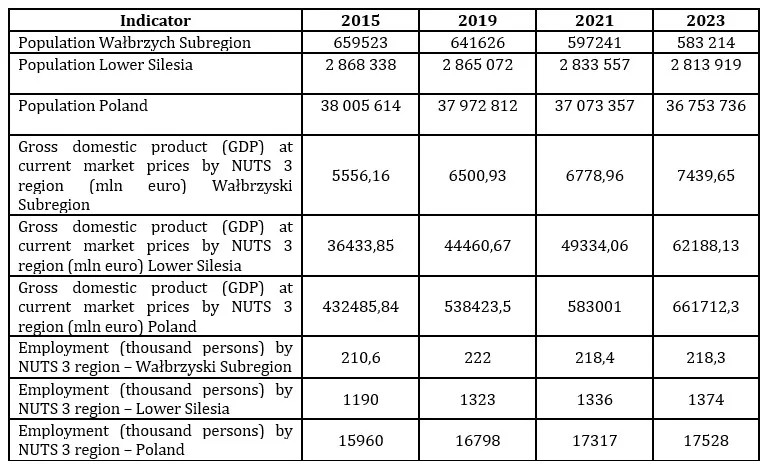
Wałbrzych Subregion was based on the coal industry until 1991 when the last mine was closed. Due to unfinished transformation, the area still faced the consequences of unfinished transformation, low level of social-economic development, infrastructure degradation and low level of endogenic potential insufficient to support long-term development process. Negative effects of transformation can be observed in social and economic indicators: GDP per capita on the level of 50% European Union’s average and 73% average for Poland. In the last decade, the pace of growth of GDP per capita was significantly slower than for the Lower Silesia Region and Poland (Eurostat 2025).
The most significant problem, not only in the post-coal region in Poland, is depopulation. On one hand, most young people decide to move to bigger cities; on the other, there is a trend toward an ageing society. Migration of young people increases the need for higher expenditure for providing care and support to people with disabilities and the elderly and the dependent people who are deprived of care from a younger generation. The median age of the inhabitants is almost 44 years, which makes the subregion the “oldest” subregion in Lower Silesia (for comparison, in Poland this indicator is slightly over 41 years) (Just Transformation Plan, 2022).
Population in Wałbrzyski subregion was 576 998 inhabitants in 2024 and was decreasing significantly since 2015 (reduction of 82525) (Eurostat 2025). Foresight analysis predicts that the Subregion will lose more than 50 000 inhabitants till 2030 (Just Transformation Plan, 2022).
The unemployment rate in the evaluated Subregion is still one of the biggest in the whole region (7,5% in comparison to 4,6% in region) (Local Data Bank, 2025). The negative trend is not only this but the relatively high percentage of unemployed young people (aged 18-34) as it is higher than the average in the region and other subregions of Lower Silesia. The number of people using social assistance on a long-term basis among those covered by support is 17.4% and is higher than the average in Lower Silesia (13.1%) (Just Transformation Plan, 2022). However, the Wałbrzych subregion still stands out with the largest number of people in working age among the other subregions of the voivodeship – approximately 393 thousand inhabitants.
Table 1. Social-economic indicators of Wałbrzyski Subregion
Source: Author’s own elaboration based on Eurostat (access May 2025).
An unfavourable legacy of the coal transformation is the high degree of decapitalisation of housing resources. 56% of the housing resources in the subregion date back to before 1945 (for comparison, in Poland – 20%, and in Lower Silesia – 40%), and, therefore, due to their age, they are characterised by a high degree of technical wear and require comprehensive modernisation, including the replacement of their heating sources from coal to low- or zero-emission. 57% of the subregion’s population lives in these buildings in comparison to Lower Silesia (Ekspertyzy 2021, p. 5). The technical condition of buildings is described as poor or very poor, and the thermal condition is 5 times higher than in those currently being built (Ekspertyzy 2021, p. 5).
It is estimated that, in the entire Wałbrzyski Subregion, there are still about 100 thousand coal furnaces to replace and about 35 thousand buildings to thermal modernization. CO2 emissions in the last 10 years have decreased by almost 25%, and, in comparison with the period of phasing out mining and mining-related activities and liquidation of enterprises from these sectors – by over 45% (1998) but still need to be reduced (in the analysed territory amounted to 461.8 thousand tons in 2020) (Just Transformation Plan, 2022).
In most coal or post-coal municipalities, the significant problem to solve is finding new functions and the transformation process of post-mining areas. In Lower Silesia, Coal Basin degraded post-mining areas constitute approx. 860 ha, of which approx. 500 ha are areas after hard coal mining (Sprawiedliwa transformacja regionów…,2022). These areas that should be subjected to reclamation and regeneration activities, enabling their optimal use.
Just Transition Mechanism in Wałbrzyski Subregion
Proposed changes in Wałbrzyski Subregion will be following undertaken actions in four fields: (Just Transformation Plan, 2022)
Improving the energy efficiency of buildings, facilities and processes, combined with reducing energy consumption (heat, cooling, electricity).
Switching optimized heat supply systems to renewable energy sources (solar, geothermal and biomass) combined with the elimination of solid fuel sources.
Electrification of energy supply systems using solar, wind and biogas sources (also in cogeneration and trigeneration), and in the future also hydrogen, with the gradual inclusion of energy storage.
Transforming businesses, processes, technologies and products towards a green transformation of the economy.
It is assumed in the document that the economic sector will be activated in the area of green technologies. Special assistance will also be given to the most embedded entities such as small and medium-sized enterprises. Another aspect is connected with busting innovation and diversification of economic activities. Jobs with significant added value will be created in industries already present in the subregion (e.g. IT, automation, mechatronics, energy and electricity, chemical, tourism, health resorts, agri-food).
The aim mentioned in Just Transition Plan is to create new, local supply chains. Examples include design companies, manufacturers and distributors of construction materials and installations, general construction companies, installation companies, companies offering energy-saving solutions (energy consulting, audit, IT), financial, service and after-sales services. It is assumed that enterprises will be incubated and scaled up in the area of renewable energy sources and low-energy construction, and that employees of existing companies will be reoriented professionally and retrained for professions related to renewable energy sources and improving energy efficiency, as well as creating and developing technology hubs, competence centres, incubators for SMEs and demonstrators of green technologies.
Another important aim connected with sustainable development is restoring the full value of degraded areas. In this field, the key factor is the thermal modernization of public and residential buildings, along with the replacement of heat sources and the installation of renewable energy devices, the replacement/modernization of central heating and hot water installations or the connection to the heating/cooling network. It is planned to create model solutions and a repository of good practices for use in public utility buildings, residential buildings and business buildings. Support is planned in the scope of investments and consulting for the construction of self-sufficient energy communes.
The regeneration of areas transformed as a result of mining and mining-related activities will be important in achieving the goal. The most important activities are: reclamation and giving new functions to post-industrial areas, the development of waste dumps, tailings ponds and spoil heaps, the creation of investment areas and the use of post-mining waters. The indicated scope will be implemented with respect to the “polluter pays” principle (Just Transformation Plan, 2022). Improving local communication accessibility, along with reducing low emissions and decarbonizing the transport sector, will be a necessary element of actions.
Investments are planned in smart and sustainable local mobility, including the development of public transport using non-emission sources of transport, including non-emission bus transport, based on hydrogen fuel cells, among others. The development of public transport involves the implementation of an intelligent management system for both the rolling stock and passenger service, as well as the introduction of autonomous solutions in public transport and the development of bicycle transport infrastructure. It assumes support for raising competences and qualifications necessary to meet the changing requirements of the labor market resulting from the transformation and responding to the needs of employers, including reducing unemployment among young people, women and permanently marginalized people by adapting their skills to the needs of the local labor market, also using career counselling.
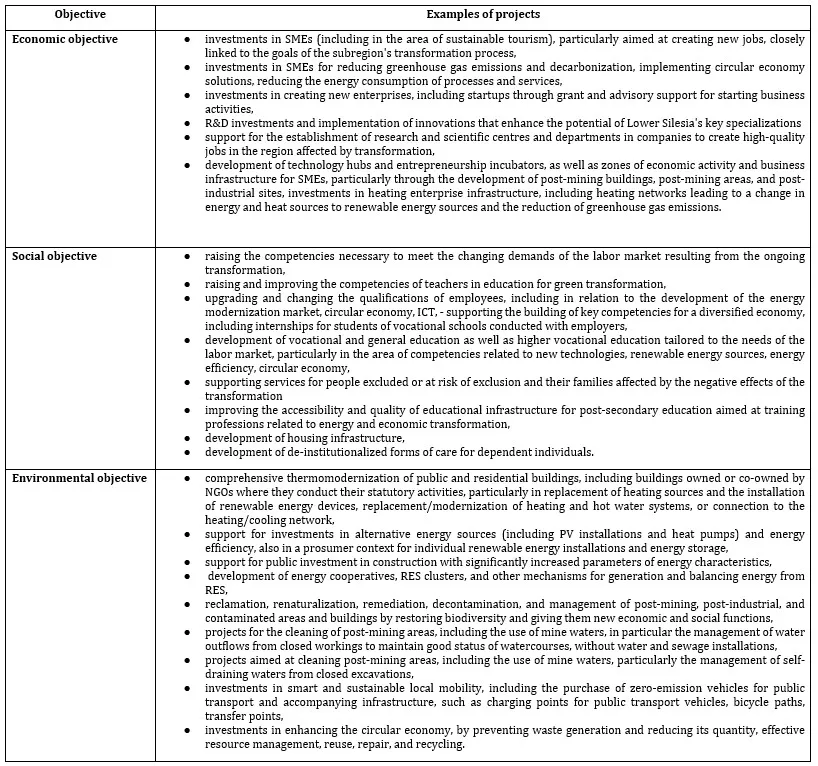
More examples of the projects are presented in table 2.
Table 2. Examples of initiatives planned to support Just Transition Plan for
Lower Silesia 2021-2030
Source: Author’s own elaboration based on: Terytorialny Plan Sprawiedliwej Transformacji dla Województwa Dolnośląskiego 2021-2030. Subregion Wałbrzyski (2022), Urząd Marszałkowski Województwa Dolnośląskiego.
The Lower Silesia plan for Just Transformation estimates a 55% reduction in total emissions by 2030 compared to 2022 levels. This reduction is equivalent to 3.58 million tonnes of carbon dioxide. The targets outlined in the following measures increase installed renewable energy capacity by 56 MW and annual production from renewable energy sources by at least 56 megawatt hours (MWh), reduce annual greenhouse gas emissions with support from the EU Emissions Trading System in both the construction sector (by approximately 36,000 CO2) and in the heating sector (by approximately 45,000 CO2) by investing in biomass combustion installations to be carried out by the local heat suppliers, improve the energy efficiency and performance of over 17,000 residential premises, 473,000 square metres (m2) of public buildings, and 93,000 m2 of buildings occupied by small and medium-sized enterprises, and finally lower annual primary energy consumption in the construction industry by approximately 23 MWh (Just Transformation Plan, 2022).
The Lower Silesia (Wałbrzych) plan focuses on transforming the local job market with the aim of creating around 7,000 jobs in green economy sectors by 2030. This will be achieved by investing in vocational education and implementing measures to upgrade qualifications and improve employment opportunities.
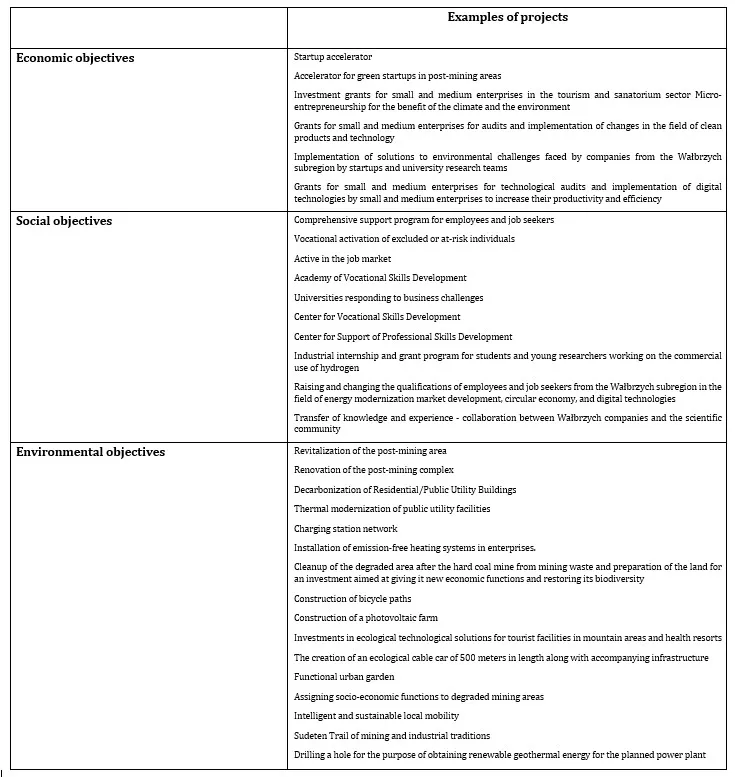
Table 3. Examples of projects submitted for financing Territorial Just Transition Plan for Lower Silesia 2021-2030
Source: Author’s own elaboration based on: List of projects that met the recruitment criteria. Attachment to Terytorialny Plan Sprawiedliwej Transformacji dla Województwa Dolnośląskiego 2021-2030. Subregion Wałbrzyski, Urząd Marszałkowski Województwa Dolnośląskiego.
The conducted analysis identifies three groups of projects selected for support from the Just Transition Mechanism program in Wałbrzyski Subregion. These are projects submitted by entities from the Wałbrzych subregion that are eligible for assistance from the program in the years 2021-2027. The inclusion of projects in the annex does not guarantee their final implementation, but indicates the direction in which entities from various sectors (local government units, business, NGOs, and social economy entities) wish to pursue. Some projects overlap and primarily relate to environmental areas: thermal modernization of public utility buildings, installation of emission-free heating systems for housing and enterprises. Projects concerning revitalization and renovation of post-mining areas are more original and multifaceted. Some of the projects aim to build sustainable mobility and green infrastructure in tourist and spa municipalities. A relatively large number of projects are dedicated to soft activities such as support programs based on changing the qualifications of employees and job seekers. The most difficult projects are probably in the economic sphere where one can find some ideas for start-ups and grants for small and medium enterprises.
Discussion and Conclusion
The main problems and conclusions can be put are the following points:
The demographic dimension is a significant challenge for a just transformation of post-coal municipalities as well as Subregions. Already today, Polish coal regions, in a demographic sense, are not perceived as attractive places to live. Taking into account the demographic scale and the change in the number of inhabitants, the most difficult initial situation for transformation occurs in the Wałbrzych Subregion. In this Subregion, there is a relatively large number of inhabitants and a very high decrease in their number. In this Subregion, the mining restructuring processes ended in the 1990s, nevertheless, in recent decades, it has not been possible to fully create a new economic base comparable to that of the 1990s.
A major challenge in the transformation of post-coal regions, both in terms of economy and environment and space, are the so-called post-industrial areas, including mining areas. The effects of liquidated or decommissioned traditional industry enterprises, including mining ones, negatively affect the investment and residential attractiveness of coal regions, and also deteriorate or seriously disturb the functioning of ecosystems.
The Territorial Just Transition Plan for Lower Silesia (Wałbrzyski Subregion) is based on the Energy Strategy of Lower Silesia, which sets climate neutrality by 2040 as a key target which corresponds with Green Deal’s main targets.
Territorial Just Transition Plan for Lower Silesia, which focuses particularly on the subregion of Wałbrzych, aims to boost the local job market by developing green technologies, nurturing innovation, diversifying economic sectors, and creating high-value jobs within industries already established in the subregion. These sectors include IT, automation, mechatronics, energy and electricity, chemical production, tourism and agri-food.
Projects submitted for financing primarily relate to environmental areas: thermal modernization of public utility buildings, installation of emission-free heating systems for housing and enterprises (Schedule for recruitment for European Funds for Lower Silesia Region 2021-2027)
References
Analiza Powiązań Funkcjonalnych w Dolnośląskim Zagłębiu Węglowym (2021), [Online], Instytut Rozwoju Terytorialnego, irt.wroc.pl
Drobniak A. (2020), Development In Regions Lagging Behind – The Case Of Coal And Post-Coal Regions; Biblioteka Regionalisty, Wroclaw University of Economics and Business, Nr 20.
European Commission. (2020), Platform on Coal and Carbon-Intensive Regions. Terms of Reference
Eurostat, [Online], https://commision.europa.eu
Fornahl, D., Hassink, R., Klaerding, C., Mossig, I., Schröder, H. (2012), From the old path of ship building onto the new path of offshore wind energy? The case of northern Germany. European Planning Studies, 20(5)
Grillitsch, M., Hansen, T. (2019), Green industry development in different types of regions. European Planning Studies, 27(11)
Janek-Kowalska I. (2024), Demonstrating the need for a just transition: Socioeconomic diagnosis of polish cities living on hard coal mining, Resources Policy, vol.89.
Local Data Bank, www.stat.gov.pl
Loorbach, D., Frantzeskaki, N., Avelino F. (2017), Sustainability transitions research: Transforming science and practice for social change. Annual Review of Environment and Resources, 42(1)
Lower Silesia Energy Strategy 2030- directions of support for the energy sector (2022), [Online] www.umwd.pl
Mapping the road to a just transition in central and eastern Europe: an Analysis of Territorial Just Transition Plans in 7 countries (2023), [Online] CEE Bankworth Network, https://www.just-transition.info
Schedule for recruitment for European Funds for Lower Silesia Region 2021-2027 (2005) [Online], adopted 5.05.2025 umwd.pl
Społeczny Terytorialny Plan Sprawiedliwej Transformacji Subregionu Wałbrzyskiego (2021) [Online], um.walbrzych.pl
Sprawiedliwa Transformacja Regionów Węglowych w Polsce, Impulsy, konteksty, rekomendacje strategiczne (2022), Drobniak A. (ed.), University of Economics in Katowice.
Terytorialny Plan Sprawiedliwej Transformacji dla Województwa Dolnośląskiego 2021-2030. Subregion Wałbrzyski (2022), Urząd Marszałkowski Województwa Dolnośląskiego
Wang X., Lo K. (2021), Just transition: A conceptual review, Energy Research & Social Science vol. 82.