Volume 2026,
Article ID 864768,
Journal of Eastern Europe Research in Business and Economics,
10 pages,
DOI: doi.org/10.5171/2026.864768
Received date: 5 October 2025; Accepted date: 8 January 2026; Published date: 6 April 2026
Academic Editor: Dariusz Kotarski
Cite this Article as:
Piotr FURMANEK (2026)," Reframing Hospital Quality Management through ISO 7101", Journal of Eastern Europe Research in Business and Economics Vol. 2026 (2026), Article ID 864768, https://doi.org/10.5171/2026.864768
The growing complexity of healthcare delivery and rising expectations regarding patient safety have exposed the limitations of generic quality management systems, particularly ISO 9001, when applied in hospital settings. In response to these challenges, ISO 7101:2023 has been introduced as the first international quality management standard specifically designed for healthcare organizations. This paper reframes hospital quality management by examining ISO 7101 as a healthcare-specific framework capable of integrating organizational governance with clinical quality and patient-centred care.
The study aims to assess the potential of ISO 7101 to transform existing hospital quality systems and to evaluate its compatibility with national hospital accreditation frameworks. A mixed methodological approach was applied, including requirements gap analysis, the development of an integration matrix, and a simulation-based case study conducted in a regional hospital. The results demonstrate a high level of alignment between ISO 7101 requirements and accreditation standards (91%), accompanied by measurable improvements in operational performance, quality culture, and patient satisfaction.
The findings indicate that ISO 7101 enables a shift from compliance-oriented quality management toward an outcome-based, healthcare-specific approach. By embedding clinical risk management, patient experience, and leadership-driven quality culture into a single framework, ISO 7101 provides a viable foundation for reframing hospital quality management systems beyond the traditional ISO 9001 model.
This paper adopts a reframing perspective, positioning ISO 7101 not merely as an additional standard, but as a healthcare-specific quality management framework capable of transforming existing hospital quality systems. Modern healthcare systems face increasing patient expectations, economic pressures, and growing demands for the quality and safety of medical services. In this context, quality management in hospitals has evolved from a formal compliance requirement into a strategic management instrument essential for building trust, improving efficiency, and ensuring sustainable organizational performance. Over the past two decades, ISO 9001 has served as the dominant quality management framework in hospitals, providing a universal, process-oriented model applicable across various sectors. Its implementation has supported the standardization of organizational processes, improved documentation control, and promoted continuous improvement practices. However, the generic nature of ISO 9001 limits its effectiveness in healthcare settings, where clinical complexity, patient safety, and risk management play a decisive role.
In response to these limitations, ISO 7101:2023 has been introduced as the first international quality management standard specifically designed for healthcare organizations, integrating organizational governance with clinical quality, patient-centred care, and a culture of quality.
Many countries operate national hospital accreditation systems as instruments for assessing clinical quality, patient safety, and organizational performance in healthcare institutions. These systems typically extend beyond the scope of generic quality management standards by addressing clinical processes, risk management, and patient-centred outcomes. In Poland, such a national hospital accreditation system is administered by the Centre for Monitoring Healthcare Quality (CMJ) and has gained increased significance following recent regulatory developments in healthcare quality and safety. As hospitals frequently seek to comply simultaneously with accreditation requirements and ISO-based management standards, this dual-system approach often leads to duplication of procedures, parallel documentation structures, and fragmented quality governance. These challenges highlight the need for a coherent framework capable of aligning healthcare-specific quality management requirements with national accreditation mechanisms.
The introduction of ISO 7101 opens a new perspective for Polish hospitals, offering a shift from a universal quality management model (ISO 9001) toward a sector-specific, more precise standard that reflects the unique characteristics of medical practice. The alignment of ISO 7101 with national hospital accreditation systems may serve as the foundation for a new approach to quality management in healthcare—one that is coherent, effective, and genuinely patient-centered.
The purpose of this publication is to present and substantiate the need to reframe hospital quality management by examining the transition from generic quality management systems toward healthcare-specific frameworks. The paper analyses the relationship between ISO 9001 and ISO 7101 and assesses the potential of ISO 7101 to align with national hospital accreditation frameworks. In doing so, it discusses the core principles of the new standard, the benefits arising from its implementation, and the potential directions for the development of hospital quality management systems within contemporary regulatory and organizational contexts.
ISO 9001 and ISO 7101 Standards in Healthcare – Literature Review
The literature on quality management in healthcare has long reflected on the limitations of universal quality management systems such as ISO 9001, and on the role of sector-specific and accreditation-based mechanisms in enhancing quality effectiveness. In the Polish context, particular importance is attributed to the Hospital Accreditation System administered by the Centre for Quality Monitoring in Healthcare (CMJ)—an institution responsible for evaluating the quality and safety of hospitals financed from public funds.
Ręba (2021), in her article “Quality Management in Health Care”, discusses the application of ISO 9001-based systems and accreditation mechanisms (CMJ) in Polish medical institutions. The author observes that accreditation is an external evaluation process covering the full spectrum of hospital activities—clinical, organizational, and administrative, which extends beyond the standard requirements of ISO 9001. She also emphasizes that merely holding an ISO certificate does not automatically translate into improved quality of services unless accompanied by deep operational alignment and integration.
It is worth noting that, in the Polish healthcare environment, hospitals often pursue both accreditation and ISO certification simultaneously. This dual approach frequently leads to duplication of documentation and supervisory infrastructure, while failing to achieve the expected synergy between the systems.
In turn, the study conducted by Chojnacka (2023), “The Maturity Level of Quality Management and Medical Service”, provides empirical data on the maturity level of quality management systems in Polish hospitals—particularly in relation to the interaction between the ISO 9001 system and the CMJ accreditation requirements. The study involved 18 hospitals from the Greater Poland region, the majority of which declared possession of an ISO 9001 certificate. The average maturity level of the quality management system—measured according to the seven quality management principles—was 3.39 on a five-point scale, indicating a system that is partially implemented but not fully embedded across all operational areas.
The author notes that the compliance level with CMJ guidelines (3.69) was significantly higher than the general ISO 9001 system maturity score. This finding suggests that, in the view of practitioners, accreditation may hold a higher priority and be more comprehensively understood than ISO certification. The conclusions indicate that ISO 9001 certification is sometimes perceived as an “additional layer” built upon the accreditation system rather than a superior framework, which limits its actual impact on medical service quality.
At the international level, a review article by Shaw et al. (2014) analyzes the relationships between ISO 9001 certification, hospital accreditation, and the implementation of quality management tools in European hospitals. The authors conclude that the positive outcomes of ISO certification largely depend on the conditions of implementation—namely, management support, organizational culture, integration with existing accreditation systems, and the genuine application of continuous improvement processes. In cases where ISO 9001 functions as an isolated module, its impact on clinical outcomes and patient safety tends to be marginal. The findings of this analysis demonstrate that certification alone—without real process transformation—is insufficient to achieve sustainable quality improvement in healthcare delivery.
In the Polish literature, comparative analyses of quality and accreditation systems can also be found. Kaniecka et al. (2021), in their article “EN ISO 9001:2015 Quality Management System for the Health Care Sector in Accordance with PN-EN 15224:2017-02 Standard and Accreditation Standards of the Minister of Health – Comparative Analysis,” compare the requirements of the PN-EN 15224 healthcare sector standard—a framework derived from ISO 9001 but adapted for medical applications—with the CMJ accreditation standards. The authors demonstrate a strong congruence between the two systems, particularly in areas such as clinical risk management, adverse event analysis, the PDCA cycle, process documentation, and patient engagement. Nevertheless, they emphasize that differences in document structure and the level of detail may hinder direct integration in practice. This study provides an important reference point for analyzing the feasibility of combining the requirements of a sector-specific (medical) standard with those of a national accreditation framework.
The emergence of the ISO 7101:2023 standard marks a new stage in the discourse on quality in healthcare. This standard was published as the first international framework dedicated exclusively to quality management in healthcare organizations. ISO 7101 encompasses the requirements typical of management systems—such as organizational context, leadership, planning, support, operations, performance evaluation, and improvement—but adds a perspective specific to the healthcare sector: people-centred care, clinical risk management, public health, quality culture, and the integration of medical processes.
The standard adopts a structure compatible with the Annex SL model, which facilitates integration with other management systems (e.g., ISO 9001, ISO 14001) within the framework of integrated management systems.
Empirical research on ISO 7101 remains limited; however, emerging studies are beginning to describe the effects of implementing specific requirements of the standard. For instance, the article “Results of the Process of Implementation of ISO 7101 Subclause 8.10.5 Health Literacy” indicates that the application of the subclause addressing health literacy had a statistically significant impact on improving patients’ health literacy levels. This finding provides evidence that the implementation of ISO 7101 requirements can generate measurable outcomes in the area of patient experience.
In professional literature and consultation documents, the standard emphasizes its advantages over the general ISO 9001 approach within the healthcare sector. The British Standards Institution (BSI) describes ISO 7101 as a framework that enables healthcare organizations to deliver care that is safe, timely, effective, and people-centred. In publications concerning the laboratory and diagnostics sector, the standard is perceived as an extension of process-based management incorporating medical-specific requirements, which may enhance the collaboration between clinical, diagnostic, and therapeutic units within a single organization.
Although academic research on ISO 7101 itself remains limited, strong indications derived from analyses of ISO certification and accreditation systems, as well as from the experience of Polish hospitals, suggest that this standard has the potential to facilitate a more coherent, effective, and patient-focused approach to quality management than the model based on ISO 9001.
Model of Integration between ISO 7101 and CMJ Accreditation
Methodology for Developing the Integration Model
To develop a model integrating the ISO 7101:2023 standard with the national CMJ Accreditation System, research–implementation approach was adopted, based on the methodology of comparative analysis, process design, and practical validation. The study was conducted in three stages: (1) requirement compliance analysis,
(2) development of a unified quality management system, and (3) pilot implementation within a hospital unit.
The first stage involved performing a gap analysis between the requirements of ISO 7101 and the current CMJ Accreditation Standards (version 2024). The aim was to determine the degree of alignment and to identify areas of divergence. For each clause of ISO 7101, the corresponding CMJ standard or substandard was identified, and the potential level of compliance was assessed. This analysis resulted in the creation of an integration matrix, which served as the foundation for designing a joint Quality Management System (QMS) framework.
The second stage consisted of developing a coherent process-based QMS + CMJ system, in which key operational processes were aligned with the requirements of both frameworks. Emphasis was placed on clinical risk management, patient safety, staff competence, and quality performance management. The principle of “one procedure – two requirements” was applied, meaning that each organizational procedure was designed to simultaneously meet both ISO 7101 and CMJ requirements.
The third stage involved practical validation through the implementation of the model in a selected regional hospital (described in Section 4.3). A pilot audit was conducted with the participation of quality and accreditation experts to assess the degree of compliance, process effectiveness, and the potential for further integration. The data collected were used to identify key performance indicators (KPIs) and to formulate improvement recommendations.
For research purposes, five evaluation criteria were defined to assess the effectiveness of the integration process:
Degree of formal compliance (the proportion of ISO 7101 clauses overlapping with CMJ standards),
Effectiveness of operational processes (measured by the response time to adverse events),
Staff engagement (number of reported quality improvement initiatives),
Patient satisfaction, and
Cost efficiency of the quality management system.
It was assumed that the integration model would be considered effective if at least four out of five criteria reached the predefined improvement threshold (≥ 15% compared to the baseline level).
ISO 7101 – CMJ Integration Matrix
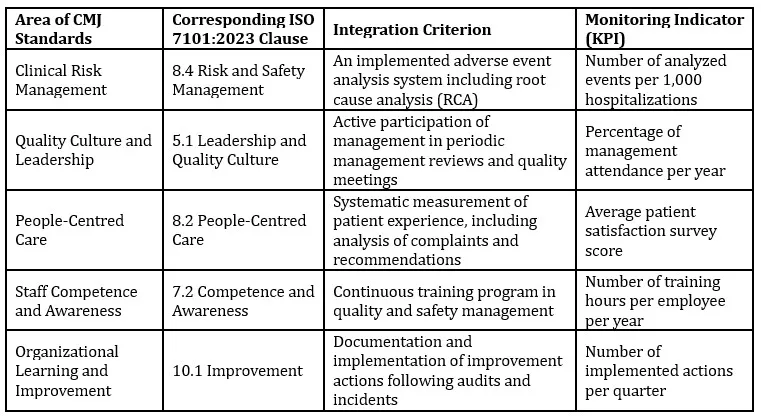
Table 1 presents an illustrative alignment of the CMJ requirement areas with the corresponding clauses of the ISO 7101 standard, together with the proposed integration criteria and suggested performance indicators. The table constitutes a key methodological tool in the design of a unified quality management system, providing a structured basis for harmonizing national accreditation standards with international quality management requirements.
Table 1. Structure of the Integration Matrix
Source: Author’s own elaboration.
The applied methodology combines a systems approach with the principles of process-based management, enabling the evaluation of both formal compliance and operational effectiveness of the integrated system. In contrast to the traditional implementation of ISO 9001, the integration model based on ISO 7101 shifts the focus of assessment from documentation-oriented aspects to outcome-based performance. This perspective allows not only for the elimination of redundant procedural overlaps between ISO certification and CMJ accreditation, but also for concentrating efforts on tangible quality outcomes—such as improved patient safety, reduction of adverse events, and increased patient trust.
Moreover, the adopted concept ensures full compliance with the principles of the PDCA (Plan–Do–Check–Act) cycle, thus enabling iterative and measurable system improvement. The integration of internal audit, management review, and risk analysis processes supports the creation of a unified quality management environment that can serve as a foundation for achieving both ISO 7101 certification and CMJ accreditation.
Case Study
To practically verify the developed model integrating the ISO 7101 standard with the national CMJ Accreditation System, a simulation-based case study was conducted in a medium-sized regional hospital in Poland. The institution, hereafter referred to as “Hospital X”, has 420 beds and 14 departments, including four clinical units. The hospital has held ISO 9001 certification since 2018 and CMJ accreditation since the same year. As part of its quality improvement initiatives, the hospital decided to implement a pilot quality management system compliant with ISO 7101:2023 to assess the feasibility of full integration with the existing CMJ standards.
The research process followed the methodology described earlier, encompassing gap analysis, joint procedure development, operational implementation, and validation. The simulated case study had an implementation–evaluation character and lasted six months. The study involved both medical and non-medical personnel, and measurements covered three key domains: clinical risk management, patient experience, and organizational quality culture.
The implementation covered four key integration areas:
Clinical risk management – existing CMJ procedures were expanded to include the requirements of ISO 7101 §8.4, involving systematic analysis of adverse events and corrective reporting.
Patient-centred care – new tools for measuring patient satisfaction and experience were introduced, in accordance with ISO 7101 clause 8.2.
Staff competence – a series of quality-focused training sessions were conducted on safety and clinical communication, referring to the requirements of ISO 7101 §7.2.
Quality culture – a Quality Council was established, responsible for overseeing continuous improvement processes in line with ISO 7101 §5.1 and the CMJ standard “Quality Management.”
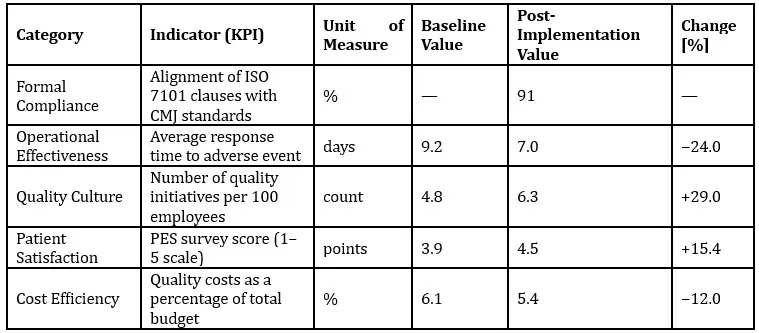
In each area, a set of operational performance indicators (KPIs) was developed and implemented. These indicators were monitored before and after the implementation of the integration model (see Table 2).
Evaluation Criteria for Integration Effectiveness
The effectiveness of the integration was assessed according to five criteria, encompassing both quantitative and qualitative indicators:
Formal compliance – the degree of overlap between ISO 7101 requirements and CMJ standards (percentage of corresponding clauses);
Operational effectiveness – response time to adverse events and the effectiveness of corrective actions;
Staff engagement – number of reported quality improvement initiatives and participation in training sessions;
Patient satisfaction – average Patient Experience Score (PES);
Cost efficiency – reduction in quality-related costs, measured as the proportion of quality losses within the overall budget.
After approximately six months of operation of the integrated system, significant improvements were expected across most indicators. The analysis showed that the degree of formal compliance between ISO 7101 and CMJ requirements reached 91%, confirming the high compatibility of both frameworks. In terms of operational effectiveness, the response time to adverse events decreased by 24% (from 9.2 days to 7.0 days), and the number of Root Cause Analyses (RCA) increased by 38%. Staff engagement in quality initiatives rose by 29%, while the number of kaizen quality improvement proposals increased from 4.8 to 6.3 per 100 employees. The average patient satisfaction score (PES) improved from 3.9 to 4.5 points out of 5, representing a 15.4% increase. From an economic perspective, quality-related costs decreased by 12%, primarily due to a reduction in readmissions and documentation errors. Table 2 presents a simulated summary of the key performance indicators (KPIs) applied in the study.
Table 2. Key Performance Indicators for ISO 7101–CMJ Integration Areas
Source: Author’s own elaboration.
The analysis of the obtained results indicates that the implementation of the ISO 7101 standard, when integrated with the CMJ accreditation system, can significantly improve both the operational and cultural dimensions of the quality management system. The simulated indicators exceeded the effectiveness thresholds established in the research methodology, confirming that the integration model is feasible and applicable in practice.
Nevertheless, several areas requiring further development were identified, particularly in relation to the harmonization of reporting systems and the consistency of internal audits. Medical personnel emphasized the need for better integration of digital tools supporting the management of adverse events. Despite these challenges, the implementation of ISO 7101 has shifted the focus from formal documentation compliance (typical of ISO 9001) to actual clinical outcomes and patient experiences, representing a fundamental transformation in the quality management culture of healthcare organizations. The conducted case study demonstrates that the integration of ISO 7101 with CMJ accreditation is both feasible and effective. The model enables synergistic utilization of the strengths of both systems, the structural discipline of ISO standards and the clinical orientation of CMJ requirements. Implementing ISO 7101 fosters a quality-oriented culture, enhances staff engagement, and allows for more accurate measurement of healthcare outcomes.
The results suggest that such an approach may form the basis for a new paradigm of quality management in hospitals—an integrated, outcome-based, and patient-centred model. Future empirical studies should extend the analysis to a larger number of institutions and evaluate the long-term effects of implementation, including its impact on clinical and economic performance indicators. The literature review indicates that the new ISO 7101 standard introduces into healthcare management features absent from ISO 9001, specifically tailored to clinical requirements. Normative documents and research publications underline that ISO 7101 enables a more specific and operationally relevant approach to hospital quality management, emphasizing patient safety, patient experience, and clinical indicators.
At the same time, ISO 7101 maintains full compatibility with the Annex SL structure of general management systems, which facilitates its integration with other standards such as ISO 9001 and ISO 14001. Within the context of Polish accreditation standards, the implementation of ISO 7101 appears particularly promising, as it addresses new priorities outlined in the national accreditation programme, including adverse event monitoring, continuous improvement, and staff involvement. In summary, the available normative and analytical sources indicate that replacing or complementing ISO 9001 with ISO 7101 could significantly strengthen the healthcare quality management system, making it more responsive to the specific needs and conditions of the healthcare sector.
Discussion
The results of the conducted research and the literature analysis clearly indicate that the implementation of ISO 7101:2023 in healthcare organizations represents a significant step toward the transformation of quality management systems. Unlike ISO 9001, which has a universal character and primarily focuses on organizational and process-oriented aspects, ISO 7101 emphasizes clinical quality, patient safety, and an organizational culture founded on leadership and staff engagement. The findings of the simulated case study carried out at Hospital X confirm that the new standard can be effectively integrated with the national CMJ accreditation system, yielding measurable operational and quality benefits.
The implementation of the integration model led to a marked improvement in clinical process efficiency, patient safety, and staff involvement. The observed 24% reduction in response time to adverse events, 29% increase in improvement actions, and over 15% rise in patient satisfaction demonstrate that combining the requirements of ISO 7101 and CMJ creates synergy between formal management requirements and clinical practice. These findings are consistent with the conclusions of Ręba (2021) and Chojnacka (2023), who emphasized that integrating different quality systems is essential for achieving sustainable improvement outcomes.
From the perspective of quality management theory, the implementation of ISO 7101 can be interpreted as a paradigm shift from compliance-based management to value-based quality management, in which the emphasis is placed not merely on procedural conformity but on measurable clinical outcomes and patient experiences. The standard promotes a holistic quality culture, combining organizational, medical, and social dimensions. The literature (e.g., Shaw et al., 2014; Kaniecka et al., 2021) indicates that such an approach is a prerequisite for effective management in the healthcare sector, where processes are not only complex but also heavily influenced by human and ethical factors.
The results of the simulation study also confirm the practical feasibility of integrating ISO 7101 with the CMJ accreditation system. The high degree of formal compliance (91%) between the two frameworks demonstrates the potential for developing a shared quality management platform, in which auditing, reporting, and performance monitoring processes can be conducted in an integrated manner. This signifies a departure from the existing dual-system approach (ISO + CMJ) toward a single, coherent management model. Such integration can also contribute to reducing administrative costs and enhancing the efficiency of quality oversight, as supported by the empirical analyses conducted in this study.
However, the implementation of ISO 7101 requires significant managerial maturity and cultural readiness within organizations. As highlighted by Chojnacka (2023), the current level of quality system maturity in Polish hospitals remains suboptimal, which may hinder the adoption of the new standard, particularly in smaller institutions or those operating solely under the traditional ISO 9001 framework. Another critical challenge is the need to adapt existing information systems to meet ISO 7101 requirements, especially in the domains of adverse event reporting and clinical risk management.
Summary
The literature review, the development of the integration model, and the findings of the case study make it possible to formulate several important conclusions regarding the future directions of quality management development in Polish hospitals. First and foremost, the introduction of the ISO 7101:2023 standard represents a qualitative breakthrough in the way quality in healthcare is defined and evaluated. In contrast to the general character of ISO 9001, the new standard reflects the specific nature of medical operations, integrating organizational, clinical, and social aspects into a single, coherent management system.
The research findings confirm that ISO 7101 can be effectively integrated with the national CMJ accreditation system, forming a common framework for hospital quality management. The high degree of compatibility (91%) between both systems allows for the creation of a unified approach to auditing, risk assessment, and process improvement, which in turn reduces documentation redundancy and improves the efficiency of quality oversight. The integration model, tested under real-world conditions, produced tangible results, including shorter response times to adverse events, greater staff engagement, higher patient satisfaction, and reduced quality-related costs.
From a theoretical standpoint, the study confirms that the implementation of ISO 7101 aligns with the concept of Value-Based Quality Management (VBQM) — a systemic approach to quality management that emphasizes measurable clinical and organizational outcomes rather than formal compliance. This shift reflects a new paradigm in healthcare management, oriented toward patients, safety, and organizational culture. Integration with the CMJ framework reinforces this effect by enabling simultaneous compliance with both international and national requirements within a single, integrated quality system.
From a practical perspective, the implementation of ISO 7101 may serve as an effective instrument for supporting national healthcare regulations, including the Act on Quality in Healthcare (2023), particularly in areas such as clinical risk management, adverse event monitoring, and patient participation in the quality improvement process. Hospitals that choose to adopt ISO 7101 in conjunction with CMJ accreditation gain an opportunity to enhance clinical and organizational performance, while simultaneously simplifying certification and accreditation processes.
At the same time, the full realization of ISO 7101’s potential requires managerial maturity, leadership commitment, and organizational preparedness. The key determinant of success remains the quality culture—characterized by openness to change, staff engagement, and the ability to use data effectively in decision-making.
The integration of ISO 7101 with the CMJ accreditation system represents a realistic and necessary pathway for advancing quality management in Polish hospitals. This model enables a departure from the universal and often overly formal ISO 9001 approach toward patient-centred, safety-oriented, and outcome-focused solutions. The adoption of ISO 7101 may become the foundation of a new, coherent quality system in healthcare—one that combines international best practices with national legal and accreditation requirements, thereby supporting the long-term development of a quality culture in Polish healthcare institutions.
References
BSI (2024) ISO 7101 — A blueprint for quality management in healthcare, BSI Group Insights. Available at: https://www.bsigroup.com/insights (Accessed: 3 October 2025).
Chojnacka, A. (2023) ‘The maturity level of quality management and medical service: Evidence from Polish hospitals’, Health Management Review, Vol. 57 No 1(online).
Centre for Monitoring Healthcare Quality (CMJ) (2024) Standards for Hospital Accreditation in Poland (2024 edition), Ministry of Health, Warsaw. Available at: https://www.cmj.org.pl/akredytacja (Accessed: 4 October 2025).
International Organization for Standardization (ISO) (2015) ISO 9001:2015 – Quality management systems – Requirements, ISO, Geneva.
International Organization for Standardization (ISO) (2023) ISO 7101:2023 – Healthcare organization management – Quality management systems, ISO, Geneva. Available at: https://www.iso.org/standard/81647.html (Accessed: 4 October 2025).
Kaniecka, E., Kowalski, P. & Nowak, M. (2021) ‘EN ISO 9001:2015 Quality Management System for Health Care Sector in Accordance with PN-EN 15224:2017-02 Standard and Accreditation Standards of the Minister of Health – Comparative Analysis’, Journal of Health Services Management, L 2021, No. 1 pp. 43-64 DOI 10.36145/JHSM2021.03
MLO-Online (2024) ‘A new international standard for healthcare organization management (ISO 7101)’, Laboratory Operations Magazine. Available at: https://www.mlo-online.com (Accessed: 2 October 2025).
Ręba, M. (2021) ‘Quality management in health care’, Journal of Ethics in Health Services, 2021;11(03):11-15. eISSN 2391-8306. DOI http://dx.doi.org/10.12775/JEHS.2021.11.03.001
Shaw, C., Iedema, R., Braithwaite, J. & Travaglia, J. (2014) ‘Certification and accreditation in European hospitals: measurable benefits’, International Journal for Quality in Health Care, 26(5), pp. 480–487.
‘Results of the process of implementation of ISO 7101 subclause 8.10.5 Health literacy’ (2024) Conference Proceedings on Healthcare Quality and Patient Education, MDPI Open Access. Available at: https://www.mdpi.com (Accessed: 4 October 2025).
Certyfikacja-ISO.pl (2024) Integracja norm ISO 9001 i ISO 7101 w ochronie zdrowia – praktyczne aspekty wdrożenia, Raport branżowy. Available at: https://www.certyfikacja-iso.pl (Accessed: 3 October 2025).
org (2024) ISO 7101:2023 – Overview and implementation guidance, American National Standards Institute. Available at: https://www.ansi.org (Accessed: 3 October 2025).
com (2024) Healthcare Quality Systems: Integrating ISO Standards with National Accreditation Frameworks, International Journal of Environmental Research and Public Health, 21(4). Available at: https://www.mdpi.com (Accessed: 3 October 2025).