Elena GRIGORE, Florina TATU, Elena BOGAN, Luminita-Costina SAFTOIU And Alexandru-Ionut BANESCU
University of Bucharest-Faculty of Geography; Bucharest, Romania
Volume 2026,
Article ID 993388,
Journal of Eastern Europe Research in Business and Economics,
12 pages,
DOI: https://doi.org/10.5171/2026.993388
Received date: 29 October 2025; Accepted date: 26 December 2025; Published date: 29 January 2026
Academic Editor: Mirela Stefanica
Cite this Article as:
Elena GRIGORE, Florina TATU, Elena BOGAN, Luminita-Costina SAFTOIU and Alexandru-Ionut BANESCU (2026)," Analysis of the Opinion of Tourists from Different Generations Regarding Mountain Tourism: The Case of Tourism in The Ciucaș Mountains in Romania ", Journal of Eastern Europe Research in Business and Economics Vol. 2026 (2026), Article ID 993388, https://doi.org/10.5171/2026.993388
The study brings to the reader’s attention the Ciucaș Mountains, a Romanian tourist region. Travel behavior helps in understanding the factors that motivate tourists. The article first examines the differences regarding motivational factors and travel preferences. It also examines the traveler’s opinion as a consumer of mountain tourism activity, to highlight the quality and evolution of mountain tourism specific to the Ciucaș area. The final goal of the research was to find out the opinion of tourists, regardless of generation, about mountain tourism activity and how it has evolved. The statistical data were collected in different years, respective 2010 and 2025, following the application of a questionnaire conducted among 200 tourists. This type of analysis may prove useful in future tourist information efforts. It may also become a source of information for local authorities and the improvement of tourism activity specific to mountain regions. The findings contribute to a better understanding of travel patterns and offer practical insights to tourism professionals whose goal is to develop tourist offers.
Tourism activity is among the few economic and social phenomena that have imposed themselves in the contemporary era. Authors such as Kaspar et al. (1992), Day et al. (2021), Gottlichova et al. (2024) and Bokor et al. (2025) consider the development of this phenomenon to be a spectacular feature characteristic of our century. The tourism sector is the most dynamic field of economic activity, seen on a global scale. The Romanian Carpathians offer, in addition to the spectacular natural landscape, opportunities to discover and experience local culture and traditions. In Romania, mountain tourism could become one of the most popular forms of tourism in our country. The Romanian mountain area offers various opportunities, starting with the possibility of exploiting the mountain landscapes, hiking, mountaineering, skiing, etc. to the joy of breathing fresh air. The specific motivation of the research consisted in the desire to deepen and understand tourist behavior regardless of generation. The transformation of tourism into a catalyst for sustainable development is conditioned by the identification of a state of equilibrium. The purpose of the analysis is to identify, analyze and evaluate the basic needs, preferences, constraints, reasons, expectations of tourists regardless of age and social status. The results of the analysis can be used as a basis for developing new proposals to improve services in all areas of tourism, but also the life of the human society involved in the activity.
Reading the reports presented at the World Economic Forum – WEF (located on the website www.weforum.org/, accessed in the years 2024, 2025 regarding tourism activity), there can be found that Romania, in the country ranking, occupies the 68th place out of 138. In the international statistics, this position is offered for the competitiveness index in tourism (respectively in the tourism and travel sector). The position in the ranking comes from a series of results presented within the WEF, which included: 108th place – prioritization of the tourism and travel sector; 92nd place – land and port infrastructure; 85th place – price competitiveness; 82nd place – air transport infrastructure; 81st place – human resources and the labor market; 76th place – business environment; 68th place – natural resources; 46th place – cultural resources and business trips; 62nd place – infrastructure related to tourist services; 60th place – ICT availability; 45th place – international opening; 43rd place – environmental sustainability; 39th place – safety and security; 31st place – health and hygiene. Returning to the Romanian statistics, according to the National Institute of Statistics of Romania (INSSE) located on the website www.insse.ro, accessed in the years 2010, 2024, 2025, it was found that the capacity utilization index of accommodation and food services in operation is approximately 25.0%. This index represents a small percentage, which confirms the fact that there is a need for intense research of tourists’ motivation in choosing tourist options. Romania’s mountainous regions have real potential as a tourism destination, but our country has not fully exploited this opportunity. For example, according to websites ec.europa.ro and statistica.com, the gross value added from the tourism sector contributed only 2.5% to Romania’s GDP in 2024, compared to an average of 5.1% globally. The same sources inform that tourism in the mountain area represents approximately 0.19% of Romania’s total GDP.
Materials, Date and Methods Used
In the tourism market, the most frequently asked question is: What importance does human perception have in scientific studies? The question comes from the fact that the connection of human society with reality is conscious. Lefton et al. (1991) argue that it has been proven that this connection is never just a perception. Perception is seen as a sensory psychic process through which we recognize certain situations, as argued by Lefton (1974) and later Zlate (1999). Reality is objective while the human perception of reality is subjective. Perception errors according to Yamane (1967) and Israel (2009) are present everywhere and have the role of distorting a reality in a subtle way, because the attitude influences our perception, judgment and actions. The analysis carried out and presented at various specific conferences indicates that in current life we often do not have time to stop and judge whether what we see, hear, or understand is a perception or a reality. For these reasons, as well as the fact that public perception is equally wrong all over the world, the application of a questionnaire regarding citizens’ perception of tourist activities has become a necessity. The research hypothesis must also begin with a deeper understanding of environmental factors, as considered by Lambin et al. (2001). The level of information processing and integration, in the conditions of everyday perception, provides a synthetic and unitary image of a phenomenon and we have the impression that everything is done instantly and automatically, according to the studies of Tapu (2004, 2020), Yanogo (2023) and Torkashvand et al. (2023). Thus, the analysis captures and presents synthetically the way of influence and the way in which the yield of the human component in a society is affected. This is possible because the process by which we perceive the phenomenon involves several states, including: identifying and detecting the phenomenon, comparing and interpreting it, reflecting etc.
Generalities of the study area
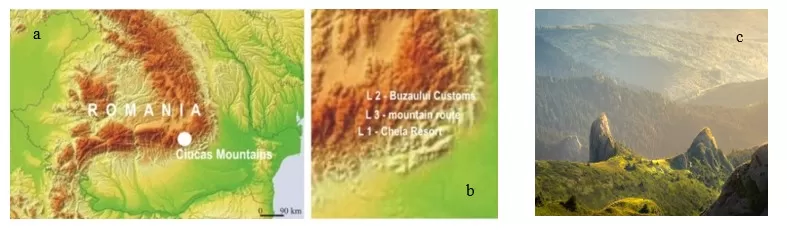
The current study brings into the attention of the reader the tourist region of the Ciucaș Mountains, geographically positioned in the curvature of the Eastern Carpathians, belonging to the Romanian Carpathian mountain range. The usual information about the importance of the analyzed area can be found in a series of Romanian sites such as www.carpati.org, www.natura2000.ro, www.mmediu.ro. According to the website www.brasovtourism.app, the mountains have with a maximum altitude of 1.954 m – Ciucaș Peak, with a relatively small area of approximately 200 km2 (Fig. 1.a).
Fig. 1. The location of the study area in Romania (a) and the application points of the questionnaires in the Ciucaș Mountains (b)
(Source: Own processing); overview – Ciucas Peak (c) (Source: Personal archive, 2023)
Ciucaș is currently a protected area (part of the Natura 2000 network; site of community importance SCI) in Romania. The area was designated with the aim of protecting biodiversity and maintaining a favorable conservation state of the spontaneous flora and fauna, as well as the natural habitats of community interest located within the area of the protection area. The main places of accommodation are found in the area of the Cheia Resort, the Muntele Roșu Chalet and the Ciucaș Chalet. The Cheia tourist resort has two hotels and numerous guesthouses. The Muntele Roșu complex includes the original chalet, built in 1948, the Bujorul Roșu chalet, the Silva chalet and a disco hall. The Ciucaș Chalet comes from the former Alexandru Vlahuță chalet, currently completely restored on the same site on Mount Chirușca, with a three-star operating regime.
Research Methodology – Data and Programs Used
Have the fundamentals of travel truly changed across generations? Consumption pattern and the behavior of tourists throughout life are influenced by events that shape each individual’s attitudes, values, and beliefs. The research methodology has consisted, first of all, in consulting the national bibliography, then, the international bibliography on the research topic. The specialized literature on the Ciucas Mountains is dominated by writings on natural resources and less on the actual tourist activity. This is the reason why the information centralized on the profile sites was frequently used and less citations from the specialized literature. Kothari (2004), in his communications, considers that the research is an original contribution to the existing specialized literature that contributes to its development. The objectives of the research have aimed to identify the motivation of tourists to choose a vacation in a mountain area. The research has started with J.C. Holloway’s opinion (2009) who presents the tourist as that person who travels to see something different and complains when he finds that things are not the same. Returning to Romanian statistics, which confirm that the capacity utilization index of accommodation and food services in operation is low (which confirms the need for thorough research into tourists’ motivation in choosing tourism options), confirmed the need to deepen the principles of organization. This type of analysis seeks to demonstrate long-term success by satisfying the client’s requirements, but also increasing the sales of the tourist product and reducing costs. Studying the needs through the opinion of tourists is a condition for the achievement of quality services. The study is logically structured according to the research directions: the evaluation of the tourist potential by analyzing the opinion of tourists using the survey method (questionnaire); comparative analysis of the results obtained following the electronic centralization of the questionnaires applied in the two years of analysis (2010 and 2025). From the methodological point of view, the primary analysis was based on the gathering of useful data. For this purpose, an individual and direct questionnaire-based pilot survey was used, according to the purpose and the method of implementation also proposed by Cauc et al (2004). The scientific instrument used in this micro-research is the questionnaire, which, by construction, aimed at highlighting the permanent correlation between the investigated theme, content and form of the items, the way of recording the answers, but also the complexity and order of the questions. This resulted in a synthetic tool, which lends itself effectively to a survey with items in a tourist area. The questionnaire was physically administered during the period June–August, both in 2010 and 2025, allowing for complete data collection during this three-month period. All participants remained anonymous. The study used a questionnaire, developed by the authors, to investigate generational differences in travel behavior and motivation among mountain-loving tourists. The questionnaire was not based on previous standardized instruments or existing theoretical models, and to increase transparency it was designed to capture relevant variables such as destination preferences, seasonal travel choices, travel companions, travel planning strategies and motivational factors, etc.
The study presents the information obtained by applying a questionnaire entitled ‘The Ciucaș Mountains – questionnaire regarding the degree of satisfaction of tourists’. The questionnaire can be seen as a monitoring one, easy to understand and complete, composed of questions related to socio-demographic data and questions regarding the experience about and from the chosen destination, namely the Ciucaș Mountains. The questionnaire model used was planned to include in its structure both closed questions with and without a Likert scale, as well as semi-open questions with multiple possible answers. This system is described, applied and constantly improved by McLeod Saul (2020), editor-in-chief of Simply Psychology. The questionnaire was identical for the two analyzed years and included 19 questions. It was applied to a sample that formed a target group of 100 people/analyzed year (100 people in 2010; 100 people in 2025). This sample is considered to be representative and dominant for the tourists identified in the area, by reference to the existing statistical data. The determination of the sample size is based on Taro-Yamane’s formula (formula launched in 1967, taken over by Israel in 1992) n = 1 / 1+N e2 (which assumes a confidence level of 95.0%, a maximum degree of variability – 50%; where: n = sample size, N = general size of those concerned, e = marginal error, equal to 8.2%). Regarding the development of the questionnaire, the authors have used identification questions and questions that led to the solving of the problem proposed for the research. The tool was applied through the investigation operators, trained to minimize the errors due to the operators (three operators in 2010 and six operators in 2025), during three weeks of field activity. These operators could be found in three areas considered strategic points, respectively: Cheia resort – L1, Buzău Customs – L2, Mountain route – Ciucaș Chalet – Ciucaș Mountain Peak – Bratocea Peak – L3 (Fig. 1.b).
Carrying out the secondary analysis, in order to obtain a quantitative and qualitative presentation as close as possible to reality, but also a conclusive statistical database (useful both for the Destination Management Organizations in the area, and for the tourist operators involved in the constant monitoring of tourist activities in national destinations), there were used statistical data analyzed horizontally (the ratio between those surveyed and individual questions) and vertically (the ratio between those surveyed and their preferences). In order to give the reader a synthetic and clear picture of the present study, in addition to predefined diagram templates, simple diagrams were used to highlight the results as explicitly as possible. In general, specific Microsoft Office (Excel, SPSS 26) and open source GIS work packages were used (ArcGIS-Spatial Analyst, Quantum GIS – QGIS, Corel Draw 12 etc.).
Results And Discussions
The analysis based on quantitative statistical data must also be supported by qualitative statistical data. The statistics resulting from the centralization of the questionnaires provided a synthetic picture of the levels of perception and the consequences of these levels on everyday life. The investigation carried out was based on a series of items that refer both to descriptive aspects of perception and to comparative reporting based on similarities and differences. Thus, it is allowed to mention the elements that give an identity and define the analyzed phenomenon, but also specifications regarding the future perspectives on the evolution etc. The items concerned both open answers and/or multiple-choice answers. The answers analyzed allow an overall picture to be drawn. The results will be analyzed both quantitatively and qualitatively, and, in the centralization, information will be inserted regarding the absolute value, but also the relative value of each answer to the questions.
The constant monitoring of tourist activities within the destination must be carried out by Destination Management Organizations and tourist operators. These organizations need to be directly involved in the organic development of a tourist destination. It is necessary to collect qualitative information through detailed investigations on the needs of visitors, by understanding the volume of activities that can lead to the full satisfaction of tourists (type of tourism practiced, hospitality services etc.). The condition of the tourist destination described by Agheorghiesei (2013) can be obtained taking into account the feedback of the tourist, together with the information provided by the socio-economic data and the type of practiced tourism. There must be reminded that the analyzed mountain is recognized as a place of rest and recreation for people suffering from nervous asthenia, physical and intellectual overwork, benign hyperthyroidism, rickets, juvenile growth disorders, secondary anemia etc. In addition to these benefits, a variety of other forms of tourism can be practiced in the area, such as mountain hiking, mountaineering, winter sports, excursions in the surroundings.
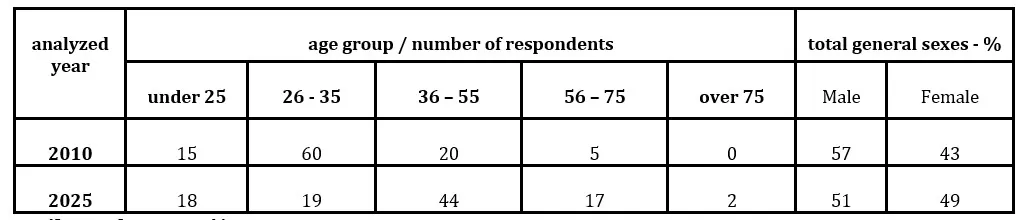
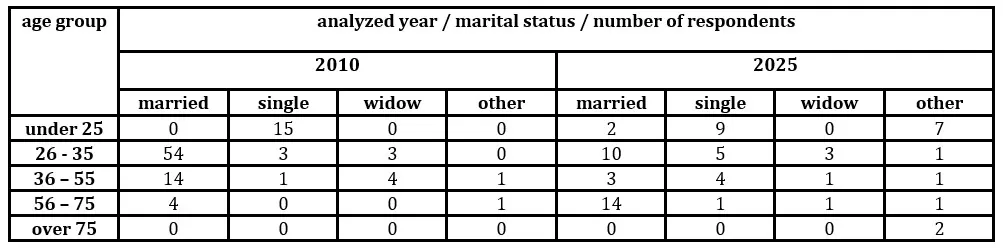
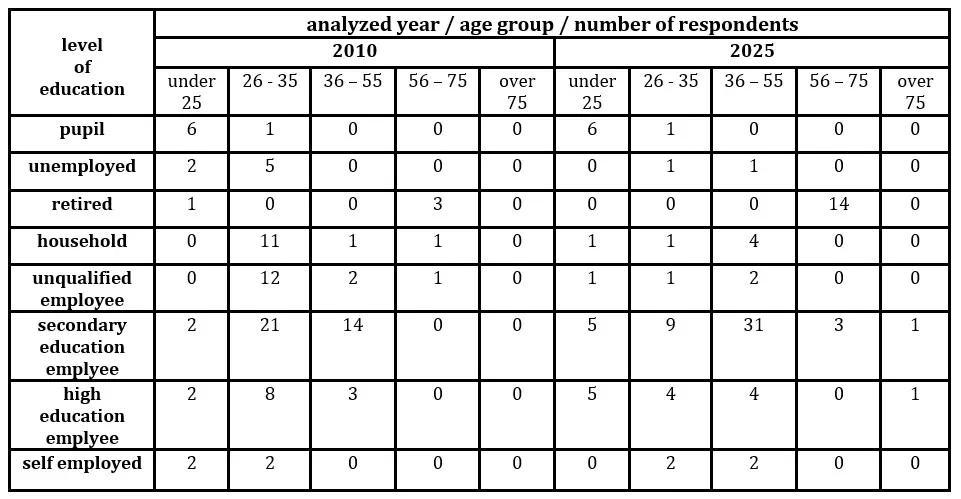
The 200 final questionnaires were applied in three representative locations (L1, L2, L3) for the tourist activity in the Ciucaș Mountains. Both in 2010 and in 2025, the same questionnaire was used, applied to 100 tourists, in the same survey points. The subjects were classified according to socio-demographic indicators (age and sex – Table 1; marital status – Table 2; level of education – Table 3).
Table 1. The subjects classified according to socio-demographic indicators – age group, sex
(Source: Own research)
Table 2. The subjects classified according to socio-demographic indicators – marital status
(Source: Own research)
Table 3. The subjects classified according to socio-demographic indicators –
level of education
(Source: Own research)
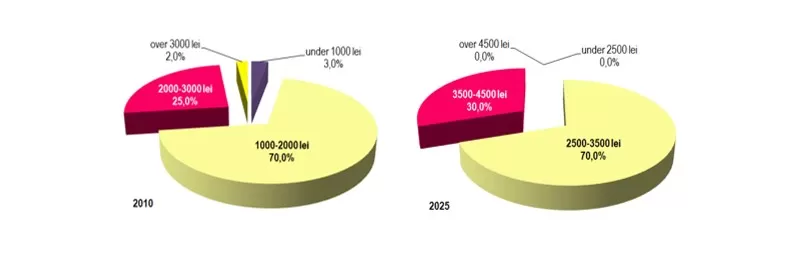
The categories of interest are centralized and represented graphically in the following tables, where one can also find detailed statistics for the three survey points (L1, L2, L3). It should be noted that at the time of the research, in 2010, there was a group of young people in the area (8 in number) who had organized a tent trip, and in 2025 a number of 6 foreign tourists were questioned (2 tourists aged over 75 years old and 4 tourists aged between 60 and 65 years, coming on vacation to Brașov). The attitude of the interviewed subjects was cooperative, most showing interest in the proposed topic. The final results for the two analyzed years indicate as tourists a percentage of 54.0% men (57.0% – 2010; 51.0% – 2025) and 46.0% women (43.0% – 2010; 49.0% – 2025), predominantly of the 26-35 age group in 2010 (60.0% of total tourists) and the 36-55 age group in 2025 (44.0% of total tourists). In 2010, the Romanian tourists registered a percentage of 100.0%, and in 2025 only 94.0%, the remaining 6.0% of tourists being foreigners. With regard to the monthly income level item (Fig.2), it is noted that, in 2010, those who earned a little more than the guaranteed minimum wage for the economy visited the area (according to the legislation – H.G. 1051/2008 – this was 600 lei/month) and in 2025, those who earned the guaranteed minimum wage for the economy (according to the legislation – H.G. 598/2024 – this was 3.700 lei/month).
Fig. 2. Monthly income of surveyed subjects
(Source: Own research)
Regarding the marital status, 78.5% are married (77.0% – 2010; 80.0% – 2025) coming on a mini-vacation with children or grandchildren. Analyzing the centralized results for the marital status item, it is found that in the two years of analysis (cumulative), in mini-vacations, the following were present: most married couples – 69.0% (66.0% – 2010; 72.0 % – 2026) met and surveyed in the Cheia resort area (63.0%); single people – 19.0% (the same percentage in both analyzed years; 2010 – 11.0% on the Mountain route L3; 2025 – 12.0% in L1); widows – 6.0% (2010 – 5.0%; 2025 – 7.0%); other categories – 6.0% (2010 – 10.0%; 2025 – 2.0%; in 2010, most being found on the mountain route – 6.0%). Most of the interviewed subjects are employees with secondary education (34.0% – 2010; 55.0% – 2025), followed by employees with higher education (28.0% – 2010; 20.0% – 2025).
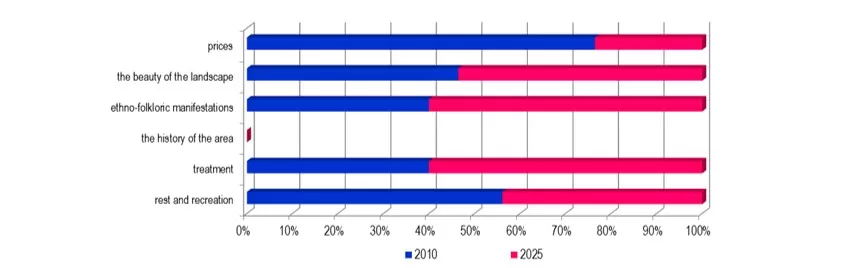
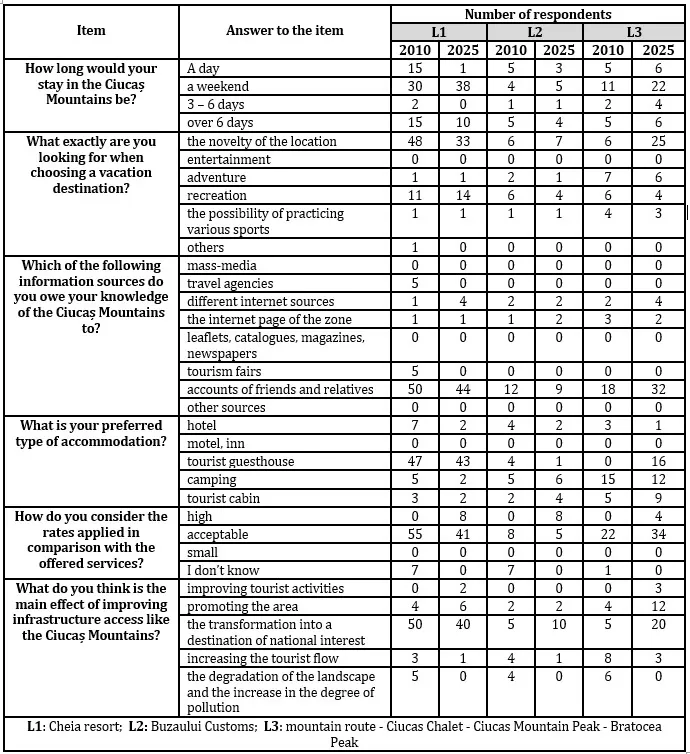
Looking at the graphic representation with the answers regarding the reason for choosing the Ciucaș Mountains as a holiday destination (Fig. 3), it can be observed that the majority chose this destination due to the charged prices, then to benefit from the different treatment packages and the period of cultural manifestations specific to the area. One can observe that only half of the tourists surveyed prefer the area for the beauty of the landscape and recreation. Tourists visiting the analyzed mountain area have few places that offer recognized food and accommodation services. These are unevenly distributed, and in some areas are completely absent. Most of the respondents (55.0%) answered the item regarding the duration of the stay in the Ciucaș Mountains, that they prefer the weekend option, but also a period of 6 days in proportion to 22.5%.
Most respondents choose their vacation destination based on the novelty of the area – over 62.5%, but also the possibilities for: recreation – 22.5%, adventure – 9.0%, practicing sports (cycling, paragliding, hiking with the ATV etc.) – 5.0%. Visualizing the centralization in Tabel 4, one can find that the tourist from the mountain area of Ciucaș is not a lover of entertainment during vacations. For the item that refers to the way in which they obtained information about the destination, most respondents (82.5%) claim that they come from relatives and friends, then, verified using Internet resources (12.5%). Being asked if they also found out from other sources, they specified that very little information from travel agencies and/or travel fairs (2.5%) and none from the mass-media or other sources, leaflets, catalogs, magazines, newspapers (0.0%) (Table 4).
Fig. 3. Answers to the item What are the reasons you chose the Ciucaș Mountains as a touristdestination?
(Source: Own research)
Table 4. The Ciucaș Mountains tourist destination – answers to different items and the number of respondents
(Source: Own research)
When asked what type of accommodation they prefer, most tourists prefer the tourist guesthouse (55.0%) and the campsite (22.5%) (Tabel 4). It should be mentioned that those who prefer camping are lovers of the mountain and the trails specific to the area, thus, being able to diversify according to their preferences of different trails. Most respondents asked about the quality-price ratio found in the area pointed out that the prices are affordable (82.5%), considering what is offered. A percentage of 7.5% do not know because they did not think to carry out such an analysis and 10.0% consider that they are high and cannot be justified (Tabel 4). At the item regarding whether the improvements would bring benefit to the analyzed area, in the opinion of many respondents (10.0%), it would increase the flow of tourists, which would also lead to the improvement of all tourist activities (2.5%) and the transformation into a destination of national interest (65.0%) (Tabel 4). Those who signaled that there would be problems related to the degradation of the landscape and would increase the degree of pollution are the tourists from the category who visit this mountain area frequently.
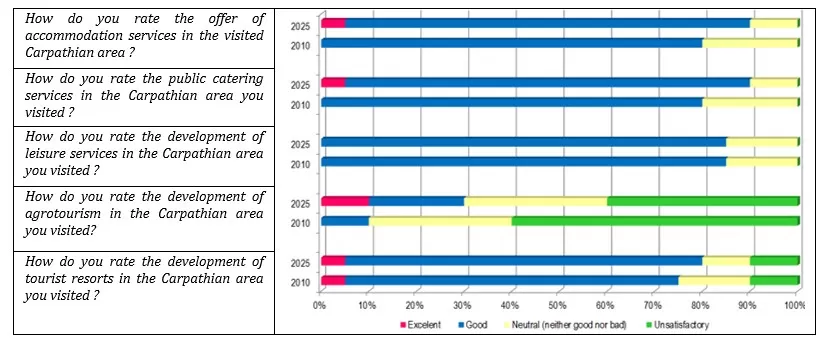
In the case of the answers to the ’How do you rate?’ items category, the following are found (Fig.4):
– the accommodation offer is considered to be good in proportion to over 70.0% of the visitors (only in 2025, a decrease of 5.0% was reported of those who had a neutral opinion);
– for the assessment of the public catering services quality found in the analyzed area, 50.0% claim that these services can be categorized as unsatisfactory and in proportion of the remaining 30.0% who have a neutral opinion and 15.0% good and only 5 .0% excellent;
– the leisure services are considered to be good in a proportion of 85.0% and only 15% have a neither good nor bad opinion;
– the agro-tourism is also appreciated as good in a proportion of 85.0% (notable, in 2025 is a decrease by 10.0% of those who had a neutral opinion and an increase by 5.0% of those who considered it excellent, many of them being among those who came for the first time in the area of the Ciucaș Mountains);
– concerning the degree of mountain resorts development, over 80.0% consider it to be good and only 5.0% consider it to be excellent, the rest having a neutral opinion.
Fig. 4. Centralization of answers (%) to the How do you rate? the tourist destination of the Ciucaş Mountains
(Source: Own research)
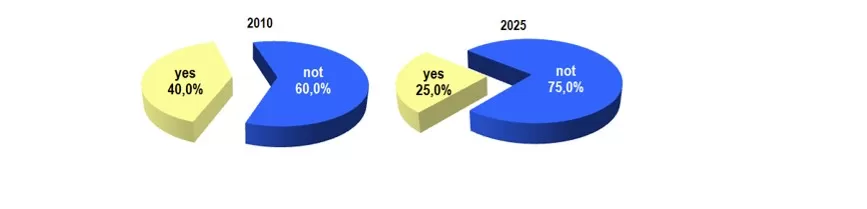
According to the centralization of the questionnaires that were the basis of the public opinion survey on the subject of the presentation (Fig.5): 67.5% of the respondents want to return to the Ciucaș Mountains area for the special natural landscape, mountain trails, etc.; 32.5% of those surveyed do not want to return to the Ciucaș Mountains area, because they are dissatisfied with the accommodation structure, food structures, leisure structures, roads etc.
Fig. 5. Answers to the item Do you consider the Ciucaș Mountains a major tourist attraction in the Carpathians?
(Source: Own research)
Among those surveyed who want to return to the Ciucaș Mountains area are tourists from the medium income category: in 2010 – income between 2000 – 3000 lei; in 2025 – income between 2500 – 3500 lei. Many of the respondents who return year after year are those who choose: the week mini-vacation category (in 2010 – 32.0%; in 2025 – 22.0%); the category that prefers a one-day nature excursion (in 2010 38.0%; in 2025 – 48.0%). The differences between 2010 and 2025 are minor. In the 15 years, the local authorities have not made significant efforts to better highlight the tourist area of the Ciucaș Mountains, the investments do not exceed 15.0% (the daisies offered to accommodation places in 2010 are also found in 2025, while the prices for accommodation are as big as in the Prahova Valley, for example), extremely poor promotion (tourists being part of the categories that return knowing the area or have learned from friends about the landscapes in the area) etc.
These results can be used to substantiate the need to educate and train the masses in the process of perceiving the tourist activity. It is necessary to call to notions that refer both to the intensity and frequency of the tourist phenomenon, to personality factors, personal expression or habit etc. Based on the documentary research, analysis of the completed questionnaires, etc. important conclusions can be drawn, on which our suggestions and recommendations can be based, for future tourism development. The initial goal was achieved through this type of research. The correct use of the results by tourism actors and authorities can ensure appropriate tourism practice in the targeted environment. Knowledge of travel needs and desires can help in the subsequent development of the area. First of all, the concept must satisfy the interests and increase the well-being of the local population. Secondly, both the natural and socio-cultural resources of the local environment must be preserved for the future generations.
Conclusions
We consider that the current analysis contributes actively in the creation and presentation of the tourist profile and potential of the region. The results of the study provide a complete synthetic picture, both of the motivation and needs, but also of the limitations and behavior of the tourists. This complex of evaluations highlights the advantages and disadvantages of each component element that provides information about a tourist potential. The conclusions can be used to develop and highlight promotion strategies for the studied area to become an attractive tourist destination on a national and, why not, on an international level. The findings can be useful in establishing directions and achieving sustainable development strategies. The result of the evaluations indicates the degree of potentiality, value, possibilities and opportunities, capitalization at a higher level, etc. The modelling of strategies must be done in accordance with the sustainable development of human society. Also, they must be built around the concrete possibilities of capitalizing on the existing elements. Practically, the conclusions of this study can be applied in the tourism industry. They can help adapt marketing strategies to meet the needs and motivations of travelers who prefer mountain tourism. The research highlights the need for a deeper understanding of preferences for traveling to the mountain area. Thus, the targeting of mountain tourism products can be improved. We believe that the purpose of the research, which is to analyze the attitude and travel trends of tourists, regardless of age, has been achieved. We also believe that the conclusions will help the tourism specialist to understand the travel behavior of tourists and develop future strategies to meet the constantly changing needs of future generations. The analysis is intended to be a useful tool in creating objective statistical databases on how people perceive a series of issues related to tourism and tourism activity. All the information obtained is useful in adopting a correct style of transmission of tourist information through evaluation and management strategies. In further research, the authors will examine the generational awareness of tourism in other countries and make international comparisons. The authors plan to conduct further studies in cooperation with tourist resorts. This will enable the authors to use the recommendations contained in the article.
Author Contributions
All authors have equal contribution to the preparation of this scientific paper.
References
Agheorghiesei (Corodeanu), D.T., (2013), „Rural tourism and agrotourism, ethics and health standards in the provision of tourism services”,
Bokor, E.C., Sava, A., Stănilă, M.V. and Nen, M., (2025), Turism, accesibilitate și apeluri 112: Studiu de caz al județului Constanța, Journal of Eastern Europe Research in Business and Economics Vol. 2025 (2025), https://doi.org/10.5171/2025.690611
Cauc, I., Manu, B., Parlea, D. and Goran-Bazarea, L., (2004), Sociological research methodology: research methods and techniques, Fundatia Romania de Maine Publishing House, Bucharest, Romania.
Day, J., Chin, N., Sydnor, S., Widhalm, M., Shah, K. and Dorworth, L., (2021), „ The implications of climate change on tourism and outdoor recreation: a case study from Indiana, USA” Climatic Change, 169(3-4). https://doi.org/10.1007/s10584-021-03284-w
Gottlichova M. and Kacerkova E., (2024), Specificul revenirii turismului ceh la aspectele pozitive ale erei pre-COVID-19, Journal of Eastern Europe Research in Business and Economics Vol. 2024 (2024), ID articol 914630, https://doi.org/10.5171/2024.914630
Holloway, J.Ch., (1994), The Business of Tourism, ed. IV, Pitman Publishing, London, Great Britain.
Holloway, J.Ch., Humphreys, C. and Davidson, R., (2009), The business of turism, Eight edition: Pretice Hall, Great Britain.
Institutul Național de Statistică (INSSE) (2010, 2024, 2025), Statistical bulletins, [Online]. INSSE. Available at: https://insse.ro
Israel, G.D. (1992), „Sampling the Evidence of Extension Program Impact. Program Evaluation and Organizational Development”, IFAS, University of Florida, USA.
Israel, G.D., (2009), Determining Sample Size, Program Evaluation and Organizational Development, IFAS,PEOD-6, University of Florida, USA.
Kaspar, C. and Scherly, F., (1992), Introduction au management touristique, Editura Paul Haupt Berne – Stuttgart – Vienne, Austria.
Kothari, C.R., (2004), Research methodolgy. Methods and techniques, New Age International Publications, Ansari Road, Daryaganj, New Delhi, India.
Lambin, E.F., Turner, B.L., Geist, H.J., Agbola, S.B., Angelsen, A. and Bruce, J.W., (2001), „Causes of land use and land cover change: moving beyond myths”, Global environmental change, 11(4): 261–269, doi : 1016/S0959-3780(01)00007-3
Lefton, L.A., (1974), „Checking the information from the matrix presented briefly”, Journal of Experimental Psychology, Vol 103(5), https://doi.org/10.1037/h0037402
Lefton, L.A. and Cutler, G., (1991), Psychology(ed. a IV-a). Allyn & Bacon, Boston, USA.
McLeod, S., Berry, K., Hodgson, C. and Wearden, A., (2020), „Atașamentul și sprijinul social în diadele romantice: o analiză sistematică”. Journal of Clinical Psychology, 76 (1), 59-101. https://doi.org/10.1002/jclp.22868
Tapu, C.S., (2004), Statistical bases of psychology, Premier Publishing House, Ploiesti, Romania.
Tapu, C.S., (2020), „Psychology of education. Psychology notes for (future) teachers and doctors”, course support, University of Agronomic Sciences and Veterinary Medicine Bucuresti.
Torkashvand, F. and Darabi, H., (2023), „Modeling the impact of citizens’ social responsibility on sustainable development based on the modifying role of the Covid-19 pandemic”,Present Environment and Sustainable Development Volume 17, number 1, DOI: https://doi.org/10.47743/pesd2023171019
Yanogo, P.I, (2023), „Rainfall variability and changes in market gardening systems: a case study in Réo (mid-west region of Burkina Faso) ”, Present Environment and Sustainable Development, Volume 17,Issue no.2/2023, https://doi.org/10.47743/pesd2023172016
Yamane, T., (1967), „Statistics: An Introductory Analysis”, New York: Harper and Row, USA, quoted by Israel (2009)
Zlate, M., (1999), Psychology of cognitive mechanisms, Polirom Publishing House Co SA, laşi,