PEDAGOGIUM Higher School of Social Sciences in Warsaw, Poland
Volume 2025,
Article ID 537889,
Journal of e-Learning and Higher Education,
9 pages,
DOI: 10.5171/2025.537889
Received date: 9 May 2025; Accepted date: 8 July 2025; Published date: 29 September 2025
Cite this Article as:
Krzysztof R. ZIELINSKI (2025)," Risk Education in the Contemporary World of Threats: A Literature Review ", Journal of eLearning and Higher Education, Vol. 2025 (2025), Article ID 537889, https://doi.org/10.5171/2025.537889
This study explores the increasing significance of risk education in the context of the complex, unpredictable, and interconnected threats of the 21st century. The motivation for this research arises from the growing inadequacy of traditional safety education models, which emphasize reactive procedures rather than proactive, reflective competencies. A critical gap in the existing literature is the limited integration of risk as a multidimensional concept – encompassing cognitive, emotional, cultural, and systemic aspects—within educational systems at all levels.
To address this gap, the paper employs a qualitative literature review methodology, analyzing key theoretical contributions by Beck, Slovic, Douglas, Arnoldi, Kolb, and others. The study maps the evolution of risk as a social and interpretive category and identifies the pedagogical implications for contemporary education. It outlines various types of modern threats—natural, technological, social, informational, and geopolitical—and demonstrates their cascading and hybrid nature, requiring interdisciplinary and experiential approaches to teaching.
The findings emphasize the necessity of embedding risk education into school curricula, teacher training, and lifelong learning strategies. Key educational models are reviewed, including cognitive, behavioral, constructivist, transformative, and experiential frameworks. The study argues for a systemic and participatory orientation in pedagogy, supporting critical thinking, adaptive decision-making, and civic resilience. By framing risk education as a foundational element of contemporary civic and security education, the paper contributes to conceptual development in the field and offers directions for future empirical research and policy implementation.
Modern societies operate in a world of dynamic and complex threats that increasingly elude simple classifications and linear prediction models. The pace of technological change, the globalization of economic and social processes, the intensification of climate change, as well as digital, political and information threats, lead to a situation of permanent uncertainty. In such conditions – as Zygmunt Bauman notes – people experience reality as “liquid”, in which security ceases to be a permanent state, but becomes a temporary equilibrium in the face of unpredictable events (Bauman, 2006).
In the face of these challenges, the importance of risk management is growing, and in particular – risk education, which is to prepare individuals and communities to live and act in a world of uncertainty. Contemporary threats are global, systemic, non-linear and often difficult to grasp immediately, which requires new approaches in both security policy and education systems. Traditional models of security education, focused mainly on procedures for dealing with crisis situations, are no longer sufficient.
As Jakob Arnoldi points out, risk has ceased to be merely a tool for calculating probability – it has become an interpretative framework through which individuals and institutions understand the future, uncertainty and responsibility (Arnoldi, 2011). Consequently, security education must evolve towards risk education, encompassing primarily the understanding of the essence of risk and its cultural determinants, as well as the analysis of the sources and types of contemporary threats. Consequently, this will allow for the development of information, decision-making and adaptive competences.
Moreover, as Ulrich Beck notes, we live in a risk society, where the side effects of technological progress and civilization development themselves become sources of new threats – invisible, global and difficult to attribute to specific entities (Beck, 2002).
In this context, risk education is no longer the exclusive domain of specialists, but should become an element of universal civic, environmental, digital and health education. Its aim is not only to impart knowledge, but above all to develop reflective, responsible and responsive attitudes in response to threats.
In view of the above, risk education becomes a key tool for building an informed and resilient society. By analyzing the nature of risk, the characteristics of contemporary threats and educational directions, this text fits into the current trend of research on security, education and uncertainty management.
Introduction to the Issue of Risk in Security Education
The concept of risk occupies a central place in contemporary security sciences, crisis management and civic education. The classical approach defines risk as the probability of an undesirable event occurring in combination with its potential effects – this approach is reflected, among others, in the definitions included in the ISO Standard 31000:2018, according to which risk is “the effect of uncertainty on objectives” (ISO, 2018).
Nevertheless, the contemporary understanding of risk has expanded significantly. It is increasingly considered not only as a technical dimension, but also as a social, cultural, political and psychological one. Ulrich Beck, the author of the concept of risk society, recognizes that “…in modern society, dangers are no longer exclusively external, but are the result of progress itself” (Beck, 2002, p. 21). Thus, risk is no longer a marginal phenomenon – it becomes the main axis organizing social reflection and institutional actions.
Uncertainty, threats, predicting the effects and managing information about risk permeate everyday life – from political decisions to consumer or educational choices.
Jakob Arnoldi in his book “Risk” indicates that risk has become an interpretive category that regulates our thinking about the future, planning and responsibility:
“In contemporary societies, risk is no longer just a tool for prediction. It becomes a category that organizes thinking about the world – risky by nature” (Arnoldi, 2011, p. 14).
In Arnoldi’s interpretation, risk results from three basic elements: values, responsibility and knowledge. What we consider risky depends on our cultural and social values; decisions made in risky conditions are associated with responsibility for their effects; and orientation in the world of uncertainty requires knowledge – not only expert knowledge, but also the ability to interpret it. Therefore, education about risk must take into account these three dimensions, becoming a space for developing reflectiveness, ethics of action and critical thinking.
In turn, Anthony Giddens emphasizes that modernity is a time of so-called “reflective modernity”, in which people consciously confront the risks produced by civilization: “In the conditions of late modernity, knowledge of the threat is not hidden – on the contrary, it is part of the reflection on the social order itself” (Giddens, 1999, p. 87).
In this context, education about security can no longer be reduced to the transmission of rigid procedures for dealing with threat situations. Its task is to teach analysis, interpretation and conscious response to complex and often non-obvious forms of risk, as well as to build critical and ethical competences in the field of decision-making.
Ortwin Renn, an expert in the field of risk management, emphasizes the need for a social and communicative approach to risk. Such an approach is confirmed by the statement that “…risk is not something that can be fully objectively measured – its meaning is created in the process of social understanding, assessment and negotiation” (Renn, 2008, p. 45). Thus, education about risk should primarily take into account the diversity of risk perception. This perception will apply to children, young people, but also to adults and the elderly. Cultural and emotional conditions must be taken into account, which will largely determine the understanding of risk and its nature and appropriate behaviors. This, in turn, will affect the social nature of responding to threats and acting in the face of threats. The role of the media and information in shaping risk awareness becomes extremely important. Mass media may, but do not have to, shape patterns of behavior in the face of threats and influence communities, how they will act after receiving information about threats and what society should do to, for example, organize an evacuation from the threatened area.
In connection with this, there is an increasing talk about the need to develop so-called risk literacy, i.e. the ability to:
understand risk as a complex and uncertain phenomenon,
interpret numerical and qualitative data,
recognize manipulation and disinformation,
make decisions in situations of uncertainty.
Paul Slovic states that “…risk is not just numbers – it is also feelings, experiences and trust” (Slovic, 2002, p. 287). He draws attention to non-rational aspects of risk perception, which are often omitted in technocratic and mathematical models of security management. Slovic, as a psychologist, emphasizes that people assess risk not only on the basis of facts and statistics, but also guided by emotions, previous experiences and the level of trust in the source of information (e.g. institutions, experts, media). In this sense, risk is a subjective cognitive and emotional construct that is shaped by the impact of the media, social narratives and the personal history of an individual. Two different threats with the same probability and consequences can be perceived completely differently depending on whether they are known, controllable, voluntary and publicized. Therefore, risk education should develop not only numerical (mathematical) knowledge, but also awareness of emotional mechanisms of risk assessment. It should contribute to learning how to critically receive information and analyze sources of trust. This will in turn allow for proper preparation for action in situations in which emotions and stress affect decisions. This approach is combined with the concept of risk-as-feeling – risk experienced, not just calculated. Risk education should therefore be a space not only for transferring knowledge, but also for building psychological and social resilience. Its aim should be to shape individuals capable of cooperation, independent thinking and responsible response in the face of unpredictable phenomena. In this sense, this education becomes one of the foundations for the development of social resilience, understood as the ability of communities to adapt and rebuild in situations of threats (Mezirow, 1991). As a result, risk ceases to be just a mathematical category of prediction – it becomes the foundation of civic, environmental, health and digital education. It is in education that risk reveals itself as an interdisciplinary concept, combining knowledge with responsibility and the ability to act in a world of uncertainty.
Characteristics of Contemporary Threats and Risks Associated with Them
The contemporary world is a space of dynamic and complex processes that generate new forms of threats and risks. Phenomena such as globalization, digitalization, climate change, social inequalities or geopolitical tensions not only create new sources of uncertainty, but also transform the way we understand and respond to risk. Therefore, it is crucial not only to identify threats, but also to understand their nature, interconnections and impact on various spheres of social life.
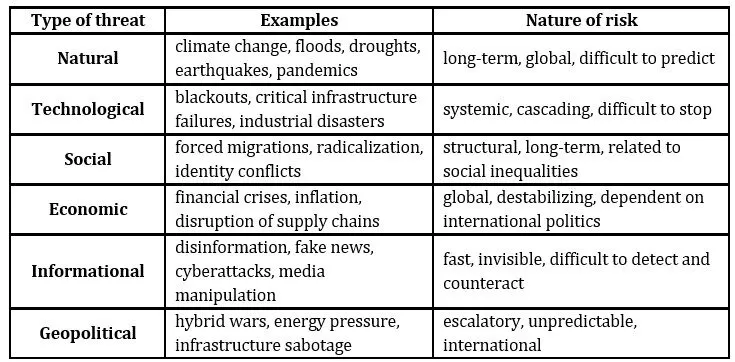
The literature on the subject distinguishes many classifications of threats, the most commonly used of which is the division into natural, technological, social, economic, information and geopolitical threats (Buzan et al., 1998; Beck, 2002; Cavelty, 2007). This typology allows for a better understanding of the sources of risks and their effects in various socio-institutional contexts.
Table 1 illustrates the main types of modern threats.
Table 1: Typology of threats and the nature of risk
Source: Author’s own elaboration based on Beck (1992) and Slovic (2000).
This typology is particularly useful in education, as it allows for gradual explanation of the diversity of contemporary threats, especially in terms of the complexity of contemporary risks. It is also a starting point for the analysis of threats and risks based on possible scenarios of scenario events. This allows for the organization of decision-making games or designing exercises in the field of crisis management. More and more contemporary threats are characterized by the so-called cascade effect, in which one event initiates a chain of subsequent, interconnected crises. An example of this is a power grid failure caused by human error or deliberate action. The effect of such a failure may be the disruption of telecommunications networks and disruptions leading to the paralysis of the functioning of rescue services, hospitals or other municipal infrastructure. In turn, such a situation may contribute to the emergence of panic among society, which may consequently lead to social and political crises. The presented situation is one of the possible scenarios of dangerous events of a cascading nature causing a complex of threats becoming a crisis for the local community exposed to a set of threats of a diverse nature and a crisis situation for local authorities, which are forced to take rescue and recovery actions. As a result, actions will be taken to restore damaged or lost resources that serve society and institutions performing tasks for society. In such a case, sectoral response becomes insufficient – intersectoral cooperation, integrated planning and systemic thinking are necessary. Risk education should therefore take into account the analysis of secondary effects, functional dependencies between infrastructures and the impact of response time on the escalation of threats.
In the era of information warfare, cyberattacks and geopolitical tensions, hybrid threats are becoming increasingly important, combining elements of military, information, economic and technological destabilising actions. They are difficult to identify, have a long-term nature and often fall outside the classic definitions of war or crisis.
An example of such a situation could be a cyberattack on water supply infrastructure. As a result, there are disruptions in the supply of drinking water to the population or a complete lack of access to it. Another effect is a decrease in trust in institutions providing services to society and an increase in social unrest. Additionally, activities related to disinformation in the media are being noticed. This scenario is another example not only of hybrid actions, but also of the cascading nature of threats considered from a cause-and-effect perspective. From an educational perspective, hybrid threats teach that not everything that is real is visible and that the ability to interpret warning signals and critical thinking are essential civic competences.
When considering the nature and sources of all threats, it is necessary to pay attention to the interdependence of natural and civilizational threats.
Natural hazards are increasingly being amplified by civilization factors (e.g. urbanization, environmental degradation, inequality). The result is complex humanitarian, ecological and social crises that cross state borders and institutional competences. As Beck (2002) emphasizes, these risks are the product of the “productive logic of modernity”.
Evidence of this is the climate changes that have been noticeable for decades, causing droughts, increasing deficits in access to water. This in turn contributes to climate migrations and increasingly frequent conflicts over access to resources. In the face of such a situation, political and social instability occurs. Such feedback loops require an interdisciplinary approach in education – combining knowledge from the natural, social and technological sciences.
An extreme example of threats that have not only a regional but possibly global reach are contemporary armed conflicts, such as the war in Ukraine. They show that military operations affect health, education, energy and information systems in a cumulative manner. They are also international in nature – affecting raw material security, cyberspace and global order. The effects of such conflicts include the destruction of energy infrastructure, communication infrastructure (roads, railways). This causes serious disruptions in the operation of healthcare facilities and hospitals, schools, and administration. At the same time, there is a noticeable increase in disinformation and regional destabilization.
Risk education should therefore include the analysis of armed conflicts not only from a military perspective, but also as a complex social and systemic risk.
The complexity, unpredictability and interdependence of threats require a new approach in security education. Teaching should include:
systems thinking – understanding the relationships between sectors,
scenario-based approach – preparation for many possible scenarios,
analysis of secondary risks – identification of indirect effects,
intersectoral cooperation – simulations and exercises involving various institutions,
information resilience – the ability to recognize disinformation and social panic.
Anthony Giddens states that “…in the society of late modernity, individuals live in constant tension between knowledge of the threat and its denial” (Giddens, 1999, p. 48). Therefore, risk education should be treated as the foundation of modern civic and environmental education – supporting not only knowledge, but also mental resilience, decision-making competences and the ability to act together. Given such an approach, from an educational perspective, the above conditions mean the need for:
teaching how to recognise cause-and-effect connections,
developing scenario thinking and the ability to predict secondary effects,
shaping systemic thinking and mental resilience,
implementing educational models that take into account real crisis situations.
The threats of the modern world do not occur in isolation. They are complex, interdependent, multidimensional and difficult to predict. This requires a new approach to risk education, based on scenario analysis, interdisciplinarity and systems thinking. Only then will education be able to prepare citizens for responsible action in conditions of global uncertainty.
The Nature of Risk – Sources and Essence
The concept of risk is one of the most ambiguous and interdisciplinary categories of contemporary science – it is present in engineering and economics, as well as in sociology, psychology, anthropology and education. Along with the development of civilization and technology, it has evolved from simple probabilistic calculations to reflection on the complexity of contemporary threats and their social reception. Understanding the nature of risk is essential to effectively teach about safety – not only through instruction, but by developing analytical, emotional, social and ethical competences.
In the traditional, technical-probabilistic approach, risk is a mathematical function expressing the possibility of an undesirable event occurring. We can present it differently, that risk is the product of the probability of a dangerous event (threat) occurring and its effects.
Such definitions are useful in engineering, finance, project management and public health. They allow for the creation of models, scenarios and procedures for reducing risk. However, their limitation is the abstraction from the social, emotional and institutional context. As Ortwin Renn notes:
“Risk is not just a function of threat – it is the context of social and institutional decisions made under conditions of uncertainty” (Renn, 2008, p. 45).
In the socio-cultural perspective, risk only becomes meaningful when it is interpreted, embedded in values and incorporated into social discourse. It does not exist as a universal fact – but as a cultural and social construction. According to Mary Douglas, “…risk perception is not just a rational process, but an expression of a system of values and social structure” (Douglas & Wildavsky, 1982, p. 8).
Different communities and groups interpret the same threat differently – depending on the context, history, trust in institutions, degree of control and sense of agency. For example, nuclear energy, vaccinations or genetically modified organisms (GMOs) are assessed completely differently in Scandinavian countries than, for example, in Central and Eastern Europe. From a psychological perspective, risk is perceived through the prism of emotions, experiences and heuristics. Paul Slovic, one of the leading researchers of risk perception, emphasizes that “…people do not perceive risk through the prism of probability and data, but through emotions, trust and symbolic meanings” (Slovic, 1987, p. 285). Following this line of thinking, we can assume that the factors influencing risk perception are:
familiarity: known risks (e.g. driving a car) seem less dangerous than new ones (e.g. artificial intelligence, nanotechnology),
voluntariness: risks that we take consciously are more easily accepted,
a sense of control: increases risk tolerance,
immediacy of effects: deferred effects (e.g. smog) are disregarded.
For this reason, risk education must teach the difference between real and perceived risk, develop media competence and emotional resilience. Many risk researchers consider it to be a certain element of political and institutional order. Ulrich Beck, in his book “Risk Society“, emphasizes that “Modern societies are not only exposed to risks – they generate them, manage them and politicize them” (Beck, 2002, p. 23). Thus, we can say that risk can be a tool of power, social control and legitimize the actions of state institutions. This is visible through the proclamation of states of emergency in a country or its part, for example as a result of the COVID-19 pandemic. Another similar action may be media campaigns that are intended to mobilize society against threats. In many countries, such actions are taken in connection with the expanding threat to cybersecurity. In a negative sense, state institutions may selectively present threats in public debates, for example by indicating that migration is caused by rapid climate change. Of course, we can find many more examples. For this reason, it is necessary to undertake educational activities that will focus on developing civic awareness, the ability to evaluate information sources and recognize manipulation.
We can therefore present the main contemporary understanding and perception of risk. First of all, it is uncertainty related to the lack of data, large and rapid variability of the environment and its unpredictability. Another feature of risk is the subjective nature of its perception and interpretation. It should be clearly stated that risk is felt individually, through emotions and experiences. Risk has a social construction based on the interpretation of risk from the perspective of individual values, culture and context. An important feature of risk is its political nature, consisting in the fact that it is repeatedly used to deliberately manage public opinion, and thus legitimize the actions of the authorities. As mentioned earlier, threats are of a cascading nature. Therefore, we can assume that risk has a systemic feature, i.e. there are dependencies between different types of risks and threats and they should be considered as cause-effect. It should be emphasized once again that risk is not only a technical computational concept. Risk is a social, cultural and emotional phenomenon that affects the way of life and decision-making. Risk education, to be adequate and effective in its operation, must cross disciplinary boundaries and teach interpretation and action. This will allow the development of values, awareness and resilience. If these requirements are met, it will be possible to prepare citizens for responsible life in a risk society – not through fear, but through understanding and conscious action.
Risk Education – Essence, Goals and Models
Risk education as a response to the complexity of contemporary threats is not only the transfer of information about potential threats. First of all, it is a complex didactic, social and cultural process, the aim of which is to develop competences to recognize, interpret, assess and manage risk in conditions of uncertainty and complexity. In the context of contemporary changes – global, environmental, technological and geopolitical – this education is gaining key importance as the foundation of a culture of security and social resilience. Paul Slovic emphasizes that: “…risk is not just numbers – it is also feelings, experiences and trust” (Slovic, 1987, p. 285).
In view of this approach, risk education should take into account not only the cognitive aspect, but also the emotional, social and ethical one, integrating the teaching of knowledge with reflection on responsibility and decisions in unpredictable situations.
In turn, Zbigniew Kwieciński emphasizes that “…the task of education is to shape the ability to live in risk conditions, without losing subjectivity, morality and the ability to act” (Kwieciński, 2000, p. 112). In order to meet these requirements, we can indicate the main goals of risk education. They should primarily include shaping the awareness of threats, i.e. understanding the sources, dynamics, mutual connections of threats and the mechanisms of their escalation and long-term consequences. Then, it is necessary to develop decision-making competences thanks to which everyone will have the ability to take action in unfavourable conditions of contradictory information and incomplete knowledge, predict the effects and plan for emergencies. At the same time, it is necessary to strengthen social responsibility consisting in promoting attitudes of solidarity, empathy, civic involvement and readiness to cooperate. These activities will allow for building a culture of security and social resistance to threats, i.e. developing adaptive, self-regulatory and conscious participation in community life. Risk education is increasingly based on active approaches that engage participants of the educational process in the processes of analysis, reflection and cooperation. In order to achieve this, it is necessary to use different learning models. The basic one should be the cognitive model, which consists in transferring knowledge about threats and safety rules. At the same time, you can use the behavioral approach, i.e. organizing exercises and improving specific behaviors in crisis situations (e.g. evacuation, first aid). In order to stimulate the creativity of participants in the educational process, the constructivist model is very useful, during which learning is based on solving problems, project activities and cooperation in a group of participants. The transformational model of education is also very helpful, which will contribute to positive changes in attitudes, values and ways of thinking about safety, threats and risk (Mezirow, 1991). The presented educational models/methods are commonly used, however, due to the need for a practical approach, especially in education about risk, one of the most effective models seems to be David Kolb’s “learning through experience” cycle (Kolb, 1984), which integrates theory with practice and reflection. This model consists of acquiring knowledge through specific experience, e.g. participation in exercises, crisis simulation or a local project. In addition, reflective observation is preferred, consisting of analyzing the course of decisions and actions taken and observing emotions. Abstract conceptualization, i.e. reference to theory, identification of mechanisms, is very helpful in this educational cycle. For learning to be effective, active experimentation is necessary, consisting of implementing, using new knowledge in a different context.
In conclusion, it should be recognized that risk education is a strategic tool of civic education, supporting the development of knowledge, skills and values necessary for living in a world of risk. It primarily plays a preventive role through awareness and prevention of threats, and a developmental role contributing to changing attitudes and thinking about the risks of threats. In addition, it plays a social role by stimulating cooperation and commitment to achieve common goals. By fulfilling a practical function, education contributes to the development of action competences and social resilience. In this approach, risk education is not limited to responding to threats, it is the basis for building a responsible, flexible and aware society.
Summary and Conclusions
Risk education is becoming a central pillar of civic education in a risk society – not only from the perspective of public safety, but also as an element of shaping conscious citizenship. Contemporary threats are complex, interconnected, often cascading and intersectoral, and risk itself is no longer just an objective statistical category, but a social, cultural and emotional construct (Slovic, 2002). As Giddens (1999) notes, we live in a state of constant tension between risk awareness and its denial – which only intensifies the need for education that is not limited to instructions, but engages in reflection and action.
The analysis shows that risk education today encounters serious systemic, cognitive and institutional barriers. There is a lack of coherent educational policy, support for teachers, integrated core curricula and professional development programs (Grotowska-Leder, 2020). In addition, the problem is the dispersion of content between different subjects and the lack of reference to local contexts of threats. In addition, the information society generates new forms of risk – such as disinformation – which are difficult to analyse without advanced media and information education. Students are often left without tools to recognise manipulation, which weakens social trust and the ability to make responsible decisions (Slovic, 2002).
In this context, school can no longer be solely a place for imparting knowledge, but should act as a laboratory of social resilience. Risk education, if it is to be effective, must go beyond the classroom and traditional subject divisions. Project-based, participatory and locally rooted activities are needed – activities that strengthen students’ subjectivity, teach cooperation with local institutions and develop competences for living in a world of uncertainty.
The analysis conducted in the article leads to the following key conclusions:
Risk is a social-cognitive construct, not just a statistical category. Therefore, education must take into account the cultural, emotional and political contexts in which risk is interpreted (Slovic, 2002; Beck, 2002).
Contemporary threats, considered to be systemic and complex, determine the interdisciplinarity of security education. Schools and universities should integrate knowledge from the field of the environment, public health, information and functioning of society. Moreover, risk education is a process of forming competences, not just the transfer of knowledge. It must include cognitive, emotional, social, decision-making and ethical competences. The learning models of Kolb (1984), Mezirow (2000), and Slovic (1987) emphasize the importance of experience, action and reflection.
The educational system in Poland still treats risk education marginally – as an addition, not a central element. Meanwhile, it should be included in the mission of the school as an institution shaping citizenship and the ability to act in conditions of uncertainty.
The most important challenges are: lack of systemic policy, low level of support for teachers, limited development of media education and too general programs not adapted to local realities of threats. The answer should be the transformation of education towards project-based, participatory and territorially rooted activities.
As Anthony Giddens (1999, p. 48) aptly notes, that “…in the society of late modernity, individuals live in a constant tension between knowledge of the threat and its denial.” Therefore, risk education cannot be treated as a set of didactic content – it must be a space for social dialogue, critical thinking and building individual and collective resilience. As evidence of this, we can quote Barry Turner (Turner & Pidgeon, 1997, p. 213), who states that “…the greatest risk is not the one we do not see – but the one we do not want to learn.“
References
Arnoldi, J. (2011) Risk: An Introduction, Cambridge: Polity Press.
Bauman, Z. (2006) Liquid Fear, Cambridge: Polity Press.
Beck, U. (2002) Risk Society: On the Way to Another Modernity, Warsaw: Scholar.
Buzan, B., Wæver, O. and De Wilde, J. (1998) Security: A New Framework for Analysis, Boulder: Lynne
Rienner Publishers.
Cavelty, M. D. (2007) Cyber-Security and Threat Politics: US Efforts to Secure the Information Age, London: Routledge.
Douglas, M. and Wildavsky, A. (1982) Risk and Culture: An Essay on the Selection of Technological and Environmental Dangers, Berkeley: University of California Press.
Giddens, A. (1999) Modernity and Identity: The Self and Society in the Age of Late Modernity, Warsaw: PWN.
Grotowska-Leder, J. (2020) ‘Preparing Teachers of Safety Education for Teaching about Risk’, Scientific Papers of the University of Lodz, 25(1), 55–68. https://doi.org/10.18778/0208-600X.25.04
ISO (2018) ISO 31000:2018 Risk Management – Guidelines, Geneva: International Organization for Standardization.
Kagan, R. A. (2001) Adversarial Legalism: The American Way of Law, Cambridge, MA: Harvard University Press.
Kasperson, R. E., Kasperson, J. X. and Pidgeon, N. (2005) The Social Amplification of Risk, Cambridge: Cambridge University Press.
Kolb, D. A. (1984) Experiential Learning: Experience as the Source of Learning and Development, Englewood Cliffs: Prentice Hall.
Kwieciński, Z. (2000) ‘Education towards risk’, Education and Dialogue, 6, 111–114.
Mezirow, J. (2000) Learning as Transformation: Critical Perspectives on a Theory in Progress, San Francisco: Jossey-Bass.
Renn, O. (2008) Risk Governance: Coping with Uncertainty in a Complex World, London: Earthscan.
Siemienicki, B. (2013) Information Culture of Society and Education, Toruń: UMK Publishing House.
Slovic, P. (1987) ‘Perception of Risk’, Science, 236(4799), 280–285. https://doi.org/10.1126/science.3563507
Slovic, P. (2002) The Perception of Risk, London: Earthscan.
Turner, B. A. and Pidgeon, N. (1997) Man-Made Disasters, 2nd ed., Oxford: Butterworth-Heinemann.