Department of Finance, Bucharest University of Economic Studies, Bucharest, Romania
Volume 2025,
Article ID 674495,
Journal of Economics Studies and Research,
8 pages,
DOI: https://doi.org/10.5171/2025.674495
Received date: 11 June 2025; Accepted date: 9 September 2025; Published date: 16 October 2025
Academic Editor: Alexandra Ioana Vintilă
Cite this Article as:
Georgeta VINTILĂ and Andreea-Raluca MOCANU (2025), “ The Positive Impact of FDI Reflected on the Economic Growth of G7 Countries: Empirical Evidence based on Panel Data ", Journal of Economics Studies and Research, Vol. 2025 (2025), Article ID 674495, https://doi.org/10.5171/2025.674495
This study is investigating the positive impact of foreign direct investment on economic growth in the case of the world’s advanced economies, G7 countries, between 2000-2023. The analysis highlights the benefits of FDI on economic growth, using the Panel EGLS (Cross-section random effects) regression method. Empirical results showed that FDI could generate up to a 15% increase in economic growth along with its positive movement in G7 economies, this being an element of novelty in the literature by analyzing the FDI’s impact from the perspective of advanced countries. Also, the results showed that renewable energy consumption and research and development expenditure bring a positive influence on the economic growth of the host countries. This research should be considered as part of the decision-making process worldwide, encouraging both developed and developing countries in attracting foreign direct investments for technological and innovation evolution. Moreover, renewable energy consumption and research and development expenditure represent key drivers in innovation, green growth and technological transfer, stimulating investments and accelerating the economic growth.
JEL Classification: E22, P33, P45
Keywords: G7 countries, economic growth, FDI, panel EGLS, random effects
Introduction
The Group of Seven (G7) represents an intergovernmental organization consisting of the world’s advanced economies as Canada, France, Germany, Italy, Japan, the United Kingdom and the United States. The purpose of this paper is to investigate the impact of foreign direct investment on economic growth in the case of G7 countries between years 2000-2023. Considering that in the specialized literature the main focus is more on the developing contries and less on the developed ones, the novelty of this paper is that we analyze the most developed countries from the perspective of the role of investments on their economies during more than the last 20 years. In the literature, the general assumption is that developing countries have a major need to extend their economies, but the real fact is that the leading industrial countries should also have the aim of attracting and absorbing all the advantages of the foreign direct investments, because the technological evolution path and innovation power represent the future.
This paper is structured in two sections including the literature review based on a summary of existing research, and the empirical analysis using the methodology approach Panel EGLS (Cross-section random effects) regression. The variables examinated in the econometric study are economic growth, as an endogenous variable, and the exogenous variables selected based on the literature review: foreign direct investment, exports, imports, gross fixed capital formation, renewable energy consumption and research and development expenditure. The hypothesis that the research starts with is that there is a positive impact of foreign direct investment on economic growth, in accordance with Wani et al (2024), Ngoc (2025), Pradhan et al (2024), Yeboah et al (2025), Raihan et al (2025), Xin et al (2024) and many other reasearchers in the literature that empirically proved this evidence.
The econometric findings of the current paper reveal that there is a positive and significant impact of investments on the economic growth of G7 countries, FDI being one of the most important triggers of economic growth evolution, stimulating it no matter how developed the host country is. The results highlighted that an increase of FDI could generate up to a 15% increase in economic growth. Also, based on the results, the renewable energy consumption and research and development expenditure are important factors that accelerate the economic growth of G7 countries. The evidence of this study should be considered as part of the decision-making process and future investing implications worldwide since the analysis covers the behavior of leading industrial countries.
Literature Review
Studies have been initiated in the specialized literature on the link between economic growth, foreign direct investment and other determinants of growth, including trade openness, renewable energy consumption, green technology, natural resources and innovation. A part of the studies focus on developing countries that need foreign direct investment to accelerate economic growth. There are also some studies that considered developed countries, even G7 member countries, and also groups of countries from various environments and geographical areas, presented in the below literature review.
Wani et al (2024) analyzed the role of foreign direct investment, green energy and green technology on green economic growth in the G7 countries, over the period 1995-2020. Using the cross-sectional autoregressive distributed lag (CS-ARDL) method to estimate the long- and short-run coefficients, the empirical results proved that investment and green energy contribute positively to green economic growth in both the short and long run. Also, green technology has a positive impact only in the long run, in the case of the analyzed countries. Ngoc (2025) analyzed the relationship between foreign direct investment and economic growth in three different scientific papers, applying the Autoregressive Distributed Lag (ARDL) approach for countries such as Japan, the United States of America and Germany. In the case of Japan, the research results showed that foreign direct investment contributes significantly to GDP growth. In the case of the United States of America, it was also shown that investments have a considerable long-term impact on economic growth. And, for Germany, the study highlighted a stronger short-term impact, compared to a weaker long-term impact of FDI on economic growth.
Pradhan et al (2024) analyzed the symmetric and asymmetric relationship between foreign direct investment, trade and economic growth in 10 ASEAN countries, during the period 1990-2020. Using the panel vector error correction model, the research results indicated a bidirectional causal relationship between investment and economic growth, and, in the short run, increased FDI generates a positive impact on GDP. Foreign direct investment also contributes to encouraging exports, which implicitly stimulates the economic growth. Another study by Garg et al (2025) investigated the determinants of sustainable economic development in the ASEAN region. Among the main factors found was foreign direct investment, which has an important role in achieving development goals, along with education, governance and renewable energy. Also, the study of Xin et al (2024) analyzed a group of South Asian countries regarding the impact of foreign direct investment on services exports, during the period 2000-2020. Using panel data techniques, the study obtained clear evidence that foreign direct investment contributes positively and significantly to the growth of services exports, and implicitly to the economic stability of South Asian countries.
In the paper conducted by Yeboah et al (2025), nine European countries were analyzed in terms of the impact of foreign direct investment and trade openness on economic growth. The econometric method applied in the study was the ADRL (Autoregressive Distributed Lag) model, using data from the period 1995-2021. The empirical results proved that foreign direct investment has a positive impact on economic growth in the short term, but a negative impact in the long term, similar to the results obtained in the case of trade openness.
In another paper by Raihan et al (2025), the autoregressive distributed lag (ARDL) method was used to quantify the impact of foreign direct investment and renewable energy on economic growth in the case of Egypt, during the period 1990-2021. The conclusions of this study highlighted a positive impact of foreign direct investment on economic growth in Egypt, both in the short term, with an increase of 1.11%, and in the long term, with an increase of 1.87%. The impact of renewable energy is also positive, but not as strong as that of investment. Also, Karimov and Belkania (2024) conducted an empirical research study regarding the effects of foreign direct investment on economic growth in Turkey, for the analysis period 1980-2017. The methods applied were Johansen cointegration and Granger causality tests, and the results highlighted the presence of cointegration between GDP and FDI, but also a unidirectional causal relationship from investment to economic growth.
Jinapor, Abor and Graham (2025) conducted a study for 32 countries in Sub-Saharan Africa during the period 2000-2019 with the aim of identifying the influence of foreign direct investment and energy consumption on inclusive growth. Using the two-stage system generalized method of moment (2SGMM), the results showed that there is a nonlinear relationship between investment and growth; more precisely, investment can initially slow down inclusive growth, but after a certain threshold it can induce it. Even so, foreign direct investment encourages the consumption of renewable and non-renewable energy, thus indirectly contributing to supporting economic growth. Mose and Kipchirchir (2024) examined the relationship between foreign direct investment and economic growth in the case of Kenya, applying the Autoregressive Distributed Lag (ARDL) method for the period 1990-2021. The empirical findings highlighted that foreign direct investment positively influences and accelerates economic growth in Kenya, both in the short and long term, trade openness and climate change also being important factors. Morover, Mahfoudi et al (2024) used the Autoregressive Distributed Lag (ARDL) approach to analyze the effects of natural resources and foreign direct investment on economic growth in Algeria, over the period 1970-2021. Empirical evidence showed that there is a positive, cumulative impact of natural resources and foreign direct investment on stimulating economic growth of Algeria. On the other hand, Makanda and Fasanya (2025) studied the relationship between foreign direct investment, institutions and economic growth in South Africa using the Autoregressive Distributed Lag (ARDL) method for quarterly data from 1996 Q1 to 2019 Q4. The empirical results revealed that there is a short-run relationship between investment and growth, and that in the long run the effect of foreign direct investment on economic growth is negative.
Concluding the literature review, there are several studies proving through the empirical studies that foreign direct investment has a positive and significant impact on economic growth. Even so, there are studies whose results highlight a negative impact, or at least depending on a certain threshold. Thus, it means that the impact could be different from one country to another, depending on the economic and political context of the country, the stage of development and the capacity to absorb investments. In the next section, we will analyze the empirical study conducted on the G7 countries, starting from the hypothesis based on most of the results in the specialized literature, namely that foreign direct investment positively influences economic growth.
Empirical Analysis
Methodology Approach
The methodology approach of this study is based on Panel EGLS (Cross-section random effects) regression, including in the analysis the economic growth as an endogenous variable, adding at different stages the following exogenous variables: foreign direct investment, exports, imports, gross fixed capital formation, renewable energy consumption and research and development expenditure.
Based on the approach of Baltagi (2005), we estimated the effect of foreign direct investment on economic growth as the below panel data regression model equation:
yit = α + X’it β + uit , i = 1,…,N, t = 1,…,T, where:
yit – endogenous variable
X’it – exogenous variable
α – constant
uit – time-varying random component
i – cross-section dimension
t – time period used in the analysis
Hausman test was applied in order to establish the optimal type of effects for panel data regression model. The null hypothesis was accepted for all the proposed regressions in the Empirical evidence section, meaning that the random effects versions are the most relevant in this study and were applied accordingly.
Variables Presentation
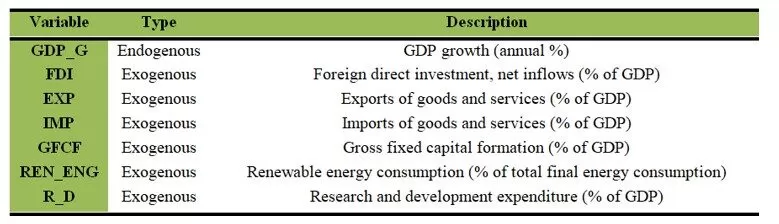
The purpose of the research is to highlight the nexus between the economic growth (GDP_G, endogenous variable) and foreign direct investment (FDI, exogenous variable) in the case of G7 countries. Moreover, the study includes in the analysis the following control variables selected based on the literature review: exports (EXP), imports (IMP), gross fixed capital formation (GFCF), renewable energy consumption (REN_ENG) and research and development expenditure (R_D). The time series variables were collected from World Bank database, with yearly frequency between 2000-2023, and expressed in percentages. All the variables are presented below in Table 1 regarding symbol, type and description.
Table 1. Variables description
Source: Authors’ own processing based on World Bank indicators
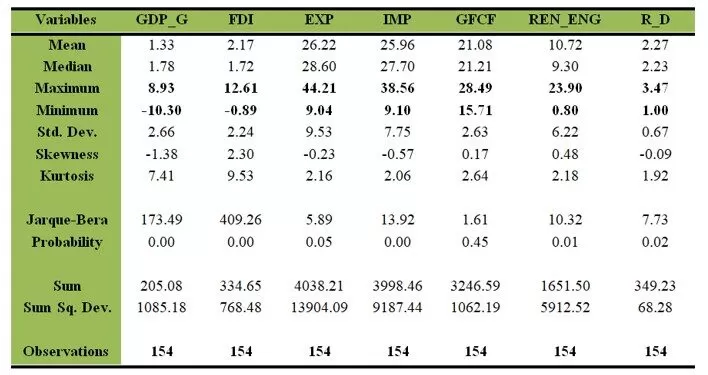
The investigation was performed using Eview10 program on the panel database created in Microsoft Excel, based on yearly indicators of each country collected from World Bank. Tabel 2 is presenting the descriptive statistics of the variables included in the analysis, and we would like to highlight the most important evolutions, as follows.
In terms of economic growth, the maximum value was registered in 2021 in the case of Italy (8.93%) and the minimum one was registered in 2020 in the United Kingdom (-10.29%). Both these extreme results are reflecting the COVID-19 health crisis implications. In 2020, COVID-19 was beginning and bringing negative effects to global economies; thus, all the countries analyzed recorded negative values, the United Kingdom being the most affected, followed by Italy and France. Also, 2021 year represents the first year of recovery after the crisis, meaning that Italy was the country that managed to reestablish its economic stability the fastest out of the 7 countries analyzed, followed by the United Kingdom and France.
Regarding the foreign direct investment evolution, the maximum value was registered by Germany (12.60% of GDP) in 2000, and the minimum was registered by the United Kingdom (-2.64%) in 2023. Year 2000 was marked in the history as liberalization of European markets and globalization, in parallel with digitalization, Germany being one of the largest economies in Europe, with an advantageous geographical position for global investors at that moment, attracting foreign capital. Also, in 2023 the decline of the United Kingdom in attracting foreign direct investment could be explained by the impact of Brexit on investor confidence, increase in financial costs compared to other regions, internal political instability and unfavorable global economic conditions.
Table 2. Descriptive statistics
Source: Authors’ own processing using Eviews 10
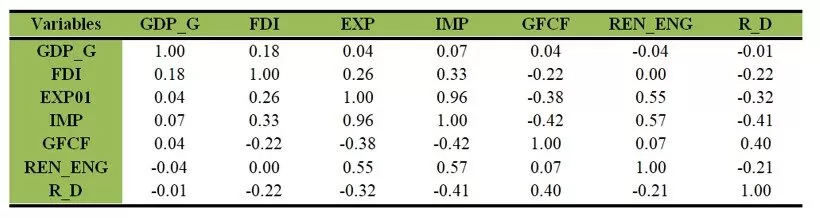
The correlation matrix was carried out to establish the intensity of the links between variables and how these could be associated in the same regression model. As we could see below in Table 3, no strong correlation was found between the variables, except for exports and imports, which were expected to be studied separately from each other. The correlation between economic growth and foreign direct investment is positive, in line with the base hypothesis from which we conduct this study. Also, there are positive correlations, but weaker than with the investment, with exports, imports and gross fixed capital formation. Closer to zero, but negative correlations of economic growth are with renewable energy consumption, and research and development expenditure.
Table 3. Correlation matrix
Source: Authors’ own processing using Eviews 10
Empirical Evidence
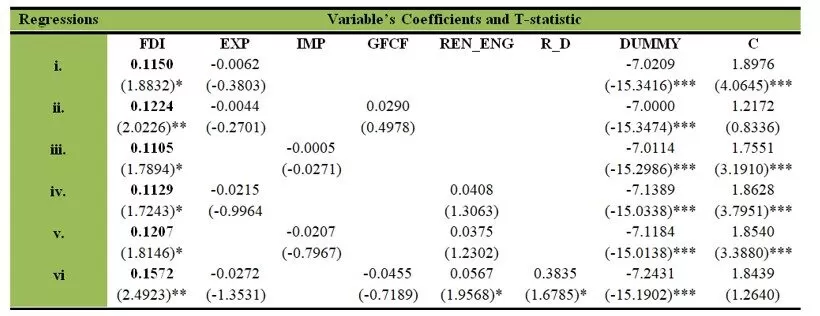
In this section, we present the empirical findings based on Panel EGLS (Cross-section random effects) regression approach used to examinate the impact of foreign direct investment on the economic growth of G7 countries, between 2000-2023. There were performed six regression models statistically valid, including economic growth as endougenous variable, foreign direct investment as principal exogenous variable and a different mix of control variables to highlight the determinants of economic growth in G7 countries. We introduced in each regression a dummy variable to capture the imbalances created by the global economic crisis in 2009 and COVID-19 in 2020. The first three regression models contain 168 observations each, meanining the analysed period is between 2000-2023 (24 years), and the last three contain 154 observations each, meaning between 2000-2021 (22 years), due to the fact that the variables included were aligned in terms of available data to keep the panel balanced.
Table 4. Regressions based on Panel EGLS (Cross-section random effects)
Source: Authors’ own processing using Eviews 10, P-value ***p<1%, **p<5%,*p<10%. Each variable is presented with the value of the associated coefficient and in parentheses with the t-statistic value.
In Table 4, the coefficients of the explanatory variables are presented, together with the t-statistic value marked in the parentheses, in order to establish the significance threshold of each variable. The foreign direct investment variable is statistically significant at a 10% significance level in all the proposed regressions and even at a threshold of 5% in regressions ii and vi. Thus, the results showed that in the case of G7 contries an increase of FDI with 1pp could generate up to a 15.72% increase in economic growth. In line with the assumption of the paper, in the case of G7 countries, foreign direct investment is not just a source of capital, representing a main driver of technology transfer and innovation, efficiency, job opportunities, export growth, public revenues, economic stability and global integration. Moreover, in the regression vi, the renewable energy consumption and research and development expenditure are also statistically significant at a 10% significance level. An increase of REN_ENG with 1pp could generate 5.67% increase in economic growth, and an increase of R_D with 1pp could generate as well 38.35% increase in economic growth. In the last years, the renewable energy consumption was an important driver of green growth in G7 countries, based on sustainability, energy efficiency, less dependence on energy imports, green jobs, stimulating investment and innovation, attracting capital and reducing long-term energy costs. Regarding the impact of research and development expenditure on economic growth, G7 countries have done considerable investments in this direction. Japan became a world leader in technology, electronics, and robotics. The United States generated as well giant companies due to its sustained support for research and innovation. Dummy variable is statistically significant at a 1% significance level in all the regressions. The other variables as exports, imports and gross fixed capital formation are not statistically significant in our study.
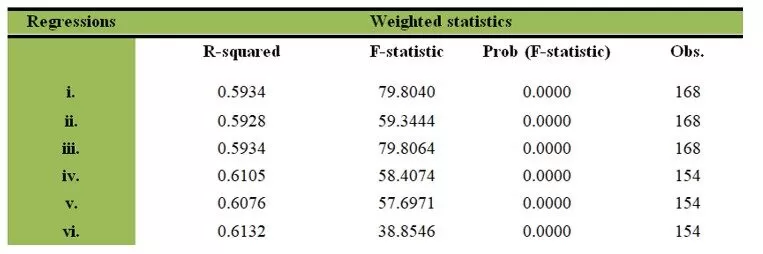
Table 5. Weighted statistics of Panel EGLS (Cross-section random effects) regressions
Source: Authors’ own processing using Eviews 10
In Table 5, we note that all the regressions registered the R-squared over 0.5, underlining that the selected exogenous variables explain properly the evolution of economic growth, being relevant as determining factors. If we take regression vi as a reference, we could consider that the economic growth variation is explained in proportion of 61.32% by the variation of foreign direct investment, exports, gross fixed capital formation, renewable energy consumption and research and development expenditure.
Therefore, the empirical analysis provides considerable evidence regarding the implication of foreign direct investment on the economic growth of G7 countries, highlighting a pozitive and significant impact as we expected based on the literature review.
Concluding Remarks
Concluding the research, G7 countries represent the world’s advanced economies with global influence in the value chain. During 2000-2023, the macroeconomic context has not always been favorable, including economic crises, health crises and wars. Foreign direct investment was not just a source of capital for G7 countries, it is also a driver of technology transfer and innovation, efficiency, job opportunities, export growth, public revenues, economic stability and global integration.
The empirical findings of the study based on Panel EGLS (Cross-section random effects) regression approach highlighted that there is a positive and significant impact of investments on the economic growth of G7 countries. The results showed that FDIs are one of the most important triggers of economic growth evolution, generating up to a 15% increase in economic growth along with their positive movement. More than that, the renewable energy consumption and research and development expenditure are important factors that accelerate the economic growth of G7 countries. The econometric evidence presented in the study is in line with the specialized literature; the same results were revealed by Wani et al (2024), Ngoc (2025), Pradhan et al (2024), Yeboah et al (2025), Raihan et al (2025), Xin et al (2024) and many other reasearchers.
This research should be considered as part of the decision-making process worldwide since the analysis covers the behavior of leading industrial countries. We encourage both developed and developing countries in attracting and absorbing all the advantages of foreign direct investments, because the technological evolution path and innovation power represent the future of any economic evolution. Also, renewable energy consumption and research and development expenditure represent key drivers in innovation, green growth and technological transfer, stimulating the investment and accelerating the economic growth of the host country.
References
Baltagi, B. H. (2005). Econometric analysis of panel data, 3rd edition. West Sussex, John Wiley & Sons Ltd.
Garg, S., Mittal, S., & Grag, A. (2025). Investigating the role of education, renewable energy and governance in sustainable economic development: Empirical insight from ASEAN economies. Renewable Energy, 249 (2025) 123239, 1-12.
Jinapor, J. A., Abor, J. Y., & Graham, M. (2025). Energy consumption and inclusive growth in Sub-Saharan Africa: Does foreign direct investment make a difference? Energy Policy, 198 (2025) 114500, 1-15.
Karimov, M., & Belkania, D. (2024). A Case Study of Foreign Direct Investment and Economic Growth Relationship in Turkey. European Journal of Marketing and Economics, 7, 58-64.
Mahfoudi, F., & Riache, S. L. (2024). The Effect Of Natural Resources And Foreign Direct Investment On Economic Growth. Economics and Environment, 1(88) 2024, 1-11.
Makanda, S., & Fasanya, I. (2025). Foreign Direct Investment, Institutions and Economic Growth: Evidence from South Africa. Scientific Annals of Economics and Business, 72 (X), 1-19.
Mose, N., & Kipchirchir, E. (2024). Foreign Direct Investment and Economic Growth in Kenya: A Comprehensive Analysis. Asian Journal of Economics, Business and Accounting, 24, 1-13.
Ngoc, X. V. (2025). Determinants of open innovation in United State of America: New evidence from ARDL method. Innovation and Green Development, 4 (2025) 100228, 1-10.
Ngoc, X. V. (2025). Nexus of FDI, GDP, renewable energy, trade openness, and environmental pollution in Japan: New evidence from ARDL method. Environmental and Sustainability Indicators, 26 (2025) 100677, 1-12.
Ngoc, X. V. (2025). Nexus of innovation, renewable energy, FDI, trade openness, and economic growth in Germany: New insights from ARDL method. Renewable Energy, 247 (2025) 123060, 1-8.
Pradhan, K., Mohapatra, S. M., Farooque, M. U., & Mohanty, L. (2024). Symmetric and Asymmetric Nexus Between FDI, Trade and Economic Growth: Evidence from ASEAN Countries. Annals of Financial Economics, 19, No. 04, 2450019 (2024)) .
Raihan, A., Ibrahim, S., Ridwan, M., Rahman, M. S., Bari, A. M., & Atasoy, F. G. (2025). Role of renewable energy and foreign direct investment toward economic growth in Egypt. Innovation and Green Development, 4 (2025) 100185, 1-12.
Wani, M. J., Loganathan, N., & Hasan Esmail, H. A. (2024). Impact of green technology and energy on green economic growth: role of FDI and globalization in G7 economies. Future Business Journal, 10(1):43, 1-13.
Xin, Y., Tabasam, A. H., Chen, Z., Zamir, A., & Ramos-Meza, C. S. (2024). Analyzing the Impact of Foreign Direct Investment, Energy Consumption on Services Exports, and Growth of the Services Sector: Evidence from SAARC Countries. Journal of the Knowledge Economy, 15, 5709–5728.
Yeboah, E., Baffour, A. A., Chibalamula, H. C., & Atiso, F. (2025). The significance of foreign direct investment (FDI) and trade openness: evidence from nine European economies. SN Business & Economics, 5:27, 1-21.