1Kauno Kolegija Higher Education Institution, Kaunas, Lithuania
2Graceland University, Lamoni, Iowa, USA
Volume 2025,
Article ID 648452,
Journal of Marketing Research and Case Studies,
12 pages,
DOI: 10.5171/2025.648452
Received date: 9 June 2025; Accepted date: 22 July 2025; Published date: 25 September 2025
Academic Editor: Iveta Linina
Cite this Article as:
Ioseb Gabelaia and Vivian Tracy (2025), “The Role of Behavioral Conditioning in AI-driven Marketing Strategies: Quantitative Research ", Journal of Marketing Research and Case Studies, Vol. 2025 (2025), Article ID 648452, DOI: https://doi.org/10.5171/2025.648452
This research explores the role of behavioral conditioning in AI-driven marketing strategies. There is limited research on the extent to which classical and operant conditioning impact consumer autonomy. While AI enables hyper-personalized marketing, conditioning methods could improve associative learning and habit creation in consumers. This article is the third in a series of works that extend research and explore the intersection of conditioning and AI marketing. The authors conducted quantitative research. Using non-probability snowball and convenience sampling, 789 participants voluntarily participated in this research. Using SPSS 30, the descriptive, correlation, and regression analyses were conducted. Moreover, two theoretical frameworks, the Technology Acceptance Model (TAM) and Self-Determination Theory (SDT), were used to better understand the existing research gap. The survey results showed a significant correlation between AI-driven conditioning strategies and their impact on buyer behaviors, engagement rates, and brand loyalty. Moreover, the need for adaptive frameworks was identified to manage the integration of AI with classical and operant conditioning. Moreover, these results offer valuable insights into the academic discourse on human-AI integration in Marketing. Hence, the authors propose actionable insights for businesses to balance innovation and consumer trust in the AI era.
Keywords: AI Marketing, Artificial Intelligence, Conditioning Behavior, Digital Marketing.
Introduction
AI-driven marketing is challenged by the “complex consumer.” Due to the current intersection of multiple generations, consumers buying behavior and purchasing decisions are characterized by careful considerations of alternatives. This is quite apparent when consumers make infrequent and routine purchases. Understanding consumer stimuli is crucial to developing timely and evidence-based marketing strategies (Gabelaia & Tracy, 2025).
Today, integrating AI and behavioral psychology methods challenges the digital marketing landscape. Moreover, conditioning behavior is a form of learning in which a given stimulus becomes increasingly effective in producing a response (Kirsch et al., 2004). However, the results depend on the type of reinforcements. The global AI in marketing market was valued at $15.8 billion in 2023 and is projected to increase at a 27.7% CAGR through 2030 (Grand View Research, 2023). AI assists in analyzing vast datasets to predict consumer preferences and behaviors. Simultaneously, classical and operant conditioning influence consumer behavior through associative learning and support mechanisms. However, there is limited research on the integration of AI and conditioning methods concerning the combined effectiveness and impact on consumer autonomy.
Furthermore, today’s available data highlight the importance of AI in consumer purchase decisions and buying habits. For instance, during the 2024 holiday season, U.S. online sales surpassed $282 billion, showing an almost 5.1 % growth from the previous year, driven by a 42% incline in AI-driven chatbot usage compared to 2023 (Business Insider, 2024). Additionally, roughly 37% of consumers would permit AI to make purchases on their behalf, demonstrating a shift toward greater acceptance of AI in consumer decision-making processes and purchasing habits (Omnisend, 2024; Reuters, 2025). Despite this progress, consumer trust remains a significant barrier, accounting for 27% of consumers reporting high mishandling based on data practices.
The authors explored the relevance of AI-driven conditioning techniques influencing purchasing decisions, engagement rates, and brand loyalty. Moreover, two theoretical frameworks were used: first, the Technology Acceptance Model (Davis, 1989) was used to understand how users come to accept and use new technology, and, second, the Self-Determination Theory (Deci & Ryan, 1985) was used to understand human motivation. This research holds both theoretical and practical value for practitioners as well as for researchers.
Literature Review
Classical and Operant Conditioning Psychology
In today’s hyper-connected digital ecosystem, businesses are challenged in how they communicate with their customers (Chowdhury et al., 2024). Besides, big data technologies and digital marketing approaches have modified the way businesses create and implement their comprehensive marketing strategies (Theodorakopoulos & Theodoropoulou, 2024). Cognitive involvement is seen in classical and operant conditioning (Kirsch et al., 2004; Akpan, 2020; Brewer, 2024). Moreover, according to Blackman (2022), classical and operant conditioning are two foundational theories of learning and behavior. They assist in understanding how consumers learn and respond to stimuli relevant to marketing strategies (Akpan, 2020; Wittich et al., 2024). Furthermore, Artificial Intelligence has significant potential to transform the marketing ecosystem, as it is the most current disruptive technology (Kumar et al., 2023). Besides, today, to understand the customer journey, smart data are required, as customers are increasingly aware of the offerings and continue to constantly evaluate their purchasing behavior and brand engagement (Theodorakopoulos & Theodoropoulou, 2024).
Psychologists Pavlov and Skinner presented these theories, which focus on how behaviors are acquired, developed, and reinforced. For instance, classical Conditioning, as presented by Pavlov (1927), applies learning through associations. Moreover, classical conditioning explains the learning process through which a stimulus achieves an emotional response by being paired with an unpleasant or pleasant event (Hermann & Sperl, 2023). Pavlov’s most fundamental experiment shows how dogs can be conditioned to respond to a neutral stimulus (a bell) by pairing it with an unconditioned stimulus (food). At last, this pairing produces a conditioned response (salivation).
In marketing, brands try to associate positive emotions or desirable experiences with offerings, thereby creating long-lasting consumer preferences (Efendioğlu, 2024). Okeleke et al. (2024) explored the transformative potential of AI in understanding consumer behavior and foreseeing market trends. For instance, marketing practitioners usually use imagery in advertisements to activate an emotional response, thereby conditioning the consumer’s behavior toward brand loyalty (Elliot, 2015).
On the contrary, Operant Conditioning focuses on the outcomes of behaviors and how reinforcement or punishment can influence future behaviors (Skinner, 1938). Moreover, positive reinforcement promotes the repetition of desired behaviors, while negative discourages undesired behaviors by removing an unpleasant stimulus (Abadi et al., 2025). Additionally, Foxall et al. (2006) used behavioral psychology to understand consumer behaviors that negatively impact the conditions.
Furthermore, in marketing, operant Conditioning is mainly used in loyalty programs, where customers are rewarded for repeat purchases, thereby increasing customer retention (Ferreira et al., 2019). Also, marketing practitioners use feedback loops to reinforce purchasing behaviors (Efendioğlu, 2024). However, while AI has the potential to improve consumer experiences, its integration in marketing, especially with conditioning behavior, introduces significant ethical and operational challenges (Vlačić et al., 2021). Thus, both classical and operant Conditioning provide valuable psychological frameworks for consumer behavior in marketing.
AI-driven Marketing
Businesses are aiming to overcome challenges and improve customer value through innovative solutions (Sharma et al., 2023). Moreover, businesses function more effectively due to disruptive technologies (Kumar et al., 2023). As a result, the ability to analyze large data has improved marketing strategies that acclimate to the distinct interests and habits of individual consumers (Theodorakopoulos & Theodoropoulou, (2024). Consumers’ awareness of the relationship between conditioned stimuli, advertisements, and unconditioned stimuli, products, improves the effectiveness of marketing strategies (Allen & Janiszewski, 1989). The convergence of AI and consumer behavior offers a framework for understanding how AI technologies impact consumer engagement, loyalty, and decision-making (Jain et al., 2024; Till et al., 2008). Moreover, this principle can be used by marketing practitioners in AI-driven advertising strategies. Furthermore, AI’s capability to predict system failures and improve operational efficiency supports its relevance in understanding consumer behavior (Nabeel, 2021).
Today, Artificial intelligence is a pivotal technology that significantly impacts marketing strategies (Sharma et al., 2023). AI-driven marketing uses technologies to develop personalized customer experiences (Anayat Rasool, 2024). Consumers appreciate personalized marketing, as over-reliance on automation can lead to disengagement between consumer and business (Danninger & Krenn, 2024). AI can analyze vast datasets in real-time and help to predict consumer preferences and purchase patterns (Chaffey, 2020). For instance, AI algorithms can track individual preferences and past interactions to create personalized product recommendations and dynamic pricing (Freeda et al., 2024). Thus, AI algorithms can improve user experiences by offering personalized recommendations (Raji et al., 2024).
Moreover, AI can scale conditioning techniques in marketing strategies (Freeda et al., 2024). Emotional advertisements are extremely effective for lesser-known brands (Smith et al., 1998). For instance, AI can facilitate classical Conditioning by using data-driven insights to automatically present conditioned stimuli that have been associated with positive responses in previous campaigns. Moreover, this creates clearer emotional connections between consumers and brands (Wittich et al., 2024). Additionally, AI can use operant conditioning principles by automating reinforcement strategies (Sharma et al., 2023). In both cases, AI systems ensure that reinforcements align with consumer expectations, thereby increasing the effectiveness of the marketing strategy (Chung et al., 2019).
Artificial Intelligence has revolutionized the marketing ecosystem (Labib, 2024). One key advantage of AI in marketing is its ability to continually refine its strategies based on consumer interaction data (Yaiprasert & Hidayanto, 2023). Unlike traditional methods, AI allows adaptive learning, where marketing campaigns grow in real-time based on the actions and reactions of the target audience (Efendioğlu, 2024). This real-time responsiveness improves classical and operant conditioning methods by allowing marketing specialists to adjust stimuli and reinforcements (Kumar et al., 2020).
Similarly, AI significantly improves behavioral tracking in marketing, that helps to predict consumer behavior and improve individual customer experiences (Allil, 2024). AI-driven tools can monitor and analyze responses to campaigns, allowing marketers to quickly identify the most effective strategies and make data-backed decisions on which stimuli or reinforcements to use for specific consumer segments (Anayat & Rasool, 2024; Whig et al., 2024).
Theoretical Framework
To explore the relevance of integrating Classical and Operant Conditioning Psychology in AI-driven marketing, the authors used two theoretical frameworks: the Technology Acceptance Model and Self-Determination Theory. The Technology Acceptance Model (Davis, 1989) helps to understand how users accept and use new technology. Additionally, TAM argues that perceived ease of use and perceived usefulness are fundamental characteristics impacting the adoption of technology. Notably, Perceived Usefulness (PU) is the degree of belief that using the AI-driven marketing tool would improve their shopping experience. On the contrary, Perceived Ease of Use (PEOU) is the belief that using the AI tool would require minimal effort. For this research, this model is particularly relevant to consumer acceptance of AI-driven marketing, which directly impacts the effectiveness of AI in changing behavior through conditioning strategies.
Furthermore, the Self-Determination Theory (Deci & Ryan, 1985) helps to understand human motivation. SDT highlights intrinsic and extrinsic motivation, indicating that individuals are motivated to act based on the fulfillment of basic psychological needs for autonomy, the sense of control over one’s actions and decisions, competence, the feeling of being capable and effective in one’s actions, and relatedness, the need to feel connected to others. For this research, AI-driven marketing and conditioning, SDT, can be applied to understand how consumers perceive their autonomy when interacting with AI technologies.
Research Methodology
Research Design, Sampling Method and Survey Design
The authors used quantitative research methodology to explore the relevance of integrating classical and operant conditioning psychology in AI-driven Marketing. The survey was created using Quantrics software. The aim was to explore the impact of AI-driven conditioning strategies on purchasing decisions, engagement rates, and brand loyalty. Furthermore, the authors used non-probability snowball and convenience sampling methods. This approach was used to reach a wide range of respondents who have had exposure to AI marketing strategies. However, the authors recognize limited generalizability due to the non-random nature of the selection.
The authors designed an inclusive survey, allowing participants to accept or decline consent and drop out at any time. The survey collected demographic and behavioral data from participants. The primary focus was on the effectiveness of AI-driven conditioning strategies, including classical and operant conditioning, on consumer behavior. The questionnaire included: first, Likert-scale questions to measure the perceived effectiveness of AI-driven marketing tools, consumer trust, and engagement, and second, multiple-choice questions to evaluate participants’ exposure to and experiences with AI in marketing.
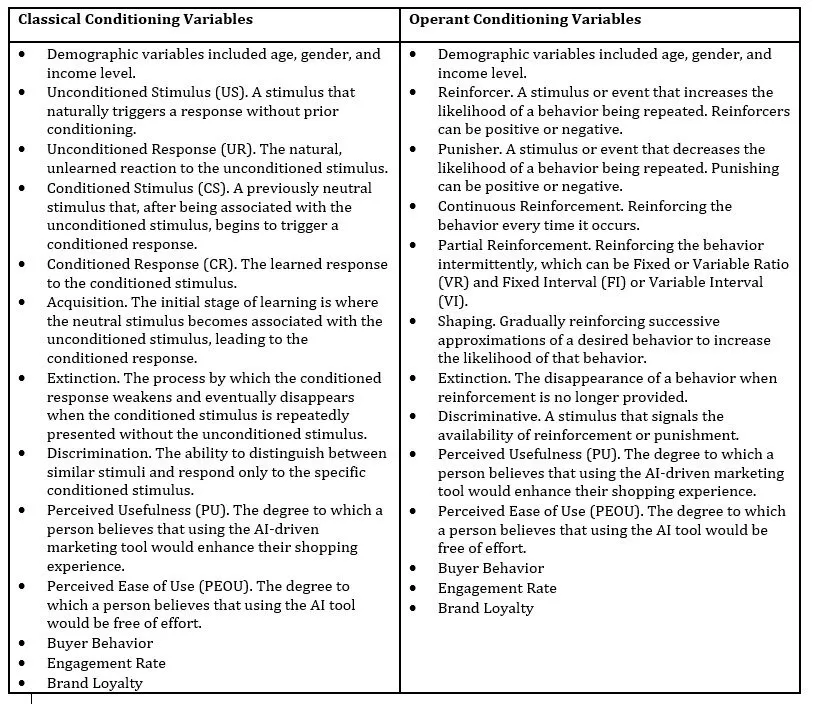
The authors used two different sets of variables to explore the relevance of the integration of AI-driven marketing with classical and operant conditioning. Table 1 demonstrates the variables that were used for the survey study.
Table 1. Description of Independent and Dependent Variables
(Developed by the Author)
Data Collection and Processing
The survey was distributed through online platforms, mainly LinkedIn and Facebook. The authors shared a Qualtrics link, which was accompanied by a message inviting participants. Participants were informed about this research purpose and confidentiality measures. A total of 834 participants voluntarily partook in the survey. The authors conducted a rigorous data-cleaning process to ensure that the dataset was accurate, consistent, and ready for statistical analysis. The data cleaning process was conducted using SPSS Software, version 30. The data cleaning process involved the following steps:
Step 1. Removal of Missing Data and response completeness. The authors had a condition: if a respondent skipped or had incomplete responses for more than 20%, they were flagged, and those responses were excluded from the dataset. Additionally, the survey was designed so that skipping or overlooking any main questions would invalidate the survey; therefore, if participants did not respond to those questions but answered others, they were excluded from the dataset.
Step 2. Identification of Duplicate Responses. Some participants may have completed the survey multiple times, either intentionally or unintentionally. Duplicates were excluded from the final dataset. Additionally, the authors used time-based checking. In some cases, participants might have completed the survey too quickly, suggesting they did not carefully read the questions. Any survey completed under 5 minutes was excluded from the final dataset.
Step 3. Outlier Detection. Outliers or extreme values in responses were flagged. Responses that were extremely high or low on Likert-scale questions were evaluated for accuracy. Participants who answered all questions in an identical or reverse order were suspected of not engaging with the survey meaningfully and were excluded.
Step 4. Handling Missing Data. Where missing data were not substantial, mean imputation or regression imputation was applied to fill in gaps for non-essential questions. However, if the main questions had missing data, they were excluded from the final dataset.
Step 5. Final Dataset. After these cleaning steps, the final cleaned dataset included 789 valid responses, which were then analyzed for descriptive statistics, correlation analysis, and regression modeling to explore the impact of AI-driven conditioning on purchasing decisions, engagement, and brand loyalty.
Results
The survey was conducted between November 2nd, 2024, and May 8th, 2025. The authors analyzed classical and operant conditioning variables across demographic categories, including age, gender, and income level, to determine whether significant differences exist in how diverse consumer groups respond to AI-driven classical and operant conditioning strategies.
At first, the authors performed one-way ANOVA to determine whether age, gender, or income level significantly impacted conditioned responses in the context of AI-driven marketing. The results revealed no significant effect of age, F(4,784) = .55, p = .702, and gender, F(2,786) = .54, p =. 583, on conditioned response scores. However, income level had a statistically significant effect, F(2,786) = 4.64, p = .010, suggesting that consumers with different income levels respond differently to classical conditioning stimuli as part of AI-based marketing strategies. Additionally, an independent samples t-test was performed to analyze gender differences in conditioned responses between male and female consumers. The results revealed no significant difference, t(524.78) = .97, p =. 335, meaning that gender does not appear to impact conditioned behavioral responses in this context.
These results indicate that, among the demographic variables, income level is the most relevant predictor of responsiveness to classical conditioning stimuli. This demonstrates the significance of developing AI-driven conditioning strategies based on economic segmentation rather than general demographic profiling.
Furthermore, the authors performed a one-way ANOVA to analyze whether age, gender, or income level impacted brand loyalty within operant conditioning frameworks. The results revealed no significant effects for age, F(4,784) = .41, p = .800, and gender, F(2,786) = 1.02, p = .360. Income level revealed a marginally significant effect, F(2,786) = 2.39, p = .092, suggesting the need for further research. Additionally, an independent samples t-test revealed no significant difference in brand loyalty between male and female respondents, t(563.78) = −.98, p = .328.
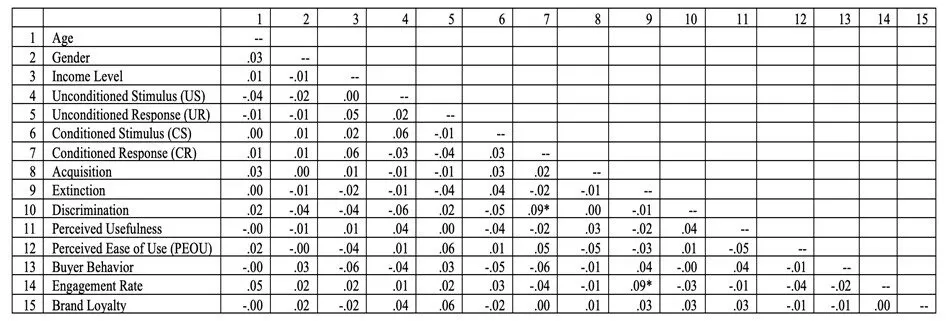
A Pearson correlation analysis was performed to analyze the relationships between classical conditioning constructs and consumer behavior outcomes. Table 2 shows the classical conditioning matrix, which includes variables such as demographics, classical conditioning constructs (US, UR, CS, CR, Acquisition, Extinction, Discrimination), perception variables (PU, PEOU), and behavioral outcomes (Buyer Behavior, Engagement Rate, Brand Loyalty).
The results revealed that Unconditioned Response was positively and weakly correlated with Brand Loyalty, r = .06, but not statistically significant at p > .05. Moreover, Conditioned Stimulus revealed an insignificant relationship with Engagement Rate, r = .01, suggesting minimal impact. Besides, no classical conditioning variable revealed strong or moderate correlations with Buyer Behavior, Engagement Rate, or Brand Loyalty. Lastly, demographic variables (Age, Gender, Income) did not show significant correlations with conditioning or behavioral constructs.
The results suggest that classical conditioning constructs alone do not show a significant impact on key consumer behavior metrics in AI-driven marketing contexts. This is supported by theoretical works that suggest higher-order cognitive and motivational factors, such as trust, autonomy, and relevance, are fundamental in developing consumer loyalty and engagement, especially in digital contexts.
Table 2. Correlation Matrix for Classical Conditioning (n = 789)
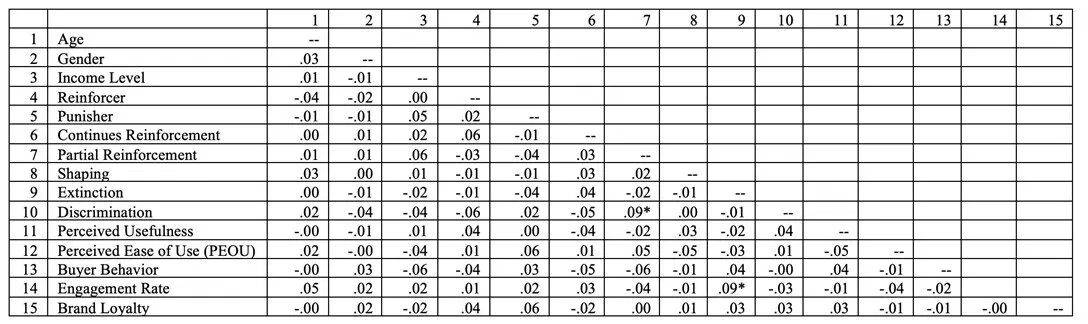
Furthermore, the authors performed a Pearson correlation for operant conditioning constructs and consumer outcomes, including Buyer Behavior, Engagement Rate, and Brand Loyalty. The variables are illustrated in Table 3, the correlation matrix for operant conditioning. The results revealed two statistically significant correlations. First, extinction and engagement rate revealed a weak positive correlation, r = .09, p = .015, indicating that as extinction (the weakening of conditioned behavior) grows, consumer engagement shows a slight upward trend. Second, partial reinforcement and discrimination also revealed a weak positive correlation, r = .09, p = .015, suggesting that exposure to partial reinforcement is modestly associated with improved stimulus
discrimination among consumers. Furthermore, all other pairwise relationships were statistically non-significant (p > .05), and the effect sizes were minimal (r < .10), meaning that there were only limited linear associations among the variables.
The results emphasize limited yet statistically accurate associations between specific operant strategies and consumer engagement results. These results suggest that operant conditioning alone may not be sufficient to drive significant changes in consumer behavior, particularly within sophisticated AI-driven marketing. Furthermore, these results suggest future research to explore how reinforcement patterns interact with emotional appeal, trust signals, and contextual variables.
Table 3. Correlation Matrix for Operant Conditioning (n = 789)
The authors performed a hierarchical multiple regression to analyze the validity of classical conditioning variables and perception metrics in predicting buyer behavior beyond demographic characteristics. Three models predicting Buyer Behavior for classical conditioning.
The results revealed that Model 1, including only age, gender, and income level, demonstrated a small proportion of variance in buyer behavior, R2= .004, F(2,786) = 1.76, p >.05. Adding classical conditioning variables in Model 2 slightly increased variance, ΔR2= .008, but the change was not statistically significant. Model 3, which included perceived usefulness and perceived ease of use, accounted for only a marginal increase in variance, ΔR2= .002, again non-significant. Overall results showed that none of the models demonstrated strong predictive power. However, the income level suggests a trend that lower-income respondents may exhibit slightly higher buyer behavior preferences in this AI-driven context, although not statistically significant.
Furthermore, the authors performed hierarchical regression to predict buyer behavior based on operant conditioning strategies and user perceptions. In Model 1, demographics alone (age, gender, income level) accounted for small variance in brand loyalty, R2 = .007, F(2,786) = 2.86, p > .05. The addition of operant conditioning variables in Model 2 increased the variance to R2= .021, but the improvement remained marginal. In Model 3, perceived usefulness and perceived ease of use were added, resulting in only a minor additional gain, R² = .025, with no statistically significant predictors.
The results suggest that operant conditioning constructs, significant to behavioral psychology, have a limited statistical impact on buyer behaviors in an AI-led marketing context. Despite a few significant correlations, reflecting very small effect sizes and emphasizing the complexity of consumer behavior in digital environments, where variables such as trust, personalization, and emotional relevance may play larger roles.
Discussions
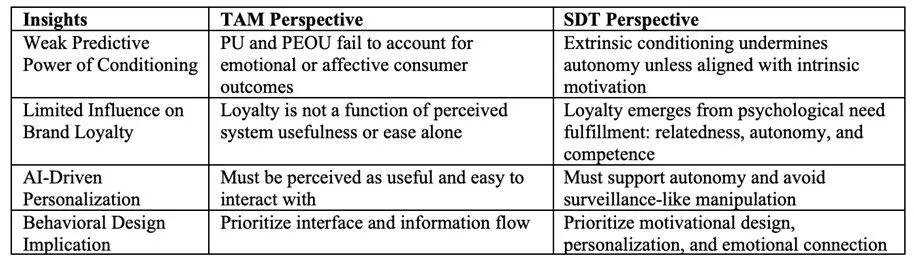
The author developed Table 4 which highlights the integration of Technology Acceptance Model and Self-determination Theory with classical and operant conditioning.
Table 4. Technology Acceptance Model and Self-determination Theory with conditioning
Technology Acceptance Model (TAM)
In the Technology Acceptance Model, Perceived Usefulness (PU) and Perceived Ease of Use (PEOU) are fundamental determinants of technology acceptance and behavioral choice. Consequently, in this research, the authors explored the TAM with classical and operant conditioning to assess their predictive power on Buyer Behavior, Engagement Rate, and Brand Loyalty. The results revealed that, in both the classical and operant conditioning regression models, PU and PEOU revealed minimal or non-significant predictive power on brand loyalty and buyer behavior. For instance, hierarchical regression showed that the addition of TAM variables marginally increased the variance from R² = .021 to R² = .025. However, none of the variables were statistically significant. Additionally, the correlation analyses verified this trend, indicating weak associations between PU/PEOU and behavioral results.
Hence, to summarize, TAM in marketing suggests that PU and PEOU are insufficient to explain affective and trust-based results. In AI-driven marketing contexts, technology acceptance is necessary but not sufficient for consumer behavior. Nevertheless, the results suggest that emotional relevance, perceived authenticity, and value congruence might be more substantial than ease or usefulness alone.
Self-Determination Theory (SDT)
Self-determination theory addresses three psychological needs such as autonomy, competence, and relatedness. The results showed that the failure of classical and operant conditioning variables to significantly predict buyer behavior emphasizes the limited role of extrinsic motivators such as stimuli, reinforcers, and punishers when intrinsic needs are unmet. For instance, extinction and partial reinforcement in operant conditioning correlated only weakly with consumer engagement and discrimination, respectively. Similarly, conditioned stimuli and responses in the classical framework revealed insignificant associations with brand-related outcomes.
Results demonstrate that consumers may perceive AI-driven conditioning as externally controlling. These results can limit autonomy, therefore decreasing intrinsic motivation to engage or remain loyal. Unlike traditional media, AI-driven conditions require marketers to design experiences that improve user agency and emotional relevance, not just behavioral predictability. Moreover, operant instruments must be aligned with personal relevance and consumer-driven meaning-making, while classical associations must support the felt authenticity.
To conclude, marketers must move beyond behaviorist models alone. The results recommend user agency by offering transparency and customization. Moreover, business needs to use conditioning mechanisms as contextual enhancers. Lastly, the results suggest prioritizing value congruence and authentic brand narratives to align classical conditioning signals with intrinsic motivations.
Conclusion
The authors explored the relevance of integrating classical and operant conditioning psychology in AI-driven marketing. The extensive data collection and analysis delivered a significant insight. This research offers more insights, especially statistical, and its integration within theoretical frameworks such as TAM and SDT.
The existing secondary data highlighted a fundamental need for AI in consumer behavior and marketing strategies, demonstrating the relevance of AI-driven marketing with conditioning mechanisms. Hence, from predictive analytics to classical conditioning, AI offers opportunities to further understand buyer behaviors which are connected to certain theoretical frameworks. However, data privacy and the need for transparency is a limitation.
To deliver relevant insights, the authors ensured the final dataset was accurate, reliable, and ready for analysis. Analysis based on 789 respondents yielded significant results, providing valuable insights into how AI-driven conditioning strategies impact consumer behavior in marketing. Both hypotheses were statistically rejected. The minimal predictive power of AI-driven behavioral conditioning strategies shows the need for integrated psychological frameworks. Marketing strategies that depend only on AI-enhanced conditioning may be insufficient.
This research demonstrates that while classical and operant conditioning theories present insights into stimulus-response dynamics, they fall short in predicting higher-end consumer behaviors. The Technology Acceptance Model and Self-Determination Theory offer critical psychological dimensions, and, together, they signal a paradigm shift from controlling behavior to co-creating meaning and motivation in digital consumption.
Disclosure: The authors used Grammarly Premium to fix minor grammatical and sentence errors.
References
Abadi, D. P., Ramli, M., & Wahyuni, F. (2025). Analysis of Behaviorism Theory: Classical Conditioning and Operant Conditioning in Changing Students’ Truancy Behavior. Jurnal Pembelajaran, Bimbingan, Dan Pengelolaan Pendidikan, 5(2), 8-8. https://doi.org/10.17977/um065.v5.i2.2025.8
Akpan, B. (2020). Classical and operant conditioning—ivan pavlov; burrhus skinner. Science education in theory and practice: an introductory guide to learning theory, 71-84.
Allen, C. T., & Janiszewski, C. (1989). Assessing the role of contingency awareness in attitudinal conditioning with implications for advertising research. Journal of Marketing Research, 26(1), 30-43. https://doi.org/10.1177/002224378902600103
Allil, K. (2024). Integrating AI-driven marketing analytics techniques into the classroom: pedagogical strategies for enhancing student engagement and future business success. Journal of Marketing Analytics, 12(2), 142-168. https://doi.org/10.1057/s41270-023-00281-z
Anayat, S., & Rasool, G. (2024). Artificial intelligence marketing (AIM): connecting-the-dots using bibliometrics. Journal of Marketing Theory and Practice, 32(1), 114-135. https://doi.org/10.1080/10696679.2022.2103435
Blackman, D. (2022). Conditioned suppression and the effects of classical conditioning on operant behavior. Handbook of operant behavior, 340-363.
Brewer, W. F. (2024). There is no convincing evidence for operant or classical conditioning in adult humans. In Cognition and the symbolic processes (pp. 1-42). Routledge.
Chowdhury, S. N., Faruque, M. O., Sharmin, S., Talukder, T., Al Mahmud, M. A., Dastagir, G., & Akter, S. (2024). The impact of social media marketing on consumer behavior: A study of the fashion retail industry. Open Journal of Business and Management, 12(3), 1666-1699. 10.4236/ojbm.2024.123090
Davis, F. D. (1989). Perceived usefulness, perceived ease of use, and user acceptance of information technology. MIS Quarterly, 13(3), 319-340. https://doi.org/10.2307/249008
Deci, E. L., & Ryan, R. M. (1985). Intrinsic motivation and self-determination in human behavior. Springer Science & Business Media. https://doi.org/10.1007/978-1-4612-6218-4
Durai, S., Manoharan, G., Priya, T. S., Jayanthi, R., Razak, A., & Ashtikar, S. P. (2024). Quantifying the impacts of artificial intelligence implementations in marketing. In Smart and Sustainable Interactive Marketing (pp. 120-144). IGI Global Scientific Publishing.
Efendioğlu, İ. H. (2024). Digital consumer behavior: a systematic literature review. Prizren social science journal, 8(1), 67-80.
Freeda, A. R., Anju, A., Kanthavel, R., Dhaya, R., & Vijay, F. (2024). Integrating AI-Driven Technologies Into Service Marketing. In Integrating AI-Driven Technologies Into Service Marketing (pp. 375-394). IGI Global.
Foxall, G. R., Oliveira-Castro, J. M., James, V. K., et al. (2006). Consumer behavior analysis and social marketing: The case of environmental conservation. Behavior and Social Issues, 15, 101–125. https://doi.org/10.5210/bsi.v15i1.338
Hartmann, J., Exner, Y., & Domdey, S. (2025). The power of generative marketing: Can generative AI create superhuman visual marketing content?. International Journal of Research in Marketing, 42(1), 13-31. https://doi.org/10.1016/j.ijresmar.2024.09.002
Hermann, C., & Sperl, M. F. (2023). Classical Conditioning. In Handbook of Clinical Child Psychology: Integrating Theory and Research into Practice (pp. 425-457). Cham: Springer International Publishing. https://doi.org/10.1007/978-3-031-24926-6_21
Jain, V., Wadhwani, K., & Eastman, J. K. (2024). Artificial intelligence consumer behavior: A hybrid review and research agenda. Journal of Consumer Behavior, 23(3), 676-697. https://doi.org/10.1002/cb.2233
Kirsch, I., Lynn, S. J., Vigorito, M., & Miller, R. R. (2004). The role of cognition in classical and operant Conditioning. Journal of clinical psychology, 60(4), 369-392.
Kumar, M., Yadav, R., Suresh, A. S., Singh, R., Yadav, M., Balodi, A., … & Srivastava, A. P. (2023, November). Mapping AI-Driven Marketing: Review of Field and Directions for Future Research. In 2023 2nd International Conference on Futuristic Technologies (INCOFT)(pp. 1-5). IEEE. 10.1109/INCOFT60753.2023.10425169
Labib, E. (2024). Artificial intelligence in marketing: exploring current and future trends. Cogent Business & Management, 11(1), 2348728. https://doi.org/10.1080/23311975.2024.2348728
Pew Research Center. (2023, April 10). Americans’ attitudes on AI personalization and data privacy. Pew Research Center. https://www.pewresearch.org/ai-privacy
Okeleke, P. A., et al. (2024). Predictive analytics for market trends using AI: A study in consumer behavior. International Journal of Engineering Research Updates, 7(1), 36–49. https://doi.org/10.53430/ijeru.2024.7.1.0032
Raji, M. A., et al. (2024). E-commerce and consumer behavior: A review of AI-powered personalization and market trends. GSC Advanced Research and Reviews, 18(3), 66–77.
Sharma, K. K., Tomar, M., & Tadimarri, A. (2023). AI-driven marketing: Transforming sales processes for success in the digital age. Journal of Knowledge Learning and Science Technology ISSN: 2959-6386 (online), 2(2), 250-260. https://doi.org/10.60087/jklst.vol2.n2.p260
Smith, P. W., Feinberg, R. A., & Burns, D. J. (1998). An examination of classical conditioning principles in an ecologically valid advertising context. Journal of Marketing Theory and Practice, 6(1), 63–72. https://doi.org/10.1080/10696679.1998.11501789
Sweldens, S., van Osselaer, S. M. J., & Janiszewski, C. (2010). Evaluative conditioning procedures and the resilience of conditioned brand attitudes. Journal of Consumer Research, 37(3), 473–489. https://doi.org/10.1086/653656
Theodorakopoulos, L., & Theodoropoulou, A. (2024). Leveraging big data analytics for understanding consumer behavior in digital marketing: A systematic review. Human Behavior and Emerging Technologies, 2024(1), 3641502. https://doi.org/10.1155/2024/3641502
(2024, January 5). Consumers are warming up to AI assistants; survey finds 1 in 3 U.S. would allow AI to make purchases. Retrieved from https://www.techradar.com/pro/consumers-are-warming-up-to-ai-assistants-survey-finds-1-3-of-us-would-allow-ai-to-make-purchases
Till, B. D., Stanley, S. M., & Priluck, R. (2008). Classical conditioning and celebrity endorsers: An examination of belongingness and resistance to extinction. Psychology & Marketing, 25(2), 179–196. https://doi.org/10.1002/mar.20205
Vlačić, B., et al. (2021). The evolving role of artificial intelligence in marketing: A review and research agenda. Journal of Business Research, 128, 187-203. https://doi.org/10.1016/j.jbusres.2021.01.055
Wang, Q., Zhang, F., & Li, R. (2025). Artificial intelligence and sustainable development during urbanization: Perspectives on AI R&D innovation, AI infrastructure, and AI market advantage. Sustainable Development, 33(1), 1136-1156. https://doi.org/10.1002/sd.3150
Whig, P., Bhatia, A. B., & Yathiraju, N. (2024). AI-Driven innovations in service marketing transforming customer engagement and experience. In AI Innovations in Service and Tourism Marketing (pp. 17-34). IGI Global.
Wittich, J. S., Salge, T. O., & Wentzel, D. (2024). Consumer behavior in the digital era: exploring identity dynamics in service innovations(Doctoral dissertation, Universitätsbibliothek der RWTH Aachen).
Yaiprasert, C., & Hidayanto, A. N. (2023). AI-driven ensemble three machine learning to enhance digital marketing strategies in the food delivery business. Intelligent Systems with Applications, 18, 200235. https://doi.org/10.1016/j.iswa.2023.200235