RISEBA University of Applied Sciences, Riga, Latvia
Volume 2025,
Article ID 790809,
Journal of Marketing Research and Case Studies,
11 pages,
DOI: 10.5171/2025.790809
Received date: 2 June 2025; Accepted date: 22 July 2025; Published date: 18 September 2025
Academic Editor: Krzysztof Sala
Cite this Article as:
Ioseb Gabelaia and Sopiko Gabelaia (2025), “Assessing the Impact of Online Travel Agencies on
Hotel Operations and Financial Outcomes: A Mix Methodology ", Journal of Marketing Research and Case Studies, Vol. 2025 (2025), Article ID 790809, DOI: https://doi.org/10.5171/2025.790809
This research aims to enhance the understanding of the Impact of OTAs on the hospitality industry, as a disruptor in the post-pandemic era. Online Travel Agencies have challenged existing and traditional strategies in the hospitality industry, particularly in areas such as room distribution, pricing, and performance oversight. Moreover, there is limited evidence that shows the strategic impact of OTAs on the operational and financial performance of hotels. The authors used a mixed-methods approach, incorporating a survey study with semi-structured interviews. Survey data were collected from 278 hotel managers, and semi-structured interviews were conducted with 12 executives. The results revealed that OTAs improve visibility, drive occupancy rates, and lower customer acquisition costs. However, they concurrently create challenges related to pricing parity, commission reliance, and brand value. Operationally, dependence on OTAs correlates with decreased direct booking and increased investment in digital integration. Financially, top revenues may improve due to a broader reach; however, net profitability usually declines due to commission arrangements. The research emphasized the need for a balance between online travel agent (OTA) platforms and the growth of direct-to-consumer (DTC) channels. Moreover, this research offers practical value in understanding the OTA dynamics. It offers actionable steps for hotel managers to lead in the digital and post-pandemic era of hospitality industry recovery.
Keywords: Online Travel Agencies (OTA), Hospitality, Digital Disruption, Post-Pandemic.
Introduction
The global hospitality industry is going through a transformation. Online Travel Agencies (OTAs) have become key in hotel distribution systems. Moreover, in 2023, 51% of all travel bookings were made through online travel agencies (OTAs), exceeding direct hotel bookings at 21% and airline bookings at 36% (Expedia Group Media Solutions, 2024). Further, global revenue reached $456.6 billion and is expected to exceed $500 billion by 2026 (Statista, 2024). Additionally, 57% of transactions were made via mobile applications, emphasizing the mobility and digital native nature of travel (Statista, 2024).
In the post-pandemic recovery era, hotels rely heavily on digital platforms to maximize their capabilities and optimize occupancy rates. While OTAs improve and create a dominance and visibility, they also challenge hotel management and leadership. For example, high commission rates can impact profit margins. Besides, they reduce price equality and capacity to create competitive pricing strategies. Lastly, reliance platforms damage brand value.
The authors used Porter’s Five Forces and the Resource-Based View (RBV) to explore this phenomenon. Porter’s five forces explain the bargaining power of online travel agencies and the competitive pressure they create on hotels. On the contrary, the Resource-Based View (RBV) emphasizes the significance of using internal sources to gain a sustainable competitive advantage.
Due to the limited empirical research, the goal was to explore the full impact of OTAs on operational efficiency and financial performance within hotel management. Consequently, the authors posted an overarching question: to what extent OTAs impact hotel operations and profitability? The following subsections present an in-depth analysis and synthesis of survey results, along with semi-structured interviews, to offer actionable insights for both practical and theoretical use.
Literature Review
Overview of Online Travel Agency
In the tourism industry, online travel agencies (OTAs) act as intermediaries between service providers and consumers (Pham & Nguyen, 2019). The travel and hospitality industry are a prime example of an arena deeply impacted by technological advancements, especially the widespread adoption of online travel agencies (Mariani & Predvoditeleva, 2019). These digital platforms have transformed how travelers plan, book, and experience travel (Chang et al., 2019; Guizzardi et al., 2019). Moreover, when searching and booking a hotel online, consumers are exposed to multiple cues such as customer reviews, price, and brand names (Wen et al., 2020).
The Internet revolution has transformed the travel industry by making travel products easily accessible to a mass consumer base (Kim et al., 2019; Dhir et al., 2020; Guizzardi et al., 2019). With the development of e-commerce, the O2O (online-to-offline) model is emerging as a prevalent business model, as it integrates online and offline channels (Chang et al., 2019; Ye et al., 2019; Shi & Hu, 2021).
Online-to-offline mode has been widely applied to the travel industry (Mariani & Predvoditeleva, 2019). OTAs do not own hotels; instead, they host websites that attract tourists and business travelers with extensive collections of hotel information, price comparisons, discounts, and review comments (Kim et al., 2019). In contrast, hotel websites are owned by hotels and serve only those specific hotels (Chang et al., 2019). Therefore, OTAs also became a significant channel for selling hotel services (Shi & Hu, 2021).
Online travel agencies (OTAs) are expanding their services to many segments of the travel and tourism industry (Mariani & Predvoditeleva, 2019). While they benefit travelers, online travel agencies (OTAs) face significant consumer resistance (Talwar et al., 2020). Hotels must pay high commission fees when cooperating with online travel agencies (OTAs) to manage online marketing channels (Ling et al., 2015; Wen et al., 2020).
The Internet has significantly influenced travel behavior, and travelers have embraced it as a crucial channel for booking hotel rooms (Ling et al., 2015). The popularity of online travel agencies has led to their increasingly significant role in the distribution systems of hotels (Pham & Nguyen, 2019). Consequently, hotels have displayed an uncertain attitude toward cooperation with OTAs because cooperating with OTAs means having to pay considerable commission fees; however, they risk losing a sizeable online market share in this e-commerce era if they do not cooperate with OTAs (Pham & Nguyen, 2019).
Transformation of the Hospitality Industry
The hospitality industry has historically relied on traditional channels such as direct bookings, travel agents, and telephone reservations to attract guests and fill their rooms (Ivanov, 2020). However, online travel agencies (OTAs) have disrupted this long-established model, offering consumers a one-stop destination to explore and book accommodation options quickly and efficiently (Moyeenudin et al., 2021; Ivanov, 2020). Online travel agencies (OTAs) have democratized access to various lodging choices, allowing consumers to compare prices, read reviews, and make reservations seamlessly (Majó et al., 2020; Peng et al., 2024; Vinod, 2022).
The hospitality and tourism industry has undergone significant changes (Högberg, 2021; Prawit et al., 2022). Digital transformation has brought disruptive changes to organizational structure, customer experience, and operations (Ye & Chen, 2024; Högberg, 2021). This transformation has revolutionized the booking process but also changed consumer behavior and expectations (Peng et al., 2024; Ye & Chen, 2024). Hence, modern travelers have high expectations, seeking instant access to information, transparent pricing, and personalized experiences (Bhandari & Sin, 2023; Bianco et al., 2024; Mariani & Predvoditeleva, 2019; Moyeenudin et al., 2021).
Sustainability has emerged as a critical concern in the hospitality industry, driving changes in operations and consumer expectations (Wei et al., 2022). Hotels and restaurants are increasingly adopting eco-friendly practices, and guests are also seeking establishments that prioritize sustainability (Abdullah et al., 2022; Martin-Fuentes et al., 2021; Bhandari & Sin, 2023). Similarly, the sharing economy and changing demographics have reshaped the hospitality landscape (Wei et al., 2023). As the hospitality industry continues to evolve, businesses must adapt to these transformations to stay competitive and meet the evolving needs of today’s travelers and diners (Högberg, 2021; Ye & Chen, 2024; Ling et al., 2015; Moyeenudin et al., 2021; Gao, Mattila, & Andreu, 2024).
Rise and Impact of OTAs on Hotels
The digital landscape continues to evolve (Moyeenudin et al., 2021; Martin-Fuentes et al., 2021; Högberg, 2021; Högberg, 2021). Hotels must adapt their strategies to harness the benefits of online travel agencies (OTAs) while effectively managing the associated challenges (Jolene, 2023; Gao et al., 2024). One of the most critical challenges facing the hotel sector has been the dominant position achieved by Online Travel Agencies (OTAs), leading to a revolutionary shift in the electronic distribution chain (Manousakis & Mattas, 2020; Anguera-Torrell & Langer, 2021).
While OTAs offer definite benefits regarding reach, visibility, and convenience, their influence on hotels is multifaceted and complex (Manousakis & Mattas, 2020). One of the most significant challenges hotels face is the commission fees imposed by online travel agencies (Jolene, 2023). In exchange for the exposure and bookings facilitated by these platforms, hotels are required to pay commissions ranging from 10% to 30% (Anguera-Torrell & Langer, 2021; Cheng & Anderson, 2020; Wei et al., 2023). Moreover, rate parity agreements enforced by OTAs prohibit hotels from offering lower rates on their websites or through other distribution channels, effectively limiting their ability to compete on price (Cheng & Anderson, 2020; Angeloni & Rossi, 2021).
People use search engines and online travel agencies similarly (Zhu et al. & Du, 2023; Berezan et al., 2013). These alternative accommodations often offer unique experiences and competitive pricing, attracting a segment of travelers seeking authenticity and local immersion (Du, 2022; Gao et al., 2024). Due to the complexity of preparing trips, the only way to collect information on offers was through a travel agency (Hua et al., 2020; Putra & Law, 2023; Jain et al., 2023).
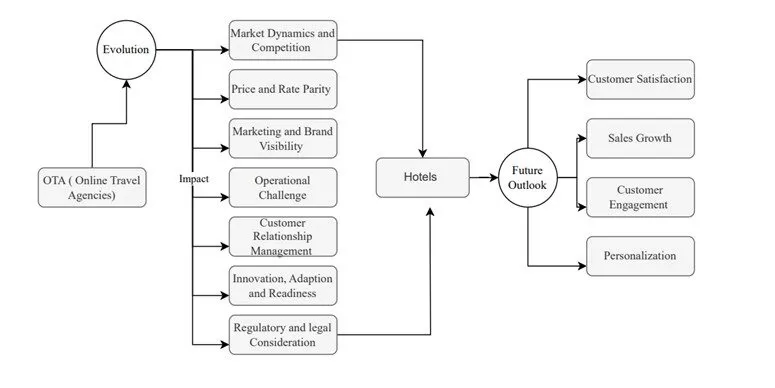
Online Travel Agencies (OTAs) have emerged as influential intermediaries in the hospitality industry, revolutionizing how hotels distribute and sell their inventory (Abdullah et al., 2022; Martin-Fuentes et al., 2021). Figure 1 shows the impact and evolution of OTAs on Hotels. The figure was developed based on systematic literature analysis. As technology evolves and consumer preferences shift, the relationship between hotels and online travel agencies (OTAs) will undoubtedly undergo further transformation (Majó et al., 2020; Angeloni & Rossi, 2021; Gao et al., 2024; Wei et al., 2022; Du, 2022).
Fig 1. The Impact of OTAs on Hotels (Developed by the Authors using Drawio)
Challenges in the Adoption of OTA by Hotels
Recognizing the challenges posed by OTA dominance, hotels have adopted various strategies to mitigate their dependence on these platforms and carve out a niche in the competitive market (Wei et al., 2023; Mariani & Predvoditeleva, 2019; Hsiao et al., 2018). In response to the challenges posed by online travel agencies, hotels have implemented various strategies to mitigate their dependence on these platforms (Ren, 2024). One approach is to diversify distribution channels by investing in direct booking channels (Putra & Law, 2023). By encouraging direct bookings, hotels can reduce their reliance on online travel agencies and retain a larger share of the booking revenue (Jain et al., 2023).
Another strategy involves optimizing revenue management practices to maximize profitability while minimizing reliance on online travel agencies (Wei et al., 2022; Chang et al., 2019; Guizzardi et al., 2019). This may involve dynamic pricing strategies, upselling ancillary services, and targeted marketing campaigns to attract high-value guests and increase revenue per available room (Li & Xie, 2023). Moreover, hotels are increasingly investing in enhancing the guest experience through personalized services (Abdullah et al., 2022; Martin-Fuentes et al., 2021).
One key strategy hotels use is incentivizing direct bookings through exclusive discounts, perks, and loyalty rewards (Nimri et al., 2020). By luring guests to bypass online travel agencies and booking directly through the hotel’s website or mobile app, establishments can reduce commission fees and retain a larger revenue share (Gao et al., 2024; Guizzardi et al., 2019). These incentives provide guests with cost savings and enhanced experiences (Hua et al., 2020).
Enhanced loyalty programs represent another avenue through which hotels seek to cultivate direct relationships with guests and reduce their dependence on online travel agencies (Ren, 2024). Such programs enhance the guest experience and foster brand affinity, leading to increased direct bookings and reduced reliance on OTA intermediation (Berezan et al., 2013). In addition to direct booking incentives and enhanced loyalty programs, hotels strategically manage price parity to maintain competitiveness across all distribution channels while adhering to OTA rate parity clauses (Li & Xie, 2023; Zhu et al., 2019). This approach enables hotels to balance revenue generation and distribution costs while maximizing direct bookings and revenue streams (Angeloni & Rossi, 2021; Wen et al., 2020).
Furthermore, hotels invest in content and branding optimization to differentiate their offerings and stand out in the crowded online marketplace (Hsiao et al., 2018). By showcasing unique selling points, compelling visuals, and engaging multimedia content, hotels enhance their online presence and appeal to discerning travelers (Putra & Law, 2023). By cultivating a distinctive brand identity and narrative, hotels attract guests who resonate with their values and offerings, thereby driving direct bookings and reducing their reliance on online travel agencies (OTAs) for customer acquisition (Ling et al., 2015; Nimri et al., 2020; Wen et al., 2020). Lastly, hotels use a range of strategic initiatives to mitigate their dependence on online travel agencies (OTAs) and differentiate their offerings in the digital marketplace (Li & Xie, 2023; Hsiao et al., 2018).
As the hospitality industry continues to evolve in response to the changing landscape of online booking platforms, hotels must remain vigilant and adaptable to navigate the complexities of the digital ecosystem (Koutoulas & Vagena, 2023; Hsiao et al., 2018). While OTAs will continue to play a significant role in the distribution landscape, hotels can influence technology, data analytics, and innovative marketing strategies to shape their niche and thrive in a competitive marketplace (Prassida et al., 2021; Li & Xie, 2023; Vinod, 2022; Dhir et al., 2020).
Research Methodology
The authors used a mixed methodology to explore the strategic impact of Online Travel Agencies (OTAs) on hotel management. The focus was on understanding the complex nature of this phenomenon, particularly in terms of operational and financial performance. This research was conducted between March 17, 2024 – April 30, 2025.
This research was grounded in two conceptual frameworks. First, Porter’s Five Forces Framework (Porter, 1980) showed the analysis of external pressures set by OTAs, especially in terms of bargaining power, competitive rivalry, and the threat of substitution. Second, the Resource-Based View (RBV) (Barney, 1991) has shown how internal capabilities, such as brand loyalty programs, direct booking systems, and data analytics, moderate the impact of OTA reliance on performance metrics.
A survey was conducted on 278 hotel managers from diverse parts of the hospitality industry, including independent hotels, boutique properties, and large chains. Initially, more than 500 hundred inquiries were distributed in countries such as Georgia, Latvia, Turkey, Lithuania, the Netherlands, and Malta. Snowball and convenience sampling were used. The authors used closed-ended questions on Likert scales focused on the perceived impact on OTAs. Furthermore, a pilot study (n = 20) was conducted to assess validity. The internal consistency was confirmed with a Cronbach’s alpha of 0.87. Obtained data were analyzed with descriptive statistics, correlations, and regressions.
Furthermore, the authors conducted 12 semi-structured interviews with executives in the hotel management sector. Interviewees were selected using purposive sampling. Interview protocols concentrated on strategic responses to OTA dominance, resource deployment, challenges with pricing control, and brand positioning efforts. All interviews were conducted on Zoom and transcribed using Otter software. Furthermore, coding was deductive to align with the theoretical frameworks and inductive to capture emerging patterns. Lastly, the triangulation with quantitative results provided validity and reduced bias.
All research participants received informed consent. Data confidentiality and anonymity were strictly monitored throughout the research process.
Research Findings
Survey Results
Three hundred-one hotel managers participated in the survey. After data cleaning, 33 respondents were eliminated due to incomplete data. Therefore, 278 sets were selected to conduct descriptive statistics. The authors used non-probability sampling techniques, particularly snowball and convenience sampling. Cronbach’s alpha yielded a reliability coefficient of α = 0.87, indicating high internal consistency. Mean scores for OTA impact on financial performance (M = 3.82, SD = 0.71) and operational performance (M = 3.94, SD = 0.68) showed a generally positive yet cautious perspective, with significant variance based on hotel type and size.
Furthermore, the author calculated Pearson’s correlation coefficients to explore the relationships between the independent variables (OTA visibility, occupancy rates, and customer acquisition costs) and the dependent outcomes. Some of the results achieved are illustrated in table 1. First, significant positive correlations were observed between OTA visibility and operational performance (r = .52, p < .001). Second, Occupancy rate impact and financial performance (r = .48, p < .001) and customer acquisition cost reduction and operational performance (r = .45, p < .001). However, negative correlations were also identified between commission dependency and financial performance (r = –.39, p < .001) and pricing parity pressure and operational flexibility (r = –.36, p < .01). These results indicate both positive strategic value and potential performance limitations imposed by OTA integration.
Table 1: Pearson’s Correlation on key OTA Variables (Developed by the Authors)
Next, Table 2 shows regression results. The authors explored predictive relationships through regression analysis. The first model evaluated the impact of OTA-related strategic variables on operational performance. Results revealed that OTA visibility (β = .31, p < .001) and reduced acquisition costs (β = .29, p < .01) were significant predictors, accounting for 36% of the variance in operational outcomes (R² = .36, F(3, 274) = 52.08, p < .001). Moreover, a second model explored predictors of financial performance. Here, occupancy rate improvement (β = .33, p < .001) appeared as the strongest predictor, while commission dependency (β = –.28, p < .01) negatively impacted financial performance. This model demonstrated 31% of the variance in financial outcomes (R² = .31, F(3, 274) = 45.19, p < .001).
Table 2: Regression Coefficients (Developed by the Authors)
The survey results suggest that while online travel agencies (OTAs) are significant in improving market visibility and gaining short-term occupancy growth, they also introduce challenges that can deteriorate long-term profitability. These results validate the applicability of both Porter’s Five Forces, which highlight the bargaining power of intermediaries, and the Resource-Based View (RBV), emphasizing the need for hotels to create internal capabilities to reduce external reliance.
Interview Results
The authors conducted 12 semi-structured interviews with executives in the hotel management sector. Executives were selected through purposive sampling. The authors targeted managers with direct strategic oversight in revenue management, operations, and brand positioning. Hence, this method allowed the collection of rich, experience-based insights. Moreover, the authors designed the interview protocol to address four key areas: strategic responses to OTA dominance, resource deployment for direct booking alternatives, pricing control, and parity challenges, as well as brand positioning under OTA impact.
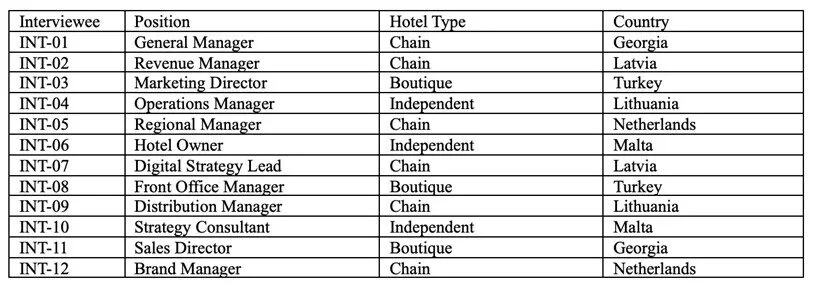
The interviews were conducted on Zoom due to the managers’ remote locations. However, the obtained recordings were first transcribed using the Zoom transcription tool and confirmed by Otter software. The authors conducted a thematic analysis using deductive and inductive coding. Table 3 shows the managers’ profiles, representing diverse locations and experiences related to the research problem.
Table 3: Manager Profiles (Developed by the Authors)
Furthermore, Table 4 highlights the emerging themes that were identified from the interviews.
OTA Dominance and Strategic Adaptation. Managers consistently defined OTAs as a “necessary intermediary,” especially for sustaining occupancy during off-peak periods. However, most voiced concern about over-dependence and reducing negotiating power. One interviewee (INT-01) noted: “We use OTAs to fill rooms quickly, but the cost is a lack of pricing freedom.”
Internal Resource Allocation. A significant theme was the strategic redirection of resources toward direct booking platforms and CRM-driven loyalty programs. Several managers noted growing investments in SEO, social media campaigns, and proprietary mobile apps to decrease OTA commission exposure.
Pricing Parity. Many managers condemned the restrictive pricing parity agreements. This is required by online travel agencies (OTAs) and restrict capability of hotels to execute dynamic pricing strategies. INT-06 stressed: “Commission fees eat into our margins. We are investing more in loyalty programs now.” This theme aligns with the broader financial performance problems identified in the quantitative data.
Brand Value and Identity. Managers expressed a shared concern about brand homogenization on OTA platforms, where hotel identities are often declined to price and photo thumbnails. INT-03 commented: “Our brand is reduced to a thumbnail and price on OTA platforms.” This topic was specifically salient among boutique and independent hotels.
Table 4: Pattern and Themes (Developed by the Authors)
The interview results strengthen the nature of OTA engagement, highlighting benefits in terms of reach and occupancy while introducing longer-term strategic vulnerabilities. These insights confirm the survey results and validate the application of Porter’s Five Forces and the Resource-Based View (RBV).
Discussion
The obtained results exposed the nature and impact of Online Travel Agencies (OTAs) on hotel management. The authors highlighted direct and indirect impact. Survey results suggested that OTAs significantly improve operational performance by improving visibility and occupancy rates. This was seen mostly from independent and boutique hotels. Moreover, this was supported by strong positive correlations between OTA presence and operational metrics. Besides, the managers expressed a high reliance on OTAs to sustain business continuity.
Moreover, interview data strengthened this operational value. Managers expressed OTAs are important for “filling rooms quickly” and “extending market reach during off-peak seasons.” Nevertheless, some significant direct trade-offs exist. For instance, higher commission fees were recognized as a core limitation, which fits into profit margins and decreases pricing flexibility. One Manager stated: “We use OTAs to fill rooms quickly, but the cost is a lack of pricing freedom.” These first-order results indicate a direct, measurable impact of OTAs on short-term performance, mainly in improving capacity utilization.
The data also demonstrated indirect impacts that influence the hotel’s long-term strategic positioning. Moreover, the regressions showed a negative relationship between commission dependency and financial performance, as well as between pricing parity pressure and operational flexibility. This suggest that while OTAs drive occupancy, they indirectly damage hotels’ profitability.
Based on interviews, managers stated that OTA agreements are a strategic trap, a condition where hotels trade long-term brand value for short-term exposure. The theme of brand valuation appeared as a recurring concern, specifically among boutique and independent hotels. As one manager stressed: “Our brand is reduced to a thumbnail and price on OTA platforms.” Additionally, interviewees examined the reallocation of internal resources as a strategic measure to offset OTA dependency. This suggests a transformation from reactive to proactive management, compatible with the Resource-Based View (RBV).
Conclusion
This research explored the strategic impact of Online Travel Agencies (OTAs) on hotel operational and financial performance, based on a survey study on 278 hotel managers and interviewing 12 hotel managers. The results contribute to already existing knowledge however emphasize the dual nature of OTAs.
Hotels that passively rely on OTAs may benefit in the short term but risk brand visibility. Contrarily, those that invest in CRM systems, are more likely to convert OTA-acquired customers into loyal, high-value guests, reducing the indirect risks. Therefore, the results revealed that the challenge is not whether to use OTAs, but how to strategically control OTAs within a revenue and brand management framework.
Theoretically, this research supports the application of Porter’s Five Forces and the Resource-Based View (RBV) in digital hospitality strategy. Porter’s models explain how OTAs increase bargaining power and strengthen competitive rivalry through pricing control. Similar, the RBV explains how hotels with more robust internal capabilities reduce impacts of OTA vulnerabilities.
Practically, this research showed the need for balanced channel management. While OTAs are important for many hotels, particularly smaller or independent properties, over-reliance can deteriorate profitability and strategic autonomy. These results indicate that hotels that diversify their digital strategy, rather rely on OTA, can optimize performance while maintaining brand identity and control margin.
This research offers several future avenues that the authors indent to continue the work. First, explore reginal differences of OTA impact, and second explore the AI personalization and OTA distribution to understand the algorithm optimization and consumer perspectives.
Disclosure: This research is AI free. The authors used Grammarly pro to fix minor grammatical and structural errors.
References
Abdullah, S., Van Cauwenberge, P., Bauwhede, H. V., & O’Connor, P. (2022). The indirect distribution dilemma: assessing the financial impact of participation in Booking.com for hotels. Tourism Review, 1024-1042. doi: https://doi.org/10.1108/TR-03-2020-0101
Angeloni, S., & Rossi, C. (2021). Online search engines and online travel agencies: A Comparative Approach. Journal of Hospitality & Tourism Research, 45(4). doi: https://doi.org/10.1177/1096348020980
Anguera-Torrell, O., & Langer, C. (2021). The impact of positioning on click-through-rates in hotel metasearch engines. Journal of Vacation Marketing, 28(2). doi: https://doi.org/10.1177/13567667211042640
Barney, J. (1991). Firm resources and sustained competitive advantage. Journal of Management, 17(1), 99–120. https://doi.org/10.1177/014920639101700108
Berezan, O., Raab, C., Yoo, M., & Love, C. (2013). Sustainable hotel practices and nationality: The impact on guest satisfaction and guest intention to return. International Journal of Hospitality Management, 34. doi: https://doi.org/10.1016/j.ijhm.2013.03.010
Bhandari, R., & Sin, M. V. (2023). Optimizing digital marketing in hospitality industries. Social Sciences and humanities. doi: https://doi.org/10.34306/sabda.v2i1.263
Bianco, S., Singal, M., & Zach, F. J. (2024). Leveraging knowledge via location proximity among hotels and short-term leases. International Journal of Hospitality Management, 119. doi: https://doi.org/10.1016/j.ijhm.2024.103719
Chang, Y.-W., Hsu, P.-Y., & Lan, Y.-C. (2019). Cooperation and competition between online travel agencies and hotels. Tourism Management, 187-196. doi: https://doi.org/10.1016/j.tourman.2018.08.026
Chang, Y.-W., Ping-Yu, H., & Lan, Y.-C. (2019). Cooperation and competition between online travel agencies and hotels. Tourism Management, 71, 187-196. doi: https://doi.org/10.1016/j.tourman.2018.08.026
Cheng, M., & Anderson, C. K. (2020). Search Engine Consumer Journeys: Exploring and Segmenting Click-Through Behaviors. Cornell Hospitality Quarterly, 62(2). doi: https://doi.org/10.1177/1938965520924649
Creswell, J. W., & Plano Clark, V. L. (2018). Designing and conducting mixed methods research (3rd ed.). SAGE Publications.
Denzin, N. K. (2012). Triangulation 2.0. Journal of Mixed Methods Research, 6(2), 80–88. https://doi.org/10.1177/1558689812437186
Dhir, A., Talwar, S., Kaur, P., & Mäntymäki, M. (2020). Why do people purchase from online travel agencies (OTAs)? A consumption values perspective. International Journal of Hospitality Management, 88. doi: https://doi.org/10.1016/j.ijhm.2020.102534
Du, F. (2022). Study on the Optimal Selection of Online Travel Agency to Cooperate for Hotels. Information Systems and Economics, 25-36. doi:DOI: http://dx.doi.org/10.23977/infse.2022.030405
Gao, Y., Mattila, A. S., & Andreu, L. (2024). Responsible Tourism and Hospitality. Journal of Hospitality & Tourism Research, 48(4). doi: https://doi.org/10.1177/1096348023122607
Guizzardi, A., Pons, F. M., & Ranieri, E. (2019). Competition patterns, spatial and advance booking effects in the accommodation market online. Tourism Management, 71, 476-489. doi: https://doi.org/10.1016/j.tourman.2018.10.028
Högberg, K. (2021). Strategic responses to digital disruption – an exploratory study of digital transformation in hospitality digital transformation in hospita. Organization Transformation & Information Systems.
Hsiao, T.-Y., Chuang, C.-M., & Huang, L. (2018). The contents, determinants, and strategic procedure for implementing suitable green activities in star hotels. International Journal of Hospitality Management, 1-13. doi: https://doi.org/10.1016/j.ijhm.2017.10.005
Hua, N., Huang, A., Medeiros, M., & DeFranco, A. (2020). The moderating effect of operator type: the impact of information technology (IT) expenditures on hotels’ operating performance. International Journal of Contemporary Hospitality Management, 32(8), 2519-2541. Doi: https://doi.org/10.1108/IJCHM-09-2019-0753
Ivanov, I. (2020). THE IMPACT OF OTA – TRANSFORMING CONTEMPORARY TOURISTS’ INTENTIONS. Economics & Law, 2(2), 50-61. doi: 10.37708/el.swu.v2i2.5
Jain, A., Shanker, S., & Barve, A. (2023). Resilience against the COVID-19 pandemic: is the hotel and tourism supply chain on the right path? Benchmarking: An International Journal, 29, 3194-3225. doi: https://doi.org/10.1108/BIJ-05-2021-0249
Jolene, K. (2023). The Influence of Online Travel Agencies (OTAs) on Hotel Revenue and Distribution Strategies. Journal of Modern Hospitality, 14-25. doi: https://doi.org/10.47941/jmh.1557
Kim, J., Franklin, D., & Hwang, E. (2019). Online Travel Agency Price Presentation: Examining the Influence of Price Dispersion on Travelers’ Hotel Preference. Journal of Travel Research, 59(4). doi: https://doi.org/10.1177/0047287519857159
Koutoulas, D., & Vagena, A. (2023). The present and future of hotel star ratings through the eyes of star rating operators. Journal of Tourism Futures. doi: https://doi.org/10.1108/JTF-04-2022-0120
Li, Z., & Xie, G. (2023). Pricing Decision and Cancellation Strategy Selection of ‘Hotel+OTA’ Based on Customer Cancellation Behavior. Advances in Economics and Management Research. doi: https://doi.org/10.56028/aemr.7.1.76.2023
Ling, L., Dong, Y., Guo, X., & Liang, L. (2015). Availability management of hotel rooms under cooperation with online travel agencies. International Journal of Hospitality Management, 145-152. doi: https://doi.org/10.1016/j.ijhm.2015.07.005
Majó Fernández, J., Vall-Llosera, L., & Moya Sanchez, D. (2020). Analysis of OTA Impact on Hotel Reservations. Case Study: Bogotá. Turismo y Sociedad. Retrieved from https://ssrn.com/abstract=35957
Manousakis, V., & Mattas, A. (2020). Statistical Analysis on the Impact of Online Travel Agents’ (OTAs) Commission Structure on Hotels’ Revenue Management. Sustainable Food Chains and Ecosystems, 63–77. doi: https://doi.org/10.1007/978-3-030-39609-1_5
Mariani, M., & Predvoditeleva, M. (2019). How do online reviewers’ cultural traits and perceived experience influence hotel online ratings? An empirical analysis of the Muscovite hotel sector. International Journal of Contemporary Hospitality Management, 31(12), 4543-4573. doi: https://doi.org/10.1108/IJCHM-11-2018-0927
Martin-Fuentes, E., Mellinas, J. P., & Parra-Lopez, E. (2021). Online travel review rating scales and effects on hotel scoring and competitiveness. Tourism Review, 76(3), 654-668. doi: https://doi.org/10.1108/TR-01-2019-0024
Merli, R., Preziosi, M., Acampora, A., & Ali, F. (2019). Why should hotels go green? Insights from guests experience in green hotels. International Journal of Hospitality Management, 81, 169-179. doi: https://doi.org/10.1016/j.ijhm.2019.04.022
Moyeenudin, H. M., Bindu, G., & Anandan, R. (2021). OTA and IoT Influence the Room Occupancy of a Hotel. Data Management, Analytics and Innovation, 265-274. doi: https://doi.org/10.1007/978-981-16-2934-1_17
Nimri, R., Patiar, A., & Jin, X. (2020). The determinants of consumers’ intention of purchasing green hotel accommodation: Extending the theory of planned behaviour. Journal of Hospitality and Tourism Management, 45, 535-543. doi: https://doi.org/10.1016/j.jhtm.2020.10.013
Porter, M. E. (2008). The five competitive forces that shape strategy. Harvard Business Review, 86(1), 78–93.
Peng, X., Zhu, J., Lee, S., Zhou, D., Song, W., & Ying, T. (2024). Digital transformation in the hospitality industry: A bibliometric review from 2000 to 2023. International Journal of Hospitality Management, 120. doi: https://doi.org/10.1016/j.ijhm.2024.103761
Pham, H., & Nguyen, T.-H. (2019). The effect of website quality on repurchase intention with the mediation of perceived value: The case study of online travel agencies in Vietnam. Journal of Global Business. doi:10.5038/2640-6489.4.1.1041
Prassida, G. F., Hsu, P. Y., & Chang, Y. W. (2021). Understanding how O2O service synergies drive customer continuance intention: a study of OTAs and hotels. Asia Pacific Journal of Tourism Research, 1139-1155. doi: https://doi.org/10.1080/10941665.2021.1952461
Prawit, P., Sruangporn, S., & Kanakarn, P. (2022). The Impact Of Digital Marketing On Hospitality Industry Performance In Thailand During COVID-19: Eastern Economic Corridor. Journal of Positive School Psychology, 6(9).
Putra, K., & Law, R. (2023). Critical success factors for virtual hotel operator partnership with small- and medium-sized hotels: perspectives of owners and operators. Journal of Hospitality and Tourism Insights. doi: https://doi.org/10.1108/JHTI-06-2022-0244
Ren, Y. (2024). Optimal format design in green tourism supply chain in the presence of a dominant online travel agency. Heliyon, 10(9). doi: https://doi.org/10.1016/j.heliyon.2024.e30477
Shi, P., & Hu, Y. (2021). Service commission contract design of online travel agency to create O2O model by cooperation with traditional travel agency under asymmetric information. Journal of Destination Marketing & Management, 21. doi: https://doi.org/10.1016/j.jdmm.2021.100641
(2024). Online travel platforms’ positive impact on profitability of hotels. https://www.statista.com/chart/33770/otas-and-hotel-profitability/
Talwar, S., Dhir, A., Kaur, P., & Mäntymäki, M. (2020). Barriers toward purchasing from online travel agencies. International Journal of Hospitality Management, 89. doi: https://doi.org/10.1016/j.ijhm.2020.102593
Vinod, B. (2022). Personalization in Hospitality. Revenue Management in the Lodging Industry, 221–244. doi: https://doi.org/10.1007/978-3-031-14302-1_6
Wei, C., Lu, L., & Lee, Y. M. (2023). Paying a Premium for Green-Label Hotels: The Role of the Mismatched Hotel-OTA Involvement. Journal of Hospitality & Tourism Research, 48(4). doi: https://doi.org/10.1177/10963480231188736
Wei, J., Liu, M., Li, W., Hou, Z., & Li, L. (2022). The impact of consumer confusion on the service recovery effect of Online Travel Agency (OTA). Current Psychology. doi: https://doi.org/10.1007/s12144-022-03540-x
Wen, J., Lin, Z., & Li, Y. (2020). The Interaction Effects of Online Reviews, Brand, and Price on Consumer Hotel Booking Decision Making. Journal of Travel Research, 60(4). doi: https://doi.org/10.1177/00472875209123
Ye, B. H., Barreda, A. A., Okumus, F., & Nusair, K. (2019). Website interactivity and brand development of online travel agencies in China: The moderating role of age. Journal of Business Research, 99, 382-389. doi: https://doi.org/10.1016/j.jbusres.2017.09.046
Ye, Y., & Chen, K.-H. (2024). Hospitality employees and digital transformation: The mediating roles of alienation and motivation. International Journal of Hospitality Management, 119. doi: https://doi.org/10.1016/j.ijhm.2024.10373
Zhu, Y., Chen, Y., Wang, X., Nie, T., & Du, S. (2023). Procedural fairness concern in tourism supply chain: The case of a dominant OTA and a sustainable hotel. Computers & Industrial Engineering, 176. doi: https://doi.org/10.1016/j.cie.2022.108919.