Comparison of the Level of Consumer Ethnocentrism, Consumer Materialism and Impulsive Consumer Behavior in The Context of Selected Sociodemographic Characteristics
Faculty of Management and Business, University of Presov, Presov, Slovakia
Volume 2025,
Article ID 932047,
Journal of Marketing Research and Case Studies,
9 pages,
DOI: https://doi.org/10.5171/2025.932047
Received date: 21 March 2025; Accepted date: 23 June 2025; Published date: 17 July 2025
Academic Editor: Lubica Gajanova
Cite this Article as:
Anna TOMKOVA, Ivana ONDRIJOVÁ and Jozef NEMEC (2025), “Comparison Of the Level of Consumer Ethnocentrism, Consumer Materialism and Impulsive Consumer Behavior in The Context of Selected Sociodemographic Characteristics ", Journal of Marketing Research and Case Studies, Vol. 2025 (2025), Article ID 932047, DOI: https://doi.org/10.5171/2025.932047
The aim of this paper was to examine and compare the level of consumer ethnocentrism, materialism and impulsive consumer behaviour. Special attention was paid to differences between respondents according to gender and educational attainment. Types of purchasing behaviour from the perspective of customers in relation to interpersonal relationships were also analysed. The research used the CETSCALE (Consumer Ethnocentrism Tendency Scale) methodology according to Schiffman and Kaňuk (2004) to measure the level of ethnocentric approach to consumption. The level of materialism was assessed through value orientation according to the Richins and Dawson scale (1992) and impulsive purchasing behaviour was assessed using the Compulsive Shopping Scale by Valance, Atous and Fortier (1988). The paper concludes with the findings from the research and their comparison with previous research in the field of consumer behaviour.
The paper outlines current knowledge in the field of retail psychology and consumer behavior. The digital revolution has caused several significant changes in business. Consumers now have more power and access to more information than ever before, and the interaction between seller and customer is becoming more interactive and immediate. Many factors influence this interaction, especially personality and relationships. These factors can be measured through identified determinants of retail behavior as well as through indicators of interpersonal relationships. The success of business relations is also related to the demographic characteristics of both parties. By examining the various motives of consumer behavior, we arrive at specific forms of their behavior. As part of this paper and its research, we have chosen the phenomenon of compulsive consumption, consumer ethnocentrism and materialism.
Present state of problem solving
The human consumer is a crucial element in the commercial communication system. Consumers are individuals who exercise free choice and select various products. Consumer behavior can be influenced and constrained, but predicting this behavior is challenging. How a person behaves in the market reflects their physical and mental life, thoughts, habits, and beliefs (Tomková, Gburová 2015). According to Kačáni and colleagues (2013), a consumer can be an individual, household, or organization obtaining consumer goods and services through trade to satisfy their needs or perform their activities. It is crucial to view the consumer as a person with certain characteristics, as their behavior is part of their overall expression. Shiffman and Kanuk (2004) state that each person is a unique personality with deeply rooted psychological traits influencing their response to product promotion and purchasing decisions. Researchers using Freud’s psychoanalytic theory to study consumer personality believe that people’s impulses are often subconscious, and consumers are not aware of the real reasons that led them to make a purchase. These researchers tend to view consumer purchases and consumption situations as a reflection and extension of the consumer’s personality. Therefore, they consider the consumer’s appearance and possessions, care for appearance, clothing, jewelry, and the like, as a reflection of the individual’s personality.
Consumer behavior is understood as the actions of consumers related to the acquisition, postponement, and use of goods and services, as well as ideas and experiences, where needs and desires are satisfied (Stávková et al., 2006). According to Kita et al. (2005), it involves visible and observable acts performed by the consumer. It encompasses mental and social processes occurring before purchasing, such as awareness of needs, during the purchase, i.e., purchasing behavior, and after the purchase, including the comparison of expected reality, satisfaction, and dissatisfaction with the purchase.
Heš et al. (2009) highlight the importance, in the analysis of consumer behavior, of understanding the criteria that influence the purchase of goods and services. While numerous criteria exist, price, quality, brand, and the strength of the product are considered crucial. From the perspective of the merchant, it is essential to know and comprehend what is significant in the decision-making process and what influences the consumer.
The business environment and its approach have also influenced the approach to the women’s segment. Here, we draw from gender studies, giving rise to gender marketing, i.e., marketing targeted at groups primarily defined by gender (Jedličková 2007; Tomková, Ondrijová 2018).
The undeniable biological and social differences between men and women allow for a clear definition of these groups in terms of consumer behavior and perspectives on specific product and service offerings. Biological differences lead to distinct mental preferences and perspectives on the world. Differences also exist in intellectual functions and subconscious, automatic, and instinctive reactions. Business strategies that respect these differences and distinctions better align with the needs, desires, and values of both groups, bringing new values in terms of corporate social responsibility. Analyzing differences in the consumer behavior of women and men, such as shopping, brand preferences, media behavior, and more, is undoubtedly important (Vysekalová 2007).
Men concentrate their thinking in the left part of the neocortex, which is the center of logical thinking. Women use a more emotional and intuitive part of the brain in combination with rational processes. When the male brain is at rest, most activities take place in its most primitive part, responsible for survival instincts, i.e., fight or flight. When the female brain is at rest, most activities take place in the limbic system, the center of emotions. This assertion is supported by research on brain activity, i.e., subconscious activity. Magnetic resonance imaging shows that processing emotions activates many more areas of the brain in women than in men. It seems that more neuron connections connecting various parts of the brain are engaged in women (Cunningham, Roberts 2006).
Haeusel (2009), in his research on the emotional structure of the brain and limbic types, examines the influence of the different proportions of individual sex hormones in women and men on the motivational and emotional systems of the brain. In the male brain, there is, on average, a stronger concentration of the sex hormones testosterone and vasopressin, while the female brain is more strongly influenced by estrogen/estradiol, prolactin, and oxytocin. Testosterone amplifies the dominance system in the emotional brain, while estrogen reinforces the balance system.
These insights enhance our understanding and interpretation of the behavior of different groups of women, particularly in the realm of consumption. When looking at women in advertising, stereotypes still prevail, portraying women as caring homemakers, ensuring hygiene, healthy nutrition, essentially a mother who knows everything, including how to cook soup from a packet, and so forth. Occasionally, a man appears in the role of an adviser recommending the right product, be it a detergent or other (Tomková, Ondrijová 2018; Frankovský, Birknerová Tomková 2017).
We can say that male decision-making within business behavior is more linear, while female decision-making resembles more of a spiral. Women often seek the perfect product, are not satisfied with compromise, require time for decision-making, and demand more interaction with the retailer and more information from their surroundings. Women often shop for the entire family, gaining more experience in shopping (Tomková, Ondrijová 2018).
There are numerous typologies that characterize differences between men and women within the population as a whole. None of these typologies can cover the entire spectrum of diversity among people and their reactions to various stimuli. Human behavior is influenced by many factors that we can never predict with absolute certainty. However, typology is indispensable for the consumer market and the psychology of commerce, and it depends on the specific task to not only select but also correctly interpret the right one.
Processes and occurrences in the human mind are currently understood only to a limited extent, and the human mind often represents a so-called ‘black box’ for retailers. It simultaneously reflects the perspective on consumer purchasing behavior based on the relationship: stimulus – black box – response. In this context, the black box represents the consumer’s interaction with a specific purchase decision, where surrounding stimuli also influence the decision-making process. The starting point of the entire process is the stimulus, whether external or internal. In this case, the black box signifies the mental process that cannot be quantified or examined. However, we can examine and quantify external factors, and some of them can even be influenced or created. Therefore, we are interested in the impact of external factors on consumer behavior and purchasing decisions in all categories of stimuli. This primarily involves socio-cultural and social influences. From the perspective of internal factors, we refer to the influences of individual (lifestyle, values) and psychological factors such as motivation, perception, and learning (Vysekalová et al. 2011).
In our paper, we investigated three specific forms of consumer behavior: compulsive consumption, consumer ethnocentrism, and consumer materialism.
As Straková Jirku (2018) notes, obsessive-compulsive disorder is characterized by subjectively experienced anxiety, tension, the presence of obsessions, and compulsions. Obsessions are intrusive, repetitive compulsive thoughts that evoke intense anxiety and tension in individuals, who seek to get rid of these thoughts. To alleviate anxiety, compulsive behavior is employed, which is observable, as well as mental compulsions, which are not visible. Individuals suffering from compulsive behavior recognize the senselessness of their actions, and such behavior does not bring them pleasure.
Compulsive buyers experience repeated, irresistible, and strong urges to buy goods, similar to the attitudes of substance-dependent individuals. This merchandise is often useless and/or unused. The availability of the online retail environment can support compulsive buying, as it allows avoiding direct social contact, conducting private transactions (e.g., hidden from the family), and provides continuous electronic feedback on product offerings and prices (Lejoyeux et al. 1996).
Kaynak and Kara (2002) define consumer ethnocentrism as the effect of purchasing decisions for products from one’s home country and those differing more or less from it. Watson and Wright (2000) highlight that ethnocentric consumers show a greater preference for domestic products in decision-making situations when a domestic alternative is available. For foreign importers, this implies the expectation of stronger competition.
The country-of-origin effect, also known as the “made in” concept, has been generally defined as the positive or negative influence that the country of production of a product may have on consumer decision processes or subsequent consumer behavior (Elliott, Cameron 1994).
Materialism is defined as the “importance ascribed to ownership and the acquisition of material goods in achieving major life goals or desired states” (Richins 2004).
Consumer materialism is a reaction to globalization. Barber (1996) coined the term “McWorld” to describe the emerging materialistic global culture; others referred to this phenomenon as the “Coca-colonization of the world.”
Individual consumers attribute meanings to material goods, and these meanings tend to be specific but dynamic. While some objects acquire relatively static meanings (e.g., heirlooms symbolizing continuity), others (e.g., branded products) acquire different meanings for the same and different people at the same time and place (Kleine, Baker 2004). Materialistic values not only differ among individual consumers but also manifest differently in various consumption contexts.
Consumer behavior can be defined as a multidimensional construct encompassing the customer and consumer on one side and the seller on the other. This post focuses on researching customers and vendors without whom the purchase of products or services would not be feasible. Consumer behavior is significantly influenced by psychological processes, with various approaches, as mentioned by Zamazalová (2009). The rational approach sees consumers as rational individuals deciding based on a rational consideration of the benefits of a purchase. The psychological approach assumes that external stimuli and the unconscious side of personality are closely related to consumer behavior. The sociological approach explains that consumer behavior is influenced by social status and the environment in which one lives. The comprehensive approach combines the above-mentioned approaches.
Korauš (2014) identifies fundamental psychological processes influencing consumer behavior. In addition to rational and emotional aspects, he introduces habitual aspects that apply to automatic and repetitive purchases. In more complex cases, such as demanding services, consumers tend to use more rational procedures.
Sales quality is closely related to the approach of the merchant toward potential customers. Toman (2011) emphasizes the necessity of trust between the merchant and the customer. While merchants in the past aimed to acquire as many customers as possible, the current trend is to maintain loyal customers, achieved through trust-building. Mažár (2019) notes that the goal of every merchant is to establish a positive relationship with customers, fostering customer loyalty, forgiveness for any potential mistakes, and gaining a new chance in case of minor failures.
The conducted research focuses on the psychological approach to consumer behavior. The subject of the study was the comparison of consumer behavior (consumer ethnocentrism, consumer materialism, and impulsive buying behavior) concerning respondents’ gender and education.
Methodology
The research sample consisted of 160 respondents aged 18 to 65 (M=35.621, SD=2.578), with 95 women and 65 men. Respondents had completed either secondary (84 respondents) or tertiary education (56 respondents). The research methodology was administered by management students and employees working in the public and private sectors in the Prešov and Košice regions in 2024. The research study used methodologies to measure the level of consumer ethnocentrism, consumer materialism, impulsive buying behavior.
The Consumer Ethnocentrism Tendency Scale (CETSCALE) by Schiffman and Kanuk (2004) was used to measure the level of consumer ethnocentrism. The 17-item scale, initially oriented towards American consumers, focuses on four areas related to the country’s economy, unemployment, patriotism, and product availability. The entire consumer ethnocentrism model measures the self-assessment response to statements on a scale of 1-7 (1 – completely disagree to 7 – completely agree). It is important to note that the Consumer Ethnocentrism Tendency Scale assesses the overall ethnocentrism level (Cronbach’s alpha=0.868), without specifying the preference for a product type but rather for its origin or manufacturing location.
Consumer materialism was examined using the Value Orientation Scale by Richins and Dawson (1992), consisting of 16 statements. Respondents rated their agreement or disagreement on a 7-point scale (1 – completely disagree, 7 – completely agree). The reliability of the methodology was at Cronbach’s alpha=0.686.
The level of impulsive buying behavior was investigated using the Compulsive Buying Scale by Valance, Atous, and Fortier (1988), consisting of 5 statements. Respondents rated their agreement or disagreement on a 7-point scale (1 – completely disagree, 7 – completely agree). The reliability of the methodology was at Cronbach’s alpha=0.714.
Results
The main objective of the research study was to compare the level of consumer ethnocentrism, consumer materialism, and impulsive consumer behavior concerning gender differences and the education level of respondents. The secondary objective was to evaluate various types of sales behavior from the customers’ perspective in the context of interpersonal relationships. The research results were processed using the IBM SPSS 20.00 Statistics program, employing inferential statistics, specifically the Two-Way Analysis of Variance, t-test for independent samples, and Pearson’s correlation coefficient. Table 1 presents descriptive data for dependent variables (consumer ethnocentrism, consumer materialism, and impulsive consumer behavior) and independent variables (gender and education).
Table 1. Descriptive Data for Independent and Dependent Variables
* p <0,05
Levene’s test for homogeneity of variances was higher than 0.05 during the analysis of the research results in all three cases. The F ratio value was statistically significant and, based on the above criteria, differences in dependent variables were analyzed. Analysis of the research results showed statistically significant differences between respondents with secondary and higher education in terms of the gender of the respondents. For research purposes, multivariate analysis was used, namely the multivariate test (Wilks’ lambda). Table 1 shows statistically significant differences between respondents with secondary and higher education in terms of the gender of the respondents. Table 2 shows the interaction effect between education and gender – multivariate test.
Table 2. Interaction Effect between Education and Gender – Multivariate Test
* p <0,05
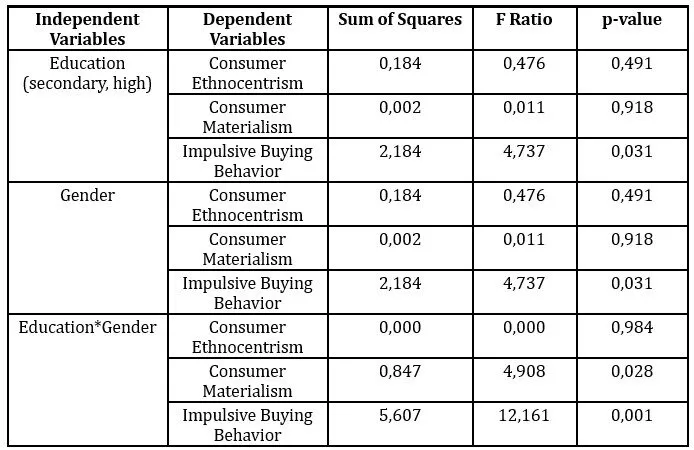
The intergroup effects test revealed statistically significant differences in the level of impulsive buying behavior between respondents with secondary education and those with tertiary education (p=0.031). Using analysis of variance, statistically significant differences were found based on the gender of respondents (p=0.031). Based on statistical analysis, statistically significant differences were found between respondents with secondary education and those with tertiary education concerning their gender (p>0.001). Table 3 illustrates the interaction effect between the education and gender of respondents.
Table 3. Interaction Effect of Education and Gender on the Level of Consumer Ethnocentrism,
Consumer Materialism, and Impulsive Buying Behavior
* p <0,05
Using the Two-Way Analysis of Variance, statistically significant differences were found between respondents with secondary education and those with tertiary education in the level of impulsive buying behavior (p=0.031). Employees with tertiary education achieved a higher level of impulsive buying behavior than respondents with secondary education. Women demonstrated a higher level of impulsive buying behavior than men. On the other hand, no statistically significant differences were found in the level of consumer ethnocentrism and consumer materialism based on the gender of respondents. Also, there were no statistically significant differences between respondents with secondary education and those with tertiary education in the level of consumer ethnocentrism and consumer materialism.
The comparison of estimated marginal means demonstrated differences in the level of impulsive buying behavior. Specifically, women with secondary education (M=3.563) showed a statistically significantly higher level of impulsive buying behavior than women with tertiary education (M=2.934). On the other hand, men with secondary education (M=3.102) did not show a statistically significantly higher level of impulsive buying behavior than men with tertiary education (M=3.168).
Discussion and Conclusion
In the discussion, the research results are compared with previous studies in the field of purchasing behavior. The research part focuses on consumer behavior (consumer ethnocentrism, consumer materialism and impulsive buying behavior).
The research results did not show statistically significant differences in the level of consumer ethnocentrism. These findings are consistent with previous studies by authors such as Caruana (1996), Pharr (2005) and Shankarmahesh (2006), who suggested that sociodemographic characteristics such as age, gender, or income do not show a clear correlation with consumer ethnocentrism. In our study, two sociodemographic characteristics (gender and education) were selected for a better understanding of the research construct. Research carried out in Poland and Slovakia indicates a higher preference for local brands over foreign ones. In addition, Gibbs and Boguszak (1995) found that Slovak consumers perceive the quality of Slovak products in the same way as foreign brands (Saffu, Walker, Mazurek, 2010).
Within the conducted research, it can be observed that the selected socio-demographic characteristics did not show statistically significant differences in the level of consumer ethnocentrism. Therefore, it might be more appropriate to focus on the product itself rather than the consumer.
The research results did not reveal statistically significant differences in the level of consumer materialism. These findings contrast with previous research (Cleveland, Laroche, Papadopoulos, 2009; Schaefer, Hermans, Parker, 2004), which found associations between consumer materialism and factors such as age, nationality, and other socio-demographic factors (income, gender, and education). Zelizer (1994) also demonstrated statistically significant gender differences in beliefs and attitudes towards money. Although money-related attitudes were not the focus of this study, they are closely related to the issue of consumer materialism. Limbu, Huhmann, and Xu (2012) discovered that women consider themselves dependent and tend to form and maintain relationships with people and organizations. This suggests that women may maintain this relationship and dependency through products, which relates to consumer materialism, thus increasing their perceived social status in society. Based on this, we hypothesized statistically significant gender differences in the level of consumer materialism, but these were not confirmed.
The research results indicated statistically significant differences in the level of impulsive buying behavior. O’Guinn and Faber (1989) emphasized the severity of physical consequences associated with impulsive buying behavior, which includes psychological and economic consequences linked to excessive compulsive buying urges. The research results demonstrated statistically significant gender differences in favor of women regarding impulsive buying behavior. These findings are consistent with previous studies (Chiger, 2001; Marks, 2002; Otnes, McGrath, 2001), where statistically significant gender differences were found in the context of purchase preferences and buying behavior. Women engaged in significantly higher levels of shopping than men.
The research results also showed statistically significant differences in the level of impulsive buying behavior based on the education of respondents. Respondents with high school education exhibited a significantly higher level of impulsive buying behavior than respondents with higher education. Previous research by Wood (1998) demonstrated a statistically significant relationship between impulsive buying behavior and experience in education. The fact that education, rather than income, is associated with impulsive buying implies attention to cultural and cognitive variables that may act as intervening variables. The analysis of research results revealed that women with high school education exhibited a significantly higher level of impulsive buying behavior than women with higher education. On the other hand, men with high school education did not show a significantly higher level of impulsive buying behavior than men with higher education. Our research findings are not entirely consistent with Wood’s (1998) study, which found that education and age are associated with impulsive buying behavior, while gender was weakly linked to impulsive buying behavior.
Elliot (1994) found that the primary function of impulsive buying is to increase the impulsive shopper’s ability to align subjective perceptions of socially desirable or desired behavior. The research analysis focused on the gender and education of employees, which can be considered a limitation of the conducted research. On the other hand, within this issue, it is crucial to include more personality-oriented variables related to the socio-demographic and psychological characteristics of consumers and customers.
Acknowledgment
This research was funded by the Slovak Research and Development Agency, grant number APVV-23-0472.
References
Barber, RB. (1996) ´Jihad Versus McWorld: How Globalism and Tribalism Are Reshaping the World,´ New York: Ballentine Books.Bauman, Z. Sociologie. Praha: Orbis.
Caruana, A. (1996) ´The effects of dogmatism and social class variables on consumer ethnocentrism in Malta,´ Marketing Intelligence & Planning, 14(4), pp. 39-51.
Cleveland, M., Laroche, M. and Papadopoulos, N. (2009) ´Cosmopolitanism, Consumer Ethnocentrism, and Materialism: An Eight-Country Study of Antecedents and Outcomes,´ Journal of International Marketing, 17, 116-146. 10.1509/jimk.17.1.116.
Cunningham, J. and Roberts, P. (2006) ´Inside Her Pretty Little Head: A new theory of female motivation and what it means for marketing,´ Cyan Books Marshall Cavendish
Elliott, RG. and Cameron, RC. (1994) ´Consumer perception of product quality and the country of origin effect,´ Journal of International Marketing, 2(2), 49-62.
Frankovský, M., Birknerová, Z. and Tomková, A. (2017) ´VYSEDI: dotazník zisťovania machiavellistických prejavov v obchodnom správaní,´ Prešov: Bookman.
Gibbs, J. and Boguszak, M. (1995) ´Open market after shocks: Czech and Slovak attitude toward brands, Towards a Market Economy: Beyond the Point of No Return,´ Second East and Central European Conference, Esomar, Warsaw, 297-314.
Hes, A. et al. (2009) ´Chování spotřebitele při nákupu potravin,´ Praha: Alfa Nakladatelství.
Chiger, S. (2001) ´Consumer shopping survey,´ Catalog Age, New Canaan. 18(9), 57-60.
Kačáni, V. et al. (2013) ´Psychológia práce a trhu,´ Bratislava: Mladé letá.
Kaynak, E. and Kara, A. (2002) ´Consumer Perceptions of Foreign Products: An Analysis of Product-Country Images and Ethnocentrism,´ European Journal of Marketing, 36, 928-949. https://doi.org/10.1108/03090560210430881
Kita, J. et al. (2005) ´Marketing,´ Bratislava: Iura Edition.
Kleine Schultz, S. and Baker, SM. (2004) ´An Integrative Review of Material Possession Attachment,´ Academy of Marketing Science Review.
Korauš, A. (2014) ´Spotrebiteľské správanie ako jedna z foriem komunikácie,´ Sustainability-Environment-Safety, Zborník z medzinárodnej vedeckej konferencie. Bratislava, 141-143.
Lejoyeux M., Adés, J., Tassain V. and Solomon, J. (1996) ´Phenomenology and psychopathology of uncontrolled buying,´ American Journal Psychiatry, 155, 1524–1529.
Limbu, BY, Huhmann, BA. and Xu, B. (2012) ´Are college students at greater risk of credit card abuse? Age, gender, materialism and parental influence on consumer response to credit cards,´ Journal of Financial Services Marketing, 17(2), 148-162.
Mažár, M. (2019) ´Ako si vybudovať dobrá vzťahy so zákazníkmi [online],´ [cit. 09-07-2024] Dostupné z: https://predajnetechniky.sk/news/ciel-obchodnika-vybudovat-dobre-vztahy-so-zakaznikom/
O’Guinn, CT. and Faber, RJ. (1989) ´Compulsive buying: A phenomenological exploration,´ Journal of Consumer Research, 16(2), 147–157. https://doi.org/10.1086/209204
Otnes, CC. and McGrath, MA. (2001) ´Perceptions and realities of male shopping behavior,´ Journal of Retailing, 77(1), 111-137.
Parker, RS., Hermans, MC. and Schaefer, AD. (2004) ´Fashion Consciousness of Chinese, Japanese and American Teenagers,´ Journal of Fashion Marketing and Management: An International Journal, 8, 176-186. https://doi.org/10.1108/13612020410537870
Pharr, J. (2005) ´Synthesizing country-of-origin research from the last decade: is the concept still salient in anera of globalbrands?´ Journal of Marketing Theory & Practice, 13(4), 34-45.
Richins, LM. (2004) ´The Material Values Scale: Measurement Properties and Development of a Short Form,´ Journal of Consumer Research, 31(1), 209–219.
Richins, LM. and Dawson, S. (1992) ´A consumer values orientation for materialism and its measurement: Scale development and validation,´ Journal of Consumer Research, 19(3), 303–316. https://doi.org/10.1086/209304
Saffu, K., Walker, J. and Mazurek, M. (2010) ´The Role of Consumer Ethnocentrism in a Buy National Campaign in a Transitioning Country: Some Evidence from Slovakia,´ International Journal of Emerging Markets, 5, 203-226. https://doi.org/10.1108/17468801011031829
Shankarmahesh, NM. (2006) ´Consumer Ethnocentrism: An Integrative Review of Its Antecedents and Consequences,´ International Marketing Review, 23, 146-172. https://doi.org/10.1108/02651330610660065
Stávková, J. et al. (2006) ´Consumer behaviour trends,´ Provozně ekonomická fakulta MZLU v Brně, Brno: MSD.
Straková, J. (2018) ´Obsedantně kompulzivní porucha u detí a dospívajícich,´ Praha: Pasparta Publishing, ISBN 978-80-88163-89-3.
Toman, M. (2011) ´Prečo sa starať o verných zákazníkov [online],´ [cit. 07-09-2024] Available from: http://marketing.epi.sk/emailing/SEE11-Z051-1E/
Tomková, A. and Gburová, J. (2015) ´Psychológia osobného predaja,´ Prešov: Bookman.
Tomková, A. and Ondrijová, I. (2018) ´Úvod do psychológie obchodu,´ Prešov: Bookman.
Valance, G., D´Atous, A. and Fortier, L. (1988) ´Compulsive buying: Concept and measurement,´ Journal of Consumer Policy, 11(3), 419-433.
Vysekalová, J. et al. (2011) ´Chování zákazníka,´ Praha: Grada Publishing.
Vysekalová, J. et al. (2007) ´Psychologie reklamy,´ Praha: Grada Publishing.
Watson, JJ. and Wright, K. (2000) ´Consumer Ethnocentrism and Attitudes toward Domestic and Foreign Products,´ European Journal of Marketing, 34, 1149-1166. https://doi.org/10.1108/03090560010342520