College of Professional Continuing Education, The Hong Kong Polytechnic University, Hong Kong
Volume 2026,
Article ID 174622,
Journal of Marketing Research and Case Studies,
10 pages,
DOI: https://doi.org/10.5171/2026.174622
Received date: 1 October 2025; Accepted date: 3 January 2026; Published date: 26 January 2026
Academic Editor: Marium Mateen Khan
Cite this Article as:
Carmen Ka-man SUM and Helen Shun-mun WONG (2026), “Unboxing the “Uncertainty” of Blind Box Marketing: The Interplay of Uncertainty Marketing and the SOR Framework", Journal of Marketing Research and Case Studies, Vol. 2026 (2026), Article ID 174622, DOI: https://doi.org/10.5171/2026.174622
The blind box phenomenon has resonated strongly with consumers. Brands and producers use uncertainty to captivate customers and build loyalty in a thriving global market. This conceptual paper reviewed relevant literature to redefine “uncertainty” in the context of blind box marketing. This study expands traditional Stimulus-Organism-Response (SOR) elements by incorporating comprehensive uncertainty dimensions (assortment, promotion, and innovation tactics) alongside variability in stakes (low to high potential gains/losses) and opacity (information concealment levels). These stimuli trigger diverse organism states, from positive emotions like curiosity and excitement to negative ones such as disappointment and risk perception. Behavioral responses range from purchase intentions and brand loyalty to avoidance or complaints, moderated by factors like consumer type, price consciousness, and product involvement. The literature review reveals gaps in prior blind box research, which often overlooks negative emotions and the full range of uncertainty. The proposed model offers practitioners targeted strategies, such as high-opacity designs for thrill-seekers or low-stakes promotions for casual buyers, while guiding empirical tests across industries like toys and entertainment. This paper also introduces a comprehensive uncertainty element with typologies (assortment, promotion, innovation) and variability dimensions (stakes, opacity), addressing limitations in prior studies that narrowly defined product uncertainty. This study advances marketing theory by unifying SOR with uncertainty marketing, providing a robust lens for uncertainty-driven strategies amid a market projected to reach USD 31 billion by 2031.
Keywords: Blind Box Marketing, Uncertainty Marketing, Stimulus-Organism-Response (SOR) Model
Introduction
The toy industry has undergone a remarkable transformation with the emergence of blind box marketing, where uncertainty serves as a core value proposition that attracts consumers and builds loyalty. Pop Mart, as China’s leading blind box retailer, exemplifies this phenomenon with revenues reaching billions through collectible figures hidden in opaque packaging. Other successful cases include Funko, Sanrio, Joguman Studio, LuLu The Piggy, Kodak, MAMA music award performances, and the Karma plush toys of K-pop boy group “Stray Kids.” The global blind box market was valued at approximately USD 14.7 billion in 2025 (Singh, 2025) and is projected to grow to USD 31 billion by 2031, which represents a compound annual growth rate of 5.5% (Ke, 2024). The phenomenal success of blind box toys raises a fundamental question:
how do uncertainty-based marketing strategies influence consumer psychology and behavior?
Recent research in blind box marketing is limited (Cruz et al., 2025; Zhan & Xiong, 2024; Zhang et al., 2022; Zhang & Zhang, 2022). Several studies have applied the Stimulus-Organism-Response (SOR) model to explain how environmental stimuli trigger consumers’ internal psychological states, which then influence their behavioral responses to blind box marketing. The SOR model was developed by Mehrabian & Russell (1974). It provides a robust framework to understand consumers’ decision-making processes. Research predominantly examines the product features of blind boxes as stimuli that influence various organism measurements, including curiosity, pleasurable emotions, arousal states, perceived value, and perceived luck (Cruz et al., 2025; Gong et al., 2024; Pang et al., 2023; Zhan & Xiong, 2024; Zhang et al., 2022; Zhang & Zhang, 2022). When examining stimuli, researchers typically focus on product uncertainty as the primary factor. Recent explorations of uncertainty marketing not only enhance our understanding of “uncertainty” but also contribute to blind box marketing research beyond the SOR framework.
Research on uncertainty marketing reveals that intentionally incorporating unexpected elements into consumer experiences can elicit powerful emotional responses (Cruz et al., 2025; Pang et al., 2023; Zhang et al., 2022; Zhang & Zhang, 2022), thereby enhancing engagement, improving conversion rates, and fostering loyalty. This theory has three major characteristics: intentionality, awareness, and non-negativity. It operates through three uncertainty tactics (assortment, promotion, and innovation) alongside two fundamental variability dimensions (stakes and opacity) (Kovacheva & Nikolova, 2024).
This paper integrates the concept of uncertainty marketing with the SOR framework to explore the blind box phenomenon, examining how uncertainty and variability features trigger consumer responses through emotional mediators. This preliminary research develops an integrated theoretical framework for blind box marketing, making valuable contributions to marketing literature while providing actionable insights for practitioners looking to implement similar strategies.
Theoretical Background
The Stimulus-Organism-Response (SOR) Theory
The Stimulus-Organism-Response (SOR) Theory is a psychological framework that explains how environmental stimuli affect an organism (typically a person), leading to behavioral responses (Mehrabian & Russell, 1974). The central concept of this theory is that an organism’s internal state, including feelings, perceptions, and cognitive processing, mediates the relationship between stimulus and response. This theory has been extensively applied across psychology and consumer behavior research to understand how external factors influence internal states and subsequent behaviors (Zhang et al., 2022).
Stimulus refers to external factors or environmental inputs that affect the organism (Mehrabian & Russell, 1974). In marketing contexts, these include advertisements, product design, product scarcity, product certainty, digital interfaces, store environment, atmospheric conditions, in-store displays, brand elements, and messages encountered by consumers (Zhang & Zhang, 2022). An organism represents the internal psychological processes within an individual, including both affective and cognitive states, which can be conscious or unconscious (Cruz et al., 2025). Examples include curiosity, excitement, perceived value, attitudes, instant gratification, and product evaluations. Response refers to the resulting behavior or reaction triggered by the organism’s internal state after processing the stimulus (Zhang et al., 2022). Examples include purchase intention, impulsive behaviors, word of mouth, and brand loyalty (Cruz et al., 2025; Pang et al., 2023; Zhang et al., 2022; Zhang & Zhang, 2022).
Literature Review
Blind Box Marketing Research within the SOR Framework
Building on the SOR model, blind box marketing research typically considers product features as the core stimulus. These include perceived novelty and surprise (Gong et al., 2024), product appeal (Cruz et al., 2025), collection and investment value (Pang et al., 2023), sociality, aesthetics, and interestingness (Zhan & Xiong, 2024), and product limitation and perceived fun (Jinling, 2024). Among these stimuli, certainty has received the most attention in research as a core construct that addresses the fundamental nature of blind boxes (Cruz et al., 2025; Pang et al., 2023; Zhan & Xiong, 2024; Zhang et al., 2022; Zhang & Zhang, 2022). Additional factors worth considering include product quality, uniqueness, design, retail environments, and product categories (Zhang & Zhang, 2022), marketing elements such as promotional efforts and price perception (Cruz et al., 2025).
For organisms, the investigated constructs typically focus on emotional and perceptual aspects. Emotional factors address consumers’ curiosity (Gong et al., 2024; Zhang et al., 2022), positive or pleasure emotions (Pang et al., 2023; Zhan & Xiong, 2024), and arousal emotions (Zhan & Xiong, 2024). For perceptual evaluation, researchers have examined perceived luck (Cruz et al., 2025; Zhang et al., 2022) and perceived value (Cruz et al., 2025; Jinling, 2024; Zhang & Zhang, 2022). Both generic and specific value perceptions (functional, emotional, and social) have been examined and confirmed as essential mediators. Researchers argue that organisms should not only focus on positive emotions, but also negative emotions triggered by uncertainty, such as perceived risks and similar concerns (Gong et al., 2024; Pang et al., 2023; Zhan & Xiong, 2024; Zhang et al., 2022).
Consumer responses to blind box marketing typically evaluate purchase intention (Jinling, 2024; Pang et al., 2023; Zhan & Xiong, 2024; Zhang & Zhang, 2022), repurchase intention (Cruz et al., 2025), and impulsive purchase intention (Gong et al., 2024; Zhang et al., 2022). By examining these different behaviors, researchers can better understand various consumer segments, including first-time buyers, repeat customers, and loyal collectors.
Beyond the three core components of the SOR model, several research studies have examined moderating factors such as consumption purposes (Zhang & Zhang, 2022), product involvement (Zhan & Xiong, 2024), and price consciousness (Gong et al., 2024). Additional moderating variables for future research may include demographic factors such as age and income (Zhang et al., 2022), brand trust and consumer attitudes (Zhan & Xiong, 2024), as well as customer types (actual collectors, first-time consumers, and prospective consumers) (Cruz et al., 2025).
Conceptualization of “Uncertainty” under Uncertainty Marketing
In blink box marketing research, perceived uncertainty refers to an individual’s incomplete understanding resulting from missing, ambiguous, or unreliable information (Becker & Knudsen, 2005). Positive uncertainty can generate challenges, create space for imagination, and deliver hedonic shopping value through joy and enjoyment (Lee & Qiu, 2009), while negative uncertainty may trigger psychological discomfort, anxiety, and disappointment (Zhang & Zhang, 2022). According to uncertainty marketing theory, uncertainty functions as a strategic marketing tactic rather than merely a configuration.
Uncertainty marketing represents a paradigm shift from traditional certainty-based approaches by leveraging consumers’ psychological responses to unknown outcomes (Kovacheva & Nikolova, 2024). In this strategic approach, businesses intentionally withhold product, service, or promotional information to create intrigue, stimulate curiosity, and drive engagement. These tactics deliberately introduce elements of ambiguity or concealed information to create customer interest and encourage consumer engagement in marketing campaigns. Withholding specific information that would normally be disclosed to consumers transforms the typical transaction into an experience characterized by mystery, anticipation, and surprise (Hill et al., 2016). The incorporation of surprising and uncertain elements transforms ordinary shopping into an exciting journey, enhancing customer engagement and driving profitable actions (Siddiqui, 2023). Customer uncertainty evokes a spectrum of emotions, from excitement and anticipation to anxiety and skepticism, that significantly influence decision-making and brand perception (Guo et al., 2025).
Uncertainty marketing has three major features (Kovacheva & Nikolova, 2024). The first is intentional uncertainty, where marketers control what information will be known and how it will be revealed. This uncertainty is deliberately integrated into the marketing context. Second, consumers are aware that certain information exists but may be missing or opaque. The third is non-negativity regarding withheld information. Marketers don’t conceal information or intentionally create outcomes that cost consumers. Instead, this uncertainty is designed to engage and entertain consumers rather than hide product shortcomings.
This theory encompasses three uncertainty categories: assortment tactics, promotional tactics, and innovation tactics (Kovacheva & Nikolova, 2024). Assortment tactics create uncertainty about which specific product a consumer will receive from a predetermined selection. This approach resembles the Japanese gacha system, driving repeat or bulk purchases as collectors strive to complete sets or discover rare “secret” figures. Increased assortment uncertainty can enhance curiosity and excitement, particularly among collectors.
Promotional tactics introduce calculated uncertainty regarding pricing structures, discount opportunities, and promotional offerings (Kovacheva & Nikolova, 2024). This approach encompasses methodically designed random price promotions, strategically timed flash sales, professionally curated mystery discount offerings, and structured loyalty programs featuring variable reward mechanisms (Barton et al., 2022; Talebi et al., 2025). Promotional uncertainty can create perceptions of scarcity and urgency, prompting consumers to make impulsive purchases.
Innovation Tactics involve the strategic limitation of product or service information until predetermined release points, thereby generating anticipation and consumer interest (Kovacheva & Nikolova, 2024). This approach encompasses teaser marketing campaigns, meticulously planned product launches featuring undisclosed specifications, and structured countdown initiatives that methodically release information according to a predetermined schedule. Innovation uncertainty attracts consumers who value novelty and seek hedonic experiences.
Each uncertainty tactic operates at two variability levels: stakes and opacity. These two dimensions are influenced by consumers’ past experiences and expectations. Stakes represent the potential benefits or losses a consumer faces when accepting uncertainty, referring to the variability in outcome magnitude (Kunreuther et al., 2002). When the stakes are low, such as with an inexpensive blind box, the financial loss is minimal even if consumers don’t receive a rare, hidden, or favored edition. In these cases, the experience of opening the blind box itself becomes part of the appeal. In contrast, the stakes are much higher for serious collectors. Limited, rare, or hidden editions with a lower probability of being found drive up the stakes considerably. These collectors may buy multiple boxes or a whole series, or even pay a premium on the resale market to acquire these scarce figures.
Opacity refers to the amount of information concealed about the offering, indicating the variability in concealment (Ellsberg, 1961). When more information is provided, the opacity is lower, making the purchase less risky. When consumers can view images and designs of blind box collectibles on advertisements or packaging, they gain a clearer understanding of their potential options. Conversely, hidden or secret editions intentionally increase uncertainty. These rare items have much lower acquisition probability, enhancing their mystery and exclusivity. Often, images of these special editions remain undisclosed until customers share their findings on social media and community groups. This heightened uncertainty particularly appeals to collectors who enjoy the excitement of discovery and the possibility of acquiring something extraordinary.
Conceptual Model Development
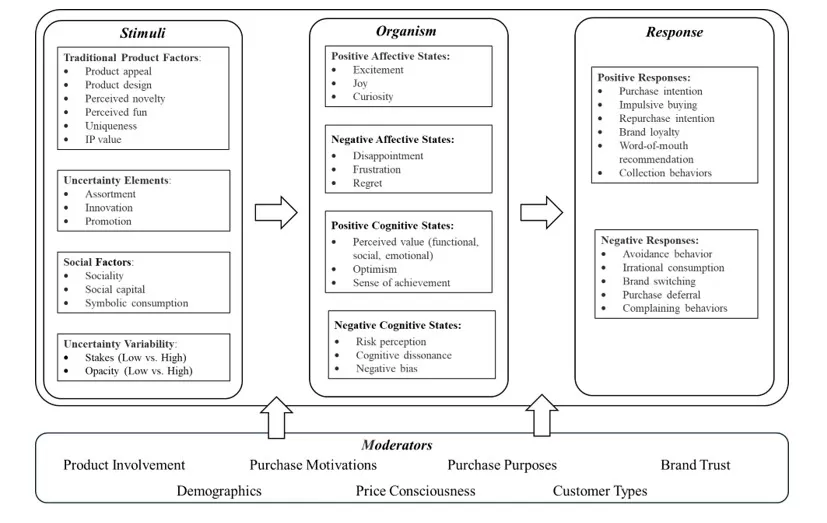
This conceptual paper reviewed existing literature on blind box marketing. Relevant sources were identified from the Internet using keywords such as “blind box,” “blind box marketing,” “surprise marketing,” and “uncertainty marketing.” Google Search Engine is used to search relevant academic journals and publications. Due to the limited literature on blind box marketing, the review covered peer-reviewed journal articles and conference proceedings. The SOR framework functioned as the core model for understanding blind box marketing and consumer behaviors, while uncertainty marketing complemented the overall design of the “uncertainty” element. The factors under stimulus, organism, and response are explored and illustrated in Figure 1.
Stimulus Constructs
Stimuli options may include traditional product factors, social elements, and a well-constructed uncertainty element (Cruz et al., 2025; Zhang & Phakdeephirot, 2023). Traditional product factors encompass product design, perceived novelty, perceived fun, product uniqueness (Cruz et al., 2025; Ke, 2024; Luan & Kim, 2022), product appeal (Cruz et al., 2025), as well as IP value and economic value (Zhang & Phakdeephirot, 2023). Social factors involve sociality, social capital, and symbolic consumption (Jinling, 2024; Zhang & Phakdeephirot, 2023).
The “uncertainty” component is the most frequently cited stimulus. It should be calibrated to a level that appeals to the target consumers (Kovacheva & Nikolova, 2024). It can be designed at two levels. The first level is the typology that can be implemented in three key areas: assortment, innovation, and promotion (Kovacheva & Nikolova, 2024). Blind box collectibles are typically designed as a series with either full or partial product information disclosed. While consumers are aware of the general design and appeal of the figures, the products come in identical surprise packaging with random contents (Jinling, 2024). This assortment approach can be enhanced by innovative tactics. Innovation uncertainty involves introducing new series with fresh designs or concepts (Jalonen, 2011). Product textures, colors, themes, and features can be innovated to satisfy consumers’ desire for novelty. Promotional uncertainty complements the assortment and innovation strategies. It includes limited-time offers, chance-based rewards, teaser ads, and pre-announcements (Goldsmith & Amir, 2010). Through these special promotions, consumers may have opportunities to obtain rare figures.
The second level addresses uncertainty variability in terms of stakes and opacity (Kovacheva & Nikolova, 2024). Figures or collectibles can be categorized as either lower-stakes or higher-stakes, based on their scarcity and commonality (Kunreuther et al., 2002). A product series typically includes common items alongside rare and hidden editions to heighten the perception of uncertainty. Within the same series, items can have varying levels of opacity regarding product information, generating excitement and appealing to diverse consumer preferences (Lee & Qiu, 2009). Therefore, the levels of stakes and opacity can be combined to form four scenarios: low stakes with low opacity, high stakes with high opacity, low stakes with high opacity, and high stakes with low opacity. Each scenario can target different consumer types and produce various emotional, cognitive, and behavioral outcomes (Lichtenstein et al., 1978).
Casual explorers and first-time buyers care less about hidden editions and are more satisfied with the product items (Zhu, 2023). Low stakes with low opacity may appeal to these consumers and generate impulse purchases or initial sales. The innovative and entertaining nature of the products, as well as social influence, may encourage their first-time purchases (Zhu, 2023).
Hardcore collectors and risk-taking enthusiasts are drawn to high-risk, high-reward purchases. These consumers are willing to invest more money to acquire hidden or rare items, even though they lack information about them (Kovacheva & Nikolova, 2024). High stakes with high opacity may appeal to these types of consumers. Hunger marketing strategies that focus on hidden models of great value or limited quantities may encourage bulk or repeat purchases (Zhu, 2023).
Some consumers are thrill seekers, who are motivated by the excitement of mystery (Zhan & Xiong, 2024). They are willing to embrace uncertainty at a lower financial risk. Low-stakes, high-opacity mystery elements paired with affordable mystery items may appeal to these consumers for repeat purchases, even when they have no idea what the box items are.
Strategic collectors are serious about their collections and willing to invest more money to maximize their chances of getting hidden or rare items (Zhan & Xiong, 2024). They are not interested in pure mystery, and some may have a more gambling mentality and a desire to show off (Zhu, 2023). They eagerly complete their product collections for personal satisfaction and prefer having more product information to make confident purchases. They are less concerned about the product price (Zhu, 2023). Therefore, they are more likely to purchase the whole collection or make bulk purchases. The stimuli mentioned in the four scenarios above may have strong, weak, positive, negative, or even inverse relationships with various behavioral and psychological states (Siddiqui, 2023).
Organism Constructs
The organism dimension encompasses both positive and negative psychological states, including affective and cognitive components (Laran & Tsiros, 2013). These psychological states can significantly influence various consumer response behaviors.
Customers may have positive affective states, including excitement, joy, happiness, and curiosity (Lee & Qiu, 2009; Russell & Carroll, 1999). Customers feel excited by the mystery and surprise, as well as the anticipation of opening a blind box. They experience happiness and satisfaction when the contents of the box meet or exceed their expectations (Zhang & Phakdeephirot, 2023). The mystery and uncertainty also trigger curiosity that further motivates their purchases (Gong et al., 2024; Zhan & Xiong, 2024).
In contrast, customers may experience negative affective components such as disappointment, frustration, and regret (Russell & Carroll, 1999; Zhang & Zhang, 2022). Customers may feel sad and disappointed when the box contents do not meet their expectations or when they receive duplicate items. Repeated unsuccessful attempts to obtain desired outcomes may also cause irritation or annoyance (Lee et al., 2025). They might also experience regret about not making additional purchases to acquire their wished-for items.
Customers may also have positive cognitive assessments, such as value perception, optimism, and a sense of achievement (Laran & Tsiros, 2013). Their perceived value of blind boxes can be enhanced if they believe that the box offers good value for money, regardless of the uncertainty (Wang, 2025). They may also feel optimistic that their future purchases will result in desirable outcomes. When they complete a collection or obtain a rare item, they may experience a sense of achievement (Zhu & Kraemer, 2005).
Some customers may experience negative cognitive states, such as risk perception, cognitive dissonance, and negative bias (Chen, 2024; Guo et al., 2025). The uncertainty of the box contents may lead consumers to perceive purchases as risky and not worth the money. After buying, they may experience mental discomfort from believing they made the wrong decision, creating internal conflicts about their purchase (Chen, 2024). They may also develop a negative bias toward blind boxes after repeated unsuccessful attempts, viewing the marketing approach as deceptive or scam-like.
Response Constructs
Consumer response behaviors are typically studied through positive outcomes, for example, purchase intention (Pang et al., 2023; Zhang & Zhang, 2022), impulsive buying (Zhang et al., 2022), and repurchase behavior (Cruz et al., 2025; Zhang & Phakdeephirot, 2023). Customers with positive psychological states often demonstrate positive behavioral outcomes. They are more likely to purchase blind boxes, make impulse purchases, and even repeatedly buy blind boxes to maintain their sense of desire, happiness, and curiosity. Other positive factors, such as brand loyalty, word-of-mouth recommendation, and collection behaviors, may also be considered (Guo et al., 2025). These customers tend to develop stronger brand loyalty, purchasing across multiple series and product lines. They are also more likely to share positive recommendations with friends and within their interest communities. Moreover, they often engage in long-term collecting behaviors motivated by their desire to complete their collections.
However, uncertainty marketing tactics can also trigger negative consumer responses that warrant investigation. These may include avoidance behavior, irrational consumption, brand switching, purchase deferral, and complaining behaviors (Chen, 2024). Some customers may avoid blind boxes or similar products after a negative “surprise” experience. Conversely, other customers might engage in excessive purchasing behaviors driven by their desire to overcome uncertainty or scarcity, potentially leading to financial strain or regret (Guo et al., 2025). Dissatisfied customers may switch to other brands to alleviate their feelings of disappointment. Some potential buyers hesitate to purchase blind boxes because they are uncertain about the value of the contents. Additionally, they may complain about perceived unfairness in blind box odds or lack of transparency in product information.
Moderators
Several factors may moderate the relationships among the S, O, and R constructs, warranting further research investigation.
First, consumers’ purchase purposes (self-collection versus gift-giving) and motivations (hedonic versus utilitarian) may influence their reactions to different uncertainty blind box configurations (Lee et al., 2025). Hedonic buyers typically respond more positively to uncertainty marketing tactics, while utilitarian buyers may focus more on perceived value and risk.
Second, product involvement affects consumers’ emotional and behavioral responses (Zhan & Xiong, 2024). Consumers with higher product involvement, such as those deeply interested in a specific brand or mystery series, are more likely to experience enjoyment and curiosity when confronted with uncertainty tactics.
Third, price consciousness influences consumer perceptions (Gong et al., 2024). More price-conscious consumers may experience stronger risk perception and lower value perception with higher-stakes blind boxes. In contrast, less price-conscious consumers tend to focus more on enjoyment, novelty, and surprise.
Fourth, demographic factors (such as age, gender, income, and spending power) can drive impulsive or collection behaviors (Zhang et al., 2022; Zhu, 2023). Younger consumers often prioritize emotional fulfillment, while older consumers tend to focus on value perception and the worthiness of box contents.
Fifth, brand trust affects consumer sensitivity to uncertainty offers (Erdem & Swait, 2004; Zhan & Xiong, 2024). Consumers with high brand trust may be less sensitive to high-stakes and low-opacity uncertainty offers, and are more likely to convert positive psychological states into purchase intentions or even impulsive buying and bulk purchases. In contrast, consumers with low brand trust tend to be more cautious when making purchase decisions as they evaluate product fairness more critically.
Finally, customer types influence reactions to various stimuli (Cruz et al., 2025; Zhu, 2023). Customers can be categorized as actual collectors, first-time consumers, repeat customers, or prospective consumers. Actual collectors typically engage more in collection behaviors when satisfied with the mystery and uncertainty of the contents. However, they may also demonstrate stronger avoidance behavior or purchase deferral if they feel disappointed due to unmet expectations.
Conclusion
This paper explores blind box marketing through the SOR framework, enriched by uncertainty marketing theory. Uncertainty-based marketing approaches enhance our understanding of the “uncertainty” element in blind box marketing, offering a more comprehensive framework for this component. “Uncertainty” can be designed across assortment, innovation, and promotion dimensions at two variability levels (stakes and opacity).
Furthermore, the SOR model can incorporate additional factors to better explain the complex blind box purchasing phenomenon. Stimuli encompass both product and social attributes, along with the specially designed “uncertainty” component. The organism component includes both positive and negative psychological states, covering affective and cognitive aspects. Response behaviors consider not only positive outcomes but also negative behaviors, addressing the diverse ways customers react to different stimuli. Finally, the effects of moderating factors on SOR relationship paths warrant further exploration.
The conceptual model presented in this paper provides a preliminary foundation for practical implementation across industries that use uncertainty-based marketing strategies. Future research could conduct empirical studies or experiments to determine relationships among these constructs. These relationships may be direct or indirect, with some potentially exhibiting inverse effects. Researchers could examine all or selected constructs across various products, consumer types, or situations. The model could also be investigated in different contexts, including tangible goods (such as toys and figures) and experiential products (such as travel, concerts, and games). Future research could explore the types of customers who engage in blind box purchases.
Fig 1. Conceptual Model for Blind Box Marketing
References
Barton, B., Zlatevska, N. and Oppewal, H. (2022), ‘Scarcity tactics in marketing: A meta-analysis of product scarcity effects on consumer purchase intentions’, Journal of Retailing, 98(4), 741–758. doi: 10.1016/j.jretai.2022.06.003.
Becker, M. C. and Knudsen, T. (2005), ‘The role of routines in reducing pervasive uncertainty’, Journal of Business Research, 58(6), 746–757. doi: 10.1016/j.jbusres.2003.10.003.
Chen, S. (2024), The Psychological Analysis of the Blind Box Craze in the Chinese Market: A Case Study of POP MART, Journal of Education, Humanities and Social Sciences IEMB.
Cruz, E. L. L., Ong, A. K. S. and Tomas, D. Q. (2025), ‘Analyzing the causal effects of product uncertainty and product appeal on repurchase intention in blind box toys’, Cogent Business and Management, 12(1). doi: 10.1080/23311975.2025.2506613.
Ellsberg, D. (1961), ‘Risk, ambiguity, and the Savage axioms’, The Quarterly Journal of Economics, 643–669.
Erdem, T. and Swait, J. (2004), ‘Brand Credibility, Brand Consideration, and Choice’, Journal of Consumer Research, 31(1), 191–198. doi: 10.1086/383434.
Goldsmith, K. and Amir, O. (2010), ‘Can Uncertainty Improve Promotions?’, Journal of Marketing Research, 47(6), 1070–1077. doi: 10.1509/jmkr.47.6.1070.
Gong, X. et al. (2024), ‘Unveiling the enigma of blind box impulse buying curiosity: The moderating role of price consciousness’, Heliyon, 10(24). doi: 10.1016/j.heliyon.2024.e40564.
Guo, W. E., Dong, B. and Palmatier, R. W. (2025), ‘Understanding surprise: Toward a theory of surprise marketing’, Journal of Retailing, 101(1), 7–24. doi: 10.1016/j.jretai.2024.11.001.
Hill, K. M., Fombelle, P. W. and Sirianni, N. J. (2016), ‘Shopping under the influence of curiosity: How retailers use mystery to drive purchase motivation’, Journal of Business Research, 69(3), 1028–1034. doi: 10.1016/j.jbusres.2015.08.015.
Jalonen, H. (2011), ‘The uncertainty of innovation: a systematic review of the literature’, Journal of Management Research, 4(1). doi: 10.5296/jmr.v4i1.1039.
Jinling, W. (2024), ‘A Study on the Mechanism of the Influence of Blind Box Marketing on Consumers’ Purchase Intention’, The EUrASEANs: Journal of Global Socio-economic Dynamics, 6(49). Available at: https://www.euraseans.com/6.
Ke, Y. (2024), ‘To What Extent Does Blind Box Marketing Affect Peoples Consuming Behavior?’, Journal of Applied Economics and Policy Studies, 10(1), 73–87. doi: 10.54254/2977-5701/10/2024092.
Kovacheva, A. and Nikolova, H. (2024), ‘Uncertainty marketing tactics: An overview and a unifying framework’, Journal of the Academy of Marketing Science, 52(1), 1–22. doi: 10.1007/s11747-023-00941-7.
Kunreuther, H. et al. (2002), ‘High stakes decision making: Normative, descriptive and prescriptive considerations’, Marketing Letters, 13(3), 259–268.
Laran, J. and Tsiros, M. (2013), ‘An investigation of the effectiveness of uncertainty in marketing promotions involving free gifts’, American Marketing Association, 77, 112.
Lee, C., Wyllie, J. and Brennan, S. (2025), ‘Eye-opening! Exploring uncertainty marketing through hedonic blind box collectibles’, Journal of Retailing and Consumer Services, 82. doi: 10.1016/j.jretconser.2024.104127.
Lee, Y. H. and Qiu, C. (2009), ‘When Uncertainty Brings Pleasure: The Role of Prospect Imageability and Mental Imagery’, Journal of Consumer Research, 36(4), 624–633. doi: 10.1086/599766.
Lichtenstein, S. et al. (1978), ‘Judged frequency of lethal events.’, Journal of Experimental Psychology: Human Learning and Memory, 4(6), 551–578. doi: 10.1037/0278-7393.4.6.551.
Luan, Y. and Kim, Y. J. (2022), ‘An integrative model of new product evaluation: A systematic investigation of perceived novelty and product evaluation in the movie industry’, PLOS ONE, 17(3), doi: 10.1371/journal.pone.0265193.
Mehrabian, A. and Russell, J. A. (1974), An approach to environmental psychology. The MIT Press.
Pang, K. et al. (2023), ‘Empirical Research on How Product Features of Blind Box Affect Consumers’ Purchase Intention—Based on Structural Equation Modeling’, in Proceedings of the 2022 International Conference on mathematical statistics and economic analysis (MSEA 2022). Atlantis Press, 849–856. doi: 10.2991/978-94-6463-042-8_121.
Russell, J. A. and Carroll, J. M. (1999) ,‘On the bipolarity of positive and negative affect.’, Psychological Bulletin, 125(1), 3–30. doi: 10.1037/0033-2909.125.1.3.
Siddiqui, R. (2023), Discover the Power of Mystery in Marketing: The Motivating-Uncertainty Effect, LinkedIn. Available at: https://www.linkedin.com/pulse/discover-power-mystery-marketing-effect-rizwan-siddiqui-ekrsf/ (Accessed: 28 September 2025).
Singh, S. (2025), Blind Box Toys Market Report 2025 (Global Edition). Available at: https://www.cognitivemarketresearch.com/blind-box-toys-market-report (Accessed: 30 September 2025).
Talebi, A., Prokopec, S. and Onculer, A. (2025), ‘Looking a Gift Horse in the Mouth: The Dark Side of Uncertain Price Promotions’, Psychology and Marketing, 42(6), 1640–1666. doi: 10.1002/mar.22197.
Wang, Z. (2025), ‘Psychological Impact of Blind Box Consumption Based on Uncertainty Mechanism’, Advances in Economics, Management and Political Sciences, 210(1), 39–45. doi: 10.54254/2754-1169/2025.bl25926.
Zhan, L. and Xiong, Y. (2024), ‘Research on the Influence Mechanism of Blind Box Product Characteristics on Consumers’ Purchase Intention’, in In: Tu, Y.P., Chi, M. (eds) E-Business. New Challenges and Opportunities for Digital-Enabled Intelligent Future. WHICEB 2024. Lecture Notes in Business Information Processing, 516. Springer, Cham., 225–236. doi: 10.1007/978-3-031-60260-3_19.
Zhang, L. and Phakdeephirot, N. (2023), ‘The Influence on Blind Box Marketing on Consumers’ Purchase Intention’, Highlights in Art and Design, 4(2), 154–160.
Zhang, Y. and Zhang, T. (2022), ‘The effect of blind box product uncertainty on consumers’ purchase intention: The mediating role of perceived value and the moderating role of purchase intention’, Frontiers in Psychology, 13. doi: 10.3389/fpsyg.2022.946527.
Zhang, Y., Zhou, H. and Qin, J. (2022), ‘Research on the effect of uncertain rewards on impulsive purchase intention of blind box products’, Frontiers in Behavioral Neuroscience, 16. doi: 10.3389/fnbeh.2022.946337.
Zhu, K. (2023), ‘The Dominant Factors Influencing Consumers to Buy Blind Boxes — The Product Itself versus Consumer Emotion’, Advances in Economics, Management and Political Sciences, 24(1), 372–380. doi: 10.54254/2754-1169/24/20230464.
Zhu, K. and Kraemer, K. L. (2005), ‘Post-Adoption Variations in Usage and Value of E-Business by Organizations: Cross-Country Evidence from the Retail Industry’, Information Systems Research, 16(1), 61–84. doi: 10.1287/isre.1050.0045.