1Kauno Kolegija Higher Education Institution, Kaunas, Lithuania,
2Graceland University, Lamoni, Iowa, USA
Volume 2026,
Article ID 361514,
Journal of Marketing Research and Case Studies,
13 pages,
DOI: https://doi.org/10.5171/2026.361514
Received date: 6 November 2025; Accepted date: 7 January 2026; Published date: 13 February 2026
Academic Editor: Iveta Linina
Cite this Article as:
Ioseb Gabelaia and David Hopfer (2026), “The Role of Multilingual Competence in Corporate Recruitment Practices: A Mixed Methodology Approach ", Journal of Marketing Research and Case Studies, Vol. 2026 (2026), Article ID 361514, DOI: https://doi.org/10.5171/2026.361514
Nowadays, multilingualism in corporate communication is essential for all forms of interaction to improve employee engagement, expand market reach, and foster innovation. Moreover, multilingualism has become a highly valued asset in recruiting talent and workforce structuring, as it serves as an enabler of inclusion and a control mechanism. This research studied multilingualism as a means of communication in corporate hiring practices in the context of corporate slavery. Hence, the authors aimed to explore the role of multilingualism in shaping contemporary hiring practices within corporations. The authors used mixed methodology. The insights were extracted from a survey study (n = 312) and semi-structured interviews (n = 30). This article reveals patterns in which multilingualism functions as a modern mechanism of corporate gatekeeping. The results demonstrate that while multilingualism could improve employability and communication practices, it can create dependency structures and cover the exploitative realities of corporate labor. Moreover, it emphasizes the power of multilingualism as a mechanism of empowerment and coercion in modern corporations. At last, the results offer theoretical and practical insights into employment practices.
In recent years, multilingualism has been a fundamental in corporate hiring practices; however, there is limited knowledge of how it is perceived in the context of hiring practices in the context of corporate slavery. Multilingualism explains the economic logic of global evolution and the sociopolitical logic of labor segmentation. Additionally, in corporations, language serves as a strategic resource. Multilingual employees are often well-equipped to handle cultural differences and address misunderstandings that may arise in high-pressure situations (Giossi & Mandratzi, 2024). It is viewed as a currency of communication, a cultural asset, and a measure of competitiveness (Gunnarsson, 2013; Haque, 2025). However, multilingualism creates potential corporate dependency within corporate slavery.
Corporate hiring practices are fundamental to finding, attracting, and hiring new employees in today’s competitive marketplace. Hiring practices allow corporations to reevaluate existing job descriptions, conduct structured interviews, and eventually offer a positive candidate experience, as today’s employees are choosing not to be corporate. Therefore, for effective onboarding, having clear communication throughout the hiring process allows employees to make informed decisions. Multilingualism, combined with digital literacy, can promote communication and improve global career opportunities (Giossi & Mandratzi, 2024).
In this research, the authors position multilingualism in hiring practices not only as a communicative advantage but as a socio-economic mechanism that can both empower and enslave. Moreover, the obtained insights highlight the contradictory role of multilingualism in hiring practices in developing modern corporate structures and employee subordination.
This research is grounded in Bourdieu’s theory of linguistic capital and Foucault’s notion of disciplinary power. According to Bourdieu (1991), linguistic capital represents a state of symbolic power in corporate hiring practices. In contrast, Foucault’s (1977) framework offers insight into how corporations internalize control through surveillance and normalization in hiring practices. Together, these attributes portray multilingualism as both an empowerment and a form of authority, a duality central to modern corporate slavery. Furthermore, this research aimed to explore the role of multilingualism in shaping modern hiring practices within corporations, in the context of corporate dependency and labor exploitation. Specifically, it aimed to explore how language proficiency functions as a criterion of employability in corporations. Hence, the authors developed the overarching question: to what extent does multilingualism impact hiring decisions and talent acquisition in corporations?
To answer these questions, the authors conducted a survey study and semi-structured interviews. The data were collected using Qualtrics Software for a survey study (n = 312) and semi-structured interviews (n = 30) conducted via Zoom Software. The obtained data were analyzed using SPSS 30 and NVivo software. The results revealed that multilingualism is portrayed as a technology of control in the corporate hiring practices. Therefore, without structural adaptation, multilingualism risks being a barrier in modern hiring practices, especially in the context of corporate dependency and labor exploitation.
Literature Review
As the world becomes increasingly interconnected, modern workplaces are becoming hubs of linguistic diversity (Fiset, 2023; Gaibrois, 2023). Also, as AI advances rapidly, it suggests that corporations transform and adapt to the modern workplace reality (Calluso & Devetag, 2025). Moreover, being able to communicate effectively in multiple languages with colleagues, clients, and partners allows employees to tackle challenges and overcome workplace barriers (Giossi & Mandratzi, 2024).
In a modern workplace, multilingualism can be an asset and a challenge (O’Rourke & Brennan, 2023). Besides, existing knowledge on multilingualism as an “add-on skill” has transformed (Kraft & Flubacher, 2023; Gunnarsson, 2013). Corporations use multilingual strategies as an organization’s broader language management strategies (De Malsche et al., 2024), as well as the thinking processes behind when, how, and why these strategies are used (Grin & Vaillancourt, 2021).
The capacity to communicate in multiple languages has become one of the most essential features that any successful company must integrate (Ali & Al-Mahmoud, 2023; Kosho, 2024). Additionally, it produces social biases associated with name ethnicity, grammar, or syntax style (Kadolkar et al., 2025). While governance frameworks advocate algorithmic audits and explainability protocols, empirical validation within multilingual contexts remains limited (van Zoonen et al., 2024).
Moreover, modern corporate slavery can be perceived as falling on a spectrum of working conditions (Christ & Helliar, 2021). The job applicant hiring process is inherently complex, containing various dimensions such as cultural fit, team dynamics, and individual qualifications (Rao & Zhao, 2025). According to Giossi and Mandratzi (2024), volatility, uncertainty, and technological changes are the dominant factors shaping workplace conditions, adding pressure on employees to acquire or upgrade new skills to stay competitive and employable (Ali & Al-Mahmoud, 2023; Biea et al., 2024; De Malsche et al., 2024). Moreover, technological advancements have led to the emergence of new types of networks and workplaces, making linguistic matters more urgent (Gunnarsson, 2013).
Today, language proficiency operates simultaneously as human capital (Hewitt, 2012). Moreover, in global labor markets, linguistic competence can improve employability while also supporting power asymmetries (Gonçalves, 2020; Goble, 2023). Furthermore, the need for “global competencies” has led to the design of new study programs that highlight the attributes employers are seeking (Gaibrois, 2023; Vessey & Nicolai, 2023).
In modern corporate environments, corporate slavery represents the exploitation of employees through extreme control, excessive demands, and restricted autonomy (Gabelaia et al., 2024). These conditions are visible in corporate settings, where accent norms, algorithmic filtering, and “fit” criteria translate into coercive or exploitative labor practices, as some critical theorists refer to as corporate slavery (Hyken, 2022; Han et al., 2024). Thus, insights into forced and dependent labor show that linguistic vulnerability moderates exploitation (Churkina et al., 2023; Grin & Vaillancourt, 2021).
Multilingual policies are increasingly necessary in human resources practice within the corporate slavery context (Gabelaia et al., 2024). Modern slavery, including forced labor, is a practice that impacts more than 40 million people (Christ & Helliar,2021). This dynamic, where limited language amplifies subordination, forms a continuum between standard precarious employment and outright coercion (Tarawneh & Al-Badawi, 2025; Mbare et al., 2024). As such, more corporations are redesigning their policies, practices, and procedures to incorporate the multilingual aspect (Tarawneh & Al-Badawi, 2025). Moreover, large-scale labor market analyses suggest that bilingualism yields uneven returns, depending on the language combination, industry, and occupational classification (Churkina et al., 2023). Moreover, according to Back and Piekkari (2024), multilingualism often improves cognitive flexibility and customer access; nevertheless, language hierarchies persist within corporations. Additionally, accent remains a powerful status marker (Hideg et al., 2024). Therefore, multilingual workers often encounter invisible ceilings (Drożdżowicz & Peled, 2024; Gaibrois, 2023).
Three recurring mechanisms connect multilingualism and corporate slavery: first, the credentialization of language (Hu et al., 2024); second, accent normativity (Hideg et al., 2024); and third, information asymmetry.
The language used in recruitment advertisements has a powerful impact on applicant behavior (Kraft & Flubacher, 2023; Goble, 2023). However, evidence indicates limited downstream impact without structural changes to screening processes (Hu et al., 2024; Mahjoub & Kruyen, 2021). Field studies also demonstrate that accent bias continues through interviews and assessment centers, reflecting cognitive shortcuts that favor linguistic familiarity (Hideg et al., 2024; Tarawneh & Al-Badawi, 2025). Notably, discriminatory lexical framing such as “energetic,” “native English speaker,” or “young team” can exclude qualified multilinguals under the guise of “cultural fit” (Burn et al., 2022; Hetjens & Hartmann, 2024; Goble, 2023).
Corporations face unique challenges that require flexible and adaptable professionals and multilingual workers capable of bridging cultural gaps, building relationships with international partners, and navigating complex business environments (Giossi & Mandratzi, 2024; Tarawneh & Al-Badawi, 2025). Therefore, in today’s globalized economy, multilingualism is a critical skill in various sectors (Pietrzyk-Kowalec, 2023; Ali & Al-Mahmoud, 2023). Language technologies based on the exploitation of large data sets, from machine translation and automatic text generation to digital voice assistants, are a particular form of human-made sign practice in which traditional language norms interact with the affordances of digital devices and the capitalist interests of those who design them (Schneider, 2022; Kosho, 2024).
Increasing attention is being paid to predictive language technologies and their impacts on individual users and public discourse (Chonka et al., 2023). In the past decade, technological innovations and their applications to recruitment systems have significantly grown (Calluso & Devetag, 2025). As artificial intelligence changes recruitment, and language bias becomes embedded in algorithms themselves (Albaroudi et al., 2024). Moreover, artificial intelligence is changing recruitment practices by improving efficiency, scalability, and perceived objectivity (Haque, 2025; Tonneau et al., 2022).
Overall, gender-inclusive job language modestly improves perceived fairness (Hetjens & Hartmann, 2024; Pietrzyk-Kowalec, 2023) but infrequently changes aggregate diversity results (Hu et al., 2024). Moreover, AI ethics frameworks highlight the significance of transparent model documentation (Rao & Zhao, 2025; Albaroudi et al., 2024). Worker-driven models that incorporate linguistic access display more significant promise in managing the linguistic dimension of exploitation (Biea et al., 2024; Lawson et al., 2022). Current scholarship lacks longitudinal evidence tracing linguistic bias from hiring to post-hire outcomes in the context of corporate slavery (Back & Piekkari, 2024; De Malsche et al., 2024; Fiset, 2023; Giossi & Mandratzi, 2024; Gunnarsson, 2013; Haque, 2025; O’Rourke & Brennan, 2023).
Research Methodology
To explore the role of multilingualism in shaping modern hiring practices within corporations, in the context of corporate dependency and labor exploitation, the authors used a mixed-methods approach. The authors examined existing literature to identify and analyze data to develop quantitative and qualitative research. Hence, based on extracted insights, the authors developed a survey study and semi-structured interviews.
The authors used a sequential explanatory design. This method allows, first, to obtain quantitative insights and, second, to use qualitative results to explain those findings. Thus, these methods lead to demonstrating results with practical and reliable insights. Languages Spoken Fluently (linguistic capital), Employment Hierarchy Level, Annual Salary, Years of Experience, Workload Index, and Job Satisfaction were identified as major variables. Data were collected using Qualtrics software. The first phase involved quantitative assessments. The authors used statistical models such as descriptives, correlations, and regressions for data analysis. In the second phase, semi-structured interviews were conducted with 30 participants.
Furthermore, the authors used purposive and snowball sampling methods. This approach was allowed for respondents with experience in multilingual corporate contexts. Interviews were transcribed and coded using NVivo Software. This ensured consistency and transparency in the analytic process.
Accordingly, survey data were analyzed using SPSS 30. The authors performed descriptive statistics, correlation, and regression analysis to identify measurable relationships between linguistic capital and employment stratification. Qualitative data were analyzed through Braun and Clarke’s (2020) six-step framework.
The authors followed ethical principles. Informed consent was obtained. Moreover, the confidentiality and anonymity of respondents were protected. All participants were informed of the research objectives as well as their right to withdraw at any time. Lastly, methodological rigor was supported through data triangulation, inter-coder reliability checks (Cohen’s κ > 0.80), and member validation to confirm interpretive accuracy.
Results and Discussions
Survey Results
The research on the role of multilingualism in shaping modern hiring practices within corporations was conducted between February 12th and August 17th, 2025. Before data analysis, the authors performed data cleaning to secure accuracy and reliability in the results. The original dataset from Qualtrics software contained 411 cases. The data were then checked for consistency, completeness, and outliers. Moreover, any case with more than 25% missing responses was excluded from the final analysis.
Additionally, duplicate entries and inconsistent coding were specified and corrected through cross-checking with raw records. After cleaning, the author selected 312 accurate cases. This represented 75.9% of the original dataset. Thus, allowing the data analysis to continue. Lastly, this sample provided a balanced basis to conduct descriptive statistics, correlations, and regression analyses while preserving representativeness across industries and geographic regions. The Survey respondents represented six industries, including finance, IT, logistics, manufacturing, retail, and consulting, and came from 28 countries. Notably, the largest groups were in Western Europe (37%), North America (29%), and Eastern Europe (21%).
Table 1 below highlights descriptive statistics and summarizes key variables related to multilingualism and employment structure. First, on average, respondents spoke 3.12 languages (SD = 1.04), demonstrating high linguistic diversity in the sample. Employment hierarchy was broken into four tiers: 1 = Entry-level, 2 = Mid-level, 3 = Managerial, 4 = Executive. Therefore, the mean employment hierarchy level (M = 2.26, SD = 0.81) demonstrates that most respondents were employed in mid-level positions. Moreover, the average annual salary of USD 74,500 (SD = 28,600) shows a moderately compensated employee. Furthermore, respondents had on average 8.3 years of experience, while working approximately 46.8 hours per week. At last, the job satisfaction marked 3.47 on a 5-point scale. This demonstrates moderate happiness at work but offers a space for improvement. Additionally, the relatively small skewness and kurtosis values suggest approximate normal distribution, validating the dataset for inferential analysis. Descriptive results reveal that linguistic capital, measured as the number of languages spoken fluently, positively associates with higher income and hierarchy, though not uniformly across tiers.
Table 1: Descriptive Statistics (N = 312) (Developed by the Authors)
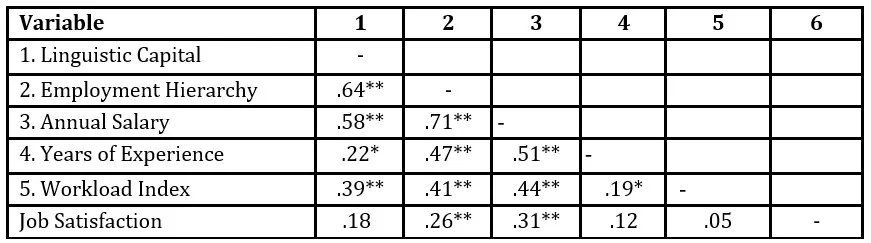
Furthermore, Pearson correlation coefficients were computed for the bivariate relationships among linguistic capital, employment hierarchy, and other job-related variables. Table 2 below shows the summary of the results. The strongest correlation was observed between employment hierarchy and annual salary (r = .71, p < .01). This suggests that higher hierarchical positions are instantly associated with raised compensation. Moreover, linguistic capital also revealed a strong positive correlation with both employment hierarchy (r = .64, p < .01) and salary (r = .58, p < .01). This suggests that multilingual mastery helps in career advancement and earning potential. Furthermore, the results revealed a moderate correlation between workload and hierarchy (r = .41) and between linguistic capital and workload (r = .39). This suggests that multilingual employees frequently have higher responsibilities, presumably due to communication capabilities.
In contrast, job satisfaction revealed weak correlations with other variables, particularly with linguistic capital (r = .18), signifying that language ability improves professional opportunities but not necessarily psychological fulfillment.
Table 2: Pearson’s Correlation Matrix (N = 312) (Developed by the Authors)
Note: p < .05; p < .01 (two-tailed)
Next, the authors performed a multiple linear regression to predict Employment Hierarchy using Linguistic Capital, Years of Experience, and Workload Index as independent variables. Tables 3 and 4 below highlight the results from the multiple regression analysis. Table 3 shows the overall regression model is statistically significant (F (3, 308) = 52.91, p < .001). It also explains 50.6% of the variance in employment hierarchy (R² = .506, Adjusted R² = .498). Further, this suggests a strong explanatory power of the selected predictors.
Table 3: Multiple Regression Model Summary (Developed by the Authors)
Table 4 further demonstrates that linguistic capital (β = .56, p < .001) is the most significant variable. This demonstrates that multilingual proficiency is the primary driver of hierarchical progress within corporations. The results show that years of experience (β = .19, p = .003) also suggests that professional tenure moderately improves position level; on the other hand, workload (β = .11, p = .043) shows a minor but significant effect. Additionally, the constant term (B = 0.84, p < .001) reveals the baseline hierarchy level when all predictors are held constant.
Table 4: Regression Coefficients (Developed by the Authors)
Interview Results
A total of 30 respondents (N = 30) were interviewed between June 1, 2025, and August 1, 2025. Overall, 12 human resource managers, 8 corporate recruiters, and 10 multilingual employees working in corporations across Western Europe, North America, and Eastern Europe were selected. Moreover, respondents spoke English, Mandarin, Spanish, French, and German, with English being the most prevalent.
Interviews were conducted using Zoom Software. On average, interviews last between 26 and 31 minutes. Overall, the authors asked 14 questions about the role of multilingualism in shaping modern hiring practices within corporations.
Interview transcripts were transcribed and examined using NVivo software, using Braun and Clarke’s (2020) six-step thematic analysis framework. Next, deductive and inductive coding was performed. Finally, the results demonstrated 178 initial codes. The authors clustered them into 12 subthemes and then converged them into three major themes. Inter-coder reliability (Cohen’s κ = 0.86) confirmed strong agreement.
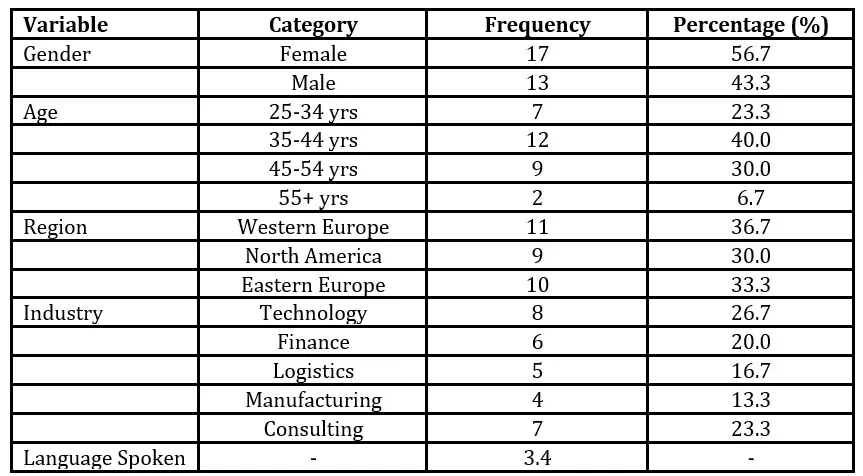
Table 5 below shows the demographics from the semi-structured interviews. The results reveal a 56.7% female and 43.3% male ratio, with the majority aged between 35 and 44 years (40%), suggesting a mid-career respondent base. Moreover, industry was led by technology (26.7%), consulting (23.3%), and finance (20%). Furthermore, respondents spoke on average of 3.4 languages, demonstrating the linguistic diversity that is fundamental for this research. Overall, the respondent sample was well-balanced, improving the research’s cross-cultural validity. The demographic data demonstrate a representative and heterogeneous group of professionals. This allowed the authors to explore the impact of multilingualism on hiring practices, workload expectations, and hierarchical progression in the context of corporate slavery.
Table 5. Participant Demographics (N = 30)
Note: Percentages may not total 100 due to rounding
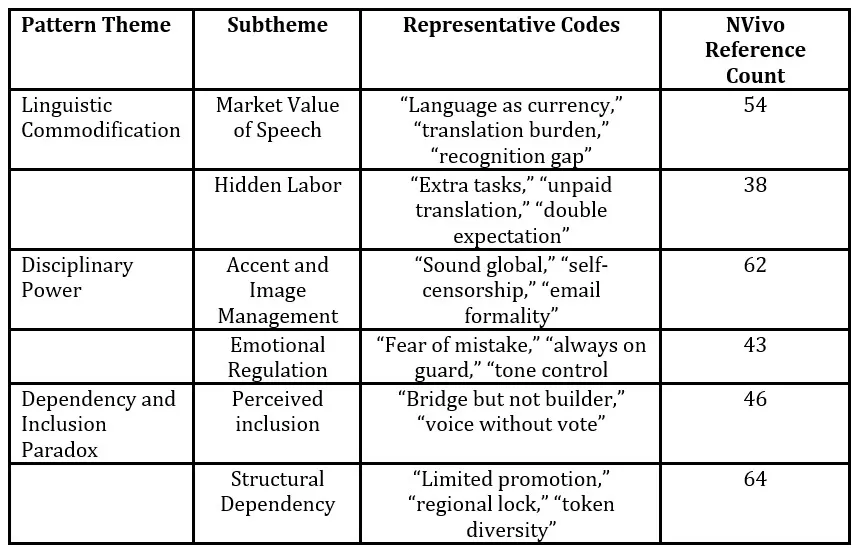
Moreover, Table 6 below shows the coding matrix derived from the thematic analysis. This reveals how raw narrative codes were organized into coherent subthemes and overarching themes, demonstrating the role of multilingualism in corporate contexts. The results revealed three central themes such as Linguistic Commodification, Disciplinary Power, and the Dependency and Inclusion Paradox.
Under Linguistic Commodification, codes such as “language as currency,” “translation burden,” and “recognition gap” demonstrate how corporations treat multilingual ability as an economic asset rather than a professional right. Moreover, Disciplinary Power extracted self-regulatory behaviors such as “sound global,” “self-censorship,” and “fear of mistake”. This demonstrates how employees internalize linguistic conformity to maintain employability. Finally, the Dependency and Inclusion Paradox theme contains codes such as “bridge but not builder” and “voice without vote,” suggesting how multilingual workers are valued for connectivity but denied decision-making power.
Table 6: Coding Matrix for Thematic Analysis (Developed by the authors)
Note: Codes derived from using Braun & Clarke (2020) six-phase framework. Cohen’s κ= .86
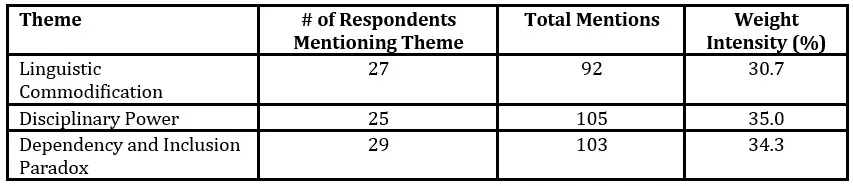
Table 7 summarizes the frequency and weighted intensity of the three major themes obtained from thematic analysis. First, Disciplinary Power appeared as the most often referenced theme, cited by 25 respondents with 105 coded references, accounting for 35% of the total thematic intensity. This dominance indicates that self-monitoring, accent regulation, and linguistic conformity are predominant experiences among multilingual employees seeking to meet corporate communication standards. Next, the Dependency and Inclusion Paradox (34.3%) was discussed by 29 respondents, emphasizing the recurring perception of being “included but powerless” within organizational hierarchies. Lastly, Linguistic Commodification (30.7%) was mentioned by 27 respondents, highlighting the economic framing of language skills as tradable labor rather than a professional competence.
Table 7: Theme Frequency and weighted Intensity
Note: Weight Intensity = (total mentions of theme/total mentions across themes) x100
Discussions
Multilingualism plays a fundamental role in modern hiring practices. This shows the growing demand for employees who can operate across linguistic and cultural boundaries. Organizations today view language proficiency as a quality of adaptability, market agility, and cross-cultural competence. Besides, this aligns well with global corporate and client diversification practices. Hence, as a result, multilingual candidates frequently earn preferential admission to employment and are perceived as more competent at bridging international teams and managing diverse stakeholders.
In contrast, multilingualism creates a hierarchy in the corporations (Haque, 2025). While it sustains employability, it can also commodify employees’ linguistic skills (Kraft & Flubacher, 2023). Therefore, this could reinforce communication ability as a form of economic capital rather than professional capability. Moreover, corporations often reward linguistic versatility at entry or mid-level positions. However, it rarely results into leadership opportunities. This reveals a structural bias. Therefore, multilingualism could both advance and constrain the modern workplace and creates dimensions for corporate slavery.
Furthermore, the results from the survey and semi-structured interviews collectively demonstrate that multilingualism has a decisive yet paradoxical role in developing modern hiring practices within corporations. The statistical results demonstrated that linguistic capital strongly predicts employability and hierarchy, supported by a significant correlation between multilingual proficiency, employment level, and salary (r = .64, – .71, p < .01) and a strong regression coefficient (β = .56, p < .001).
Moreover, these results demonstrate that multilingualism functions as a strategic differentiator in the global labor market. This represents adaptability, cross-cultural fluency, and international readiness (Bourdieu, 1991). Therefore, the results once more show that multilingualism is institutionalized as a measure of inclusion at recruitment but rarely as a determinant of strategic authority. This again reinforces the symbolic rather than structural value of linguistics in hiring practices.
The semi-structured interview results supported and reinforced the survey results. Transcribed themes highlighted how corporate hiring systems commodify language as a productivity mechanism rather than a pathway to empowerment.
Interviews with recruiters and employees demonstrated that multilingual candidates are often recruited due to linguistic skills. One of the HR managers stated, “It is not who speaks best, it is who speaks for the company.” Also, multilingual employees stated that “their skills often increased workload without improving status or compensation”. Moreover, “We’re told to ‘sound global’, which actually means sound Western,” an Eastern European respondent observed. Moreover, during the interviews, it was observed that respondents constantly self-corrected their pronunciation and tone. Furthermore, one of the mid-level managers noted: “I’m always the bridge but never the builder.” This connects well with Foucault’s (1977) notion of disciplinary power, wherein employees internalize linguistic expectations to sustain employability.
Conclusion
This research article explored the impact of multilingualism in corporate hiring practices in the context of corporate slavery. The research was grounded in Bourdieu’s (1991) linguistic capital and Foucault’s (1977) theory of disciplinary power theory, demonstrating that language proficiency can mirror aspects of corporate slavery.
The results indicate that multilingualism simultaneously empowers and constrains the contemporary workforce. It improves access to employment in corporations, yet it also develops corporate dependency structures. Hiring practices strongly valorize linguistic capital but also transform language into economic capital. This highlights not only who can be employed but also how employees could be positioned and perceived within corporate hierarchies.
Quantitative results demonstrated a significant positive correlation between multilingual proficiency and employability. While qualitative proof revealed the lived experiences of overwork, undervaluation, and identity commodification among multilingual employees. Therefore, multilingualism improves entry and mid-level opportunities but fails to offer opportunities for strategic leadership positions.
Theoretically, this research contributes to critical management and sociolinguistic scholarship. The results strengthen the concept that corporate structures do not reward language ability but convert linguistic diversity into economic productivity. Hence, linguistic capital evolves into a disciplinary mechanism. However, from the applied science perspective, the results hold significant implications for human resource management, diversity policy, and organizational ethics.
In conclusion, without structural change, linguistic inclusion risks strengthening rather than dismantling corporate hiring practices. As globalization continues, corporates face an imperative to transform multilingualism from an instrument of control into a platform for empowerment.
Copyright Notice
Authors who publish in any IBIMA Publishing open access journal retain the copyright of their work under a Creative Commons Attribution 3.0 Unported License, which allows the unrestricted use, distribution, and reproduction of an article in any medium, provided that the original work is properly cited. No permission is required from the authors or the publishers. While authors retain copyright of their work with first publication rights granted to IBIMA Publishing, authors are required to transfer copyrights associated with commercial use to this Publisher. Revenues produced from commercial sales and distribution of published articles are used to maintain reduced publication fees and charges.
References
Albaroudi, E., Mansouri, T., & Alameer, A. (2024). A comprehensive review of AI techniques for addressing algorithmic bias in job hiring. ai, 5(1), 383-404. https://doi.org/10.3390/ai5010019
Ali, H., & Al-Mahmoud, A. (2023). The Use of Bilingualism in Business and Commerce: A Study of Multilingual Communication Strategies in Global Organizations. Research Studies in English Language Teaching and Learning, 1(1), 14–23. https://doi.org/10.62583/rseltl.v1i1.4
Back, Hilla & Piekkari, Rebecca (2024). “Language-based discrimination in multilingual organizations: A comparative study of migrant professionals’ experiences across physical and virtual spaces,” Journal of World Business, Elsevier, vol. 59(3). https://doi.org/10.1016/j.jwb.2024.101518
Biea, E. A., Dinu, E., Bunica, A., & Jerdea, L. (2024). Recruitment in SMEs: the role of managerial practices, technology and innovation. European Business Review, 36(3), 361-391. https://doi.org/10.1108/EBR-05-2023-0162
Bourdieu, P. (1991). Language and symbolic power (J. B. Thompson, Ed.; G. Raymond & M. Adamson, Trans.). Harvard University Press.
Braun, V., & Clarke, V. (2020). One size fits all? What counts as quality practice in (reflexive) thematic analysis? Qualitative Research in Psychology, 18(3), 328–352. https://doi.org/10.1080/14780887.2020.1769238
Burn, Ian, Button, Patrick, Munguia Corella, Luis, & David Neumark (2022). “Does Ageist Language in Job Ads Predict Age Discrimination in Hiring?” Journal of Labor Economics, University of Chicago Press, vol. 40(3), pages 613-667. DOI: 10.1086/717730
Calluso, C., & Devetag, M. G. (2025). The impact of technology acceptance and personality traits on the willingness to use AI-assisted hiring practices. International Journal of Organizational Analysis, 33(5), 1368-1385. https://doi.org/10.1108/IJOA-06-2024-4562
Chonka, P., Diepeveen, S., & Haile, Y. (2023). Algorithmic power and African indigenous languages: search engine autocomplete and the global multilingual Internet. Media, Culture & Society, 45(2), 246-265. https://doi.org/10.1177/01634437221104705
Christ, K. L., & Helliar, C. V. (2021). Blockchain technology and modern slavery: Reducing deceptive recruitment in migrant worker populations. Journal of Business Research, 131, 112-120. https://doi.org/10.1016/j.jbusres.2021.03.065
Churkina O, Nazareno L, Zullo M (2023). The labor market outcomes of bilinguals in the United States: Accumulation and returns effects. PLoS ONE 18(6): e0287711. https://doi.org/10.1371/journal.pone.0287711
Damari, R. R., Rivers, W. P., Brecht, R. D., Gardner, P., Pulupa, C., & Robinson, J. (2017). The demand for multilingual human capital in the US labor market. Foreign Language Annals, 50(1), 13-37. https://doi.org/10.1111/flan.12241
De Malsche, F., Tobback, E., & Vandenbroucke, M. (2024). Multilingualism in performance appraisal interviews: strategies to bridge language gaps. Frontiers in Communication, 9, 1343267. https://doi.org/10.3389/fcomm.2024.1343267
Drożdżowicz, A., & Peled, Y. (2024). The complexities of linguistic discrimination. Philosophical Psychology, 37(6), 1459–1482. https://doi.org/10.1080/09515089.2024.2307993
Fiset, J. (2023). Multilingual organisations: employee motives and human resource management adaptive strategies. In Understanding the Dynamics of Language and Multilingualism in Professional Contexts (pp. 102-118). Edward Elgar Publishing. https://doi.org/10.4337/9781789906783.00016
Foucault, M. (1977). Discipline and Punish: The Birth of the Prison. (A. Sheridan, Transl.). Random House Vintage Books.
Gonçalves, K. (2020). Managing people with language: language policy, planning and practice in multilingual blue-collar workplaces. Lang Policy 19, 327–338. https://doi.org/10.1007/s10993-020-09553-1
Gabelaia, I., Bagociunaite, R., Navickiene, V. (2025). Corporate Slavery: Exploring Power Dynamics and Employee Well-Being in Modern Corporate Structures. In: Kabashkin, I., Yatskiv, I., Prentkovskis, O. (eds) Reliability and Statistics in Transportation and Communication: Human Sustainability and Resilience in the Digital Age. RelStat 2024. Lecture Notes in Networks and Systems, vol 1337. Springer, Cham. https://doi.org/10.1007/978-3-031-87532-8_23
Gaibrois, C. (2023). Introduction to Multilingualism in a rapidly changing world: New perspectives on language differences in organisations. In Understanding the Dynamics of Language and Multilingualism in Professional Contexts (pp. 7-12). Edward Elgar Publishing. https://doi.org/10.4337/9781789906783.00008
Goble, R. A. (2023). Resumes and job postings as cognitive tools for narrating Anglophone language learners’ multilingual–professional identities and trajectories in career advising appointments. The Modern Language Journal, 107(2), 428-450. https://doi.org/10.1111/modl.12842
Giossi, S., & Mandratzi, D. (2024). MULTILINGUALISM AND DIGITAL LITERACY: KEY DRIVERS FOR OPENING GLOBAL CAREER OPPORTUNITIES DURING CRISIS PERIODS. In ICERI2024 Proceedings (pp. 5686-5694). IATED. 10.21125/iceri.2024.1383
Grin, F., Vaillancourt, F. (2021). The Economics of ‘Language[s] at Work’: Theory, Hiring Model and Evidence. In: Lewis, H., McLeod, W. (eds) Language Revitalisation and Social Transformation. Language and Globalization. Palgrave Macmillan, Cham. https://doi.org/10.1007/978-3-030-80189-2_8
Grüner, L., & Krüger, K. (2024). Exploring Linguistic and Cultural Differences in Online Job Advertisement Analysis for NLP Applications. Annals of Computer Science and Information Systems, 41, 83-94. 10.15439/2024F5992
Gunnarsson, B. L. (2013). Multilingualism in the workplace. Annual Review of Applied Linguistics, 33, 162-189. https://doi.org/10.1017/S0267190513000123
Han, C., Jia, F., Jiang, M., & Chen, L. (2024). Modern slavery in supply chains: a systematic literature review. International Journal of Logistics Research and Applications, 27(7), 1206-1227. https://doi.org/10.1080/13675567.2022.2118696
Haque, A. (2025). AI is hiring you: algorithmic power, ethical risks, and the future of recruitment. International Journal of Organization Theory & Behavior, 1-9. https://doi.org/10.1108/IJOTB-02-2025-0045
Hetjens, Dominik & Hartmann, S. (2024). “Effects of gender sensitive language in job listings: A study on real-life user interaction,” PLOS ONE, Public Library of Science, vol. 19(8), pages 1-18, August.
Hewitt, R. (2012). Multilingualism in the workplace. In The Routledge handbook of multilingualism (pp. 283-296). Routledge.
Hideg, I., Shen, W., & Koval, C.Z. (2024). Hear, hear! A review of accent discrimination at work. Current opinion in psychology, 60, 101906 . https://doi.org/10.1016/j.copsyc.2024.101906
Hu, Yang, Denier, Nicole, Lei Ding, Monideepa Tarafdar, Alla Konnikov, Karen D Hughes, Shenggang Hu, Bran Knowles, Enze Shi, Jabir Alshehabi Al-Ani, Irina Rets, Linglong Kong, Dengdeng Yu, Hongsheng Dai, Bei Jiang (2024). Language in job advertisements and the reproduction of labor force gender and racial segregation, PNAS Nexus, Volume 3, Issue 12, December 2024, pgae526, https://doi.org/10.1093/pnasnexus/pgae526
Hyken, A. (2022). Contracting against slavery: Corporate accountability for human rights supply chain violations. Brook. J. Int’l L., 48, 301.
Kadolkar, I., Kepes, S., & Subramony, M. (2025). Algorithmic management in the gig economy: A systematic review and research integration. Journal of Organizational Behavior, 46(7), 1057–1080. https://doi.org/10.1002/job.2831
Kraft, K., & Flubacher, M. C. (2023). Multilingualism in the workplace: Issues of space and social order. In The Routledge handbook of multilingualism (pp. 369-382). Routledge.
Kosho, P. (2024). Ethical AI in Immigrant-Serving Workforce Development: A Global Perspective. World Journal of Advanced Research and Reviews, 24(1), 2775-2782. https://doi.org/10.30574/wjarr.2024.24.1.2953
Lawson, M. A., Martin, A. E., Huda, I., & Matz, S. C. (2022). Hiring women into senior leadership positions is associated with a reduction in gender stereotypes in organizational language. Proceedings of the National Academy of Sciences, 119(9), e2026443119. https://doi.org/10.1073/pnas.2026443119
Mahjoub, A., & Kruyen, P. M. (2021). Efficient recruitment with effective job advertisement: an exploratory literature review and research agenda. International Journal of Organization Theory & Behavior, 24(2), 107-125. https://doi.org/10.1108/IJOTB-04-2020-0052
Mbare, B., Perkiö, M., & Koivusalo, M. (2024). Algorithmic management, wellbeing and platform work: understanding the psychosocial risks and experiences of food couriers in Finland. Labour and Industry, 34(4), 386–411. https://doi.org/10.1080/10301763.2024.2423442
O’Rourke, B., Brennan, S.C. (2023). Multilingualism in the Workplace. In: Strani, K., Pfeiffer, K. (eds) Intercultural Issues in the Workplace. Palgrave Macmillan, Cham. https://doi.org/10.1007/978-3-031-42320-8_12
Pietrzyk-Kowalec, P. (2023). Multilingualism and the Job Market in the European Union: A Comprehensive Analysis. Proceedings of The World Conference on Education and Teaching. 2. 1-8. 10.33422/etconf.v2i1.71.
Rao, S., & Zhao, T. (2025). Ethical AI in HR: A Case Study of Tech Hiring. Journal of Computer Information Systems, 1-18. ttps://doi.org/10.1080/08874417.2024.2446954
Schneider, B. (2022). Multilingualism and AI: The regimentation of language in the age of digital capitalism. Signs and Society, 10(3), 362-387. https://doi.org/10.1086/721757
Tarawneh, A., Al-Badawi, M. (2025). Implementing Multilingual Policies in HR: Best Practices and Challenges. In: Al-Sartawi, A., Ghura, H. (eds) Artificial Intelligence, Sustainable Technologies, and Business Innovation: Opportunities and Challenges of Digital Transformation. Studies in Computational Intelligence, vol 1171. Springer, Cham. https://doi.org/10.1007/978-3-031-77925-1_58
Tonneau, M., Adjodah, D., Palotti, J., Grinberg, N., & Fraiberger, S. (2022). Multilingual detection of personal employment status on Twitter. arXiv preprint arXiv:2203.09178. https://doi.org/10.18653/v1/2022.acl-long.453
Vessey, R., & Nicolai, E. (2023). The language ideologies of multilingual nannies in London. Journal of Sociolinguistics, 27(3), 221-244. https://doi.org/10.1111/josl.12589
van Zoonen, W., Sivunen, A. E., & Treem, J. W. (2024). Algorithmic management of crowdworkers: Implications for workers’ identity, belonging, and meaningfulness of work. Computers in Human Behavior, 152, Article 108089. https://doi.org/10.1016/j.chb.2023.108089