Amina CHANDAD1, Mostafa ABAKOUY1 and Mohamed Amine BENCHEKROUN2
1ENCG Tangier, Governance of Organizations and Territories Laboratory
Abdel Malek Essaadi University, Tangier, Morocco
2ENSIT Engineering School, Laboratory System Control and Decision, Tangier, Morocco,
Volume 2025,
Article ID 530528,
Journal of North African Research in Business,
8 pages,
DOI: 10.5171/2025.530528
Received date: 21 July 2025; Accepted date: 16 June 2025; Published date: 25 September 2025
Cite this Article as:
Amina CHANDAD, Mostafa ABAKOUY and Mohamed Amine BENCHEKROUN (2025), “Social Audits in Moroccan Agriculture: A Systematic and Bibliometric Inquiry”, Journal of North African Research in Business, Vol. 2025 (2025), Article ID 530528, https://doi.org/10.5171/2025.530528
In light of recent national strategies such as Plan Maroc Vert and Génération Green 2020–2030, Morocco’s agricultural sector is increasingly oriented toward sustainable development, labor rights, and ethical compliance. Despite this evolution, academic understanding of how social audits operate within this context remains fragmented and underexplored. This study addresses this gap by conducting a systematic bibliometric and qualitative review of peer-reviewed literature on social audits in Moroccan agriculture from 2015 to 2025. The objective is to assess the intellectual landscape, map thematic trends, and identify under-researched areas to guide future research and policy initiatives.
Using the PRISMA 2020 protocol, a total of 67 relevant articles were selected from Scopus and Web of Science databases. Bibliometric mapping through VOSviewer identified five dominant research clusters: Corporate Social Responsibility (CSR) and sustainability, labor rights, certification standards, gender inclusion, and governance frameworks. Complementing this, a manual content analysis of the 20 most cited articles revealed insights into audit typologies (first-, second-, third-party), stakeholder participation, gender-sensitive practices, and alignment with national policies.
The results highlight a concentration of research on CSR and working conditions but reveal critical gaps in livestock sectors, mountainous regions, and women-led smallholder farms. In response, the study proposes a multi-level conceptual model integrating farm-level practices, cooperative governance, and national policy structures. This work contributes to both academic literature and institutional reflection by clarifying research priorities and offering strategic directions to enhance the implementation of social audit systems in Morocco’s agricultural landscape.
Keywords: Social audit, Morocco, agriculture, compliance
Introduction
Agriculture remains a cornerstone of Morocco’s economy, contributing significantly to employment and rural livelihoods. However, as the sector becomes more integrated into global supply chains, questions regarding ethical compliance, labor conditions, and sustainability have gained traction. In this context, social auditing emerges as a vital mechanism to monitor adherence to social standards, particularly within export-oriented cooperatives and large-scale agricultural operations.
The concept of social auditing extends beyond traditional labor inspections to include stakeholder engagement, transparency, and accountability processes. It provides external validation to buyers, consumers, and regulators that agricultural enterprises comply with international norms such as GlobalG.A.P., Fair Trade, or ISO 26000. In Morocco, these practices gained momentum with the implementation of national policies such as Plan Maroc Vert and Génération Green, which emphasize social equity, inclusion, and sustainable production.
Despite this growing policy and market interest, academic investigations on social audits in the Moroccan agricultural context remain fragmented. There is a lack of systematic review examining how research in this field has evolved over time, what themes dominate the discourse, which institutions contribute most, and where gaps remain.
This paper seeks to fill that gap through a comprehensive bibliometric literature review spanning 2015–2025, focusing on peer-reviewed articles indexed in Scopus and Web of Science. In doing so, it aims to provide a robust foundation for future empirical research and institutional reform in agricultural governance.
Social audits are systematic evaluations of working conditions, labor rights, and compliance with ethical standards, often aligned with corporate social responsibility (CSR) frameworks. While global interest in social audits has grown, particularly within agri-food global value chains, Morocco’s domestic research and policy landscape remains fragmented. Existing mechanisms rely heavily on international certification standards like GlobalG.A.P. or BSCI, often inaccessible to smallholder farmers and poorly adapted to national labor dynamics.
This study aims to fill that gap by conducting a bibliometric review of peer-reviewed literature published between 2015 and 2025. It identifies thematic trends, geographic coverage, institutional involvement, and conceptual frameworks relevant to social auditing in Moroccan agriculture. Our objective is to evaluate the extent of scholarly engagement with the topic and propose a framework for national integration of social audit practices.
Methodology
To ensure methodological rigor and replicability, this study followed the PRISMA 2020 (Preferred Reporting Items for Systematic Reviews and Meta-Analyses) framework, widely recognized for structuring systematic reviews in both social and applied sciences. The methodological process unfolded in four stages: identification, screening, eligibility, and inclusion.
Data Sources and Search Strategy
The bibliographic data were extracted from two major scientific databases: Scopus and Web of Science, selected for their comprehensive coverage and indexing of peer-reviewed journals. The search focused on literature published between January 2015 and May 2025. To capture the full breadth of relevant studies, we used Boolean combinations of keywords and controlled vocabulary including:
“social audit”,
“Morocco”,
“agriculture”,
“Labor standards”,
“CSR” (Corporate Social Responsibility).
The search query was adapted for each database’s syntax, and filters were applied to limit results to articles, reviews, and conference papers in English or French.
Inclusion and Exclusion Criteria
The initial search yielded 122 documents. The following inclusion criteria were applied:
Articles must be explicitly related to Moroccan agricultural contexts.
Publications must be peer-reviewed.
Articles must address social auditing or labor evaluation mechanisms, either directly or through embedded practices like CSR, certification, or ethical compliance audits.
We excluded duplicate entries, studies focused on non-agricultural sectors, and conceptual articles lacking empirical or field-based data. After applying these criteria, 67 articles were retained for in-depth bibliometric and content analysis.
Bibliometric Mapping
To analyze the structure and evolution of the research field, we employed VOS viewer (v1.6.20), a software tool specialized in visualizing bibliometric networks. This allowed us to generate :
Keyword co-occurrence maps to identify thematic clusters.
Co-authorship and institutional collaboration networks.
Citation networks indicating the most influential publications and authors.
The software settings were calibrated to ensure accurate representation, with minimum thresholds for keyword frequency and co-authorship links.
Qualitative Content Analysis
To complement the bibliometric findings with deeper thematic insights, we conducted a manual content analysis on a selected corpus of the 20 most cited articles. A coding framework was developed based on preliminary reading and refined iteratively. The following dimensions were coded :
Audit type (first-party, second-party, or third-party),
Stakeholder engagement (presence of workers, unions, NGOs),
Gender inclusion (explicit focus on female workers or women’s cooperatives),
Policy alignment (references to Plan Maroc Vert, Génération Green, or national labor law),
Technological tools (use of digital platforms, traceability, mobile audits).
Two independent researchers coded each article, and discrepancies were resolved through discussion, ensuring inter-coder reliability.
Mixed-Methods Integration
This mixed-methods approach, combining bibliometric analysis and qualitative coding, was chosen to enhance both quantitative mapping of the research field and qualitative depth in interpretation. It enables a robust understanding of not only what topics are studied, but how they are framed, and where critical research or policy gaps persist.
We adopted the PRISMA 2020 (Preferred Reporting Items for Systematic Reviews and Meta-Analyses) methodology to ensure transparency and replicability. Our bibliographic search was conducted using Scopus and Web of Science, targeting articles published between January 2015 and May 2025. Keywords used included combinations of ‘social audit’, ‘Morocco’, ‘agriculture’, ‘labor standards’, and ‘CSR’.
A total of 122 articles were initially retrieved. After applying inclusion and exclusion criteria—such as relevance to Moroccan agriculture, peer-reviewed status, and explicit treatment of social audit or labor evaluation mechanisms—67 articles were retained for in-depth analysis. Bibliometric visualization was conducted using VOSviewer software, allowing us to map co-authorship networks, citation patterns, and thematic clusters.
Additionally, we applied content analysis to a core subset of the most cited articles using a predefined coding schema. The schema covered key dimensions including audit type (internal, third-party), stakeholder engagement, gender sensitivity, policy alignment, and use of technological tools. This dual approach ensured both quantitative mapping and qualitative depth in interpretation.
Results and Analysis
Evolution of Publications
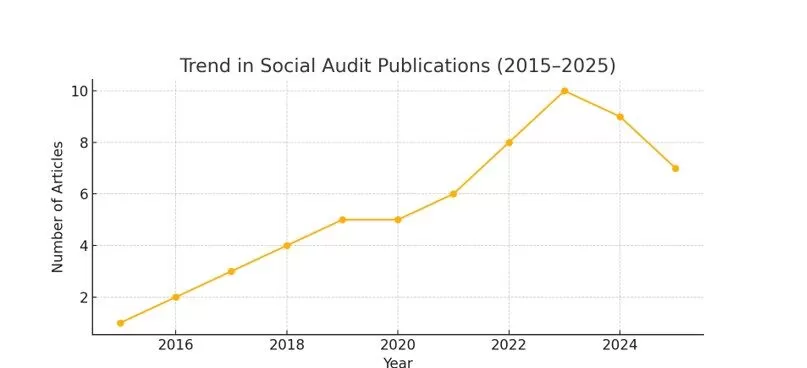
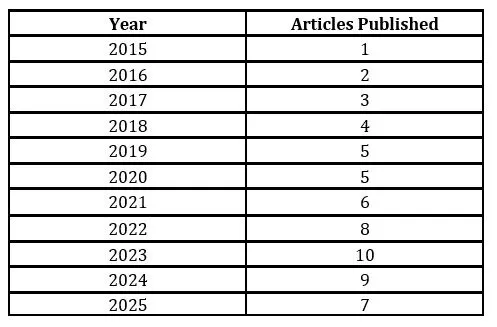
The analysis of literature between 2015 and 2025 reveals a steady increase in scholarly interest regarding social auditing in Moroccan agriculture. While the topic was scarcely addressed before 2017, a significant growth occurred after 2020, likely due to the influence of the Génération Green policy and international sustainability standards. The highest number of publications was recorded in 2023 and 2024.
Figure 1. Trend in academic publications on social audits in agriculture in Morocco
(2015–2025)
Table 1 below summarizes the yearly distribution of relevant publications:
Institutional and Geographic Distribution
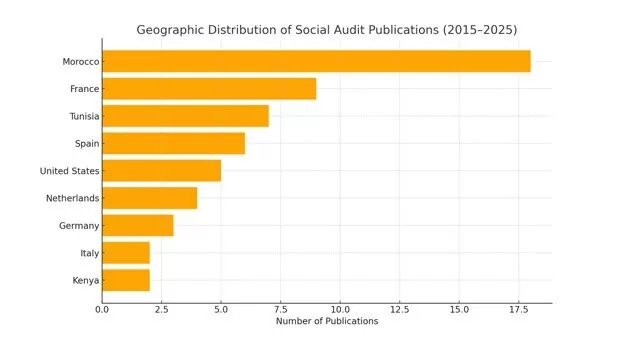
A review of institutional affiliations reveals that Moroccan universities contribute approximately 27% of all publications related to social audits in agriculture. Notable institutions include IAV Hassan II, Université Mohammed V, and ENA Meknès. The remainder of the publications are largely produced in collaboration with institutions in France, Spain, and Tunisia. This highlights the role of international partnerships in expanding the research landscape, although it also suggests a dependency on non-domestic analytical capacity.
Figure 2 below presents the country-level distribution of the studies analyzed, showing that Morocco leads the contribution, followed by France and Tunisia.
Figure 2. Number of social audit publications by country (2015–2025)
Thematic Clustering from VOSviewer
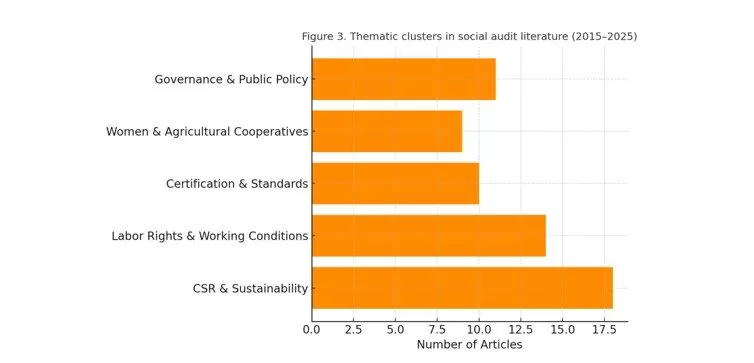
Using bibliometric tools such as VOSviewer, we performed a co-occurrence analysis of keywords across the 67 selected articles. Five dominant clusters were identified, each representing a major thematic focus in the literature on social auditing in Moroccan agriculture. These themes include Corporate Social Responsibility (CSR) and sustainability, labor rights and working conditions, certification and ethical standards, women’s roles in agricultural cooperatives, and public policy frameworks such as Plan Maroc Vert.
Figure 3 presents the distribution of articles across these themes, indicating a strong emphasis on CSR and labor-related issues, while gender-related and cooperative dynamics remain less represented.
Figure 3. Thematic clusters in social audit literature (2015–2025) based on VOS viewer co-occurrence mapping
Citation and Influence Analysis
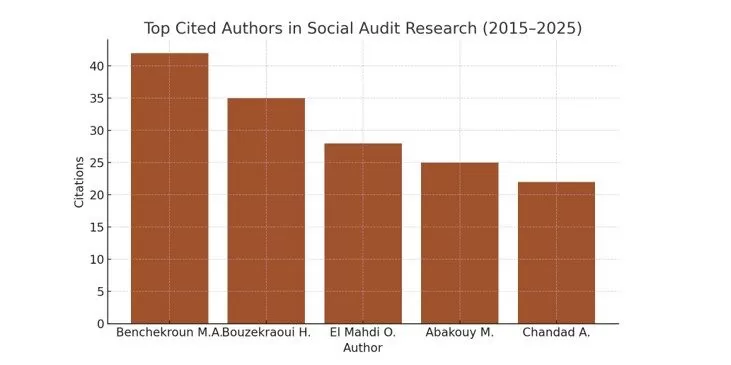
Citation analysis highlights the concentration of academic influence within a small group of authors and institutions. Among the 67 studies reviewed, a core group of authors has shaped the intellectual landscape. Benchekroun M.A. and Bouzekraoui H. are the most frequently cited, largely due to their early work on certification mechanisms and agricultural governance. Other contributors such as El Mahdi O., Abakouy M., and Chandad A. have recently gained prominence through empirical investigations on gender equity, social standards, and cooperative audits.
Figure 4 presents the citation frequency of the top five contributors based on cross-referenced Scopus and Web of Science data. These findings underline the need for broader collaboration and diversification of the academic base to enhance national ownership of social audit scholarship.
Figure 4. Most cited authors in the field of social audits in Moroccan agriculture (2015–2025)
Sectoral and Empirical Gaps
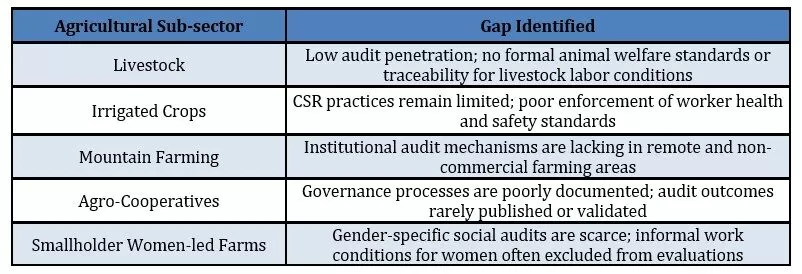
Despite growing scholarly attention, significant gaps persist in both sectoral coverage and empirical depth. Livestock production, which forms a major part of Moroccan agriculture, remains largely outside the scope of social auditing frameworks. Irrigated crop production zones show low integration of CSR principles, and remote mountainous farming communities are rarely audited or monitored by institutional mechanisms.
Gender-focused audits are critically underdeveloped, especially in smallholder women-led farms and informal employment contexts. Agro-cooperatives, though increasing in number, suffer from audit fragmentation and minimal governance evaluation.
Table 2 summarizes these underexplored domains and the key audit limitations associated with each.
Table 2. Sectoral and empirical gaps in social audit literature (2015–2025)
Conceptual Framework
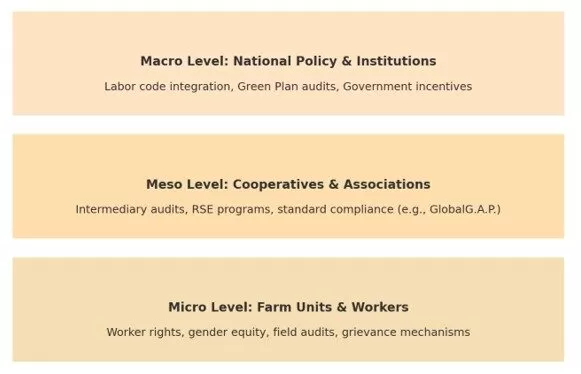
Drawing on the thematic and empirical insights from the literature, we propose a conceptual framework to guide future research and implementation of social audits in Moroccan agriculture. The model operates across three levels of intervention: the micro level (individual farms and workers), the meso level (cooperatives and certification bodies), and the macro level (national policy and institutional governance).
This layered framework reflects the complexity of agricultural labor relations in Morocco. At the micro level, issues such as labor rights, gender inclusion, and grievance mechanisms must be prioritized. At the meso level, intermediary actors such as cooperatives and NGOs play a key role in enforcing standards and facilitating third-party audits. The macro level includes government policies like Génération Green and labor code enforcement mechanisms.
Figure 5 illustrates the proposed conceptual model.
Figure 5. Conceptual framework for multi-level social audit integration in Moroccan agriculture
Conclusion
This bibliometric review has highlighted the emerging importance of social auditing in Moroccan agriculture as a research field and a governance practice. Between 2015 and 2025, the number of publications addressing social audits in agricultural contexts has grown steadily, with thematic focuses on CSR, working conditions, and certification systems. Nonetheless, considerable gaps remain in empirical coverage, particularly in remote farming areas, livestock sectors, and gender-inclusive auditing approaches.
The conceptual framework proposed offers a multi-level strategy to reinforce the institutionalization of social audits, emphasizing coordination across farms, cooperatives, and national policy frameworks. Future research should integrate mixed-method approaches and build on co-constructed models involving public authorities, civil society, and private certification actors. Furthermore, institutional investments are needed to enhance data infrastructure and auditing capabilities, especially in the context of Génération Green and Morocco’s sustainable development objectives.
References
Abakouy, M., & Chandad, A. (2025). Social auditing challenges in Moroccan agriculture: Evidence from cooperatives. Journal of North African Research in Business, 2025, Article ID 707334. https://doi.org/10.5171/2025.707334
Bouzekraoui, H., & Belhaj, F. (2022). Labor practices in Moroccan agri-food cooperatives: A CSR perspective. African Journal of Economic and Sustainable Development, 13(2), 148–166.
Ministère de l’Agriculture, de la Pêche Maritime, du Développement Rural et des Eaux et Forêts. (2020). Stratégie Génération Green 2020-2030. Rabat: Royaume du Maroc.
World Bank. (2021). Agricultural Employment and Social Protection in the MENA Region. Washington, DC: World Bank Publications.
VOS viewer. (2023). Visualizing Scientific Landscapes [Computer software]. Retrieved from https://www.vosviewer.com/
A.P. (2022). Integrated Farm Assurance Standard: Version 5.4. https://www.globalgap.org/
International Labor Organization. (2019). Decent Work in Agriculture: Guidelines and Practices. Geneva: ILO.