University of Tunis El Manar, Faculty of Economics and Management of Tunis, Tunis
Volume 2025,
Article ID 507705,
Journal of Organizational Management Studies,
10 pages,
DOI: 10.5171/2025.507705
Received date: 11 April 2025; Accepted date: 10 July 2025; Published date: 17 September 2025
Academic Editor: Sinda Ben Sedrine Doghri
Cite this Article as:
Faten HOSNI (2025)," Thinking The Future in the Plural : Multiculturalism And the Co-Construction Of Shared Visions in Strategic Foresight ”, The Journal of Organizational Management Studies, Vol. 2025 (2025), Article ID 507705, https://doi.org/10.5171/2025.507705
In an increasingly volatile and interconnected world, organizations must navigate complex environments shaped by cultural diversity. This study explores how multicultural dynamics can act as a lever to improve strategic foresight processes by enhancing the quality of anticipation, scenario-building, and collective visioning. Despite the growing importance of both foresight and intercultural management, existing literature rarely connects these fields in a systematic way.
To address this gap, the paper adopts an interdisciplinary approach, combining insights from organizational studies, intercultural communication, and future research. The methodology is qualitative and based on thematic and lexical analysis of interviews conducted with professionals involved in foresight processes within culturally diverse teams. Interviews were conducted primarily in French and translated into English, with attention to preserving cross-cultural nuances.
Findings suggest that multicultural teams contribute to richer foresight outcomes by introducing diverse mental models, reframing weak signals, and promoting inclusive decision-making under uncertainty. Moreover, culturally diverse groups appear better equipped to co-construct resilient and adaptive future narratives. These results highlight the need to incorporate intercultural intelligence into strategic foresight practices and raise critical questions for future research.
This paper contributes to both theory and practice by proposing a framework for “thinking the future in the plural,” positioning multiculturalism not as a constraint but as a strategic asset in navigating complexity.
Understanding and preparing for the future is no longer merely a technical exercise in forecasting trends or building abstract scenarios. In today’s interconnected and culturally plural world, the practice of strategic foresight must evolve to reflect the diversity of mental models, values, and representations of time and change that exist across cultures. This paper argues that embracing multiculturalism is not just a contextual necessity, but a strategic imperative for organizations seeking to navigate complexity and anticipate change in a meaningful and inclusive way.
While the field of strategic foresight has matured significantly over the past two decades, much of its conceptual and methodological development remains rooted in Western paradigms of rationality, linearity, and control. This has created a blind spot in the literature—namely, the limited integration of intercultural dynamics into foresight frameworks. Existing studies tend to either overlook cultural heterogeneity or treat it as a background variable rather than as a source of epistemological richness. As Andersen and Haines (2025) contend, integrating cultural diversity into foresight practices allows organizations to move beyond the monolithic narratives of the future and instead explore plural, contested, and co-constructed visions.
This research seeks to address that gap by examining how multiculturalism—understood as the active presence and interaction of different cultural logics within organizations—can enhance the processes and outcomes of strategic foresight. The analysis builds on interdisciplinary foundations that span organizational theory, intercultural communication, and future studies, and is grounded in empirical data drawn from foresight practitioners operating in international and culturally diverse contexts.
Prior work by Panizzon and Barcellos (2019) has emphasized the need to assess an organization’s cultural readiness for engaging in anticipatory thinking. Similarly, scholars such as Kuuluvainen (2022) and Zapata (2012) advocate for inclusive foresight communities in which diverse voices contribute equally to the imagining of possible futures. This aligns with research by Epps and Demangeot (2013) and Lakshman and Gonzalez (2023), who have shown that multicultural teams are better positioned to generate creative and adaptive strategies in volatile environments.
By focusing on the co-construction of shared visions of the future in multicultural environments, this study makes both a theoretical and practical contribution. It proposes that cultural diversity should not be seen as a challenge to be managed, but as a cognitive and relational asset in the design of strategic futures. In doing so, it responds to the call for more inclusive and context-sensitive foresight models, offering insights that are highly relevant for scholars and practitioners alike—particularly in the context of high-impact, peer-reviewed publication.
Research Question
To what extent do intercultural dynamics influence the quality, relevance, and transformative impact of strategic foresight practices in multicultural organizational contexts?
Research Objectives
This study sets out to:
Emphasize the strategic value of cultural diversity in shaping future-oriented thinking within organizations.
Examine how different cultural frameworks shape the way futures are imagined, articulated, and co-created.
Develop and propose methodological tools to meaningfully embed multicultural perspectives in foresight processes.
Illustrate, through case examples, how organizations have leveraged multicultural collective intelligence in building robust long-term strategic visions.
Theoretical Framework
Multiculturalism as a Cognitive and Relational Diversity
Multiculturalism in organizational contexts encompasses more than the coexistence of varied nationalities or ethnic backgrounds; it signifies a deeper cognitive and relational diversity. This includes differing value systems, conceptualizations of time, uncertainty, and change (Hofstede, 2001; Trompenaars & Hampden-Turner, 1997; Rezaei et al., 2023). Cultural frameworks deeply influence how individuals and groups perceive the world, anticipate the future, and approach strategic decision-making. For example, linear and long-term planning typical of Western cultures contrasts with more cyclical or intuitive approaches found in other cultural traditions.
While such differences can be sources of friction, they also present unique opportunities. Research shows that culturally diverse teams tend to outperform homogeneous groups in creativity, problem-solving, and adaptive thinking (Iyanda Ismail et al., 2024; Epps & Demangeot, 2013). These qualities are essential in envisioning plural and disruptive futures.
However, the potential of this diversity is only realized within inclusive environments that foster dialogue, active listening, and mutual respect. Building a culture of inclusion becomes essential to harness these differences productively (Jonsen et al., 2021; Shore et al., 2018; Mor Barak, 2020; Nishii, 2013).
Strategic foresight is not about predicting the future but about enabling organizations to anticipate, imagine, and prepare for multiple possible futures. It involves structured methodologies such as scenario planning, horizon scanning, weak signal detection, and backcasting (Godet, 2001; Berger, 1967). Yet beyond these tools, foresight is fundamentally a mindset—one that embraces uncertainty, complexity, and systemic thinking (Kuuluvainen, 2022).
Foresight practices rely on collective intelligence and participatory processes, where diverse stakeholders are invited to co-construct possible futures. This requires moving beyond linear logic to embrace creative, dialogical, and pluralistic thinking (Rhisiart et al., 2015; Popper, 2019; Miles & Saritas, 2020).
However, cultural worldviews deeply shape how these scenarios are built. For instance, foresight exercises conducted with primarily Western participants may yield different insights than those involving individuals from African, Asian, or Latin American backgrounds—not due to competence gaps, but because of differing epistemologies and cultural assumptions (Hosni, 2021).
Intersections Between Multiculturalism and Strategic Foresight
The intersection between multiculturalism and foresight represents a powerful yet underexplored axis of innovation. Incorporating a diversity of perspectives into foresight exercises strengthens scenario relevance, exposes blind spots, and counters the dominance of hegemonic narratives (Andersen & Haines, 2025; Kabadayi & O’Connor, 2021).
Cultural diversity stimulates divergent thinking, enabling the exploration of radical disruptions and alternative trajectories often overlooked by conventional Western strategic frameworks. This ability to challenge dominant paradigms is essential in developing resilient strategies fit for a volatile and interconnected world.
Kuuluvainen (2022) emphasizes the importance of cultivating intercultural dialogue spaces within foresight processes, where participants can express and negotiate their cultural assumptions regarding time, future, and transformation. Such spaces require facilitation by leaders trained in intercultural competence, capable of ensuring equitable participation and methodological neutrality.
In this view, foresight becomes a platform for collaborative wisdom, where differences are not minimized, but mobilized as assets for strategic imagination.
Toward Intercultural Foresight for Organizational Resilience
In today’s environment of constant transformation, resilience is a strategic imperative. Organizational resilience refers to an entity’s capacity to absorb shocks, adapt, and emerge stronger from unexpected disruptions. This adaptability is closely tied to anticipatory capacity and the intelligent mobilization of human capital in all its diversity.
Evidence suggests that organizations that embed multicultural perspectives into their leadership and foresight practices demonstrate greater responsiveness, innovation, and long-term vision (Lakshman & Gonzalez, 2023). Sowcik et al. (2015) argue that future leadership must be intercultural, dialogue-based, and anticipatory.
Implementing intercultural foresight requires culturally sensitive facilitation methods, neutral language practices, and participatory scenario-building that authentically includes all voices. Hosni (2021) calls this the development of “strategic collective intelligence”: the capacity to embrace multiple futures through the integration of diverse worldviews, leading to more creative and resilient solutions.
However, this approach presupposes the existence of intercultural leadership—individuals capable of mediating tensions, managing complementarities, and guiding organizations in transforming cultural diversity into a long-term strategic asset.
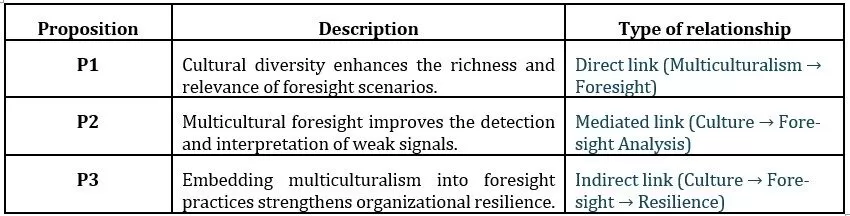
The following table summarizes the core research propositions guiding this study, derived from the theoretical framework:
Table 1. Research Propositions elaborated by the authors based on the literature review
These three propositions encapsulate the key assumptions derived from the theoretical framework developed above. Proposition 1 asserts that cultural diversity serves as a direct asset in the foresight process, enriching the construction of scenarios by introducing a plurality of lenses, values, and interpretations. This multiplicity strengthens the creative and exploratory dimensions of strategic anticipation. Proposition 2 emphasizes the mediating role of culture in how signals—especially weak or ambiguous ones—are perceived and decoded. Cultural background influences what is seen as relevant, urgent, or meaningful, thereby shaping the foresight analysis itself. Proposition 3 introduces an indirect yet vital link: when multicultural inputs are integrated effectively into foresight processes, they can reinforce an organization’s long-term resilience by fostering agility, inclusiveness, and collective adaptability.
These propositions will serve as the analytical backbone of the empirical section, guiding the interpretation of findings and grounding the contribution of this study within current debates on intercultural foresight and strategic management. They reflect a deliberate shift from viewing diversity as a contextual variable to understanding it as a structural driver of organizational future-readiness.
Methodology
This research adopts a qualitative, exploratory design, well-suited to investigate complex, under-explored relationships—in this case, between multicultural dynamics, strategic foresight, and organizational resilience. A qualitative approach enables us to capture the depth, nuance, and contextual richness of participants’ experiences, especially when dealing with culturally embedded phenomena such as future anticipation and intercultural collaboration.
Research Strategy
A multiple case study strategy was chosen to allow for comparative insight across diverse organizational environments. This approach provides the flexibility to explore foresight practices across a range of cultural and strategic contexts while identifying patterns of convergence and divergence in how multiculturalism influences future thinking. Each case includes organizations recognized for both their strategic foresight activities and their multicultural workforce composition.
The research followed a cross-sectional timeline, capturing insights during a defined period while integrating retrospective perspectives to better understand how foresight practices and resilience capabilities evolved over time.
Participant Selection and Scope
The study targeted professionals actively involved in foresight or long-term strategic processes within culturally diverse organizational settings. These included strategic planning officers, innovation managers, foresight consultants, human resource leaders, and change management professionals. The inclusion criterion was broad yet focused: participants had to be directly or indirectly engaged in activities related to anticipation or organizational transformation in multicultural contexts.
A purposive and theoretical sampling method (Patton, 2002; Glaser & Strauss, 1967) was applied to ensure diversity in both organizational sector and cultural representation. Sampling continued until thematic saturation was reached, which was achieved after 12 in-depth semi-structured interviews.
Data Collection Methods
Three complementary data sources were used to ensure triangulation and analytical depth:
Semi-structured interviews (60–90 minutes) focused on five thematic areas: individual perceptions of the future, foresight methodologies, the role of cultural diversity, decision-making approaches, and organizational resilience strategies.
Document analysis included strategic plans, internal foresight reports, intercultural charters, and scenario documentation, providing contextual and procedural insights.
Optional intercultural focus groups (conducted in two of the cases) were used to observe real-time group dynamics during scenario development exercises.
An interview guide was developed to ensure consistency across interviews while leaving room for contextual elaboration. Questions were open-ended and designed to elicit reflection on lived experiences, cultural perceptions, and foresight processes.
Data Analysis and Validation
Data were analyzed through a reflexive thematic analysis (Braun & Clarke, 2006), involving several stages: familiarization, initial coding, theme development, and thematic refinement. This inductive process was particularly attentive to how culture influenced the way participants imagined the future, interpreted uncertainty, and engaged in collaborative foresight.
To support intercultural comparison, an analytical matrix based on Hofstede’s (2001) and Trompenaars & Hampden-Turner’s (1997) cultural dimensions was applied. This matrix enabled the interpretation of behavioral and perceptual differences across national and organizational cultures.
In addition, the study employed the resilience framework developed by Lengnick-Hall et al. (2011) and Barasa et al. (2018), to analyze how anticipatory practices contributed to the organization’s capacity for adaptation, learning, and recovery in complex environments.
A lexical and statistical analysis was conducted using IRaMuTeQ software (R Interface for Multidimensional Analysis of Texts and Questionnaires). This allowed for cluster analysis and word co-occurrence mapping, enhancing transparency and reliability by confirming emergent patterns with textual data.
To ensure methodological rigor, several strategies were implemented:
Triangulation of data sources (interviews, documents, focus groups) to confirm consistency and enrich interpretation.
Audit trail through a research journal documenting analytical decisions and reflexive observations.
Member checking with participants to verify the accuracy of interpretations and reduce researcher bias.
Thick description was employed to facilitate analytical generalization and to allow transferability of insights to similar organizational contexts.
Lastly, since the research involved multilingual participants, language considerations were addressed. All interviews were conducted in the preferred language of the respondent (French, English, or Spanish), and when translation was necessary, back-translation procedures were applied to preserve semantic and cultural meaning. The impact of translation was critically reflected upon during analysis to account for any interpretative biases.
Results
Through qualitative thematic and lexical analysis of twelve interviews and supporting organizational documents, five core themes emerged that illustrate how multiculturalism shapes strategic foresight practices and contributes to organizational resilience. The results presented here are triangulated with document review and intercultural focus group observations. Interviews were conducted in English, French, and Spanish, depending on participants’ preferences. Translations were subsequently backchecked by bilingual researchers to ensure semantic consistency and preserve cultural nuances. Reflexivity regarding language impact was integrated into the coding process, particularly in the interpretation of metaphors, implicit meaning, and culturally bound concepts of time, authority, and collaboration.
Cultural Diversity as a Catalyst for Expanding and Complexifying Future Imaginaries
Participants widely affirmed that working in multicultural environments led to broader, more complex conceptions of the future. Diverse temporal perceptions—such as linear versus cyclical time (Hofstede, 2001; Trompenaars & Hampden-Turner, 1997)—emerged in scenario planning. Some team members emphasized structured developmental trajectories, while others framed futures in terms of intuition, disruption, or spiritual continuity.
Such diversity was not only cognitive but also imaginative. As Meyer (2014) and Hosni (2021) argue, strategic thinking is shaped by cultural assumptions. Our data confirmed that mixed teams challenged dominant Western linear rationalities, enabling more plural, open, and adaptive scenarios.
“Oftentimes, one feels hostile while working in Arab countries… our mental abilities are questioned in relation to Western thinking. (.) But working and learning side-by-side equals eliminating those barriers.”
— Mr. M., R&D Director (Interview conducted in French)
This quote reflects a phenomenon we call cognitive decolonization—the disruption of dominant epistemologies and the incorporation of culturally grounded insights into foresight processes (Zapata, 2012; Kuuluvainen, 2022).
Multiculturalism as an Engine for Collaborative Innovation and Mutual Learning
While diversity sometimes created friction, especially when priorities differed, intercultural teams that established safe communicative spaces turned potential conflict into creative synergy. This aligns with Shore et al. (2018) and Mor Barak (2020), who show that inclusive environments unlock innovation through psychological safety.
In organizations that employed intercultural facilitators or visual co-creation methods (e.g., journey mapping, persona development), tensions were transformed into constructive divergence. Scenario-building became a dialogical process, not a linear consensus-driven one (Popper, 2019).
“It’s slow at the beginning. We do not always get each other. But when we get accustomed to cooperating, we’re incredibly creative.”
— Strategy Consultant (Interview conducted in English)
Participants repeatedly described foresight not just as planning, but as a shared learning journey where cross-cultural exposure nurtured
empathy and creative problem-solving (Jonsen et al., 2021).
“We learned from each other… even differences in behavior positively impact the work.”…“It’s multicultural learning—a font of creativity.”
— Mr. T., IT Manager (Interview conducted in Spanish, translated and back-checked)
Cultural Pluralism and the Foundations of Organizational Resilience
Several cases demonstrated a direct link between multicultural foresight and stronger resilience capabilities—particularly in responding to crises, such as COVID-19, geopolitical risks, or digital disruption. Organizations that embedded cultural diversity into foresight teams reportedhigher levels of scenario preparedness, adaptability, and collective response planning (Lengnick-Hall et al., 2011; Barasa et al., 2018).
Common strategies included:
Using culturally diverse personas in scenario modeling;
Conducting foresight workshops that compared cross-cultural responses to past disruptions;
Integrating ethnographic insights into trend analysis (Andersen & Haines, 2025).
“Our Indian, Brazilian, and German teams didn’t just react differently. They anticipated differently. That’s our strategic advantage now.”
— Director of Strategy, Global Logistics Firm
This supports the notion of resilience as a culturally embedded capability, not just a structural trait (Habegger, 2010).
Shared Purpose and Emotional Resilience in Intercultural Teams
Another significant outcome was the emergence of collective identity and shared responsibility. When teams saw themselves as representing not only their companies but also their national or cultural groups, motivation and emotional engagement increased. This contributed to affective resilience, where team cohesion buffered stress and uncertainty (Sowcik et al., 2015).
“Every one of us feels as if we’re on some sort of national mission… in charge of our nation’s image.”
— Mr. M., Director of IT (Interview in French)
“Collaborating in multicultural businesses is something unique… the rivalry among us was always extremely cordial.”
— Mr. Y., CIO (Interview in English)
Such findings reinforce the view that diversity, when valued and institutionally supported, creates emotional anchors for collective effort and post-crisis recovery.
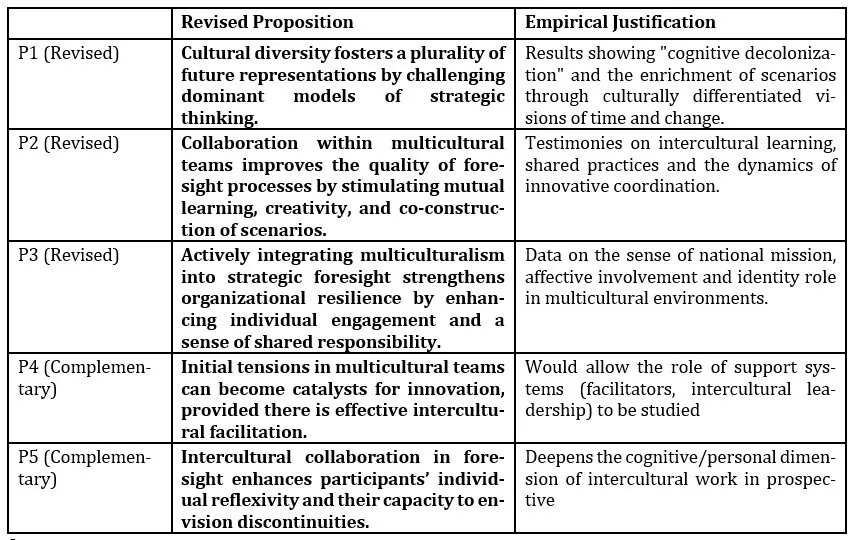
Revised and Complementary Propositions
Table 2. Summarizes the revised and complementary propositions
developed by the authors after empirical analysis
Source: Authors’ own elaboration (2025)
Discussion
The findings of this study provide a strong empirical grounding for the central argument: multiculturalism, far from being a contextual constraint in strategic foresight, constitutes a source of cognitive richness, creative tension, and organizational resilience when it is consciously integrated into foresight processes. This discussion will reflect on the theoretical and practical implications of these results, relate them back to the conceptual framework, and explore their contribution to the field of intercultural management and foresight.
Multiculturalism and the Expansion of Strategic Imaginaries
As shown in section 4.1, cultural diversity enables a broader spectrum of future representations. This observation reinforces previous claims by Hofstede (2001) and Kuuluvainen (2022) that cultural context influences not only communication styles but also perceptions of time, risk, and desirable futures. When participants were exposed to diverse cognitive maps, they reported a form of intellectual decentralization—what some researchers call cognitive reframing (Jonsen et al., 2021). In foresight processes, this translates into scenarios that are less deterministic and more open to discontinuities.
This diversification of imaginaries can serve as an antidote to “groupthink” and cultural bias in strategic planning (Miles & Saritas, 2020). It suggests that multicultural foresight teams are structurally more capable of envisioning emerging disruptions that homogeneous teams might ignore or underestimate.
Intercultural Learning as a Precursor to Innovation
The study confirms the hypothesis that mutual learning within multicultural teams enhances innovation capacity in strategic foresight, echoing the work of Epps & Demangeot (2013) and Nishii (2013). But beyond learning new methods or ideas, the process was often experiential and reflexive, leading participants to question their own assumptions.
This finding aligns with what Sowcik et al. (2015) identify as dialogical leadership—a form of leadership grounded in humility, active listening, and reflexivity. It implies that leadership in foresight contexts should not merely “manage” diversity but enable intercultural dialogue as a strategic method.
Cultural Diversity as a Strategic Asset in Organizational Resilience
Perhaps one of the most significant insights is the link between multiculturalism and adaptive capacity. Organizations that leveraged their internal cultural plurality reported faster and more creative responses to disruption. This supports Barasa et al. (2018) who describe resilience not just as structural robustness, but as a function of dynamic capabilities—in which culture plays a role in sensemaking, flexibility, and distributed intelligence.
The integration of culturally informed personas, cross-cultural analysis of emerging trends, and structured intercultural facilitation significantly enhanced the organization’s anticipatory responsiveness and strategic adaptability. These methods echo what Habegger (2010) calls anticipatory governance, and they position cultural literacy as a resilience enhancer—not only a DEI (diversity, equity, inclusion) issue.
Intercultural Commitment and the Ethics of Foresight
Interestingly, the emotional and ethical dimensions of foresight were particularly salient in multicultural environments. Participants expressed feelings of responsibility, pride, and collective identity, which align with emerging research on emotional resilience (Jonsen et al., 2021; Mor Barak, 2020). These findings invite us to reconsider foresight not only as a technical tool but as an ethical and relational process, rooted in mutual recognition and cultural respect.
Such recognition is consistent with Erin Meyer’s (2014) emphasis on cultural decoding as a managerial competency, especially when building trust in global teams. It also echoes Hosni’s (2021) plea for decolonizing foresight by making space for plural visions of progress, intelligence, and sustainability.
Contribution to Theory and Practice
This study contributes to strategic foresight literature by empirically validating the intersection between multiculturalism and future-oriented thinking. While theoretical calls for inclusion have grown (e.g., Zapata, 2012; Andersen & Haines, 2025), few studies have provided a methodological roadmap for integrating cultural diversity into scenario planning and organizational resilience strategies. This research fills that gap.
From a practical standpoint, it suggests that managers and foresight practitioners should:
Invest in intercultural facilitation and culturally sensitive foresight tools;
Incorporate diverse epistemologies and imaginaries into scenario-building;
Recognize diversity not only as a resource for equity, but as a driver of strategic agility.
Conclusion
This research set out to explore how multiculturalism can serve as a powerful catalyst in enriching strategic foresight practices and enhancing organizational resilience. Through a qualitative and interdisciplinary inquiry, we have shown that cultural diversity does not merely represent a contextual variable to manage but rather a cognitive and relational resource capable of transforming how futures are imagined, discussed, and constructed collectively.
The findings affirm that multicultural dynamics foster a plurality of temporal representations, encourage reflexivity among actors, and strengthen the ability of organizations to navigate uncertainty. Far from being a source of fragmentation, cultural diversity—when accompanied by inclusive leadership and adapted facilitation tools—nurtures creative tensions, mutual learning, and long-term strategic coherence. It allows foresight to become a genuinely dialogical and participative process, in which divergent voices contribute to a more holistic understanding of emerging futures.
The research contributes to filling a notable gap in literature, by articulating a conceptual framework that bridges organizational foresight, intercultural theory, and resilience studies. It advances five empirically grounded propositions that can guide further theoretical development and practical applications within foresight and innovation strategy fields. These propositions reinforce the idea that intercultural foresight is not only more inclusive, it is also more robust and better equipped to anticipate discontinuities in a complex world.
Nevertheless, some limitations must be acknowledged. While the study involved multilingual interviews (conducted in English and French, with some contributions translated from Arabic), translation may have influenced how certain cultural nuances were interpreted or coded. This linguistic mediation was handled carefully, with member-checking procedures and reflexive journaling, but future research could benefit from triangulation with native-language analysis and deeper linguistic-cognitive mapping.
Moreover, the sample, while diverse, focused on actors already familiar with foresight practices in relatively formalized organizational contexts. Future research could explore informal foresight practices in community or non-profit settings or further investigate the role of intercultural foresight in high-stakes negotiation or public policy domains.
Ultimately, this article invites foresight practitioners, managers, and researchers to consider cultural diversity not as a challenge to overcome, but as a strategic and ethical imperative. Thinking the future in the plural is not only a way to gain strategic agility, but also a way to honor the multiplicity of human experience that shapes the world ahead.
References
Ackoff, R. L. (1961) ‘Management misinformation systems,’ Management Science, 14(4), 147–156.
Andersen, P. D. and Haines, M. B. (2025a) Exploring cultural diversity in scenario planning. Edward Elgar Publishing.
Andersen, P. D. and Haines, M. B. (2025b) Exploring cultural diversity in scenario planning and futures thinking practices. Edward Elgar Publishing.
Barasa, E., Mbau, R. and Gilson, L. (2018) ‘What is resilience and how can it be nurtured? A systematic review of empirical literature on organizational resilience,’ International Journal of Health Policy and Management, 7(6), 491–503.
Berger, G. (1967) Phénoménologie du temps et prospective. Paris: PUF.
Braun, V. and Clarke, V. (2006) ‘Using thematic analysis in psychology,’ Qualitative Research in Psychology, 3(2), 77–101.
Epps, A. and Demangeot, C. (2013a) ‘Foresight,’ Emerald Publishing.
Epps, A. and Demangeot, C. (2013b) ‘The rainbow of diversity versus the rain of fragmentation: The futures of multicultural marketing in the UAE,’ Foresight, 15(6), 364–373.
Glaser, B. and Strauss, A. (1967) The discovery of grounded theory: Strategies for qualitative research. Chicago: Aldine.
Godet, M. (2001) Creating futures: Scenario planning and strategy for the future. Economica.
Habegger, B. (2010) ‘Strategic foresight in public policy: Reviewing the experiences of the UK, Singapore, and the Netherlands,’ Futures, 42(1), 49–58.
Hofstede, G. (2001) Culture’s consequences: Comparing values, behaviors, institutions, and organizations across nations (2nd ed.). Sage Publications.
Hosni Hedhli, F. (2021) Prospective stratégique et capacités d’innovation: Rôle du leadership collaboratif [PhD thesis]. Université de Tunis.
Iyanda Ismail, A., Rengasamy, E. and Wahab, N. O. (2024) ‘Megatrends and the future of work: Unlocking management strategies and HR models in digitalizing the United Arab Emirates,’ in HRM, Artificial Intelligence and the Future of Work. Springer.
Jonsen, K., Maznevski, M. L. and Schneider, S. C. (2021) Diversity and inclusion at work: Facing the global challenges. Edward Elgar Publishing.
Kabadayi, S. and O’Connor, G. C. (2021) ‘Foresight capabilities and the emergence of future-ready firms: A conceptual framework,’ Futures, 129, 102742.
Kuuluvainen, S. (2022a) Designing diverse and inclusive futures. Theseus.fi. Available at: https://www.theseus.fi.
Kuuluvainen, S. (2022b) ‘Designing diverse and inclusive futures: A framework for a co-creation process,’ fi – Applied Futures Research. Available at: https://www.theseus.fi.
Lakshman, C. and Gonzalez, J. (2023) ‘From TMT multiculturalism to strategic agility: Business model innovation in MNEs,’ Multinational Business Review, 31(2).
Lengnick-Hall, C. A., Beck, T. E. and Lengnick-Hall, M. L. (2011) ‘Developing a capacity for organizational resilience through strategic human resource management,’ Human Resource Management Review, 21(3), 243–255.
Magruk, A. (2022) ‘Strategic foresight in organizational development: A comparative study of multicultural versus monocultural teams,’ Futures, 135, 102869.
Miles, I. and Saritas, O. (2020) ‘The systemic nature of foresight: Participatory methods and embedded intelligence,’ Technological Forecasting and Social Change, 155, 119965.
Mor Barak, M. E. (2020) Managing diversity: Toward a globally inclusive workplace (4th ed.). Sage Publications.
Nishii, L. H. (2013) ‘The benefits of climate for inclusion for diverse groups,’ Academy of Management Journal, 56(6), 1754–1774.
Panizzon, M. and Barcellos, M. (2019) ‘Culture readiness in foresight projects: Toward an anticipatory maturity model,’ Journal of Futures Studies, 24(1), 67–83.
Patton, M. Q. (2002) Qualitative research and evaluation methods (3rd ed.). Sage Publications.
Popper, R. (2019) ‘Foresight methodology,’ in Futures Research Methodology (Version 3.0). The Millennium Project.
Rezaei, S., Alavi, S. and Ebrahimi, R. (2023) ‘A strategic foresight approach to organizational resilience: Insights from multi-stakeholder environments,’ Technological Forecasting and Social Change, 193, 122595.
Rhisiart, M., Miller, R. and Brooks, S. (2015) ‘Learning to use the future: Developing foresight capabilities through scenario processes,’ Technological Forecasting and Social Change, 101, 124–133.
Sabri, E. H. and Beamon, M. (2000) ‘A multi-objective approach to simultaneous strategic and operational planning in supply chain design,’ Omega: an International Journal of Management Science, 28(1), 581–598.
Shore, L. M., Cleveland, J. N. and Sanchez, D. (2018) ‘Inclusive workplaces: A review and model,’ Human Resource Management Review, 28(2), 176–189.
Sowcik, M., Andenoro, A. and McNutt, M. (2015) Leadership 2050: Critical challenges, key contexts, and emerging trends. Taylor & Francis.
Trompenaars, F. and Hampden-Turner, C. (1997) Riding the waves of culture: Understanding diversity in global business. Nicholas Brealey Publishing.
Zapata, F. (2012) ‘Anticipation and pluralism in foresight thinking,’ Futures, 44(7), 583–592.