4 Albanian University, Faculty of Medical Sciences, Tirana, Albania
5 Medicine University of Tirana, Faculty of Technical Medical Sciences, Tirana, Albania
Volume (2016),
Article ID 560158,
Journal of Respiratory Medicine Research and Treatment,
9 pages,
DOI: DOI: 10.5171/2016.560158
Received date: 30 April 2014; Accepted date: 6 June 2014; Published date: 21 September 2016
Academic Editor: Iwona Stelmach
Cite this Article as:
Fatmira Xhixha, Alkerta Ibranji A, Alketa H. Bakiri and Ervin Ç. Mingomataj E (2016), “Risk Factors Exposure during the First Life Year and Asthma Development among Albanian Children “ Journal of Respiratory Medicine Research and Treatment , Vol. 2016 (2016), Article ID 560158, DOI: 10.5171/2016.560158
Background: Different environmental factors are accused as risk factors (RF) in the development of allergic respiratory diseases. This study aimed to investigate the role of exposure to suspected RFs during the first life year in the development of childhood asthma among Albanian capital residents with a provincial or suburban origin. Method: Parental reports about own asthmatic children (276, m 160, f 116, aged 1-14, mean age 5.6) were collected regarding the conduction of cesarean delivery, breast feeding, exposure to high house humidity, pets, or to passive tobacco smoke, and the presence of familiar atopy or atopic dermatitis during the first life year. These results were compared with a sample of non-allergic children (100, m 49, f 51, mean age 5.7), diagnosed with common upper respiratory infections.Results: Conduction of cesarean section (OR = 9.8, p = 0.0002), exposure to high humidity at home (OR = 3.77, p = 0.0001), or to passive tobacco smoke (OR = 4.78, p < 0.0001), as well as the presence of atopic dermatitis (OR = 10.37, p = 0.0001) was significantly associated with asthma development. Familiar atopy (OR = 1.07) and exposure to pets (OR = 1.66) resulted in insignificant, whereas breast feeding resulted in protective factor (OR = 0.48, p = 0.0134).Conclusions: Cesarean section during birth, increased humidity level at home, atopy and passive tobacco smoke during the first life year could be RFs regarding the asthma development. The avoidance of mentioned factors at least during the mentioned period may reduce the development risk of this disease.
Keywords: Asthma, first life year, risk factors.
Introduction
Asthma is one of the most common chronic respiratory disorders [1]. Many epidemiology studies have suggested an increasing trend of asthma especially in the industrialized world, and that perinatal exposure to several risk factors and genetic predisposition have been associated with the development of childhood asthma or other respiratory allergic diseases [1-4]. The identified risk factors of asthma and other respiratory allergic diseases include maternal smoking and environmental tobacco smoke, traffic-related pollution, antibiotics, home dampness, etc [1,5-7]. To further investigate the regional role of some of these environmental factors and their contribution to the first year of life in asthma development, we conducted a retrospective study in asthmatic subjects and the control group presented in a multidisciplinary clinic of Tirana (capital city of Albania).
Methodology
This study is focused on familiar history and indoor risk factors during the first year of life on asthmatic children who presented in our clinic during 2008-2010. The parents of each child respectively have provided written informed consent and completed self-administered questionnaires. Questionnaires included questions about two optional answers yes or no regarding the mode of delivery (cesarean or natural), breast feeding, and exposure to high humidity in their dwellings, pets, or environmental passive smoking as well as the presence of family atopic history or atopic dermatitis. The study consisted of 276 asthmatic children aged 1-14 years (m 160, f 116, mean age 5.6±1.1), and a control group composed of 100 children (m 49, f 51, mean age 5.7±1.4), diagnosed with acute common upper respiratory infections. Diagnosis of asthma was confirmed or excluded due to clinical examination, ISAAC questionnaire, presence or absence of obstruction during spirometry (including salbutamol reversibility test), and results of skin prick tests with Mediterranean aeroallergens. The study group and the control group matched in regard to age and sex indexes. The comparative data were shown as odd ratio (OR) and confidence interval (CI), and chi2-test was used to evaluate the significance level. Statistical significance was settled for p < 0.05.
Results
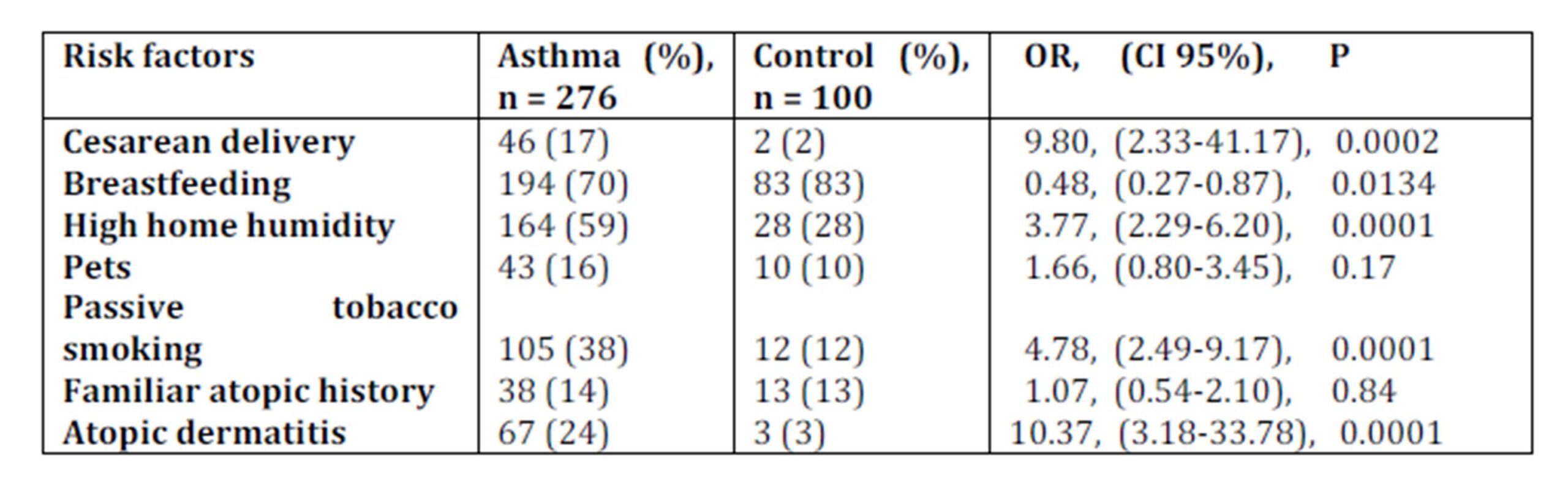
Our study shows a significant association of bronchial asthma with cesarean delivery (46/276 vs. 2/100, OR 9.8, CI 2.33-41.17, p = 0.0002), high indoor humidity exposure (164/276 vs. 28/100, OR 3.77, CI 2.29-6.2, p = 0.0001), environmental tobacco smoke (105/276 vs. 12/100, OR 4.78, CI 2.49-9.17, p = 0.0001), as well as the presence of atopic dermatitis (67/276 vs. 3/100, OR 10.37, CI 3.18-33.78, p = 0.0001). Breastfeeding on the other part resulted in a protective factor (194/276 vs. 83/100, OR 0.48, CI 0.27-0.87, p = 0.0134). Both, family atopic history (38/276 vs. 13/100, OR 1.07, CI 0.54-2.1, p = 0.84) and pet exposure findings (43/276 vs. 10/100, OR 1.66, CI 0.8-3.45, p = 0.17) were statistically insignificant (see Table 1).
Table 1: Perinatal risk factors, atopy, and development of asthma
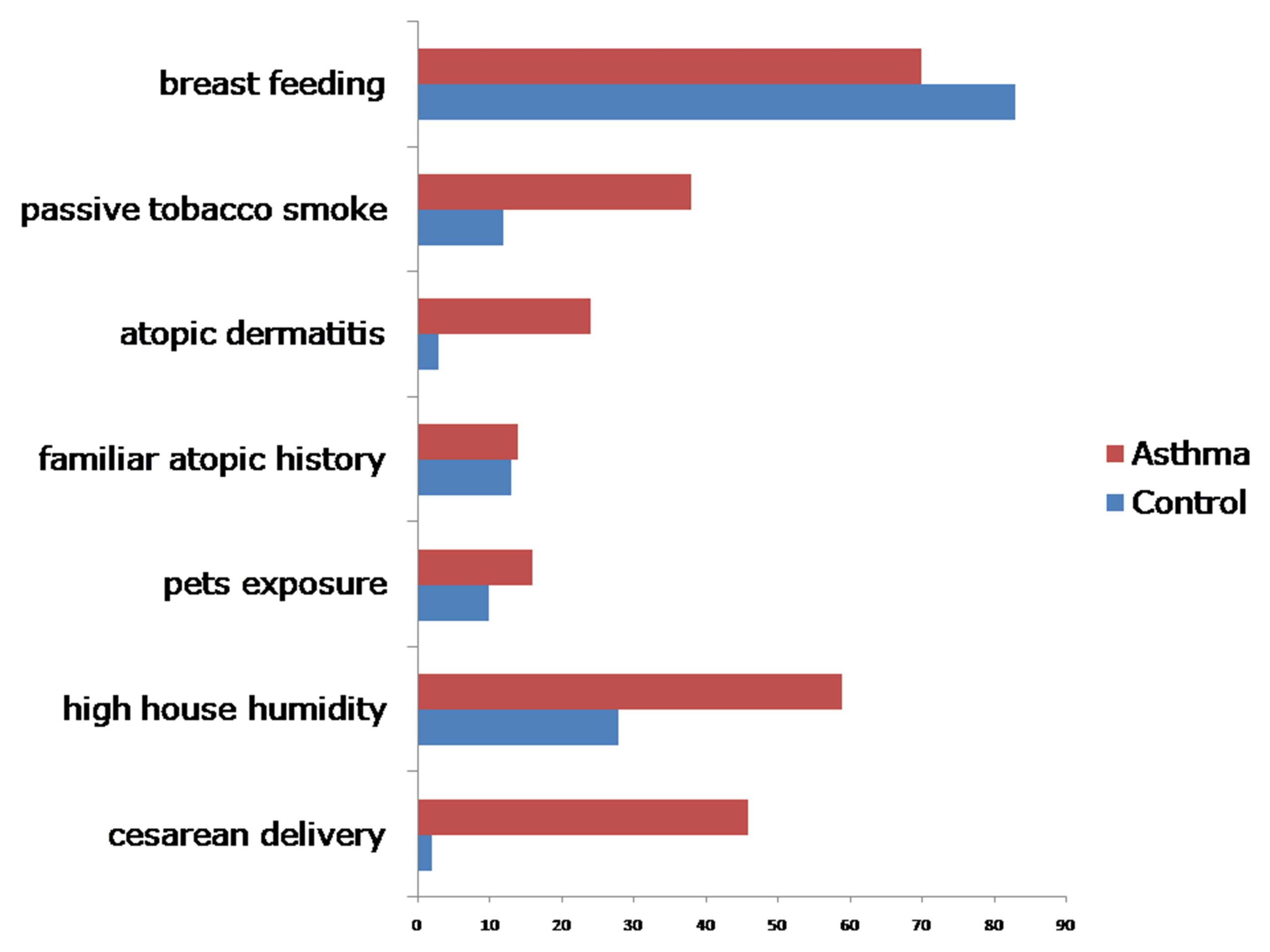
Figure 1: Frequency (%) of exposure to risk factors in control and asthma
group during first life year
Breast feeding resulted as protective factor, pet exposure and familiar atopy were non-significant risk factors, whereas atopic dermatitis, cesarean delivery, high house humidity, and passive exposure to tobacco resulted as important risk factors.
Discussion
Asthma in itself is a disease that depends on the interplay between genetic and environmental factors [1, 2, 8]. The main impact on both factors originates in intrauterine and early extra-uterine life that corresponds to novel immune maturation [5, 9]. Specifically, it is estimated that the period from mid-gestation until 2 years after birth is one of a particular concern relative to allergic diseases and asthma [5]. Although most published studies are underpowered to study interactions between genetic polymorphisms and ambient exposures, the identified risk factors play an active role in biologic mechanisms of immunologic balance and responsiveness [8, 10]. The emerging data onto our study demonstrated that the development of atopic dermatitis and a familiar history for atopic diseases are relative risk factors in the development of childhood asthma. Similarly to this, a recent German cohort evidenced an augmented asthma incidence of offspring up to adulthood in subjects with parental asthma and nasal allergy [11]. Developing dynamically through childhood, comorbidity of atopic pathologies in children increases with age, reaching a higher frequency and persistence among subjects with parental atopy [4]. These findings indicate that allergy-related diseases should be neither seen nor studied as isolated entities. In a previous study, we have found that younger generations of atopic respiratory patients report a family history of allergic disease about half as frequently as older ones, indicating for the existence of environmental factors in the development of asthma and allergic rhinitis [12]. Several further studies in the past decades have clearly shown a mark difference in the prevalence between urban and rural regions, indicating that the protective effect of the rural region consists of early exposure to microbes or microbial products and modulating of the immune system so as to reduce the future risk of asthma and allergies [1]. It should be taken into account that our collected data belong to a survey enrolled among the metropolitan subjects of a developing country. Specifically, the vast majority of this population originates from suburban regions that nowadays reside in the Albanian metropolis. Consequently, these subjects are generally exposed to a novel environment, even if asthma prevalence remains relatively low [12, 13]. In the present study, most of children are successors of the above-mentioned population, and during their first life year they are exposed to outdoors and mostly indoors allergens inside their dwellings [5]. Therefore, this might support the estimation, that many of these indoor and outdoor triggers have strong driving power over immature airway, toward “asthma battle” risk in later phases of their lives. With respect to indoor factors, our proper data evidenced a strong role in the pre- and perinatal exposure to environmental tobacco smoke. This agrees with the little published data that stress out the role of environmental tobacco smoke and other ambient air pollutants in the interaction with genetic polymorphism in asthma [6, 8]. This exposure, with time leads to deficits in lung function, early onset of asthma, and respiratory-related school absenteeism among children [14-16]. In concert with other measures, avoiding tobacco smoke exposure to pregnancy might prevent or delay the development of asthma [11]. Home dampness during first life year is also reported on the risk factors of the present survey. Independently to familiar history for atopy, associations between home dampness and respiratory diseases among children are proven through the protective influence of opening the windows of the child’s room at night and cleaning the child’s room frequently [6, 17]. Similarly to our study, early exposure to visible mould and/or dampness has been associated with an increased asthma risk [18]. These findings stress out the fact that modern hermetical and air conditioning environment leads to increased allergic burden indoors, and therefore, to high rates of persistent childhood asthma [19]. In contrast to environmental tobacco smoke and home dampness, our study suggested for an protective role in breastfeeding. It is postulated that breastfeeding provides immunological protection when the infant’s immune system is immature and a modest protective effect against asthma in early childhood, while induction of epigenetic mechanism by colonizing bacteria results in a functional immune phenotype and no expression of disease [3, 20]. This protective effect has been evidenced in our study even though generally the breastfeeding in our country is very common, independently to the subsequent health outcome of the respiratory system. Emerging data onto ISAAC multi-centric study also denied the consistent association with breastfeeding in the first life year and either a history or current symptoms of wheezing, rhino-conjunctivitis or eczema in 6-7 year old children [21]. Similarly to our study, breastfeeding for longer than four months among populations of certain industrialized countries has shown protective effects, especially among preschool age children with allergic heredity [6, 22, 23]. According to this evidence, the authors found out that introduction to preventive guidelines with regard to breastfeed (and other risk factors) during pre- and perinatal age is associated with an important reduction of recurrent wheezing and asthma at 2 years of age [6]. In the present study, pet exposure (as a marker of infant exposure to distinct microbiomes) was revealed as an insignificant risk factor of the development of childhood asthma, indicating that suburban origin and actual metropolitan life play a complex role on the genetic-environment relationship. Nevertheless, several studies have shown controversial or insignificant results in the development of asthma and allergic sensitization [24-26]. Children originating from atopic parents living in households with indoor dogs at birth were less likely to develop frequent wheezes than those without indoor dogs’ presentation, whereas this effect has been not proven in children exposed to cats [24, 27]. Although perinatal exposure to pets might show a weak protective effect, sensitization to perennial household furry pets were associated with increased asthma risk [26, 28]. In summary, these findings indicated that pet ownership in early life did not appear to either increase or reduce the risk of asthma or allergic rhinitis symptoms in children [25-27]. Similarly to pet exposure, delivery mode is considered a potential marker for infant exposure to distinct microbiomes [26]. It is believed that premature and cesarean delivery can lead to inadequate intestinal colonization, resulting in the absence of adequate bacterial-epithelial “crosstalk” and an increased incidence of immune-mediated diseases like asthma [20, 29]. The strong effect of cesarean delivery of the development of childhood asthma has been observed both in our study and in further surveys [20, 29-31]. Thus, analyses of first-borns demonstrated that elective caesarean section was associated with an increased risk of dispensed inhaled corticosteroids in children aged between 2 and 5 years [30]. However, recent studies point out, first, the presence of confounding factors, and second, they do not support the role of inadequate bacterial colonization during cesarean delivery and its association with childhood asthma [29, 30]. In this context, Nathan et al. reported that children delivered through caesarean sections did not have higher IgE levels nor were they more sensitized to aeroallergens, while multiple logistic regression show that asthma was significantly associated with a positive family history of atopy [31]. In turn, Kolokotroni et al. concluded from adjusting to potential confounders that the association between cesarean delivery and asthma diagnosis in children indicates that family history of allergies may modify the effect of cesarean delivery on atopy [32]. Specifically, these authors observed a two-fold increase in the odds of being atopic among children with a familiar heredity if born by cesarean section, but any association was evidenced in children without a family history for allergic pathologies. Furthermore, Almqvist et al. observed that only emergent obstetrical intervention accounted for increased asthma diagnosis and medication during the year of follow-up in children born with cesarean delivery, whereas elective section was insignificant [29]. Concluding that vaginal microflora plays no casual effect of the association with delivery mode and childhood asthma, these authors postulated that a more probable explanation should be sought in the indications for emergency cesarean section. Possibly, emergency cesarean delivery is a marker for cumulative maternal and prenatal stress, as long as these mothers are more likely to have asthma and higher stress is associated with increased IL-13 and decreased IFN-gamma [9]. If true, an additional adjusting for stress would have suppressed the association between emergency cesarean delivery and the development of asthma [29]. Especially in developing countries, it is likely that expensive elective cesarean delivery is actually preferred by mothers with high socioeconomic status, whereas among mothers with low socioeconomic status, emergency cesarean sections are generally applied to unexpected complications and constitute a supplemental stressor. In fact, maternal cumulative adversity and lower maternal childhood socioeconomic status is also associated with increased cord blood IgE levels, asthma and repeated wheeze through both direct and indirect effects [33-35]. Among children of atopic mothers, the positive association with stress and IgE was stronger in the high dust mite group; in contrast to them, children of non-atopic mothers have shown a positive association between stress and IgE, especially in the low allergen group [34]. Consequently, authors of this survey concluded that prenatal stress is independently associated with elevated cord blood IgE, and mechanisms underlying stress effects on fetal immunomodulation may differ based on maternal atopic status [34]. With respect to (Albanian) mothers with highest socioeconomic status, the association with elective cesarean sections and childhood asthma observed in previous surveys may account for the confounding role of family atopy background, which in fact, should be associated with deviation from traditional life [13, 30, 32]. After adjustment for interfering confounding factors, the elective cesarean section seems to play no causative effect of the development of childhood asthma [29]. In summary, these findings provide new insights into the role of social inequalities as determinants of childhood asthma risk, which need furthered clarification [33].
Conclusion
The present study supports the idea that atopic dermatitis is a better indicator of a potential asthma development during childhood as compared to family history for atopic disease; however, they seem to be only an evident externalization of what lies in the genes. This suggests that the understanding of the genetic predisposition and of interaction modalities between genetic and environment factors are decisive for the future development of preventive strategies for asthma [1]. Notably, our data indicate that children with suburban origin, but in the same time metropolis residents of a developing country like Albania, are subjects of de novo exposure to a wide variety of risk factors. Thus, cesarean delivery, high humidity inside the dwellings and passive tobacco smoke during the first life year were described as important indoor risk factors for asthma development. These lead to the conclusion that mentioned adjuvant factors may act as nonspecific triggers for the development of atopy, and their avoidance of this immunologically fragile period may prevent the asthma development [6, 36]. Nevertheless, the role of protective factors of breast feeding, respiratory infections in early life, a “healthy” indoor environment, and stress avoidance needs to be evaluated in prospective studies. Additional detailed studies are necessary for the detection of real asthma triggers, which could be hidden behind the well-determined risk factors.
11. Grabenhenrich LB, Gough H, Reich A, Eckers N, Zepp F, Nitsche O, et al. Early-life determinants of asthma from birth to age 20 years: A German birth cohort study. J Allergy Clin Immunol 2014;pii: S0091-6749(13)01860-5.[Epub ahead of print] Google Scholar
12. Mingomataj EÇ, Xhixha F, Gjata E, Hyso E, Qirko E. Prevalence of a family history of atopic disease among 3 generations of atopic respiratory patients in Tirana, Albania. J Investig Allergol Clin Immunol 2008; 18: 190-3. Google Scholar
21. Björkstén B, Aït-Khaled N, Innes Asher M, Clayton TO, Robertson C; ISAAC Phase Three Study Group. Global analysis of breast feeding and risk of symptoms of asthma, rhinoconjunctivitis and eczema in 6-7 year old children: ISAAC Phase Three. Allergol Immunopathol (Madr) 2011;39:318-25.
31. Nathan AM, de Bruyne J, Khalid F, Arumugam K. Caesarean section and asthma in Malaysian children: a case-control study. Asian Pac J Allergy Immunol 2012;30:204-8. Google Scholar