Blanca Flor Mendoza Sànchez1, Mario Mendoza Sànchez1, Milka Ramirez Zevallos2 and Juan Romelio Mendoza Sànchez1
1Universidad Nacional de Cajamarca. Perú 2Universidad San Pedro. Perú
Volume 2025,
Article ID 554585,
Journal of Organizational Management Studies,
7 pages,
DOI: 10.5171/2025.554585
Received date: 22 April 2025; Accepted date: 3 July 2025; Published date: 22 September 2025
Cite this Article as:
Blanca Flor Mendoza Sànchez, Mario Mendoza Sànchez, Milka Ramirez Zevallos and Juan Romelio Mendoza Sànchez (2025)," Institutional Management and Educational Quality in a Secondary Level Institution in the La Libertad Region; 2023”, The Journal of Organizational Management Studies, Vol. 2025 (2025), Article ID 554585, https://doi.org/10.5171/2025.554585
The purpose of this research is to determine the relationship between institutional management and educational quality in a secondary level institution in the La Libertad 2023 region. The methodology applied was a non-experimental research design, descriptive-correlational, and cross-sectional. Developed with the hypothetical deductive method, we worked with a sample of 35 teachers, to whom two questionnaires were applied, the first consisting of 40 items corresponding to institutional management with the dimensions: educational leadership, strategic planning, institutional climate and institutional evaluation, and the second also consists of 40. Items related to educational quality with the dimensions: institutional management, support for teaching performance, joint work with families and the community, use of information and infrastructure and resources for learning. Once the results were obtained, the correlation analysis was carried out between the variables institutional management and educational quality using Spearman’s Rho, obtaining a correlation of 0.799 with a significance level of less than 0.05 (p-value=0.012). Concluding in this way that there is a significant and positive correlation between the study variables.
Keywords: Team work, academic performance
Introduction
In the modern world, talking about institutional management and educational quality responds to everything related to resources that allow us to provide an educational service in accordance with 21st century education, in which educational quality is reflected, whether in person or virtual, turning it into a social and academic learning experience, where students and parents demonstrate good attention, administrative and academic services of optimal quality. However, we can observe shortcomings both in the institutional management of private and state educational entities worldwide, which are fundamentally associated with bureaucracy and poor administrative culture of institutional management, the latter being considered a bottleneck in the different educational processes, which does not allow providing adequate education, despite the fact that the directors of educational institutions are aware that the development of a society depends on good educational training, with basic education being essential for the training of new generations, they do not care about properly managing and providing education with high quality rates.
In Peru, institutional management also presents limitations such as scarce resources for the acquisition of infrastructure and educational materials, lack of commitment to teaching activity, elderly teachers who carry out their work with certain limitations such as the management of technologies, translating into poor teaching performance, which is currently proportionally affecting the significant learning of students.
In our field of study, we can evidence this problem from the use of outdated institutional management designs, as well as the restricted and insufficient resources, the inconsequential diligence when evaluating the actions carried out, the distancing of identity on the part of the educational representatives to responsibly take charge of the commitment to plan and execute activities in favor of the development of the educational institution, the low level of training for administrative collaborators and teachers, among others, which undoubtedly has an impact on the quality of education.
Regarding retrospective studies regarding our study variables, it has been possible to investigate different institutional repositories, search engines and metasearch engines, finding studies in the international field such as Quintana (2018) who concludes that educational management should be a tool for making decisions, keeping in mind the reality that each educational institution in the country is going through (p.114).
Likewise, Rodríguez (2019) concludes that institutional management is the result of the experience of those who make decisions. Institutional management addresses the pedagogical sense to build a didactic methodology, at the same time the didactic must be considered as a training strategy (pp.198).
Regarding the national level, we find studies such as that of Hinojosa (2019), who established the influence of institutional management on the educational quality of representative public educational institutions in Tacna, whose results indicate a Pearson coefficient of 0.767 (p-value=0.000); therefore, it is concluded that a positive and significant relationship coexists between the study variables (p.89).
Meanwhile, Llamo (2018) concludes that there is a moderate correlation (rho=0.68; p-value=0.015) between the way in which institutional management is being developed in an educational center in relation to the educational quality standard that the educational institution has, as well as in the characteristics of the institutional management variable (organization, interpersonal relationships and managerial leadership) and educational quality (p.67).
Thus, Huayllani (2018) also obtained as results with respect to the institutional management of the educational center that 86% of teachers indicate that the situation is efficient; on the other hand, with respect to how the educational quality has been presented, 90% of the teachers indicate that this is in good condition, in addition, the calculated Pearson coefficient is equal to 0.49 (sig=0.00). Reaching the conclusion that there is a direct and significant relationship between the study variables in the I.E. Santiago of the Lucanas district (p.106).
Institutional Management
According to Alvarado (1999), he points out that institutional management is the implementation of methods, techniques, procedures and various tools to manage resources and develop the operations of an organization.
Manes (2004) established the following dimensions for institutional management: (a) Directive leadership, (b) Strategic planning, (c) Institutional climate, (d) Institutional evaluation.
This variable is supported by the theory of institutional management of Fayol (1987) who states that institutional management refers to the art of bringing people together on a common platform so that they work towards a predefined common objective. It also allows the optimal use of resources through meticulous planning and control in the work center. On the other hand, institutional management gives a sense of direction to the collaborators of the institution, since individuals know their roles and responsibilities well and know what they are supposed to do in the institution or organization.
Educational Quality
IPEBA (2013) is the reference point for the entire teaching-learning process based on effectiveness and efficiency through the application of tools that help improve teaching, communicating and cooperating with public wisdom and principles that label the minimum achievements expected in students.
IPEBA (2011) considers the following dimensions: (a) Institutional direction, institutional management, (b) Support for teaching performance, (c) Joint work with families and the community, (d) Use of information. This variable is supported by the theory of educational quality of Muñoz (2011), covered by the General Law of Education No. 28044 Article 13, who formulates his theory called optimal education where he mentions that education is the optimal level of training that students desire and it is up to them to face the challenges of human development, and to be able to display their citizenship as well as prolong their learning throughout life. For this, it is necessary to acquire intellectual equipment and cultural representation to add value to the processes that shape adequate life and educational social interaction.
The present study is justified since it will provide an academic benefit by addressing an important topic in the education sector, such as institutional management and educational quality, which was developed by the need to improve educational quality taking into account the opinion of teachers, supported by institutional management, which will benefit the students, and therefore society in general. Based on the background already presented above and based on the problematic reality, the following research question has been formulated: What is the relationship between institutional management and educational quality in a secondary level Institution in the La Libertad 2023 region?, having as a hypothesis that: There is a significant relationship between institutional management and educational quality in a secondary level Institution in the La Libertad 2023 region and as a general objective: Determine the relationship between institutional management and educational quality in a secondary level Institution of the La Libertad 2023 region.
Regarding the specific objectives, we have: (a) Identify the level of institutional management in a secondary level Institution in the La Libertad 2023 region, (b) Identify the level of educational quality in a secondary level Institution in the La Libertad 2023 region, (c) Analyze the relationship between managerial leadership and educational quality in a secondary level Institution in the La Libertad 2023 region, (d) Analyze the relationship between strategic planning and educational quality in a secondary level Institution in the La Libertad 2023 region, (e) Analyze the relationship between institutional climate and educational quality in a secondary level Institution in the La Libertad 2023 region, (f) Analyze the relationship between institutional evaluation and educational quality in a secondary level Institution in the La Libertad 2023 region.
Material and Methods
The research is of a basic descriptive type which Hernández, Fernández and Baptista (2016) specify that it is used in order to try to determine, narrate and describe a specific fact. Therefore, in this investigation we will seek not only the what, but the why of things, and how they have reached the state in question.
It also presents a non-experimental and cross-sectional design since it was carried out without premeditated manipulation of variables and can only be analyzed in a natural way. The population for our study, the population and the sample will be the same because it is small, corresponding to 35 teachers in a secondary level Institution in the La Libertad 2023 region.
The technique that will be used for data collection is the survey and the instrument for both variables is the questionnaire, which has been taken from Claros (2016); the first questionnaire consists of 40 items; in the same way, questionnaire 2 on educational quality has 40 items, prepared using the Likert scale.
Results
Table 1: Correlation between institutional management and educational quality
** The correlation is significant at the 0.01 level (two-tailed).
Regarding the general objective, the result is a p-value of 0.000 that is less than 0.05, therefore, Spearman’s Rho coefficient is statistically significant. On the other hand, Spearman’s Rho coefficient is 0.799. The positive sign of the coefficient indicates that there is a moderate positive correlation between the institutional management variable and the educational quality variable; this means that, by reinforcing institutional management, educational quality is improved as shown below:
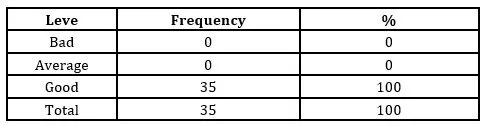
Table 2: Teaching institutional management levelSource: Data systematization in SPSS, IBM25
In relation to the first specific objective: Identify the level of institutional management; It can be seen that 100% of the teachers surveyed believe that the level of institutional management is good, as shown in the table.
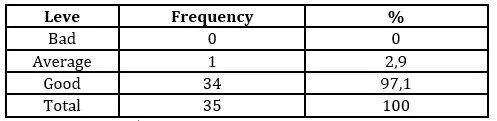
Table 3: Teacher educational quality level
** The correlation is significant at the 0.05 level (two-tailed).
Regarding the second specific objective: Identify the level of educational quality; It is found that 97.1% (34) of the teachers surveyed believe that the level of educational quality is high, then 2.9% (only one) think that the level is medium and none indicate that it is low.
Table 4: Correlaton between managerial leadership and educational quality
** The correlation is significant at the 0.05 level (two-tailed).
Regarding the third specific objective: Analyze the relationship between managerial leadership and educational quality; It is observed that p-value is 0.012, which is less than 0.05, therefore, Spearman’s Rho coefficient is statistically significant. On the other hand, Spearman’s Rho coefficient is 0.428. The positive sign of the coefficient indicates that there is a moderate positive correlation; this means that, by improving effective leadership, educational quality is improved.
Table 5: Correlation between strategic planning and educational quality
** The correlation is significant at the 0.05 level (two-tailed).
Regarding the fourth specific objective: Analyze the relationship between strategic planning and educational quality; It is observed that p-value is 0.000 which is less than 0.05, therefore, Spearman’s Rho coefficient is statistically significant. On the other hand, Spearman’s Rho coefficient is 0.520. The positive sign of the coefficient indicates that there is a moderate positive correlation; this means that, by reinforcing strategic planning, educational quality is improved.
Table 6: Correlation between institutional climate and educational quality
** The correlation is significant at the 0.05 level (two-tailed).
In relation to the fifth specific objective: Analyze the relationship between institutional climate and educational quality; It can be seen that p-value is 0.000, which is less than 0.05, therefore, Spearman’s Rho coefficient is statistically significant. On the other hand, Spearman’s Rho coefficient is 0.734. The positive sign of the coefficient indicates that there is a moderate positive correlation; this means that, by reinforcing the institutional climate, educational quality is improved.
Table 7: Correlation between institutional evaluation and educational quality
** The correlation is significant at the 0.05 level (two-tailed).
Finally, in reference to the sixth specific objective: Analyze the relationship between institutional evaluation and quality; It is observed that p-value is 0.000 which is less than 0.05, therefore, Spearman’s Rho coefficient is statistically significant. On the other hand, Spearman’s Rho coefficient is 0.827. The positive sign of the coefficient indicates that there is a moderate positive correlation; this means that, by reinforcing the institutional evaluation, educational quality is improved.
Discussion
After having obtained the results and contrasting hypotheses, it was found that the variables worked in the same trajectory, whose obtained finding indicates a positive correlation; this means that, if strategies are applied to improve institutional management, as a consequence educational quality will improve, and vice versa. These results corroborate what was found by Hinojosa (2019), Llamo (2018), Claros (2016) and differs from the finding found by Huayllani (2018) being a moderate positive correlation; thus, the correlation between these characteristics tends to be between moderate and high demonstrating that in the face of changes in institutional management this is reflected in a high percentage in educational quality. What was analyzed above is the basis for it (Rodríguez, 2019).
For institutional management, the data indicate that 100% of the teachers believe that in the educational institution there is a good level of institutional management, revealing that the management carried out in this educational institution is very aggressive and is always used to solve the different problems that always occur with the aim of continuing to improve. In almost the same way, the results of educational quality are presented where 97.1% of teachers state that this quality has high levels, and 2.9% believe that the level is medium; thus, it is sensed that the students of this part of the country are reaching the optimal levels of training as people (MINEDU, 2003) and are also progressing and strengthening themselves as human beings, understanding that the improvement in the institution has been optimal. (Malpika, 2013)
With respect to the relationship between the managerial leadership dimension and educational quality, a moderate positive correlation was recorded; the same happens with the strategic planning dimension (moderate correlation); however, with the institutional climate dimension, the correlation is high as with the institutional evaluation dimension. With these results, it is clear that if an educational institution presents problems in educational quality, we can improve it by applying strategies to improve the institutional climate and evaluation and to a lesser extent intervene in managerial leadership and strategic planning, although we should not downplay the importance of all of them, as stated by Quintana (2018).
Conclusions
In relation to the general objective, it is concluded that there is a high positive correlation (Spearman Coefficient = 0.799, p-value = 0.000) between institutional management and educational quality, and the correlation is also highly significant.
Regarding the first specific objective, it is concluded that 100% of the teachers consulted believe that the level of institutional management is good.
Meanwhile, the second specific objective leads us to conclude that 97.1% (34) of the teachers consulted think that the level of educational quality is high, then 2.9% (only one) thinks that the level is medium and none indicates that it is low.
In relation to the third specific objective, we conclude that there is a moderate positive correlation (0.428) between managerial leadership and educational quality, and the p-value (0.012) of the correlation hypothesis test is less than 0.05; so, the correlation is significant.
Regarding the fourth specific objective, it is concluded that there is a moderate positive correlation (0.520) between strategic planning and educational quality, with the p-value (0.000) of the correlation hypothesis test being less than 0.05; so, the correlation is highly significant.
In reference to the fifth specific objective, we conclude that there is a high positive correlation (0.734) between institutional climate and educational quality, with the p-value (0.000) of the correlation hypothesis test being less than 0.05; so, the correlation is significant.
Finally, in relation to the sixth specific objective, we can conclude that a high positive correlation (0.827) was evident between institutional evaluation and educational quality, with the p-value (0.000) of the correlation hypothesis test being less than 0.05; so, the correlation is significant.
Bibliographic References
Alvarado, O. (1999). Gestión Educativa. Universidad de Lima: Fondo de Desarrollo Editorial.
Claros, F. (2016) Gestión institucional y calidad educativa en las instituciones educativas de Sayán – Huaura 2015 (Tesis de maestría). Universidad Cesar Vallejo, Lima.
Fayol, H. (1987). Administración Industrial y General (14va ed.). Buenos Aire: El Ateneo.
Hernández, R., Fernández, C., & Baptista, P. (2014). Metodología de la investigación (6ta ed.). México: McGraw-Hill.
Hinojosa, L. (2019) Gestión institucional y calidad educativa, según percepción de docentes y administrativos de las instituciones educativas emblemáticas públicas de Tacna, 2018 (Tesis de doctor) Universidad Nacional de Educación Enrique Guzmán y Valle, Lima.
Huayllani, M. (2018) La gestión institucional y la calidad educativa de la Institución Educativa Patrón Apóstol Santiago del distrito de Lucanas, 2018 (Tesis de maestría). Universidad Nacional de Educación Enrique Guzmán y Valle, Lima.
(2013). Qué y cómo evaluamos la gestión de la institución educativa (2ª. ed.). Lima, Perú: Ministerio de Educación.
Llamo, J. (2018) Gestión institucional y calidad educativa de las instituciones educativas emblemáticas del distrito Ate, UGEL 06. (Tesis de maestría). Universidad Nacional de Educación Enrique Guzmán y Valle, Lima.
Manes, J. (2004). Gestión estratégica para instituciones educativas: Guía para planificar estrategias de gerenciamiento institucional. Buenos Aires: Granica.
Terrones, E. (24 de abril de 2016). Eudoro Terrones Blog. Recuperado de http:/ /eudoroterrones.blogspot.com/2016/04/gine-y-el-sistema-de-calidad-educativa.html
Rodríguez, M. (2019). La gestión institucional, elemento para la calidad educativa en la formación docente; un estudio de caso en el marco de las políticas públicas comparadas de los procesos de la formación en las Escuelas Normales del Estado de Michoacán (Tesis de doctorado). Universidad Latinoamericana de Ciencias Sociales, sede académica de México. México.