Bratislava University of Economics and Business, Bratislava, Slovak Republic
Volume 2026,
Article ID 134429,
IBIMA Business Review,
9 pages,
DOI: doi.org/10.5171/2026.134429
Received date: 30 March 2026; Accepted date: 30 June 2026; Published date: 14 September 2026
Academic Editor: Katarina Tomicic-Pupek
Cite this Article as:
Anita ROMANOVA, Robert HANAK and Benita BELANOVA (2026)," “ Strategic ICT Importance and Employee Workload: The Mediating Role of Digitalization and Virtualization“, IBIMA Business Review, Vol. 2026 (2026), Article ID 134429, https://doi.org/10.5171/2026.134429
This study examines whether the strategic importance assigned to information and communication technology (ICT) is associated with selected work-related outcomes through the implementation of specific digital technologies. Although prior research has linked digital technologies to work intensity and workload, less attention has been paid to the mediating role of distinct implementation domains, particularly digitalization, virtualization, and augmented reality. Using quantitative survey data collected electronically from 286 companies in Slovakia, the study tested mediation models in which the strategic importance of ICT was specified as the predictor, and four dependent variables were examined: work intensity/workload, autonomy at work, degree of supervision/control, and work–life balance. Three mediators were analyzed: implementation of digitalization, implementation of virtualization, and implementation of augmented reality. Altogether, 12 mediation models were tested. The results indicate that the strategic importance of ICT is positively associated with the implementation of digitalization, virtualization, and augmented reality. However, statistically significant partial mediation was confirmed only in the models where work intensity/workload served as the dependent variable. More specifically, digitalization and virtualization partially mediated the relationship between ICT importance and workload. The indirect effect through digitalization accounted for 29.19% of the total effect, while the indirect effect through virtualization accounted for 21.60%. No statistically significant mediation effect was observed for augmented reality. Overall, the findings suggest that organizations assigning greater strategic importance to ICT are more likely to implement digital and virtual technologies, which may be associated with higher work intensity.
Keywords: Importance of information and communication technology (ICT), Implementation of digitalization/virtualization, employee work intensity/work load
Introduction
ICT strategic prioritization drives whether firms systematically plan and consequently adopt advanced technologies and how they align investments with business goals. When ICT is embedded in corporate strategy and led by management, firms adopt digital tools that reshape processes; conversely, weak strategic planning correlates with partial or fragmented adoption in smaller firms. Large firms that tie ICT into strategy apply comprehensive ICT guidelines and adopt technologies more systematically than firms lacking strategic planning. Firms that embed ICT in strategy prioritize process redesign and enterprise systems, increasing adoption readiness (Magalhães et al., 2020). Therefore, we can expect that companies that consider the importance of information and communication technology (ICT) at a high level will act accordingly. In other words, they will be active in the implementation of IT projects. Nasiri et al. (2022) found empirical evidence for this. In practical terms, strategic ICT alignment (planning and governance) is a key enabler for IaaS and virtualization projects. We have evidence also for augmented reality, where Zhang et al. (2025) found that strategic emphasis on training, use‑case selection, and integration with operations raises AR adoption likelihood.
In this context, strategic ICT importance is understood not merely as an attitudinal assessment of technology, but as an organizational signal that ICT is embedded in managerial priorities, investment decisions, and process redesign (Bharadwaj et al., 2013). This distinction is relevant because the consequences of ICT strategy are often observed indirectly, through the technologies that firms decide to implement and the changes these technologies introduce into everyday work. The present study therefore treats technological implementation as the mechanism through which strategic ICT importance may influence employees’ experience of workload.
Digital Technologies Work Pace and Workload
There is a systematic body of scientific work related to the digital technologies’ work pace and workload. Empirical evidence shows that there is a relationship that seems to be consistent through independent studies. Multiple sources associate new technologies with increased pace, intensified workloads, and more frequent interruptions (Pusch et al., 2024; Thiemann & Kozica, 2019). A more detailed picture and specific ways and processes of how this mechanism works are describe in the following scientific studies. Zhang et al. (2025) found that digitalization is linked to heightened work intensity. These factors contribute to employee role overload and job burnout. They studied the “side effects” of digitalization, examining role overload and job burnout among employees. The study found that digitalization mediates ICT effects by increasing role demands, leading to overload and burnout. This represents a critical negative mediation pathway. They conclude that while digitalization can enhance performance, research reveals significant negative mediation effects on work intensity. This negative relationship is applicable at various spectrum of technologies. Meyer & Hünefeld (2021) examined work-related ICT use and work intensity, focusing specifically on the role of mobile devices. Using data from the 2019 German survey “Digitization and Change in Employment,” their study found that work-related use of smartphones or tablets is related to significantly higher levels of work intensity and work extension, regardless of the indicator considered. Xi et al. (2023) conducted an experimental study on the challenges of entering the metaverse, examining the effect of extended reality on workload. Their study found that extended/augmented reality technologies significantly affect workload through cognitive and perceptual demands. The experiment revealed that extended/augmented reality creates unique workload profiles distinct from traditional digital interfaces. Chesley (2014) examined information and communication technology use, work intensification, and employee strain and distress. Their study found that ICT use significantly alters job conditions in ways indicative of work intensification, which in turn leads to employee strain and distress. This research establishes a clear mediation pathway: ICT use → work intensification → strain and distress. Ubiquitous digital access extends work across time and space, increasing occasions where employees must react quickly or repeatedly, thus raising pace (Cavicchioli et al., 2025; Focacci et al. 2024). All of the aforementioned scientific studies describe the direct impact of digitalization, virtualization and extended/augmented reality on the pace of work, and the resulting workload. Despite our most extensive efforts, we have identified only a single study in the literature that operates with all three variables simultaneously. Zacher & Rudolph (2024) conducted a longitudinal study examining workplace digitalization and workload changes across three years. The research revealed reciprocal relationships: digitalization increases workload, and increased workload further drives digitalization adoption. This bidirectional mediation suggests a reinforcing cycle where digital technologies and work intensity mutually amplify each other over time. Higher digitalization was associated with subsequently higher levels of workload, and vice versa (Zacher & Rudolph, 2024). A mediating relationship was also found in a similar domain, where Wang & Zhang (2025) found that digital drive fully mediates the relationship between digital adoption and innovation performance.
From a work-design perspective, these findings imply that digital technologies do not automatically reduce work demands even when they improve process efficiency. Digital tools may remove some routine activities, but they can also increase the number of tasks to be processed, shorten expected response times, and make work more continuously visible to managers and customers (Ayyagari et al., 2011; Barley et al., 2011). Virtualization may create similar pressures because remote access, cloud-based systems, and virtual collaboration environments extend the spatial and temporal boundaries of work (Mazmanian et al., 2013). Augmented reality may further add perceptual and cognitive demands, although its impact is likely to depend on the level of organizational adoption and the specific tasks for which it is used.
Current scholarly understanding in this field remains insufficient, as the aforementioned studies primarily employ bivariate models. To address this existing research gap, we conducted this study, which extends the current body of knowledge in three distinct and original areas. Our first original contribution, while Zacher and Rudolph (2024) utilized the constructs of digitalization and digital adoption, “digitalization” remains a relatively broad term. We have sought to further specify this construct by operationalizing the variable as the strategic importance of Information and Communication Technology (ICT). Consequently, our findings contribute to the literature by elucidating the weight and significance that organizations attribute to ICT. Our second unique contribution is that there is currently a notable absence of empirical research examining specific sub-dimensions of the broad digitalization construct, such as virtualization. Although studies regarding variables such as extended or augmented reality exist, they are limited to bivariate analyses.
Our third novel original contribution is that the constructs of work intensity/workload account for only a limited subset of the observed effects of digitalization. Extant research by Zacher and Rudolph (2024) suggests broader applicability across other domains. Accordingly, we have opted to test additional dependent variables within alternative mediation models, specifically: independence at work, degree of supervision/control, and work-life balance.
By examining these relationships in one empirical framework, the study moves beyond a simple assumption that ICT strategy directly affects workload. Instead, it tests whether this relationship is partly transmitted through the implementation of specific technologies. This approach is useful for both theory and practice, because it separates the strategic importance assigned to ICT from the organizational consequences of actually implementing digital, virtual, and augmented-reality solutions (Vial, 2019). It also clarifies why the same strategic orientation toward ICT may not have identical effects across all domains of work experience.
Methodology
Procedure
The research was conducted utilizing a quantitative approach, with a questionnaire survey employed as the primary data collection method. Data collection took place during the period from February to May 2025. The questionnaire was administered electronically and anonymously, which may have reduced social desirability bias and encouraged more candid responses.
The electronic mode of data collection was suitable for the research aim because the study focused on enterprises’ use of ICT and digital technologies. Respondents completed the questionnaire without direct researcher intervention, which reduced the likelihood of interviewer effects.
Materials
The structured questionnaire instrument was administered online and comprised closed-ended questions. The questionnaire was divided into three primary sections: The first section addressed the basic demographic characteristics of the enterprise. The second section evaluated the degree of implementation and utilization of Information and Communication Technologies (ICT). The third section examined the subjective perception of digital technologies within the work environment. Selected items were assessed using a 7-point Likert scale, ranging from 0 to 6.
Sample
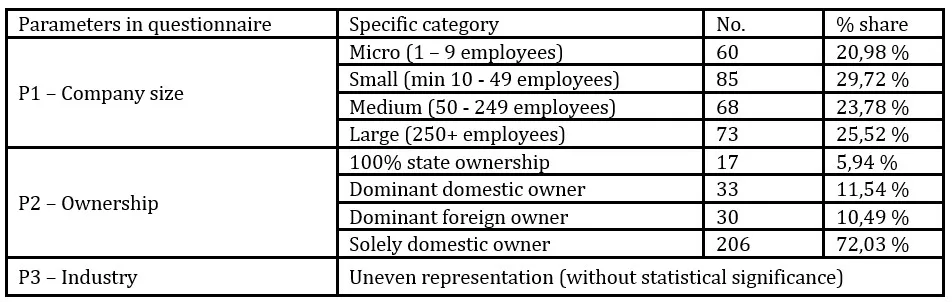
The research sample comprised a total of 286 respondents from companies operating in Slovakia. Respondent selection was conducted via convenience sampling; therefore, the results cannot be fully generalized to the entire population. Nonetheless, they provide a relevant insight into the investigated issue. The structure of the research sample was analyzed based on selected demographic variables (Table n. 1): Variable P1 represents company size; as illustrated in Table 1, the enterprises are relatively evenly distributed. Variable P2 represents the ownership structure of the company, which was dominated by entities with exclusively domestic ownership. Variable P3 indicates the respondents’ industry.
The inclusion of micro, small, medium-sized, and large enterprises provided variation in organizational size, which is relevant because ICT implementation capacity may differ considerably across firms. However, the use of convenience sampling and the national context of Slovakia should be taken into account when interpreting the external validity of the findings. The sample is therefore best understood as an empirical basis for testing the proposed mediation logic rather than as a fully representative profile of all enterprises.
Table 1: Research sample characteristics (Source: prepared by authors)
(Source: prepared and created by authors)
Research Design
In our research, we had only one predictor variable: The strategic importance of Information and Communication Technology (ICT). We had three mediator variables: 1. Implementation of digitalization; 2. Implementation of virtualization; 3. Implementation of augmented reality (AR). And finally, we had four dependent variables: 1. Work intensity/work load, 2. Independence at work, 3. Degree of supervision/control, 4. Work/life balance. The four dependent variables were operationalized by four separate survey questions asking respondents how the use of ICT and digital technologies affects (1) the tempo of their work, (2) their autonomy at work, (3) the degree of supervision/control over their work, and (4) their work–life balance. Each of these items was evaluated on the same 7-point scale ranging from 0 to 6.
Combining these mediators with dependent variables, we created 12 mediation models that represent all possible combinations. Primarily, we were interested in the three mediation models where: predictor is: Strategic importance of Information and Communication Technology (ICT), dependent variable is: Work intensity/work load in organizations, mediators are: 1. Implementation of digitalization; 2. Implementation of virtualization; 3. Implementation of augmented reality (AR).
Based on these models, we set our hypotheses as follows:
H1: The implementation of digitalization significantly mediates the relationship between the strategic importance of Information and Communication Technology (ICT) and work intensity/load within organizations.
H2: The implementation of virtualization significantly mediates the relationship between the strategic importance of Information and Communication Technology (ICT) and work intensity/load within organizations.
H3: The implementation of augmented reality significantly mediates the relationship between the strategic importance of Information and Communication Technology (ICT) and work intensity/load within organizations.
The mediation design was selected because the theoretical argument assumes that ICT strategy may influence workload indirectly through implementation processes. In this model, the path from strategic ICT importance to each mediator represents the association between strategic prioritization and the implementation of a given technology, while the path from each mediator to the dependent variable represents the association between technological implementation and perceived work consequences. Testing the models separately made it possible to compare whether digitalization, virtualization, and augmented reality functioned in the same way or whether their mediating roles differed.
Results
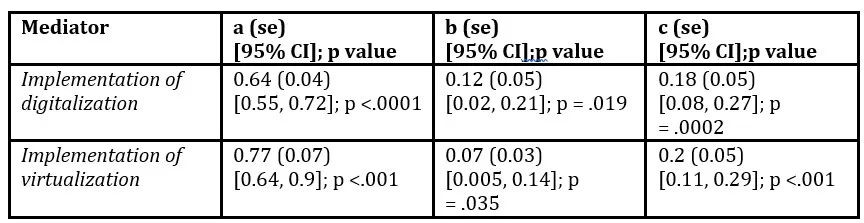
To clarify the outcome structure of the study, four dependent variables were operationalized through four separate survey questions capturing respondents’ perceptions of how the use of ICT and digital technologies affects the tempo of their work, their autonomy at work, the degree of supervision/control over their work, and their work–life balance. These four outcome variables were combined with the three mediators—implementation of digitalization, implementation of virtualization, and implementation of augmented reality—to produce a total of 12 mediation models. Although all 12 models were estimated, statistically significant partial mediation was observed only in the models where work intensity/workload served as the dependent variable. More specifically, the significant results concerned the models with digitalization and virtualization as mediators, as reported in Tables 2–4. The remaining models, based on autonomy at work, degree of supervision/control, and work–life balance, did not show statistically significant mediation effects and are therefore not presented in comparable detail.
As discussed above, we tested all twelve mediation models, but, out of all the investigated mediation models, only two demonstrated statistical significance for partial mediation, thereby confirming the mediation effect (see Tables 2, 3, and 4).
The pattern of results indicates that the strongest empirical support was found for the outcome most directly linked to work intensification. Although our study also examined autonomy, supervision/control, and work-life balance, these outcomes did not produce statistically significant mediation effects in the tested models. This suggests that the implementation of digitalization and virtualization is more clearly related to the tempo and intensity of work than to broader perceived changes in autonomy, control, or work-life balance in this sample. The absence of significant mediation for augmented reality should also be interpreted cautiously, because this technology may be less widely implemented than conventional digitalization and virtualization.
Table 2: Mediation Estimates where: predictor variable is: Strategic importance of Information and Communication Technology (ICT), dependent variable is: Work intensity/work load in organizations, mediator variable is: Implementation of digitalization.
(Source: prepared and created by authors)
A comparison of the individual effects expressed as percentages within the mediation model (with “implementation of digitalization” as the mediator) reveals that the indirect effect (mediation estimates a x b) accounts for only 29.19% of the total effect. The primary strength of the relationship resides in the direct effect: c = 70.81%. Likewise, in the case of the second statistically significant mediation model, the mediation model (with “implementation of virtualization” as the mediator) reveals that the indirect effect (mediation estimates a x b) accounts for only 21.6 % of the total effect. The primary strength of the relationship resides in the direct effect: c = 78.4%.
Table 3: Mediation Estimates where: predictor variable is: Strategic importance of Information and Communication Technology (ICT), dependent variable is: Work intensity/work load in organizations, mediator variable is: Implementation of virtualization.
(Source: prepared and created by authors)
The obtained results thus indicate in both cases only partial mediation: the variables: Implementation of virtualization and Implementation of digitalization mediate the relationship between Strategic importance of Information and Communication Technology (ICT) and Work intensity/work load in a statistically significant, albeit non-exclusive, manner.
Table 4: Path Estimates for the two above-described mediation models (table 3 and 4), where the predictor is variable: Strategic importance of Information and Communication Technology (ICT), and the dependent variable is: Work intensity/work load in organizations, and mediator variables are: Implementationof digitalization and Implementation of virtualization.
(Source: prepared and created by authors)
In the mediation models, the direct effect was found to be statistically significant. In other words, the strategic importance of Information and Communication Technology (ICT) has a statistically significant positive impact on the Implementation of digitalization, virtualization, and augmented reality.
Based on the results above, we accept hypotheses H1 and H2, and we reject hypothesis H3.
The results further show that the direct effect remained statistically significant in both supported mediation models. This means that digitalization and virtualization explain part, but not all, of the relationship between strategic ICT importance and workload. From an empirical perspective, this finding is important because it prevents an overinterpretation of the mediation effects and indicates that additional organizational factors may contribute to work intensification.
Discussion
Our findings indicate that the variable Strategic importance of Information and Communication Technology (ICT) significantly drives work intensity, partially mediated by the implementations of two mediator variables: 1. digitalization, and 2. virtualization. This supports Zhang et al. (2025) findings, who strongly link digitalization to heightened work intensity and role overload. The relationship’s primary strength resides in the direct effect rather than indirect mediation (tables 2 and 3), confirming that ubiquitous digital access systematically accelerates work pace (Cavicchioli et al., 2025). Accepting H1 and H2 provides empirical backing for the reinforcing cycle where technology adoption and work load/intensity mutually amplify over time (Zacher & Rudolph, 2024). Conversely, we found that the implementation of augmented reality (H3) did not demonstrate a statistically significant mediation effect. While augmented reality creates distinct cognitive workload profiles (Xi et al., 2023), its current organizational adoption may lack the comprehensive enterprise readiness typically associated with standard digitalization (Magalhães et al., 2020). Another explanation could be that augmented reality is still not fully present in most of the organizations and in the future this relationship could change and will become significant.
Our research has several limitations. Firstly, we utilized convenience sampling comprising 286 respondents from companies operating strictly in Slovakia, which means the results cannot be fully generalized to the broader foreign population. Furthermore, utilizing only a single predictor variable restricts the broader contextualization of these technological mechanisms.
Another limitation concerns the use of single survey items for the dependent variables. While this approach was suitable for a concise enterprise survey, future studies could use multi-item scales to capture work intensity, autonomy, supervision, and work-life balance more comprehensively. This would also allow researchers to test measurement reliability of used instruments and compare whether the observed relationships differ across more nuanced dimensions of work experience.
A practical implication of these findings is that the strategic prioritization of ICT should be treated not only as a technological decision but also as an organizational change process with consequences for employees’ work intensity (Vial, 2019). Since digitalization and virtualization partially mediate the relationship between ICT importance and workload, their implementation should proceed gradually and be monitored carefully rather than introduced simultaneously (Nasiri et al., 2022). Organizations should assess whether new tools increase task volume, time pressure, or response expectations, as prior research has linked digitalization and ICT use to greater work intensity, role overload, and employee strain (Ayyagari et al., 2011; Zhang et al., 2025; Meyer & Hünefeld, 2021; Chesley, 2014). This suggests for the organization and managers in the need for clear role communication, employee support, and regular workload review during implementation. From an academic perspective, future research should examine the specific conditions under which ICT-related implementation is more likely to intensify workload, including sectoral differences, organizational size, and implementation maturity. Also longitudinal designs would be useful for testing whether these effects remain stable or strengthen over time. Overall, the present findings support a more balanced research agenda that considers both the performance potential of ICT and its human costs.
The fact that the mediation effects were partial rather than full is important for interpretation. It suggests that implementation of digitalization and virtualization explains only part of the relationship between ICT importance and workload, while other organizational mechanisms may also be involved. These mechanisms may include changes in managerial expectations, communication routines, reporting requirements, or performance monitoring practices (Barley et al., 2011; Mazmanian et al., 2013) that accompany strategic ICT orientation but were not directly measured in this study. Future research should therefore examine whether organizational culture, leadership style, digital skills, or employee participation in implementation decisions moderate the workload consequences of ICT strategy. Such extensions would help distinguish between technology-driven work intensification and broader management practices associated with digital transformation.
Conclusion
When the strategic importance of Information and Communication Technology ICT is effectively embedded into corporate strategy, firms are driven to systematically implement digitalization and virtualization in their internal processes. However, this strategic alignment significantly increases work intensity and overall workload for their employees. To ensure sustainable growth, management must balance strategic ICT investments with proactive organizational measures to prevent the well-documented side effects of digitalization, namely employee strain and job burnout (Chesley, 2014; Zhang et al., 2025). Thus, the study does not argue against ICT prioritization. Rather, it indicates that strategic ICT decisions should be accompanied by managerial attention to employees’ workload consequences. This finding is relevant because it positions ICT implementation as a dual process: it may support organizational modernization while also creating conditions under which employees experience greater work intensity. This balanced interpretation is particularly important for managers who seek efficiency gains without unintentionally increasing employee strain.
Acknowledgement
This research was supported by a grant from the Ministry of Education, Science, Research and Sport of the Slovak Republic, VEGA 1/0520/24, titled “Aspects of Building the Company’s Ambient Ecosystem”.
References
Ayyagari, R., Grover, V. and Purvis, R. (2011), ‘Technostress: Technological antecedents and implications,’ MIS Quarterly, 35(4), 831-858. [Online], [Retrieved June 15, 2026], https://doi.org/10.2307/41409963
Barley, S. R., Meyerson, D. E. and Grodal, S. (2011), ‘E-mail as a source and symbol of stress, ‘ Organization Science, 22(4), 887-906. [Online], [Retrieved June 15, 2026], https://doi.org/10.1287/orsc.1100.0573
Bharadwaj, A., El Sawy, O. A., Pavlou, P. A. and Venkatraman, N. (2013), ‘Digital business strategy: Toward a next generation of insights, ‘ MIS Quarterly, 37(2), 471-482. [Online], [Retrieved June 15, 2026], https://doi.org/10.25300/MISQ/2013/37.2.3
Cavicchioli, M., Demaria, F., Nannetti, F., Scapolan, A. C. and Fabbri, T. (2025), ‘Employees’ attitudes and work-related stress in the digital workplace: An empirical investigation, ‘ Frontiers in Psychology, 16,
Chesley, N. (2014). ‘Information and communication technology use, work intensification and employee strain and distress, ‘ Work, employment and society 28(4), 589-610.
Focacci, C. N., Pichault, F. and Rondeaux, G. (2025), ‘Managers in the era of digital transformation: navigating the dual realities of time, ‘ New Technology, Work and Employment 40(3), 458-467.
Magalhães, P. M., Sousa, H., Gonçalves, M. C., Calvetti, D., Dias, P. and Camargo, F. (2020), ‘People, Process, Technology in Construction 4.0 – Balancing Knowledge, Distrust and Motivations’. [Online], [Retrieved April 05, 2026], https://doi.org/10.46421/2706-6568.37.2020.PAPER016
Mazmanian, M., Orlikowski, W. J. and Yates, J. (2013). ‘The autonomy paradox: The implications of mobile email devices for knowledge professionals, ‘ Organization Science, 24(5), 1337-1357. [Online], [Retrieved June 18, 2026], https://doi.org/10.1287/orsc.1120.0806
Meyer, S. C. and Hünefeld, L. (2021). ‘Work related ICT use and work intensity, ‘ Soziale Welt, 72(H. 4), 453-482.
Nasiri, M., Saunila, M. and Ukko, J. (2022). ‘Digital orientation, digital maturity, and digital intensity: determinants of financial success in digital transformation settings,’ International Journal of Operations & Production Management, 42(13), 274–298. [Online], [Retrieved April 14, 2026], https://doi.org/10.1108/ijopm-09-2021-0616
Pusch, T., Kudic, M., Gerbracht, M. and Hochhaus, J. (2024). ‘Transformation der Arbeit durch die Einführung neuer digitaler Technologien,’ Wirtschaftsdienst. [Online], [Retrieved April 18, 2026], https://doi.org/10.2478/wd-2024-0093
Thiemann, D. and Kozica, A. (2019). ‘Digitalisierung der Arbeitswelt: Eine empirische Analyse relevanter Handlungsfelder bei der digitalen Transformation von Geschäftsprozessen,’ Praxis Der Wirtschaftsinformatik, 56(4), 721–734. [Online], [Retrieved April 10, 2026], https://doi.org/10.1365/S40702-019-00545-2
Vial, G. (2019). ‘Understanding digital transformation: A review and a research agenda,’ Journal of Strategic Information Systems, 28(2), 118-144. [Online], [Retrieved June 18, 2026], https://doi.org/10.1016/j.jsis.2019.01.003
Wang, S. and Zhang, H. (2025). ‘Digital Transformation and Innovation Performance in Small- and Medium-Sized Enterprises: A Systems Perspective on the Interplay of Digital Adoption, Digital Drive, and Digital Culture,’ Systems, 13(1), [Online], [Retrieved April 05, 2026], https://doi.org/10.3390/systems13010043
Xi, N., Chen, J., Gama, F., Riar, M. and Hamari, J. (2023). ‘The challenges of entering the metaverse: An experiment on the effect of extended reality on workload,’ Information Systems Frontiers, 25(2), 659-680.
Zacher, H. and Rudolph, C. W. (2024). ‘Workplace digitalization and workload: changes and reciprocal relations across 3 years,’ Dental Science Reports, 14. [Online], [Retrieved April 10, 2026], https://doi.org/10.1038/s41598-024-56537-w
Zhang, B., Han, X., Yang, J., Akylbekova, N., Biibosunov, B. I. and Ibraimova, S. M. (2025). ‘Research on the correlation between information technology applications driven by digital transformation and enterprise business process optimization and management model innovation,’ Edelweiss Applied Science and Technology, 9(8), 1413–1437. [Online], [Retrieved April 14, 2026], https://doi.org/10.55214/2576-8484.v9i8.9640
Zhang, Q.-A., Dai, W., Chen, J., Gu, Y. and Zhao, Y. (2025). ‘The “side effects” of digitalization: A study on role overload and job burnout of employees,’ PLOS ONE. [Online], [Retrieved April 10, 2026], https://doi.org/10.1371/journal.pone.0322112