Volume 2026,
Article ID 178858,
IBIMA Business Review,
12 pages,
DOI: https://doi.org/10.5171/2026.178858
Received date: 12 December 2025; Accepted date: 7 February 2026; Published date: 9 June 2026
Academic Editor: Hishamuddin Bin Ismail
Cite this Article as:
Severina Marsovna KHAMIDOVA and Yanqing WANG (2026)," The Moderating Role of Network Management and Environment in Business Networks for Entrepreneurship: A Systematic Narrative Review (1995-2020) “, IBIMA Business Review, Vol. 2026 (2026), Article ID 178858, https://doi.org/10.5171/2026.178858
This research presents a systematic narrative review of research on how business networks contribute to entrepreneurship. Analysing 35 relevant articles published between 1995 and 2020, the review identifies two critical moderating factors that determine the effectiveness of business networks for entrepreneurial development: network management and the network environment. Furthermore, the analysis reveals that these moderating factors are themselves influenced by the demographic characteristics of entrepreneurs and the specific attributes of their firms. The findings offer practical guidance for entrepreneurs, suggesting that strategic attention to network governance and environmental context tailored to their specific profile is key to enhancing firm performance and ensuring survival.
Keywords: business networks, entrepreneurship, review
Introduction
Business networks evolve as a result of technological development, social networks, network construction capabilities, and the development of international relations (Ma et al., 2019). Business relations provide entrepreneurs with opportunities to obtain various tangible and intangible resources, with the availability of such resources depending on the approach used by respective entrepreneurs to manage their business networks (Hoang and Antoncic, 2003). The existent literature is important to review as it examines the elements that play a role in the degree of effectiveness that business networks have in influencing entrepreneurship development.
Various external and internal moderating factors affect business networks. Research conducted by Boehe (2013), Beckman et al (2004) and Wang et al (2015), for instance, confirmed the influence of both network location and organisational size on the innovation performance of an organisation.
Other moderating factors, that affect business networks, include: the behaviour of entrepreneurs and the entrepreneurs’ drive to connect with international firms (Jack et al., 2008; Abdul-Aziz et al., 2011). It has been concluded that entrepreneurs should be very selective in building international business networks, as selecting the right ones can help create strong competitive advantages and greater innovation efficiency (Zaefarian et al., 2016 Markovic et al., 2021).
The above-mentioned findings are a call to action for the use of a systematic narrative review (SNR) with an advanced systematic database search method. Such a method relies on scholarly research from peer-reviewed academic articles from high-ranked business journals.
The structure of this SNR includes: a discussion about the applied SNR methodology; an explanation of review protocols; descriptive and thematic analyses of the findings; data synthesis; along with conclusion and limitations.
Choosing a Review Methodology
The review methodology adopted in this research was inspired by two methodologies: a systematic literature review (Tranfield et al., 2003; Macpherson and Holt, 2007; Crossan and Apaydin, 2010); and an SNR (Hakala et al., 2020; Green et al., 2006).
A systematic literature review involves three steps: (1) defining the review protocols; (2) analysing the data (in terms of descriptive and thematic analysis), and (3) synthesising the data. Methodological triangulation is used to obtain perspectives from data sources, which increases the reliability and validity of data (Durif-Bruckert et al., 2014).
Due to the designs of the research selected for this review (including a variety of research types and approaches to analysis), the above standard approach of using meta-analysis for conducting steps (2) and (3) of a systematic literature review was not possible. An SNR approach was instead used for synthesis. An SNR describes a summary of diverse research papers (Hill and Burrows, 2017).
Definition of the Review Protocols
Planning and Processing
Systematic search methods were used to extract relevant and high-quality studies. A definition of the review protocol was identified with inclusion and exclusion criteria (Macpherson and Holt, 2007; Bhimani et al., 2019).
A first filter ensured that articles were in either EBSCO host, Emerald or Science Direct databases. This was done for two reasons: they represent the leading databases, that provide the most valuable information to researchers and practitioners (Zott et al., 2011; Singh and Sahu, 2020); and they were accessible to the authors at the time of writing. The database search and collection of articles were conducted on December 27th-28th 2021.
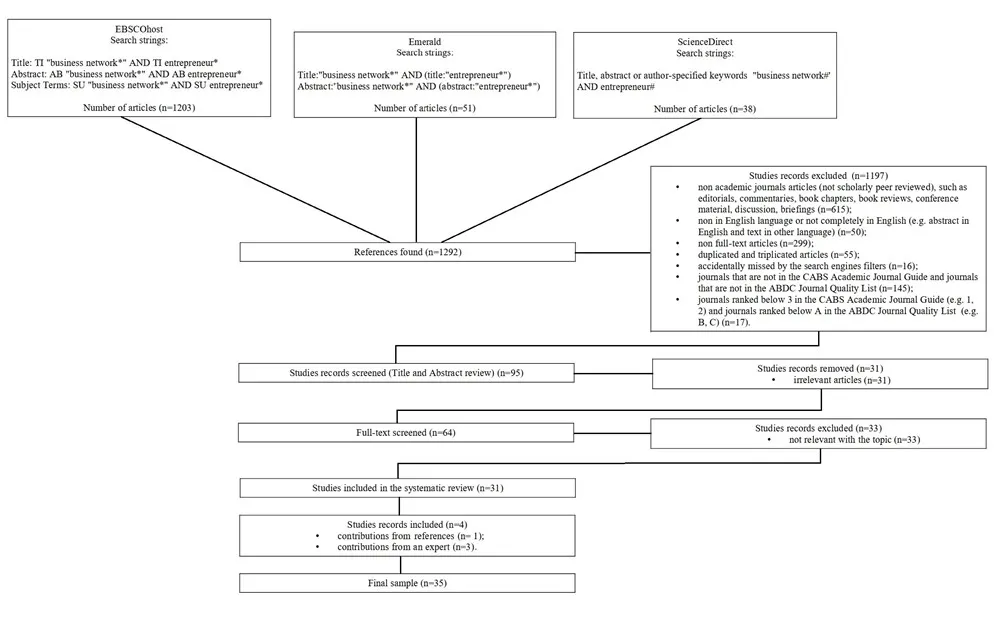
A second filter used keywords to extract thematically appropriate articles. Keywords were used to search three fields (“Titles”, “Abstract” and “Keywords/Subject Terms”): “business network*” AND entrepreneur* (Figure 1). The initial sample consisted of 1292 articles.
The third filter ensured that this SNR included only peer-reviewed articles that had undergone a rigorous review process. 615 articles were removed from the initial sample (677 remaining articles).
The fourth filter meanwhile included a selection of articles based on English language (627 remaining articles).
The fifth filter meanwhile served to exclude articles that were incomplete or were not fully accessible given the privileges associated with the university-affiliated research account (328 articles remaining).
The sixth filter removed duplicates from the above-mentioned databases using Zotero software based on Title and Abstract screening (273 articles remaining). Thereafter, an additional 16 articles were removed, as they were identified as non-academic and/or non-English language (257 articles remaining).
Finally, the analysis further filtered articles that were highly ranked in both the Chartered Association of Business Schools Academic Journal Guide 2021 (CABS) and the Australian Business Deans Council Journal Quality List (ABDC). Only articles published in 4*, 4 and 3 ranked journals (according to the CABS), and articles that were published in A* and A ranked journals (according to the ABDC) were retained (Vrontis et al., 2020; Siachou et al., 2021). In order to further refine the search, the authors proceeded to read the Titles and Abstracts of the 95 remaining articles. This filter resulted in 64 articles meeting the prescribed criteria. After a full-text scan, only 31 articles were identified for further evaluation.
As an additional precaution and in order to minimize the possibility of omitting an article from the SNR, references from among the selected 31 articles were carefully studied. Suitable articles from the references were also filtered through inclusion and exclusion criteria. This referencing led to the inclusion of an additional article into the final list (32). To ensure the validity and reliability of the selected articles, consultations took place with an expert. The authors of this SNR provided a list of the 32 articles and asked the expert to find other relevant articles that should be added to the final list. The expert recommended three articles that were subsequently added to the list. After all the stages, the final sample contained 35 articles.
Fig 1.Process of selecting articles included in the review
Analysis of the Data
Descriptive Analysis of the Literature
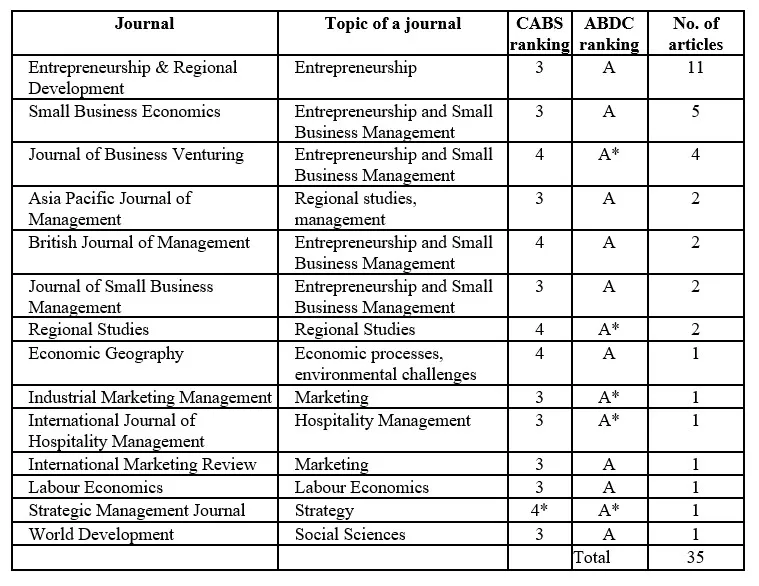
The present section analyses data extracted from the final list of articles (articles marked with an asterisk (*) in the reference list). An overview includes the technical characteristics of the 35 articles (filtered from the original 1292). These characteristics were collected and sorted into the following categories: year of publication, name(s) of the author(s), article title, journal title, journal rank based on the CABS and ABDC (Table 1), type of research study, methodological approach and publication details (sample and data characteristics, geographical location) (Figure 2; Figure 3). This approach helped systematize and visualize the large volume of technical characteristics associated with the articles.
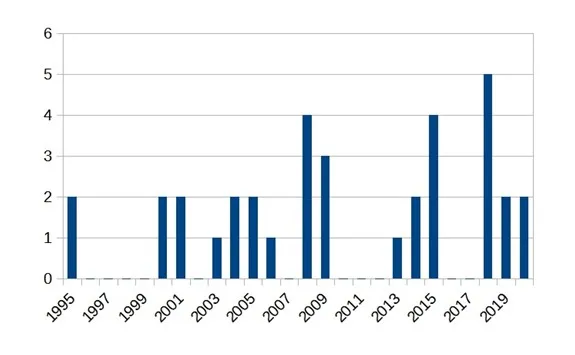
As previously mentioned, this SNR had no time limitations. Figure 4 shows that the earliest articles that were included in this review, both published in 1995, were concerned about how features of a business network influenced the development of entrepreneurship. Further, from Figure 4, it can be seen that the number of published articles varied over time between 2004 and 2018, albeit with periods of increased attention to the field by scholars in the latter half of this period (except for 2019 and 2020). This result reflects an overall trend of researchers seeking to better understand how business networks influence entrepreneurship development.
The findings of the SNR demonstrate that, from the sample of 35 articles, the majority were empirical (82.86%), with only two being theoretical (5.71%) and four conceptual (11.43%). This suggests that the relevant literature was characterized mostly by empirical and conceptual studies, while theoretical studies represented a small percentage of publications. In terms of methodological approach in the sample articles: 51.43% of the studies relied on a quantitative methodological approach; qualitative methodology approaches were used in 28.57% of the studies; and mixed qualitative and quantitative methodology approaches were employed in 20% of the studies.
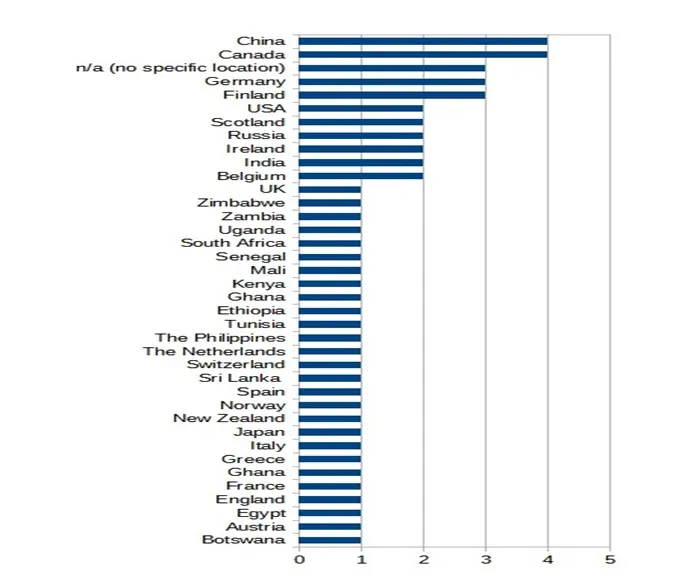
An analysis of the geographic focus of the 35 articles revealed that studies had been undertaken in different jurisdictions, but there was a strong geographic clustering of the research (illustrated in Figure 2). Four studies focused on studying cases in Canada and China respectively, while Germany and Finland were both the focus of three studies. The rest of the studies used one or two countries as a sample in their research or did not provide any information about their geographical coverage.
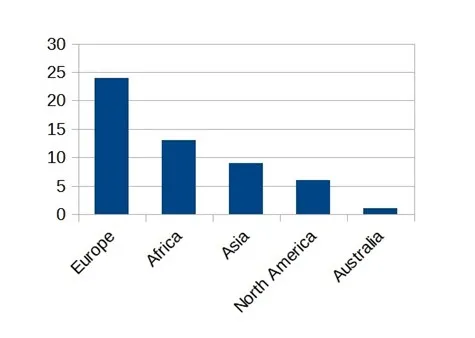
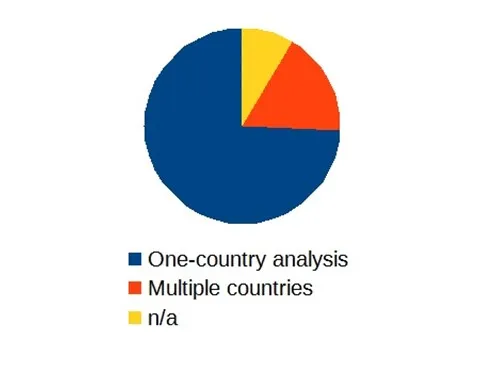
Despite there being 35 articles included in the SNR, the number of countries represented by the articles totalled 37. As can be demonstrated in Figure 5, only six articles studied more than one country. In addition, results show that despite most studies taking into account only one country (74.29%), there was significant geographical concentration as countries from Europe (45.28%) and Africa (24.53%) turned out to be the most frequently studied (Figure 3). The above trends reflect a lack of representation of the study of countries from continents other than Europe and Africa.
The results, therefore, underscore the need for comparative analyses between countries, along with developing more knowledge in countries that have not already been widely studied.
Table 1: The list of journals included in the sample
Fig 2. Geographical locations of samples in selected articles
Fig3. The most studied geographical continents
Fig 4. Number of articles per year
Fig 5. Country-focus analysis
Thematic Analysis of the Literature
A thematic analysis of 35 articles made it possible to identify key themes, on which two moderating factors were based: the network management and the network environment. Further details of each moderating factor as part of an SNR are provided in the next section.
Data Synthesis
Network Management
The first moderating factor in this SNR is network management. The following is an overview of the articles included in this review that featured an analysis of network management.
Many studies have focused on network management. Huggins et al (2015), as well as Zhao and Aram (1995), emphasized that networks need to be managed actively, especially at an early stage of the firm’s life cycle. The importance of early-stage network management was echoed by findings from a study on French micro-startups which ultimately confirmed that being involved in a business network in the startup design phase has a positive impact on start-up growth (Boyer and Blazy, 2014). Similarly, the experience of startups in the biotechnology industry in Canada showed that, when alliance networks were created early, these resulted in both a faster subsequent transition from organisation to operation, as well as higher initial productivity for organisations (Baum et al., 2000). Other considerations in network management are related to both the early creation of business networks and also the initial size of such networks. One study found that an initially large network had a negative impact on furthering the diversity and the dynamics of the network’s size (Batjargal, 2006). This finding means that firms with larger organisational networks at the early stages of their life cycle will have less initiative to develop their networks in the late stages.
A sub-set of the articles underscored the existence of several key characteristics of a business network. Chell and Baines (2000), for example, noted that the quality of network activity depends on the type of owner-manager. Their finding pointed to the importance of the behaviour of the owner-manager as being a key driver to the business performance of firms.
The importance of individuals within enterprises was also a recurring theme in a number of articles that were considered in this SNR. For example, the entrepreneur’s previous managerial experience was found to influence the activity and innovation levels of respective enterprises, but such influence was not always positive (Boyer and Blazy 2014). One of the 35 articles discovered that the performance of the organisation depends on the style of business network utilization as well as the resilience and self-efficacy of entrepreneurs (Newman et al., 2018). The creative capacity of an entrepreneur meanwhile was noted as important to strengthen relatively weak ties between a firm and other business entities, along with enhancing its innovative intensity (Julien et al., 2004). Active management strategies were similarly found to help benefit firm performance by developing external partnerships (Boso et al., 2013; Su et al., 2015). External relations meanwhile were found to provide an access to competitive advantages (George et al., 2001). Lastly, one research team found that firms could extend their external networks by benefiting from entrepreneurs who engaged in greater intensity and range of networking (Zhao and Aram, 1995).
Building on the above, some articles found that an intensive collaboration, along with motivation to participate in joint projects, were beneficial to entrepreneurship development. These were found to increase both knowledge base and innovation levels (Elvekrok et al., 2018). The practice of collective involvement was found to foster the creativity and innovation of startups (Braun et al., 2018). Furthermore, the researchers concluded that participation in trade fairs increased national and international contacts, which in turn helped stimulate the growth of enterprises (Donckels and Lambrecht, 1995; Hampel-Milagrosa et al., 2015).
Other articles meanwhile found that network capabilities could positively affect a firm’s performance (Li et al., 2009; Srećković, 2018). Similarly, Donckels and Lambrecht (1995) found that organisations that opted not to participate in trade fairs (and therefore forego the opportunity to foster contacts) only enjoyed regional contacts. This may be contrasted with research that has shown that firms with more network relations have more non-material and material support (Premaratne, 2001).
Network Environment
The second moderating factor used in this SNR is the network environment. Below is an overview of the articles that featured an analysis of the network environment along with brief summaries of their respective findings.
The importance of a network environment to a firm has been widely studied. Findings in the articles have approached the study of the network environment through different lenses. For instance, a multi-jurisdictional study of Finland, New Zealand, and Canada found that internationalization and the environment affect the nature of the business network (Leppäaho et al., 2018). That same study also showed that the size of the domestic market, locality of universities and research institutes, as well as different cultural contexts, can serve as an incentive to search for contacts internationally. Moreover, that same study also discovered that Canadian entrepreneurs had focused on domestic customers and relied on local research institutions, as opposed to Finnish and New Zealand-based entrepreneurs who deployed a strategy of collaborating with both local and international research institutions. A small market size was found to be the driver that encouraged the latter group to focus mainly on international customers. The above conclusions from the above-mentioned multi-jurisdictional analysis imply that the strategy of dealing with domestic and/or international universities, as well as research institutes, depends heavily on both cultural context and the local business climate.
Another article noted that, in order to reach international markets, business networks should be open to establishing inter-regional and international cooperation with unknown firms as well as developing business networks that foster mutual trust (Semlinger, 2008). Trust is assessed by the experience of enterprises; therefore, it is very important to share information about good and bad practices in order to exclude free-riders (Parker, 2008). This approach allowed business networks to emerge naturally and increase the efficiency of enterprises (Mackinnon et al., 2004; Parker, 2008). New generation African entrepreneurs meanwhile quickly internalized information about beneficial business practices, adopted common strategies found in other jurisdictions and adapted these to the conditions in their own countries (McDade and Spring, 2005). Such entrepreneurs were attracted by the possibility of financial independence; these were ready to work hard and develop their business acumen (McDade and Spring, 2005).
Developed business networks have also been known to help individual organisations grow their network capital. Huggins and Thomson (2015) found that the capacity to accumulate network capital from external organisations helps enterprises to overcome the inability to generate all the knowledge necessary for innovation and development. They also noted that, upon reaching a maturity phase, enterprises were less likely to gain access to knowledge from other firms outside their own regions and countries. A longitudinal network analysis of manufacturing and business services enterprises in the Netherlands meanwhile showed that, after three years, young firms narrow their territorial boundaries to inter-regional ties (Schutjens and Stam, 2003). However, it should be noted that not every entrepreneur has the ability to accumulate a business network. An article with a focus on Tunisia concluded that entrepreneurial education does not have the desired effect on the ability to accumulate business networks (Alaref et al., 2020; Yang et al., 2019). Meanwhile, research conducted in Finland found that a conducive institutional environment can contribute to the development of competence (Torkkeli et al., 2019). The above shows that, ultimately, developing the ability to accumulate network capital depends on different countries’ institutional environments.
In addition, the location may be an influencing factor on business networks (Parker 2008). Accessibility to external business networks and the efficiency of such business networks were higher in urban areas than in rural ones (Parker, 2008). Copus et al (2008) also found that urban areas provide greater accessibility to building business networks. Finally, a study of the Aberdeen oil complex conducted by Mackinnon et al (2004) empirically proved that extra-local networks offer necessary access to broader sources of knowledge.
As mentioned above, both the ability to accumulate networks and the location of the firm played an important role in entrepreneurship development. At the same time, network institutions have also been deemed essential (Aidis et al., 2008). In the case of Russia, some institutions have created a negative and hostile business environment, especially during the startup phase of business development (Aidis et al., 2008). Access to business networks in Russia is controlled by ‘entrepreneurial insiders’, which are enterprises with extensive business experience; these were deemed detrimental to start-up business activities. The less access to existing business networks, the more vulnerable Russian entrepreneurs at the heads of startups were to extortion by officials. Widespread distrust, suspicion, and ambivalence among Russians were found to exacerbate the situation (Batjargal, 2006).
An American study similarly supported the importance of the environment as it relates to business networks (Gittell and Sohl, 2005). Gittell and Sohl (2005) concluded that close ties and tight networks could lead to group thinking, irrational behaviour and make it difficult to reverse non-prudent group behaviour. Notwithstanding the above findings from the USA and Russia, a study conducted by Tajeddini et al. (2020) about the Japanese hospitality industry showed that, when strong business and social networks interacted, business performance was likely to increase. Lastly, one article from China found that, in a transition economy, firms needed to establish close ties with both business partners and government agencies in order to be successful (Yang et al., 2019). The above findings lead to the conclusion that superior business performance could be influenced by a number of factors, including (but not necessarily limited to) the location of a dynamic institutional environment and the strength of the business network in which the organisation is established.
The theme of unequal opportunity was also prevalent in the literature. A number of articles concluded that unequal access to business networks based on entrepreneurial identity, namely gender, determined entrepreneurial outcomes (Hanson and Blake, 2009; McGrath and O’Toole, 2014). Differences in ethnicity were also found to play a role in limiting access to transnational networks for a number of Canadian ethnic and minority groups (Kariv et al., 2009).
Conclusion
This SNR aimed to clarify the existent knowledge about the role that two moderating factors play in the degree of effectiveness that business networks have in influencing entrepreneurship development.
35 articles showed: that entrepreneurs take into account the conditions of the business environment; and that these should strive to use all the possibilities of the network at the stage of planning, managing and establishing business network relations.
Taking into account the institutional environment of the countries in which firms are located is also important for survival. Entrepreneurs should not only be open to participating in fairs but also be able to establish new network contacts at different regional and international levels, especially at the initial stage of the life cycle of their enterprise. The initial size of the business network that they are a part of should be moderate, rather than large. This is preferred, as it would avoid the negative impacts that are expected when a firm in its infancy builds a large business network.
Participating in fairs and sharing the firm’s experience with other firms helps acquire new knowledge, opportunities and resources. This may increase mutual trust between firms and speed up the business networking rate.
It is hoped that this SNR may also inspire new research. There is a strong need for additional comparative analyses of firms in a variety of jurisdictions. Future research is also encouraged to consider exploring the moderating factors of business networks that influence entrepreneurship development in multiple countries that have yet to be represented in the existent research.
Limitations
The research approach has three primary limitations. The first limitation is related to the search engine. The systematic search of online databases has proved a useful formula for locating research on the topic. Future research may wish to expand the number of databases to include in the search.
The second limitation concerns experts. Only one expert in the field of business and entrepreneurship was involved in identifying methodological limitations. The general guide for conducting a literature review suggests collaborating with two reviewers for the purposes of reviewing the selected articles to ensure the quality and reliability of the search protocol (Snyder, 2019).
Finally, the third limitation relates to the analysis of the articles. This review used an SNR that did not feature meta-analysis. Meta-analysis could be used with selected articles that are quantitative in nature to simplify the review process.
Acknowledgements
The authors are grateful to Sacha Alaby for his insightful comments and suggestions that enhanced the quality of the article.
References
Abdul-Aziz, AR. et al. (2011), ‘Internationalization of Malaysian quantity surveying firms: exploring the best fit models,’ Construction Management and Economics, 29, 49-58.
*Aidis, R., Estrin, S. and Mickiewicz, T. (2008), ‘Institutions and entrepreneurship development in Russia: A comparative perspective,’ Journal of Business Venturing, 23 (6), 656-672.
*Alaref, J., Brodmann, S. and P. (2020), ‘The medium-term impact of entrepreneurship education on labor market outcomes: Experimental evidence from university graduates in Tunisia,’ International Journal of Hospitality Management, 62, 101787.
*Batjargal, B. (2006) ‘The dynamics of entrepreneurs’ networks in a transitioning economy: the case of Russia,’ Entrepreneurship and Regional Development, 18 (4), 305-320.
*Baum, JAC., Calabrese, T. and Silverman, BS. (2000), ‘Don’t go it alone: alliance network composition and startups’ performance in Canadian biotechnology,’ Strategic Management Journal, 21 (3),267-294.
Beckman, CM., Haunschild, PR. and Phillips, DJ. (2004), ‘Friends or strangers? Firm-specific uncertainty, market uncertainty, and network partner selection,’ Organization Science, 15, 259-275.
Bhimani, H., Mention, AL. and Barlatier, PJ. (2019), ‘Social media and innovation: A systematic literature review and future research directions,’ Technological Forecasting & Social Change, 144, 251-269.
Boehe, D(2013) ‘Collaborate at Home to Win Abroad: How Does Access to Local Network Resources Influence Export Behavior?,’ Journal of Small Business Management, 51(2),167-182.
*Boso, N., Story, VM. and Cadogan, JW. (2013), ‘Entrepreneurial orientation, market orientation, network ties, and performance: Study of entrepreneurial firms in a developing economy,’ Journal of Business Venturing, 28 (6), 708-727.
*Boyer, T. and Blazy, R. (2014), ‘Born to be alive? The survival of innovative and non-innovative French micro-start-ups,’ Small Business Economics, 42, 669-683.
*Braun, T. et al. (2018), ‘Another Post‐heroic View on Entrepreneurship: The Role of Employees in Networking the Start‐up Process,’ British Journal of Management, 29, 652-669.
*Chell, E. and S. (2000), ‘Networking entrepreneurship and microbusiness behaviour,’ Entrepreneurship & Regional Development, 12, 195-215.
*Copus, A., Skuras, D. and Tsegenidi, K. (2008), ‘Innovation and Peripherality: An Empirical Comparative Study of SMEs in Six European Union Member Countries,’ Economic Geography, 84 (1), 51-82.
Crossan, MM. and Apaydin, M. (2010), ‘A multi-dimensional framework of organizational innovation: A systematic review of the literature,’ Journal of Management Studies, 47 (6), 1154-1191.
*Donckels, R. and Lambrecht, J. (1995), ‘Networks and Small Business Growth: An Explanatory Model,’ Small Business Economics, 7, 273-289.
Durif-Bruckert, C. et al. (2014), ‘Shared decision-making in medical encounters regarding breast cancer treatment: the contribution of methodological triangulation,’ European Journal of Cancer Care, 24 (4), 461-72.
*Elvekrok, I. et al. (2018), ‘Firm innovation benefits from regional triple-helix networks,’ Regional Studies, 52 (9), 1214-12
*George, GD., Wood, RD. and Khan, (2001), ‘Networking strategy of boards: implications for small and medium-sized enterprises,’ Entrepreneurship & Regional Development, 13, 269-285.
*Gittell, R. and Sohl, J. (2005), ‘Technology centres during the economic downturn: what have we learned?,’ Entrepreneurship & Regional Development, 17, 293-312.
Green, BN., Johnson, CD. and Adams, (2006), ‘Writing Narrative Literature Reviews for Peer-reviewed Journals: Secrets of the Trade,’ Journal of Chiropractic Medicine, 5 (3), 101-117.
Hakala, H. et al. (2020), ‘Re‐storying the business, innovation and entrepreneurial ecosystem concepts: The model‐narrative review method,’ International Journal of Management Reviews, 22 (1), 10-32.
*Hampel-Milagrosa, A., Loewe, M. and Reeg, C. (2015), ‘The Entrepreneur Makes a Difference: Evidence on MSE Upgrading Factors from Egypt, India, and the Philippines,’ World Development, 66, 118-1
*Hanson, S. and Blake, B. (2009), ‘Gender and Entrepreneurial Networks,’ Regional Studies, 41 (1), 135-1
Hill, C. and Burrows, G. (2017), ‘New voices: The usefulness of a narrative approach to social work research,’ Qualitative Social Work: Research and Practice, 16 (2), 273-2
Hoang, H. and Antoncic, (2003), ‘Network-Based Research in Entrepreneurship: A Critical Review,’ Journal of Business Venturing, 18, 165-187.
*Huggins, R. and Thompson, (2015), ‘Entrepreneurship, innovation and regional growth: a network theory,’ Small Business Economics, 45 (1), 103-128.
*Huggins, R. et al. (2015), ‘Network evolution and the spatiotemporal dynamics of knowledge sourcing,’ Entrepreneurship & Regional Development, 27 (7-8), 474-4
Jack, S., Dodd, SD. and Anderson, (2008), ‘Change and the development of entrepreneurial networks over time: a processual perspective,’ Entrepreneurship & Regional Development, 20 (2), 125-159.
*Julien, PA., Andriambeloson, E. and Ramangalahy, (2004), ‘Networks, weak signals and technological innovations among SMEs in the land-based transportation equipment sector,’ Entrepreneurship and Regional Development, 16 (4), 251-270.
*Kariv, D. et al. (2009), ‘Transnational networking and business performance: Ethnic entrepreneurs in Canada,’ Entrepreneurship & Regional Development, 21 (3), 239-2
*Leppäaho, T., Chetty, S. and Dimitratos, (2018), ‘Network embeddedness in the internationalization of biotechnology entrepreneurs,’ Entrepreneurship & Regional Development, 30 (5-6), 562-584.
*Li, S., Schulze, W. and Li, Z. (2009), ‘Plunging into the sea, again? A study of serial entrepreneurship in China,’ Asia Pacific Journal of Management, 26 (4), 667-6
Ma, Z. et al. (2019), ‘The impact of overseas human capital and social ties on Chinese returnee entrepreneurs’ venture performance,’ International Journal of Entrepreneurial Behavior & Research, 25 (1), 67-83.
*Mackinnon, D., Chapman, K. and Cumbers, A. (2004), ‘Networking, trust and embeddedness amongst SMEs in the Aberdeen oil complex,’ Entrepreneurship & Regional Development, 16 (2), 87-106.
Macpherson, A. and Holt, R. (2007), ‘Knowledge, learning and small firm growth: A systematic review of the evidence,’ Research Policy, 36 (2), 172-1
Markovic, S. et al. (2021), ‘Business-to-business open innovation: COVID-19 lessons for small and medium-sized enterprises from emerging markets,’ Technological Forecasting and Social Change, 170, 120883.
*McDade, BE. and Spring, (2005), ‘The ‘new generation of African entrepreneurs’: networking to change the climate for business and private sector-led development,’ Entrepreneurship & Regional Development, 17 (1), 17-42.
*McGrath, H. and O’Toole, (2014), ‘A cross-cultural comparison of the network capability development of entrepreneurial firms,’ Industrial Marketing Management, 43 (6), 897-910.
*Newman, A. et al. (2018), ‘Can Your Network Make You Happy? Entrepreneurs’ Business Network Utilization and Subjective Well‐being,’ British Journal of Management, 29, 613-6
*Parker, S C. (2008) ‘The economics of formal business networks,’ Journal of Business Venturing, 23 (6), 627-6
*Premaratne, S P. (2001) ‘Networks, Resources, and Small Business Growth: The Experience in Sri Lanka,’ Journal of Small Business Management, 39 (4), 363-3
*Schutjens, V. and Stam, (2003), ‘The Evolution and Nature of Young Firm Networks: A Longitudinal Perspective,’ Small Business Economics, 21 (2), 115-134.
*Semlinger, K. (2008) ‘Cooperation and competition in network governance: regional networks in a globalised economy,’ Entrepreneurship & Regional Development, 20 (6), 547-5
Siachou, E. et al. (2022), ‘Market knowledge acquisition and transfer in international SMEs: peculiarities, specifications and linkages to market success,’ International Marketing Review, 39 (3), 529-567.
Singh, M. and Sahu, GP. (2020), ‘Towards adoption of Green IS: A literature review using classification methodology,’ International Journal of Information Management, 54, 102147.
Snyder, H. (2019) ‘Literature review as a research methodology: An overview and guidelines,’ Journal of Business Research, 104, 333-3
*Srećković, M. (2018) ‘The performance effect of network and managerial capabilities of entrepreneurial firms,’ Small Business Economics, 50 (4), 807-8
*Su, Z., Xie, E. and Wang, D. (2015), ‘Entrepreneurial Orientation, Managerial Networking, and New Venture Performance in China,’ Journal of Small Business Management, 53 (3), 228-2
*Tajeddini, K., Martin, E. and Ali, A. (2020), ‘Enhancing hospitality business performance: The role of entrepreneurial orientation and networking ties in a dynamic environment,’ International Journal of Hospitality Management, 90, 102605.
*Torkkeli, L. et al. (2019), ‘Institutional environment and network competence in successful SME internationalisation,’ International Marketing Review, 36 (1), 31-55.
Tranfield, D., Denyer, D. and Smart, P. (2003), ‘Towards a methodology for developing -informed management knowledge by means of systematic review,’ British Journal of Management, 14 (3), 207-2
Vrontis, D., Christofi, M. and Katsikeas, CS. (2020), ‘An assessment of the literature on cause-related marketing: implications for international competitiveness and marketing research,’ International Marketing Review, 37 (5), 977-1012.
Wang, H. et al. (2015), ‘Network centrality, organizational innovation, and performance: A meta-analysis,’ Canadian Journal of Administrative Sciences, 32, 146-1
*Yang, H., Dess, GG. and Robins, (2019), ‘Does entrepreneurial orientation always pay off? The role of resource mobilization within and across organizations,’ Asia Pacific Journal of Management, 36 (3), 565–591.
Zaefarian, R., Eng, TY., and Tasavori, M. (2016), ‘An exploratory study of international opportunity identification among family firms,’ International Business Review, 25, 333–3
*Zhao, L. and Aram, JD. (1995), ‘Networking and growth of young technology-intensive ventures in China,’ Journal of Business Venturing, 10, 349-3
Zott, C., Amit, R. and Massa, L. (2011), ‘The business model: Recent developments and future research,’ Journal of Management, 37 (4), 1019–1042