Yuri YACTAYO-ALANYA, Eymi SANCHEZ-VARGAS and Roberto MACHA-HUAMÁN
Universidad Peruana Unión, Lima, Perú
Volume 2026,
Article ID 221508,
IBIMA Business Review,
14 pages,
DOI: https://doi.org/10.5171/2026.221508
Received date: 1 June 2026; Accepted date: 23 September 2026; Published date: 23 October 2026
Cite this Article as:
Yuri YACTAYO-ALANYA, Eymi SANCHEZ-VARGAS and Roberto MACHA-HUAMÁN (2026)," “Adaptation and Validation of a Multidimensional Organizational Justice Scale: Evidence from Transport Sector Workers “, IBIMA Business Review, Vol. 2026 (2026), Article ID 221508, https://doi.org/10.5171/2026.221508
Organizational justice is a key component in ensuring an equitable, functional, and sustainable work environment. The objective of the research was to analyze the adaptation and validation of an organizational justice scale, in order to guarantee its applicability in the Peruvian labor context. The methodology used was a quantitative, cross-sectional and instrumental approach. It was analyzed through the AFE, AFC and PLS-SEM; the sample was 250 workers in the transport sector. The results demonstrated three dimensions: procedural justice, distributive justice and interpersonal justice. The indicators were adequate Chi-square norm (X^2/gl) = 2.564, RMSEA = 0.079, SRMR = 0.021, TLI = 0.972 and CFI = 0.981. It is concluded that the instrument presents adequate levels of validity and reliability, to be applied in other sectors of the Peruvian context.
Organizational justice has been the subject of study for more than four decades in the workplace, as it represents a key component in ensuring a fair, functional, and sustainable work environment. According to Rodríguez (2014), this construct comprises multiple dimensions that are fundamental to effective organizational performance. Various studies have shown that the perception of fairness directly influences employee job satisfaction, organizational commitment, and performance (Ngodo, 2008).
Over time, various instruments have been developed to measure organizational justice, adapted to specific cultural contexts such as the Portuguese (Abril et al., 2020), Italian (Spagnoli et al., 2017), Japanese (Shibaoka et al., 2010) and Mexican (Patlán et al., 2014). However, despite the growing interest in this topic, there is still no scale specifically adapted and validated for the Peruvian context. This absence represents a significant limitation to understanding how organizational justice is perceived in key sectors such as transportation, where work environments tend to be complex and dynamic.
Therefore, this study set out to adapt and validate a scale for assessing organizational justice among Peruvian employees in the transportation sector. This process not only aims to ensure the cultural relevance of the instrument but also to provide a reliable tool that enables organizations to make informed strategic decisions. Furthermore, it seeks to address current theoretical gaps regarding organizational justice in diverse work environments, taking into account variables such as cultural sensitivity, organizational conflicts, and the evolution of work in the Latin American context (Adamovic, 2023). One particularly relevant version is the one proposed by Colquitt (2017), whose scale was validated for the Argentine context by Omar et al. (2018), through a study involving 406 employees from various organizations. In this study, the four factors originally proposed (distributive, procedural, interpersonal, and informational justice) were confirmed, explaining 67% of the total variance, with adequate goodness-of-fit indices and reliability coefficients ranging from 0.83 to 0.88. In addition, the authors reported factor invariance across gender and occupation, which supports the instrument’s stability across different groups.
Despite international progress, there remains a lack of tools adapted and validated for the Peruvian context that would allow for an accurate assessment of organizational justice, especially in strategic sectors such as transportation. In light of this need, this study aims to adapt and validate an organizational justice scale for Peru, with the goal of rigorously assessing this construct and contributing to the development of organizational policies that promote equity, satisfaction, and the well-being of employees.
From a theoretical perspective, the study contributed to the advancement of scientific knowledge by adapting an instrument previously validated in other international contexts—such as Japan—to the Peruvian setting. This adaptation made it possible to analyze the factor structure of the construct in a new cultural and linguistic sample, thereby enriching the academic debate on the cross-cultural validity of organizational justice. In terms of its practical relevance, the study provided organizations in the transportation sector with a useful tool for assessing employees’ perceptions of equity, fair treatment, transparency, and resource distribution. This information proved essential for improving human talent management and organizational decision-making, as well as for fostering fairer, more sustainable, and more productive work environments.
Consequently, the research aims to analyze the adaptation and validation of an organizational justice scale to ensure its applicability in the Peruvian workplace context.
Literature Review
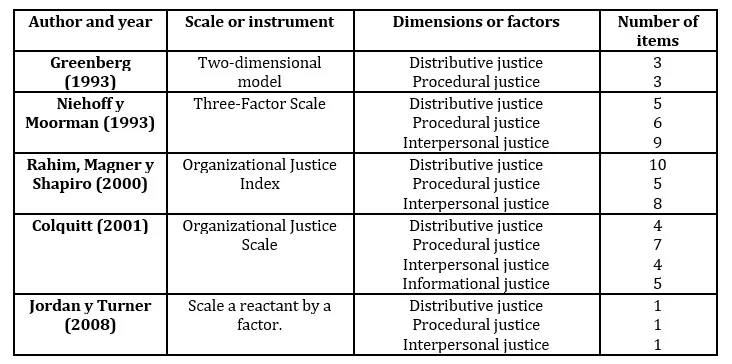
In the literature, there are various models of instruments for measuring organizational justice, and different authors support different concepts regarding the dimensions related to organizational justice. According to Greenberg (1993), organizational justice is viewed as having two traditional dimensions: distributive justice and procedural justice, both of which are considered crucial for understanding how employees perceive justice in organizations. On the other hand, Niehoff and Moorman (1993) identify organizational justice as having three dimensions—distributive justice, procedural justice, and interpersonal justice—which influence the behavior of the organization’s employees. Furthermore, Rahim et al. (2000), scholars of organizational justice, classify it into three dimensions—distributive justice, procedural justice, and interpersonal justice—which influence employees’ styles of conflict management with their superiors. It also focuses on how perceptions of justice affect employees’ emotional responses and behavior in the face of organizational conflicts. Colquitt (2001), for their part, validates and confirms that the four dimensions of organizational justice are distinct from one another, yet encompass all aspects of organizational justice; furthermore, this scale is used in various organizational studies because it is highly reliable. Finally, Jordan and Turner (2008) point out that it is possible to measure the dimensions of organizational justice using a single question for each dimension, based on the main dimensions of distributive justice, procedural justice, and interpersonal justice.
Table 1: Measurement scales for organizational justice.
In this study, it was deemed important to adapt the organizational justice scale to the Spanish language from Colquitt (2001). This instrument has been previously validated by various authors:
According to Shibaoka et al.(2010), The Japanese version of the organizational justice measurement instrument was developed and validated. The instrument used was developed by researcher Colquitt in the year 2001, translated from English into Japanese and consisting of 20 items. The scale was developed by 229 employees of large manufacturing companies, including researchers, machine operators, and administrative staff. Exploratory factor analysis (EFA) was used, which supported the four-factor model of organizational justice. The internal consistency was remarkably high, with a Cronbach’s alpha of 0.96, and the test-retest reliability, assessed using an intraclass correlation coefficient, was 0.9. These results indicate that the organizational justice instrument is a reliable and valid measure that may be suitable for predicting employee health in the Japanese workplace.
The study conducted by the authors Díaz et al. (2014)validated the instrument in Spain using a sample of 460 employees from the service sector, including retail, tourism, hospitality, information technology, transportation, business services, gambling, real estate, financial services, and health and social services. Through confirmatory factor analysis (CFA), they confirmed the four dimensions for the Spanish version: distributive justice, procedural justice, interpersonal justice, and informational justice. Cronbach’s alpha reliability ranged from 0.88 to 0.95 for each dimension. The results were statistically significant and of moderate to high magnitude, indicating adequate construct validity. On the other hand, scientists Omar et al. (2018) validated the instrument in Argentina. An empirical, quantitative, and instrumental study was conducted using a cross-sectional design and a sample of 406 employees from various organizations located throughout the country (industry, commerce, banks, insurance companies, consulting firms, and public and private educational institutions). The results of the confirmatory factor analysis (CFA) supported the four-factor structure of the organizational justice scale: distributive, procedural, interpersonal, and informational justice. The instrument demonstrated high reliability indices (ordinal alpha and composite reliability values greater than 0.80) and adequate discriminant and convergent validity (average extracted variance indices greater than 0.60). Therefore, it is concluded that these psychometric characteristics of the instrument make it a useful tool for measuring perceptions of justice within organizations.
For their part, the researchers Duque et al. (2018) validated the instrument in Ecuador using a sample of 862 employees from two universities. The factor structure of the scale was examined in depth using exploratory factor analysis (EFA) and confirmatory factor analysis (CFA), with the maximum likelihood estimation method. This study supports the four-factor structure of organizational justice; however, for this study, only three factors were used: distributive justice (criteria of equity and equality), procedural justice (appropriate allocation process, fair and equitable treatment), and interpersonal justice (appropriate, dignified, courteous, and respectful treatment). In conclusion, this study reinforces the validation of the construct’s structural diversity in the academic context.
However, the authors Spagnoli et al. (2017)adapted and validated the instrument in Italy, demonstrating the construct validity and reliability of the Italian translation of the scale. The psychometric properties were analyzed among employees in the public and private sectors, using a sample of 927 participants, including office staff, operational staff, teachers, managers, retail workers, healthcare workers, consultants, and military personnel. The organizational justice instrument was adapted, translated, and validated from English to Italian by a bilingual translator. Confirmatory factor analysis (CFA) was performed using five structural equation and factor models: unifactorial, bifactorial, trifactorial, quadrifactorial, and second-order factorial. The Cronbach’s alpha reliability analysis showed excellent results, with values above 0.85. It is concluded that the Italian version of the organizational justice instrument can be used for research within the Italian context.
Finally, according to the author Baka (2018), the purpose of this study is to test the psychometric properties of Colquitt’s Organizational Justice Questionnaire as applied in Poland. The research was conducted on a sample from two sectors: public organizations (209 employees) and private organizations (659 employees), including civil servants, customer service representatives, office staff, production staff, and accountants. Exploratory (EFA) and confirmatory (CFA) factor analyses were used, as well as Cronbach’s alpha to assess reliability. Furthermore, the study analyzed the correlation between organizational justice and related work factors and outcomes, taking into account work resources and work behavior. Finally, the Polish version of the organizational justice questionnaire demonstrated acceptable psychometric properties and proved useful for application in the Polish workplace context.
Organizational Justice
Organizational Justice, according to the authors Shkoler y Tziner (2017), refers to employees’ perception of whether an organization treats them fairly, with respect, and provides them with adequate information and appropriate resources; this is reflected in their first impressions of organizational events and their evaluations of specific aspects, such as leaders and coworkers. Greenberg (1990) states that organizational justice is “the extent to which employees consider organizational decisions to be fair.” Furthermore, organizational justice is key to fair treatment, as it improves social interactions and the organization’s effectiveness; it also influences employees’ behaviors and attitudes, leading to either positive or negative performance (Akram et al., 2017). The authors Galvan et al. (2024) reveal that organizational justice stems from humanistic, egalitarian, and motivational theories; this is reflected in how employees perceive fairness among their supervisors and coworkers, as well as in their emotional states and behaviors in response to these perceptions. Organizational justice is essential for organizations to strategically manage workplace interactions, promoting job satisfaction, emotional commitment, and workplace happiness among their human capital. In this context, Adams (1965), in the article “Inequity in Social Exchange,” proposed the equity theory, which explains perceptions of fairness or unfairness in the workplace that influence employees’ motivation and behavior, emphasizing that unfairness is not an inevitable condition. Cetina et al. (2023) identify equity theory as the main precursor to organizational justice. This theory involves comparing an employee’s contributions with the results obtained and, in turn, comparing those with those of other employees. For their part, Cropanzano et al. (2001) point out that equity theory is the employees’ assessment of the degree of fairness in relation to outcomes; furthermore, this theory has been criticized for being very limited in its explanation of how judgments of fairness are formed. Finally, Deepa (2020) argues that organizational justice is related to the work environment; based on Adams’ equity theory, the perception of justice arises from comparisons among employees and from an equitable distribution of income and benefits, which influences the attitudes and behavior of the organization’s employees, thereby affecting their long-term performance and the achievement of objectives.
Distributive justice
Distributive justice is the first type of justice present in an organization, where employees consider whether the allocation of benefits is fair. At the same time, distributive justice ensures people’s dignity, independence, and respect, so that their effort, performance, and involvement are valued by providing compensation commensurate with their contribution (Deepa, 2020). Arboleda (2009) defines distributive justice as the result of resolving a problem by compensating the consumer—such as by offering a refund, providing a product or service, and/or offering future discounts. Likewise, the authors Santos et al. (2023) point out that distributive justice is related to outcomes such as salaries, rewards, promotions, and profits, among others. Therefore, when employees perceive a fair distribution, this is reflected in their commitment to the organization, their job satisfaction, and their intention to continue working there. However, if they perceive inequality, this can lead to negative feelings and a possible decline in their performance. The authors Chuquilin et al. (2023) reveal that it is the way employees perceive the distribution of outcomes—such as recognition, rewards, or penalties—and assess whether they are fair or not. However, the researchers Cropanzano et al. (2007) point out that distributive justice is based on three components or criteria. The first criterion is equity, which seeks to reward employees according to their contributions; the second criterion is equality, which aims to provide each employee with similar compensation; finally, the third criterion is need, which consists of providing benefits based on the employee’s needs.
Procedural Justice
According to the authors Pan et al. (2018), procedural justice is an individual’s perception of the processes used within a social system to distribute resources; it also has a significant impact on employees’ cognitive, emotional, and behavioral responses toward the organization. Furthermore, Chuquillin et al. (2023), for their part, point out that it is employees’ perception of the organization’s processes and procedures, taking into account whether the distribution of resources and compensation for their work is fair or not. For their part, Peña y Durán (2016) indicate that it is based on the interpretation of reality, in relation to the balance within organizations, by applying criteria and procedures to make decisions that affect employees. Santos et al.(2023) point out that procedural justice focuses on analyzing the procedures used in organizational methodologies, such as staff selection and performance evaluation, including decisions related to employee promotions. It is linked to decision-making aimed at achieving organizational objectives. Furthermore, Cropanzano et al. (2007) identify the following components related to procedural justice, such as: consistency (equal treatment of all employees), lack of bias (decisions free from discrimination or mistreatment), accuracy (decision-making based on accurate information), representation of stakeholders (participation of all stakeholders in decision-making), fairness (an appeals process or other mechanism for correcting errors), and ethics (based on standards of professional conduct).
Interpersonal Justice
According to the authors Guimarães et al. (2022), interpersonal justice refers to the quality of human treatment during organizational processes; it is related to social sensitivity and to the respect employees receive in decisions regarding the allocation of resources. However, Wiseman y Stillwell (2022) state that it involves reducing undesirable outcomes among employees by promoting positive behavior at all levels—from employees to senior management—and exceeding workplace expectations.
On the other hand, Chuquilin et al. (2023) indicate that this is the impression employees have of the treatment they receive from their superiors, considering whether it is dignified, courteous, and respectful. Interpersonal justice is the perception of fairness that employees experience during their daily activities, taking into account dignity and respect when interacting with their superiors. (Nathan, 2025).
Informational Justice
According to Guimarães et al. (2022), informational justice focuses on transparency and communication, providing detailed information and explanations regarding decisions related to the allocation of resources. The authors Wiseman y Stillwell (2022) point out that it is the perception of organizational decisions and the quality of the explanations that matter; therefore, this is important for organizations, since the exchange of information influences how employees perceive and respond to organizational initiatives. Chuquilin et al. (2023) define it as employees’ perception of the protection—or lack thereof—they receive from the organization. However, Nathan (2025) refers to fairness in the dissemination of information to employees, as reflected in timely communications and explanations regarding decisions, policies, or situations, which contributes to the perception that the organization treats employees fairly.
Methodology
The methodology used was a quantitative, cross-sectional, and instrumental approach (Ato et al. 2013).
Participants
A total of 250 workers from the transportation sector in the city of Lima participated in the validation of the organizational justice instrument. Of these, 88.8% were male and 11.2% were female. Additionally, 78.4% work in operations and 21.6% in administration. Finally, 41.2% were between the ages of 36 and 45, followed by 27.2% between the ages of 26 and 35, 13.6% between the ages of 46 and 55, 10.4% between the ages of 18 and 25, and 7.6% aged 56 and older.
instrumentThe original organizational justice instrument, adapted from the Japanese context by Colquitt (2017), was used. This 20-item instrument is grouped into four dimensions. The first dimension is procedural justice, consisting of 7 items; the second dimension is distributive justice, with 4 items; the third dimension is interpersonal justice, with 4 items; and finally, the fourth dimension is informational justice, with 5 items. A Likert scale was used for measurement; response options range from 1 to 5, with statements such as: “Strongly disagree,” “Somewhat disagree,” “Neither agree nor disagree,” “Somewhat agree,” and “Strongly agree.”
Procedure
This instrument, consisting of 20 items grouped into 4 dimensions, was adopted and adapted to the Peruvian context. First, it was translated into Spanish following translation quality control guidelines (Muñiz et al. 2013). The instrument was then validated by three expert raters and quantified using Aiken’s V formula, which demonstrates content validity (Ventura 2019). Finally, its applicability was tested on a pilot sample to verify the test’s reliability and conduct a preliminary analysis of the 20 items regarding their direction and meaning. The instrument was administered via Google Forms, with informed consent and voluntary participation.
Data Analysis
To identify the most appropriate instrumental model and confirm the internal structure of the instrument, Exploratory Factor Analysis (EFA) was performed using the statistical software Jamovi, version 2.6.44, and Confirmatory Factor Analysis (CFA) was performed using the statistical software SmartPLS 4.
Results
Exploratory Factor Analysis (EFA)
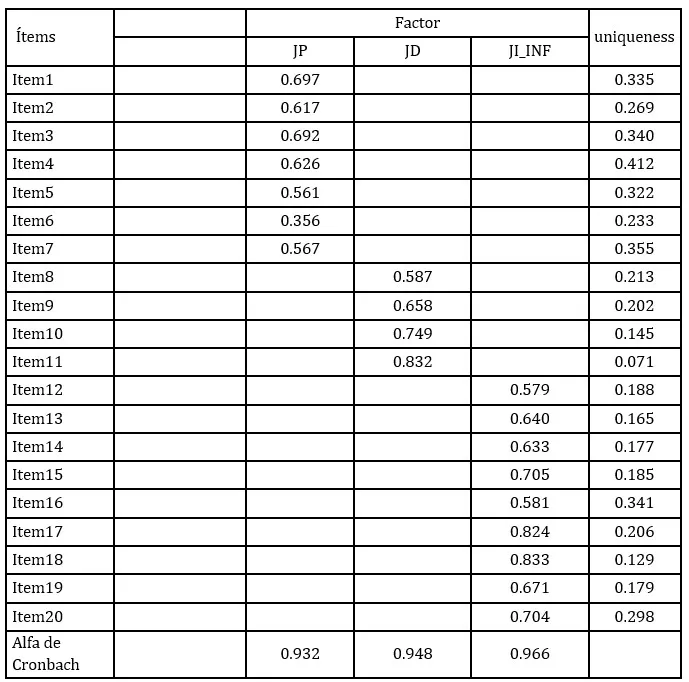
AFE allows us to analyze the interrelationships among variables and their dimensions, which are referred to as common underlying factors (Hair et al., 2019). In other words, its purpose is to identify factors or dimensions of a variable. It also allows for the analysis of the Kaiser-Meyer-Olkin (KMO) statistic, which should preferably be greater than 0.7, Bartlett’s sphericity test—which consists of the chi-square (X^2) value, the degrees of freedom (df), and the p-value, which should be less than 0.05 (Hair et al., 2019). Furthermore, the cumulative explained variance must be greater than 50%. In this regard, the original instrument for the organizational justice variable consisted of 20 items divided into four dimensions: (1) procedural justice with 7 items, (2) distributive justice with 4 items, (3) interpersonal justice with 4 items, and (4) informational justice with 5 items. However, when analyzed using EFA, three factors emerged: (1) procedural justice (PJ), (2) distributive justice (DJ), and (3) interpersonal and informational justice (IJ_INF). In other words, EFA identified interpersonal justice and informational justice as a single factor. These results are supported by a KMO value of 0.935, accompanied by a significant Bartlett’s sphericity test, with a chi-square (X^2) value of 6287; df: 190 and a p-value less than 0.01. The factor extraction method used was maximum likelihood, and the rotation method was Varimax. These three factors account for a cumulative explained variance of 76.2%, and their reliability coefficients are greater than 0.90 (see Table 2).
Table 2: Factor loadings for the items of the social justice variable
Note: Created using Jamovi software, version 2.6.44
Confirmatory Factor Analysis (CFA)
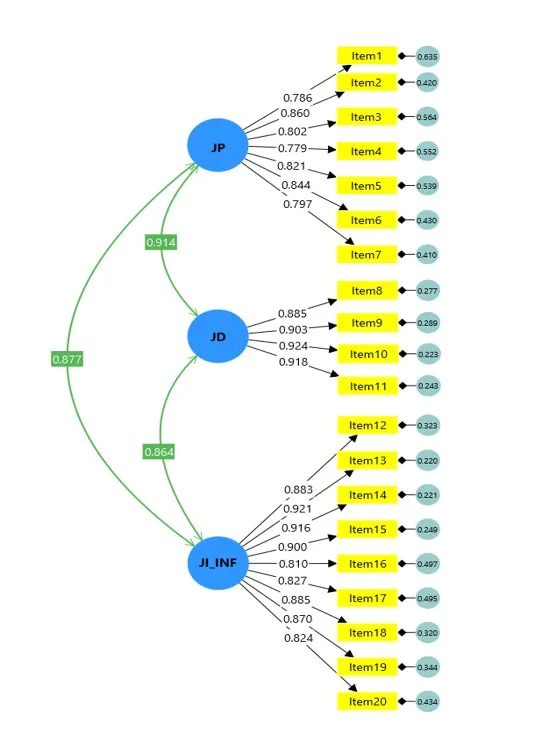
AFC is a multivariate technique that allows us to test how well a theory aligns with reality (Hair et al., 2019). This technique allows us to confirm the factors identified through Exploratory Factor Analysis. In this regard, Figure 1 confirms the three factors of the organizational justice variable: (1) procedural justice (PJ), (2) distributive justice (DJ), and (3) interpersonal and informational justice (IJ_INF).
Figure 1. Factors of the organizational justice variable (initial model)
Note: Prepared using SmartPLS 4.
To validate the factors of the organizational justice variable, we propose conducting a reliability analysis using Cronbach’s alpha and composite reliability (CR). Likewise, for the validity analysis, we propose using convergent validity and discriminant validity.
Reliability and validity of the initial model (Figure 1)
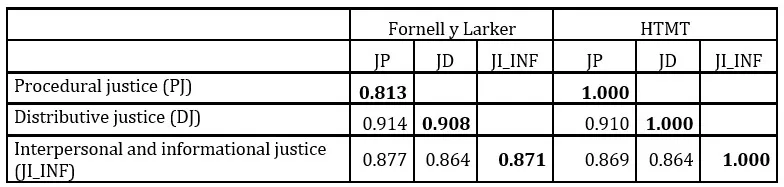
Table 3 shows the reliability of the factors as measured by Cronbach’s alpha and composite reliability (CR), both of which must be greater than 0.7 (Hair et al., 2019). Likewise, to verify internal consistency, it shows convergent validity through average variance extracted (AVE), which must be greater than 0.5 for adequate convergence (Hair et al., 2019). Table 4, meanwhile, shows discriminant validity based on the criteria of Fornell and Larker (1981), as it compares the square root of each AVE (diagonal values) with the correlations of the factors. That is, when the square root of each AVE is greater than the correlation between the factors, discriminant validity is accepted (Hair et al., 2019). In this case, discriminant validity is not accepted under this criterion because both the correlation between JP and JD, as well as between JP and JI_INF, are greater than the square root of the AVE. Table 4 also shows discriminant validity based on the Heterotrait-Monotrait (HTMT) criterion. That is, when the HT/MT ratio is greater than 0.90, there is a problem with discriminant validity (Hair et al., 2019). In this case, discriminant validity is also not accepted under this criterion because the correlation between JP and JD is greater than 0.90.
Table 3: Reliability and Convergent Validity of the Initial Model
Note: Prepared using SmartPLS 4.
Table 4: Discriminant validity of the initial model
Note: Prepared using SmartPLS 4.
Reliability and validity of the revised model (Figure 2)
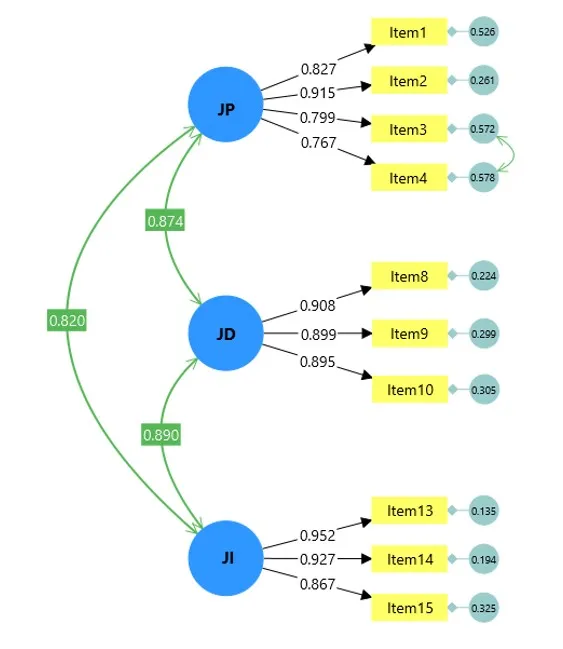
Figure 2 shows the revised factor model for the organizational justice variable. This figure shows that only 4 items from the procedural justice (PJ) factor, 3 items from the distributive justice (DJ) factor, and 3 items from the interpersonal justice (IJ) factor remain, while the items corresponding to informational justice were eliminated.
Figure 2. Factors of the organizational justice variable (revised model)
Note: Prepared using SmartPLS 4.
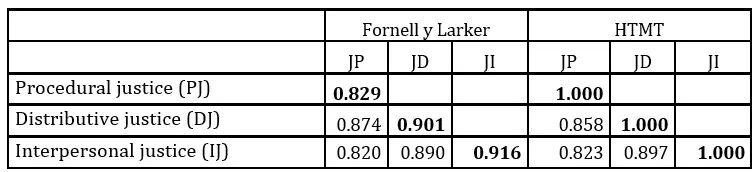
Table 5 shows the reliability of the factors as measured by Cronbach’s alpha and composite reliability (CR), both of which are greater than 0.7 (Hair et al., 2019). Likewise, convergent validity, as measured by the average variance extracted (AVE), is greater than 0.5 (Hair et al., 2019). Table 6, meanwhile, shows discriminant validity according to the criteria of Fornell and Larker (1981), where the square root of each AVE is greater than the correlation between the factors, except between JP and JD, which is 0.045 higher—a difference that does not invalidate discriminant validity. Table 8 also shows discriminant validity based on the Heterotrait-Monotrait (HTMT) criterion. In this case, discriminant validity is accepted under this criterion because the correlations are less than 0.90.
Table 5: Reliability and Convergent Validity of the Corrected Model
Note: Prepared using SmartPLS 4.
Table 6: Discriminant Validity of the Corrected Model
Note: Prepared using SmartPLS 4.
Fit indicators for the initial model and the corrected model
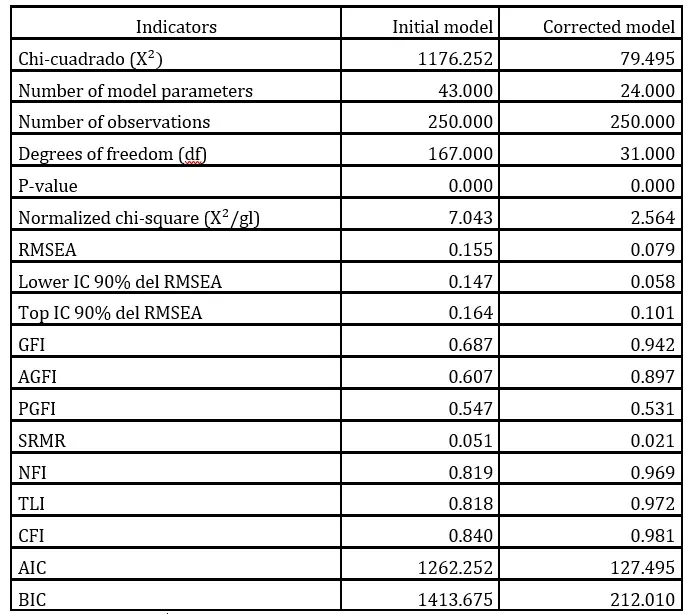
Table 7 is used to analyze the main indicators: chi-square (X^2); degrees of freedom (df); normalized chi-square (X^2/df), which should ideally be between 1 and 2; and the p-value, although the use of the p-value is not recommended because it is highly sensitive to sample size (Brown, 2015). Likewise, we propose evaluating the model using absolute fit indices, such as the RMSEA, which should be between 0.03 and 0.08 (Hair et al., 2019). In addition, we will use incremental fit indices, such as the CFI and TLI, which should be greater than 0.95 to indicate a good fit (Hair et al., 2019). In this regard, these adequate fit indices support the revised model.
Table 7: Fit indices for the initial model and the corrected model
Note: Prepared using SmartPLS 4.
Discussion
The objective of this study was to analyze the adaptation and validation of an organizational justice scale, in order to ensure its applicability in the Peruvian workplace (created by Colquitt et al. (2001)). It was found that the scale possesses adequate psychometric properties in its three-factor structure; this indicates that Peruvian workers perceive organizational justice based on transparency in procedures, the quality of interpersonal treatment, and the distribution of rewards. This may be because, in the transportation sector in Peru, there is frequent interaction with supervisors, and perceptions of fairness in procedures are of greater importance. Likewise, various authors have studied organizational justice in different contexts and have confirmed the consistency of the dimensions, while others have additionally identified other dimensions. For example, Greenberg (1993) studied organizational justice in two dimensions: distributive justice and procedural justice. For their part, Niehoff y Moorman (1993) studied organizational justice in three dimensions, adding interpersonal justice to the previous author’s framework. Similarly, Rahim, Magner y Shapiro (2000) y Jordan y Turner (2008) studied organizational justice using the same dimensions as Niehoff y Moorman (1993). These studies are consistent with the findings of the present study, which identified three dimensions—distributive, procedural, and interpersonal justice—which are the dimensions most frequently studied by various authors. Unlike previous research showing a four-dimensional structure, this study identified a three-factor model. This difference could be associated with cultural differences, as well as characteristics specific to the transportation sector, which may influence how workers conceptualize organizational justice.
Conclusions
The results confirmed that the instrument exhibits adequate levels of validity and reliability. First, unlike the original instrument for the organizational justice variable—which consisted of four dimensions: procedural justice, distributive justice, interpersonal justice, and informational justice—the AFE identified only three dimensions: procedural justice, distributive justice, and interpersonal and informational justice, combining the latter two. These dimensions were confirmed by the AFC; however, the indicators of the initial model were not adequate to support the twenty items divided into three dimensions. Accordingly, reliability and validity were assessed to obtain a revised model, resulting in 4 items for the procedural justice factor, 3 items for the distributive justice factor, and 3 items for the interpersonal justice factor, with the items corresponding to informational justice being eliminated. In other words, out of the 20 items in the author’s original instrument (Colquitt et al. (2001)), this study validated only 10 items with appropriate indicators, as shown in the revised model. These 10 items were assessed for reliability using Cronbach’s alpha and composite reliability, for convergent validity using the average extracted variance, and for discriminant validity using Fornell and Larker and the HTMT.
These results can help assess organizational justice within companies in both the private and public sectors. In addition, the instrument can be used for future research in the Peruvian context. However, this study had methodological limitations due to the fact that it was conducted at a single point in time and because of the sample size. Therefore, it is recommended that future research increase the sample size and be conducted in other sectors.
References
Abril, T., Waldzus, S., & Collins, E. (2020). Validation of the organizational justice scale in a portuguese context. https://doi.org/10.1037/mgr0000106
(2023). Organizational justice research: A review, synthesis, and research agenda. https://onlinelibrary.wiley.com/doi/10.1111/emre.12564
Adams, J. S. (1965). Inequity In Social Exchange. En Advances in Experimental Social Psychology. Elsevier. https://doi.org/10.1016/S0065-2601(08)60108-2
Afzalur, M., Magner, N., & Shapiro, D. (2000). Do justice perceptions influence styles of handling conflict with supervisors?: What justice perceptions, precisely). International Journal of Conflict Management. https://doi.org/10.1108/eb022833
Akram, T., Lei, S., Haider, M., Hussain, S., & Puig, L. (2017). The effect of organizational justice on knowledge sharing: Empirical evidence from the Chinese telecommunications sector. https://doi.org/10.1016/j.jik.2016.09.002
Arboleda, A. (2009). La actitud del consumidor según la percepción de justicia organizacional. Estudios Gerenciales, 99-122. https://doi.org/10.1016/S0123-5923(09)70091-9
Baka, L. (2018). Development and validation of the polish version of Colquitt’s organizational justice scale. https://doi.org/10.13075/ijomeh.1896.01187
Cetina, T., Carrillo, D., Centeno, G., & Mézquita, Y. (2023). Justicia organizacional: Su dimensionalidad. https://doi.org/10.32995/praxispsy.v24i39.221
Chuquilin, B., Diaz, N., & Troya, D. (2023). Justicia organizacional y compromiso de colaboradores de servicios de salud en Perú. https://doi.org/10.38147/invneg.v16i28.172
(2001). On the dimensionality of organizational justice: A construct validation of a measure. (3). https://doi.org/10.1037/0021-9010.86.3.386
Cropanzano, R., Bowen, D., & Gilliland, S. (2007). The Management of Organizational Justice. Academy of Management Perspectives. https://doi.org/10.5465/amp.2007.27895338
Cropanzano, R., Byrne, Z. S., Bobocel, D. R., & Rupp, D. E. (2001). Moral Virtues, Fairness Heuristics, Social Entities, and Other Denizens of Organizational Justice. Journal of Vocational Behavior. https://doi.org/10.1006/jvbe.2001.1791
Deepa, S. (2020). The effects of organizational justice dimensions on facets of job engagement. International Journal of Organization Theory & Behavior. https://doi.org/10.1108/ijotb-05-2019-0066
Díaz, L., Barbaranelli, C., & Moreno, B. (2014). Spanish version of Colquitt’s Organizational Justice Scale. Psicothema. https://doi.org/10.7334/psicothema2014.110
Duque, E., Ortega, J., & Grueso, M. (2018). Propiedades psicométricas de la escala de justicia organizacional de Colquitt para el contexto latinoamericano. Una aplicación en el Ecuador.
Galvan, E., Ravina, R., Salazar, M. A., & Sorzano, D. M. (2024). El trinomio compromiso, satisfacción y justicia organizacional en el binomio felicidad e intención de rotar. https://doi.org/10.17163/ret.n28.2024.01
Greenberg, J. (1990). Organizational Justice: Yesterday, Today, and Tomorrow. https://doi.org/10.1177/014920639001600208
Greenberg, J. (1993). The social side of fairness: Interpersonal and informational classes of organizational justice. En Justice in the workplace: Approaching fairness in human resource management (pp. 79-103). Lawrence Erlbaum Associates, Inc.
Guimarães, L. N., Porto, J. B., & Borges, J. E. (2022). Organizational Justice—An Overview of the Brazilian Scientific Production. Psicologia: Teoria e Pesquisa, 38, e38518. https://doi.org/10.1590/0102.3772e38518.en
Jordan, J. S., & Turner, B. A. (2008). The feasibility of single-item measures for organizational justice. Measurement in Physical Education and Exercise Science, 12(4), 237-257. https://doi.org/10.1080/10913670802349790
Nathan, C. (2025). AI as a talent management tool: An organizational justice perspective. https://doi.org/doi.org/10.1016/j.bushor.2025.03.005
Ngodo, O. E. (2008). Liderazgo transformacional – Resultados organizacionales Relación. 4(1).
Niehoff, B., & Moorman, R. (1993). Justice as a mediator oh the relationship between methods of
monitoring and organizational citizenship behavior. Academy of Management Journal, (3), 527-556. https://doi.org/10.2307/256591
Núñez, M. J. S., & Jurado, D. M. B. (s. f.). Organizational justice and psychological capital: Factors that are related to job satisfaction.
Omar, A., Salessib, S., Vaamonde, J., & Urteaga, F. (2018). Psychometric properties of Colquitt’s Organizational Justice Scale in Argentine workers. Revista Peruana de Psicología, 24(1), 61-79.
Pan, X., Chen, M., Hao, Z., & Bi, W. (2018). The Effects of Organizational Justice on Positive Organizational Behavior: Evidence from a Large-Sample Survey and a Situational Experiment. Frontiers in Psychology, 8, 2315. https://doi.org/10.3389/fpsyg.2017.02315
Patlán, J., Flores, R., Martínez, E., & Hernández, R. (2014). Validez y confiabilidad de la escala de justicia organizacional de Niehoff y Moorman en población mexicana.
Peña, M., & Durán, N. (2016). Justicia organizacional, desempeño laboral y discapacidad. Revista Colombiana de Ciencias Sociales, 201. https://doi.org/10.21501/22161201.1540
Rodríguez, R., Martínez, M., & Salanova, M. (2014). Justicia organizacional, engagement en el trabajo y comportamientos de ciudadanía organizacional: Una combinación ganadora. Universitas Psychologica, 13(3). https://doi.org/10.11144/Javeriana.UPSY13-3.joet
Santos, E., Venturini, L., Sallaberry, J., Klein, L., & Flach, L. (2023). Organizational fairness and task performance: A study between different activities and positions in the justice sector. Revista de Administração Da UFSM. https://doi.org/10.5902/1983465972136
Shibaoka, M., Takada, M., Watanabe, M., Kojima, R., Kakinuma, M., Tanaka, K., & Kawakami, N. (2010). Development and validity of the Japanese version of the organizational justice scale. https://doi.org/10.2486/indhealth.48.66
Shkoler, O., & Tziner, A. (2017). The mediating and moderating role of burnout and emotional intelligence in the relationship between organizational justice and work misbehavior. Revista de Psicología del Trabajo y de las Organizaciones. https://doi.org/10.1016/j.rpto.2017.05.002
Spagnoli, P., Farnese, M., D’Olimpio, F., Millefiorini, A., & Scafuri, L. (2017). Psychometric properties of the Italian version of Colquitt’s Organizational Justice Scale (OJS). https://doi.org/10.1108/ijoa-01-2017-1113
Wiseman, J., & Stillwell, A. (2022). Organizational Justice: Typology, Antecedents and Consequences. Encyclopedia. https://doi.org/10.3390/encyclopedia2030086