LARPEG Laboratory, Université du Sultan Moulay Slimane, Beni Mellal, Morocco
Volume 2026,
Article ID 273985,
IBIMA Business Review,
22 pages,
DOI: https://doi.org/10.5171/2026.273985
Received date: 2 June 2026; Accepted date: 15 July 2026; Published date: 16 September 2026
Academic Editor: Jennifer ABOU HAMAD
Cite this Article as:
Soukaina ALAOUI, Icam ABDELLAOUI and Issam IZZA (2026)," “ Evolving Theoretical Frameworks in Management Control: Insights from Morocco and France “, IBIMA Business Review, Vol. 2026 (2026), Article ID 273985, https://doi.org/10.5171/2026.273985
While theoretical frameworks in management control were traditionally oriented toward internal structures through purely technical approaches, recent research demonstrates an unconventional openness to external themes and theoretical perspectives. These borrowings from neighboring disciplines confer upon management control a pioneering character, similar to other fields that engage in self‑critique and adapt to changing environments through innovative openings. Such openness enables effective responses to the multitude of financial, human, environmental, and ethical constraints and challenges. The study focuses on Morocco and France as two distinct contexts, yet historically connected and increasingly reinforced by growing mutual interests. Morocco is currently witnessing a new era that directs public sector management toward performance‑based governance. In addition, the private sector, with the aim of labeling its production, concentrates efforts on the “Made in Morocco” initiative, characterized by the hybridization of French practices and their adaptation to local contexts. These emerging practices encounter several constraints in both the public and private sectors. The French case, with its extensive achievements in scientific research, seeks to maintain its position among global leaders in the field, to address major societal challenges, and to strengthen the country’s scientific sovereignty. This article seeks to explore the extent to which management control engages with other disciplines, and whether such openness unfolds in the same way in Morocco as in France. Comparative research on the theoretical frameworks of management control between Morocco and France remains scarce. Indeed, no recent scientific article directly addresses the comparison of theoretical frameworks across the two countries. To conduct this comparison, a scientometric study was carried out for the period 2019–2025 in order to provide a recent overview of research and to integrate recent theoretical and methodological developments.
The findings highlight differences in theoretical maturity between the two contexts. They empirically confirm that disciplinary openness has now become a structural feature of research in management control. Furthermore, the specificities of managerial culture and institutional logics in both Francophone countries shape the dynamics of theoretical framework selection. Finally, the results of this study highlight several insights that may guide the practices of researchers, editorial boards, higher education institutions, and organizations that mobilize knowledge produced in management control.
Management control, traditionally rooted in accounting and financial principles, is now facing increasingly complex organizational and managerial challenges. This evolution has led researchers and practitioners to emphasize the crucial importance of an interdisciplinary approach.
Indeed, from the 1970s onwards, the management control experienced a very particular boom. It moved from the implementation phase to a research phase: “It thus went from being a subject taught to a discipline in its own right: assimilation of a conceptual framework, development and discussion of this framework.” (Bouquin, & Pesqueux, 2004).
This evolution marks the transition from a simple object of teaching to an established discipline, defined by the assimilation of a specific conceptual framework, its progressive deepening and the debate on its foundations. Since this transition, scientific research in management control has been characterized by a certain permeability (compared to intracellular exchanges) as it attempts to draw on different disciplines to explain certain behaviors or choices within organizations. “Although developing its own tools and concepts at the intersection of auditing and accounting, management control is diversifying.” (DUPUY, 2002).
The attention of two authors, Bollecker and Azan, was drawn to unusual disciplinary borrowings which sparked their interest in exploring and understanding the boundaries of research in accounting and management. “The themes of certain special issues of the journal Comptabilité, Contrôle, Audit also demonstrate such openness: sociology of accounting (CCA, 2004), history of accounting, management and auditing (CCA, 2005).”(Bollecker & Azan, 2008).
Some authors, like Thierry Lévy-Tadjine[i] wanted to shift the scientific perspective by proposing an alternative to universal and normative models, through atypical paths allowing researchers to think “out of the box”.
By emphasizing intersubjectivity and the uniqueness of contexts, this approach has revitalized research methods in management science, opening the discipline to interdisciplinary and qualitative perspectives. It thus helps to move beyond normative models and integrate the diversity of organizational experiences.
Thus, the openness to different theoretical approaches and models has fueled a race among researchers to discover the unprecedented. This race has been characterized by: “a competition driven by the desire to be the first to discover and the first to publish, the first to be recognized and the first to win an award.” (Karpik, 2012).
In the context of our study, management control (MC) research represents a dynamic field, influenced by a multitude of factors, particularly institutional and academic ones, which determine not only the volume and density of publications, but also their thematic orientation. In France and Morocco, these influences diverge and converge, reflecting the specificities of their educational, political, and cultural systems. This in-depth analysis aims to decipher these dynamics, highlighting the similarities and differences that shape academic production in these two countries.
This led us to want to know how scientific research in CG is doing in Morocco and France within the framework of these openings, a research production of two countries which is unified among other things by the Francophonie.
Thus, we seek to answer the following research questions:
What themes are addressed in each of the two contexts?
Does the place of research in general knowledge allocated in each country, as well as managerial culture, create a difference in terms of the quantity and diversity of theoretical frameworks used, but also in terms of the choice of themes?
In generalist journals, are the theoretical frameworks used classical or are some borrowed from other disciplines? Similarly, in specialized journals, are the themes and theoretical frameworks used strictly specialized or is there a degree of openness to this?
Scientific research in management control: A literature review
Scientific research: a semantic approach
Scientific research attracts free spirits who want to conquer the unknown or the unknown evil with the aim of enriching knowledge and building the image of the future by permeating practices. In the expression scientific research, we will examine the terms “science” and “research”.
On the one hand, science is impressive and exciting (Allais, n.d.). Its purpose is to demystify the unknown. “It opens the doors behind which mysteries are hidden.” (Solé, 1998).
Built in a solid manner, it achieves consent from citizens and even (or even) nations around what it provides as a result; let us remember the “legitimacy: we had no choice but to believe them” of scientific research laboratories regarding the administration of vaccines on a global scale during the Covid-19 period. In this sense, science wields considerable power over a country’s image or the reliability of an idea (Curie & Quinn, 1981).
We can speak of a characteristic of “recognition” attributed to scientific research. This recognition is explained by Puigelier in a chapter of his book: recognition offers a form of power to those who establish it as well as to those who benefit from it.”[ii] (Puigelier, n.d.). This author emphasizes that recognition, whether social, institutional, or academic, is never neutral. It acts as a mechanism of power. For those who establish it, granting recognition is an exercise of symbolic authority.
Disciplines themselves, when recognized, gain autonomy and institutional legitimacy. This case brings us back to the passage cited earlier (in the introduction) on the transformation of a subject into a discipline, as discussed by Bouquin & Pesqueux.
On the other hand, “Scientific research is a very exciting activity, but also one that is little known to the public.”(Deheuvels, 1990). Thus, this author emphasizes the spirit of intellectual adventure that drives researchers to explore the unknown and push their own boundaries, even though these efforts are often invisible to society. This creates a distance between the scientific community and civil society, a distance reinforced by technical language and dissemination channels that are not accessible to everyone (specialized journals, conferences).
25 years later, we can reformulate Deheuvels’ quote (keeping the spirit of the author) to contextualize it in the current era (2025) as follows: Scientific research remains exciting, but it is now better known to the public thanks to contemporary popularization — while remaining exposed to the risks of simplification by reducing scientific complexity to slogans and of media coverage by creating buzz at the expense of rigor.
In this section, we will attempt to understand the relationship between the discipline of Global Competence (GC) and scientific research. We will also examine how GC has transformed into a strategic pillar, integrating interdisciplinarity and critical approaches for overall performance.
The relationship between Management control and scientific research: a literature review
Management control (MC) is defined as the set of mechanisms, processes, and practices implemented to guide an organization’s actions toward achieving its strategic objectives. Its history is marked by a significant transition. At the beginning of the 20th century, under the influence of industrial models such as the Sloan-Brown model, it was primarily a tool for rationalization and budget monitoring. However, with the decentralization of organizations and the advent of information systems in the 1920s-1990s, MC acquired a more strategic and multidimensional dimension.
Today, it is no longer limited to cost management, but also encompasses performance support, governance, and even innovation facilitation. This evolution reflects organizational theories, which link cost management to contingency approaches[iii] systematic[iv] and behavioral[v].
The current[vi]dealing with the relationship between MC and scientific research is the richest in terms of research elements given the much higher complexity than for other sectors studied.
This complexity stems from the uncertainty inherent in innovative projects, in addition to the multitude of dimensions to be controlled, namely scientific quality, innovation potential, and long-term strategic impact. A systematic review by Lill et al. (2021), which examines 79 articles from 1959 to 2019, demonstrates that the repressive nature of control is not inherent to control itself, but rather depends on the design of the management control system. A rigid design can influence its application, leading to a logic of compliance rather than innovation, thus limiting managers’ capacity for adaptation and initiative.
Continuing our desire to understand the mechanisms between MC and scientific research, Lövstål & Jontoft, (2017) highlight four types of tensions inseparable from control represented by: tensions inherent in innovation, tensions inherent in control, tensions created by control, and tensions related to decision-making.
Bollinger & Burger-Helmchen (2021) reinforce previous ideas by highlighting the duality of control and creativity, believing that the effectiveness or ineffectiveness of this duo is inherent in a categorization of work into three dimensions: the type of management, the form of control, and the measurement of performance.
Bollinger (2019) shows that, across 169 companies, management control tools used for steering and monitoring tend to converge despite the divergence of the companies studied, but that they are deployed at two complementary levels: formal (information systems) and informal (human relations). The interaction of these two levels makes it possible to combine rigor and flexibility, paving the way for creativity.
Hooge & Roland (2016) study management control applied to R&D at Renault. They suggest a frugal management system.[vii] The authors propose a triangular approach to values-based management, emphasizing that leadership must respect three complementary dimensions: economic uncertainty, strategy, and stakeholder buy-in. This triangulation thus facilitates the management of innovative and uncertain projects while maintaining team motivation and commitment.
Finally, the scientific literature highlights a shared observation: traditional management control tools, such as budgets, dashboards, and performance indicators, show their limitations when directly applied to the field of scientific research. Indeed, this domain is characterized by significant uncertainty, objectives that emerge gradually throughout projects, and often complex and difficult-to-predict cause-and-effect relationships. These characteristics render traditional tools ineffective if they are not adapted, and underscore the need for management control specifically designed to support the unique dynamics of research.
The Management Control: towards an interdisciplinary and critical approach
The MC, from accounting to integrated strategy
Historically rooted in cost accounting and financial performance measurement, the shift in general accounting is now visible in how companies assess their performance. They now include environmental, social, and governance criteria alongside traditional financial indicators. A national survey conducted by Rihouet & Gérard (2026) involved 1200 professionals (management controllers, clients of management control, and no less than 300 students who participated in the study), shows that the management control is being deployed in a context of rapid transformation between digitalization, AI, big data, agile management and the value/society-centered approach.
The shift from a traditional approach to a modern, holistic vision has contributed to strengthening the missions of the MC. The works of Kaplan & Norton (1992) and Simons (1995) as foundational works, have led to repositioning the MC within a strategic framework.
However, we can attribute this transformation to several sources, including: the increasing complexity of organizations, due to globalization and the decentralization of growing and diversifying businesses, necessitating a more holistic approach to Corporate Social Responsibility (CSR) and performance.
Furthermore, societal pressure towards CSR for a sustainable and ethical approach has driven companies to integrate non-financial indicators into their control systems. In addition, technological advancements, such as AI, Big Data, and digital tools, offer new analytical and forecasting capabilities, enabling more agile management.
Interdisciplinarity at the heart of the Management Control (MC)
MC aims to contribute insights that align objectives and strategy within approaches that consider the interests of all stakeholders. Hence the paramount importance of integrating interdisciplinarity as a cornerstone of modern management control. This fosters a more nuanced understanding and more effective management of organizational dynamics. By combining perspectives from diverse disciplines, management control overcomes traditional limitations to embrace a comprehensive view of performance.
Current research, particularly that of Chanegrih (2015) demonstrates that corporate governance can no longer be confined to a single-discipline approach. It now draws on methods and perspectives from organizational science, strategy, sociology, engineering, and even anthropology. This cross-fertilization of perspectives allows for the examination of corporate governance systems (CGS) in specific contexts, such as those of small and medium-sized enterprises (SMEs), and for an understanding of stakeholder dynamics and institutional environments.
In the public sector, interdisciplinarity is particularly relevant. According to (Book, 2008a) Management control would be a process that managers use to govern. Book (2008b) adds that management control, like accounting which enabled its emergence, pursues two essential goals: it informs decision-making and is part of a governance framework. According to the author, current discussions surrounding the application of the OLFL (Organic Law relating to Finance Laws) clearly illustrate the limitations of too narrow a conception of this function. Bouquin thus sought to explain the tensions between a purely technical view of management control and its broader governance role.
Thus, community governance (CG) is increasingly used as a governance mechanism to strengthen the performance, transparency, and accountability of local authorities and public administrations. The appropriation of control tools by stakeholders, influenced by behavioral and sociological approaches, is crucial for the success of these initiatives.
Critical approaches: between the analysis of power and ethics
Critical approaches, on the other hand, allow us to understand general governance from different angles. These perspectives question the ultimate nature of rationality and efficiency.
Critical studies draw on theoretical currents, such as radical humanism (which insists on human dignity, freedom and the critique of systems that confine or dominate) and the thought of Habermas (German philosopher who sees communication and public debate as essential to democracy. His work serves to analyze how management practices influence transparency and legitimacy), to explore CG as a “discursive formation” and a disciplinary modality shaped by impersonal forces.
This means that MC is not simply a set of tools (budgets, dashboards), it is also a discourse, a way of speaking and thinking about the organization. Thus, when we talk about “performance,” “efficiency,” and “governance,” we are using a language that shapes reality and influences behavior. The critical approach highlights the need to move beyond a purely instrumental view of control tools to integrate power dynamics and social contexts.
Consequences for organizational relationships
These critical approaches also analyze the impact of control on inter-organizational relations, notably in sensitive sectors such as the medical-social sector where human issues are very present. Critical approaches study how MC influences relations between different organizations (for example, between a hospital and a medical-social association), raising the issue that MC can have effects beyond the internal structure.
They question how control systems can influence the behavior of actors in a sensitive sector like public health (guiding the behavior of managers and doctors, for example), sometimes coercively by imposing rules or indicators. These approaches also highlight how these control systems can be used to justify managerial decisions that are not always in everyone’s best interest.
Thus, control systems can be used to legitimize choices by reducing a budget, closing a service, or imposing a new method. The problem raised by critical approaches is that these decisions are not always made in the interest of all (citizens, patients, employees), but sometimes to respond to financial or political constraints, moving away from ethical principles in favor of profit-making goals.
Finally, according to Bouquin (2011), Management control cannot be reduced to a simple set of technical tools; it also has an ethical dimension, since it engages the responsibility of actors in the use they make of information to guide organizational choices.
Disciplinary openness in Management Control: a choice or an obligation?
Lyet makes an important observation regarding the introduction of a discipline: “It was a matter of accounting for the diverse dimensions of a phenomenon, the disciplinary approach (in my case, sociology) initially used failing to analyze the multidimensionality of this phenomenon.” (Lyet, 2016). This author, referring to “pluri(and/or) inter(and/or) transdisciplinarity”, shares the same vision as “that of constructing a multi-referential understanding” Ardoino (1993) “to account for the complexity of reality.”
In management control, interdisciplinary openness appears less as a voluntary choice than as an inherent obligation in the evolution of organizations and management science. Research shows that this discipline cannot develop without drawing on theoretical frameworks from economics, sociology, strategy, and information science, to name just a few.
The literature shows that disciplinary openness in accounting has evolved from an accounting-focused field towards an interdisciplinary approach, although it presents this as an emerging or contingent necessity rather than addressing it as a choice in the face of an obligation.
Academic work highlights a notable evolution in the understanding of MC. Otley (1995) emphasizes that the literature has long been confined to an essentially accounting-based approach, and insists on the need to broaden this framework. More than a decade later, Maggina (2009) observed that general knowledge is now open to a plurality of scientific disciplines and tends to function as an open, constantly expanding system. Following this dynamic, the increasing fragmentation of the field is documented by proposing a mapping of the different analytical conceptualizations of general knowledge systems, across a diversity of theoretical frameworks.
Indeed, general knowledge remains a discipline in constant development. It has gradually established itself as an autonomous discipline, but its identity remains marked by conceptual hybridity. As Sponem and Pezet remind us in their work, the discipline has drawn on contributions from multiple fields to become a central mechanism for regulating organizations Sponem & Pezet (2021).
Furthermore, interdisciplinary openness is a scientific necessity. Marc Bollecker and Wilfrid Azan demonstrate that management control research draws on a plurality of theoretical frameworks, reflecting an obligation to be open in order to account for the complexity of organizational practices. This openness is not optional, but a condition for scientific legitimacy and empirical relevance Bollecker & Azan, Wilfrid (2008).
Finally, it represents a requirement linked to organizational challenges. In the contemporary context, companies operate in uncertain and interconnected environments. MC must therefore integrate perspectives from strategy, finance, organizational sociology, and even cognitive science. Research in management control in Morocco illustrates this dynamic of openness, mobilizing multidisciplinary approaches to analyze local practices El Hamdaoui et al. (2023).
In conclusion, openness represents a choice when it is perceived or mobilized as an intellectual strategy to enrich the discipline. Conversely, it becomes an obligation when it is perceived as a necessity, since, without it, general knowledge would risk remaining a descriptive technique, incapable of grasping the complex challenges of modern organizations.
Analysis Methodology
Our approach is based on a scientometric perspective, understood as “the analysis of scientific activity through a system of statements reflecting logically structured and communicated reasoning” Callon et al. (1993). Two complementary approaches can be used in this context: bibliometric analysis and thematic analysis Denis and Czellar (1997).
The first approach relies on studying the bibliographic references of the articles, while the second focuses on the content of the publications themselves, identifying the themes favored by a discipline and classifying the works according to their main subject. Given the objectives of this research, it is this second approach that was chosen.
Method for selecting the documentary corpus
The corpus of the study was constructed according to a systematic literature review approach based on explicit inclusion and exclusion criteria.
Journal selection process
Our choice of journals was based on four criteria:
Journals regularly publish works in management science;
They are recognized by national academic bodies (CNRST for Morocco and CNRS/FNEGE for France);
They cover the entire period 2019–2025;
They represent both specialized and generalist journals in order to allow for comparison.
Thus, four journals were selected:
For Morocco: African Management Review (RAM): generalist review; Control, Accounting and Audit Review (RCCA): specialized review.
For France: International Review of Organization and Management Sciences (RISOM): generalist review; Accounting Control Audit (CCA): specialized review.
The period studied:
All articles published between January 2019 and December 2025 were examined. The choice of this period allows: • obtaining a recent view of research; • avoiding biases related to old editorial orientations; • integrating recent methodological and theoretical developments.
Search for articles:
Each issue of the journal was consulted in its entirety. The articles were identified based on: • their title; • their abstract; • their keywords; • their full text when necessary.
Inclusion criteria:
Only the following articles were selected:
published between 2019 and 2025;
peer-reviewed;
relating to management control or explicitly mobilizing management control;
addressing at least one issue of control, performance, management, control systems, dashboards, cost, budgeting, organizational control or performance.
Exclusion criteria:
The following were excluded:
The editorials;
reading notes;
the proceedings of colloquia;
calls for communication;
book reviews;
articles outside management sciences;
Articles that do not focus on management control as their primary objective.
Selection procedure
The selection process took place in four stages. Stage 1: consultation of all issues published between 2019 and 2025. Stage 2: reading of titles. Stage 3: reading of abstracts and keywords. Stage 4: full reading when eligibility remained uncertain.
Classification of articles
Each selected article was then coded according to an analysis grid comprising:
The journal; the year of publication; the methodology; the theme; the theoretical frameworks used; the original discipline of the theories; the number of theories used; the type of journal (general or specialized). This framework then allowed us to carry out the scientometric and thematic analyses presented in the results.
The methodology adopted is based on identifying articles that use the concepts of control or performance in journals classified as generalist by the CNRST in Morocco and the CNRS in France. This choice aims to avoid the “microcosm” effect that could result from analyzing specialized journals.
An examination of various rankings, notably those of the CNRS (2003, 2007), highlights several journals considered to be generalist in management sciences.
The term “generalist journal” refers to publications that address several areas of management science, employing diverse methodologies from different paradigms. Examples of such journals include the African Journal of Management, the Moroccan Journal of Quantitative and Qualitative Research, the International Journal of Organization and Management Sciences, and the Journal of Management Sciences. These generalist journals deal with management control, among other topics, but are not limited to it, thus offering theoretical and methodological diversity. For the purposes of our study, it seems particularly relevant to examine a journal described as “generalist” in order to analyze whether the theoretical frameworks it employs differ from those used in articles published in specialized journals such as RCCA, which focus on management control in Morocco.
The analysis focused on the period 2019–2025, with the aim of comparing French and Moroccan research. Indeed, Moroccan publications in management control remain quite recent, especially regarding the borrowed theoretical frameworks, making little reference to related disciplines such as sociology or philosophy before this period, as one might say (Gendron & Baker, s. d.).
We were able to identify the following classification:
The articles on organizational themes dealing with management control systems, analyzing specific contexts such as SMEs, state-owned enterprises… We have raised other themes within the “organizational” theme such as management control and change (organizational adaptation following an evolution of the management control system, adoption of new control tools, evolution of the control function within the organization); “control of behavior” (responsibility, monitoring practices, customer-supplier relationship); organizational control (in contexts of differentiated information systems, enterprise networks…); “project control” (of information systems, R&D, teams); “control of the efficiency of public policies” (fight against corruption, school dropout…); the control of ICT (in e-commerce, digital platforms or supply chain management).
Articles dedicated to instrumentation: Works devoted to instrumentation were also selected (even in the absence of the term “control” since these instruments are typical of the CG): cost calculation, target cost, activity-based costing (ABC), budget, economic value added, GP-UVA method, evaluation and performance indicators, dashboards, balanced scorecard, ERP, PCI etc. Note the presence of some ambiguities, namely: considering the economic value added method as a management control method is debatable insofar as the end can also claim membership in it.
The work focusing on the theme of Information and decision-making is remarkable, as this perspective is of particular interest to managers and executives.
Articles dealing with the behavior of actors, both management controllers and managers: This dimension analyzes the interactions, attitudes and mutual influences between management controllers and managers, as well as the strategies for managing behavior within the organization.
Obviously, articles dealing with epistemological and methodological analyses in management control were also covered.
Many articles deal with more than just the theme of “hybrids”.
Thus, those dealing with both activity-based accounting and activity-based management can be considered as much “instrumental” as “organizational” contributions (in this specific case, we have opted for the theme of “organization”). Similarly, the impact of ERP implementation on the control function falls under both “instrumentation” and “organization.” The criterion used to carry out the grouping was then that of the dominant theme which remains eminently subjective.
This selection work led us to retain a total of 125 articles distributed as follows: 30 articles for the RCCA, 25 articles for the RAM, 40 articles for the CCA, and 30 articles for the RISOM.
The analysis made it possible to identify conceptual frameworks that are not traditionally associated with management control, in order to highlight the importance of the theoretical borrowings mobilized by researchers.
The count of conceptual frameworks was based on their explicit citation by the authors.
Given that various terms can designate the same framework, we retained those qualified as “theory”, “paradigm”, “approach”, or “current”. Conversely, when none of these qualifiers were present, implicit references were not taken into account, even if they concerned major authors associated with an identifiable framework.
Results
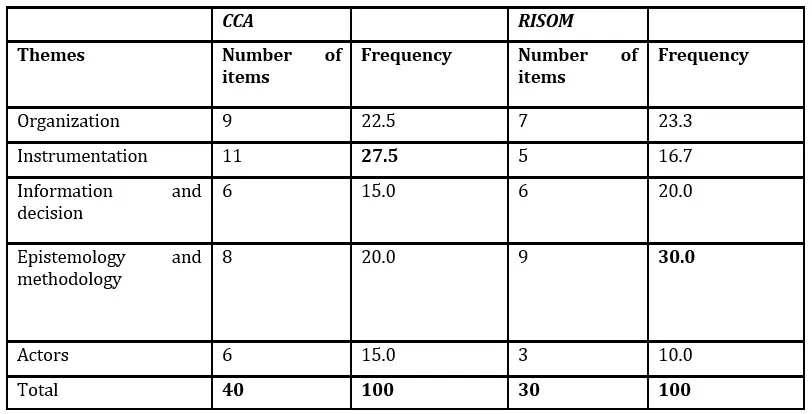
Table 1: Topics covered in management control publications
In Morocco
The thematic distribution of articles published in the two Moroccan journals, the “Revue du Contrôle Comptabilité et de l’Audit” (RCCA) and the “Revue Africaine de Management” (RAM), highlights significant divergences in epistemological and methodological orientations.
Indeed, the RCCA is characterized by a predominance of themes related to instrumentation (33.3%) and organization (26.7%), reflecting a strong grounding in the technical and structural dimensions of management control. Conversely, RAM gives more importance to epistemology and methodology (28.0%) as well as to information and decision (24.0%), which demonstrates a disciplinary openness and an orientation towards theoretical reflection and decision-making processes.
The topic of stakeholders remains marginal in both journals (10.0% for RCCA and 12.0% for RAM), leading us to interpret that the human dimension of management control, although recognized, has not yet become central to scientific production in Morocco. This underrepresentation can be interpreted as reflecting a continued focus on structural and methodological concerns at the expense of behavioral or sociological approaches.
Furthermore, to build on the 26.7% figure in the specialized journal RCCA, this emphasis placed on organizational themes such as behavioral control (customer-supplier relationships, virtual teams, responsibility, etc.), innovation and change, or organizational control (corporate networks, etc.) reflects growing scientific interest. These concerns are the result, according to Besson (2000), of theoretical and practical questions on the risks of opportunism and coordination.
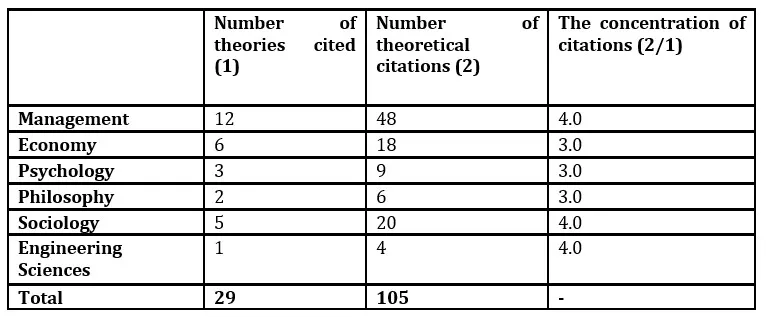
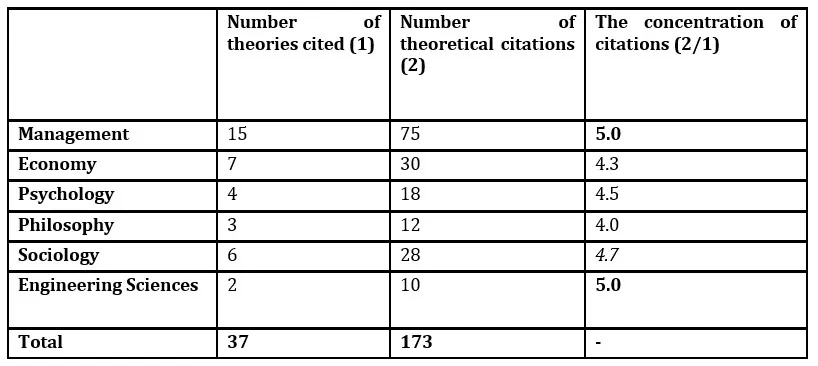
However, the analysis shows (after excluding duplicates) for Moroccan journals, out of 105 theoretical citations identified, an average of 1.90 citations per contribution; whereas in the French case, out of 173 theoretical citations identified, the average is 2.47 citations per contribution.
In France
The comparison of themes between the two French journals, the “Revue Comptabilité, Ctrôle, Audit” (CCA) and the “Revue Internationale des Sciences de l’Organisation et du Management” (RISOM), also highlights different orientations in scientific production.
The CCA is distinguished by a strong presence of themes related to instrumentation (27.5%) and organization (22.5%), which reflects a marked anchoring in the technical and structural dimensions of management control, a typical choice for this type of specialized journal.
Conversely, the RISOM gives more space to epistemology and methodology (30.0%), favoring reflection on the foundations of knowledge as well as research methods. The information and decision-making aspect (20.0%), representing one-fifth of its content, revealed the importance given to concrete applications.
The theme of actors also appears as secondary in both French journals (15.0% for the CCA and 10.0% for the RISOM), which suggests that the human dimension of management control remains relatively marginal in scientific debates, in favor of structural and methodological approaches.
Table 2: Frequency of citation of internal and external theories of control
In Morocco
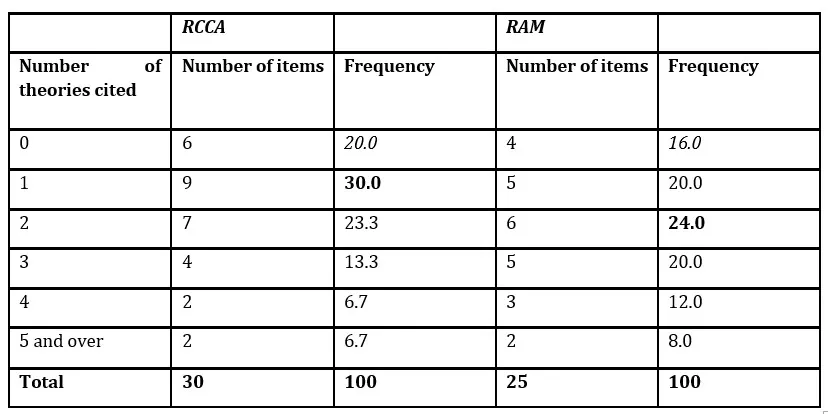
Examining the frequency of citation of internal or external theories to management control in the “Revue du Contrôle, Comptabilité et de l’Audit” (RCC A) and the “Revue Africaine de Management” (RAM) reveals significant differences in the mobilization of theoretical frameworks.
In the specialized journal RCCA, nearly a third of the articles (30.0%) favor a single theory, which reflects a limited mobilization, thus reflecting an orientation towards the consolidation of CG tools and practices. While 23.3% mobilize two, the proportion of articles without explicit theoretical reference remains relatively high (20.0%), reflecting a practical or descriptive orientation, rather than a search for conceptualization.
RAM, on the other hand, presents a more balanced distribution: 24.0% of articles mobilize two theories, 20.0% mobilize three, and 12.0% mobilize four. The proportion of articles without theoretical reference is slightly lower (16.0%), which suggests a greater propensity to situate the work within diverse conceptual frameworks or a broader academic debate.
In France
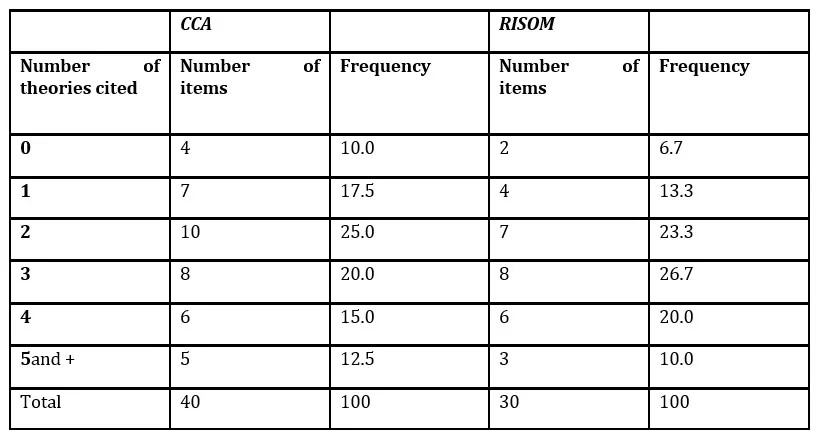
Examining the frequency of citation of internal or external theories to management control in the journal Accounting, Control, Auditing (CCA) and the International Journal of Organizational and Management Sciences (RISOM) reveals notable differences in the mobilization of conceptual frameworks.
The CCA is characterized by a high proportion of articles mobilizing two theories (25.0%) and three theories (20.0%), reflecting an orientation towards an intermediate methodological approach. The presence of articles mobilizing four theories (15.0%) and five or more theories (12.5%) (double that of the Moroccan RCCA) testifies to a progressive opening of the CCA towards theoretical complexity.
However, 10.0% of the articles that remain without explicit reference still reflect a persistence of descriptive or practical approaches.
Table 3: Theories by theme
In Morocco
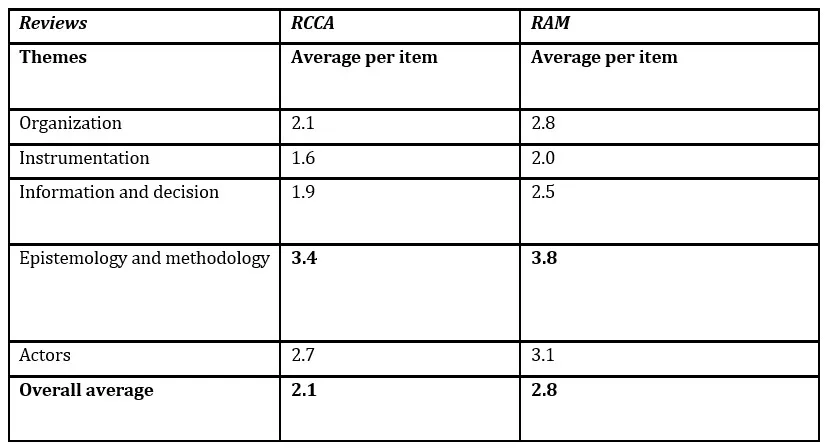
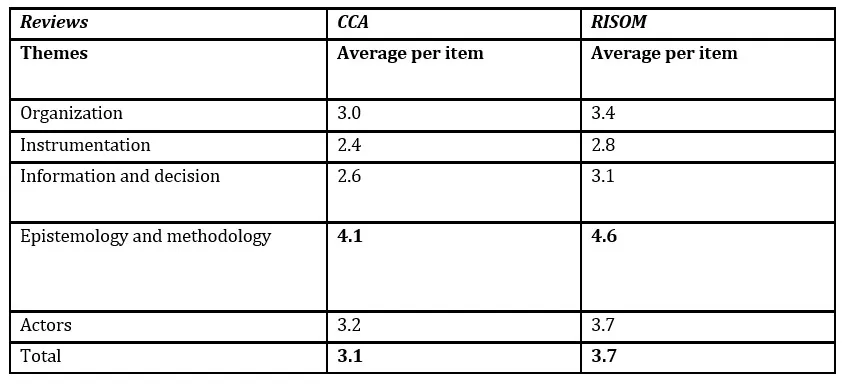
An examination of the average citations of thematic theories in the “Revue du Contrôle, Comptabilité et de l’Audit” (RCCA) and the “Revue Africain de Management” (RAM) reveals differences in the theoretical density mobilized. The overall average per article is higher in the RAM (2.8) than in the RCCA (2.1), reflecting a greater propensity to situate the work within diverse conceptual frameworks. By theme, the RAM consistently surpasses the RCCA.
We can observe a particularly notable gap for epistemology and methodology (3.8 vs. 3.4) and for actors (3.1 vs. 2.7), which suggests a more reflective orientation and increased attention to the human and methodological dimension of management control in RAM. In addition, the themes related to organisation (2.8 vs. 2.1) and information and decision (2.5 vs. 1.9) also confirm this tendency towards a denser theoretical mobilization for the same generalist journal.
In France
In the French case, an examination of the means of citing theories by theme in the journals Comptabilité, Contrôle, Audit (CCA) and the Revue Internationale des Sciences de l’Organisation et du Management (RISOM) reveals a higher theoretical density in RISOM (overall average of 3.7) than in CCA (3.1).
This difference reflects a more marked orientation of the RISOM towards conceptual pluralism and disciplinary openness.
Thematically, RISOM systematically surpasses CCA. We can highlight the significant difference for epistemology and methodology (4.6 versus 4.1), which testifies to an increased willingness for critical reflection and methodological diversification.
The themes related to organisation (3.4 vs. 3.0), information and decision (3.1 vs. 2.6), and actors (3.7 vs. 3.2) confirm this tendency towards a denser and more varied theoretical mobilisation. Even within the traditionally more technical field of instrumentation, RISOM shows a higher average (2.8 versus 2.4), indicating that articles in this journal attempt to address topics holistically in order to answer the questions they raise.
Table 4: Theoretical citations by scientific discipline
In Morocco
An examination of theoretical citations by scientific discipline reveals a differentiated concentration of references used in management control research.
Management appears as the most frequently cited discipline, with 12 theories mentioned and 48 occurrences, representing an average concentration of 4.0 citations per theory. This predominance reflects the disciplinary grounding of management control in its original field.
Sociology and engineering sciences also show a high concentration (4.0), despite a more limited number of theories mobilized (5 and 1 respectively). This suggests that, when called upon, these disciplines are used intensively to shed light on organizational and technical problems.
Economics, psychology, and philosophy, on the other hand, show a slightly lower concentration (3.0), reflecting a more balanced but less dense mobilization. These disciplines contribute to enriching theoretical reflection, but their use remains complementary rather than central.
In France
The examination of theoretical citations by scientific discipline highlights a particularly high conceptual density in the fields of management and engineering sciences, each displaying an average concentration of 5.0 citations per theory. Management, with 15 mobilized theories and 75 occurrences, confirms its role as the parent discipline of management control, while engineering sciences, although less represented (2 theories), are exploited intensively when they are called upon.
Sociology (4,7) and psychology (4,5) also show high levels of concentration, reflecting a significant mobilization of these disciplines to enrich the analysis of organizational behaviors and social dynamics. Economics (4, 3) and philosophy (4, 0) show slightly lower concentrations, but contribute to diversifying theoretical perspectives by providing complementary explanatory frameworks.
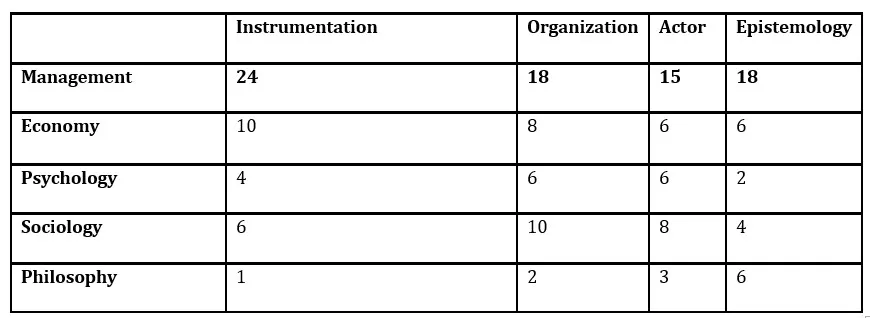
Table 5: Theoretical citations by discipline and theme
In Morocco
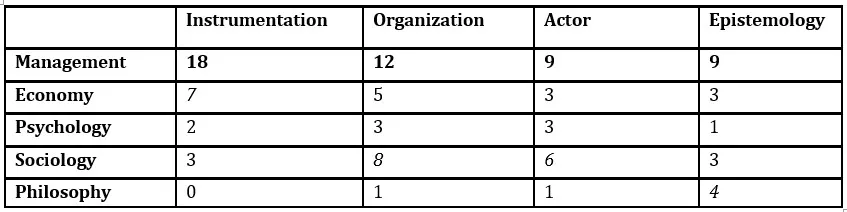
An examination of theoretical citations by discipline and theme reveals a differentiated distribution of references used in management control research. Management largely dominates all themes, with a strong concentration in instrumentation (18 citations) and organization (12), confirming its structuring and foundational role.
Sociology is distinguished by a significant presence in the organization (8) and actors (6), reflecting an orientation towards the analysis of social dynamics and human interactions. Psychology, although less represented overall, contributes in a targeted way to the themes of actors (3) and organization (3), highlighting the importance of behavioral dimensions.
The economy retains an intermediary place, mobilized in a balanced way in instrumentation (7) and organization (5), which reflects its role in articulating the logics of performance and rationality. Finally, philosophy, although marginal in instrumentation and organization, focuses more on epistemology (4), which translates into a critical and reflexive contribution to the construction of theoretical foundations.
In France
The analysis of theoretical citations by discipline and by theme reveals a differentiated distribution of the references mobilized in research in management control.
For Management, it largely dominates all thematic areas, with a strong concentration in instrumentation (24 citations), organization (18) and epistemology (18). This predominance confirms its structuring and foundational role, as the parent discipline of the field.
Sociology is distinguished by a significant presence in organisation (10) and actors (8), reflecting an orientation towards the analysis of social dynamics and human interactions.
Psychology, although less represented globally, contributes in a targeted way to the themes of actors (6) and organization (6), highlighting the importance of behavioral dimensions.
The economy maintains an intermediary position, mobilized in a balanced way in instrumentation (10) and organization (8), which reflects its role in the articulation of the logics of performance and rationality. Finally, philosophy, although marginal in instrumentation and organization, focuses more on epistemology (6), which reflects a critical and reflexive contribution to the construction of theoretical foundations.
Interpretation of the results
Thematic distribution of publications in management control
The study of publications in MC over the period 2019-2025 highlights a thematic organization whose forms vary according to national contexts and the type of journal.
In Morocco, the specialized journal RCCA reveals a strong concentration of research on instrumentation and organization, with these two themes alone accounting for more than half of the published articles. This focus reflects a particular attention paid to the tools, formal structures, and technical mechanisms of community governance.
Conversely, the generalist journal RAM is characterized by a more marked presence of research in epistemology and methodology, as well as on the theme of information and decision-making, demonstrating a broader openness to conceptual and methodological questions.
In France, the thematic distribution appears more balanced. The analyzed journals CCA and RISOM devote significant space to themes related to organization, epistemology, methodology, and actors. This diversity reflects a broader conception of general knowledge, simultaneously integrating its technical, organizational, and human dimensions.
These results show that, although the MC remains historically focused on instrumentation, generalist journals, both in Morocco and in France, constitute privileged spaces for the renewal of themes and the diversification of approaches.
Density and intensity of mobilization of theoretical frameworks
Examining the number of theoretical frameworks used per article reveals significant differences between the two contexts studied.
In Morocco, a significant proportion of articles utilize a limited number, or even none, of explicit theoretical frameworks, particularly in the specialized journal RCCA. The majority fall into the categories of “one” or “two theoretical frameworks,” reflecting an approach often centered on a dominant reference point. In contrast, the generalist journal RAM presents a slightly higher theoretical density, with a larger proportion of articles mobilizing three or more frameworks.
In France, the results show a significantly higher theoretical intensity. Articles published in CCA and RISOM frequently draw on several theoretical frameworks simultaneously, with a significant proportion citing three to five or more theories. This trend reflects a more pronounced practice of theoretical plurality and an explicit desire to combine analytical perspectives.
Thus, theoretical density emerges as a differentiating marker of research practices between the two countries, becoming a criterion for comparing their working methods. This density has also highlighted the structuring role of generalist journals as a driver of innovation, paving the way for the encouragement of conceptual openness.
Theoretical citations and disciplines used
Analysis of theoretical citations by discipline confirms the predominance of management science theories in both contexts studied. However, this dominance is accompanied by varying degrees of openness to related disciplines.
In Morocco, theories from economics and sociology occupy a secondary but significant place, providing considerable theoretical support, while psychology, philosophy and engineering sciences remain marginal. The concentration of citations suggests a relatively targeted use[viii]external frameworks, often mobilized in a complementary way to management theories to enrich or illuminate certain aspects without becoming central.
In France, disciplinary diversity is more pronounced. In addition to management sciences, contributions from sociology, economics, and psychology are more frequently used, with a higher frequency of citation.
This disciplinary plurality is particularly evident in the work[ix]Drawing on epistemology and actor analysis, this demonstrates a desire to broaden the discussion and move beyond a purely technical approach. This plurality thus confirms a more reflexive and critical orientation of the research.
Discussion: A comparison between Morocco and France
In light of the empirical data, we will discuss the results obtained from a multitude of perspectives.
A differentiated structuring of research in management control
The results highlight a contrasting structure of MC research between Morocco and France. In Moroccan journals, the strong representation of works devoted to instrumentation reflects an orientation still largely focused on management tools, budgetary mechanisms, and performance evaluation tools. This predominance reflects a conception of management control as a set of techniques designed to improve organizational efficiency.
Conversely, French journals present a more balanced thematic distribution between organizational, methodological, and human dimensions. This diversification reflects an evolution of the discipline towards a more integrative approach where cognitive behavioral is considered a complex organizational phenomenon, mobilizing social, cognitive, and institutional dimensions.
This difference aligns with Henri Bouquin’s analysis, according to which control management has gradually evolved from an essentially instrumental logic to one of the supporting organizational transformations. It also confirms the observations of Serge Sponem and François Pezet, who emphasize that contemporary issues extend far beyond the simple technical design of control mechanisms.
Generalist journals as a vehicle for scientific work
A second important contribution concerns the differentiated role played by generalist journals.
In both countries, a larger proportion of articles are devoted to questions of epistemology, methodology and organisation. This observation suggests that editorial diversity favours the emergence of new research problems. This result can be interpreted in light of the work of Marc Bollecker and Wilfrid Azan, who show that the boundaries of management control are becoming more and more porous and that the discipline is now borrowing theoretical frameworks from many neighboring sciences. Generalist journals thus play a role as scientific laboratories, allowing the importation of concepts from sociology, psychology, strategy, or even organizational theory.
A gradual intensification of theoretical pluralism
The results also show that French articles mobilize more theoretical frameworks simultaneously. This greater theoretical density does not simply reflect an accumulation of bibliographic references. It primarily reflects an evolution of scientific practices towards theoretical pluralism. While early research in management control generally relied on a single conceptual framework, contemporary research frequently combines several approaches to explain multidimensional organizational phenomena. This evolution aligns with the recommendations made by Pierre Lyet regarding the need to mobilize several disciplines to understand the complexity of social phenomena. It also fits within the logic of the multi-referential approach developed by Jacques Ardoino, according to which no discipline can, on its own, account for the totality of organisational phenomena.
An interdisciplinarity that is still asymmetrical
Analysis of the disciplines involved shows that management sciences remain largely dominant in both contexts studied. However, this dominance is accompanied by a progressive opening towards economics, sociology, and psychology. This evolution reflects a profound transformation of management control. Initially conceived as an essentially technical discipline, it is progressively becoming a hybrid discipline situated at the intersection of several scientific fields. The results here align with the observations formulated by Yves Dupuy, according to which management control has progressively been enriched by contributions from neighboring disciplines in order to better understand organizational behaviors. Nevertheless, this openness remains uneven. In Morocco, theoretical borrowings remain relatively concentrated around management science and economics. In France, they appear much more diversified, reflecting a greater maturity of the scientific communities involved.
An institutional and academic reading of the observed differences.
Although France and Morocco present different contexts, common points and major divergences emerge in the way institutional and academic factors influence research in management control.
Institutional Factors: A Shared Objective of Modernization
Both countries recognize the crucial importance of government policies and legislative reforms to guide and formalize research and practice of management control.
In France, ambitious national policies, such as the Multiannual Research Programming Law, strongly influence research topics, budgets, and priority areas, including management control. Domestic expenditure on research and development (R&D) represents a significant share of the Gross Domestic Product (GDP). Investment in R&D is not limited to the public sector; The private sector also plays a crucial role, employing a significant proportion of researchers. This public-private duality enriches research in management control, directing it towards both theoretical and applied issues, responding to the needs of businesses and administrations.
In Morocco, the Moroccan legislative and regulatory framework plays a leading role in guiding research in management control. Fundamental texts such as Organic Law No. 130-13 relating to the Finance Law and Decree No. 2-22-580 have made the development of this function indispensable in ministerial departments and public structures. Furthermore, Moroccan public reforms, inspired by the principles of New Public Management, emphasize management control as a steering and steering tool. performance. This directs studies towards the effectiveness, efficiency and results of public programs. Circulars and practical guides, such as the Practical Guide to Management Control of July 2024, structure the areas of application and research questions around implementation, management and performance. Thus, the modernization of public management and the adoption of good governance principles are shared objectives. However, the approach and stage of development differ.
France, with a more established institutional framework, is focusing on the evolution and optimization of existing systems, while Morocco is in the process of implementing and harmonizing its regulatory framework, seeking to integrate international standards while respecting its specificities.
Academic Factors: Density and Orientation
The density of research is closely linked to the number of researchers and teacher-researchers. France, with its vast academic network and well-developed research infrastructures, generates a larger and more diverse volume of publications. Specialized national journals and academic institutions stimulate abundant production, often focused on process balancing and the influence of relational systems. Also, funding systems, agencies, and research policies influence the density of publications and thematic choices, including for studies on general governance and management sciences in public/private contexts. In Morocco, although interest in management control research is growing rapidly, production remains more focused on adapting theories and practices to local realities. Publications in local languages (French and Arabic) and the availability of decrees orient academic production towards operational recommendations and regulatory frameworks, rather than abstract works. Some research focusing on determinants (education, age, culture) explains why some MC practices are implemented or not, directing research questions on adoption, resistance, and organizational contexts. The influence of dominant theoretical frameworks (particularly French) is palpable in Morocco, but it is enriched by a particular attention paid to local cultural and institutional specificities.
Impact of Relational Systems
Research on the influence of relational actor systems on management control practices is relevant in both contexts. In France, it can be manifested by the analysis of power dynamics and influence networks within large organizations. In Morocco, it takes on an additional dimension with the integration of sociocultural factors and community structures into the practical understanding of internal control.
Finally, the differences between the two countries should not be interpreted as a gap in scientific quality. They primarily reflect different institutional contexts. The French system benefits from a longer tradition in management control research, a highly structured academic network, and a significant international scientific output. The Moroccan context, on the contrary, is characterized by a more recent development of the discipline, with a strong focus on the operational problems encountered by public and private organizations. From this perspective, the differences observed correspond more to two stages of development of the same scientific field than to two levels of quality. This interpretation aligns with work on the structuring of scientific communities, which shows that the evolution of a discipline generally passes from a phase of methodological consolidation to a phase of theoretical diversification.
Theoretical implications
Beyond the comparison between Morocco and France, we were able to highlight contributions to literature on three levels during this study.
Firstly, it empirically confirms that disciplinary openness now constitutes a structural characteristic of research in management control.
Secondly, it shows that editorial policies directly influence the theoretical frameworks used, with generalist journals favouring interdisciplinary approaches more than specialized journals.
Thirdly, it suggests that the degree of theoretical pluralism can be considered an indicator of the maturity of a scientific field.
Thus, the evolution of management control is no longer solely reflected in the development of new management tools, but also in the continuous broadening of the theoretical references used to analyze contemporary organizations.
Managerial implications
The results of this study highlight several teachings likely to guide the practices of researchers, editorial managers, higher education establishments and organizations mobilizing knowledge produced in management control.
Encourage a diversification of research topics
Thematic analysis shows that Moroccan publications, particularly in the RCCA, are predominantly focused on instrumentation issues, while works dealing with actors, organizational dimensions, or epistemological questions remain relatively less numerous.
This concentration suggests that the editorial boards of Moroccan journals could encourage more research devoted to the human, behavioral and organizational dimensions of management control. Such a development would promote a more global understanding of steering mechanisms, integrating not only the tools, but also the interactions between actors, organizational structures and institutional contexts.
For researchers, these results invite the development of work focusing on change processes, the role of the management controller, governance, collective dynamics, or the appropriation of control mechanisms.
Strengthening theoretical pluralism in research work
The results in the tables show that articles published in French journals generally mobilize a greater number of theoretical frameworks than those published in Moroccan journals. This greater theoretical density testifies to a greater conceptual openness.
This observation leads to a recommendation that researchers and research directors encourage the mobilization of complementary theoretical frameworks rather than the systematic use of a single theory.
The intersection of perspectives from management science, sociology, economics, and psychology allows for a more nuanced understanding of the complexity of organizational phenomena and enhances the explanatory power of research. Doctoral schools could integrate this requirement into their methodological training, particularly through seminars dedicated to interdisciplinarity and theoretical pluralism.
Adapting editorial policies to promote scientific innovation
The results also show that generalist journals (RAM and RISOM) give more space to epistemological and methodological research than specialized journals. This difference underscores the role of editorial policies in shaping scientific output. Editorial boards could encourage the publication of thematic issues devoted to interdisciplinarity, new theoretical frameworks, or innovative methodological approaches. Such a strategy would help to renew research topics and strengthen the international visibility of journals.
Developing the interdisciplinary skills of researchers
Analysis of the disciplines mobilized reveals that management sciences remain largely dominant, while the contributions of sociology, psychology or philosophy remain relatively limited, particularly in Moroccan journals.
This situation suggests that universities could promote interdisciplinary training and research projects involving multiple specialties. A better grasp of theories from related disciplines will enrich analyses and produce more innovative research. Research laboratories could also encourage the formation of multidisciplinary teams bringing together specialists in management control, strategy, organizational sociology, and work psychology. The results of this multidisciplinary work could contribute to solving the most complex problems in public and private organizations. This will be able to reconcile the business world with the academic world ideally in the Moroccan context, thus encouraging private funding of research.
Strengthening international scientific collaborations
The differences observed between Morocco and France reflect distinct trajectories of scientific development rather than a gap in quality. The results notably show a greater disciplinary openness in French journals. From this perspective, the development of collaborations between Moroccan and French teams appears as a relevant lever for promoting knowledge transfer, the dissemination of new theoretical approaches, and the improvement of research practices. International projects, joint PhD supervision or Francophone research networks could contribute to accelerating this dynamic.
Designing CMS for hybrid contexts
In cases where companies have subsidiaries in both countries or are transnational, it is advisable to integrate mixed theoretical frameworks. An effective French model can focus on quantitative and rational approaches since corporate governance and corporate culture are already well established in this context. The French “recipe for success” will not yield the same results when applied to Moroccan companies. Thus, the Moroccan context may require more flexibility to manage crises and uncertainties, with an environment often characterized by emerging contexts.
In this scenario, leaders should favor management systems that combine rigorous financial control with non-financial indicators, such as innovation and organizational culture. This broad approach allows for greater resilience to external shocks and improved overall performance. Managers in a hybrid environment are therefore compelled to create a framework with a deep understanding of local nuances.
The key would therefore be to contextualize so that performance rhymes with the uniqueness of the ecosystem.
Skills development
Indeed, the MC is all the more effective if the emphasis is placed on the quality of human resources and a harmonization of interactions between the different stakeholders.
Investing in training and development: It is essential, even mandatory, to train teams to understand the benefits of using control tools and how to use them effectively to ensure the successful implementation of the General Accounting (GA) system, especially in Morocco where this discipline is being adopted, particularly in SMEs. The required skills therefore vary, encompassing technical expertise in accounting and finance, as well as communication and analytical skills.
In Morocco, where digitalization is progressing rapidly, adopting French frameworks can prove beneficial for efficiency, provided that investment is made in appropriate local training to prevent resistance. This leads to increased strategic alignment and improved overall performance, according to some empirical studies.
To guide organizational practices
The results finally show that the most recent research tends to move beyond a strictly instrumental view of management control to integrate organizational, informational, and behavioral dimensions. For organizations, this evolution implies that control mechanisms should no longer be conceived solely as technical tools for measuring performance. Their effectiveness also depends on their ability to support coordination, improve information flow, support decision-making, and foster stakeholder buy-in. Managers and controllers would therefore benefit from combining the implementation of management tools with communication, training, and change management initiatives.
Furthermore, encouraging action research and joint projects between Morocco and France can enrich the theory[x] and practice[xi] managerial.
In fine, the expected goals of this research were:
To analyze the epistemological diversity by identifying and comparing the theoretical frameworks used in CG in Morocco and in France, whether they are classical or borrowed from other disciplines;
To contribute to comparative literature by enriching the debate on the internationalization of research in CG, thus showing how national contexts influence methodological and epistemological choices;
To promote scientific cooperation by encouraging collaborations between Moroccan and French researchers to enhance the visibility and impact of their work, ideally with work written in the same language;
And to improve socio-economic relevance by showing how epistemological choices influence the ability of CG research to meet the needs of businesses and public decision-makers.
Conclusion
Nowadays, a nation’s potential to adapt to the modern world depends on its capacity for innovation, which is itself based on its scientific research, the cornerstone of all its technologies Deheuvels (1990). This explains the policy of some countries to devote a considerable part of their GDP to research, boosting their image as world leaders in the fields of research and innovation.
Thus, the synergy between scientific research and research institutions, particularly those stemming from higher education, makes it possible to contribute to addressing increasingly complex contemporary challenges. UNESCO (The Futures of Higher Education and Research: Addressing Global Challenges, 2021) recalls that higher education is a central player in responding to global challenges.
Furthermore, the mobilization of research in support of businesses can be analyzed as a vector of legitimation and performance, since scientific research is not limited to the production of abstract knowledge. According to Mintzberg et al. (1999), “All theories are false: they are merely words, or images, put down on paper…usefulness becomes the key criterion.” Mintzberg et al. (1999).
Regarding research in management control, the disciplinary openness both in terms of chosen themes and in the diversity of epistemological frameworks mobilized (this diversity depends on each country) makes this discipline a living subject that questions itself, and develops in order to respond to complex organizational problems.
Competitive intelligence research then becomes a strategic lever for organizational transformation, competitiveness, and sustainability in volatile and unpredictable environments. Companies that integrate research findings into their management and innovation practices strengthen their market position by drawing on and investing in innovative and pragmatic solutions directly tailored to their specific needs. This reinforces the relevance and impact of research on economic and social development.
Recommendations to future researchers
For researchers who want to delve deeper into this exciting topic, they could analyze “the impacts of public management reforms on management control research in the Maghreb”, or investigate “the influence of cultural factors on management control practices in North Africa”, or even “the evolution of management control research themes in France over the last 20 years and the impact on organizational performance”.
Bibliography
Allais, M. (s. d.). La passion de la recherche. Autoportraits d’un autodidacte. Clément Juglar.
Ardoino, J. (1993). L’approche multiréférentielle (plurielle) des situations éducatives et formatives, Pratiques de Formation-Analyses. Formation Permanente, (n° 25-26), 15‑
Besson, P. (2000). Risques organisationnels et dynamique du controle. In Encyclopédie de Comptabilité, Controle et Audit (B. Colasse (dir), p. 1065‑1078). Economica.
Bollecker, M., & Azan, W. (2008). Les frontièresdelarechercheencontrôledegestion : Une analysedescadresthéoriquesmobilisés. 29èmecongrèsdel’AssociationFrancophonedeComptabilité:La comptabilité, lecontrôleetl’auditentrechangementetstabilité, Cergy-Pontoise,France.
Bollecker, M., & Azan, Wilfrid. (2008). Les frontières de la recherche en contrôle de gestion : Une analyse des cadres théoriques mobilisés. 29ème congrès de l’AFC. Archive ouverte HAL
Bollinger, S. (2019). Creativity and forms of managerial control in innovation processes : Tools, viewpoints and practices. European Journal of Innovation Management. https://doi.org/10.1108/EJIM-07-2018-0153
Bollinger, S., & Burger-Helmchen, T. (2021). Du contrôle de l’innovation à la créativité : Vers un cadre intégrateur. Revue d’économie industrielle. https://doi.org/10.4000/rei.10365
Bouquin, H. (2008a). Le Controle de gestion. Presses Universitaires de France.
Bouquin, H. (2008b). Quelles perspectives pour la recherche en contrôle de gestion ? Finance Contrôle Stratégie, Université Paris-Dauphine, 11(hors-série).
Bouquin, H. (2011). Les fondements du contrôle de gestion (Presses Universitaires de France,).
Bouquin, H., & Pesqueux, Y. (2004). Comptabilité de gestion (Que sais-je n. 3746). Presses Universitaires de France (PUF).
Chanegrih, T. (2015). L’évolution des outils de contrôle de gestion : Une influence culturelle ? Management & Avenir, 77, 141‑
Curie, E., & Quinn, S. (1981). Madame Curie (Guallimard). Odile Jacob.
Deheuvels, P. (1990). La recherche scientifique. Presses Universitaires de France.
DUPUY, Y. (2002). Editorial de la Revue Audit, controle et Audit. 2 et 3.
El Hamdaoui, M., Sadki, O., & Rifki, S. (2023). La recherche en contrôle de gestion : État des lieux des articles publiés dans les revues scientifiques marocaines. African Scientific Journal.
Gendron, Y., & Baker, R. (s. d.). Par-delà les frontières disciplinaires et linguistiques : L’influence des penseurs français sur la recherche en comptabilité. Association Francophone de Comptabilité, 7(2), 5‑
Hooge, S., & Roland, S. (2016). Performance de la R&D et de l’innovation—Du contrôle de gestion à la gestion contrôlée. org.
Kaplan, R. S., & Norton, D. P. (1992). The Balanced Scorecard : Measures that Drive Performance. Harvard Business Review, 70(1), 71‑
Karpik, L. (2012). Performance, Excellence et création scientifique. Revue Francaise de Socio-économie, 2(10), 113-135.
Lill, P., Wald, A., & Munck, J. C. (2021). In the field of tension between ceativity and efficiency : A systematic literature review of management control systems for innovation activities. European Journal of Innovation Management, Emerald, 24(3), 919‑
Lövstål, E., & Jontoft, A.-M. (2017). Tensions at the intersection of management control and innovation : A literature review. Jourrnal of Management Control. https://doi.org/DOI%252010.1007/s00187-016-0244-3
Lyet, P. (2016). La mobilisation d’approches de plusieurs disciplines dans les recherches conjointes : Une des dimensions de la mise en discussion de points de vue différents sur la réalité. Forum, Pluri – inter – trans – disciplinarité : discours, enjeux et pratiques dans le champ social Forum, (148).
Maggina, A. (2009). Management Control : A review. International Journal of Managerial and Financial Accounting.
Mintzberg, H., Ahlstrand, B., & Lampel, J. (1999). Safari en pays stratégie : L’exploration des grands courants de la pensée stratégique. Village mondial.
Otley, D. (1995). Research in Management Control : An overview of its Development. British Journal of Management.
Puigelier, C. (s. d.). Pouvoir de la science. Des Lois européennes vers l’Asie. In La recherche scientifique : Un droit fondamental? Tome II (Bilingue, p. 381). mare & martin.
Rihouet, O., & Gérard, B. (2026, mars). Rôle social, IA et Innovation : Le contrôle de gestion en pleine mutation. Grant Thornton France + Université Paris-Dauphine–PSL.
Simons, R. (1995). Levers of Control : How Managers Use Innovative Control Systems to Drive Strategic Renewal (Harvard Business School Press).
Solé, R. (1998). Les savants de Bonaparte. Editions du seuil.
Sponem, S., & Pezet. (2021). Les grands auteurs en contrôle de gestion. (EMS Éditions).
The Futures of Higher Education and Research : Addressing Global Challenges. (2021). Paris: UNESCO Publishing.
End notes
[i]The major contribution of the singularities model, developed by Thierry Lévy-Tadjine in 2008, lies in the recognition of the specificity of organizational and entrepreneurial practices.
[ii]This point is borrowed by the author from the work of the author Pierre Chabal, “Interregional recognition Europe-Central Asia after the Cold War: comparative conceptual and interpretative approaches”, p.367
[v]Taking into account the reactions of the stakeholders.
[vi]The current of research that addresses the relationship between general knowledge (GQ) and scientific research (SR) is one such current among others. Examples include: the current of research dealing with “The measurement of performance and university research” or “GQ in the public sector and universities”.
[vii]Frugal: in this case, it means a simple, efficient and inexpensive system that avoids the cumbersome nature of complex devices.
[viii]The fact that the citations are concentrated on a few references shows that the researchers use external theoretical frameworks selectively.
[ix]The treatment of works on epistemology or those of actors (both linked to the CG) has implications for knowledge and theoretical foundations, as well as for the behavior and interactions of actors. This moves them away from the purely technical nature (of the CG) towards “legitimate” approaches that prioritize abstract reflection, consideration of human values, or the social approach.
[x]Nourishing managerial theory: researchers from both countries can develop new ideas, concepts or models thanks to the results observed in these projects.
[xi]Putting it into practice: managers and organizations can directly apply these findings to improve how they manage, make decisions, or collaborate.