Ricardo Elías JARAMA SOTO, Alexander David DE LA CRUZ-VARGAS, Yessica ERAZO-ORDOÑEZ and Guido Angelo, HUAPAYA-FLORES
Universidad Peruana Unión, Lima, Perú
Volume 2026,
Article ID 680047,
IBIMA Business Review,
12 pages,
DOI: doi.org/10.5171/2026.680047
Received date: 31 March 2026; Accepted date: 15 July 2026; Published date: 29 September 2026
Academic Editor: Richard Aguirre-Camarena
Cite this Article as:
Ricardo Elías JARAMA SOTO, Alexander David DE LA CRUZ-VARGAS, Yessica ERAZO-ORDOÑEZ and Guido Angelo, HUAPAYA-FLORES (2026)," Strategic Alignment and Organizational Climate among University Staff: Empirical Evidence based on Sociodemographic Characteristics “, IBIMA Business Review, Vol. 2026 (2026), Article ID 680047, https://doi.org/10.5171/2026.680047
Universities operate in dynamic and competitive environments; therefore, aligning human resources with institutional strategy is crucial. This study examines the relationship between sociodemographic factors, strategic alignment, and organizational climate among the staff of a faith-based higher education institution in Peru. A quantitative approach was employed, utilizing a non-experimental design with a correlational and comparative scope. The sample consisted of 299 employees. The instruments were validated via factor analysis (KMO = 0.945 for organizational climate; KMO = 0.887 for strategic alignment), yielding Cronbach’s alpha reliability coefficients of 0.981 and 0.914, respectively. The results reveal that 83.6% of the staff perceive the organizational climate as favorable to very favorable, while 43.5% demonstrate levels of strategic alignment ranging from acceptable to optimal. Regarding knowledge of strategic elements, 32.8% possess a good-to-excellent level of knowledge concerning the institutional vision; 38.8% regarding the mission; and 59.2% regarding the values. Spearman correlation analysis indicated that various sociodemographic factors show significant relationships with both variables. The study concludes that more than one sociodemographic factor is related to strategic alignment and organizational climate within the institution analyzed.
Contemporary organizations face the ongoing challenge of aligning their human resources with institutional strategic objectives. In the context of higher education, this alignment takes on particular significance, given that academic and administrative staff constitute the primary asset for achieving the institutional mission and vision (Flores Rivera & Herrera Freire, 2025). Organizational climate, defined as the set of perceptions that employees hold regarding the work environment, emerges as a determining factor in the effectiveness of this alignment (Correa Vergara et al., 2025).
The specialized literature has extensively documented the importance of organizational climate for job performance and employee satisfaction (Sotamba Romero, 2025). However, there is a knowledge gap regarding how sociodemographic factors influence both the perception of organizational climate and the degree to which staff are strategically aligned with institutional goals. This gap is particularly evident in the context of faith-based higher education institutions in Latin America, where the intersection of religious identity and academic objectives creates unique dynamics that warrant in-depth research.
Strategic alignment is a process through which an organization’s employees understand, internalize, and act in accordance with the purposes, policies, and strategic priorities defined by the institution (Kaplan & Norton, 2006). This concept goes beyond the simple communication of objectives, involving an emotional and cognitive connection to the institutional philosophy that requires multiple levels of integration. In the case of faith-based universities, this alignment takes on additional dimensions related to the religious values that underpin the institution (Serquen & Marquez Yauri Seminary, 2022).
The organizational climate, for its part, reflects the collective perception that members of an organization form regarding characteristics of the work environment such as leadership, communication, supervision, working conditions, and opportunities for professional development (Brunet, 2005). This perception is not static but changes based on employees’ experiences, expectations, and personal characteristics, constituting a dynamic social construct.
The relationship between these two constructs has been the subject of research in various organizational contexts. However, most studies have focused on the business context and the healthcare sector, leaving a gap in our understanding of this dynamic in faith-based institutions of higher education (F. Chilón and A. Huapaya, 2016; Villamar Palma, 2021). Additionally, the influence of sociodemographic variables such as age, gender, marital status, educational level, and geographic origin on this relationship remains insufficiently explored in the Latin American academic literature.
The objective of this study was to determine the relationship between sociodemographic factors and strategic alignment and organizational climate among the staff of a faith-based university in Peru. Specifically, the study sought to identify which sociodemographic factors are significantly correlated with both variables, examine the staff’s level of knowledge regarding key strategic elements (vision, mission, values), and analyze differences in these variables by campus and faculty affiliation.
Literature Review
Fundamentals of Organizational Climate
The concept of organizational climate has evolved significantly since it was first formulated in the 1960s. Litwin and Stringer (1998) defined it as the sum of employees’ perceptions of their work environment, arguing that these perceptions directly influence motivation and organizational behavior. Subsequently, Brunet (2005) expanded on this conceptualization, emphasizing that climate is not an objective characteristic of the organization but rather a subjective construct based on employees’ interpretations of their environment.
The dimensions of organizational climate have been the subject of numerous theoretical proposals. Palma (2004) identified five fundamental dimensions: personal fulfillment, work engagement, supervision, communication, and working conditions. These dimensions refer, respectively, to the perception of opportunities for professional growth, a sense of belonging and commitment to the organization, the quality of managerial support, the effectiveness of information channels, and the availability of resources for work.
Personal fulfillment is the most fundamental aspect of the organizational climate, as it reflects employees’ perceptions of their opportunities for professional and personal development within the organization. When employees perceive that the organization invests in their growth, provides learning opportunities, and recognizes their achievements, they tend to develop a more positive relationship with the organization. Work engagement, for its part, relates to the extent to which employees feel they are an integral part of the organization and committed to its goals.
Supervision is a critical element that bridges the gap between organizational strategy and its implementation at the operational level. Supervisors who provide support, constructive feedback, and recognition foster more favorable work environments. Communication, as the channel through which organizational information flows, largely determines the clarity of objectives, policies, and institutional changes. Finally, working conditions include both the physical aspects of the work environment and factors related to safety, pay equity, and the availability of the tools necessary for job performance.
The importance of organizational climate lies in its predictive power regarding key organizational outcomes. Recent research has shown that a favorable organizational climate is associated with higher levels of productivity, lower absenteeism, reduced staff turnover, and greater job satisfaction (Flores Rivera & Herrera Freire, 2025). In university settings, a positive climate promotes the retention of high-quality faculty and enhances the effectiveness of educational processes. Additionally, a favorable climate facilitates the implementation of organizational changes and the adoption of new strategic initiatives.
Fundamentals of Strategic Alignment
Strategic alignment is a multidimensional concept that integrates cognitive, conative, and affective aspects of the relationship between the individual and the organization (Kaplan & Norton, 2006). The cognitive dimension refers to the employee’s knowledge of the organizational strategy, including its vision, mission, objectives, and policies. The conative dimension involves the individual’s intention and willingness to act in accordance with these strategic elements. The affective dimension encompasses emotional commitment and personal identification with institutional goals.
Khadem (2002) argues that effective strategic alignment requires that the strategy defined at the highest levels be rolled out and translated into concrete actions at all organizational levels. This deployment is not automatic but depends on communication, training, and leadership processes that facilitate staff understanding and adoption of the strategy. Strategic deployment requires that each organizational unit translate general objectives into specific goals and that each employee understand how their duties contribute to the achievement of these objectives.
In institutions of higher education, strategic alignment takes on specific characteristics. Faculty and administrative staff must understand not only the institutional objectives but also how their specific roles contribute to the fulfillment of the educational mission. Additionally, in faith-based universities, alignment includes identification with the religious and ethical values that underpin the institution (Seminario Serquen & Marquez Yauri, 2022). This integration of religious values with academic objectives creates an additional layer of complexity that requires careful management.
The strategic alignment process in faith-based universities must take into account that staff members come from diverse backgrounds with varying degrees of identification with the institution’s religious values. Some staff members may be active members of the religious community that underpins the institution, while others may be hired professionals who do not necessarily share the same religious faith but who value the institution’s ethical and educational principles.
Relationship between Strategic Alignment and Organizational Climate
Although strategic alignment and organizational climate are distinct constructs, there is a theoretical relationship between the two. A positive organizational climate—characterized by trust, effective communication, and quality leadership—facilitates strategic alignment processes (Correa Vergara et al., 2025). When employees perceive that their supervisors support them, that information flows smoothly, and that their contributions are valued, they tend to be more willing to align with organizational objectives.
Conversely, when employees feel aligned with institutional goals, they tend to experience a more favorable climate. This alignment generates a sense of purpose and meaning in the work, which in turn improves the perception of the work environment. However, this relationship is neither unidirectional nor deterministic. Previous studies have documented cases in which employees perceive a favorable climate but maintain low strategic alignment, or vice versa. This suggests that mediating variables, including sociodemographic factors, play an important role in shaping this relationship.
Theory suggests that the relationship between organizational climate and strategic alignment is mediated by factors such as the clarity of strategic communication, the consistency between stated values and organizational actions, and the degree to which the strategy is perceived as relevant to employees’ day-to-day work.
Influence of Sociodemographic Factors
Sociodemographic factors such as age, gender, marital status, educational level, geographic origin, and employment status are variables that shape employees’ perceptions and attitudes toward work. Age, for example, has been associated with differences in work motivation and openness to organizational change (Marchant, 2006). Younger employees may have different expectations regarding professional development and work flexibility, while older employees may prioritize stability and recognition.
Gender can influence perceptions of development opportunities and equitable treatment (Saavedra, 2012). Although contemporary research emphasizes the importance of gender equity in organizations, differences persist in how men and women perceive the work environment and their opportunities for advancement. Educational level is related to the ability to understand complex strategies and expectations regarding workplace autonomy. Employees with higher levels of education tend to have higher expectations regarding participation in decision-making and professional development.
In university settings, geographic origin can influence identification with the institution, particularly at universities located in specific areas that attract staff from different regions. Marital status and the presence of dependents affect the availability of time and energy for deep professional engagement (Elli Domínguez, 2025). Employees with significant family responsibilities may prioritize stability and benefits over professional development opportunities.
Materials and Methods
A non-experimental design of a descriptive, correlational, and comparative nature was employed. The descriptive nature of the study made it possible to characterize the levels of strategic alignment and organizational climate in the study population, providing a snapshot of the current state of these variables. The correlational component facilitated the analysis of relationships between sociodemographic variables and the main constructs, allowing for the identification of patterns of association. The comparative aspect made it possible to identify differences based on campus and faculty affiliation, revealing whether the organizational experience varies according to specific work contexts.
The study population consisted of all staff (academic and administrative) at a Peruvian religious university with campuses in three geographic locations: Lima (coast), Juliaca (highlands), and Tarapoto (jungle). The institution has multiple schools, including Business, Health Sciences, Engineering, Humanities and Education, Theology, and Graduate Studies, in addition to administrative support units. The inclusion criteria were being academic or administrative staff and having been employed for more than 6 months. Students and parents were excluded.
The sample consisted of 299 employees, distributed proportionally by campus and college. The sampling was non-probabilistic, based on availability and willingness to participate in the study. Although this approach has limitations in terms of statistical representativeness, it is common in organizational research where voluntary participation is essential for obtaining honest responses.
Measuring Instruments
Organizational Climate Questionnaire. The instrument developed by Sonia Palma (2004) was used, consisting of 50 items distributed across five factors: personal fulfillment (10 items), job engagement (10 items), supervision (10 items), communication (10 items), and working conditions (10 items). Each item was rated on a five-point Likert scale ranging from “strongly disagree” to “strongly agree.” Construct validity was verified through factor analysis (KMO = 0.945, Bartlett’s test p = 0.000), indicating that the items shared significant common variance. Internal reliability was assessed using Cronbach’s alpha (α = 0.981), indicating excellent internal consistency and suggesting that the items consistently measured the construct of organizational climate.
Strategic Alignment Questionnaire. A 22-item instrument was used, organized into three dimensions: institutional purposes (with the subdimensions of vision, mission, and values), strategic priorities, and institutional policies. Respondents rated the items on a five-point scale ranging from “I am unfamiliar with the topic” to “I can clearly explain and interpret it.” Construct validity was confirmed through factor analysis (KMO = 0.887, Bartlett’s test p = 0.000). Reliability was established using Cronbach’s alpha (α = 0.914), indicating good internal consistency.
Sociodemographic Factors Questionnaire. Information was collected on age (categorized by age range), gender, marital status, geographic origin (coast, highlands, jungle, abroad), educational level (elementary, technical, undergraduate, graduate), employment status (part-time, full-time, full-time only), work location (Lima, Juliaca, Tarapoto), affiliated faculty, length of service at the institution, and number of dependents.
Data collection was conducted using self-administered questionnaires distributed via Google Forms during 2022. Coordination with faculty deans ensured that survey dates did not interfere with academic activities. To encourage participation, a raffle for a tablet was held among those who correctly completed the questionnaires. The process was carried out with the approval of the institutional Ethics Committee, ensuring confidentiality and informed consent from participants.
The data were processed using SPSS version 22 and Excel. Descriptive analyses were performed using frequencies, percentages, and measures of central tendency to characterize the sample and the main variables. For inferential analysis, Spearman’s correlation was used, since normality tests (Kolmogorov-Smirnov) indicated non-normal distributions for several variables. For comparisons between groups, the Kruskal-Wallis test for independent samples was used, followed by post-hoc tests when necessary to identify specific pairs of groups that differed significantly.
Results
Sociodemographic Characteristics of the Sample
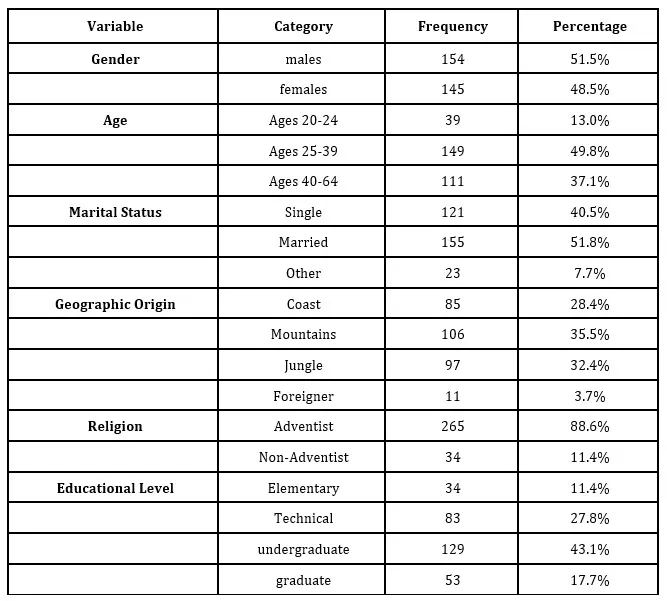
The sample included 299 participants, of whom 51.5% were men (n = 154) and 48.5% were women (n = 145), reflecting a relatively balanced gender distribution. Regarding age, 49.8% (n = 149) were young adults aged 25 to 39, 37.1% (n = 111) were middle-aged adults aged 40 to 64, and 13.0% (n = 39) were young adults aged 20 to 24. This distribution suggests a workforce with significant experience, but with a substantial representation of younger employees.
51.8% (n = 155) were married, 40.5% (n = 121) were single, and 7.7% (n = 23) were in other marital statuses (widowed, divorced, cohabiting). Regarding geographic origin, 35.5% (n = 106) came from the highlands, 32.4% (n = 97) from the jungle, 28.4% (n = 85) from the coast, and 3.7% (n = 11) were foreigners. This distribution reflects the institution’s multiregional nature, with locations in different geographic areas of Peru.
88.6% (n = 265) were Adventists, while 11.4% (n = 34) were not. This proportion is consistent with the institution’s denominational nature, although it indicates that approximately one in nine employees does not share the institution’s religious faith.
In terms of educational level, 43.1% (n = 129) had a college education, 27.8% (n = 83) had a technical education, 17.7% (n = 53) had a graduate degree, and 11.4% (n = 34) had a basic education. 51.8% (n = 155) were combining work and study, while 48.2% (n = 144) were working only, indicating that approximately half of the staff was engaged in ongoing academic training.
Regarding distribution by faculty, 18.7% (n = 56) belonged to Business Sciences, 12.0% (n = 36) to Health Sciences, 11.7% (n = 35) to Engineering, 4.0% (n = 12) to Humanities and Education, 3.3% (n = 10) to Theology, 1.7% (n = 5) to Graduate Studies, and 48.5% (n = 145) to non-academic areas. The predominance of staff in non-academic areas reflects the complexity of the administrative infrastructure required to operate a higher education institution.
46.2% (n = 138) held executive administrative positions, 12.4% (n = 37) combined teaching and administration, 12.4% (n = 37) were exclusively teachers, 5.7% (n = 17) combined teaching and research, and 23.4% (n = 70) performed other duties. 68.2% (n = 204) had staff under their supervision, while 31.8% (n = 95) did not, indicating that approximately two-thirds of the staff held some leadership or supervisory role
Table 1: Sociodemographic Characteristics of the Sample
Organizational Climate Levels
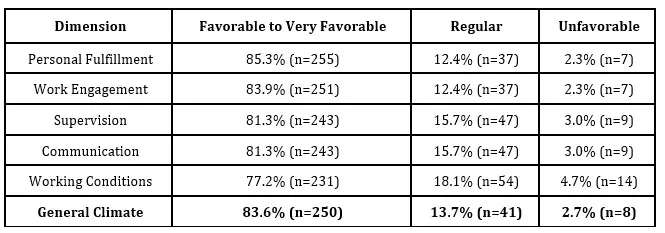
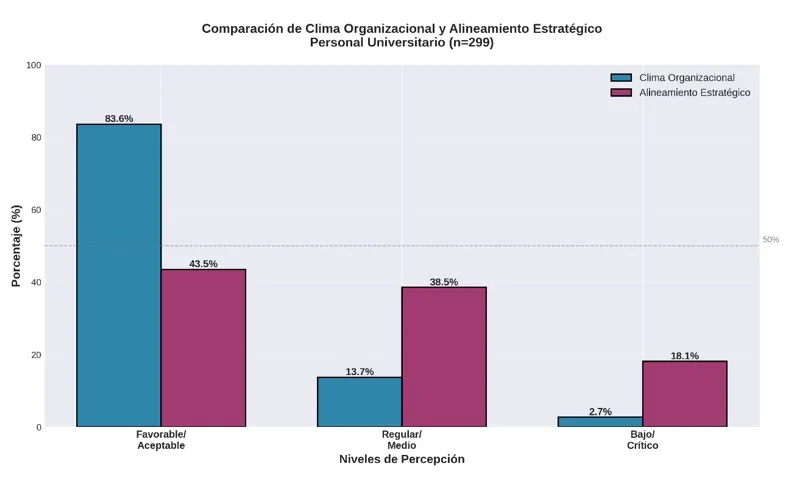
The descriptive analysis revealed that 83.6% (n = 250) of the staff perceived the organizational climate as favorable to very favorable, 13.7% (n = 41) as average, and only 2.7% (n = 8) as unfavorable to very unfavorable. This highly positive distribution suggests that the institution has succeeded in creating a work environment generally perceived as favorable by the majority of its employees.
Regarding specific dimensions, personal fulfillment showed that 85.3% (n = 255) perceived levels ranging from favorable to very favorable, with only 12.4% (n = 37) at a moderate level and 2.3% (n = 7) at an unfavorable level. This finding suggests that employees perceive significant opportunities for professional growth and development within the institution.
Work engagement was perceived as favorable to very favorable by 83.9% (n = 251), with 12.4% (n = 37) reporting an average level and 2.3% (n = 7) reporting an unfavorable level. This positive perception of engagement suggests that staff feel they are an integral part of the organization and are committed to its goals.
Supervision was rated as favorable to very favorable by 81.3% (n = 243), fair by 15.7% (n = 47), and unfavorable by 3.0% (n = 9). Communication showed similar patterns: 81.3% (n = 243) rated it as favorable to very favorable, 15.7% (n = 47) as fair, and 3.0% (n = 9) as unfavorable. These findings suggest that supervisors generally provide adequate support and that communication channels function effectively.
Working conditions were perceived as favorable to very favorable by 77.2% (n = 231), average by 18.1% (n = 54), and unfavorable by 4.7% (n = 14). Although this is the factor with the lowest percentage of favorable responses, it remains largely positive, suggesting that, while there are opportunities for improvement in resources and the physical environment, these do not constitute critical problems.
Table 2: Organizational Climate Levels by Dimension
Levels of Strategic Alignment
43.5% (n = 130) of the staff had acceptable to optimal levels of strategic alignment, 38.5% (n = 115) had average levels, and 18.1% (n = 54) had low to critical levels. This distribution, although largely positive, reveals a significant gap regarding organizational climate, suggesting that a favorable perception of the work environment does not automatically translate into strategic alignment.
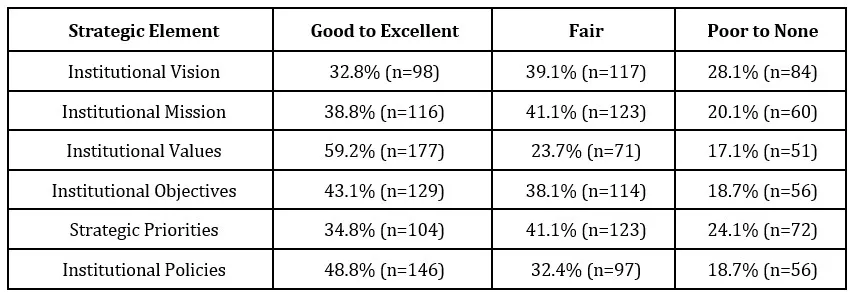
Regarding the institutional purposes dimension, 43.1% (n = 129) had good to excellent knowledge, 38.1% (n = 114) had fair knowledge, and 18.7% (n = 56) had poor to no knowledge. This distribution suggests that, although there is significant knowledge of institutional purposes, approximately one in five employees lacks an adequate understanding.
For the strategic pillars, 34.8% (n = 104) had good to excellent knowledge, 41.1% (n = 123) had fair knowledge, and 24.1% (n = 72) had poor to no knowledge. This factor shows the lowest percentage of good to excellent knowledge, suggesting that the strategic pillars are less well-known than other strategic elements.
With regard to institutional policies, 48.8% (n = 146) had good to excellent knowledge, 32.4% (n = 97) had fair knowledge, and 18.7% (n = 56) had poor to no knowledge. Institutional policies show the highest percentage of good to excellent knowledge, possibly because they more directly affect employees’ daily work.
Specifically, regarding the institutional vision, 32.8% (n = 98) had good to excellent knowledge, 39.1% (n = 117) had fair knowledge, and 28.1% (n = 84) had poor to no knowledge. Regarding the mission, 38.8% (n = 116) had good to excellent knowledge, 41.1% (n = 123) had fair knowledge, and 20.1% (n = 60) had poor to none. Finally, regarding values, 59.2% (n = 177) had good to excellent knowledge, 23.7% (n = 71) had fair knowledge, and 17.1% (n = 51) had poor to no knowledge.
This pattern is particularly interesting: while the vision is known by less than one-third of the staff, the values are known by nearly two-thirds. This suggests that values—being more abstract and potentially aligned with personal religious convictions—are more easily internalized than more specific and technical strategic elements.
Table 3: Understanding of Key Strategic Elements
Relationships between Sociodemographic Factors and Key Variables
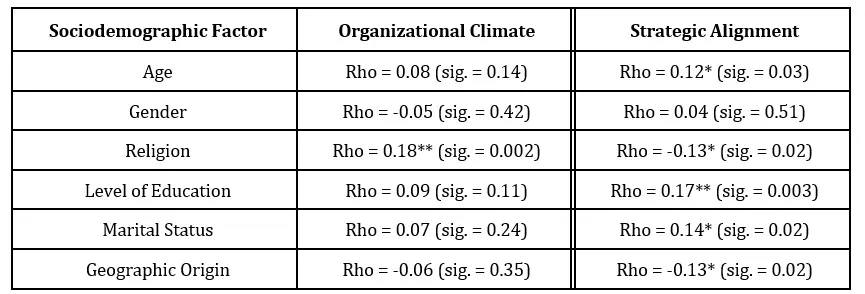
Spearman’s correlation analysis revealed that age was significantly and positively correlated with strategic alignment (Rho = 0.12, p = 0.03), suggesting that older employees tended to be more strategically aligned. This relationship may reflect the fact that employees with greater professional maturity have a greater ability to understand and articulate organizational strategy.
Gender did not show significant correlations with any of the main variables, suggesting that perceptions of organizational climate and strategic alignment do not differ significantly between men and women at this institution.
Religion showed a significant positive relationship with organizational climate (Rho = 0.18, p = 0.002) but a significant negative relationship with strategic alignment (Rho = -0.13, p = 0.02). Level of education correlated positively with strategic alignment (Rho = 0.17, p = 0.003) but not with organizational climate. Marital status showed a significant positive correlation with strategic alignment (Rho = 0.14, p = 0.02) but not with organizational climate. Geographic origin correlated negatively with strategic alignment (Rho = -0.13, p = 0.02) but not with organizational climate.
Table 4: Spearman’s Correlations between Sociodemographic Factors and Main Variables
*p < 0.05; **p < 0.01
Comparative Analysis by Campus and Faculty
The Kruskal-Wallis tests did not reveal any significant differences in strategic alignment or organizational climate based on work location (p > 0.05). However, significant differences were identified based on the faculty to which participants were affiliated. Strategic alignment showed significant differences across faculties (p = 0.01), while organizational climate showed a trend toward significance (p = 0.052).
Fig 1. Comparison of Organizational Climate and Strategic Alignment
Discussion
The findings of this study reveal a complex organizational situation at the institution analyzed. On the one hand, there is a largely favorable perception of the organizational climate (83.6% rated it as favorable to very favorable), suggesting that staff members generally feel satisfied with the work environment, interpersonal relationships, and managerial support. This positive perception is consistent with previous research documenting that faith-based universities tend to foster more cohesive work environments due to a shared identification with institutional values (Flores Rivera & Herrera Freire, 2025).
However, levels of strategic alignment are significantly lower (43.5% at acceptable to optimal levels), indicating a significant gap between the perception of the climate and the
degree of alignment with institutional goals; given that there is empirical evidence that a positive organizational climate facilitates strategic alignment processes (Correa Vergara et al., 2025). This discrepancy suggests that, although staff perceive a favorable environment, this does not necessarily translate into a deep understanding or concrete actions geared toward strategic objectives. This gap is particularly significant in university settings where strategic alignment is fundamental to the fulfillment of the educational mission.
Particularly relevant is the finding regarding knowledge of key strategic elements. While 59.2% have a good understanding of institutional values, only 38.8% have an adequate understanding of the mission and 32.8% of the vision. These results are consistent with the theoretical framework proposed by Kaplan & Norton (2006), which states that strategic alignment integrates cognitive aspects—referring to the employee’s knowledge of the organizational strategy, including vision, mission, objectives, and policies— conative aspects, referring to the individual’s willingness to act in accordance with these strategic elements; and affective aspects, which involve emotional commitment and personal identification with institutional goals. This inverse progression suggests that values—being more abstract and potentially aligned with personal religious convictions—are more easily internalized than more specific and technical strategic elements. This pattern has important implications for the design of communication and alignment strategies.
The relationship between sociodemographic factors and the main variables reveals interesting patterns. The positive correlation between age and alignment suggests that employees with more years of work experience—or who are potentially more mature—tend to exhibit greater alignment. Educational attainment also correlates positively with alignment, which may reflect that individuals with higher academic qualifications have a greater capacity to understand and articulate complex strategies.
The negative relationship between religion and strategic alignment is particularly intriguing in the context of a religious university. One possible interpretation is that employees who do not profess the institution’s religion may perceive a disconnect between formal strategic elements and the religious values underpinning the institution, leading to less identification with strategic alignment. Alternatively, Adventist employees may take alignment with religious values for granted without needing to explicitly align themselves with formal strategic elements.
The absence of significant differences by campus suggests that strategic alignment and organizational climate are relatively consistent across the institution’s geographic locations. However, differences by faculty of affiliation suggest that the type of activity (academic versus administrative, specific discipline) does influence these constructs. This may reflect that different faculties have varying degrees of alignment with the institutional strategy or different organizational cultures.
Conclusions
This study documents that, at a Peruvian religious university, more than one sociodemographic factor is significantly related to strategic alignment and the organizational climate among staff. Specifically, age, educational level, marital status, religion, and geographic origin showed significant correlations with at least one of the main variables. The most relevant finding is the gap between the favorable perception of the organizational climate and the moderate levels of strategic alignment. This suggests that although staff perceive a positive work environment, translating this perception into understanding and action aligned with strategic goals requires additional interventions.
It is recommended that the institution develop specific communication and training strategies aimed at improving understanding of key strategic elements, particularly its vision and mission. These strategies should be tailored to the sociodemographic characteristics of the staff, recognizing that employees of different ages, educational levels, and backgrounds may require different approaches. Additionally, it is suggested that the relationship between religion and strategic alignment be investigated more deeply, with the aim of understanding how personal religious identity relates to identification with institutional strategic purposes. This could reveal opportunities to strengthen the integration between religious values and formal strategic objectives.
Finally, given that differences were identified based on the faculty to which staff members belong, it is recommended that each academic unit develop specific strategic alignment plans that recognize the unique characteristics of its context and functions. Future research should explore the specific mechanisms through which sociodemographic factors influence perceptions of the organizational climate and strategic alignment, using qualitative methodologies that allow for a deeper understanding of staff members’ subjective experiences.
References
Abzari, M., & Abbasi, R. (2011). Investigating impact of organizational climate on intention to knowledge sharing behavior by using theory of planned behavior (TPB). Interdisciplinary Journal of Contemporary Research in Business, 2(12), 121-134.
Barra, A. M. (2015). Alineamiento estratégico sectorial: Caso de estudio aplicado a una universidad chilena. Formación Universitaria, 8(3), 3-12. https://doi.org/10.4067/S0718-50062015000300002
Bautista, W. (2017). Modelo de alineamiento estratégico para la Facultad de Ingeniería de la Universidad Incca de Colombia [Tesis de maestría, Universidad Nacional Abierta y a Distancia UNAD]. Repositorio institucional.
Bernardez, M. L. (2009). Desempeño humano: Manual de consultoría. AuthorHouse.
Brunet, L. (2005). El clima de trabajo en las organizaciones. Editorial El Buho.
Cabrera, R. A. (2007). Lineamientos de un plan estratégico para el mejoramiento de la calidad del servicio brindado en el Hospital Militar Central de Lima [Tesis doctoral, Universidad Nacional Mayor de San Marcos]. Repositorio institucional.
Chiang Vega, M. M., Salazar Botello, C. M., Huerta Rivera, P. C., & Nuñez Partido, A. (2008). Clima organizacional y satisfacción laboral en organizaciones del sector estatal (Instituciones públicas) Desarrollo, adaptación y validación de instrumentos. Universum, 23(2). https://doi.org/10.4067/s0718-23762008000200004
Chilón Troncos, R. F. (2016). Clima organizacional y el alineamiento estratégico en los trabajadores +administrativos y asistenciales de la Clínica Good Hope, Lima, 2016.
Correa Vergara, F. I., Gonzales Picón, D. S., & Cordova Bustinza, V. (2025). Clima organizacional en la relación motivación-compromiso organizacional en el sector eléctrico: estudio de buenas prácticas. Impulso, Revista de Administración, 5(9), 221-236. https://doi.org/10.59659/impulso.v.5i9.73
Davis, K., & Newstrom, J. (1999). Comportamiento humano en el trabajo (10ª ed.). McGraw Hill.
De la Fuente Anuncibay, R., & De Diego Vallejo, R. (2008). Estrategias de liderazgo y desarrollo de personas en las organizaciones. Editorial Pirámide.
Elli Domínguez, M. E. (2025). Plan de bienestar laboral basado en diagnóstico sociodemográfico para empresas tecnológicas: Estudio transversal en Asunción. Concordia, Revista de Administración y Educación, 5(9), 12-24.
Fernández, J. (2009). Psicología del trabajo y las organizaciones y de los recursos humanos. Biblioteca Nueva.
Flores Rivera, A. R., & Herrera Freire, A. H. (2025). Confianza y clima organizacional: Un vínculo esencial en el ámbito empresarial. Concordia, Revista de Administración y Educación, 5(9), 1-20. https://doi.org/10.62319/concordia.v.5i9.34Furnham, A. (2004). Psicología organizacional. Editorial Alfa y Omega.
García, M., & Gonzalez, M. (2016). Dos enfoques diferentes de alineación estratégica. Revista Multidisciplinaria de Avances de Investigación, 2, 60-74.
Guillén del Campo, M. (2013). Clima organizacional en la Editorial Ciencias Médicas a partir del análisis de dos de sus dimensiones. Revista Cubana de Salud Pública, 39(2), 242-252.
Hernández Sampieri, R., Fernández Collado, C., & Baptista Lucio, P. (2003). Metodología de la investigación (3ª ed.). McGraw-Hill.
Huamán Pulgar-Vidal, L., & Rios Ramos, F. (2011). Metodologías para implantar la estrategia: diseño organizacional de la empresa (2ª ed.). Universidad Peruana de Ciencias Aplicadas.
Johnson, D., & Johnson, R. (2009). An educational psychology success story: Social interdependence theory and cooperative learning. Educational Researcher, 38(5), 365-379.
Kaplan, R., & Norton, D. P. (2006). Alignment: Cómo alinear la organización a la estrategia a través del Balanced Scorecard (Vol. 1). Gestión 2000.
Khadem, R. (2002). Alineación total: Cómo convertir la visión de la empresa en realidad (1ª ed.). Grupo Editorial Norma.
Labrada, A. (2008). Modelo de diseño organizacional para el Complejo de Investigaciones de Tecnologías Integradas [Tesis de maestría, Instituto Superior Politécnico José Antonio Echeverría].
Litwin, G., & Stringer, H. (1998). Organizational climate. Harvard University Press.
Marchant, R. (2006). Factores organizacionales críticos para fortalecer el alineamiento estratégico del personal. Universidad de Viña del Mar.
Martínez, M., & Valderrey, P. (2005). Remuneración basada en los resultados como lineamiento estratégico para mejorar la productividad organizacional. Revista Venezolana de Gerencia, 10(29), 45-67.
Palma, S. (2004). Escala de clima organizacional (ECO). Ediciones Cartolan.
Pulgar-Vidal, L., & Rios, F. (2011). Alineación estratégica de una institución sin fines de lucro del sector salud. Revista de Administración y Negocios, 15(2), 89-104.
Saavedra, J. (2012). Diseño organizacional y el potencial humano del clima organizacional de los trabajadores del centro de salud Max Arias Schreiber del distrito de La Victoria [Tesis de licenciatura, Universidad del Pacífico]. Repositorio institucional.
Seminario Serquen, K. Z., & Marquez Yauri, H. Y. (2022). Programa motivacional para mejorar el clima organizacional en la Facultad de Ciencias Empresariales de una universidad privada. Ñeque, Revista de Investigación en Ciencias Administrativas y Sociales, 5(13), 241-254. https://doi.org/10.33996/revistaneque.v5i13.97
Sotamba Romero, V. J. (2025). Efectos del liderazgo en el clima organizacional de la gestión marítima: análisis de caso. Revista Enfoques, 9(34), 139-155. https://doi.org/10.33996/revistaenfoques.v9i34.202
Villamar Palma, J. I. (2021). Clima organizacional y alineamiento estratégico del personal médico y asistencial en un Centro de Salud de Guayaquil, 2021.