Corporate Social Responsibility (CSR) and Corporate Reputation: A Case Study of the Agricultural Company Selva Central in Codo del Pozuzo, Huánuco, Peru – 2025
Ebette Alejandra Chávez Trinidad, Charito Sofía Pajares Salas, Saraí Nelly Samán Chingay and César Zuloeta Miyasato
Universidad Privada del Norte, Perú
Volume 2026,
Article ID 747583,
IBIMA Business Review,
10 pages,
DOI: doi.org/10.5171/2026.747583
Received date: 15 May 2026; Accepted date: 8 July 2026; Published date: 17 September 2026
Cite this Article as:
Ebette Alejandra Chávez Trinidad, Charito Sofía Pajares Salas, Saraí Nelly Samán Chingay and César Zuloeta Miyasato (2026)," “Corporate Social Responsibility (CSR) and Corporate Reputation: A Case Study of the Agricultural Company Selva Central in Codo del Pozuzo, Huánuco, Peru – 2025 “, IBIMA Business Review, Vol. 2026 (2026), Article ID 747583, https://doi.org/10.5171/2026.747583
The primary objective was to determine the relationship between Corporate Social Responsibility (CSR) and corporate reputation. The research is justified by the growing importance of CSR as a strategic practice capable of strengthening organizational trust, legitimacy, and competitiveness, particularly in rural productive sectors where social and environmental dynamics present unique characteristics. A basic research methodology was employed, featuring a quantitative approach, a correlational level, and a non-experimental, cross-sectional design; analysis was conducted using non-parametric methods based on the Spearman correlation test. Data collection involved a probability sample of 370 residents from areas surrounding the company (selected from a population of 9,592) using a structured questionnaire survey. The results demonstrated a positive and statistically significant relationship between CSR and corporate reputation, a finding consistent with previous studies conducted in Latin American contexts. It was found that higher perceptions of ethical, environmental, and community-oriented practices were associated with more favorable public perceptions and greater trust in the organization. The study concludes that the authentic and consistent implementation of CSR directly contributes to strengthening corporate reputation, acting as a key strategic resource for the company’s positioning and sustainability, while also enhancing the understanding of the dynamics between CSR and reputation in rural agro-industrial contexts.
Corporate Social Responsibility (CSR) has become a fundamental strategic component that connects organizations with society, preventing them from operating independently of the social and environmental demands of their surroundings.
From this perspective, Valverde et al. (2022) argue that CSR has gained increasing importance among organizations worldwide, as many companies seek to differentiate themselves from their competitors by responding to the growing expectations of stakeholders, who increasingly favor organizations committed to society and environmental sustainability. Consequently, CSR is no longer viewed solely as an ethical obligation but also as a strategic management approach aimed at creating organizational value. In this regard, CSR contributes to strengthening Corporate Reputation (CR), which has become a fundamental determinant of organizational development. Corporate reputation represents a strategic intangible asset that enhances organizational legitimacy and competitive advantage, thereby promoting long-term sustainability and growth, as highlighted by Castaño and Arias (2021).
Across Latin America, numerous organizations have adopted CSR as a strategic tool to strengthen relationships with customers, communities, and other stakeholders. These responsible practices promote ethical commitment while simultaneously generating social benefits and improving corporate reputation.
In this context, corporate reputation has become a strategic organizational resource that enhances credibility and stakeholders’ positive perceptions. Previous studies indicate that a well-established corporate reputation reflects not only compliance with ethical and social responsibilities but also sustained organizational performance, conveying trust, transparency, and institutional stability to the market. As a consequence, organizations with a strong reputation tend to achieve higher levels of competitiveness. Nevertheless, many companies still underestimate the strategic value of reputation. According to Reyes et al. (2020), a favorable corporate reputation positively influences stakeholders’ perceptions, strengthens organizational trust, and contributes to long-term institutional performance.
At the national level, Peru continues to exhibit a lower degree of CSR implementation compared with international standards. As noted by Moscoso (2024), CSR remains largely voluntary and is not supported by effective regulatory mechanisms that encourage its adoption. This situation reveals important regulatory gaps despite the growing incorporation of ethical and sustainable principles by some organizations. Such changes are largely driven by increasingly informed consumers who demand greater social and environmental responsibility from companies.
Likewise, the social, political, and cultural environment significantly influences CSR implementation, as CSR emerges as a response to society’s expectations. Andrade and De la Cruz (2022) argue that CSR plays a crucial role in protecting fundamental rights and propose that socially responsible practices should evolve from voluntary initiatives into essential organizational commitments capable of reducing environmental impacts, preventing social conflicts, and fostering sustainable economic development.
Furthermore, Barrio et al. (2024) emphasize that corporate reputation depends not only on financial performance but also on an organization’s commitment to society and environmental sustainability. Corporate reputation is primarily built upon ethical and responsible organizational behavior, while consumers’ perceptions of the company’s brand largely shape this intangible asset. Consequently, socially responsible organizations generate greater trust among customers, investors, and other stakeholders, making reputation an important source of competitive advantage in today’s business environment.
The present study adopts the CSR conceptualization proposed by De León (2015), who defines Corporate Social Responsibility as the alignment between organizational identity, institutional policies, and business practices to satisfy the social, ethical, economic, and environmental expectations of stakeholders, including shareholders, customers, competitors, employees, and the community.
Accordingly, Corporate Social Responsibility integrates practices aimed at balancing economic performance, social commitment, and environmental sustainability while strengthening stakeholder relationships and organizational legitimacy.
Regarding Corporate Reputation, Fombrun (1996) defines it as an intangible organizational asset reflected in the perceptions that stakeholders develop regarding an organization’s identity, image, and behavior. Corporate identity represents the essential characteristics that distinguish one organization from another, whereas corporate image and reputation are primarily determined by stakeholders’ perceptions and evaluations.
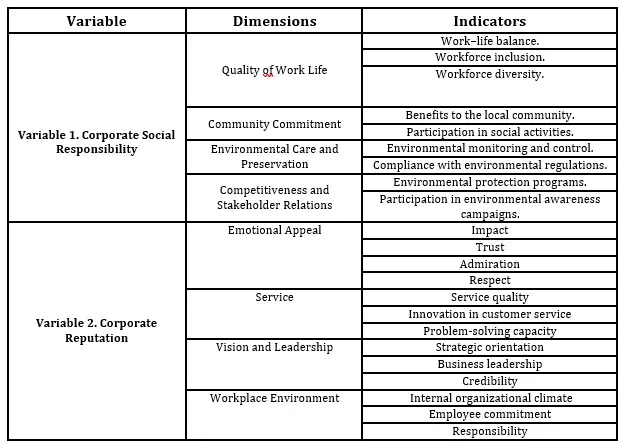
Corporate reputation is built through several dimensions reflecting stakeholders’ overall assessment of organizational behavior and identity. These dimensions include emotional appeal, based on admiration and respect; service quality, understood as the organization’s ability to satisfy customers through quality and innovation; vision and leadership, referring to strategic direction, credibility, and managerial capability; and workplace environment, which encompasses organizational climate, employee commitment, and internal relationships. Together, these dimensions constitute a valuable intangible asset that, according to Gaona (2017), increases organizational value by strengthening stakeholder trust, loyalty, and long-term relationships.
Previous empirical studies have examined the relationship between CSR and Corporate Reputation. Bach et al. (2023) identified a positive and statistically significant relationship between Corporate Social Responsibility and Corporate Reputation in Vietnamese agricultural organizations, demonstrating that socially responsible practices strengthen stakeholder trust.
Similarly, Dolores et al. (2025) analyzed the relationship between Corporate Social Responsibility and internal corporate image in industrial and commercial SMEs. Their findings revealed no statistically significant association, suggesting that the influence of CSR on organizational image or reputation may vary depending on organizational characteristics, contextual factors, and stakeholder groups.
Likewise, Córdova et al. (2023) reported a positive and statistically significant relationship between Corporate Social Responsibility and Corporate Reputation in Ecuadorian banana-producing organizations, confirming that responsible business practices enhance stakeholders’ favorable perceptions in agro-industrial sectors.
Valverde et al. (2022) demonstrated that Corporate Social Responsibility positively influences the competitive success of Peruvian agro-export companies, highlighting CSR as a strategic factor capable of strengthening organizational competitiveness within the agricultural sector.
Similarly, Demeke and Ravi (2024) found that Corporate Social Responsibility activities positively influence corporate image within the food and beverage industry. Their study reinforces the notion that the economic, ethical, legal, and philanthropic dimensions of CSR contribute significantly to public perceptions of organizations.
Finally, Carrasco et al. (2021) analyzed the influence of Corporate Social Responsibility on corporate image as perceived by local communities. Their findings indicate that socially responsible practices strengthen organization–community relationships, particularly when these initiatives are visible, coherent, and highly valued by stakeholders.
The present research was conducted at Selva Central Agricultural Company, located in the district of Codo del Pozuzo, Huánuco, Peru. This organization has operated in the agricultural sector for several years while implementing socially responsible practices aimed at strengthening community relationships and improving its corporate reputation. According to company management, maintaining a favorable public image contributes to customer recommendations, increased competitiveness, and improved financial performance.
Considering that Codo del Pozuzo is characterized by extensive agricultural and livestock activities, where numerous organizations compete within the same productive sector, corporate reputation and socially responsible behavior have become essential competitive differentiators. Despite growing evidence regarding the relationship between Corporate Social Responsibility and Corporate Reputation, important research gaps remain concerning rural and agro-industrial environments, particularly in developing countries such as Peru, where social, economic, and cultural dynamics differ considerably from urban contexts.
Accordingly, the following research question was formulated:
What is the relationship between Corporate Social Responsibility and Corporate Reputation in Selva Central Agricultural Company, located in the district of Codo del Pozuzo, Huánuco, Peru, during 2025?
The general objective of this study was:
To determine the relationship between Corporate Social Responsibility and Corporate Reputation in Selva Central Agricultural Company, located in the district of Codo del Pozuzo, Huánuco, Peru, during 2025.
The research hypotheses were formulated as follows:
H1: There is a positive relationship between Corporate Social Responsibility and Corporate Reputation in Selva Central Agricultural Company, located in the district of Codo del Pozuzo, Huánuco, Peru, during 2025.
H0: There is no positive relationship between Corporate Social Responsibility and Corporate Reputation in Selva Central Agricultural Company, located in the district of Codo del Pozuzo, Huánuco, Peru, during 2025.
This research addresses the need to examine, through a scientific approach, the relationship between Corporate Social Responsibility and Corporate Reputation within strategic productive sectors such as agro-industry. Although previous studies have widely recognized that CSR contributes to improving corporate image, limited evidence exists regarding how this relationship develops in rural and agro-industrial settings, where social, economic, and environmental dynamics differ substantially from those observed in urban or industrial contexts.
Methodology
The present study adopted a basic research approach because its primary purpose was to analyze and explain the relationship between Corporate Social Responsibility (CSR) and Corporate Reputation (CR) within Selva Central Agricultural Company. According to Muntané (2010), basic research seeks to expand scientific knowledge by developing theoretical foundations without pursuing an immediate practical application.
The study followed a quantitative approach, with a descriptive-correlational scope and a non-experimental, cross-sectional research design. This design was considered appropriate because the variables were observed in their natural context without manipulation, and data were collected at a single point in time.
The unit of analysis was Selva Central Agricultural Company, located in the district of Codo del Pozuzo, Huánuco, Peru. The target population consisted of 9,592 residents living in the communities surrounding the company, distributed as follows: Codo del Pozuzo (8,753 inhabitants), San Juan del Codo (417 inhabitants), Río Codo (203 inhabitants), Alto Mashoca (74 inhabitants), and Bajo Mashoca (145 inhabitants).
The sample size was determined using the finite population formula, considering a 95% confidence level and a 5% margin of error. The sample calculation was performed using Microsoft Excel and IBM SPSS Statistics, resulting in a representative sample of 370 respondents.
Regarding the participants’ characteristics, approximately 70% were male and 30% were female. Respondents ranged in age from 30 to 60 years. Concerning educational attainment, participants exhibited diverse educational backgrounds, including primary and secondary education. Most respondents were self-employed and engaged primarily in agricultural and livestock activities (Aguilar, 2005).
A probability sampling technique, specifically systematic random sampling, was employed to ensure that every member of the population had an equal probability of selection. This sampling method consists of selecting individuals at regular intervals from a randomly chosen starting point, providing an efficient and unbiased procedure for data collection.
Data were collected through the survey technique, using a structured questionnaire as the research instrument. The questionnaire included 30 items measuring Corporate Social Responsibility and 20 items assessing Corporate Reputation. All items were designed according to the research objectives and the dimensions established for each variable, ensuring that every question contributed relevant information to the study.
Responses were measured using a five-point Likert scale, ranging from (1) Never to (5) Always. Consequently, both variables were measured at an ordinal level, since the response categories represent ordered levels without assuming equal intervals between them.
Data analysis was performed using IBM SPSS Statistics and Microsoft Excel, applying both descriptive and inferential statistical techniques. Before hypothesis testing, data normality was assessed using the Kolmogorov–Smirnov test, which was selected because the sample size exceeded 50 observations. Since the significance values were below 0.05, the assumption of normality was rejected, indicating that the data did not follow a normal distribution. Therefore, non-parametric statistical procedures were employed.
Hypothesis testing was conducted using Spearman’s rank-order correlation coefficient (Spearman’s rho) to determine the relationship between Corporate Social Responsibility and Corporate Reputation, as well as between their respective dimensions.
The reliability of the research instrument was evaluated using Cronbach’s Alpha coefficient. The analysis produced coefficients of 0.990 for Corporate Social Responsibility and 0.987 for Corporate Reputation, indicating excellent internal consistency according to internationally accepted reliability standards.
Regarding ethical considerations, the study adhered to the principles of truthfulness, confidentiality, respect, and voluntary participation. Participants were informed about the academic purpose of the research, their anonymity was guaranteed, and all collected information was treated confidentially and used exclusively for scientific purposes.
TABLE 1: OPERATIONALIZATION OF VARIABLES
Source: Authors’ own elaboration. The conceptualization of the variables was informed by De León (2015) and Gaona (2017).
Results
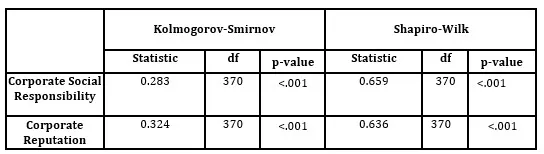
To analyze the statistical results obtained from the 370 completed questionnaires, the Kolmogorov–Smirnov normality test was applied because the sample size exceeded 50 observations. The results showed a statistic of 0.283 (p < .001) for Corporate Social Responsibility (CSR) and 0.324 (p < .001) for Corporate Reputation (CR). Since both significance values were lower than 0.05, the null
hypothesis of normality was rejected, indicating that the data did not follow a normal distribution.
Consequently, non-parametric statistical procedures were considered appropriate for subsequent inferential analyses. Therefore, Spearman’s rank-order correlation coefficient (Spearman’s rho) was employed to test the proposed research hypotheses.
The results of the normality test are presented in Table 2.
Table 2. Normality Test for Corporate Social Responsibility and Corporate Reputation
Note: df = degrees of freedom.
Source: Authors’ own elaboration based on the study data processed in IBM SPSS Statistics.
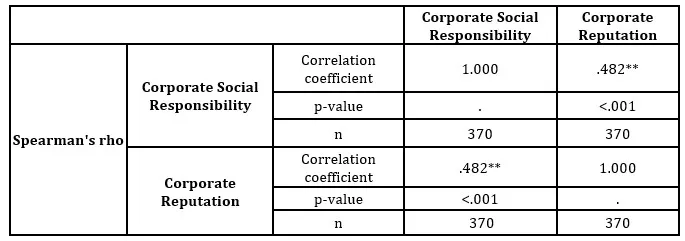
The general hypothesis was tested using Spearman’s rank-order correlation coefficient, based on the responses collected from the 370 participants residing in the communities surrounding Selva Central Agricultural Company.
Table 3. General Hypothesis Test: Relationship Between Corporate Social Responsibility and Corporate Reputation
Note: **Correlation is significant at the 0.01 level (two-tailed).
Source: Authors’ own elaboration based on the study data processed in IBM SPSS Statistics.
According to Spearman’s correlation analysis, the relationship between Corporate Social Responsibility and Corporate Reputation was positive and statistically significant (ρ = 0.482; p < 0.001). This result indicates a moderate positive correlation, suggesting that organizations demonstrating higher levels of socially responsible practices also tend to achieve stronger corporate reputation among their stakeholders.
Since the significance level was below 0.05, the null hypothesis was rejected and the alternative hypothesis was accepted, confirming the existence of a statistically significant relationship between Corporate Social Responsibility and Corporate Reputation.
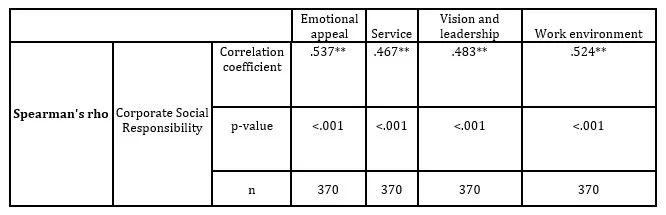
Regarding the first specific hypothesis, which proposed a relationship between Corporate Social Responsibility and the dimensions of Corporate Reputation, the results revealed statistically significant positive correlations for all dimensions (p < 0.001).
Specifically, the Emotional Appeal dimension presented the strongest relationship (ρ = 0.537), indicating a moderate positive correlation. Likewise, the Service dimension showed a moderate positive relationship (ρ = 0.467), while Vision and Leadership also exhibited a moderate positive correlation (ρ = 0.483). Finally, the Workplace Environment dimension demonstrated a moderate positive relationship (ρ = 0.524).
These findings confirm that improvements in Corporate Social Responsibility practices are consistently associated with more favorable stakeholder perceptions across all dimensions of Corporate Reputation.
Table 4. Specific Hypothesis 1: Relationship Between Corporate Social Responsibility and the Dimensions of Corporate Reputation
Note: **Correlation is significant at the 0.01 level (two-tailed).
Source: Authors’ own elaboration based on the study data processed in IBM SPSS Statistics.
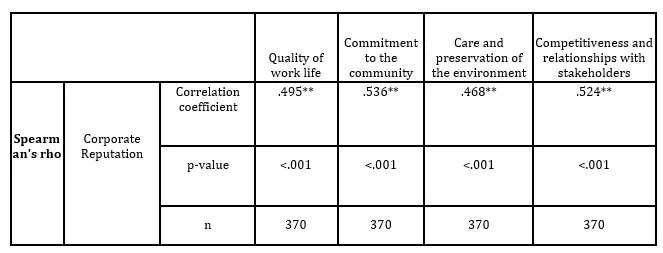
The second specific hypothesis proposed a relationship between Corporate Reputation and the dimensions of Corporate Social Responsibility. As presented in Table 5, all CSR dimensions were positively and significantly associated with Corporate Reputation (p < 0.001).
The Quality of Work Life dimension showed a moderate positive correlation (ρ = 0.495), whereas Community Commitment exhibited the strongest relationship (ρ = 0.536). Similarly, Environmental Care and Preservation demonstrated a moderate positive correlation (ρ = 0.468), while Competitiveness and Stakeholder Relations also presented a moderate positive association (ρ = 0.524).
Overall, these results indicate that improvements in each dimension of Corporate Social Responsibility contribute positively to strengthening Corporate Reputation within the organizational context analyzed.
Table 5. Specific Hypothesis 2: Relationship Between Corporate Reputation and the Dimensions of Corporate Social Responsibility
Note: **Correlation is significant at the 0.01 level (two-tailed).
Source: Authors’ own elaboration based on the study data processed in IBM SPSS Statistics.
Discussion And Conclusions
The findings of this study provide empirical evidence of a positive and statistically significant relationship between Corporate Social Responsibility (CSR) and Corporate Reputation (CR). This result suggests that socially responsible practices implemented by Selva Central Agricultural Company positively influence stakeholders’ perceptions, reinforcing the organization’s legitimacy and strengthening its competitive position within the agro-industrial sector.
These findings are consistent with those reported by Bach et al. (2023), who identified a significant positive relationship between CSR and Corporate Reputation in Vietnamese agricultural organizations. Likewise, Córdova et al. (2023) concluded that socially responsible practices enhance corporate reputation within Ecuadorian banana-producing companies. Similarly, Valverde et al. (2022) demonstrated that CSR contributes significantly to the competitive success of Peruvian agro-export companies. Collectively, these studies reinforce the argument that socially responsible behavior constitutes a strategic resource capable of generating sustainable competitive advantages.
Unlike the findings of Dolores et al. (2025), who did not identify a statistically significant relationship between CSR and internal corporate image in industrial and commercial SMEs, the present research confirms that the relationship between CSR and Corporate Reputation becomes more evident within rural agro-industrial environments. This difference may be explained by the greater proximity between organizations and local communities in rural settings, where stakeholders interact more directly with the company and therefore evaluate its social and environmental commitment more closely.
From a theoretical perspective, these results support Stakeholder Theory, which proposes that organizations achieve greater legitimacy and long-term sustainability when they respond effectively to the expectations of their stakeholders. Likewise, the findings are consistent with the Resource-Based View, which considers Corporate Reputation an intangible strategic asset capable of generating sustainable competitive advantages.
Methodologically, the application of the Kolmogorov–Smirnov normality test followed by Spearman’s rank-order correlation coefficient proved appropriate considering the ordinal nature of the variables and the non-normal distribution of the data. Furthermore, the excellent reliability coefficients obtained through Cronbach’s Alpha demonstrate the consistency and robustness of the research instrument.
Despite these contributions, this study presents certain limitations. First, the research was conducted within a single agricultural company located in one rural district, which limits the generalizability of the findings to other organizational contexts. Second, the cross-sectional design does not allow causal relationships to be established between the variables. Consequently, future research should consider longitudinal designs and comparative analyses involving organizations from different productive sectors and geographical regions.
Overall, the evidence obtained suggests that CSR should not be understood merely as an ethical obligation but rather as a strategic management tool capable of strengthening Corporate Reputation and promoting organizational sustainability, particularly in rural agro-industrial environments where relationships with local communities constitute a critical success factor.
This study demonstrated the existence of a moderate, positive, and statistically significant relationship between Corporate Social Responsibility and Corporate Reputation in Selva Central Agricultural Company, located in the district of Codo del Pozuzo, Huánuco, Peru. The Spearman correlation coefficient (ρ = 0.482; p < 0.001) confirms that organizations implementing socially responsible practices tend to achieve stronger corporate reputation among their stakeholders.
From a theoretical perspective, the study contributes to the existing literature by providing empirical evidence that the relationship between Corporate Social Responsibility and Corporate Reputation also exists in rural agro-industrial contexts, thereby extending the applicability of Stakeholder Theory and the Resource-Based View beyond urban and industrial environments.
From a practical standpoint, the findings indicate that agricultural organizations can strengthen their corporate reputation by implementing consistent Corporate Social Responsibility strategies focused on community engagement, environmental sustainability, and ethical organizational behavior. Such initiatives may enhance stakeholder trust, organizational legitimacy, and long-term competitiveness.
Among the principal limitations of this study are its restricted geographical scope and the use of a cross-sectional research design, both of which limit the generalization of the findings and prevent the establishment of causal relationships between the variables.
Future research should expand the analysis to different productive sectors and geographical regions while incorporating longitudinal research designs that allow a more comprehensive understanding of the long-term relationship between Corporate Social Responsibility and Corporate Reputation. Additionally, future studies could examine the mediating or moderating effects of organizational culture, stakeholder engagement, and corporate governance on this relationship.
Aguilar Condori, I. M., Layme Uchochoque, R., & Garcia-Mamani, W. (2025). Responsabilidad social empresarial en la reputación corporativa de las empresas mineras de Tacna, Perú. Cátedra Villarreal, 13(1), 12–20. https://doi.org/10.24039/rcv20251311890
Andrade, C. A., & De la Cruz, O. (2022). Responsabilidad social corporativa: una estrategia para promover y garantizar la protección del derecho fundamental a un medio ambiente sano y equilibrado. Revista de Derecho Ambiental, 2(18), 189-221. https://doi.org/https://doi.org/10.5354/0719-4633.2022.66370
Argandoña, A. (1998). La teoria de los stakeholders y el bien común. DOCUMENTO DE INVESTIGACIÓN N°355, 1-15. https://www.iese.edu/media/research/pdfs/DI-0355.pdf
Bach, A., Nguyen, H., Nguyen, T., & Anh, N. (2023). The role of corporate social responsibility and company reputation toward production re-linking intention between farmers and enterprises. VNUHCM Journal of Economics – Law and Management, VII(3), 4582-4594. https://doi.org/https://doi.org/10.32508/stdjelm.v7i3.1231
Barrio, E., Enrique, A. M., Vidal Mestre, M., & Freire Sánchez, A. (2024). Análisis conceptual del propósito corporativo: Sostenibilidad, RSC, ODS y comunicación. Cuadernos.info(59), 251–272. https://doi.org/http://dx.doi.org/10.7764/cdi.59.75543
Briceño Peña, A. N., Flores Gutiérrez, J. O., & Flores Márquez, S. L. (2023). Responsabilidad social empresarial, imagen y reputación de la empresa petrolera venezolana. Contaduría y Administración, 70(1), 122-147. https://doi.org/10.22201/fca.24488410e.2025.5163
Carrasco-Mauricio, L. I., Vilca-Tantapoma, M. E., & Vilca-Horna, N. M. (2021). Social responsibility of terminal internacional and its influence on the corporate image with the community. SCIÉNDO, 24(3), 163–168. https://doi.org/10.17268/sciendo.2021.020
Cordova Hernandez, D. J., León Saltos, A. C., & Saltos Cruz, J. G. (2023). La reputación empresarial y la responsabilidad social corporativa en las organizaciones bananeras ecuatorianas. Universidad, Ciencia y Tecnología, 27(118), 29–38. https://doi.org/10.47460/uct.v27i118.684
De León, R. (2015). Modelo de Responsabilidad Social Compartida. FECHAC, 1-200. libro_fechac_modelo_rsc2.pdf
Demeke, Y. A., & Ravi, J. (2024). Effects of corporate social responsibility activities on Corporate Image: Evidence from food and beverage industry in Amhara Region. Cogent Business & Management, 11(1), Article 2316928. https://doi.org/10.1080/23311975.2024.2316928
Dolores, E., Salazar, J., Valdivia, M., & Hernández, M. (2025). Efecto de la responsabilidad social empresarial en la imagen corporativa interna. RIDE Revista Iberoamericana Para La Investigación Y El Desarrollo Educativo, 15(30). https://doi.org/https://doi.org/10.23913/ride.v15i30.2442
Domínguez, J. C., Madrid, E. C., & Gastello, W. (2025). Responsabilidad social empresarial y economía circular en una empresa público-privada en Perú. Espacios, 46(3), 236–250. https://doi.org/10.48082/espacios-a25v46n03p18
Fombrun, C. (1996). REPUTATION: REALIZING VALUE FROM THE CORPORATE IMAGE. En C. Fombrun, REPUTATION: REALIZING VALUE FROM THE CORPORATE IMAGE (20th Aniversary ed., págs. 1-591). Harvard Business School Press. https://ri.reptrak.com/hubfs/_PDF/RLN/Reputation_Book.pdf
Gaona, N. (2017). LA REPUTACIÓN CORPORATIVA DE LA MUNICIPALIDAD DISTRITAL DE. TESIS PARA OBTENER EL TITULO PROFESIONAL, 1-55. Gaona_CNO.pdf
Gómez, L., Orozco, J., Restrepo, E., & Vélez, O. (2022). Análisis y desarrollo de la reputación corporativa en las organizaciones modernas. Un acercamiento al estado del arte. Ingeniería Industrial, 42(42), 183-200. https://doi.org/ https://doi.org/10.26439/ing.ind2022.n42.5864
Lozada, S., Begoña, N., & Ramos, A. (2023). Internal corporate responsibility, effects on reputation and care for senior employees: a case study at Mediaset. Revista de Comunicación, 22(2), 299–318. https://doi.org/https://doi.org/10.26441/RC22.2-2023-3273
Martínez, I., & Olmedo, I. (2010). Revisión teórica de la reputación en el entorno empresarial. Cuadernos de Economía y Dirección de la(44), 59-77. https://www.redalyc.org/pdf/807/80715045004.pdf
Melé, D. (2007). IESE Business School. IESE Business School: Domènec Melé | IESE Business School
Mercader, V., Galván Vela, E., Salazar Altamirano, M., Ravina Ripoll, R. (2025). Business ethics, corporate social responsibility and fostering innovation as predictors of employee happiness. Suma de Negocios, 16(34), 92-103. https://doi.org/https://doi.org/10.14349/sumneg/2025.V16.N34.A9
Moscoso, K. M. (2024). INTEGRANDO LA AUDITORÍA AMBIENTAL Y LA RESPONSABILIDAD SOCIAL EMPRESARIAL EN EL PERÚ Estudio de enfoque mixto. Revista de filosofía y ciencias Prometeica (31), 95-108. https://doi.org/https://doi.org/10.34024/prometeica.2024.31.18798
Muntané, J. (2010). INTRODUCCIÓN A LA INVESTIGACIÓN BÁSICA. 33(1-8), 3. https://www.researchgate.net/publication/341343398
Ospina Cuartas, C. T., Bautista Londoño, L. G., & Castaño Tello, S. B. (2025). Responsabilidad social empresarial y su incidencia en el paradigma de la sostenibilidad financiera: Una contribución a la función social. South Florida Journal of Development, 6(5), 1–16. https://doi.org/10.46932/sfjdv6n5-049
Reyes, C., Briano Turrent, G. d., & Saavedra García, M. L. (2020). Diversidad de género en el consejo y su incidencia en la responsabilidad social en empresas cotizadas de Colombia y México. Contaduría y administración, 65(3), 1-27. https://doi.org/https://doi.org/10.22201/fca.24488410e.2020.2241
Valverde, M. T., De Paz Lázaro, A. C., Muro Ruiz, J. V., Vilcarino Osorio, L. F., & Mariños Obregón, G. (2022). Responsabilidad social empresarial y el éxito competitivo de las empresas agroexportadoras de la provincia de Barranca. Revista Llamkasun, 3(1), 29-37. https://doi.org/https://doi.org/10.47797/llamkasun.v3i1.80
Villa, L. E., Perdomo Ortiz, J., & Pedraza, C. E. (2021). Responsabilidad social empresarial en empresas de la industria colombiana: una aproximación comprensiva. Revista Venezolana De Gerencia, 26(95), 918-942. https://doi.org/https://doi.org/10.52080/rvgluz.27.95.29