When Globalness Matters More Than Foreignness: The Effects of Geopolitical Uncertainty, Consumer Identity, and Perceived Brand Globalness on Purchase Intentions
College of Business, Empire State University, Saratoga Springs, NY, USA
Volume 2026,
Article ID 857887,
IBIMA Business Review,
15 pages,
DOI: https://doi.org/10.5171/2026.857887
Received date: 24 March 2026; Accepted date: 18 June 2026; Published date: 24 July 2026
Cite this Article as:
Luis J. CAMACHO and María Claudia LOVEGROVE (2026)," When Globalness Matters More Than Foreignness: The Effects of Geopolitical Uncertainty, Consumer Identity, and Perceived Brand Globalness on Purchase Intentions “, IBIMA Business Review, Vol. 2026 (2026), Article ID 857887, https://doi.org/10.5171/2026.857887
This study examines how geopolitical uncertainty and competing consumer identity orientations shape purchase intentions toward foreign apparel brands in Colombia. While prior research has emphasized consumer xenocentrism and ethnocentrism as important explanations for foreign-brand preferences, less is known about how these orientations operate alongside perceived brand globalness under conditions of global instability. Drawing on uncertainty-identity theory, the Theory of Planned Behavior, and Consumer Culture Theory, this study analyzes the relationships among geopolitical uncertainty, consumer ethnocentrism, consumer xenocentrism, perceived brand globalness, and purchase intention. Data were collected from 425 Colombian consumers and analyzed using structural equation modeling. The results show that perceived brand globalness is the strongest direct predictor of purchase intention. Geopolitical uncertainty positively influences consumer ethnocentrism, perceived brand globalness, and purchase intention, while consumer ethnocentrism affects purchase intention indirectly through perceived brand globalness. In contrast, consumer xenocentrism does not significantly predict either perceived brand globalness or purchase intention. These findings suggest that foreign apparel purchase intention in Colombia is driven less by generalized admiration for foreign products and more by the perceived global legitimacy, prestige, and symbolic strength of foreign brands. The study contributes to international marketing and consumer behavior research by demonstrating that perceived brand globalness is a key mechanism through which uncertainty and identity-based orientations are translated into marketplace behavior.
Foreign brand consumption in emerging markets is not simply a utilitarian marketplace decision; it is also a symbolic act shaped by identity, aspiration, legitimacy, and context-specific perceptions of risk. This is particularly evident in the apparel and fashion sector, where products are consumed not only for their functional utility but also for the meanings they convey about lifestyle, prestige, modernity, and social positioning. Prior research suggests that consumers often interpret foreign and global brands as markers of superior status, cosmopolitan belonging, and aspirational self-expression, which enhances their perceived value beyond objective product performance (Balabanis & Diamantopoulos, 2016). In visible consumption categories such as fashion, these symbolic meanings become especially salient because apparel serves as a socially communicative resource through which individuals project identity, distinction, and affiliation with desired reference groups (Pino et al., 2019). Accordingly, in emerging markets, preferences for foreign fashion brands may reflect not only consumption utility but also broader efforts to negotiate status, legitimacy, and self-concept amid market transformation and social comparison (Safeer et al., 2022). In such categories, foreign brands often acquire symbolic value because they are associated with sophistication, international recognition, and status, especially in contexts where consumers are highly exposed to global cultural and commercial influences (Balabanis & Diamantopoulos, 2016; Camacho et al., 2020).
One of the most influential constructs used to explain preferences for foreign offerings is CXENO, understood as the tendency to perceive foreign products, lifestyles, or cultures as superior to local alternatives (Balabanis & Diamantopoulos, 2016). Prior research indicates that CXENO can positively influence product attitudes and PI toward imported goods, particularly in developing and emerging-market settings where foreignness is associated with quality, prestige, and social desirability (Camacho et al., 2020; Camacho et al., 2022a; Rojas-Méndez & Chapa, 2020). More recent evidence, however, suggests that xenocentrism may not operate uniformly across contexts. In some settings, admiration for the foreign remains symbolically salient but becomes a weaker direct predictor of intention, particularly under conditions of instability or threat (Camacho & Miranda, 2025; Camacho et al., 2025).
A parallel stream of research focuses on CETH, which reflects a preference for domestic products grounded in national identity, economic loyalty, and a perceived moral obligation to support the home economy (Shimp & Sharma, 1987). Although ethnocentrism has traditionally been associated with resistance to foreign products, recent studies suggest that its influence may be more contingent and context-dependent than classical models imply (He & Wang, 2015). During periods of disruption, identity-protective responses may intensify; however, their behavioral consequences may depend on how consumers evaluate foreign brands and interpret their symbolic position in the marketplace (Camacho et al., 2022b; Camacho et al., 2025).
These dynamics are especially relevant in the context of GEOUN, which has become an increasingly salient feature of contemporary consumer environments. International conflict, diplomatic tensions, sanctions, and broader perceptions of global instability may reshape consumer perceptions and intentions by activating concerns about control, belonging, and symbolic security (Korolev, 2025). Recent research has begun to conceptualize GEOUN as a consumer-level perception with direct behavioral implications rather than merely a macroeconomic background condition (Camacho et al., 2025). Under such conditions, consumers may not only become more cautious but may also rely more heavily on symbolic and legitimacy-based cues when evaluating brands.
One such cue is PBG. Consumers may not prefer foreign brands merely because they are foreign, but because they are perceived as globally recognized, internationally legitimate, and associated with superior standards of quality and prestige. Research on global branding suggests that PBG functions as a powerful signal of credibility, status, and cosmopolitan value, particularly in categories where image and identity expression are central (Liu et al., 2021; Mandler et al., 2021). This makes PBG especially relevant in apparel and fashion, where brands serve as visible markers of social meaning and symbolic distinction (Mandler et al., 2023).
Despite these theoretical advances, the literature has not sufficiently integrated GEOUN, CETH, CXENO, and PBG within a single framework to explain purchase intention toward foreign apparel brands. Existing studies have often examined these constructs separately or within contexts such as tourism or generalized imported-product consumption, leaving the question unresolved of how they operate together within a symbolic product category in an emerging market.
Colombia provides a relevant setting for examining these relationships. The apparel market presents a clear contrast between domestic and foreign alternatives, while symbolic and reputational cues strongly influence purchase decisions in this category. In this context, intention toward foreign brands may emerge from multiple, potentially competing processes: outward-looking admiration for the foreign, a protective domestic identity, sensitivity to geopolitical instability, and reliance on the brand’s perceived global stature.
This study is theoretically grounded in uncertainty-identity theory, the Theory of Planned Behavior, and Consumer Culture Theory. Together, these perspectives help explain how macro-level instability, identity-based consumer orientations, and symbolic brand cues shape purchase intention. More specifically, the study seeks to determine whether purchase intention toward foreign brands is driven primarily by a protective domestic orientation, an outward-looking affinity for the foreign, the destabilizing effects of geopolitical uncertainty, or the perceived global legitimacy and prestige of the brand itself.
This study makes three principal contributions. First, it integrates ethnocentrism and xenocentrism within a single model, thereby enabling a more nuanced examination of competing identity orientations in foreign-brand consumption. Second, it extends the emerging literature on geopolitical uncertainty by positioning it as a contextual force that shapes both consumer identity and brand evaluation. Third, it identifies PBG as a proximal marketplace mechanism through which contextual and identity-based forces are translated into purchase intention. In doing so, the study advances a more integrative explanation of foreign apparel brand choice in an emerging-market setting. Accordingly, the study addresses the following research questions:
RQ1. How does GEOUN influence CETH, CXENO, PBG, and PI toward foreign apparel brands in Colombia?
RQ2. To what extent does PBG explain PI toward foreign apparel brands?
RQ3. Do CETH and CXENO exert direct or indirect effects on PI?
RQ4. Does PBG mediate the effects of GEOUN and identity-based consumer orientations on PI?
Literature Review
Theoretical Foundation
This study is grounded in uncertainty-identity theory (Hogg & Adelman, 2013; Hogg, 2014), the Theory of Planned Behavior (Ajzen, 1991), and Consumer Culture Theory (Arnould & Thompson, 2005). Together, these perspectives provide a suitable foundation for explaining purchase intention toward foreign brands in a context characterized by instability, symbolic consumption, and tensions between global and local identity orientations. Uncertainty-identity theory proposes that, under conditions of threat or ambiguity, individuals seek psychological certainty through identity-affirming responses, often by gravitating toward meaningful in-groups and stable symbolic categories (Hogg & Adelman, 2013; Hogg, 2014). The Theory of Planned Behavior explains how beliefs and evaluations translate into behavioral intention (Ajzen, 1991), whereas Consumer Culture Theory emphasizes that consumption choices are not merely functional but also socially and symbolically constructed (Arnould & Thompson, 2005).
These perspectives suggest that purchase intention toward foreign apparel brands cannot be adequately explained by a single attitudinal force. Instead, intention appears to emerge from the interaction among contextual instability, identity-based consumer orientations, and symbolic marketplace cues such as perceived brand globalness (PBG). This integrative logic has been applied in recent research on uncertainty, ethnocentrism, and xenocentrism in tourism contexts, where identity-driven orientations were found to respond differently under conditions of threat (Camacho et al., 2025).
Geopolitical Uncertainty
GEOUN refers to consumers’ perceptions of instability associated with international conflict, political tensions, sanctions, and broader global disorder. Recent work suggests that geopolitical uncertainty is not merely a macroeconomic background condition, but a consumer-relevant perception that can shape evaluation, motivation, and behavioral readiness (Auruškevičienė et al., 2025; Camacho et al., 2025). From this perspective, uncertainty may alter how consumers interpret foreign brands, national identity, and the symbolic meaning of global consumption.
Prior research indicates that, under uncertainty, consumers often seek symbolic reassurance, legitimacy, and stability in their decision-making processes (Hogg, 2014). In consumer settings, this may increase attention to brands perceived as globally recognized, socially validated, and resilient. Recent evidence further suggests that geopolitical instability can reconfigure, rather than simply suppress, consumer demand by redirecting preferences toward options perceived as legitimate or secure (Camacho et al., 2025; Cui & Li, 2025; Korolev, 2025). This logic is particularly relevant in foreign-brand markets, where uncertainty may activate identity concerns while simultaneously increasing reliance on signals of global stature. Accordingly, the following hypotheses are proposed:
Consumer ethnocentrism refers to the belief that purchasing domestic products is appropriate and desirable, whereas buying foreign goods may be viewed as economically or morally problematic (Shimp & Sharma, 1987). Rooted in social identity processes, ethnocentrism reflects in-group loyalty, national attachment, and a tendency to protect local producers and the domestic economy (Balabanis et al., 2001; Shimp & Sharma, 1987). During periods of disruption, these concerns may become more salient, thereby strengthening preferences for symbolic proximity and local belonging.
Recent research shows that ethnocentrism remains relevant in contemporary consumer behavior, especially when national identity and country-of-origin evaluations are activated by uncertainty or crisis conditions (Camacho et al., 2022a; Prince et al., 2020). At the same time, its behavioral consequences are not always linear. In some contexts, ethnocentric consumers do not simply reject foreign products outright; rather, they evaluate them through more complex lenses involving legitimacy, symbolic dominance, and marketplace status (Camacho et al., 2022a). This suggests that ethnocentrism may shape not only direct purchase preferences but also the way consumers interpret the global stature of foreign brands.
In the context of foreign apparel brands, ethnocentric consumers may be particularly sensitive to the contrast between domestic and international offerings. This heightened sensitivity may increase awareness of the symbolic power and global visibility of foreign brands, even when it does not directly translate into outright rejection.
Consumer xenocentrism refers to a favorable orientation toward foreign products, services, or lifestyles, accompanied by a relative devaluation of domestic alternatives (Balabanis & Diamantopoulos, 2016; Rojas-Méndez & Chapa, 2020). Unlike general openness to international offerings, xenocentrism reflects a deeper symbolic hierarchy in which the foreign is associated with prestige, desirability, and superiority. This construct has received increasing attention in research on emerging markets because foreign products are often perceived as markers of sophistication, advancement, and social status (Balabanis & Diamantopoulos, 2016).
Studies conducted in Latin American contexts have shown that xenocentrism can positively influence attitudes and purchase intention toward imported goods (Camacho et al., 2020, 2022b). Similarly, tourism research has extended the concept beyond product consumption, demonstrating that xenocentrism can shape motivation and purchase intention in international travel settings (Camacho & Miranda, 2025). These findings suggest that xenocentrism remains an important explanatory construct for understanding aspirational, foreign-oriented consumption.
However, recent evidence also indicates that xenocentrism does not always translate into action under unstable conditions. Camacho et al. (2025) found that, under geopolitical uncertainty, xenocentrism remained theoretically relevant but became behaviorally weaker than expected. This raises the possibility that xenocentric admiration may persist at a symbolic level while becoming less effective as a direct predictor of intention when uncertainty heightens concerns related to control and identity protection. In the apparel context, xenocentric consumers may still be expected to associate foreign brands with greater prestige and stronger global standing. Therefore, these hypotheses are proposed:
PBG refers to the extent to which consumers perceive a brand as globally available, internationally recognized, and associated with worldwide prestige and quality (Mandler et al., 2021; Steenkamp et al., 2003). Globalness functions as a marketplace signal through which consumers infer credibility, legitimacy, consistency, and symbolic value. In emerging markets, such signals may be especially influential because global brands are often associated with higher status, cosmopolitan identity, and aspirational consumption (Safeer et al., 2022; Steenkamp et al., 2003).
The relevance of PBG is particularly strong in apparel and fashion, where brands function not only as products but also as visible symbols of identity and distinction. Consumers may purchase foreign apparel brands not simply because they are foreign, but because they are perceived as globally legitimate and socially valued. In this sense, PBG represents a more proximal explanatory mechanism than broader ideological orientations such as ethnocentrism or xenocentrism.
Recent work has also emphasized that perceptions of globalness are linked to ideas of prestige, competence, and international legitimacy, particularly when consumers evaluate foreign alternatives under conditions of uncertainty (Camacho et al., 2025; Mandler et al., 2021). Therefore, PBG is expected to play a central role in explaining purchase intention in the present study.
Identity-based consumer orientations and contextual instability may influence purchase intention indirectly through brand-level evaluations. Prior research has shown that broad attitudinal constructs often require more proximal evaluative mechanisms to translate into intention. For example, xenocentrism has been shown to affect purchase intention through product attitudes rather than solely through direct effects (Camacho et al., 2020). Likewise, in tourism settings, the effects of uncertainty and identity orientations on intention have been found to operate through mediating mechanisms such as motivation (Camacho & Miranda, 2025; Camacho et al., 2025).
In the present study, PBG is positioned as the key explanatory mechanism. Consumers may not intend to purchase foreign apparel brands simply because they hold ethnocentric or xenocentric attitudes or because they perceive geopolitical instability. Rather, these forces may first shape the extent to which foreign apparel brands are viewed as globally recognized, legitimate, and prestigious, and these perceptions may subsequently influence purchase intention. Accordingly, the following mediation hypotheses are proposed:
H10. PBG mediates the relationship between geopolitical uncertainty and purchase intention toward foreign apparel brands.
H11. PBG mediates the relationship between consumer ethnocentrism and purchase intention toward foreign apparel brands.
H12. PBG mediates the relationship between consumer xenocentrism and purchase intention toward foreign apparel brands.
Because geopolitical uncertainty is also expected to activate consumer ethnocentrism, a sequential indirect effect is also plausible. Under conditions of instability, consumers may become more ethnocentric, which may shape their perceptions of foreign brands’ global stature and, ultimately, influence purchase intentions.
H13. Consumer ethnocentrism and PBG sequentially mediate the relationship between geopolitical uncertainty and purchase intention toward foreign apparel brands.
Conceptual Synthesis
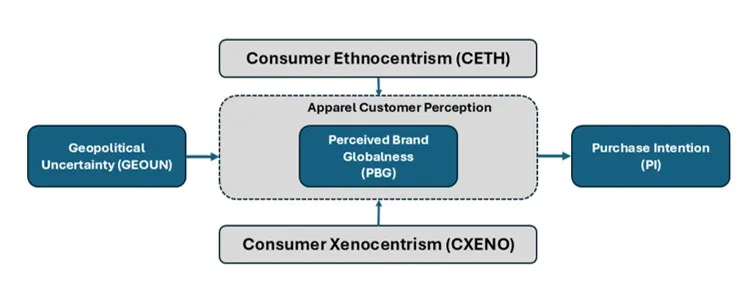
Overall, the literature suggests that geopolitical uncertainty serves as a contextual force that can reshape both identity-based consumer orientations and marketplace evaluations. Consumer ethnocentrism and consumer xenocentrism represent competing identity dispositions, yet their effects may not be symmetrical under conditions of instability. PBG is therefore positioned as the key brand-level mechanism by which contextual uncertainty and identity-based beliefs translate into purchase intention. This perspective enables the study to explain foreign apparel brand choice in Colombia not simply as a function of admiration for the foreign or loyalty to the domestic, but as the outcome of a more complex process involving uncertainty, identity, and symbolic brand interpretation. Figure 1 presents the conceptual model.
Figure 1. Conceptual model
Methodology
Research Design
This study employed a quantitative, cross-sectional survey design to examine the relationships among GEOU, CETH, CXENO, PBG, and PI regarding foreign apparel brands in Colombia. The survey design was appropriate because the objective was to test a theoretically specified model involving multiple latent constructs and their directional relationships. This approach is consistent with prior consumer behavior research that has employed survey-based structural models to examine xenocentrism, ethnocentrism, country-of-origin, and purchase behavior in Latin American contexts.
The study focused on foreign apparel brands available in the Colombian market for both theoretical and practical reasons. Apparel and fashion are particularly well-suited to examining identity-based consumption because brands in this sector serve not only as utilitarian products but also as symbolic carriers of prestige, distinction, and social identity. In addition, this category offers a visible contrast between domestic and foreign alternatives, which is essential for studying ethnocentrism and xenocentrism in consumer decision-making.
Population, Sample, and Data Collection
The target population consisted of adult consumers in Colombia familiar with apparel and fashion purchasing. The final valid sample comprised 425 respondents, which is adequate for structural equation modeling and exceeds commonly cited minimum thresholds for latent-variable models of moderate complexity. Prior SEM research has often relied on rules of thumb, such as a minimum of 200 observations or approximately 10 respondents per estimated parameter, and the present sample meets these general criteria.
Data were collected through an online questionnaire administered in Spanish. Participation was voluntary and anonymous and was restricted to individuals aged 18 years or older. Before beginning the survey, respondents were informed of the study’s academic purpose and the confidential treatment of their responses. No personal identifying information was collected. Responses were screened before analysis to identify incomplete questionnaires and inconsistent response patterns, and only usable cases were retained for the final SEM estimation.
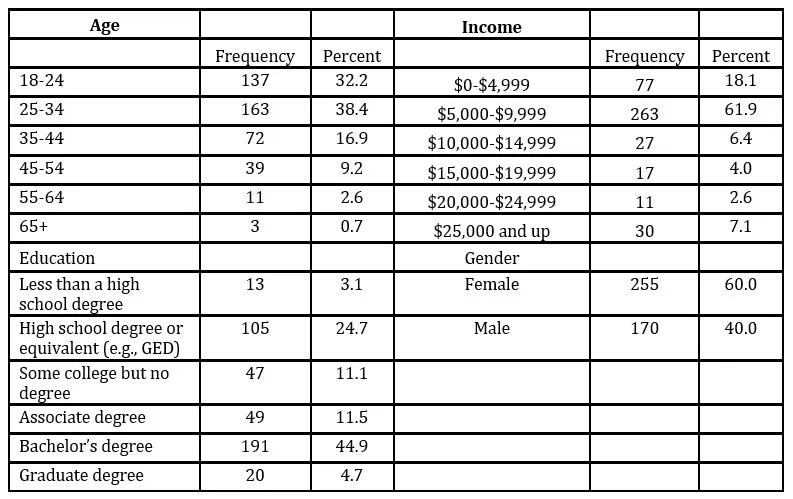
The sample consisted of 425 respondents from Colombia. In terms of gender, 255 respondents (60.0%) were female and 170 (40.0%) were male. With respect to age, the largest group was 25-34 years (n = 163, 38.4%), followed by 18-24 years (n = 137, 32.2%) and 35-44 years (n = 72, 16.9%). Smaller proportions were represented in the 45-54 years (n = 39, 9.2%), 55-64 years (n = 11, 2.6%), and 65 years or older (n = 3, 0.7%) categories. Regarding educational attainment, the largest proportion of respondents held a bachelor’s degree (n = 191, 44.9%), followed by those with a high school diploma or equivalent (n = 105, 24.7%). In terms of income, most respondents reported monthly income in the $5,000-$9,999 range (n = 263, 61.9%), followed by $0-$4,999 (n = 77, 18.1%). Overall, the sample was composed primarily of young to early middle-aged adults with relatively high levels of educational attainment.
Measurement Instrument
The questionnaire comprised five sections corresponding to the latent constructs included in the model. All items were measured on a five-point Likert-type scale ranging from 1 (strongly disagree) to 5 (strongly agree). GEOU was measured using the consumer-level scale developed by Camacho et al. (2025). CETH was measured using items adapted from the CETSCALE (Shimp & Sharma, 1987). CXENO was measured using items adapted from Balabanis and Diamantopoulos (2016). PBG was measured using items adapted from Mandler et al. (2021). Finally, PI was measured using an adapted scale from Hsu and Huang (2010). A pilot test was conducted with 50 participants.
Table 1. Demographics
Data Analysis Procedure
The measurement model was assessed using confirmatory factor analysis, with attention to factor loadings, internal consistency, convergent validity, and discriminant validity. Composite reliability (CR) and average variance extracted (AVE) were used to evaluate reliability and convergent validity, whereas discriminant validity was assessed using standard latent-variable criteria. The structural model was estimated using AMOS, and model fit was evaluated using multiple goodness-of-fit indices, including chi-square (χ²), CMIN/DF, CFI, SRMR, RMSEA, and PClose.
Results
Descriptive Statistics and Correlations
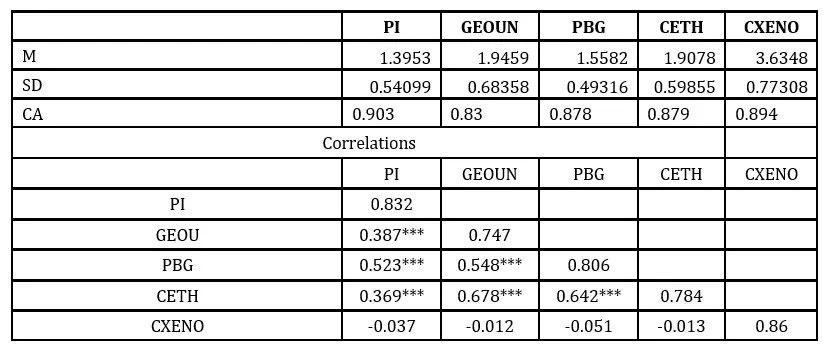
Table 2 presents the means, standard deviations, Cronbach’s alpha coefficients, and interconstruct correlations for the study variables. Among the constructs, consumer xenocentrism (CXENO) exhibited the highest mean (M = 3.6348, SD = 0.7731), followed by consumer ethnocentrism (CETH) (M = 1.9078, SD = 0.5986), geopolitical uncertainty (GEOU) (M = 1.9459, SD = 0.6836), perceived brand globalness (PBG) (M = 1.5582, SD = 0.4932), and purchase intention (PI) (M = 1.3953, SD = 0.5409). Internal consistency was acceptable to excellent across all constructs, with Cronbach’s alpha coefficients ranging from .830 to .903. Specifically, alpha values were .903 for PI, .830 for GEOU, .878 for PBG, .879 for CETH, and .894 for CXENO, indicating satisfactory internal reliability. The correlation matrix revealed several significant positive associations. Purchase intention was positively correlated with GEOU (r = .387, p < .001), PBG (r = .523, p < .001), and CETH (r = .369, p < .001), but not with CXENO (r = -.037, ns). GEOU was positively correlated with PBG (r = .548, p < .001) and CETH (r = .678, p < .001), whereas its association with CXENO was not significant (r = -.012, ns). PBG was also positively related to CETH (r = .642, p < .001), whereas its relationship with CXENO was not significant (r = -.051, ns). These preliminary findings suggest that perceived brand globalness (PBG), geopolitical uncertainty (GEOU), and consumer ethnocentrism (CETH) exhibit stronger associations with purchase intention than consumer xenocentrism (CXENO).
Table 2. Descriptive statistics
Significance of Correlations: *** p < 0.001
Measurement Model Assessment
The measurement model was assessed using factor loadings, composite reliability (CR), average variance extracted (AVE), maximum shared variance (MSV), and the heterotrait-monotrait ratio (HTMT). Overall, the results indicate adequate internal consistency, convergent validity, and discriminant validity. PGB1 and CXENO1 were eliminated from the model to improve its reliability.
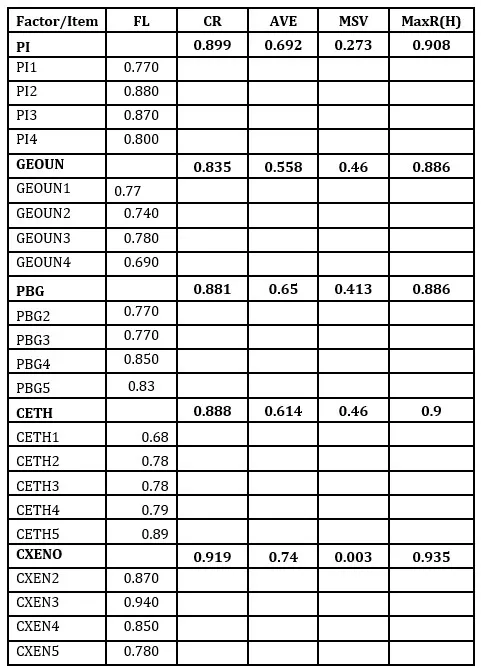
Table 3 presents the measurement model results. All constructs demonstrated satisfactory internal consistency. Composite reliability values exceeded the recommended threshold of .70 for all constructs: PI = .899, GEOU = .835, PBG = .881, CETH = .888, and CXENO = .919. Likewise, AVE values were above the recommended cutoff of .50, indicating adequate convergent validity: PI = .692, GEOU = .558, PBG = .650, CETH = .614, and CXENO = .740. Factor loadings were also acceptable across constructs. For PI, item loadings ranged from .770 to .880. GEOU item loadings ranged from .690 to .780. PBG item loadings ranged from .770 to .850. CETH item loadings ranged from .680 to .890. CXENO item loadings ranged from .780 to .940. These results provide empirical support for the adequacy of the measurement model.
Table 3. Model fit
Notes: FL: Factor Loading; CR: Composite reliability; AVE: Average Variance extracted; MSV: Maximum shared variance; MaxR(H): Maximal Reliability
Discriminant validity was assessed using both the Fornell-Larcker criterion and heterotrait-monotrait (HTMT) ratios. In the Fornell-Larcker matrix, the square root of the AVE for each construct exceeded its correlations with the remaining constructs: PI = .832, GEOU = .747, PBG = .806, CETH = .784, and CXENO = .860. In addition, the MSV values were lower than the corresponding AVE values for all constructs, providing further evidence of discriminant validity.
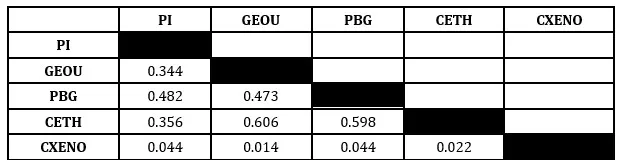
Table 4 presents the HTMT values, which likewise support discriminant validity. All HTMT ratios were well below both the conservative threshold of .85 and the more liberal threshold of .90. The highest HTMT value was observed between GEOU and CETH (.606), followed by PBG and CETH (.598) and PBG and PI (.482). All remaining HTMT values were substantially lower, particularly those involving CXENO. Overall, these results indicate that the constructs were psychometrically distinct and appropriate for subsequent structural analysis.
Table 4. Discriminant validity analysis
Thresholds are 0.850 for strict and 0.900 for liberal discriminant validity.
Structural Model Results
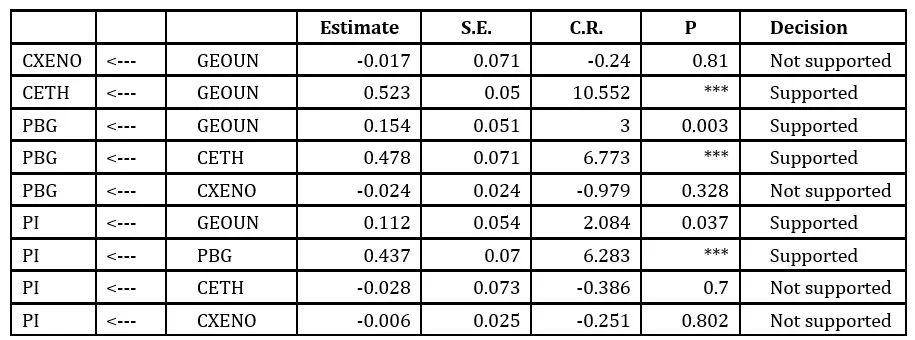
The structural model was estimated to test the hypothesized direct relationships among GEOUN, CETH, CXENO, PBG, and PI toward foreign apparel brands. Table 5 presents the results. The path estimates showed that geopolitical uncertainty positively influenced consumer ethnocentrism (β = .523, p < .001), thereby supporting H1. In contrast, the path from GEOUN to CXENO was not significant (β = -.017, p = .810); therefore, H2 was not supported. Geopolitical uncertainty also had a positive and statistically significant effect on PBG (β = .154, p = .003), supporting H3, and a smaller but still significant positive effect on purchase intention (β = .112, p = .037), supporting H4. CETH positively influenced PGB (β = .478, p < .001), supporting H5. However, its direct effect on PI was not significant (β = -.028, p = .700); thus, H6 was not supported. CXENO did not significantly influence PBG (β = -.024, p = .328) or PI (β = -.006, p = .802). Accordingly, H7 and H8 were not supported. Finally, PBG had a strong positive effect on purchase intention (β = .437, p < .001), supporting H9. Among the direct predictors included in the model, PBG emerged as the strongest predictor of PI.
Table 5. Hypotheses validation
The structural results indicate that purchase intention (PI) toward foreign apparel brands in Colombia is driven primarily by perceived brand globalness (PBG). Geopolitical uncertainty (GEOUN) also contributes to PI through both direct and indirect pathways. In contrast, consumer ethnocentrism (CETH) influences PI only indirectly via perceived brand globalness, while consumer xenocentrism (CXENO) does not exhibit a statistically significant structural effect within the model.
Indirect and Mediation Effects
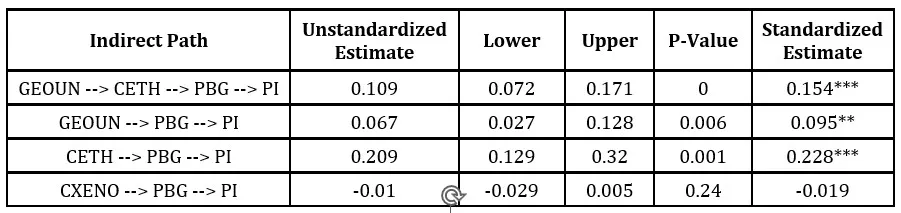
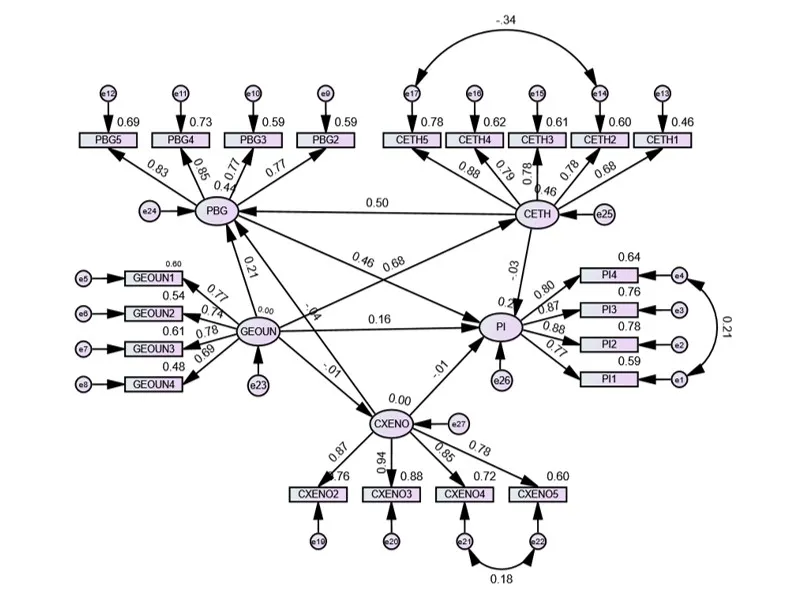
Table 6 and Figure 2 present the results of the mediation analysis. The indirect effects provide further support for the mediating role of PBG. First, the indirect effect of GEOUN on PI through PBG was significant (unstandardized estimate = 0.067, 95% CI [0.027, 0.128], p = .006; standardized estimate = 0.095), supporting H10. This result indicates that geopolitical uncertainty increases PI, in part, by strengthening perceptions of foreign apparel brands as global. Second, the indirect effect of CETH on PI through PBG was also significant (unstandardized estimate = 0.209, 95% CI [0.129, 0.320], p = .001; standardized estimate = 0.228), supporting H11. This finding suggests that CETH does not directly increase or reduce PI; rather, its effect operates through its positive influence on PBG. Third, the indirect effect of CXENO on PI through PBG was not significant (unstandardized estimate = -0.010, 95% CI [-0.029, 0.005], p = .240; standardized estimate = -0.019). Accordingly, H12 was not supported.
The sequential indirect path from GEOUN to PI through CETH and PBG was significant (unstandardized estimate = 0.109, 95% CI [0.072, 0.171], p CXENO -> PBG, GEOU -> CXENO -> PBG -> PI, and GEOU -> CXENO -> PI were all nonsignificant. Likewise, the indirect path GEOU -> CETH -> PI was not significant, indicating that CETH influences PI only when its effect operates through PBG. Overall, these findings indicate that GEOUN, CETH, and, most notably, PBG play central roles in explaining PI toward foreign apparel brands in Colombia. By contrast, CXENO does not emerge as a meaningful predictor in the final model.
Table 6. Mediation analysis
Figure 2. Structural equation model
Discussion
This study examined how GEOU, CETH, CXENO, and PBG shape PI toward foreign apparel brands in Colombia. Overall, the findings indicate that PI is explained primarily by PBG, whereas GEOUN exerts both direct and indirect effects. In addition, GEOUN significantly increases CETH, which, in turn, positively influences PGB. By contrast, CXENO does not significantly predict either PBG or PI. This pattern suggests that, in the Colombian foreign apparel market, purchase intention is driven less by a generalized attraction to foreign products and more by the perceived global legitimacy, prestige, and symbolic strength of the brand itself.
The strongest direct effect on the model was the positive relationship between PBG and PI. This finding is consistent with PGB research indicating that PGB functions as a signal of credibility, prestige, and quality, particularly in emerging-market settings where consumers often rely on globalness as a heuristic of legitimacy (Mandler et al., 2021; Safeer et al., 2022; Steenkamp et al., 2003). In symbolic consumption categories such as apparel, this logic is especially salient because brands are consumed not only for their utility but also for the social meanings they convey. This result is also consistent with the broader conceptual discussion advanced by Camacho et al. (2025), in which global and foreign-oriented meanings are associated with modernity, prestige, competence, and symbolic distinction, and globalness is explicitly treated as a cue that can shape downstream intentions under conditions of uncertainty. In this respect, the present findings extend prior work by showing that, in the apparel and fashion category, perceived brand globalness serves as the most immediate marketplace mechanism through which contextual and identity-based factors translate into purchase intention.
A second major finding is that GEOUN positively influences PBG and PI and increases CETH. This finding supports the argument that uncertainty does not suppress foreign-oriented consumption in a simple linear manner. Rather, it can reconfigure consumer judgment by altering the cues consumers rely on. Camacho et al. (2025) make this point explicitly, arguing that geopolitical instability can redirect, rather than merely diminish, behavioral readiness by activating identity repair and evaluative mechanisms in the face of threat. The present results are consistent with that interpretation, but within a branding context rather than a tourism context. In the Camacho et al (2025) study, GEOUN significantly increased ethnocentrism and had a small positive direct effect on domestic touristic purchase intention, whereas stronger effects operated through motivational mechanisms. Similarly, in the present study, GEOUN did not simply weaken the appeal of foreign brands. Instead, it strengthened PBG, suggesting that under conditions of instability, consumers may rely more heavily on globally established brands as signals of legitimacy, resilience, and symbolic certainty. This interpretation is also broadly consistent with recent work on geopolitical tension and market behavior, which indicates that geopolitical shocks can shape brand evaluation and consumer spending in ways that are more complex than standard uncertainty-aversion models would predict (Auruškevičienė et al., 2025; Cui & Li, 2025).
One notable finding concerns CETH. As hypothesized, GEOUN significantly increased ethnocentrism, consistent with uncertainty-identity theory and prior research showing that threat strengthens in-group alignment and domestic preference (Camacho et al., 2025). However, CETH did not directly predict PI. Instead, it positively influenced PBG, and its indirect effect on PI through PBG was significant. This finding challenges the conventional view that ethnocentrism simply reduces willingness to buy foreign products. Similar evidence was reported by Camacho et al. (2022), who found no significant effect of ethnocentrism on planned online purchase behavior during the pandemic. The present results suggest that, although ethnocentrism is activated by uncertainty, it shapes how foreign brands are evaluated rather than directly determining PI. One possible explanation is that ethnocentric consumers become more attentive to the symbolic strength and global standing of foreign brands. This helps explain why the path from CETH to PBG was significant, whereas the path from CETH to PI was not. The significant indirect path from GEOUN to CETH, then to PBG, and finally to PI further supports this interpretation.
The most notable difference from earlier studies concerns consumer xenocentrism. In the present model, neither the path from geopolitical uncertainty to xenocentrism nor the paths from CXENO to PBG and PI were significant. This contrasts with earlier findings showing positive effects of xenocentrism on purchase intention across product and tourism contexts (Camacho et al., 2020; Camacho et al., 2022; Camacho et al., 2025). Rather than problematic, this divergence is theoretically informative. Prior research has suggested that xenocentrism may remain symbolically meaningful yet become behaviorally weak under conditions of uncertainty, particularly when identity-protective and control-oriented concerns are salient. The present results align with that interpretation. In the Colombian foreign apparel market, xenocentrism does not appear to be the primary mechanism driving purchase intention. Instead, purchase intention seems to depend more on whether foreign brands are perceived as globally legitimate and prestigious. This suggests that xenocentrism is context-sensitive rather than uniformly influential across settings.
Viewed collectively, the present findings align with the broader research stream associated with Camacho and colleagues. Earlier consumer-product studies showed that xenocentrism can foster favorable evaluations and purchase intention toward imported offerings, while the 2025 tourism study extended this pattern to experiential consumption. By contrast, the 2025 Businesses article suggested that, under geopolitical uncertainty, ethnocentrism becomes more behaviorally salient and xenocentrism weakens. The present study more closely reflects this latter pattern. It confirms that geopolitical uncertainty strengthens ethnocentric identity protection while showing that, in the foreign apparel context, perceived brand globalness is the key marketplace mechanism shaping purchase intention. In this way, the study extends prior research by indicating that the effects of uncertainty on purchase intention do not always operate through product attitudes or tourism motivation; rather, they operate primarily through perceived brand globalness.
Theoretical Implications
These findings offer three principal theoretical implications. First, they support the view that geopolitical uncertainty operates as an active consumer-level force capable of reshaping identity orientations and evaluative processes, rather than functioning merely as a background macro-level condition. Second, they suggest that CETH and CXENO do not operate as symmetrical opposites in their behavioral consequences. Under conditions of uncertainty, ethnocentrism becomes more salient and may exert influence through indirect pathways, whereas xenocentrism may remain symbolically relevant but structurally weak. Third, the findings reinforce PBG’s role as the key mechanism linking contextual instability and identity-based orientations to purchase intention.
Managerial Implications
For foreign apparel brands operating in Colombia, these findings suggest that communication strategies should emphasize global recognition, international legitimacy, symbolic prestige, and perceived quality standards. These cues appear to matter more than generalized admiration for the foreign alone. The results also indicate that uncertainty does not necessarily diminish the attractiveness of foreign brands; under certain conditions, it may increase consumers’ reliance on globally established brands as symbols of stability and legitimacy. At the same time, because ethnocentrism intensifies under conditions of uncertainty, foreign brands may benefit from combining signals of global prestige with locally resonant positioning that reduces symbolic distance from domestic identity concerns.
Conclusion
This study examined how GEOUN, CETH, CXENO, and PBG shape purchase intention toward foreign apparel brands in Colombia. Overall, the findings indicate that PI is driven primarily by PBG, while GEOUN exerts both direct and indirect effects through identity-based and brand-evaluative mechanisms. More specifically, geopolitical uncertainty significantly increased CETH, PBG, and PI, whereas CETH positively influenced PBG but did not directly predict PI. By contrast, CXENO did not significantly influence either PBG or PI. These results suggest that, in the Colombian foreign apparel market, purchase intention is influenced less by generalized admiration for foreign products and more by the degree to which foreign brands are perceived as globally legitimate, prestigious, and symbolically powerful.
The study makes several contributions to the literature. First, it reinforces the importance of PBG as the most proximal driver of foreign-brand PI, consistent with prior branding research showing that globalness signals legitimacy, quality, and status (Mandler et al., 2021; Safeer et al., 2022; Steenkamp et al., 2003). Second, it supports the view that GEOUN should be understood as an active consumer-level force rather than merely a macroeconomic background condition. In line with recent work on uncertainty and identity-based consumption, the findings suggest that instability can reshape consumer orientations and redirect decision processes rather than simply suppress foreign-oriented behavior (Auruškevičienė et al., 2025; Camacho et al., 2025; Hogg, 2014). Third, the results indicate that CETH and CXENO do not operate symmetrically under conditions of uncertainty. In this study, ethnocentrism became more salient and influenced purchase intention indirectly through PBG, whereas xenocentrism remained structurally weak. This extends prior research by suggesting that xenocentrism is not uniformly behaviorally potent and may depend on context, product category, and the presence of more proximal brand-level cues (Balabanis & Diamantopoulos, 2016; Camacho et al., 2020, 2022b, 2025).
The findings also carry managerial implications. For foreign apparel brands operating in Colombia, the results suggest that communication strategies should emphasize global recognition, international legitimacy, symbolic prestige, and perceived quality standards, as these cues appear to matter more than a generalized preference for foreign brands alone. The results further suggest that GEOUN does not necessarily weaken consumer interest in foreign brands; under some conditions, it may strengthen reliance on globally established brands as symbols of stability and legitimacy. At the same time, because ethnocentrism intensifies under uncertainty, foreign brands may benefit from combining global prestige with culturally sensitive positioning that reduces symbolic distance from local identity concerns.
Despite these contributions, the study has several limitations. First, the research employed a cross-sectional design, which limits the strength of causal inference. Second, the analysis focused on a single country and a single product category, thereby limiting generalizability. Third, the study relied on self-reported perceptions and intentions rather than observed purchase behavior. These limitations warrant caution in extending the findings beyond the present empirical setting.
Future research could extend this work in several directions. Comparative studies across additional Latin American markets would help determine whether the same pattern of relationships holds under different institutional and cultural conditions. Researchers could also examine whether the relative weakness of xenocentrism persists across other symbolic product categories, such as cosmetics, electronics, or luxury goods. Longitudinal and experimental designs would be especially valuable for understanding how geopolitical instability reshapes consumer identity orientations over time. Future studies might also investigate whether PBG interacts with country-of-origin effects, luxury positioning, or national identity salience to generate different pathways to PI.
References
Ajzen, I. (1991), The theory of planned behavior,’ Organizational Behavior and Human Decision Processes, 50 (2), 179-211.
Arnould, EJ. and Thompson, CJ. (2005), Consumer culture theory (CCT): twenty years of research,’ Journal of Consumer Research, 31 (4), 868-882.
Auruškevičienė, V., Survilaitė, E., Misiūnas, D. and Reardon, J. (2025), ‘Geopolitical uncertainty and spending behavior: examining the roles of consumer risk perception, coping appraisal, and resilience,’ Organizations and Markets in Emerging Economies, 16 (1), 6-30.
Balabanis, G. and Diamantopoulos, A. (2016), Consumer xenocentrism as determinant of foreign product preference: a system justification perspective,’ Journal of International Marketing, 24 (3), 58-77.
Balabanis, G., Diamantopoulos, A., Mueller, RD. and Melewar, TC. (2001), ‘The impact of nationalism, patriotism and internationalism on consumer ethnocentric tendencies,’ Journal of International Business Studies, 32 (1), 157-175.
Camacho, LJ. and Miranda, R. (2025), ‘The xenocentric tourist: an examination of motivation and purchase intention in the Dominican Republic’s tourism sector,’ Multidisciplinary Business Review, 18 (1), 79-93.
Camacho, LJ., Pancorbo, S. and Miranda, R. (2025), ‘Competing identities under threat: ethnocentrism, xenocentrism, and touristic motivation amid geopolitical uncertainty,’ Businesses, 5 (4), Article 58.
Camacho, LJ., Ramirez-Correa, P. and Salazar-Concha, C. (2022a), ‘Consumer ethnocentrism and country of origin: effects on online consumer purchase behavior in times of pandemic,’ Sustainability, 14 (1), Article 348.
Camacho, LJ., Salazar-Concha, C. and Ramirez-Correa, P. (2020), The influence of xenocentrism on purchase intentions of the consumer: the mediating role of product attitudes,’ Sustainability, 12 (4), Article 1647.
Camacho, LJ., Salazar-Concha, C. and Ramirez-Correa, P. (2022b), ‘Xenocentrism and formal education: evaluating its impact on the behavior of Chilean consumers,’ Journal of Risk and Financial Management, 15, Article 166.
Cui, R. and Li, X. (2025), ‘Geopolitical tensions and multinational brands: evidence from China,’ Finance Research Letters, 85, Article 108126.
Fornell, C. and Larcker, DF. (1981), Structural equation models with unobservable variables and measurement error: algebra and statistics,’ Journal of Marketing Research, 18 (3), 382-388.
Hair, JF. and Sarstedt, M. (2019), Factors versus composites: guidelines for choosing the right structural equation modeling method,’ Project Management Journal, 50 (6), 619-624.
Hair, JF., Hult, GTM., Ringle, CM. and Sarstedt, M. (2017), A primer on partial least squares structural equation modeling (PLS-SEM), Sage, Thousand Oaks, CA.
He, J. and Wang, CL. (2015), ‘Cultural identity and consumer ethnocentrism impacts on preference and purchase of domestic versus import brands: an empirical study in China,’ Journal of Business Research, 68 (6), 1225-1233.
Hogg, MA. (2014), From uncertainty to extremism: social categorization and identity processes,’ Current Directions in Psychological Science, 23 (5), 338-342.
Hogg, MA. and Adelman, J. (2013), ‘Uncertainty-identity theory: extreme groups, radical behavior, and authoritarian leadership,’ Journal of Social Issues, 69 (3), 436-454.
Korolev, A. (2025), When hedging fails: structural uncertainty, protective options, and geopolitical (im)prudence in smaller powers’ behaviour, Cambridge University Press, Cambridge.
Liu, H., Schoefer, K., Fastoso, F. and Tzemou, E. (2021), Perceived brand globalness/localness: a systematic review of the literature and directions for further research,’ Journal of International Marketing, 29 (1), 77-94.
Mandler, T., Bartsch, F. and Han, CM. (2021), Brand credibility and marketplace globalization: the role of perceived brand globalness and localness,’ Journal of International Business Studies, 52 (8), 1559-1590.
Mandler, T., Bartsch, F., Krüger, T., Kim, KA. and Han, CM. (2023), Consumer animosity: the mitigating effect of perceived brand globalness,’ International Marketing Review, 40 (2), 365-384.
Pino, G., Amatulli, C., Peluso, AM., Nataraajan, R. and Guido, G. (2019), ‘Brand prominence and social status in luxury consumption: a comparison of emerging and mature markets,’ Journal of Retailing and Consumer Services, 46, 163-172.
Prince, M., Yaprak, A., Cleveland, M., Davies, MAP., Josiassen, A., Nechtelberger, A., Nechtelberger, M., Palihawadana, D., Renner, W., Chovanova Supekova, S. and Von Wallpach, S. (2020), ‘The psychology of consumer ethnocentrism and cosmopolitanism: a five-country study of values, moral foundations, gender identities and consumer orientations,’ International Marketing Review, 37 (6), 1013-1049.
Rojas-Méndez, JI. and Chapa, S. (2020), X-scale: a new scale to measure consumer xenocentrism,’ Marketing Intelligence & Planning, 38 (3), 354-368.
Safeer, AA., Zhou, Y., Abrar, M. and Luo, F. (2022), Consumer perceptions of brand localness and globalness in emerging markets: a cross-cultural context,’ Frontiers in Psychology, 13, Article 919020.
Shimp, TA. and Sharma, S. (1987), Consumer ethnocentrism: construction and validation of the CETSCALE,’ Journal of Marketing Research, 24 (3), 280-289.
Steenkamp, J-BEM., Batra, R. and Alden, DL. (2003), ‘How perceived brand globalness creates brand value,’ Journal of International Business Studies, 34 (1), 53-65.