Royer Enrique Cabrera Sulca, Ligia Andrea Quispe Vera, Saraí Nelly Samán Chingay and César Zuloeta Miyasato
Universidad Privada del Norte, Perú
Volume 2026,
Article ID 989064,
IBIMA Business Review,
12 pages,
DOI: doi.org/10.5171/2026.989064
Received date: 7 May 2026; Accepted date: 8 July 2026; Published date: 30 September 2026
Academic Editor: Laura Elena Zapata Jiménez
Cite this Article as:
Royer Enrique Cabrera Sulca, Ligia Andrea Quispe Vera, Saraí Nelly Samán Chingay and César Zuloeta Miyasato (2026)," “The Role of social media in the Purchasing Decisions of Fast-food Consumers, Cajamarca, 2024“, IBIMA Business Review, Vol. 2026 (2026), Article ID 989064, https://doi.org/10.5171/2026.989064
The objective of the study is to identify the relationship between social media and the purchasing decisions of customers of a fast-food micro-enterprise in the city of Cajamarca. The research was justified by the growing influence of digital environments on buyer attitudes, particularly within the food service sector. The study adopted a quantitative approach using a non-experimental, basic, correlational, and cross-sectional design. The population consisted of 850 customers registered on the micro-enterprise’s social media channels, and a validated questionnaire was administered to a sample of 265 individuals. The results indicated a significant relationship between the variables studied—social media and customer purchasing decisions—with a Spearman’s Rho value of 0.691. Furthermore, a moderate positive relationship was found between purchasing decisions and both content creation (Rho = 0.652) and interactions (Rho = 0.581), whereas the use of digital platforms showed a weak positive relationship (Rho = 0.549). The findings indicate that social media serve as a key tool for influencing consumer decisions, with content and interaction being the most decisive factors.
Keywords: Social media, purchase decision, digital marketing
Introduction
Throughout history, human beings have consistently demonstrated a natural tendency to interact with others by expressing thoughts, emotions, and ideas while seeking and sharing knowledge and information. Social media platforms are digital environments in which users create, share, and disseminate personal and professional information with both acquaintances and strangers. Owing to the exponential growth in smartphone usage and the widespread expansion of Information and Communication Technologies (ICT), social media have become one of the preferred channels for communication and information exchange. They have also established themselves as primary platforms for brand discovery and exploration, explaining why marketing professionals increasingly rely on these platforms not only to enhance brand visibility but also to obtain valuable insights into consumer behavior and support strategic decision-making throughout the development of marketing campaigns.
Consequently, it is understandable that the technological revolution driven by advances in communication technologies has profoundly influenced human behavior across different dimensions of social life. Network intelligence has gradually redefined relationship marketing and customer experience, while modern marketing methodologies increasingly operate within complex technological environments. For organizations, this transformation provides guidance on how to adapt marketing strategies to a hyperconnected, automated, and highly personalized environment. Such changes are based on the premise that technological developments have significantly modified the way individuals communicate, thereby influencing their social interactions and everyday lives.
As a result, consumers have shown a greater propensity to purchase products and services through online channels, frequently using social media platforms during the purchasing process. Likewise, they tend to conduct extensive research on products and services before making a purchase decision and place considerable importance on the opinions and experiences shared by other consumers. Consumer purchase decisions are influenced by both marketing-related and non-marketing-related factors. Internal factors include beliefs, attitudes, perceptions, lifestyles, roles, and social status, whereas external factors comprise cultural influences, reference groups, and individuals’ positions within society.
In recent years, external factors have become increasingly relevant in explaining consumer purchase decisions. Reference groups have emerged as powerful influencers in decision-making processes, while digital recommendations and online reviews have become determining factors in the selection of food establishments, particularly within the fast-food sector. Today’s consumers seek not only accessibility and speed but also confidence derived from the experiences of other customers. Consequently, ratings available on platforms such as Google Reviews, TripAdvisor, and social media function as mechanisms of social validation that directly influence perceptions of quality, safety, food options, and overall customer experience. This behavior reflects an increasingly demanding, connected, and well-informed consumer profile. For fast-food brands, understanding these dynamics is essential for strengthening digital positioning through social media strategies, attracting new customers, and enhancing customer loyalty. Furthermore, companies operating in the food industry recognize that recommendations and electronic word-of-mouth constitute strategic marketing assets that ultimately contribute to organizational profitability.
Online reviews have become fundamental references in consumers’ selection of dining establishments, with nearly 60% of fast-food customers considering online reviews before making a purchase decision. Digital opinions exert a growing influence on consumer behavior, making marketing strategies aligned with current digital trends essential for establishing and maintaining a strong competitive position in the digital marketplace. Consequently, fast-food companies increasingly perceive investments in social media as investments in credibility, customer trust, and sustainable conversion rates.
An analysis conducted by Guerrón et al. in Ecuador examined the relationship between experiential marketing and consumers’ purchase decisions within the restaurant industry. The findings revealed a strong and statistically significant positive correlation between both variables (Spearman’s Rho = 0.854). Customers highly valued factors such as a welcoming environment, personalized service, memorable experiences, and activities that generated lasting impressions. Furthermore, recommendations and marketing strategies were identified as key determinants in restaurant selection.
According to Ozioma D., social media marketing strategies significantly influence consumer purchasing decisions among young adults in Nigeria, a population characterized by intensive use of platforms such as Facebook, Instagram, and X (formerly Twitter). The study found that the most influential dimensions were visual advertising and interactive content. Through the analysis of conversion metrics and campaign performance indicators, the research demonstrated that influencer credibility and social validation, reflected through engagement and user feedback, play a decisive role in shaping purchasing behavior. The study reported a Spearman’s Rho coefficient of 0.672, indicating a statistically significant relationship between social media marketing and consumer purchase decisions. Consequently, the implementation of effective social media marketing strategies directly influences consumers’ purchasing behavior.
Similarly, Olha Sokhatska and Siddharth S. reported that social media marketing strategies exert a substantial influence on consumer behavior and purchase decisions. Digital reviews, online recommendations, personalized content, and continuous interaction encourage consumers to complete purchasing processes more effectively. Their study, conducted among European consumers, concluded that users place greater trust in information obtained through social media than in traditional marketing communications. The authors also highlighted the relevance of influencer participation, demonstrating that consumers tend to identify with shared experiences rather than conventional advertising messages. Consequently, the consumer decision-making process has evolved from a traditional linear model toward one driven by social approval, significantly contributing to customer loyalty and brand engagement. Moreover, personalized and user-oriented content proved to generate considerably better outcomes than conventional marketing strategies.
The findings reported by Lăzăroiu et al. identified several psychological factors influencing consumer purchase decisions within social commerce environments. Specifically, the study examined electronic commerce conducted through social media platforms and identified perceived risk, particularly regarding transaction security and data privacy, as a major determinant of purchasing behavior. Consumers often delayed purchase decisions because of uncertainty; however, positive reviews, recommendations from other users, and favorable customer experiences significantly increased purchase intention. Trust emerged as the most influential factor, fostered through interaction, credibility, and confidence in the digital environment. Consequently, online reputation and the strategic management of social media interactions play a decisive role in converting consumer interest into actual purchases.
Likewise, the study conducted by Villavicencio and Álvarez proposed a social media advertising strategy aimed at increasing brand visibility and strengthening brand positioning. The authors found that the most effective content consisted of authentic product photographs, visually attractive food images emphasizing lighting, colors, originality, promotional campaigns, discounts, and high-quality presentations of products shared through Instagram and Facebook. Their findings demonstrated that effective social media planning contributes significantly to increased sales performance and stronger customer loyalty.
According to Alay [13], purchase decisions within the fast-food industry are strongly influenced by perceived quality and service speed. The research analyzed consumer behavior in the fast-food sector by considering perceived quality, customer service, overall experience, and advertising effectiveness. The study concluded that social media and digital marketing strategies play a fundamental role in motivating consumer purchases.
At the national level, Barros et al. [14] analyzed the influence of social media on consumption habits and active purchasing behavior among the Millennial generation. Their study focused on digital interactions and consumer trust in social media content. The results revealed that social media significantly influences need recognition (50.6%), information search (37.7%), and evaluation of alternatives (35.3%), with statistically significant relationships (p < 0.01). Furthermore, the coefficient of determination (R² = 0.458) indicated that social media explain 45.8% of purchase decision variability. Millennials reported greater confidence in content generated by influencers, peer recommendations, and authentic brand communication, perceiving social media as a platform capable of fostering customer engagement and emotional connections with brands.
Similarly, Choquepata and Molina analyzed the influence of digital marketing through social media on the purchasing decisions of fast-food restaurant customers. Among the principal findings, 71% of respondents stated that frequent social media content directly influenced their purchase decisions. Attractive photographs of products, positive customer reviews, and promotional campaigns emerged as the most influential factors. The study concluded that continuous exposure to digital content significantly increases consumers’ willingness to visit a specific restaurant, while higher levels of engagement strengthen trust and credibility toward the brand.
Social media have become one of the most influential components of contemporary marketing strategies. According to Kotler and Gary Armstrong, social media comprise a set of digital platforms that facilitate interaction between organizations and consumers through the creation, dissemination, and exchange of information. Beyond functioning as communication channels, these platforms enable companies to establish long-term relationships with customers, strengthen brand positioning, and generate value through personalized and interactive experiences.
Likewise, Philip Kotler, Hermawan Kartajaya and Iwan Setiawan argue that the emergence of Marketing 4.0 has transformed organizational communication by integrating traditional marketing with digital technologies. In this context, organizations no longer compete solely through product quality or pricing strategies but also through their capacity to generate relevant digital content, foster meaningful interactions, and establish emotional connections with consumers via social media platforms.
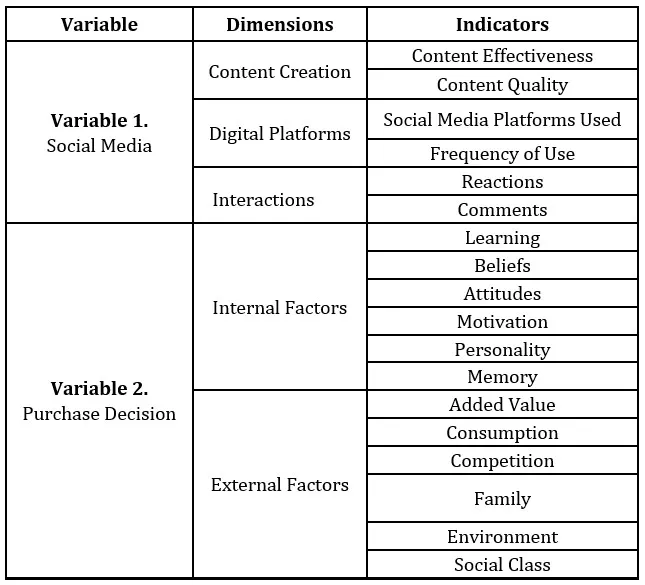
Within this framework, the present study conceptualizes Social Media as the independent variable and operationalizes them through three dimensions: content creation, digital platforms, and interactions. Content creation refers to the generation of valuable, attractive, and relevant information capable of capturing consumers’ attention and encouraging active engagement. Digital platforms encompass the technological environments through which organizations communicate with consumers, including Facebook, Instagram, TikTok, and other digital channels. Finally, interactions refer to the exchange of messages, comments, reactions, recommendations, and feedback that strengthen the relationship between organizations and consumers while fostering trust and engagement.
The dependent variable, Consumer Purchase Decision, is understood as the process through which individuals recognize a need, evaluate available alternatives, and ultimately select a product or service that best satisfies their expectations. According to Philip Kotler and Kevin Lane Keller, purchase decisions are influenced by a combination of internal and external factors. Internal factors include motivation, perceptions, attitudes, personality, learning, and memory, whereas external factors comprise culture, social class, family influence, and reference groups.
In today’s digital marketplace, consumers increasingly rely on information obtained through social media before making purchasing decisions. User-generated content, online reviews, recommendations, influencer marketing, and brand interactions have become strategic elements that shape consumer perceptions and reduce uncertainty throughout the purchasing process. Consequently, organizations that effectively manage their digital presence are more likely to attract customers, strengthen customer loyalty, and enhance their competitive advantage.
Despite the growing body of literature on social media marketing and consumer behavior, limited empirical evidence is available regarding the influence of social media on consumer purchase decisions within fast-food microenterprises located in medium-sized Peruvian cities such as Cajamarca. Most previous studies have focused on large metropolitan areas or international contexts, creating an important research gap in regional markets characterized by different consumer behaviors, levels of digital adoption, and competitive dynamics.
Addressing this gap, the present research seeks to answer the following research question:
What is the relationship between social media and consumer purchase decision in a fast-food company located in Cajamarca, Peru?
Accordingly, the general objective of this study is:
To determine the relationship between social media and consumer purchase decision in a fast-food company located in Cajamarca, Peru.
Based on the theoretical foundations and empirical evidence presented, the following research hypothesis is proposed:
H1: There is a positive and statistically significant relationship between social media and consumer purchase decision in a fast-food company located in Cajamarca, Peru.
This study contributes to the existing literature from both theoretical and practical perspectives. Theoretically, it provides empirical evidence regarding the influence of social media on consumer behavior within an underexplored regional context. Practically, the findings offer valuable guidance for managers and marketing professionals seeking to strengthen digital strategies through content creation, customer interaction, and effective use of social media platforms. Furthermore, the results may support decision-making processes aimed at improving customer engagement, increasing purchase intention, and enhancing organizational competitiveness within the fast-food industry.
Methodology
The present study is basic research. According to Roberto Hernández Sampieri et al. (2014), this type of research is aimed at generating knowledge through the development and validation of theoretical foundations without pursuing immediate practical applications.
Likewise, the study adopted a quantitative approach, since it sought to obtain objective and measurable results through deductive reasoning and hypothesis testing. Quantitative research allows researchers to validate theoretical assumptions by applying statistical methods that facilitate the analysis and interpretation of observed phenomena.
This research is correlational, as it examines the relationship between the use of social media and consumers’ purchase decisions. Social media provide organizations with direct communication channels that facilitate closer interaction between brands and consumers, thereby influencing purchasing preferences and buying behavior.
The research adopted a non-experimental correlational design, since the variables were observed and analyzed without manipulation or intervention by the researchers. Furthermore, the study employed a cross-sectional design, as data were collected at a single point in time during the year 2024 without longitudinal follow-up of participants.
The population is defined as the complete set of elements or cases that meet previously established characteristics or criteria. Accordingly, the study population consisted of 850 customers, aged between 18 and 35 years, registered in the customer database of a fast-food company located in Cajamarca, Peru.
Regarding the sample, it represents a subset of the population selected to obtain conclusions that can be generalized to the entire population. A simple random probabilistic sampling method was employed using a 95% confidence level and a 5% margin of error, resulting in a final sample of 265 consumers.
For finite populations, the sample size was calculated using the following formula:
Applying these parameters produced a required sample size of 265 participants. The calculation was verified using an electronic spreadsheet.
The data collection technique employed was the survey, which enabled the collection of quantitative information for subsequent statistical analysis. The research instrument consisted of a structured questionnaire, developed according to the methodological recommendations proposed by Hernández et al. (2014). Prior to participation, respondents provided their informed consent.
An appropriate measurement instrument is one that accurately collects observable data representing the variables intended to be measured. Accordingly, all responses were processed in aggregate form, ensuring participants’ confidentiality.
The questionnaire consisted of 23 items distributed across the two research variables according to their respective dimensions.
The independent variable, Social Media, comprised three dimensions: Content Creation, Digital Platforms, Interactions
The dependent variable, Purchase Decision, comprised two dimensions: Internal Factors and External Factors.
Both variables were measured using a five-point Likert scale, producing ordinal data.
Considering the ordinal nature of the variables and the results of the normality tests, the relationship between variables was analyzed using Spearman’s Rank Correlation Coefficient (Spearman’s Rho), an appropriate non-parametric statistic for ordinal variables and non-normally distributed data.
Data collection was conducted through a QR-code-based online questionnaire, which facilitated efficient data gathering. The participating company formally authorized the dissemination of the survey among its customers.
Instrument validity refers to the extent to which the questionnaire accurately measures the constructs under investigation. Consequently, the instrument was subjected to expert judgment validation to ensure content relevance and conceptual consistency.
Instrument reliability refers to the consistency and stability of measurements. Reliability was assessed using Cronbach’s Alpha coefficient, whose values range from 0 to 1.
The obtained coefficients were: Social Media = 0.751, indicating acceptable reliability; Purchase Decision = 0.890, indicating good reliability.
Following data collection, responses were processed using IBM SPSS Statistics Version 25, which enabled descriptive and inferential statistical analyses.
Finally, the research adhered to the ethical principles applicable to consumer behavior and marketing studies. Participation was voluntary, and all respondents were informed of the academic purpose of the study before completing the questionnaire. No sensitive or personally identifiable information was collected. Furthermore, all information obtained was used exclusively for research purposes, guaranteeing the confidentiality and anonymity of all participants.
Table 1: Operationalization Of Variables
Source: Prepared by the authors based on IBM SPSS Statistics 25 output.
Results
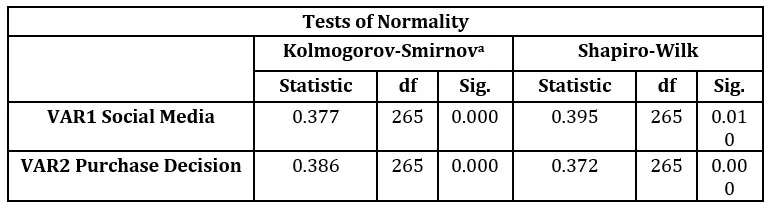
This section presents the results obtained according to the objectives established in Section II. First, the inferential statistical analysis is described. The normality of the study variables was assessed considering that the sample size exceeded 50 participants; therefore, the Kolmogorov–Smirnov test was applied. The results indicated that the Social Media variable obtained a p-value of 0.000, while the Purchase Decision variable also obtained a p-value of 0.000. Since both values were lower than the significance level of 0.05, the variables did not follow a normal distribution. Consequently, the Spearman’s Rank Correlation Coefficient (Spearman’s Rho) was employed for hypothesis testing. Table 2 presents the normality test conducted on the sample of 265 respondents.
Table 2: Normality Test Of The Social Media And Purchase Decision Variables
Source: Prepared by the authors based on IBM SPSS Statistics 25 output.
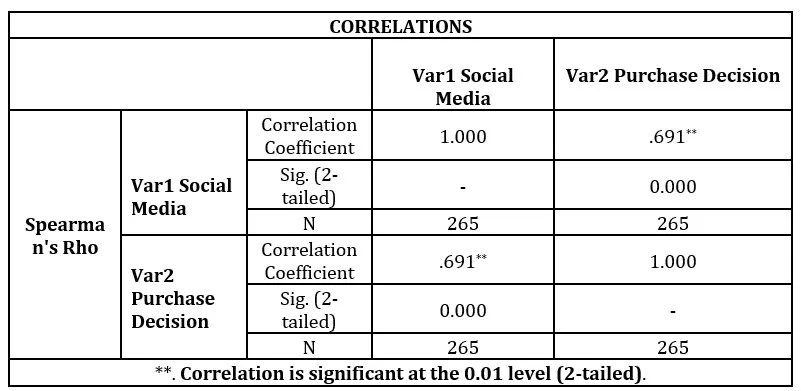
Regarding the results obtained from the survey administered to 265 customers of the fast-food company located in the city of Cajamarca, Table 3 presents the results corresponding to the general hypothesis.
Table 3: General Hypothesis Test: Relationship Between Social Media And Purchase Decision
Source: Prepared by the authors based on IBM SPSS Statistics 25 output.
Table 3 shows a Spearman’s Rho coefficient of 0.691, indicating a strong positive correlation between Social Media and Purchase Decision among customers of the fast-food company in Cajamarca. Furthermore, the significance value (p < 0.001) is lower than the established significance level of 0.05, leading to the rejection of the null hypothesis and acceptance of the research hypothesis.
Therefore, the general hypothesis is accepted: There is a statistically significant relationship between Social Media and Purchase Decision among customers of a fast-food company in Cajamarca, Peru. Consequently, the null hypothesis stating that no significant relationship exists between these variables is rejected.
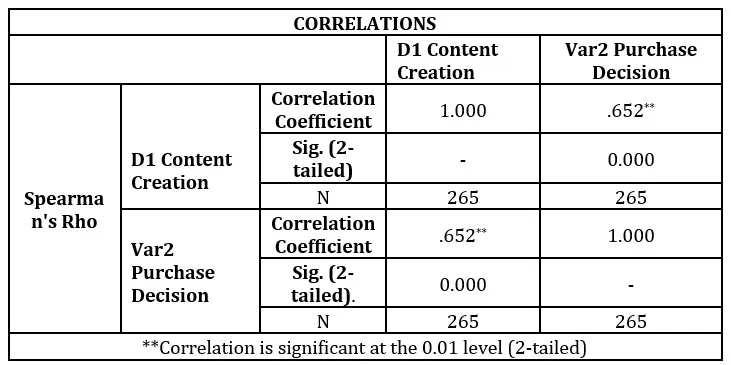
With respect to the first specific hypothesis, which proposed a positive relationship between the Content Creation dimension and Purchase Decision, the Spearman correlation analysis produced a coefficient of 0.652, indicating a strong positive relationship. Likewise, the significance level (p < 0.001) was below 0.05, confirming statistical significance and supporting the proposed hypothesis.
Table 4: Specific Hypothesis 1: Relationship Between Content Creation And Purchase Decision
Source: Prepared by the authors based on IBM SPSS Statistics 25 output.
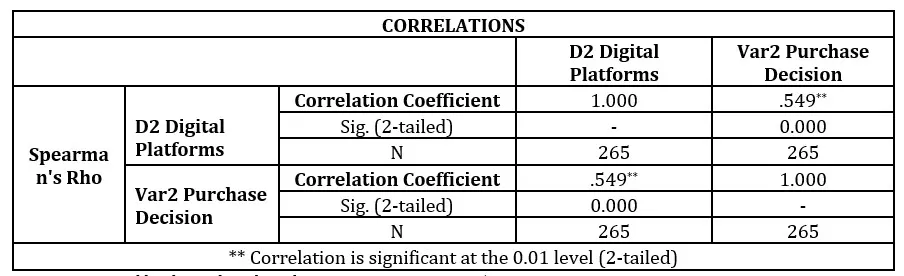
Regarding the second specific hypothesis, Table 5 shows a positive relationship between the Digital Platforms dimension and Purchase Decision. The Spearman correlation coefficient reached 0.549, indicating a moderate positive relationship. Additionally, the significance value (p < 0.001) was below 0.05, confirming that the relationship is statistically significant.
Although the correlation strength is moderate, the findings support the proposed hypothesis, demonstrating that an active presence on digital platforms contributes to influencing consumers’ purchasing behavior.
Table 5: Specific Hypothesis 2: Relationship Between Digital Platforms And Purchase Decision
Source: Prepared by the authors based on IBM SPSS Statistics 25 output.
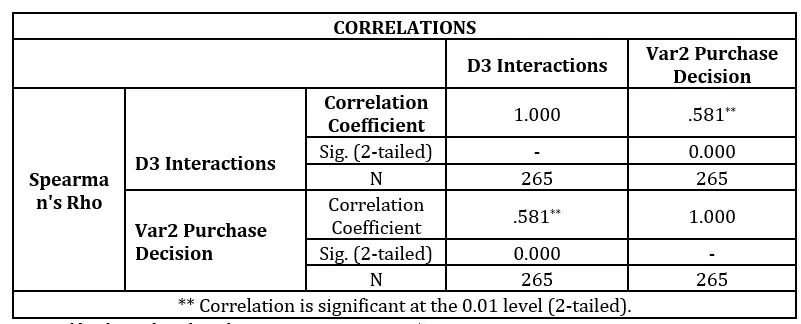
Regarding the third specific hypothesis, Table 6 shows the relationship between the Interactions dimension and Purchase Decision. The Spearman correlation coefficient was 0.581, indicating a moderate positive relationship. Likewise, the significance value (p < 0.001) was lower than 0.05, confirming that the relationship is statistically significant.
Therefore, the third specific hypothesis is accepted, demonstrating that consumer interactions through social media significantly contribute to purchase decision-making within the fast-food sector.
Table 6: Specific Hypothesis 3: Relationship Between Interactions And Purchase Decision
Source: Prepared by the authors based on IBM SPSS Statistics 25 output.
Discussion And Conclusions
The present study determined the relationship between Social Media and Purchase Decision among consumers of a fast-food company located in Cajamarca, Peru, during 2024. The findings revealed a strong positive and statistically significant relationship between both variables, as evidenced by a Spearman’s Rho coefficient of 0.691 (p < 0.05). Consequently, the null hypothesis was rejected, and the research hypothesis was accepted. These findings suggest that the strategic use of social media significantly influences consumers' purchase decisions within the fast-food industry.
The results are consistent with those reported by Ozioma (2023), who concluded that social media marketing strategies significantly influence consumer purchasing behavior among young adults in Nigeria. The study identified visual advertising, interactive content, influencer credibility, and social validation through engagement and user feedback as the most influential factors affecting purchasing decisions. Similarly, the reported Spearman’s Rho coefficient of 0.672 confirms a statistically significant relationship between social media marketing and purchase decision, supporting the findings of the present investigation.
Likewise, the findings are consistent with those reported by Sokhatska and Siddharth (2019), who demonstrated that digital reviews, online recommendations, interactive content, and continuous communication through social media substantially influence consumer purchasing behavior. Their study emphasized that social media have transformed the traditional linear purchasing process into a socially validated decision-making model, thereby increasing brand loyalty and customer engagement.
Similarly, Choquepata and Molina (2020) reported that digital marketing through social media significantly influences purchase decisions among fast-food consumers. Their findings indicated that 71% of respondents acknowledged that the content regularly published on social media affected their purchase decisions. Authentic product photographs, positive customer reviews, and promotional campaigns were identified as the primary drivers of consumer engagement and purchase intention. These findings reinforce the results obtained in the present research.
The results also confirm that content quality and influencer authenticity are decisive factors influencing consumers’ final purchase decisions. Previous studies have demonstrated that influencer credibility and parasocial interaction—defined as the psychological connection established between consumers and influencers—produce a significant positive effect on purchase intention.
Regarding the Content Creation dimension, the findings demonstrate that valuable, attractive, and relevant content contributes to attracting consumers, encouraging interaction, and strengthening trust between brands and customers. Effective content creation represents one of the most important digital marketing strategies because it captures users’ attention while simultaneously contributing to the achievement of organizational marketing objectives.
The increasingly demanding and digitally connected consumer evaluates not only the quality of products but also the quality of information shared through social media. Consequently, organizations operating within the food industry should prioritize digital strategies that generate trust through authentic communication, customer recommendations, and electronic word-of-mouth, all of which ultimately contribute to improved profitability and competitive positioning.
The findings reported by Ozioma (2023) also demonstrated that interactive content and visually attractive advertising significantly improve campaign effectiveness. Furthermore, influencer credibility and social validation through engagement positively affect consumer purchase decisions. The similarity between both investigations reinforces the importance of content quality as one of the primary determinants of digital marketing effectiveness.
Likewise, Lăzăroiu et al. (2020) concluded that personalized and user-oriented content generates better outcomes than traditional marketing strategies. Their study identified perceived risk, purchase intention, and consumer trust as the principal psychological factors influencing purchase decisions within social commerce environments. Moreover, online reputation management and strategic use of social media platforms significantly contribute to increasing purchase conversion rates. Similarly, Villavicencio and Álvarez (2023) emphasized that authentic product images, creative visual content, promotional campaigns, and discounts substantially enhance brand visibility, customer loyalty, and sales performance.
Regarding the Digital Platforms dimension, the findings suggest that online trust and perceived risk continue to represent fundamental determinants of consumer purchasing behavior. Social commerce positively influences every stage of the customer journey, from need recognition to post-purchase evaluation. Consequently, organizations should strengthen customer support strategies and optimize digital experiences across social media platforms, particularly within the fast-food industry.
Digital platforms facilitate cognitive processing during the purchasing process by increasing perceived value, social learning, trust, and confidence while simultaneously reducing uncertainty. These findings confirm that digital environments have become strategic mechanisms for influencing consumer behavior beyond their traditional communication function.
With respect to the Interactions dimension, the results indicate that interactions function as catalysts for rapid purchase decisions while simultaneously strengthening customer loyalty. Within the fast-food industry, continuous communication through surveys, responses to comments, reactions, and personalized interactions generates stronger emotional engagement with the brand, thereby increasing consumers’ purchase intentions.
This finding is consistent with previous studies indicating that approximately 72% of consumers prefer brands that actively interact with their audiences through social media. Attractive visual content, immediate responses, and authentic communication generate positive emotional connections that directly influence purchasing behavior. Furthermore, influencer-consumer relationships established through parasocial interaction significantly increase purchase intention, particularly among younger consumers.
Overall, the findings confirm that social media should no longer be considered merely a communication channel. Instead, it has evolved into a strategic marketing ecosystem capable of generating trust, strengthening customer relationships, increasing brand loyalty, and significantly influencing consumer purchase decisions.
The findings demonstrate a strong positive and statistically significant relationship between Social Media and Purchase Decision among consumers of a fast-food company in Cajamarca, Peru. The obtained Spearman’s Rho coefficient of 0.691 (p < 0.05) confirms that effective social media strategies contribute substantially to influencing consumers' purchasing behavior.
Among the dimensions analyzed, Content Creation exhibited the strongest relationship with purchase decision, highlighting the importance of developing authentic, relevant, and visually attractive content capable of generating trust and customer engagement. The Interactions dimension also demonstrated a significant positive relationship, emphasizing the value of continuous communication and emotional connections between brands and consumers. Although Digital Platforms presented a moderate relationship, the results confirm that an active digital presence contributes significantly to consumer decision-making.
From a theoretical perspective, this study extends existing knowledge regarding the influence of social media on consumer behavior within regional contexts that remain underrepresented in the literature. From a practical standpoint, the findings provide valuable guidance for managers and marketing professionals seeking to strengthen digital strategies through high-quality content, customer engagement, and effective management of social media platforms.
The principal limitation of this study lies in its cross-sectional design and the analysis of a single fast-food company located in Cajamarca, which may limit the generalizability of the findings. Future research should consider longitudinal designs, larger samples, additional economic sectors, and advanced analytical techniques such as Structural Equation Modeling (SEM) to obtain a more comprehensive understanding of digital consumer behavior.
Hasan, A. A.‑T., Shah, M. S., Islam, M. T., & Hossain, M. S. (2021). Factors influencing online shopping intentions: The mediating role of perceived enjoyment. Turkish Journal of Marketing, 6(3), 239‑253. https://doi.org/10.30685/tujom.v6i3.132
Gillpatrick, T. (2019). The digital transformation of marketing: Impact on marketing practice & markets. Economics – Innovative and Economics Research Journal, 7(1), 1–13. https://doi.org/10.2478/eoik-2019-0023
Melovic, B., Sehovic, D., Karadzic, V., Dabic, M., & Cirovic, D. (2021). Determinants of Millennials’ behavior in online shopping. Implications on consumers’ satisfaction and e-business development. doi:https://doi.org/10.1016/j.techsoc.2021.101561
Salem, M. (2018). Impact of social media marketing features on consumer’s purchase decision in the fast-food industry: Brand trust as a mediator. doi:https://doi.org/10.1016/j.jjimei.2022.100102
Park, J., Kim, H., & Foroudi, P. (2021). Effect of online review ratings and perceived crowding on restaurant choice intention: The moderating role of gender.Frontiers in Psychology, 11, Article 780863. https://doi.org/10.3389/fpsyg.2021.780863
Guerrón López, L. D., Cueva Estrada, J. M., & Sumba Nacipucha, N. A. (2024). Marketing de experiencias y su relación con la decisión de compra de los consumidores en el sector gastronómico. Revista Economía y Negocios, 15(15), 1‑19. https://doi.org/10.29019/eyn.v15i2.1300
Ozioma, D. (2023). How Does Social Media Marketing Impact the consumer decision- making in nigeria. Obtenido de https://www.diva-portal.org/smash/get/diva2%3A1769767/FULLTEXT01.pdf
Sokhatska, O., & Siddharth, S. (2019). The impact of social media marketing on consumer buying behaviour: theoretical aspect. Journal of European Economy, 18(2), 285–297. https://doi.org/10.35774/jee2019.02.285
Lăzăroiu, G., Neguriţă, O., Grecu, I., Mitran, P. C., & Dvořák, J. (2020). Consumers’ decision-making process on social commerce platforms: Online trust, perceived risk and purchase intentions. Frontiers in Psychology, 11, 890. https://doi.org/10.3389/fpsyg.2020.00890
Villavicencio, J. G., & Álvarez, J. F. (2023). Propuesta de campaña publicitaria en redes sociales para la empresa La Galería Bakery [Tesis de grado, Universidad del Azuay]. Repositorio Digital de la Universidad del Azuay. https://dspace.uazuay.edu.ec/handle/datos/13486
Alay, N. (2021). Análisis del comportamiento del consumidor de comida rápida y su decisión de compra en la línea de la ciudad de Manta [Tesis de licenciatura, Universidad Laica Eloy Alfaro de Manabí]. Repositorio ULEAM. https://repositorio.uleam.edu.ec/handle/123456789/3316
Choquepata, J., & Molina, J. (2020). El marketing digital en redes sociales para influenciar la decisión de compra de clientes de restaurantes de comida rápida. https://hdl.handle.net/20.500.12867/3881
Lara‑Navarra, P., López‑Borrull, A., Sánchez‑Navarro, J., & Yànez, P. (2018). Medición de la influencia de usuarios en redes sociales: propuesta SocialEngagement. El Profesional de la Información, 27(4), 899–908. https://doi.org/10.3145/epi.2018.jul.18
Hernández, S. L. y Avila, D.D. (2020). Técnicas e instrumentos de recolección de datos. Científico de las Ciencias Económico Administrativas del ICE,9(17),51-53.
Hettiarachchi, H. A. H., Wickramasinghe, C. N., & Ranathunga, S. (2018). The influence of social commerce on consumer decisions. International Technology Management Review, 7(1), 47–58. https://doi.org/10.2991/itmr.7.1.5
Gonçalves, M. J. A., Oliveira, A., Abreu, A., & Mesquita, A. (2024). Social networks and digital influencers in the online purchasing decision process. Information, 15(10), 601. https://doi.org/10.3390/info15100601
Sokolova, K., & Kefi, H. (2020). Instagram and YouTube bloggers promote it, why should I buy? How credibility and parasocial interaction influence purchase intentions. Journal of Retailing and Consumer Services, 53, 1–16. https://doi.org/10.1016/j.jretconser.2019.01.011
Samán Chingay, S. N., Mendoza‑Alfaro, W. I., & Castañeda Castillo, J. M. (2022). Resiliencia y competitividad empresarial: Una revisión sistemática, período 2011–2021. Revista de Ciencias Sociales, 28(3), 306–317.https://doi.org/10.31876/rcs.v28i3.38476