Volume 2026,
Article ID 165005,
Journal of Eastern Europe Research in Business and Economics,
8 pages,
DOI: https://doi.org/10.5171/2026.165005
Received date: 21 November 2025; Accepted date: 15 September 2026; Published date: 2 October 2026
Academic Editor: Viktorija Šipilova
Cite this Article as:
Marek LESNIAK (2026)," India’s Trade with Europe: Trends from 2004–2024 and Poland’s Emerging Role ", Journal of Eastern Europe Research in Business and Economics Vol. 2026 (2026), Article ID 165005, https://doi.org/10.5171/2026.165005
Economic cooperation between India and the European Union has been undergoing significant changes in recent years. This paper presents the results of an analysis regarding shifts in the direction of this cooperation between 2004 (the year Poland joined the European Union) and 2024. The study highlights the specific impact of European integration on Poland’s trade relations with India. The findings clearly demonstrate an increase in trade volume between the parties over the course of two decades, as well as the growing importance of imports from India.
Keywords: India, European Union, cooperation, Poland
Introduction
Research context. The end of 2025 is the planned date for the completion of the negotiations on the Comprehensive Free Trade Agreement (FTA) between the EU and India, which have been ongoing since 2007. The conclusion of these negotiations and the implementation of the arrangements may result in a new opening in trade. Meanwhile, the last 20 years have been a period of dynamic development of trade between the European Union and India. Poland also contributes to this growth, especially in connection with its accession to the European Union in May 2004. This accession was a watershed moment for economic relations between the country and global partners. Until then, Poland operated within the framework of limited access to world markets. Integration with the EU has opened up new trade and investment opportunities. India, as a dynamically developing economy (Suresh, 2024) and one of the world’s largest exporters, has become an important trading partner for Poland (Poland Ministry of Foreign Affairs, 2025) and the entire European Union. The year 2004 was a turning point for Poland. Since then, free access to trade within the common European market and EU import tariffs have changed the structure of Poland’s trade with India. Trade between Poland and India has shown untapped potential so far, which only began to be realized after European integration. This period was also used to strengthen cooperation through numerous mutual visits, the most important of which was the official visit of Prime Minister Narendra Modi on 21-22 August 2024 on the occasion of the 70th anniversary of the establishment of diplomatic relations between India and Poland.
Aim of the article. This article first presents an assessment of the direction of changes in economic cooperation between the European Union and India. In the next part, it presents the results of an analysis for the transformation of Polish trade with India in the period of post-accession of the EU (2004-2024), pointing to changes in the structure of trade and the impact of European integration on the volume and directions of trade. In the next part, it presents the results of Polish surveys on the recognition of Indian brands. The main objective of the study presented in the article is to assess the scale and directions of EU-India cooperation, as well as to indicate the prospects for future cooperation in the context of trade negotiations.
Bilateral Trade between the European Union and India in the Years (2004-2024)
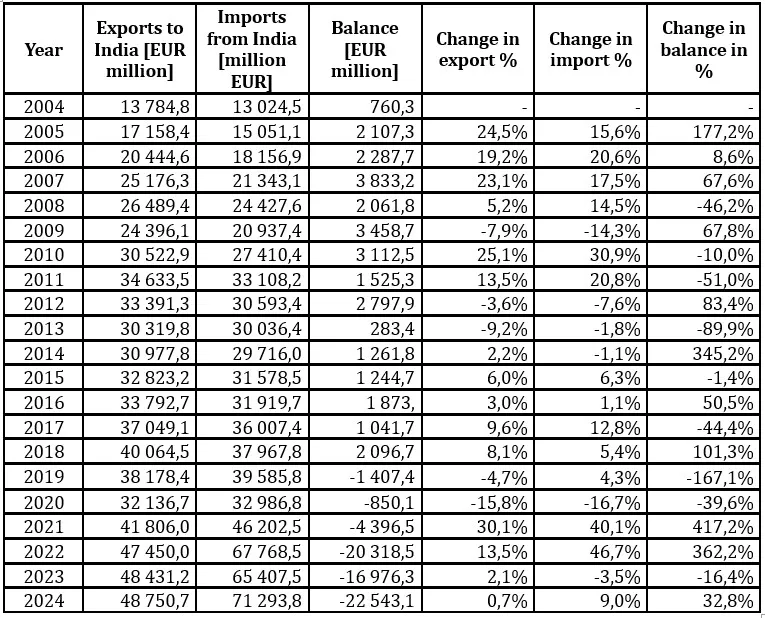
The years 2004-2024 were a period of transformation in economic relations between the European Union and India. It was characterized by dynamic growth in trade and a significant inflow of foreign capital. Total trade increased from €33.6 billion in 2004 to €120.1 billion in 2024, an increase of as much as 257 percent, with an average annual growth of 6.6%. The data were presented in the report “European Union (EU27) – INDIA” (2024). The analysis of trade showed clear growth cycles associated with changes in the global economic situation. In the initial period of 2004-2007, a marked acceleration was observed. Trade increased by 67% – from EUR 33.6 billion to EUR 56.1 billion. Detailed information is presented in table 1.
Table 1. Economic exchange between the European Union and India in the years 2004 to 2024
Source: Author’s own study based on European Union, Eutostat, https://ec.europa.eu/eurostat/databrowser/view/ext_lt_maineu__custom_18870699/default/table
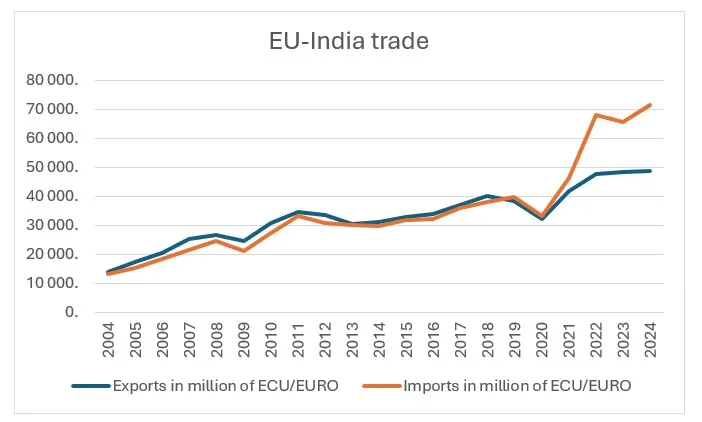
Between 2004 and 2024, the European Union’s trade with India underwent significant changes, reflecting the dynamics of global economic relations. Initially, the EU recorded a steady increase in exports from an annual level of EUR 13.8 billion and a steady increase in imports from EUR 13.0 billion. The average annual growth of exports in this period was 15.4%, and the average annual growth of imports was 12.2%. The situation changed with the onset of the global economic crisis caused by the American subprime crisis, which caused a significant decline in both values, especially in 2009. As the world emerged from the crisis, trade revived rapidly in the following years. Despite numerous fluctuations, until 2018 the EU maintained a favourable trade balance with India. The average annual growth of exports in this period was 3.1%, and the average annual growth of imports was 3.9%. Since 2019, these relations have undergone a groundbreaking transformation – the inflow of goods from India to the European Union has become significantly higher than exports from the EU to India, which has translated into a trade deficit that has deepened with each subsequent year. The years 2021–2024 immediately after COVID-19 are particularly high, when imports from India grew very dynamically, reaching an average annual value of 18.1%, while exports from the EU showed an increasingly weaker upward trend at an annual average of 5.5%. As a result, imports from India amounted to EUR 71.3 billion, and the trade balance reached a record negative level in 2024 and amounted to EUR 22.5 billion. Summarizing the last trading period, i.e. 2021-2024, it should be noted that India’s trade surplus over the period of these 4 years exceeded more than 2.3 times the trade surplus of the European Union generated in the first 16 years of the analysis. This situation indicates the growing importance of India as a supplier of goods to the European market, which may be the result of changes in global supply chains or increased demand for strategic products. At the same time, such a trend of a widening trade deficit is a potential challenge to the macroeconomic balance of the European Union and may require further analysis and adequate measures on the trade and economic policy side. The whole clearly indicates that, after 2019, the EU’s trade with India has transformed from an export advantage to a strong import advantage. These trends are presented in the chart below.
Chart 1. Economic exchange between the European Union and
India in the years 2004 to 2024
Source: Author’s own study based on European Union, Eutostat
Bilateral Trade between Poland and India in the Years (2004-2024)
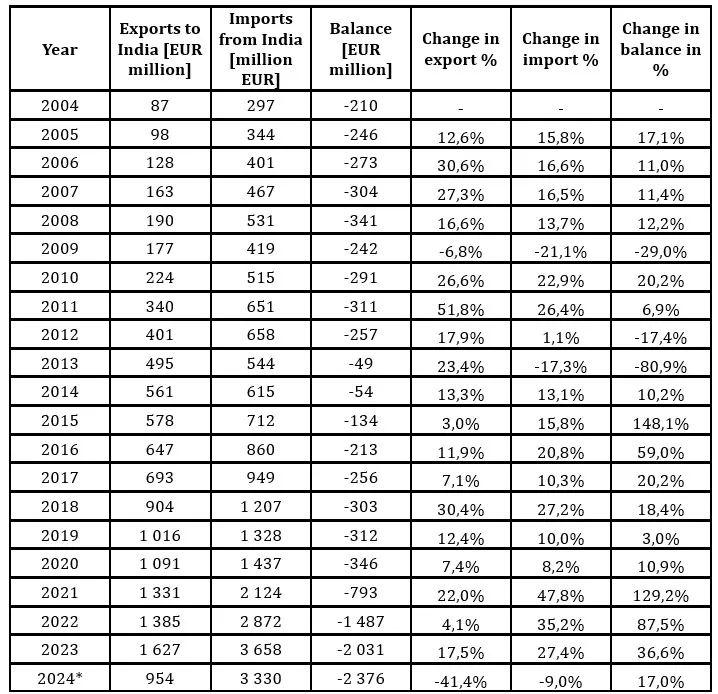
The history of modern trade relations between India and Poland dates back more than seventy years, since the two countries formally established diplomatic relations in 1954. Relations between countries were built on common ideological views that negated colonialism, imperialism and racism. Polish-Indian relations have developed over decades on the basis of close political and economic cooperation. The initial stages of trade cooperation were marked by the idea of “socialist modernization” of both countries. During the Cold War, when Poland was under the influence of the Soviet bloc and India was building its independent position on the international arena, trade between countries was regulated and carried out through agreements and state trade organizations. An important event for the development of cooperation was the visit of Pandit Jawaharlal Nehru to Warsaw in 1955. It became a symbolic moment that initiated intensive contacts at the highest levels, leading to the expansion of diplomatic networks and, among other things, the opening of the Indian Embassy in Warsaw in 1957. Scientific research on Polish-Indian relations is conducted by research institutions of both countries. The key role is played by the Polish Institute of International Affairs (PISM), which since 2012 has been organizing regular specialist seminars together with the Indian Council of World Affairs (ICWA). Research on aspects of foreign trade between countries is conducted by Dygas R. (2024). In his research, he analyses the determinants of foreign direct investment from India to Poland, or the impact of the Indian diaspora on the economic development of Poland. In the academic literature, we also find works devoted to the cultural dimension of relations, which is the basis for economic cooperation. Solanki L. (2020) from the University of Calcutta, in his article published in the Polish Political Science Review (2020), argues that cultural diplomacy between India and Poland is a key foundation for building future strategic relations. Expert studies on economic opportunities point to significant untapped potential. Latymowicz J. (2025), a specialist in business relations with India from Legally.smart, shows in her analyses that Polish-Indian relations have entered a phase of dynamic intensification, especially in the high-tech, biotechnology and consulting services sectors. Detailed information is presented in table 2.
Table 2. Economic exchange between Poland and India in the years 2004 to 2024
Source: Author’s own elaboration based on data contained in GUS reports (stat.gov.pl, section “Foreign Trade”),
*2024 data cover the period from January to October 2024
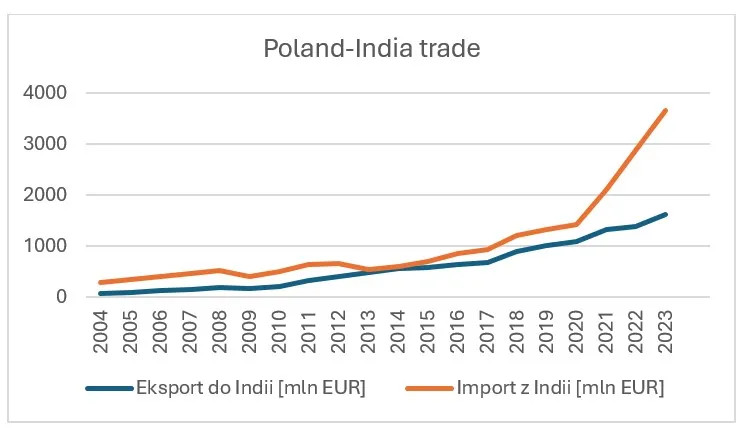
The collected data presented in Table 2 clearly indicate a long-term trend of growth in trade between Poland and India. The analysis of the data indicates a deterioration in Polish trade balance during the period of the survey and a particular deterioration in the value of the balance sheet in recent years. Data analysis reveals several key trends. First of all, it should be pointed out that trade will become more dynamic in the long term. Over the course of 20 years (2004-2023), trade has shown rapid growth. Polish exports to India increased from EUR 87 million in 2004 to EUR 1,627 million in 2023, an increase of almost 19 times. Imports from India have developed on an even larger scale, from EUR 297 million to EUR 3658 million, which means an increase of more than 12 times. This may indicate a significant deepening of economic relations, conditioned by the progressive globalization and the increase in the competitiveness of Polish producers in the Indian market. Secondly, the asymmetry of trade between countries should be pointed out. From the very beginning of the analyzed period, Poland has systematically recorded a negative trade balance vis-à-vis India. In 2004, the deficit amounted to EUR 210 million, and by 2023 it reached an unprecedented level of EUR 2,031 million. This asymmetry intensified especially in the period 2021–2023 (the period after the covid 19 pandemic), when imports from India grew much faster than Polish exports. This indicates that Poland is increasingly dependent on the import of Indian goods, with a simultaneous limited increase in Polish exports to the Indian market. The years 2021-2023 represent a turning point in trade relations. In 2021, imports from India increased by 47.8% and the balance deteriorated by 129.2%. In 2022, this trend intensified, as imports increased by 35.2% in turn, while the balance deteriorated by 87.5%. The increase in imports in this period outpaced the growth in exports, which suggests an increase in the Polish economy’s demand for Indian goods, including, according to preliminary assessments, pharmaceuticals, textiles and chemical products. A graphic presentation of trade is presented in chart 2.
Chart 2. Economic exchange between Poland and India in the years 2004 to 2024
Source: Author’s own elaboration based on data contained in GUS reports (stat.gov.pl, section “Foreign Trade”
To sum up, Polish trade with India is undergoing a transformation with an initial positive trend of export growth to a situation of growing trade imbalance. Polish companies are facing challenges of competitiveness in the Indian market, while the Polish economy is showing an increasing demand for Indian goods. It should be emphasized that, for the size of the Indian market, it is the 5th largest economy in the world (Sriram G. Suchi K, 2024). Polish exports to India are very small and, in 2023, they accounted for only 0.5% of total exports. This clearly indicates the weakness of Polish companies in this area, while at the same time being an unused opportunity for sales development.
Survey Research
The survey included 62 respondents. The group was diverse in terms of professional status, with a predominance of students and full-time employees. Respondents came mainly from larger cities, with representation of rural areas and smaller centers of less than 100,000 inhabitants. The data reveal the ignorance of India as a country and its economy among the surveyed group. Only 7% of respondents declared good or very good knowledge of India. The dominant answers were “I don’t know at all” (19%), “rather poorly” (50%) and “neutrally” (24%). Only 2 respondents visited India, and only a few people planned such a visit. This fundamental knowledge gap translates into a limited understanding of India’s economic and business realities. Paradoxically, despite the poor general knowledge of India, respondents indicated knowledge of specific Indian brands. It turned out that the companies had the greatest recognition, especially in the IT and business services sector. The most frequently mentioned were: Tata Consultancy Services (TCS) – mentioned by over 60% of respondents, Infosys, Wipro, HCL Technologies – mentioned by 30-40% of respondents, and such brands as: UFLEX, Genpact, Zensar Technologies, Videocon, Escorts, Ranbaxy Laboratories, Reliance Industries. This means that Poles know India primarily through the prism of the IT services and outsourcing sector, and not through traditional consumer products. This familiarity is focused on the corporate mothers rather than the products available in the retail market. Respondents additionally mentioned well-known brands such as: Tata, TVS, Solis, Royal Enfield, Mahindra.
A significant proportion of respondents (approx. 45%) have never purchased a product or service from India. Among those who made such purchases “one or twice” or “several times”, food products dominated – especially spices, tea, yogurt (the most frequently mentioned category), textiles and clothing – clothes, footwear, consumer electronics, and cosmetics and care products. Experiences among buyers were mixed. Respondents rated the products as “satisfactory – reliable products” or “medium – quality problems”, which indicates an inconsistency between expectations and reality. Not many people declared the rating “good – I am happy to buy them”. When analysing the factors determining the selection of goods from India, respondents indicated such factors as price – the dominant argument (mentioned by the majority of respondents), product quality, or availability in Polish stores – very important for a large part of the group. Respondents expect to find on the Polish market mainly Indian textiles and clothing, food products, electronics and appliances, as well as IT, tourism and financial services. In the part of the survey analysing the strengths of Indian products, respondents pointed to an attractive price and a good price-quality ratio. Their weaknesses included low quality – indicated by 46% of respondents, problems with service and warranty – mentioned by 26%, or concerns about the working conditions of employees – mentioned by a significant part, especially younger respondents. The survey also examined the potential for increasing sales of Indian products on the Polish market, asking whether respondents would be interested in buying more Indian products if they were more available on the market. The following answers were rather yes / definitely yes – 58% of respondents, I have no opinion – 27%. This may indicate dormant market potential. From the survey, it can be concluded that the problem does not lie in the interest in the products, but in their poor availability and promotion.
To sum up, the study shows a paradoxical situation. Poles have limited knowledge about India as a country and its economy (69% of respondents), assessing their knowledge as “not at all” or “rather poor”, but they are familiar with specific Indian corporate brands and occasionally buy Indian products. The market is seen primarily through the prism of low prices. The main barrier to the development of the exchange of goods is not the interest of consumers (58% would be interested), but the lack of availability of products on the Polish market and poor promotion of the Indian offer. Therefore, it will be crucial for Indian companies entering the Polish market: (1) ensuring the availability of products in retail chains, (2) building European certifications, (3) educating consumers about the quality and origin of products, and (4) using appropriate channels, including social media, for promotion, where people aged 18-25 are active in the sample.
Summary and Conclusions
Trade between the European Union and India increased from EUR 33.6 billion in 2004 to EUR 120.1 billion in 2024, an increase of 257% with an average annual growth rate of 6.6%. The study identifies a key structural change: for most of the period under review (2004-2018), the EU maintained a trade surplus with India, but since 2019 there has been a landmark transformation – imports from India have exceeded EU exports, generating a growing trade deficit. In 2024, the trade balance reached a record negative level of EUR -22.5 billion. A particularly dynamic increase in imports from India to the Union occurred in 2021-2024 (after the COVID-19 pandemic), when imports grew by an average of 18.1% per year, while EU exports showed only 5.5% of the average annual growth. India’s trade surplus over this four-year period exceeded 2.3 times the EU’s trade surplus generated in the first 16 years of the analysis. Polish-Indian economic relations, which formally began in 1954 with the establishment of diplomatic relations, underwent a significant transformation after Poland’s accession to the EU in 2004. Polish exports to India increased almost 19-fold – from EUR 87 million in 2004 to EUR 1627 million in 2023. Imports from India developed even more dynamically, increasing more than 12 times – from EUR 297 million to EUR 3658 million. In 2004, they amounted to EUR 210 million, and by 2023 they reached EUR 2031 million. The years 2021-2023 represent a turning point: in 2021, imports from India increased by 47.8% and the balance deteriorated by 129.2%. In 2022, imports increased by 35.2% consecutively, and the balance deteriorated by 87.5%. The conducted study revealed a paradoxical situation. Poles showed limited knowledge of India as a country and its economy (only 7% of respondents declared good or excellent knowledge of India) while having knowledge of specific Indian brands, mainly from the IT sector: Tata Consultancy Services (TCS) mentioned by over 60% of respondents, and Infosys, Wipro, HCL Technologies by 30-40%. Respondents pointed to price as the main asset of Indian products, but at the same time raised concerns about low quality (46%), service and warranty problems (26%), and the lack of European certifications. The key discovery in this regard is market potential. 58% of respondents declared their interest in buying more Indian products if they were more available on the Polish market. The study showed that the main barrier to the development of trade is not consumer interest, but the lack of product availability and poor promotion. Research has also pointed to an interesting trend in the export of digital services between Poland and India. Future studies will be dedicated to this topic.
The study indicates that the widening trade deficit poses a potential challenge to the macroeconomic balance of the European Union and Poland and may require appropriate measures within the framework of trade and economic policy. India’s growing importance as a supplier of goods to the European and Polish markets reflects changes in global supply chains and an increase in demand for strategic products, including pharmaceuticals, textiles and chemicals.
Recommendations
EU-Polish and Indian trade requires further research. The direction for the study is the profitability of economic exchange between partners in individual industries. Surveys also need to be expanded, among other things, in order to learn about the paradoxically high knowledge of Indian goods by Poles, while at the same time very poor knowledge of India and the Indian economy.
R. (2024) “The Impact of the Indian Diaspora on Polish’s Economic Development in the Last Decade in the Context of the War in Ukraine and the Middle East”, European Research Studies Journal, Vol. XXVII, Issue 4, 458-471,
European Parliament (2021) „UE-Indie: wspieranie współpracy od handlu po klimat”, downloaded on: 15.12.2025
J. (2025) “Poland and India Strengthen Cooperation: A New Chapter in Economic Relations” Poland Insight, downloaded on: 03.11.2025, https://polandinsight.com/poland-and-india-strengthen-cooperation-a-new-chapter-in-economic-relations-37085/
Polish Ministry of Development and Technology (2024) „Indie: charakterystyka rynku”, downloaded on: 30.09.2025 https://www.trade.gov.pl/wiedza/indie-charakterystyka-rynku/
L. (2020) “India-Polish relations: transformation of cultural relations to cultural diplomacy”, Polish Political Science Review, 8(1),
Suresh, P. R. (2024). “Income and employment: A comparative analysis of India with leading global economies”. In India@2047: Society and Economy (pp. 21–29).