1University of Economics and Technology, Warsaw, Poland
2Military University of Technology, Warsaw, Poland
Volume 2026,
Article ID 956620,
Journal of Eastern Europe Research in Business and Economics,
8 pages,
DOI: https://doi.org/10.5171/2026.956620
Received date: 1 October 2025; Accepted date: 5 January 2026; Published date: 4 February 2026
Academic Editor: Joanna Dynowska
Cite this Article as:
Maciej SIKORSKI and Iwona PRZYCHOCKA (2026)," Smart Rentals, Smarter Profits: How Artificial Intelligence Improves Operational and Financial Efficiency in Short-Term Apartment Management ", Journal of Eastern Europe Research in Business and Economics Vol. 2026 (2026), Article ID 956620, https://doi.org/10.5171/2026.956620
This paper explores how artificial intelligence (AI) can enhance operational efficiency and financial performance in the short-term rental market. Using a qualitative single case study of Solarento, a new technology-driven operator in Poland, the study examines the implementation of AI in revenue management, demand forecasting, operational automation, and owner-facing financial transparency. The research integrates comparative insights from two established competitors: Sun & Snow and Downtown Apartments, to better contextualize the AI-driven approach.
Data sources include internal reports, public statistics, market studies, and the company’s digital performance dashboards. Thematic analysis identifies key patterns and differentiators across five strategic areas. Findings show that AI-enabled models not only reduce operational costs and vacancy periods, but also improve guest experience and owner satisfaction through greater transparency and adaptive pricing.
Despite the operational and economic benefits, the study highlights several challenges such as data dependency, algorithmic opacity, and ethical risks related to automation and guest profiling. The paper concludes with a set of recommendations for implementing hybrid models that balance automation with human oversight.
This research contributes to the growing literature on digital transformation in the hospitality industry and provides practical insights for rental operators aiming to remain competitive in a data-driven economy.
The short-term rental market is undergoing a dynamic transformation driven by changing consumer preferences, the development of digital technologies, and growing expectations of property owners towards operators. In particular, the COVID-19 pandemic and the subsequent digitalization of management processes have significantly influenced how companies operating in the hospitality sector manage bookings, guest services, and investor relations.
In this context, artificial intelligence (AI) is becoming a key tool supporting operational, financial, and strategic processes in short-term rentals. AI enables dynamic price adjustment to demand highly accurate occupancy forecasting, automation of processes like cleaning or guest communication, and generation of transparent financial reports for apartment owners.
Moreover, as automation expands, ethical and trust-related challenges emerge, requiring responsible AI frameworks within hospitality management.
The aim of this article is to present how the use of artificial intelligence can increase the efficiency of apartment management and improve the profitability of short-term rentals. The main subject of the analysis is Solarento, a new operator active for only a few months, which based its business model from the start on automation and transparency. The article compares its approach with more established operators such as Sun & Snow and Downtown Apartments, highlighting advantages stemming from AI integration.
The main research question guiding this study is: To what extent can artificial intelligence improve operational and financial efficiency in the short-term rental market?
Supporting questions include:
What are the key AI tools applied in management processes?
How do these tools affect transparency, costs, and owner satisfaction?
Methodology
Previous research on the application of artificial intelligence in the hospitality sector has focused mainly on global hotel chains and large international operators (e.g., PwC, 2023; Deloitte, 2022). However, there is a lack of studies examining how AI impacts smaller, technology-driven companies in the European short-term rental market. In Central and Eastern Europe, digitalization in hospitality remains fragmented, and most operators still rely on manual or semi-automated systems.
This paper addresses this gap by providing a focused case study of Solarento, a “digital-born” operator that uses AI as a core management tool. Unlike traditional players, Solarento applies automation and real-time data analytics in all operational areas – from pricing and demand forecasting to owner reporting allowing for a unique comparative assessment of efficiency and scalability.
This study takes the form of a qualitative case study, with the primary research goal being the analysis of artificial intelligence (AI) solutions applied in the operational activities of Solarento, a new participant in the Polish short-term rental market. To deepen the analysis, a single case study approach was enriched with elements of contextual comparison (embedded comparative framework) involving two leading operators in this sector: Sun & Snow and Downtown Apartments.
Data triangulation included both internal documentation from Solarento (e.g., operational reports, communication materials directed to property owners, statistical data) and publicly available market information from secondary sources—including data from the Central Statistical Office of Poland (GUS), Eurostat, and official websites of competing entities. The study also involved a review of current industry and academic literature on AI applications in the hospitality sector, with particular emphasis on short-term rentals.
Thematic analysis was employed to identify and interpret patterns across five key operational areas of the short-term rental operator: (1) pricing and revenue management, (2) demand forecasting and occupancy optimization, (3) operational process automation, (4) transparency and financial control in relations with owners, and (5) the structure of a cooperation model based on partnership and data exchange.
The objective of the analysis is to determine to what extent the integration of AI tools contributes to the operational and financial efficiency of the operator and to investigate whether a newly established company can effectively compete with established entities through an innovative model based on digital automation and transparency.
Literature Review and Theoretical Background
Digital transformation driven by artificial intelligence (AI) is changing how companies operate in many economic sectors, including hospitality and short-term rental management. The literature increasingly emphasizes the strategic importance of AI for improving efficiency, revenue predictability, process optimization, and building competitive advantage.
AI is no longer just the domain of IT departments – it is becoming the foundation of business model transformation. Przegalińska and Jemielniak (2021) argue that properly implemented AI supports management boards in decision-making, optimizes resource allocation, and creates flexible business operation models. Similar conclusions are drawn by Kumar (2017), highlighting AI’s growing role as a management tool under market uncertainty. Works such as Artificial Intelligence for Managers (Anand, 2020) and The AI Value Playbook (Sengupta and Parker, 2023) illustrate how AI transforms operational structures, automates tasks, eliminates errors, and allows scalability without proportional cost increases. From the Polish perspective, Szpringer (2022) analyzes regulatory and competitive dilemmas of AI adoption, while Nowakowski (2021) discusses adaptive challenges related to project management and organizational structures.
The short-term rental sector is characterized by high seasonality, demand variability, and a need for rapid market response. AI in this context becomes a key decision-support tool to improve profitability. The book Artificial Intelligence in Tourism, Hospitality and Events (Filimonau, 2021) showcases specific AI implementations in hospitality, including guest communication, pricing management, reservation handling, and occupancy prediction. Tech-Enabled Hospitality (Williams and Conley, 2022) highlights digital transformation impacts on operator models, including serviced apartment rentals. In Poland, Solarento, as a new market player, uses similar tools to those described in international literature: service automation, dynamic pricing, and demand forecasting confirmed by empirical data and operational reports.
Reports from the Warsaw Tourist Organization (2019) and Emmerson Evaluation (2022) affirm the growing scale of the short-term rental market in Poland, especially the rising interest in aparthotels and condohotels in major cities and tourist spots. According to Emmerson’s report (2022), over 75% of condo and aparthotel projects operated under an operator model, with average occupancy levels of 65-70% in summer and 45-55% off-season.
The Fortech Consulting report (2020) indicates that operational and management costs consume up to 30-35% of gross revenues in traditional aparthotel operators, limiting their ability to offer attractive cooperation terms to owners. In this context, AI application through automation, dynamic pricing, and precise demand forecasting can significantly enhance operational efficiency and margins, empirically validated in the Solarento case.
In the literature, dynamic revenue management is cited as the primary AI application in short-term rentals. Kimes (2003), a pioneer in the field, described the impact of pricing management on profitability under limited resources and seasonality. Later works like Revenue Management for the Hospitality Industry (Hayes and Miller, 2021) and Pricing and Revenue Optimization (Phillips, 2020) build on this by underscoring the use of historical data, current demand, and machine learning to maximize revenue from each available unit. AI can automatically adjust prices in real time, increasing occupancy and revenue, as reflected in Solarento’s operations. Polish authors, such as Marcinkowska (2021), focus on financial reporting, while Wach (2023) analyzes predictive portfolio models in investment project management.
Case Study: Solarento Compared to Competitors
Solarento is a new short-term rental operator that started operations in the Polish market only a few months ago. Despite its short tenure, the company already manages over 200 apartments and plans to acquire another 200 units in the next quarter mainly from NanoApart. A key distinguishing feature of Solarento is the full integration of artificial intelligence (AI) with rental management processes. From the outset, the company focuses on automation, dynamic pricing, predictive occupancy models, and financial transparency towards property owners. Thanks to AI, Solarento can provide apartment owners with higher profitability and more income stability, even during the off-season. The cooperation model is partnership-based—the owner retains control and full access to data, while Solarento handles operational and analytical aspects of rentals.
Based on internal data and company reports, four main areas of AI application in Solarento’s model were identified. First is dynamic pricing (AI pricing), which is automatically adjusted based on historical data, seasonal trends, local competition, nearby events, and user behavior on OTAs such as Booking or Airbnb. Algorithms update prices in real time-up to several times daily maximizing revenue from each available night. Second is demand and occupancy forecasting (AI forecasting), based on analysis of several years of data, booking patterns, and macroeconomic factors, enabling occupancy prediction with over 85% accuracy, which aids pricing strategy, promotions, and cleaning and service staff allocation. Third, operational automation (AI automation) includes guest communication, access code generation, check-out reminders, and service orders all handled automatically with minimal human involvement, significantly reducing operational costs and improving service quality. The fourth element is the owner dashboard and transparency (AI-enabled reporting). Clients’ apartment owners have access to an advanced online panel where they can monitor revenues, costs, occupancy, guest ratings, as well as AI forecasts and recommendations. Monthly reports include complete financial settlements, market value estimations, and ROI calculations.
Data from Solarento’s first three months demonstrate concrete effects of AI implementation. Average gross revenue per apartment increased by 18.3% compared to results under the previous operator (NanoApart). Occupancy rose by an average of 12-14 percentage points, even outside the summer season. Additionally, the average vacancy period between bookings shortened from 3.4 to 1.8 days. Apartment owners report higher satisfaction, pointing to greater transparency and control over financial outcomes.
Compared to market data, Solarento’s results in the first quarter were significantly above average. According to Emmerson Evaluation (2022), average rental revenue growth after operator changes in the condotel market ranged from 4% to 9% annually, whereas Solarento achieved an 18.3% increase in just three months. Moreover, vacancy reductions and occupancy increases far exceeded standards of non-AI-based models. These differences suggest that data-driven intelligent optimization can be a key competitive advantage factor.
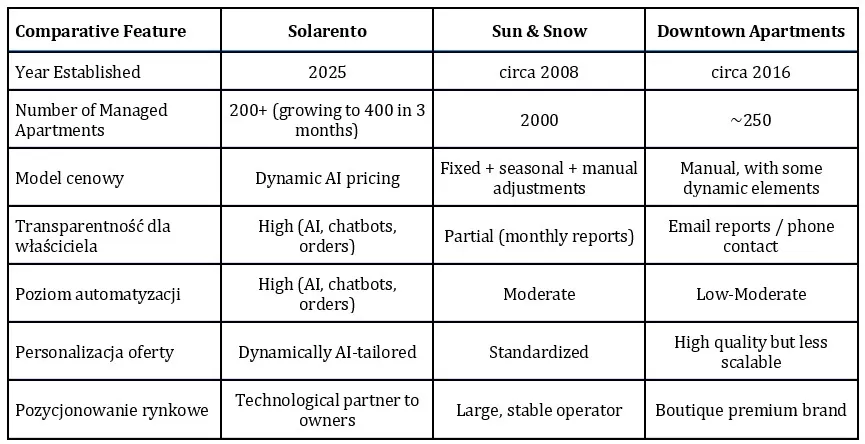
A more in-depth analysis compared Solarento’s model with two other Polish operators: Sun & Snow, the market leader by apartment volume, and Downtown Apartments, a premium brand focused on the Tri-City market. The comparison shows that despite its short market presence, Solarento competes effectively not by scale, but by technological advancement, transparency, and a partnership cooperation model. Unlike traditional operators, the company offers owners wider data access, greater flexibility, and better financial results with lower operational costs. Sun & Snow, despite its market position, does not provide full automation or real-time data access, which may be a barrier for modern investors. Downtown Apartments, despite high service quality, relies mainly on manual processes, limiting scalability and operational efficiency long-term.
Table 1: Comparative Overview of Short-Term Rental Operators: Solarento, Sun & Snow, and Downtown Apartments
Discussion
The Solarento case study and comparison with competing operators confirm that using artificial intelligence (AI) in short-term rentals can be a significant source of competitive advantage. The speed at which the young company scaled operations and improved results shows that technology, if implemented properly, can compensate for the lack of long-term market experience. The Solarento case reveals several key success factors for operators in this demanding market. Above all, AI was integrated into the company’s operations from the start, allowing the operational model to be designed with technology at its core, avoiding costly transformations of existing processes.
Transparency and openness towards apartment owners are also important factors; full access to data, forecasts, and AI-generated reports increase client trust and facilitate portfolio scaling. Operational automation reduces the need for manual repetitive tasks, cutting costs, minimizing errors, and enhancing guest service quality. A flexible cooperation model, in which owners retain independence and real control over results, offers an attractive alternative to rigid and often opaque guaranteed rental models. Compared to more established operators, Solarento demonstrates a higher level of adaptability and service personalization, which is especially important given changing investor and guest expectations.
At the same time, AI use in short-term rentals involves risks and limitations. Algorithm effectiveness heavily depends on input data quality; unforeseen events like lockdowns, sudden shocks, or random incidents may reduce prediction accuracy. Excessive automation may weaken guest or owner relationships if real human contact is missing. Questions of responsibility for AI-driven decisions arise—for example, when the system sets prices too low or fails to respond to market changes, resulting in lost revenue.
According to Fortech Consulting (2020), traditional operator models rely heavily on fixed costs and limited flexibility in responding to demand changes, leading to low efficiency in low-occupancy seasons. AI implementation can reduce costs and improve responsiveness to external conditions, though effectiveness depends on real-time data interpretation quality.
The costs of deploying and maintaining advanced AI systems, though potentially justifiable in the long term, constitute a significant entry barrier for smaller operators. Ethical issues also become increasingly relevant with automation and user profiling. AI systems may make financially justified decisions that raise concerns about fair treatment, data protection (GDPR), and transparency. Examples include dynamic price discrimination based on user history or restricting offer availability for less “profitable” guests.
Despite these challenges, apartment owners working with Solarento largely express positive opinions, appreciating higher reporting transparency, better financial results, and simplified communication and service processes. Guests particularly rate features like seamless booking and self-check-in, automatic reminders, clear stay rules, and technical support availability via app highly. The Solarento case demonstrates that responsible and thoughtful AI deployment balancing technology and human relations can be a source of sustainable competitive advantage and growth engine in the dynamic short-term rental market.
Ethical Challenges of AI Integration
Implementing artificial intelligence in the short-term rental industry brings not only tangible operational and financial benefits but also several ethical challenges that remain under-discussed in public and industry debates. While AI significantly improves management, efficiency, and decision accuracy, it is not a neutral tool; each algorithmic decision affects people, their experiences, and, in the rental context, property owners’ revenues and guest service quality. One key challenge is algorithmic transparency being able to explain how decisions regarding pricing, availability, and booking prioritization are made. Lack of insight into system functioning can lead to a sense of lost control for both apartment owners and end customers. If a user does not understand why a price changed suddenly or why their booking was rejected, trust and relationship with the operator may weaken. Against this backdrop, Solarento’s model stands out by offering full visibility into price changes and demand forecasts via the owner’s dashboard, reducing uncertainty and enabling informed responses. However, maintaining this level of transparency will become increasingly challenging as the business scales, requiring clear communication and user education.
Another issue is accountability for AI-driven decisions. Traditional models identify specific individuals or departments responsible for decisions, but, in algorithmic models, responsibility boundaries blur. If the system sets too low a price, blocks an attractive date, or fails to react dynamically to demand changes, who bears responsibility for lost profits? The lack of clear procedures in such cases can cause disputes and erode trust in the operator. Addressing these challenges requires implementing transparent AI operating principles, allowing manual overrides of algorithmic decisions, and regularly validating predictive model effectiveness.
Attention must also be paid to profiling ethics. Algorithms learning from booking data, ratings, and client behavior may unintentionally favor certain user groups. For example, the system might automatically raise prices for repeat users (price discrimination), prioritize guests with higher scoring, or restrict availability for less profitable profiles. While financially beneficial for the operator, such practices raise serious ethical and regulatory concerns (e.g., GDPR, equal treatment principles).
Finally, in hospitality, too much automation can reduce the human connection and emotional dimension that are central to service. Direct interaction, hospitality, and flexibility remain decisive competitive advantages for many guests. Therefore, hybrid models should be developed where AI supports rather than replaces humans. Investments in team training, ethical data management standards, and easy access to real human apartment managers can help maintain this balance and build sustainable, trust-based cooperation models.
Conclusion and Future Directions
The Solarento case analysis and comparison with Sun & Snow and Downtown Apartments show that artificial intelligence not only boosts operational efficiency but also redefines business models in the short-term rental sector. Despite a short market presence, Solarento effectively used AI as a tool to increase predictability, revenues, and owner satisfaction indicating high technology potential in hospitality.
Industry reports indicate that traditional condotel and short-term rental operators in Poland work under high operating cost shares (up to 30-35% of revenues) and limited flexibility in responding to demand changes. Meanwhile, AI implementation, as illustrated by Solarento, enables not only price optimization and better occupancy management, but also increased owner trust through data transparency. This suggests the need for further comparative research on cost efficiency and customer satisfaction in AI-based versus traditional models.
Applying algorithms for dynamic pricing, occupancy prediction, process automation, and transparent communication allows operators to achieve greater seasonality resilience, reduce vacancies, manage costs precisely, and improve service quality at relatively lower operational input. For property owners, this translates to more stable income, real-time performance monitoring, and partnership relationships based on data and trust.
However, AI implementation involves challenges that cannot be ignored. Dependence on input data quality, limited algorithmic decision transparency, and ethical issues related to automation and user profiling can impact client trust and operational effectiveness. Therefore, designing hybrid models combining AI potential with human care is crucial. Educating owners and guests about system functioning principles, implementing ethical data use standards, and creating transparent, auditable processes are essential.
Under growing competition, market volatility, and regulatory pressure, operators that integrate technology with flexibility and trust will gain advantage. Solarento, as a next-generation operator example, shows that such a model is both feasible and scalable in other European markets.
The findings extend existing literature by demonstrating that AI adoption not only improves operational metrics but also reshapes governance and cooperation models between property owners and operators, introducing a new paradigm of data-driven partnership management.
Future research directions include comparative financial performance analysis of AI versus non-AI operators over longer horizons (at least 24 months), quantitative studies on owner trust in AI systems and its impact on cooperation duration and quality, and deeper understanding of AI’s influence on customer experience, both functional and emotional. Analyses of local regulation impacts on algorithmic model effectiveness and development of explainable AI (XAI) tools that not only make decisions but also explain their logic to owners and guests are also necessary. Only such an approach can guarantee sustainable technological development in this rapidly evolving industry.
literature
Anand, A. (2020) „Artificial Intelligence for Managers”. New Delhi: BPB.
Emmerson Evaluation (2022) „Rynek hoteli oraz condohoteli w Polsce”. Available at: https://www.emmerson-evaluation.pl/wp-content/uploads/2022/08/raport-rynek-hoteli-oraz-condohoteli-w-polsce-2022.pdf (Accessed: 5 January 2026).
Filimonau, V. (2021) „Artificial Intelligence in Tourism, Hospitality and Events”. Bingley: Emerald.
Fortech Consulting (2020) „Condo/Aparthotele – struktura i opłacalność”. Available at: https://fortech-consulting.pl/wp-content/uploads/2020/10/condo.pdf (Accessed: 5 January 2026).
Hayes, D.K. and Miller, A.A. (2021) „Revenue Management for the Hospitality Industry”. Hoboken: Wiley.
Inwestycje w Kurortach (2023) „Ceny transakcyjne mieszkań w miastach turystycznych”. Available at: https://inwestycjewkurortach.pl/raporty-i-trendy,raport-ceny-transakcyjne-mieszkan-w-miastach-turystycznych-od-116-do-156-tys-za-m2 (Accessed: 5 January 2026).
Kumar, R. (2017) „Machine Learning and Cognition in Enterprises”. New York: Apress.
Marcinkowska, E. (2021) „Proces przygotowywania e-sprawozdań finansowych”. Kraków: Uniwersytet Jagielloński.
Phillips, R. (2020) „Pricing and Revenue Optimization”. Stanford: Stanford University Press.
Przegalińska, A. and Jemielniak, D. (2021) „AI w strategii”. Warszawa: MT Biznes.
Raport Solarento (2025) “Dane wewnętrzne i publikacje operacyjne”. [Internal documentation].
Sengupta, B. and Parker, R. (2023) „The AI Value Playbook”. Hoboken: Wiley.
Solarento (2025) „Raport Lato 2025”. Available at: https://www.linkedin.com/posts/solarento_raport-lato-2025-oczami-solarento-activity-7375088523399491584-6p03 (Accessed: 5 January 2026).
Szpringer, W. (2022) „Sztuczna inteligencja w zarządzaniu”. Warszawa: C.H. Beck.
Wach, W. (2023) „Model analizy predykcyjnej w zarządzaniu portfelem projektów inwestycyjnych”. Wrocław: Uniwersytet Ekonomiczny we Wrocławiu.
Warszawska Organizacja Turystyczna (2018) „Aparthotele i condohotele w miastach”. Available at: https://wot.waw.pl/wp-content/uploads/2019/04/raport_aparthotele_miasta_20181210.pdf (Accessed: 5 January 2026).
Williams, L. and Conley, A. (2022) „Tech-Enabled Hospitality”. London: Taylor & Francis.