Bucharest University of Economic Studies, Bucharest, Romania
Volume 2026,
Article ID 738518,
Journal of e-Learning and Higher Education,
8 pages,
DOI: doi.org/10.5171/2026.738518
Received date: 10 June 2026; Accepted date: 1 September 2026; Published date: 28 September 2026
Academic Editor: Irina Severin
Cite this Article as:
Dragoș DANȚIȘ (2026)," The Scientific Article Review Process in Higher Education: Perspectives and Practices", Communications of the IBIMA, Vol. 2026 (2026), Article ID 738518, https://doi.org/10.5171/2026.738518
The incentive for the creation of this paper has been the aspiration of the writer to present their own experience in the field of scientific article reviewing process. This activity, typically, is associated with higher education or professional roles, once a PhD. is being completed. Performing the evaluation of an article before publication, in a scientific journal of conference proceedings, represents a different type of work and contributes to the development of specific skills. Originality of this paper is provided by the motivation of the author to use the experience gained to cover the existing knowledge gap among the students. Being involved in the reviewing process allows PhD. candidates to enhance their academic abilities and approach the study in a constructive and proactive manner.
The research questions will offer the readers the opportunity to identify the core parts of the article for an effective understanding of the content. Methodology is being founded on the assessment of several research papers and on the characteristics identified by the author, while performing review for various scientific events. Students interested and involved in this type of activity will have practical messages and guidelines to integrate in their work. As a general statement, the review process represents a challenge and an opportunity to improve academic skills. It is an activity that provides a new meaning to the higher education and offers the reviewer student a new perspective. In practice, this translates in the support towards colleagues in their learning journey.
This work will have as theme the characteristics associated with the reviewing process as it has been understood lately by the author. Even though it cannot be classified as a professional continuous activity, the writer would like to indicate their own perspectives towards such an occupation and skills that may be developed.
What has to be addressed from the beginning is the novelty of the reviewing process for a PhD. student. It represents a different activity to the ones a scholar may be accustomed with. First of all, it is the impact while facing a first request to review a scientific article and the question mark regarding the level of inner trust in performing such an assignment. Beyond the novelty level, participating in article evaluation is a challenging role, as it requires better understanding of the structuring of a work, the way information should be present, sources should be verified, general message and research objectives should be evaluated. During the PhD. programme at the Bucharest University of Economic Studies, the author has received several requests to evaluate scientific papers submitted at international symposiums by other students or researchers. These have been the reasons that generated the first question on the subject: “How many research articles are published worldwide?”
Performing an interrogation via open sources data, on the website OurWorldinData.org have been identified two graphical representations (National Science Foundation Science and Engineering Indicators, via World Bank (2026); United Nations Population Division, national statistical offices, and Eurostat, via World Bank (2026) – processed by Our World in Data):
The first one shows the annual articles published in scientific and technical journals, 2022, including disciplines, such as: physics, biology, chemistry, mathematics, clinical medicine, biomedical research, engineering and technology, earth and space sciences.
The second, associates to the previous described perimeter, a yearly trend from 1996 to 2022.
Analysing the two figures on the website OurWorldinData.org (2026), it is shown clearly the increasing trend in the number of scientific articles published, reaching values of several million papers per year, even though the question may remain open for further assessment, to investigate if these numbers include all the existing indexing libraries and all categories of papers, such as: preprints, reviews, conference papers.
These considerations may be supported by a report from UNESCO (2021) that is indicating the following points:
In 2018, there were 8.854 million (full-time equivalent) researchers in the world, increasing from a value of 7.790 million in 2014.
Globally, there has been a yearly increase of 21%, between 2015 and 2019, in scientific publications’ results.
The collaboration between authors in various countries is expanding.
Putting together all this information can be understood the increased level of infrastructure required, to sustain quantitatively and qualitatively the reviewing and publication of millions of articles every year.
Literature Review
Research literature is quite rich and is dedicating lots of attention to this subject, as the reviewing process is seen as a core activity of the academic environment and science advancement. One of the first opinions encountered mentions the requirement to have good quality peer reviews and indicates several recommendations for researchers at the beginning of their activity (Forero, Glatt and Oermann, 2025).
Canova-Barrios and Berduc (2025) associate to the scientific communication several skills of the reviewers, such as: integrity, preparation and ethical attitude. Napolitani, Petrini and Garattini (2017) indicate the changing realities of the reviewing process, discuss the conduct of reviewers and selection committee. First of all, the ethics principles associated to the review have to be strengthened: competence, conflict of interests, transparency and integrity.
Cengher and LeBlanc (2024) highlight that teaching students how to perform as reviewers requires further development. Their study analyses the review process and offers guidelines to perform such an activity. Halder, Tyrer and Casey (2021) start in the same way their content, by addressing the definition of reviewing and heading towards the motivation for such an activity, review data and supporting information.
Sucato and Holland-Hall (2018) in their paper reiterate the same ideas presented by other authors: the importance of peer-review, the absence of classes in the field and offering of provision on realising such an activity. Kurdi (2015) focuses on the reviewing of the publishing in the medical research and on the present limits, analysing the process behind.
Bagchi et al. (2017) provide the motivation for dedicating effort to reviewing process, how to do it and how to communicate. Bharti et al. highlight in their paper from 2022 the importance of peer review and the need to identify constructive feedbacks that enhance the quality of delivered articles. The principles behind peer review, the significance, and the motivation to enrol in such a journey are evaluated by Koshy et al. in their article published in 2018.
Bonavia and Marin-Garcia (2023) raise the attention on a new concept, the “noise level in the peer review process”. This notion is seen as the variability present in the evaluations of different reviewers on the same theme. This article advances some actions that journals can construct to upgrade their peer review process.
Moirano et al. (2024) reaffirm the significance of the peer review for the scientific environment, bringing benefits, presenting in the same time some questions. To understand better the theme, a survey questionnaire has been distributed to over 500 healthcare professionals. After the results have been generated, it has been observed that the peer review is needed for the scientific work, even though it is not perfect, and discussions should continue on the subject inside the scientific community.
Stracke and Bayer (2013) associate to the perimeter of peer review several notions like: open access, open research, Internet and platforms. They present the evolution of digital and technology that has impacted the scholarly research, communication and publication, leading to improved times. The authors include in their article the Scholarly Lifecycle Framework, analysing the subject from a business process modelling perspective. Fritz and Gloning have in the centre of their analysis the digital communication that allows faster messaging, interaction and publication. This work from 2012 evaluates the attributes linked to this kind of communication.
Saad et al. (2024) indicate in their study that the rising number of papers to be reviewed in time and with qualitative feedback puts pressure on the reviewers and they may decide to re-evaluate their participation in such activity. The authors proposed as solution the use of an AI chatbot to perform the same actions as a human assessor. A practical case took place; a number of articles have been reviewed, using both human intervention and AI chatbots and the results have been compared in terms of quality and final decision. The conclusion of the article indicated that AI chatbots can supplement regular review and improve some steps of the editorial process; nevertheless, it is not recommended to have fully automated AI evaluation.
The last paper mentioned in the Literature Review closes the circle with an innovative feature of the research, the Generative Artificial Intelligence. Cuaya-Simbro and Ruiz (2025) investigate a platform using such characteristic, to develop the reviewing process, automating specific actions and highlighting areas that need upgrading.
It can be noticed that the reviewing process is evaluated quite extensively in the literature and has many concepts associated. It distinguishes itself as a dynamic reality, with various characteristics that influence the publication and the advancement of academic research. There are many authors that highlight the need of training and development of skills for researchers covering such roles. Technical abilities, communication, and innovation support the fulfilment of the process.
Research Questions
The research questions take into account the scenario of students or young researchers being at the start of their experience as reviewers. The following open points have been deliberated for the current paper:
RQ1: What should be considered by a reviewer, in a first instance, while evaluating an article?
RQ2: What are the technical aspects to be approached, in order to provide a constructive review?
RQ3: Which are the skills that should be developed to fulfil the role of reviewer?
Methodology
Several articles have been assessed, all of them mentioned in the Literature Review section.
Most of the information present in Results and Discussions section has been shaped having as motivation the research and professional activities performed as reviewer in international scientific events. Clearly, there are limitations in terms of number of papers reviewed, which may impact on the output of the evaluation, even though useful guidelines will be identified in these pages for the students involved in reviewer roles and activities.
Results and Discussions
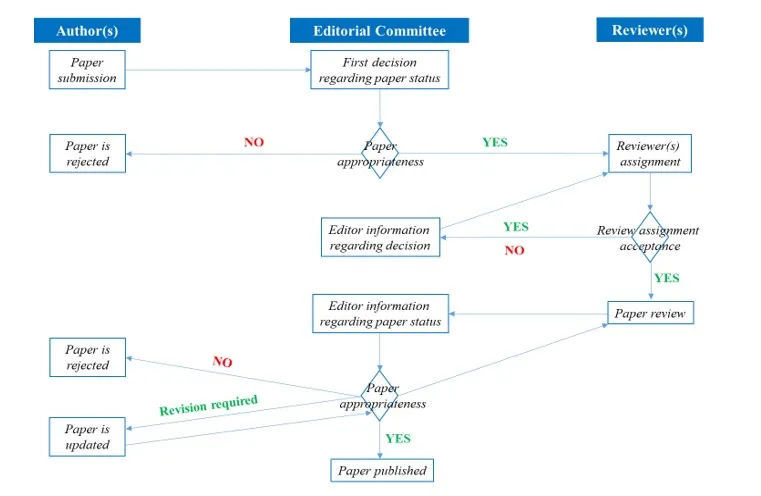
The scientific articles’ reviewing process has been represented in Figure 1 having as inspiration the following sources:
feedback received and communication done by the author, performing as a writer, with various editorial teams, while submitting articles towards scientific journals or conferences for review and publication;
feedback delivered by the author, performing as a reviewer, towards editorial committees, containing opinions regarding the status of research papers evaluated.
Fig 1. Scientific Article Reviewing Process
Source: Created by author based on own experience
For RQ1, a reviewer could address the following areas, while receiving the invitation to evaluate an article for publication. In the beginning, attention should be paid to the title and the abstract of the paper, as these elements should provide first information regarding the content. These support the evaluator in understanding if he has enough technical competency to offer constructive feedback on the theme. Contemporarily, another check should be done to see the names of the authors (if present), and, in case of conflicts of interest, the reviewer should inform the editor that he will decline the review and propose, if possible, other colleagues to perform the task. Refusal to evaluate a paper, in case of conflicts of interest, should be viewed as a strong point regarding the ethics and transparency principles and should strengthen the collaboration between the editor and the reviewer for future projects.
After this, the reviewer should have a look at the keywords and JEL codes to see if there is congruency with the title and the abstract.
Introduction should be read to see the motivation of the researcher in addressing such a theme and obtain more information regarding the direction of the research.
Furthermore, the reviewer can read once or twice the paper entirely, to understand the granularity of the information, the technical complexity level and the general quality of the content. The assessor should observe the time period required to perform the task and should consider if he is familiarised with the technical content and if he can conclude the activity within the required deadline. If the evaluator understands that he cannot finish the reviewing process in the indicated timeline, he should decline the invitation, inform the editor or organizing committee and recommend, if possible, another professional for the task.
The reviewer should try to understand if there are areas of information generated with AI, mentioning AI use and comparing it with the methodological requirements of the conference and/or scientific journal and, if needed, informing the editor.
One important part of the detailed assessment would be to be familiarised with the reviewing template, to be able to structure effectively the answer. This part contributes to the realization of constructive feedback towards the journal and the author(s) being included in the RQ2 perimeter.
Communication channel is important as well if the answer should be provided in a template document via email or through a specialized research platform. This is influencing the representation of the information inside the template and the possibilities of personalizing the feedback with technical details or specific recommendations. In case of a technical platform, the reviewer should take into consideration possible errors or technical malfunctions that could limit the fulfilment of the evaluation and delivery in due time.
In the perimeter of RQ2 for the creation of constructive feedback, the assessor should go into the details of Research Questions, of the Methodological framework and of the content of the Results and Discussions sections. The research questions should be meaningful and should shape the directions of the research inside the paper. The methodological framework should be well constructed and proper tools should be chosen to allow content creation and sustain information representation. The methodology section can be used by authors to announce limitations in their research given by the availability of sources.
Another attention point is linked to the foundations and their citation style inside the text and in the References section. The reviewer should verify the compliance with the citation style and that all sources of information are included in the text and in the References section and to make recommendations towards the author(s), if needed. Contemporarily, the significance of the mentioned sources should be evaluated and further recommendations could be advanced to increase the quality of the paper evaluated.
The Results and Discussions section should be appraised with increased level of attention to find gap analysis or content misalignment with Introduction, Literature Review, Research Questions and Methodology. The reviewer can have an increased understanding of the analytical skills of the author(s) assessing the work in this section. The results’ presentation should be fluent and should support the general objective of the paper and even announce in a brief way the Conclusions. If the reviewer identifies data representation or graphics, where content is not clear, he may ask for the files used for data calculation.
While analysing the Conclusions of a paper, the reviewer should keep in mind the objectives of the research, and scenarios resulted after the analysis and the statements mentioned in this final section. The end of the article should be characterised by the harmony of the message and the logical flow of the information. The reviewer should try to recognise if the author(s) consider(s) further development of their scientific effort, linking the theme of the evaluated paper with future works.
The constructive feedback of the reviewer should include various recommendations based on the quality of the paper and the proposal regarding publication status towards the editor:
general endorsement on the research effort and how the author(s) was(were) involved in the representation of the work;
if particular sections of the article require improvements or if there should be written better the links between the sections to assure the fluency of the content;
if specific graphs, tables, or methodological representation need update;
if certain sources are missing or are cited in an improper way in the text or in the references;
opinion on the novelty of the subject;
if the paper contains a good theoretical model, suggest to the author(s) the recommendation to verify the results in a practical proof of concept;
propose to the authors to enlarge the scope of their theme in future papers.
It can be seen that the evaluation of a scientific paper before publication requires involvement from the reviewer and consideration of various research dimensions. The last part of this section mentions the skills a reviewer should have or develop, answering to RQ3.
A professional, covering the role of an evaluator, should have a good level of English to be able to understand the general content of the paper and the technical terms, if it is a paper in a specialised sector.
The reviewer should be responsible for his decision to assess or not a specific paper, taking into consideration possible conflicts of interest, limitations in understanding the theme of the research or time constraints.
There should be present a continuous interest in the field of activity in research and keeping up to date with the practical or theoretical changes. An attitude focused on development and continuous learning supports the reviewing process in a qualitative analysis oriented towards constructive feedback.
The analytical ability of the reviewer is essential in understanding the evaluated papers’ content, methodology used and the way the results have been represented by the various authors. The reviewer can develop this capability by being in a first instance an author, by writing various articles and submitting them to conferences or journals for evaluation. In this way, the reviewer will be part of a continuous learning cycle, familiarising with research methods, critical thinking and analytical framework construction.
The reviewer should have good technical skills to address in a suitable manner the different digital platforms or use the feedback collection templates. One possible starting point would be to create research profiles on dedicated platforms, where to read comments or articles on the use of digital tools.
Communication should be a core skill of the reviewer in their response towards the editorial board of a journal or a conference. This should be seen in the general reviewing process, in specific messages and in the feedback provided to the author(s).
Conclusions
The reviewing process represents an important area in the portfolio of academic and research activities. This can be understood as a main idea highlighted in many of the studies on the theme (mentioned in the Literature Review section).
Performing such an activity requires a good level of understanding of the subject and to continue to specialise in various fields of research. It can be an activity that may require an increased level of involvement, depending on the complexity of the study and on the examination maturity of the reviewer.
Furthermore, Coxhead et al. (2023) indicate that a possible solution to developing reviewer skills would be to involve students in editorial boards and to provide mentoring, while performing evaluation activities. This can be seen as an interesting proposal to increase the number of specialised profiles that could contribute to the effort associated to scientific articles’ reviewing process. Current statement takes into account the information presented in the Introduction section of this paper, having as sources OurWorldinData.org and UNESCO study.
One attention point for the reviewing process will be the development of Artificial Intelligence and how various characteristics of this technology will be integrated and implemented, having as control key the ethics and academic integrity.
What can be mentioned as a conclusion is the fact that there is no specific formula for the review of a paper. Information present in the Results and Discussions section of the current work has its limitation depending upon the number of reviewed papers. Nevertheless, it is an activity that has a professional and personal value for the people performing such a role. It is an activity the author would like to continue to develop and to provide an update in several years, after obtaining more experience in the field. This should not only include additional operational guidelines, but also provide an evaluation of the technical developments at strategic level for the reviewing process.
References
Bagchi, R., Block, L., Hamilton, R.W. and Ozanne, J.L. (2017), ‘A Field Guide for the Review Process: Writing and Responding to Peer Reviews’, JOURNAL OF CONSUMER RESEARCH, 43 (5), 860-872, https://doi.org/10.1093/jcr/ucw066.
Bharti, P.K., Ghosal, T., Agarwal, M. and Ekbal, A. (2022), ‘BetterPR: A Dataset for Estimating the Constructiveness of Peer Review Comments’, LINKING THEORY AND PRACTICE OF DIGITAL LIBRARIES (TPDL 2022), 13541, 500-505, https://doi.org/10.1007/978-3-031-16802-4_53.
Bonavia, T. and Marin-Garcia, J.A. (2023), ‘A noise audit of the peer review of a scientific article: a WPOM journal case study’, WPOM-WORKING PAPERS ON OPERATIONS MANAGEMENT, 14 (2), 137-166, https://doi.org/10.4995/wpom.19631.
Canova-Barrios, C.J. and Berduc, A. (2025), ‘Dear reviewer 2 …: A brief guide to reviewing scientific manuscripts’, SPANISH JOURNAL OF MEDICAL EDUCATION, 6 (4), https://doi.org/10.6018/edumed.678451.
Cengher, M. and LeBlanc, L.A. (2024), ‘Reviewing manuscripts for behavior-analytic journals: A primer’, JOURNAL OF APPLIED BEHAVIOR ANALYSIS, 57 (1), 71-85, https://doi.org/10.1002/jaba.1034.
Coxhead, A., Batchelor, J., Mushi, O., Qiu, XX. and Hyon, S. (2023), ‘Becoming a reviewer: Insights from the student and editorial boards of ESPJ’, ENGLISH FOR SPECIFIC PURPOSES, 72, 20-25, https://doi.org/10.1016/j.esp.2023.06.003.
Cuaya-Simbro, G. and Ruíz, S.D.D. (2025), ‘Scientific article review platform using generative artificial intelligence to streamline the peer review process’, INTERNATIONAL JOURNAL OF ASSESSMENT TOOLS IN EDUCATION, 12 (4), 983-994, https://doi.org/10.21449/ijate.1589451
Forero, D.A., Glatt, S.J. and Oermann M.H. (2025), ‘Reviewing manuscripts for scientific journals: recommendations for early career scientists’, BMC RESEARCH NOTES, 18 (1), https://doi.org/10.1186/s13104-024-07060-8.
Fritz, G. and Gloning, T. (2012), ‘Critique and controversy in digital scientific communication New formats and their affordances’, EXPLORING ARGUMENTATIVE CONTEXTS, 4, 213-231.
Halder, N. Tyrer, P. and Casey, P. (2021), ‘Peer reviewing made easier: your questions answered’, BJPSYCH ADVANCES, 27 (4), 255-262, https://doi.org/10.1192/bja.2020.62.
Koshy, K., Fowler, A.J., Gundogan, B. and Agha, R.A. (2018), ‘Peer review in scholarly publishing part A: why do it?’, INTERNATIONAL JOURNAL OF SURGERY-ONCOLOGY, 3 (2), https://doi.org/10.1097/IJ9.0000000000000056.
Kurdi, M.S. (2015), ‘Scholarly peer reviewing’: The art, its joys and woes’, INDIAN JOURNAL OF ANAESTHESIA, 59 (8), 465-470, https://doi.org/10.4103/0019-5049.162981.
Our World In Data. ‘Annual articles published in scientific and technical journals per million people’, part of the following publication: Hannah Ritchie, Edouard Mathieu, and Max Roser (2023) – ‘Research and Development’. Data adapted from National Science Foundation Science and Engineering Indicators, via World Bank, United Nations Population Division, national statistical offices, and Eurostat, via World Bank. Retrieved May 2, 2026 from https://archive.ourworldindata.org/20260417-112857/grapher/scientific-publications-per-million.html [online resource] (archived on April 17, 2026).
Moirano, G., Listorti, E., Asta, F., Macciotta, A., Murtas, R., Ottone, M., Petri, D. and Renzi, M. (2024), ‘The peer-review process: critical issues and challenges from an online survey’, EPIDEMIOLOGIA & PREVENZIONE, 48 (2), https://doi.org/10.19191/EP24.2.A622.042.
Napolitani, F., Petrini, C. and Garattini, S. (2017), ‘Ethics of reviewing scientific publications’, EUROPEAN JOURNAL OF INTERNAL MEDICINE, 40, 22-25, https://doi.org/10.1016/j.ejim.2016.12.011.
National Science Foundation Science and Engineering Indicators, via World Bank (2026) – processed by Our World in Data. ‘Annual articles published in scientific and technical journals’ [dataset]. National Science Foundation Science and Engineering Indicators, via World Bank, ‘World Development Indicators 125’ [original data]. Retrieved May 2, 2026 from https://archive.ourworldindata.org/20260417-112857/grapher/scientific-and-technical-journal-articles.html (archived on April 17, 2026).
Saad, A., Jenko, N., Ariyaratne, S., Birch, N., Iyengar, K.P., Davies, A.M., Vaishya, R. and Botchub, R. (2024), ‘Exploring the potential of ChatGPT in the peer review process: An observational study’, DIABETES & METABOLIC SYNDROME-CLINICAL RESEARCH & REVIEWS, 18 (2), https://doi.org/10.1016/j.dsx.2024.102946.
Stracke, C.M. and Beyer, J. (2013), ‘QUO VADIS PEER REVIEW? THE SCHOLARLY LIFECYCLE FRAMEWORK, CURRENT REVIEW PROCESSES FOR SCHOLARLY AND SCIENTIFIC LITERATURE AND PUBLICATIONS, OPEN ACCESS, AND ALTERNATIVE PEER REVIEW METHODOLOGIES. 6TH INTERNATIONAL CONFERENCE OF EDUCATION, RESEARCH AND INNOVATION (ICERI 2013), 1702–1713.
Sucato, G.S. and Holland-Hall, C. (2018), ‘Reviewing Manuscripts: A Systematic Approach’, JOURNAL OF PEDIATRIC AND ADOLESCENT GYNECOLOGY, 31 (5), 441-445, https://doi.org/10.1016/j.jpag.2018.06.005.
(2021), UNESCO Science Report: the Race Against Time for Smarter Development. Schneegans, S., Straza, T. and Lewis, J. (eds). UNESCO Publishing: Paris.