1RISEBA University of Applied Sciences, Riga, Latvia
2Graceland University, Lamoni, Iowa, USA
Volume 2026,
Article ID 132473,
Journal of Marketing Research and Case Studies,
13 pages,
DOI: doi.org/10.5171/2026.132473
Received date: 12 June 2026; Accepted date: 20 July 2026; Published date: 9 September 2026
Cite this Article as:
Ioseb GABELAIA and Samuel STEINER (2026), “Balancing Customer Effort and Communication Outcomes in Chatbot and Human-Agent Customer Interactions: A Quantitative Study", Journal of Marketing Research and Case Studies, Vol. 2026 (2026), Article ID 132473, DOI: https://doi.org/10.5171/2026.132473
In digital era, organizations continue to face a significant dilemma between the efficiency of automation and the quality of human-centered service. Existing literature has extensively studied chatbot adoption, customer satisfaction, and technology acceptance; yet, there is limited empirical evidence on the balance between customer effort and communication outcomes in chatbot versus human-agent interactions. This research aimed to address this gap by exploring the extent to which chatbots, compared with human agents, provide a more effective balance between customer effort and communication outcomes. Four hypotheses were developed and tested using a quantitative research design. Data were collected through an online survey administered via Qualtrics, yielding 291 valid responses. SPSS version 30 was used to conduct descriptive and inferential statistical analyses. Additionally, this research was grounded in the Technology Acceptance Model (TAM). The results revealed that chatbot interactions were perceived as more effective for low-complexity, transactional service tasks because they reduced response times and increased convenience. In contrast, human-agent interactions yielded stronger outcomes in high-complexity and emotionally sensitive contexts, especially regarding trust, reassurance, and perceived resolution quality. The results further suggest that hybrid chatbot–human service models may provide the strongest effort–outcome balance by combining the efficiency of automation with human empathy and deeper problem-solving capabilities.
Keywords: Chatbots, Communication, Artificial intelligence, Algorithmic Communication, Human-Agent, AI Marketing.
Introduction
Continuous growth of digital ecosystems continues to transform how organizations communicate with consumers. As AI chatbots shift from tools to companions, critical questions arise: who controls the conversation in human–AI chatrooms? (Yun et al., 2026; Gabelaia, 2025). AI-driven chatbots are adopted in customer service while offering automated responses, real-time assistance, and scalable communication support. Chatbots or virtual voice assistants are already part of many people’s everyday experience (Carli et al., 2024). This allows organizations to reduce operational costs and accelerate response times. Eventually, chatbots have developed into a strategic tool for service automation. However, the increasing reliance on algorithmic communication also poses an important managerial and academic dilemma, raising the question of whether automated chatbot interaction can achieve communication outcomes comparable to, or better than, human-agent interaction while simultaneously reducing customer effort.
These days, customer communication is not only about service availability but also about emotional relevance, quality, trustworthiness, and the efficiency of the interaction. Humanness is paramount in human-chatbot conversations because it may profoundly impact the quality of the interaction (Rapp et al., 2024). Therefore, customer effort has become a critical dimension of service experience. While chatbot systems may decrease effort for routine, low-complexity service tasks by delivering immediate answers and simplified navigation, they may be less effective in situations that require empathy, contextual judgment, reassurance, or complex problem-solving (Carli et al., 2024; De Cicco, 2024). Thus, the relationship between service automation and communication quality remains, both theoretically and practically, under-examined. Moreover, current literature extensively studied chatbot adoption, customer satisfaction, service technology acceptance, and the role of digital tools in improving the customer experience. Notably, studies reveal that perceived usefulness and perceived ease of use impact consumer acceptance of service technologies. However, there are limited results regarding the balance between customer effort and communication outcomes when comparing chatbot-based service encounters with human-agent interactions.
The aim of this research was to explore the extent to which chatbots, compared with human interaction, provide a more effective balance between customer effort and communication outcomes. This situation is essential in today’s service ecosystem, where organizations increasingly adopt automation without fully understanding when chatbot interaction is applicable and appropriate, when human intervention is necessary, and how hybrid service models can optimize customer experience. The following four hypotheses were developed to test the relationships between chatbot interaction, human-agent interaction, customer effort, and communication outcomes.
H Customer interactions with chatbots will be perceived as requiring lower effort (time, convenience, cognitive demand) compared to interactions with human agents.
H2. Customer interactions with human agents will yield higher outcome satisfaction (resolution quality, trust, emotional reassurance) compared to interactions with chatbots.
H3. The overall balance between effort and outcome will differ depending on the context, such for low-complexity, transactional tasks, chatbots will provide a better balance. While, for high-complexity, emotionally charged tasks, human agents will provide a better balance.
H Hybrid models (where chatbots handle initial effort-heavy tasks before escalation to humans) will outperform both stand-alone chatbots and stand-alone human interactions in achieving an optimal effort–outcome balance.
To explore this research problem, the authors conducted a survey study. The survey was administered via Qualtrics, and the data were analyzed using SPSS 30. Moreover, the authors calculated the descriptive and inferential statistics. Furthermore, this research was grounded in the TAM framework to explore how consumers assess AI-driven chatbot communication relative to human-agent interaction. This research shows the value of hybrid chatbot–human service models, which integrate the efficiency of automation with the empathy and interpretive capacity of human agents. The results contribute to the literature on human-computer interaction, service communication, and technology acceptance.
Literature Review
Using artificial intelligence technologies in customer service through chatbots is revolutionizing companies’ commercial practices and business models (Gomes et al., 2025; Zhou et al., 2023). In today’s world, customer communication has shifted from human interactions to more automated conversations with chatbots or AI tools (Følstad & Brandtzæg, 2017). Chatbots are software agents that can interact with customers through natural language and are often used in customer service, e-commerce, banking, tourism, retail, and other digital services (Karri et al., 2025). This form of communication is increasingly used to reduce service costs, shorten response times, and ensure continuous availability for an organization (Waladi et al., 2024). Følstad and Brandtzaeg (2017) argue that chatbots represent an important development in human-computer interaction because they shift digital interaction away from graphical interfaces toward conversational ones.
The increasing relevance of chatbots is also tied to customer expectations; they increasingly value speed and convenience (Karri et al., 2025). The combination of chatbots with live chat support from human agents creates a new type of man-machine coordination problem (Vassilakopoulou & Pappas, 2022). Moreover, Følstad and Brandtzaeg (2017) argued that users often enjoy chatbots because they are way more productive, provide quick information, and reduce the effort for routine tasks. This makes chatbots extremely useful for low-complexity service interactions such as order tracking, account updates, appointment scheduling, and frequently asked questions (Zhou et al., 2023; Adam et al., 2021). However, customer interaction is not only transactional (Gomes et al., 2025; Waladi et al., 2024). Customer service often involves emotional, rational, and trust-based conversations, especially when customers face uncertainty, complaints, financial issues, or challenging problems (Chukkala, 2025).
The literature suggests that AI-based service agents should not replace human employees but should be comparable and support each other to deliver customer service as fast and as high-quality as possible (Karri et al., 2025). According to Huang et al. (2024), AI is reshaping service tasks across different forms of intelligence, including mechanical, intuitive, analytical, and empathetic intelligence. The strong suit of AI is structure, while human agents remain very important for empathy and judgment (Huang & Rust, 2018; Wirtz et al., 2018; Gomes et al., 2025). The comparison between human agents and chatbots is important because customers do this all the time based on their experience with both forms of communication over the last few years (Rapp et al., 2024; Zhou et al., 2023). Moreover, according to Huang et al. (2024), chatbots are performing well in customer service, but building trust remains a challenge.
The Technology Acceptance Model is one of the most widely used frameworks for explaining how customers accept new technologies. According to Davis (1968), users are more likely to use and accept technology when it is useful and easy to use (Ashfaq et al., 2020). In chatbot research, perceived usefulness refers to an AI or chatbot helping users solve their problems (Venkatesh & Davis, 2000). This helps organizations to study customer communication and acceptance of it (Venkatesh & Davis, 2000).
Recent studies on chatbots have adapted TAM to include trust, satisfaction, perceived intelligence, enjoyment, social presence, and continuance intention (Venkatesh & Davis, 2000). For example, Ashfaq et al. (2020) developed a model combining the Expectation-Confirmation model, the Information Success model, and TAM. They tried to determine how satisfied users were with talking to an AI agent rather than a human agent (Ashfaq et al., 2020). Other studies show that customers are positive about using chatbots in online shopping because chatbots can build trust, feel suitable for their needs, and make the experience more enjoyable (De Cicco et al., 2022). All these studies show that TAM is a model organizations can trust, as it provides a clear overview of how customers accept new technology (Alboqami, 2023).
Hybrid service models combine the best of both worlds: the efficiency of chatbots with human support in specific situations (Pandey et al., 2026; Yu et al., 2024). Chatbots can handle simple, repetitive tasks, while human agents step in for emotional, complex, or unresolved issues (Song et al., 2025). According to Jiang et al. (2023), hybrid models pose different challenges because customers’ perceptions can change depending on whether they know humans are involved. This means, as mentioned above, we must be transparent and communicate clearly with users to build trust in hybrid service systems (Pandey et al., 2026). A good hybrid model can reduce effort when teamwork between the chatbot and the human agent is smooth (Vassilakopoulou & Pappas, 2022). However, if the customer needs to repeat himself or struggles to reach a human agent, effort increases; thus, we need to ensure they work well together to satisfy our customers and earn their trust (Markovitch et al., 2024; Martijn et al., 2026).
Powered by artificial intelligence (AI), chatbots are increasingly capable of simulating human-like conversations (Sun et al., 2024). Customer effort is a key factor in service research (Khan et al., 2025). Dixon et al. (2010) developed the Customer Effort Score and argued that reducing customers’ effort can be a stronger predictor of loyalty than exceptional service. Moreover, this is highly relevant for chatbot conversations because they reduce effort and are 24/7 available to customers (Dixon et al., 2010; George & Edward, 2025). Moreover, chatbots can reduce user effort by providing fast answers and handling simple tasks efficiently (Asokan-Ajitha & Sengupta, 2026). On the other hand, it can also increase effort when the customer must repeat his question or problem because he doesn’t get the answer he is looking for, or when he struggles to reach a human agent for an emotional issue (Sun et al., 2024). Therefore, this study views customer effort as more than just timesaving. It also includes convenience, clarity, emotional strain, and cognitive demand (Følstad & Taylor, 2021; Söderlund & Mårtensson, 2025).
Chen et al. (2023) argue that the quality of AI agents can influence customer loyalty through satisfaction, which makes sense: if a customer is satisfied, they are more likely to come back. On the other hand, when efficiency is achieved at the expense of emotional support or problem-solving, customer experience may weaken (Singh & Singh, 2024; Ng & Zhang, 2025). It is also important to be transparent: you must ask your customer whether they are interacting with a chatbot or a human beforehand, because transparency also builds trust, especially when the service encounter is sensitive or complex (Ltifi, 2023). But we must also note that social presence is not everything; the chatbot still needs to be able to solve the customer’s problem (Al-Oraini, 2025). Therefore, chatbot and human-agent communication are not the same thing and won’t replace each other; they must work together to create the best experience for the customer (Vassilakopoulou & Pappas, 2022).
Research Methodology
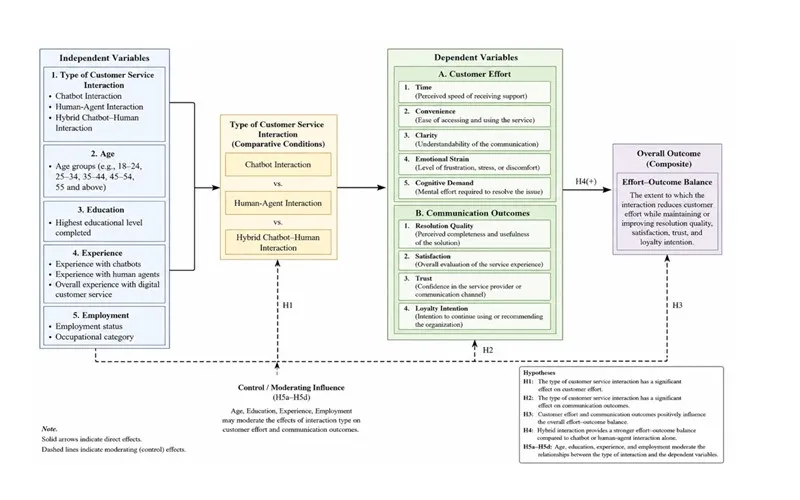
To explore customer perceptions of AI-driven chatbot communication in comparison with human-agent interaction, the authors used a quantitative research method. This approach was valid to measure the extent to which chatbots provide a more effective balance between customer effort and communication outcomes. The intent was to identify measurable patterns, differences, and relationships among effort-related and outcome-related constructs in customer service interactions. The research model is shown in figure 1.
The research design permitted the authors to statistically compare perceptions of chatbot-mediated communication and human-agent communication across multiple dimensions, including time efficiency, convenience, clarity, emotional strain, cognitive demand, resolution quality, satisfaction, trust, and loyalty intention. Moreover, this research was grounded in the Technology Acceptance Model (TAM), which explains users’ acceptance of technology through perceived usefulness and perceived ease of use. The target population was consumers who had experience using digital customer service channels, especially AI-driven chatbots and human-agent support systems. It was important that respondents had prior exposure to online service interactions. The respondents were from the banking, retail, telecommunications, education, travel, and public services sectors. Non-probability sampling was used; specifically, purposive sampling was applicable because respondents needed sufficient familiarity with customer service technologies to assess customer effort and communication outcomes meaningfully.
Data were collected via an online survey administered via Qualtrics. The survey included closed-ended and Likert-type scale questions to gain insights on customer effort and communication outcomes. The authors developed a study to explore two primary variables, customer effort and communication outcomes. The first classification focused on effort-related constructs. This captured the extent to which customers perceived chatbot or human-agent interaction as easy, efficient, and manageable. The second focused on outcome-related constructs, including resolution quality, satisfaction, trust, and loyalty intention. This captured the perceived effectiveness of the communication process and the extent to which the interaction produced desirable service outcomes. The authors broke the questionnaire into five major sections, including demographic and background information, respondents’ general experience with chatbot and human-agent interactions, effort-related perceptions, communication outcomes and comparative items asking respondents to evaluate whether chatbot interaction, human-agent interaction, or a hybrid model provided the strongest balance between reduced effort and effective outcomes.
Fig 1. Research Model (Developed by the Author using Draw.io tool)
Data were analyzed using SPSS 30. The descriptive and inferential statistical analyses were performed. Inferential statistical analysis was performed to test the hypotheses and explore whether statistically significant differences or relationships existed among the study variables. Independent samples t-tests, correlation analysis, and regression analysis were conducted. T-tests compared customer perceptions of chatbot and human-agent interactions. Pearson’s correlation examined relationships among customer effort variables and communication outcome variables. Lastly, regression analysis assessed the extent to which customer effort dimensions predicted communication outcomes, including satisfaction, trust, resolution quality, and loyalty intention.
Before conducting the survey, respondents were informed of the research purpose, the voluntary participation, and confidentiality. Participation was anonymous, and no personal data were collected. Lastly, respondents were asked to assess their perceptions of chatbot and human-agent service interaction based on their prior experience.
Results
The research was conducted between September 24th, 2025, and April 1st, 2026. The authors explored the extent to which chatbots, compared to human interaction, provide a more effective balance between customer effort and communication outcomes. The survey was shared within professional networks.
Before statistical analysis, the authors carefully screened the dataset for accuracy and completeness. Overall, 327 responses were received. After checking on missing values, incomplete responses, duplicate entries, straight-lining patterns, and inconsistent responses, 291 valid cases were retained. Afterward, preliminary assumption testing was performed. Normality was assessed to determine whether the main research variables met the assumptions required for parametric statistical analysis. The normality assessment included examining descriptive indicators such as skewness and kurtosis. The results showed that the variables were within acceptable ranges for further statistical testing. Reliability testing was then conducted to evaluate the internal consistency. Cronbach’s alpha coefficients were calculated for the main constructs, including customer effort, resolution quality, satisfaction, trust, loyalty intention, and overall effort–outcome balance. A Cronbach’s alpha value of .70 or higher was considered acceptable for internal consistency. Constructs meeting the acceptable threshold for internal consistency were retained for further analysis.
Descriptive statistics were performed. The descriptive results show that respondents were evenly distributed across the three types of customer service interactions. Chatbot interaction accounted for 35.7%, human-agent interaction for 29.6%, and hybrid chatbot–human interaction for 34.7%. This distribution indicates that the sample was appropriate for comparing perceptions across automated, human, and hybrid service conditions. Moreover, the largest age group was 25-34 years old with 30.2%, followed by 35-44 years old with 24.4%. This suggests that the sample was comprised of working-age consumers who are likely to have experience with digital customer service. Regarding education, most respondents held a bachelor’s degree with 38.5% and a master’s degree with 34.7%. This suggests a relatively well-educated sample. Additionally, 40.9% of respondents reported moderate experience with digital customer service, while 40.5% reported high experience. Employment data showed that nearly half of the respondents were employed full-time with 47.1%.
Table 1 shows that customer effort had a mean score of 3.62, suggesting that respondents perceived service interactions as moderately manageable in terms of time, convenience, clarity, emotional strain, and cognitive demand. Furthermore, resolution quality had a mean score of 3.79, suggesting that respondents generally viewed the service outcomes as useful and reasonably complete. Satisfaction received a mean score of 3.84, which was the highest among the dependent variables, suggesting that respondents tended to evaluate their service experiences positively. Besides, trust had a mean score of 3.56, which was lower than those for satisfaction and resolution quality. This suggests that while customers may value the efficiency and usefulness of digital service interactions, trust remains a more sensitive and potentially weaker outcome, especially in AI-mediated communication. Further, loyalty intention had a mean score of 3.71. Conclusively, the overall effort–outcome balance had a mean score of 3.76, suggesting that respondents generally perceived a favorable balance between reduced customer effort and positive communication outcomes.
Table 1: Descriptive Statistics for Dependent Variables (N = 291)
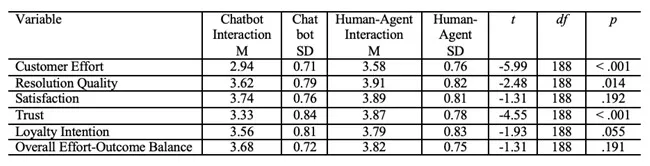
The authors performed an independent t-test to compare customer effort and communication outcomes between respondents who assessed chatbot interaction and those who evaluated human-agent interaction. The results are illustrated in Table 2. The results showed that respondents who assessed chatbot interaction revealed significantly lower customer effort than those who assessed human-agent interaction, t(188) = -5.99, p < .001. This suggests that chatbots were perceived as more efficient at reducing the burden of service interactions. Regardless, human-agent interaction had significantly stronger scores for resolution quality, t(188) = -2.48, p = .014, and trust, t(188) = -4.55, p < .001. This suggests that human agents were perceived as more competent in offering complete solutions. Differences in satisfaction, loyalty intention, and overall effort-outcome balance were not statistically significant at the conventional .05 level, although loyalty intention approached significance, p = .055. Overall, the results suggest that chatbot interaction is more effective at reducing customer effort, whereas human-agent interaction is stronger for relational and quality-based communication outcomes, especially trust and perceived resolution quality.
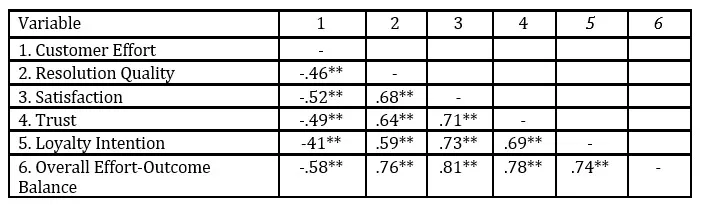
Next, the authors performed Pearson’s correlation analysis. This allowed to assess the relationships among customer effort, resolution quality, satisfaction, trust, loyalty intention, and overall effort-outcome balance. The results are illustrated in Table 3. The results demonstrated statistically significant relationships among all major customer effort and communication outcome variables. Customer effort was negatively and significantly associated with resolution quality, r = -.46, p < .01, satisfaction, r = -.52, p < .01, trust, r = -.49, p < .01, loyalty intention, r = -.41, p < .01, and overall effort–outcome balance, r = -.58, p < .01. These results suggest that, as customers experience greater effort during service interaction, their perceptions of resolution quality, satisfaction, trust, loyalty intention, and overall service balance decrease. In contrast, the communication outcome variables were positively and strongly correlated with one another. Satisfaction revealed strong positive relationships with trust (r = .71, p < .01) and loyalty intention (r = .73, p < .01), indicating that customers who are more satisfied with the service interaction are also more likely to trust the service provider and continue using or recommending the organization. Overall effort–outcome balance was strongly associated with resolution quality, r = .76, p < .01, satisfaction, r = .81, p < .01, trust, r = .78, p < .01, and loyalty intention, r = .74, p < .01. Altogether, the results suggest that effective customer communication depends not only on lowering effort but also on producing strong relational and outcome-based responses.
Table 3: Pearson Correlations among Customer Effort and Communication Outcome (N = 291)
Note.p < .01
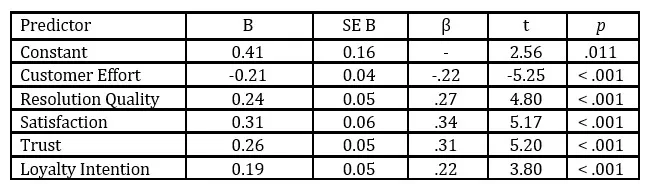
Next, the authors performed multiple regression analysis. This allowed exploring the extent to which customer effort, resolution quality, satisfaction, trust, and loyalty intention predicted the overall effort-outcome balance in chatbot, human-agent, and hybrid customer service interactions. The dependent variable was overall effort–outcome balance. The predictor variables were customer effort, resolution quality, satisfaction, trust, and loyalty intention. The results are illustrated in Tables 4, 5, and 6.
Table 4: Multiple Regression Model Summary Predicting Overall Effort-Outcome Balance
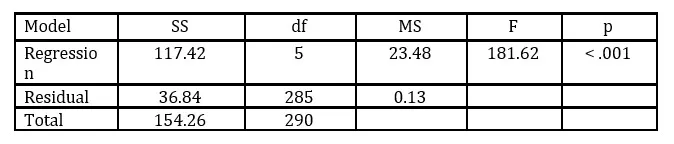
Table 5 shows ANOVA for the multiple regression model.
Table 5: ANOVA Summary for the Multiple Regression Model (N = 291)
Note. DV – Overall Effort-Outcome Balance. Predictors – Customer effort, resolution quality, satisfaction, trust and loyalty intention.
The results showed that customer effort, resolution quality, satisfaction, trust, and loyalty intention collectively explained a significant proportion of the variance in overall effort-outcome balance, R² = .76, adjusted R² = .75. The overall regression model was statistically significant, F(5, 285) = 181.62, p < .001. This suggests that the selected predictors significantly explained customers’ perceptions of the balance between service effort and communication outcomes. Customer effort was a significant negative predictor of overall effort-outcome balance, β = -.22, p < .001. This suggests that higher perceived effort was associated with a weaker overall service evaluation. In contrast, resolution quality, β = .27, p < .001, satisfaction, β = .34, p < .001, trust, β = .31, p < .001, and loyalty intention, β = .22, p < .001, were all significant positive predictors. Among these variables, satisfaction was the strongest predictor, followed by trust and resolution quality. These results suggest that an effective customer service model cannot be judged solely by reduced effort or speed; rather, the strongest effort-outcome balance happens when customers experience low effort alongside high satisfaction, trust, high resolution quality, and future loyalty intention.
The purpose of this research was to explore the extent to which AI-driven chatbots, compared with human-agent interaction, provide a more effective balance between customer effort and communication outcomes. The authors grounded this work in the TAM framework to better understand whether chatbot interaction reduces customer effort while sustaining key communication outcomes. The results revealed that chatbots are effective at reducing customer effort, especially in low-complexity and transactional service contexts; however, human-agent interaction is stronger in relational and quality-sensitive contexts, such as trust and perceived resolution quality. Notably, the results showed that hybrid chatbot–human models seem to offer the strongest overall balance between automation efficiency and human-centered communication.
Furthermore, these results offer few justifications regarding the hypotheses developed at the beginning of the research. This discourse is created based on Pearson’s correlation and regression analysis. The following section highlights major results and their justifications.
The obtained results supported H1. The independent-samples t test revealed that respondents who assessed chatbot interaction noted significantly lower customer effort than those who assessed human-agent interaction, t(188) = -5.99, p < .001. This result suggests that chatbot interaction was perceived as more efficient in reducing the limitations associated with service communication. From a TAM perspective, this result is theoretically significant because reduced effort reflects perceived ease of use. When customers can receive quick responses, access service support easily, and avoid waiting for a human representative, the interaction becomes less time-consuming, more convenient, and less cognitively demanding. Thus, chatbot systems seem to offer practical value in service encounters where speed, accessibility, and procedural simplicity are the immediate customer expectations. Accordingly, this supports one of the main arguments that AI-mediated communication is especially useful for routine, low-complexity, and transactional tasks. However, the result should not be interpreted as evidence that chatbots are universally superior. Rather, the result suggests that chatbots are strongest when the service problem is structured, predictable, and does not require emotional interpretation or complex judgment.
H2. Human-agent interaction produces significantly stronger communication outcomes than chatbot interaction.
The obtained results partially supported H2. Human-agent interaction delivered significantly higher scores than chatbot interaction for resolution quality, t(188) = -2.48, p = .014, and trust, t(188) = -4.55, p < .001. These results suggest that customers perceived human agents as more competent in delivering complete solutions and creating confidence in the service process. This result is significant because communication outcomes are not limited to efficiency, as they also affect reassurance, credibility, empathy, and contextual understanding. Moreover, human agents are better placed to interpret unclear customer needs, respond to emotional cues, and adapt explanations to complex situations. Although differences in satisfaction, loyalty intention, and overall effort–outcome balance were not statistically significant, the stronger results for trust and resolution quality display that human-centered service is essential in high-complexity or emotionally sensitive contexts.
H3. Customer effort is negatively associated with communication outcomes.
The obtained results supported H3. Pearson correlation analysis showed that customer effort was negatively and significantly associated with resolution quality, r = -.46, p < .01, satisfaction, r = -.52, p < .01, trust, r = -.49, p < .01, loyalty intention, r = -.41, p < .01, and overall effort–outcome balance, r = -.58, p < .01. These results show that when customers experience greater effort during service interaction, their evaluation of the service outcome declines. This result is consistent with the logic of customer effort theory and extends TAM by indicating that perceived ease of use does not merely impact technology acceptance; it also impacts broader communication outcomes. The negative association between effort and outcome variables confirms that customer effort is a major determinant of service communication effectiveness. Thus, organizations should not evaluate chatbot systems only by adoption rates or response speed. Accordingly, they must also determine whether the interaction genuinely reduces the customer’s emotional burden.
H4. Hybrid chatbot–human service models provide the strongest overall effort–outcome balance.
The results supported H4 conceptually and empirically through the broader pattern of results. Descriptive results indicated that the overall effort–outcome balance was moderately high, while the comparative analysis revealed that chatbots were stronger at reducing effort, while human agents were stronger in trust and resolution quality. Multiple regression analysis further demonstrated that overall effort–outcome balance was significantly predicted by customer effort, β = -.22, p < .001, resolution quality, β = .27, p < .001, satisfaction, β = .34, p < .001, trust, β = .31, p < .001, and loyalty intention, β = .22, p < .001. The full model explained 76% of the variance in overall effort–outcome balance, R² = .76, adjusted R² = .75, F(5, 285) = 181.62, p < .001. These results suggest that the strongest service model is not the one that only reduces effort or only improves relational quality, but the one that integrates both dimensions. Hybrid chatbot–human models are therefore theoretically and practically justified because they enable chatbots to handle routine, repetitive, and low-complexity tasks while allowing human agents to intervene when trust, empathy, and complex problem-solving are required.
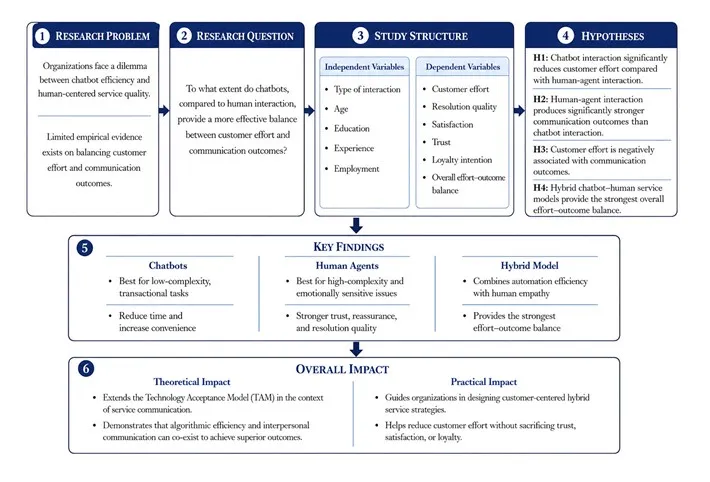
These results are summarized in Figure 2. The results show that chatbot and human-agent interactions produce distinct forms of service value. Chatbots are valuable because they reduce customer effort, especially by improving speed, convenience, and accessibility. Human agents are valuable because they strengthen trust, reassurance, and perceived resolution quality.
Fig 2. Overall Research Results and Impact (Developed by the Author using Draw.io tool)
Conclusion
In this research, the authors explored the extent to which AI-driven chatbots, compared with human-agent interaction, provide a more effective balance between customer effort and communication outcomes. Using a quantitative survey of 291 valid cases, the results showed that chatbot interaction is particularly effective at reducing customer effort, especially in low-complexity, transactional service contexts where speed, convenience, and accessibility are central to the customer experience. This supports the view that AI-driven service technologies improve perceived ease of use and can improve operational efficiency in digital customer communication. Nevertheless, this research showed that reduced effort alone does not guarantee stronger communication outcomes.
The main contribution of this research is that chatbot and human-agent interaction should not be treated as competing service models. Instead, they should be understood as complementary communication systems that create different types of value for customers. This research therefore contributes to human-computer interaction, customer service, and technology acceptance literature by showing that effective AI-mediated communication depends not only on usefulness and ease of use but also on the preservation of relational and outcome-based service quality.
Moreover, these results extend the Technology Acceptance Model. In TAM reasoning, customers are more likely to accept a technology when it is useful and easy to use. However, in customer service communication, usefulness and ease are insufficient if the interaction fails to generate trust, satisfaction, or perceived resolution quality. Furthermore, from a practical perspective, organizations should avoid treating chatbots as direct substitutes for human agents. Such a strategy may reduce operational costs but can damage customer trust if automation is applied to complex or emotionally sensitive issues.
Finally, future research should examine the organizational design of hybrid chatbot–human systems. More attention should be given to how escalation processes, response timing, chatbot training quality, human-agent availability, and service recovery protocols impact customer satisfaction and loyalty.
References
Adam, M., Wessel, M., & Benlian, A. (2021). AI-based chatbots in customer service and their effects on user compliance: M. Adam et al. electronic markets, 31(2), 427-445. https://doi.org/10.1007/s12525-020-00414-7
Alboqami, H. (2023). Factors affecting consumers adoption of AI-based chatbots: the role of anthropomorphism. American Journal of Industrial and Business Management, 13(4), 195-214.
Al-Oraini, B. S. (2025). Chatbot dynamics: trust, social presence and customer satisfaction in AI-driven services. Journal of Innovative Digital Transformation, 2(2), 109-130. https://doi.org/10.1108/JIDT-08-2024-0022
Ashfaq, M., Yun, J., Yu, S., & Loureiro, S. M. C. (2020). I, Chatbot: Modeling the determinants of users’ satisfaction and continuance intention of AI-powered service agents. Telematics and informatics, 54, 101473. 1016/j.tele.2020.101473
Asokan-Ajitha, A., & Sengupta, S. (2026). Creating inclusive servicescapes: transforming service encounters for a more equitable society. Journal of Services Marketing, 40(2), 167-187. https://doi.org/10.1108/JSM-11-2024-0569
Carli, R., Najjar, A., & Al-Thani, D. (2024). Human-Agent Interaction and Human Dependency: Possible New Approaches for Old Challenges. In Proceedings of the 12th International Conference on Human-Agent Interaction (pp. 214-223). https://doi.org/10.1145/3687272.3688308
Chen, Q., Lu, Y., Gong, Y., & Xiong, J. (2023). Can AI chatbots help retain customers? Impact of AI service quality on customer loyalty. Internet Research, 33(6), 2205-2243. https://doi.org/10.1108/INTR-09-2021-0686
Chukkala, R. (2025). The Convergence of CCAI, Chatbots, and RCS Messaging: Redefining Business Communication in the AI Era. In International Conference of Global Innovations and Solutions (pp. 194-213). Cham: Springer Nature Switzerland. https://doi.org/10.1007/978-3-032-02853-2_13
Davis, F. D. (1989). Perceived usefulness, perceived ease of use, and user acceptance of information technology. MIS quarterly, 13(3), 319-340. https://doi.org/10.2307/249008
De Cicco, R., Iacobucci, S., Aquino, A., Romana Alparone, F., & Palumbo, R. (2021, November). Understanding users’ acceptance of chatbots: an extended TAM approach. In International workshop on Chatbot research and design (pp. 3-22). Cham: Springer International Publishing. DOI https://doi.org/10.1007/978-3-030-94890-0_1
De Cicco, R. (2024). Exploring the dark corners of human-chatbot interactions: A literature review on conversational agent abuse. In International workshop on chatbot research and design (pp. 185-203). Springer, Cham. https://doi.org/10.1007/978-3-031-54975-5_11
Følstad, A., & Brandtzæg, P. B. (2017). Chatbots and the new world of HCI. interactions, 24(4), 38-42. https://doi.org/10.1145/3085558
Følstad, A., & Taylor, C. (2021). Investigating the user experience of customer service chatbot interaction: a framework for qualitative analysis of chatbot dialogues. Quality and User Experience, 6(1), 6.https://doi.org/10.1007/s41233-021-00046-5
Gabelaia, I. (2025). The Relevance of AI-Driven Marketing Through Design Thinking for a Strategic Approach to Resilient Problem-Solving and Communication for SMEs. Sustainability, 17(20), 8994. https://doi.org/10.3390/su17208994
George, S. R., C, M., & Edward, M. (2025). Artificial intelligence in frontline service encounters: a systematic review and research agenda. International Journal of Consumer Studies, 49(3), e70048. https://doi.org/10.1111/ijcs.70048
Gomes, S., Lopes, J. M., & Trancoso, T. (2025). Customer experience in digital transformation: the influence of intelligent chatbots toward a sustainable market. International Journal of Innovation Science, 17(4), 803-823. https://doi.org/10.1108/IJIS-06-2024-0148
Huang, D., Markovitch, D. G., & Stough, R. A. (2024). Can chatbot customer service match human service agents on customer satisfaction? An investigation in the role of trust. Journal of Retailing and Consumer Services, 76, 103600. https://doi.org/10.1016/j.jretconser.2023.103600
Huang, M. H., & Rust, R. T. (2018). Artificial intelligence in service. Journal of service research, 21(2), 155-172.https://doi.org/10.1177/1094670517752
Jiang, Z., Rashik, M., Panchal, K., Jasim, M., Sarvghad, A., Riahi, P., … & Mahyar, N. (2023). CommunityBots: creating and evaluating A multi-agent chatbot platform for public input elicitation. Proceedings of the ACM on Human-Computer Interaction, 7(CSCW1), 1-32. https://doi.org/10.1145/357946
Karri, S. B., Gawali, S., Rayankula, S., & Vankadara, P. (2025). AI Chatbots in Banking: Transforming Customer Service and Operational Efficiency. In Advancements in Smart Innovations, Intelligent Systems, and Technologies: Proceedings of the 1st International Conference on Innovations in Engineering and Emerging Technologies (ICIEET 2025), Biel/Bienne, Switzerland, 9-10 June 2025 (pp. 61-81). 1 Oliver’s Yard, 55 City Road, London, EC1Y 1SP: SAGE Publications.
Khan, M. I., Fatima, J. K., Bahmannia, S., Chatrath, S. K., Dale, N. F., & Johns, R. (2025). Investigating the influence of perceived humanization of service encounters on value creation of chatbot-assisted services. Journal of Service Theory and Practice, 35(1), 56-88. https://doi.org/10.1108/JSTP-10-2023-0282
Markovitch, D. G., Stough, R. A., & Huang, D. (2024). Consumer reactions to chatbot versus human service: an investigation in the role of outcome valence and perceived empathy. Journal of Retailing and Consumer Services, 79, 103847. https://doi.org/10.1016/j.jretconser.2024.103847
Martijn, G., van Burgsteden, L., te Molder, H., & van Hooijdonk, C. (2026). “Hold on, I’ll connect you to a human agent”: Recipient design, repair, and their impact on progressivity in human-chatbot conversations. Discourse & Communication, 20(1), 74-97. https://doi.org/10.1177/17504813261418360
Ng, S. W. T., & Zhang, R. (2025). Trust in AI chatbots: A systematic review. Telematics and Informatics, 97, 102240. 1016/j.tele.2025.102240
Pandey, S., Chawla, D., & Puri, S. (2026). Insurance chatbot adoption and continued usage in emerging markets: impact of human-agent access. International Journal of Bank Marketing, 1-28. https://doi.org/10.1108/IJBM-03-2025-0225
Rapp, A., Boldi, A., Curti, L., Perrucci, A., & Simeoni, R. (2024). How do people ascribe humanness to chatbots? An analysis of real-world human-agent interactions and a theoretical model of humanness. International Journal of Human–Computer Interaction, 40(19), 6027-6050. https://doi.org/10.1080/10447318.2023.2247596
Singh, P., & Singh, V. (2024). The power of AI: Enhancing customer loyalty through satisfaction and efficiency. Cogent Business & Management, 11 (1), 2326107. https://doi.org/10.1080/23311975.2024.2326107
Söderlund, M., & Mårtensson, M. (2025). Self-promotion by non-human service agents: An examination of the impact on customer satisfaction. Services Marketing Quarterly, 46(3-4), 113-137. https://doi.org/10.1080/15332969.2025.2504291
Song, T., Tan, Y., Zhu, Z., Feng, Y., & Lee, Y. C. (2025). Multi-agents are social groups: Investigating social influence of multiple agents in human-agent interactions. Proceedings of the ACM on Human-Computer Interaction, 9(7), 1-33. https://doi.org/10.1145/3757633
Sun, Y., Chen, J., & Sundar, S. S. (2024). Chatbot ads with a human touch: A test of anthropomorphism, interactivity, and narrativity. Journal of Business Research, 172, 114403. 1016/j.jbusres.2023.114403
Vassilakopoulou, P., & Pappas, I. O. (2022). AI/Human augmentation: a study on chatbot–human agent handovers. In International Working Conference on Transfer and Diffusion of IT (pp. 118-123). Cham: Springer International Publishing. https://doi.org/10.1007/978-3-031-17968-6_8
Venkatesh, V., & Davis, F. D. (2000). A theoretical extension of the technology acceptance model: Four longitudinal field studies. Management science, 46(2), 186-204. https://doi.org/10.1287/mnsc.46.2.186.11926
Waladi, C., Lamarti, M. S., & Khaldi, M. (2024). Transforming Customer Experiences with Customer-Centric AI-Powered Chatbots in the Fourth Industrial Revolution. In 2024 Mediterranean Smart Cities Conference (MSCC) (pp. 1-5). IEEE. DOI: 1109/MSCC62288.2024.10697060
Wirtz, J., Patterson, P. G., Kunz, W. H., Gruber, T., Lu, V. N., Paluch, S., & Martins, A. (2018). Brave new world: service robots in the frontline. Journal of service management, 29(5), 907-931. https://doi.org/10.1108/JOSM-04-2018-0119
Yu, S., Xiong, J., & Shen, H. (2024). The rise of chatbots: The effect of using chatbot agents on consumers’ responses to request rejection. Journal of Consumer Psychology, 34(1), 35-48. https://doi.org/10.1002/jcpy.1330
Yun, B., Taranova, E., & Yi Wang, A. (2026). Does My Chatbot Have an Agenda? Understanding Human and AI Agency in Human-Human-like Chatbot Interaction. In Proceedings of the 2026 CHI Conference on Human Factors in Computing Systems (pp. 1-32). https://doi.org/10.1145/3772318.3791620
Zhou, Q., Li, B., Han, L., & Jou, M. (2023). Talking to a bot or a wall? How chatbots vs. human agents affect anticipated communication quality. Computers in Human Behavior, 143, 107674. 1016/j.chb.2023.107674