Celeste da Cruz Meirinho ANTÃO1, António José Gonçalves FERNANDES2,4,, Urbano José Castilho RODRIGUES3 and Maria Isabel Barreiro RIBEIRO4
1Research Centre for Active Living and Wellbeing
(Live-Well), Instituto Politécnico de Bragança, Campus de Santa Apolónia, 5300-253 Bragança, Portugal
2,4CIMO, LA SusTEC, Instituto Politécnico de Bragança,Campus de Santa Apolónia, 5300-253 Bragança, Portugal
3Unidade Local de Saúde do Nordeste, Av. Abade Baçal 5301-852, Bragança, Portugal
4CIMO, LA SusTEC, Instituto Politécnico de Bragança, Campus de Santa Apolónia, 5300-253 Bragança, Portugal
Volume 2026,
Article ID 711153,
Journal of Organizational Management Studies,
11 pages,
DOI: https://doi.org/10.5171/2026.711153
Received date: 19 January 2026; Accepted date: 8 June 2026; Published date: 9 July 2026
Academic Editor: Paulo Pinto-Moreira
Cite this Article as:
Celeste da Cruz Meirinho ANTÃO, António José Gonçalves FERNANDES and Urbano José Castilho RODRIGUES and Maria Isabel Barreiro RIBEIRO (2026)," Assessing Nurses’ Job Satisfaction in the Post-pandemic Period: A Portuguese Cross-sectional Study”, The Journal of Organizational Management Studies, Vol. 2026 (2026), Article ID 711153, https://doi.org/10.5171/2026.711153
Job satisfaction (JS) among nurses has been the subject of study by academia and organizations worldwide. Its potential impact on the quality and safety of patient care is described in several studies. Therefore, the aim of this research was to determine nurses’ level of JS in a hospital unit in Northeast Portugal. This cross-sectional and analytical study was conducted. A simple random sample of 149 nurses was surveyed through a questionnaire that included sociodemographic variables and the JS Scale by Siqueira (2008). The data were analyzed using software suitable for Social and Health Sciences. The internal consistency of the JS scale dimensions, assessed using Cronbach’s alpha, was good to very good (α > 0.8). The JS was low , primarily due to dissatisfaction with salaries and career progression . Satisfaction with colleagues work’s nature and management contributed positively to JS. Furthermore, satisfaction with colleagues varied by age, service length, and contract type (p < 0.05). Additionally, gender was a significant factor in salary satisfaction (p<0.05). Finally, JS differed in service length (p < 0.05). Most nurses expressed dissatisfaction, highlighting the need to implement strategies to improve JS, particularly through more attractive salaries and opportunities for career advancement, as well as through gradual development of skills, knowledge, and responsibility.
Job satisfaction (JS) has been studied across many professional fields. Considered an important variable in organizational behavior, it influences organizational functioning, potentially impacting performance and management and, consequently, the quality of services provided. JS has become a critical issue for healthcare organizations, particularly in nursing, due to nursing workforce shortages, its impact on patient care, and associated costs (Mendes, 2014). The OECD (2025) report states that nurses were the professional group in the healthcare sector most negatively impacted during the COVID-19 pandemic, particularly mental health problems, which gave them a primary role in care delivery. The same report notes that nurses in Portugal are among the lowest paid in the 38 OECD countries, earning just over half the OECD average. During the pandemic, nurses faced increased workloads and numerous concerns. Furthermore, stress and challenges (Cheraghi et al., 2023; Salahat & Al-Hamdan, 2022), as well as the responsibility for several administrative and operational tasks that vary by seniority, can impact JS (Suhaimi et al., 2023). The relationship between JS and productivity, as well as with nurses’ quality of life, physical and mental health, and overall performance, was reported by Yasin et al. (2020). For example, the study by Marcomini (2025) showed that organizational variables were predictive of nurses’ JS. That is, workload, work-life balance, burnout, and staff inadequacy were all predictors of higher levels of nurse dissatisfaction. Conversely, high-quality leadership, opportunities for development, and a good teamwork climate were predictors of higher levels of satisfaction.
Nursing constitutes the fundamental foundation of healthcare systems, acting as the first link between patients and the delivery of healthcare services (Alzoubi et al., 2024). Nurses are vital members of healthcare institutions (Cayllahua Curiñaupa et al., 2025) due to their roles in providing patient-centered care, ensuring quality care, and consistently promoting quality care (Ismail et al., 2018). Their professional performance affects patient satisfaction, quality-of-care indicators, and the achievement of organizational objectives (Sarıköse & Göktepe, 2022). According to Hynes et al. (2025), the COVID-19 pandemic not only drew attention to the well-documented global nursing shortage but also exacerbated it. Due to these new challenges, healthcare organizations face the need to redefine their strategies and policies to respond to emerging health needs (Sarıköse & Göktepe, 2022). Human resources management and its performance are relevant challenges for organizations today (da Cruz et al., 2018).
JS is a crucial topic in organizational terms, particularly in healthcare settings (Sameer et al., 2025), as it impacts both the well-being of healthcare professionals and the quality of patient care (Georgousopoulou et al., 2025). Among nurses, JS is notable, as satisfied nurses are more committed to their professional roles and responsibilities (Kallerhult et al., 2024). Nurses’ JS has been associated with positive outcomes, such as lower intention to leave the workplace and better healthcare quality (Montuori et al., 2024; Moura Ramos et al., 2025). In the opinion of Sameer et al. (2025), given the crucial role nurses play in healthcare delivery, their JS levels are critical to the quality of nursing care provided. JS is assumed to be a multidimensional concept that includes, as preliminary aspects, satisfaction of workplace needs, happiness, rewarding emotional responses to working conditions, and the value of work or equity (Liu et al., 2023). It is based on individual psychosocial characteristics and on individuals’ adaptation to the work environment (Sameer et al., 2025). It includes feelings such as satisfaction or dissatisfaction arising from employees’ work experiences, positive emotional attitudes towards work, and perceived love (Salar et al., 2016). That is, it is defined as a positive emotional response resulting from professional experiences, a key factor influencing the well-being, retention, and performance of nurses (Montuori et al., 2022). In this context, JS includes several elements, including working conditions, salaries, promotion opportunities, work quality, organizational policies, appreciation, safety, and interpersonal communication (Halcomb, Smyth, & McInnes, 2018). Factors such as workload, work-life balance, and workplace support influence nurses’ engagement and commitment, as well as JS (Hogan, 2025). Work-life balance is a crucial factor influencing the well-being and JS of healthcare professionals, particularly generalist nurses. Increased job demands, shift work, and inadequate pay contribute to burnout, stress, and turnover among nurses (Hujová et al., 2025). In fact, according to You et al. (2025), JS is influenced by work-life balance, pay, and professional development. In this context, the present study aimed to assess nurses’ JS levels at a local health unit (LHU) in northern Portugal and to identify differences in JS levels, while accounting for sociodemographic and organizational variables.
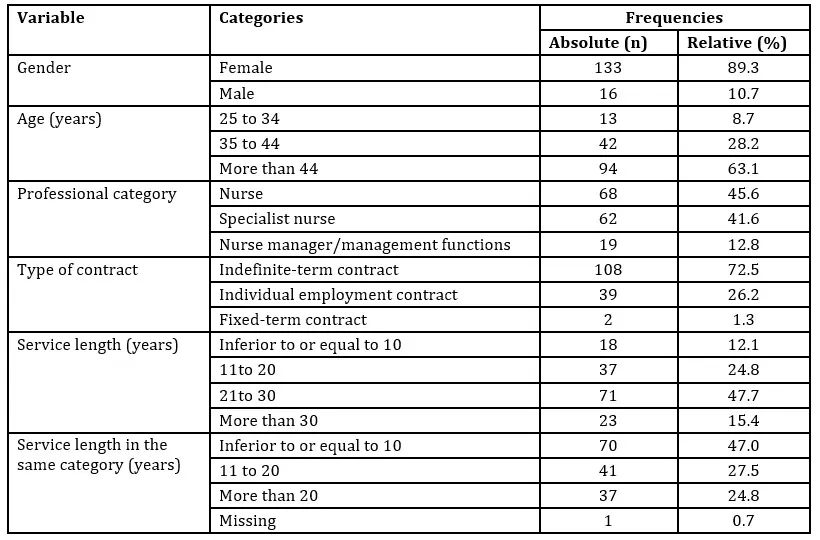
Table 1: General information about nurses
As shown in Table 1, most nurses were female (86.3%), over 44 years of age (63.1%), without a specialist title (45.6%), with an indefinite-term contract (72.5%), more than 20 years of service length (63.1%), and had been in the same professional category for more than 10 years (52.3%).
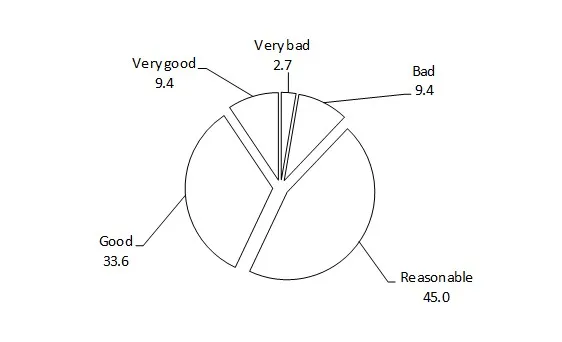
Most nurses who participated in this study considered their health status to be fair (45%) or good (33.6%), as shown in Figure 1.
Fig 1. Nurses’ health status (self-perception)
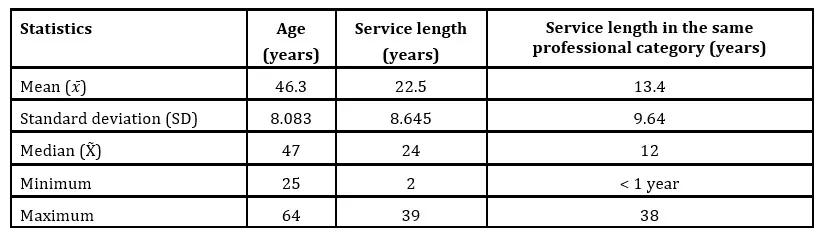
The nurses’ ages ranged from 25 to 64 years, with an average of 46.3 (SD = 8.083) and a median of 47. Regarding the length of service, within the same professional category, the average was 13.4 years (SD = 9.640). Total length of service ranged from 2 to 39 years. On average, nurses had 22.5 years of service (SD = 8.645), as shown in Table 2.
Table 2: Central tendency and dispersion measures, by age and service length
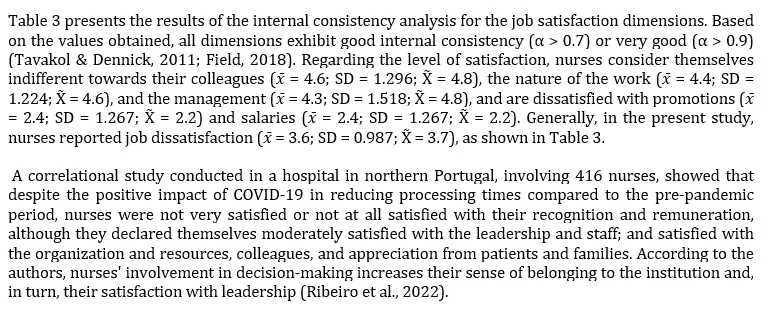
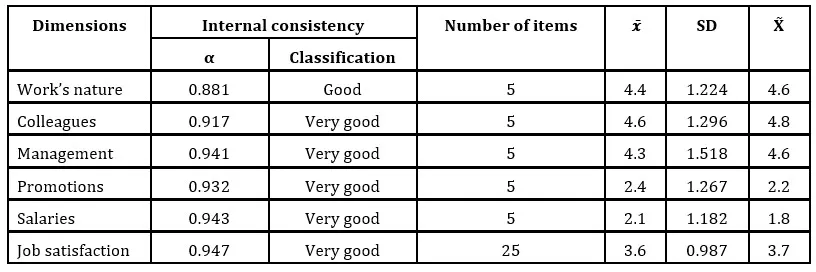
Table 3: Reliability and descriptive statistics of the JS dimensions
The results of this research are consistent with those of a cross-sectional, analytical study conducted at a private hospital in Brazil involving 149 nursing professionals. Professionals expressed satisfaction with colleagues and management. However, results regarding salary and career progression demonstrate dissatisfaction. Furthermore, most nursing professionals were indifferent to their work satisfaction (Zaidan et al., 2022). Interestingly, the results of this study are also like those obtained in a study that included 155 participants working at a regional hospital in Oman. The overall mean satisfaction score was 3.49, indicating moderate job satisfaction (Al Maqbali, 2015). However, a study carried out in three regions of Spain, namely Murcia, Lleida, and Galicia, which included 228 nurses, reported a job satisfaction ranging from moderate to high (Acea-López et al., 2021). According to a study conducted in Italy involving 1,304 nurses from 15 wards in public hospitals across several cities in northern, central, and southern Italy, job satisfaction was low. Furthermore, nurses considered autonomy and salary to be important factors in job satisfaction (Sansoni et al., 2016). In a descriptive and cross-sectional study involving 338 nurses working in secondary and tertiary hospitals in Greece, the level of JS was moderate (Georgousopoulou et al., 2025).
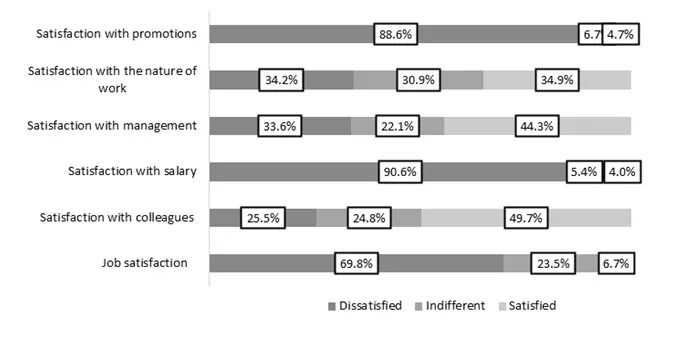
Figure 2 shows that most nurses were dissatisfied with salaries (90.6%) and promotions (88.6%). Overall, the majority (69.8%) of nurses reported being dissatisfied with their work.
Fig 2. Nurses distributed by JS level
The same results were obtained in a study conducted in Iraq involving 140 nurses (Aljebory, 2023). According to the author, most nurses (61.9%) were dissatisfied and considered their salaries insufficient. However, the results of Kaddourah et al. (2013) indicate that, of 140 nurses, 111 (79.3%) were satisfied with their jobs. Furthermore, 65 nurses (46.4%) were dissatisfied with their salaries, and almost half were dissatisfied with the nurse-to-patient ratio, autonomy, and the time to discuss problems with the team.
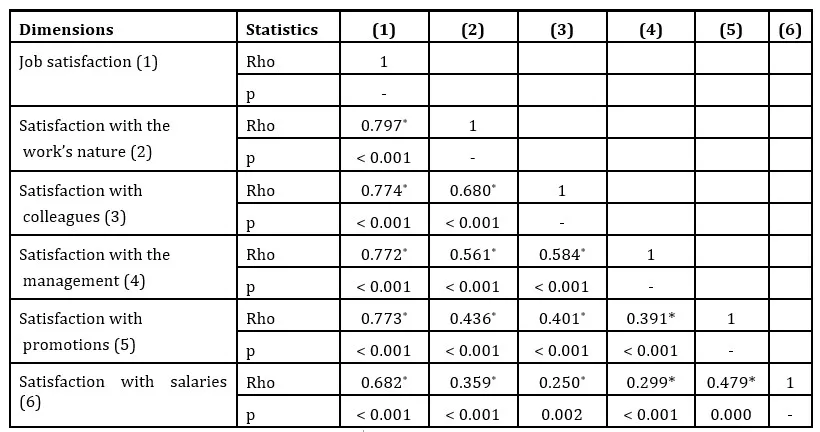
Table 4 shows the correlation between JS and its dimensions. All correlations are statistically significant at the 1% significance level (p < 0.01). The results of the Spearman correlation test show that all dimensions, except salary satisfaction, which has a moderate and positive correlation with JS (0.5 < Rho < 0.7), are strongly and positively correlated with job satisfaction (Rho > 0.7).
Table 4: Spearman correlations (Rho) between the dimensions of JS
* There is a statistically significant correlation at a significance level of 0.01
Regarding gender, there were no differences in JS levels or in the various dimensions, except for salary satisfaction (p < 0.05). Salary satisfaction is particularly relevant for males (Appendix 1). Roney and Acri (2028) conducted a study among pediatric nurses who reported high levels of JS, although no association was found between satisfaction levels and gender. However, Sansoni et al. (2016) consider autonomy and salary to be important factors that contribute to increasing JS (Sansoni et al., 2016). Furthermore, in a study by Alfuqaha et al. (2021), which included 786 nurses from five hospitals in Jordan, gender was identified as a significant predictor of JS.
Age was a significant differentiator in satisfaction with colleagues, especially for older nurses (aged 45 or older), as shown in Appendix 1. Interestingly, these results are like those obtained in a study of 155 participants working at a regional hospital in Oman. Interaction with colleagues and extrinsic rewards, respectively, were associated with the highest and lowest JS ratings. The results showed that age had a statistically significant effect on overall JS (Al Maqbali, 2015).
In this study, satisfaction with colleagues varied by contract type (p = 0.004). Nurses with indefinite-term contracts reported the highest levels of satisfaction (Appendix 1). In this regard, the study by Acea-López et al. (2021) found that nurses with temporary contracts exhibit high rates of burnout, as well as high levels of emotional fatigue, depersonalization, and a lack of personal fulfillment. Differences were found in the dimensions of satisfaction with colleagues (p = 0.010) and job satisfaction (p = 0.037) over time. Zaidan et al. (2022) state that satisfaction levels appear to increase as healthcare professionals’ experience in the unit increases. Hertrich et al. (2025) conducted a study involving 753 German intensive care unit professionals across all professional groups. The results revealed significant differences in JS depending on nurse-to-patient ratio, professional category, professional experience, and gender. Nursing staff reported higher satisfaction and lower stress levels. Younger and less experienced staff reported insufficient preparation, increased stress, and lower satisfaction.
Finally, professional category and service length within the same category did not differ in JS levels or their dimensions (Appendix 1). A study conducted at Stikland Psychiatric Hospital in Cape Town, South Africa, involving 127 nurses, found no significant associations between JS and gender, hierarchical level, or years of experience (Payne et al., 2020). Hussain and Soroya (2017) found that salary and job security were differentiating factors in JS, with employees with higher salaries and permanent jobs reporting higher job satisfaction. The results of a descriptive study conducted by Çınar, Uğrak, and Serin (2025) in Turkey, involving 276 healthcare professionals from a tertiary public hospital, showed no statistically significant differences in job satisfaction across sociodemographic characteristics.
Conclusion
This study identified a significant prevalence of overall job dissatisfaction, particularly in areas related to salary and promotions. On the other hand, nurses reported greater satisfaction with their colleagues, management, and their work, albeit at moderate levels.
These findings reinforce the need for strategic interventions by healthcare institutions to value nurses’ work, improve working conditions, and develop retention and professional recognition policies, which are essential for promoting satisfaction and, consequently, the quality of care provided to patients.
In this context, the priority of the NLHU administration should be to implement more competitive salaries and professional growth processes that involve progression in skills, knowledge, and responsibilities over time, whether through promotions to higher hierarchical positions, the acquisition of new skills, or moving nurses to different areas.
This research was conducted in three hospitals within the NLHU, which are public facilities. Therefore, the results obtained in this study cannot be generalized to private hospitals or to the entire country. Another limitation is the study’s cross-sectional design. A longitudinal study would help assess JS and its dimensions, accounting for the time factor. Future research employing this design could more effectively evaluate the administration’s decision-making regarding human resources management.
Acknowledgments
This work was supported by national funds through FCT/MCTES (PIDDAC): CIMO, UIDB/00690/2020 (DOI: 10.54499/UIDB/00690/2020) and UIDP/00690/2020 (DOI: 10.54499/UIDP/00690/2020); and SusTEC, LA/P/0007/2020 (DOI: 10.54499/LA/P/0007/2020).
References
Acea-López, L., Pastor-Bravo, M.D.M., Rubinat-Arnaldo, E., Bellon, F., Blanco-Blanco, J., Gea-Sanchez, M., and Briones-Vozmediano, E. (2021), ‘Burnout and job satisfaction among nurses in three Spanish regions,’ Journal of Nursing Management, 29, 2208–2215.
Al Maqbali, M.A. (2015), ‘Job Satisfaction of Nurses in a Regional Hospital in Oman: A Cross-Sectional Survey,’ Journal of Nursing Research, 23 (3), 206-216.
Alfuqaha, O.A., Al-Hairy, S.S., Al-Hemsi, H.A., Sabbah, A.A., Faraj, K.N., and Assaf, E.M. (2021), ‘Job rotation approach in nursing profession,’ Scandinavian Journal of Caring Sciences, 35 (2), 659–667.
Aljebory, M.K.A. (2023), ‘Assessment of Nurses Job Satisfaction in Hospitals,’ Bahrain Medical Bulletin, 45 (1), 1256–1259.
Alkubati, S.A., Alrashidi, O.A., Albaqawi, H., Alharbi, A., Laradhi, A.O., Albani, G.F., Alsaqri, S., Pasay-An, E., and Ali, A.Z. (2025), ‘The mediating effect of resilience and job satisfaction on the relationship between critical care nurses’ stress and task performance: findings to improve nursing care,’ BMC Nursing, 24, 579.
Alzoubi, M.M., Al-Mugheed, K., Oweidat, I., Alrahbeni, T., Alnaeem, M.M., Alabdullah, A.A.S., Abdelaliem, S.M.F., and Hendy, A. (2024), ‘Moderating role of relationships between workloads, job burnout, turnover intention, and healthcare quality among nurses,’ BMC Psychology, 12 (1), 495.
Cayllahua Curiñaupa, A.J., Rojas Palma, Y.S., Cajachagua Castro, M., and Huancahuire-Veg, S. (2025), ‘Attitude toward teamwork and work engagement as predictors of job satisfaction in nurses: a cross-sectional study,’ BMC Nursing, 24, 791.
Cheraghi, R., Ebrahimi, H., Kheibar, N., and Sahebihagh, M. (2023), ‘Reasons for resistance to change in nursing: an integrative review,’ BMC Nursing, 22, 310.
Çınar, Ş., Uğrak, U., and Mersinlioğlu Serin, G. (2025), ‘Healthcare conflict and job satisfaction: A case of tertiary hospital,’ Turkish Bulletin of Hygiene and Experimental Biology, 82 (1), 151-164.
Da Cruz, L., Jesus, L., Falcão, V., Ferreira, T., and Resch, S. (2018), ‘Clima organizacional e satisfação no trabalho: Estudo de caso em empresa do setor industrial do Mato Grosso do Sul,’ II Encontro Internacional de Gestão, Desenvolvimento e Inovação, 20 a 23 de novembro de 2028, Naviraí, MS.
Field, A. (2018), ‘Discovering Statistics Using IBM SPSS Statistics,’ Sage, Newbury Park.
Georgousopoulou, V., Amanatidou, M., Vlotinou, P., Lahana, E., Tsiakiri, A., Koutelekos, I., Koutra, E., and Manomenidis, G. (2025), ‘The Role of Organizational Culture and Emotional Intelligence: Enhancing Healthcare Professionals’ Job Satisfaction,’ Social Sciences, 14, 286.
Halcomb, E., Smyth, E. and McInnes, S. (2018), ‘Job satisfaction and Career Intentions of Registered Nurses in Primary Health Care: An integrative review,’ BMC Family Practice, 19 (1), 136.
Hertrich, A.C., Briegel, J., Weeverink, N., Naendrup, J.-H., and Hoffmann, J. (2025), ‘Arbeitsbedingungen auf deutschen Intensivstationen – eine berufsgruppenübergreifende Analyse,’ Med Klin Intensivmed Notfmed, 120, 462–472.
Hogan, C., (2025), ‘A discovery into the levels of work engagement of young Irish nurses working in post COVID-19 Australia.’ British Journal of Community Nursing, 30 (7), 340-344.
Hujová, A., Zemanová, M., Stupková, D., and Vostrý, M. (2025), ‘Exploring the Determinants Impacting Work–Life Balance for General Nurses in Diverse Healthcare Settings: A Cross-Sectional Study,’ Journal of Nursing Management, 2025, 8856776.
Hussain, S., and Soroya, S.H. (2017), ‘Exploring the factors affecting job satisfaction of paraprofessional staff working in University Libraries of Pakistan,’ Library Review, 66 (3), 144-162.
Hynes, L., Geraghty, S., McChlery, S., Smyth, A., Brar, R., and Clark-Burg, K. (2025), ‘Nurses’ and midwives’ job satisfaction and retention during COVID-19: a scoping review,’ BMC Nursing, 24, 299.
Ismail, A. I., Abdul Majid, A.H., Zakaria, M.N., Abdullah, N.A.C., Hamzah, S., and Mukari, S.Z.S. (2018), ‘Factors predicting health practitioners’ awareness of UNHS program in Malaysian non-public hospitals,’ International Journal of Pediatric Otorhinolaryngology, 110, 46-51.
Kaddourah, B.T., Khalidi, A., Abu-Shaheen, A.K., and Al-Tannir, M.A. (2013), ‘Factors impacting job satisfaction among nurses from a tertiary care centre,’ J Clin Nurs., 22 (21-22), 3153-3159.
Kallerhult Hermansson, S., Norström, F., Hilli, Y., Rennemo Vaag, J., and Bölenius, K. (2024), ‘Job satisfaction, professional competence, and self-efficacy: a multicenter cross-sectional study among registered nurses in Sweden and Norway,’ BMC Health Services Research, 24 (1), 734.
Liu, Y., Duan, Y., and Guo, M. (2023), ‘Turnover intention and its associated factors among nurses: A multi-center cross-sectional study,’ Frontiers in Public Health, 11, 1141441.
Marcomini, I., Di Nitto, M., Zaghini, F., Caponnetto, V., Cesare, M., Iovino, P., Longobucco, Y., Alvaro, R., Lancia, L., Manara, D.F., Rasero, L., Rocco, G., Cicolini, G., Zega, M., Mazzoleni, B., Bagnasco, A. and Sasso, L. (2025), ‘Predictors of Nurses’ Job Satisfaction in Home Care Settings: Findings From the AIDOMUS-IT Study,’ journal of nursing scholarship, 14, 3754-3764.
Mendes, A.P. (2014), ‘Satisfação profissional dos enfermeiros de cuidados de saúde primários do ACES Baixo Mondego II,’ Escola Superior de Enfermagem de Coimbra, Portugal.
Montuori, P., Sorrentino, M., Sarnacchiaro, P., Di Duca, F., Nardo, A., Ferrante, B., D’Angelo, D., Di Sarno, S., Pennino, F., Masucci, A., Triassi, M., and Nardone, A. (2022), ‘Job satisfaction: knowledge, attitudes, and practices analysis in a well-educated population,’ International Journal of Environmental Research and Public Health, 19 (21), 14214.
Moura Ramos, O., Gomes, J., Galvão, A., and Gomes, M.J. (2025), ‘Satisfação no trabalho e intenção de abandono em enfermagem: a influência do empoderamento profissional,’ Millenium -Journal of Education, Technologies, and Health, 2 (ed. espec. nº16), e37744.
OECD (2025), ‘Health at a Glance 2025: OECD Indicators,’ OECD Publishing, Paris.
Payne, A., Koen, L., Niehaus, D. J.H., and Smit, I.-M. (2020), ‘Burnout and job satisfaction of nursing staff in a South African acute mental health setting,’ South African Journal of Psychiatry, 26, 1-6, a1454.
Pestana, M., and Gageiro, J. (2014), ‘Análise de Dados para Ciências Sociais: A complementaridade do SPSS,’ Edições Sílabo, Lisboa.
Ribeiro, O.M.P.L., Coimbra, V.M.O., Pereira, S.C.d.A., Faria, A.d.C.A., Teles, P.J.F.C., and Rocha, C.G.d. (2022), ‘Impact of COVID-19 on the Environments of Professional Nursing Practice and Nurses’ Job Satisfaction”, J. Environ. Res. Public Health, 19, 16908.
Roney, L.N., and Acri, M.C. (2018), ‘The Cost of Caring: An Exploration of Compassion Fatigue, Compassion Satisfaction, and Job Satisfaction in Pediatric Nurses,’ Journal of Pediatric Nursing, 40, 74–80.
Salahat, M.F., and Al-Hamdan, Z.M. (2022), ‘Quality of nursing work life, job satisfaction, and intent to leave among Jordanian nurses: A descriptive study,’ Heliyon, 8 (7), e09838.
Salar, A. R., Zare, S., Salar, H. and Salar, E. (2016), ‘The Survey of the job satisfaction rate in the nurses Working in the Training Hospitals of Zahedan University of Medical Sciences 2015,’ International Journal of Medical Research and Health Sciences, 5 (7), 300–305.
Sansoni, J., De Caro, W., Marucci, Sorrentino, A.R.M., Mayner, L., and Lancia, L. (2016), ‘Nurses’ job satisfaction: An Italian study,’ Annali Di Igiene Medicina Preventiva e di Comunita, 28 (1), 58–69.
Sarıköse, S., and Göktepe, N. (2022), ‘Effects of nurses’ individual, professional and work environment characteristics on job performance,’ Journal of Clinical Nursing, 31 (5–6), 633–641.
Siqueira, M. (2008), ‘Satisfação no Trabalho,’ In: Siqueira, M. (org.). Medidas do Comportamento Organizacional: Ferramentas de Diagnóstico e de Gestão (pp. 257-266), Bookman/Artmed.
Suhaimi, A., Mulud, Z.A., Sharoni, S.K.A., and Zainodin, W.H.W. (2023), ‘Factors contributed to job satisfaction among nurses working at tertiary hospitals in the Klang Valley: an Adaptation of the Hertzberg’s theory,’ Journal of Sustainability Science and Management, 18 (6), 135-148.
Tavakol, M., and Dennick, R. (2011), ‘Making sense of Cronbach’s alpha,’ International Journal of Medical Education, 2, 53-55.
Yasin, Y.M., Kerr, M.S., Wong, C.A., and Bélanger, C.H. (2020), ‘Factors affecting job satisfaction among acute care nurses working in rural and urban settings,’ Journal of Advanced Nursing, 7 6 (9), 2359-2368.
You, W., Verrall, C., Willis, E., and Hills, D., (2025), ‘Sustaining the General Practice Nursing Workforce in Australia: Demographics, Job Satisfaction, and Professional Development Challenges,’ Nursing and Health Sciences, 27 (2), 1-15.
Zaidan, J. L., Aquino, J. M., Lima, A. G., Barros, A. C., and Silva, E. R. (2022), ‘Satisfação no trabalho de profissionais de enfermagem das clínicas médicas e cirúrgicas de uma unidade hospitalar,’ Revista de Enfermagem Referência, 6 (1), e22017.



 , primarily due to dissatisfaction with salaries
  and career progression
  . Satisfaction with colleagues
 work’s nature
  and management
  contributed positively to JS. Furthermore, satisfaction with colleagues varied by age, service length, and contract type (p < 0.05). Additionally, gender was a significant factor in salary satisfaction (p<0.05). Finally, JS differed in service length (p < 0.05). Most nurses expressed dissatisfaction, highlighting the need to implement strategies to improve JS, particularly through more attractive salaries and opportunities for career advancement, as well as through gradual development of skills, knowledge, and responsibility.