Eliza DABEK1, Mariusz GIERGIEL1, Tomasz BURATOWSKI1, Bartlomiej BONAR1and Piotr MALKA2
1AGH University of Krakow, Aleja Adama Mickiewicza 30, Kraków, Poland
2Cracow University of Technology, Warszawska 24, Kraków, Poland
Volume 2026,
Article ID 540288,
Communications of the IBIMA,
12 pages,
DOI: doi.org/10.5171/2026.540288
Received date: 27 March 2026; Accepted date: 28 August 2026; Published date: 18 September 2026
Cite this Article as:
Eliza DABEK, Mariusz GIERGIEL, Tomasz BURATOWSKI, Bartlomiej BONAR and Piotr MALKA (2026)," Magnetic Climbing Robots for Industrial Inspection: Adhesion, Locomotion, and Surface Adaptation", Communications of the IBIMA, Vol. 2026 (2026), Article ID 540288, https://doi.org/10.5171/2026.540288
Magnetic climbing robots allow for inspection, maintenance, and cleaning of ferromagnetic structures where manual access is hazardous, costly, or impractical. Existing studies emphasize different aspects of robot design, making it difficult to identify common relationships between adhesion strategy, locomotion architecture, and surface geometry. This paper reviews magnetic climbing robot designs reported between 2020 and 2025, focusing on their adhesion strategies, locomotion architectures, and adaptation to different surface geometries. The reviewed systems include magnetic modules mounted in the chassis, magnetic wheels and tracks, legged platforms with magnetic feet, and crawling mechanisms. They are compared with respect to adhesion arrangement, drive principle, adaptation to planar and curved surfaces, and the ability to negotiate welds, corners, and transitions between planes. Among the reviewed systems, wheeled platforms are the most common, combining continuous motion with relatively simple mechanical construction. Tracked, legged, crawling, and articulated platforms can provide greater adaptability to complex surface geometries but usually require more complex mechanical structures or control. The reviewed designs reveal several common engineering challenges, including maintaining sufficient adhesion without restricting mobility, enabling controlled detachment, preserving contact on surfaces with varying curvature, and negotiating surface transitions without loss of stability. Overall, the review highlights the main design considerations that link adhesion, mobility, and surface adaptation when selecting a magnetic climbing architecture for industrial inspection.
Keywords: magnetic adhesion; climbing robot; magnetic wheels; magnetic tracks; industrial inspection; literature review
Introduction
Industrial inspection often involves ferromagnetic surfaces on ship hulls, storage tanks, pipelines, turbine components, bridges, and industrial ducts. These surfaces may be vertical, curved, enclosed, or otherwise difficult to access. Manual inspection under such conditions can be hazardous, costly, and time intensive. By carrying inspection or maintenance equipment directly across the inspected structure, mobile climbing robots can reduce the need for personnel to work at height, in confined spaces, or under other hazardous conditions.
Among the available adhesion methods, magnetic adhesion is particularly suitable for ferromagnetic surfaces because it can provide high holding forces without the need to maintain a pressure differential. Magnetic adhesion also introduces several design constraints. Increasing the holding force may require larger or additional permanent magnets, which can increase robot mass and make movement or detachment more difficult. Electropermanent magnets and systems that reorient them provide greater control over adhesion but require additional components and more complex control. Adhesion and locomotion must therefore be considered together, particularly when the robot must traverse welds, changes in curvature, corners, or transitions between planes.
Magnetic climbing robots use different combinations of adhesion and locomotion mechanisms to meet these requirements. Some designs place magnets in the chassis and use conventional or omnidirectional wheels, while others integrate magnets directly into wheels or tracks. Legged and crawling robots use separate magnetic contact points that attach and detach in sequence. These choices are often described in studies focused on specific applications, which limits direct comparison between robot architectures. Similar inspection tasks can therefore be addressed using different magnetic circuits, suspension systems, and transition mechanisms.
This paper reviews magnetic climbing robot designs reported between 2020 and 2025. The comparison considers magnetic adhesion layout, locomotion system, and target surface geometry. Particular attention is given to surface adaptation, corner crossing, and controlled detachment. Rather than ranking individual systems using results obtained under different test conditions, the review identifies common mechanical solutions and the design decisions that influence architecture selection for industrial inspection.
Scope and comparison criteria
This review covers magnetic climbing robot studies reported between 2020 and 2025. The reviewed material includes journal articles, conference papers, and preprints identified through IEEE Xplore, arXiv, and publisher websites including Springer Nature, SAGE, and MDPI. Studies were selected when they described the robot architecture, magnetic adhesion system, locomotion method, or surface adaptation in sufficient detail for comparison.
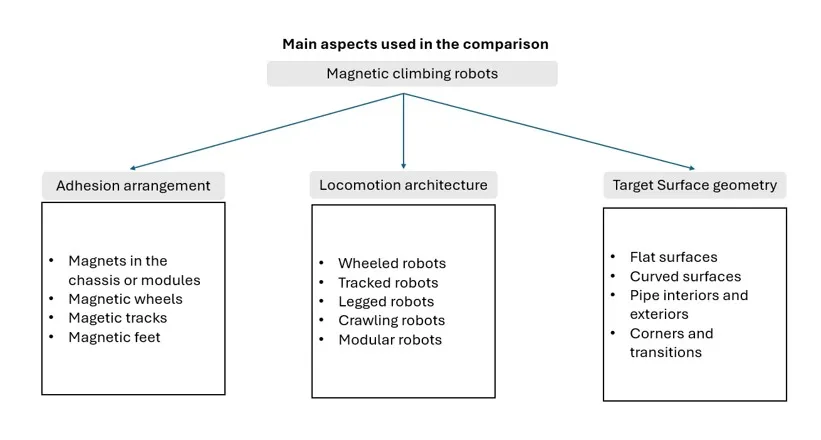
The comparison considers three aspects of robot design. The first is the arrangement of the magnetic adhesion system, including magnets placed in the chassis, wheels, tracks, feet, or separate contact modules. The second is the locomotion mechanism, including wheeled, tracked, legged, crawling, and modular designs. The third is the geometry of the operating surface, including flat and curved surfaces, pipe interiors and exteriors, corners, and transitions between planes. These aspects are considered together because a single robot can combine several of them, such as a modular body with passive joints and actively controlled magnetic elements.
For each design, the review considers the mechanical architecture, magnetic adhesion arrangement, locomotion principle, surface adaptation mechanism, and intended application. Numerical results are included only when they are clearly reported in the original source and help explain the design. The comparison therefore focuses on architectural differences rather than ranking robots using results obtained under different experimental conditions.
Figure 1 summarizes these three aspects and shows how they are used to compare the reviewed designs.
Fig. 1. Schematic overview of the three aspects used in the comparison: adhesion arrangement, locomotion architecture, and target surface geometry.
Overview of magnetic climbing robot architectures
Magnetic climbing robots differ in how magnetic adhesion is generated and integrated with the locomotion system. Wheeled robots appear most frequently in the studies reviewed here. Tracked, legged, crawling, and modular designs provide alternative ways to adapt to curved or irregular surfaces, negotiate transitions, and control attachment and detachment during motion.
Robots with magnetic adhesion in the chassis or separate modules
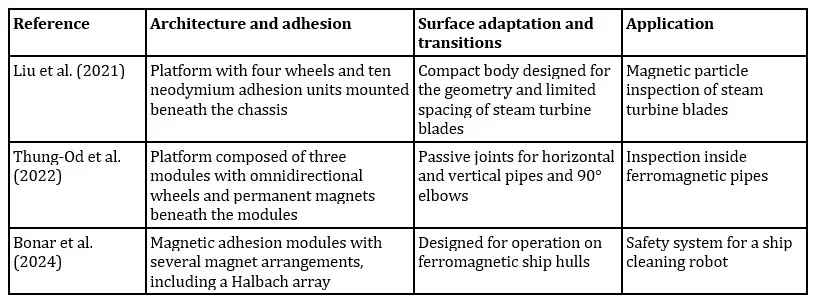
Liu et al. (2021) developed a compact robot with four wheels for automatic magnetic particle inspection of steam turbine blades. Ten neodymium adhesion units are mounted beneath the chassis, and each unit combines a magnet, a rubber sleeve, and a steel yoke. The rubber sleeves increase friction, while the yokes help close the magnetic circuit. Locomotion is provided by four driven wheels, and the compact body allows the robot to operate in the limited space between adjacent turbine blades.
Thung-Od et al. (2022) presented a robot composed of three modules for inspection inside ferromagnetic pipes. Permanent magnets are mounted beneath each module, while omnidirectional wheels provide longitudinal and transverse motion. Passive joints between the modules help maintain contact with the pipe wall and allow the robot to pass through 90° elbows. This combination of modular articulation and omnidirectional wheels allows the robot to change orientation inside confined pipes.
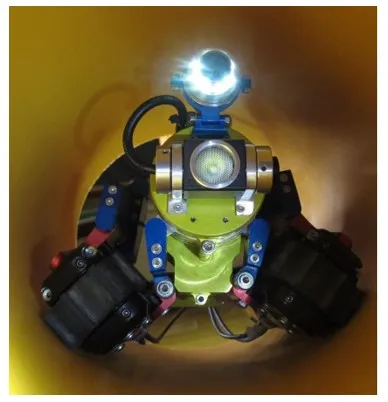
Figure 2 shows a compact platform for inspection inside pipes. Several wheel modules are arranged around a central body so that the platform can maintain contact with the inner pipe surface. Articulated connections allow the wheel assemblies to adapt to the cylindrical geometry of the pipe, while front lighting supports visual operation in confined spaces.
Fig. 2. Compact pipe inspection platform with articulated wheel
modules arranged around the central body.
Bonar et al. (2024) investigated magnetic adhesion modules developed for a robot intended to clean ferromagnetic ship hulls. The study compared several magnet arrangements, including a Halbach array, using numerical analysis and measurements of physical modules. The aim was to obtain sufficient adhesion for safe operation of the cleaning robot on the hull surface.
Table 1 summarizes the systems in which magnetic adhesion is integrated into the chassis or separate modules.
Table 1. Comparison of magnetic adhesion systems integrated into the chassis or separate modules
Robots with magnetic wheels
Integrating magnets into the wheels combines adhesion and rolling contact in one component. The reviewed designs differ in magnet geometry, magnetic circuit arrangement, tire construction, and the method used to change magnetic force during surface transitions or removal of the robot.
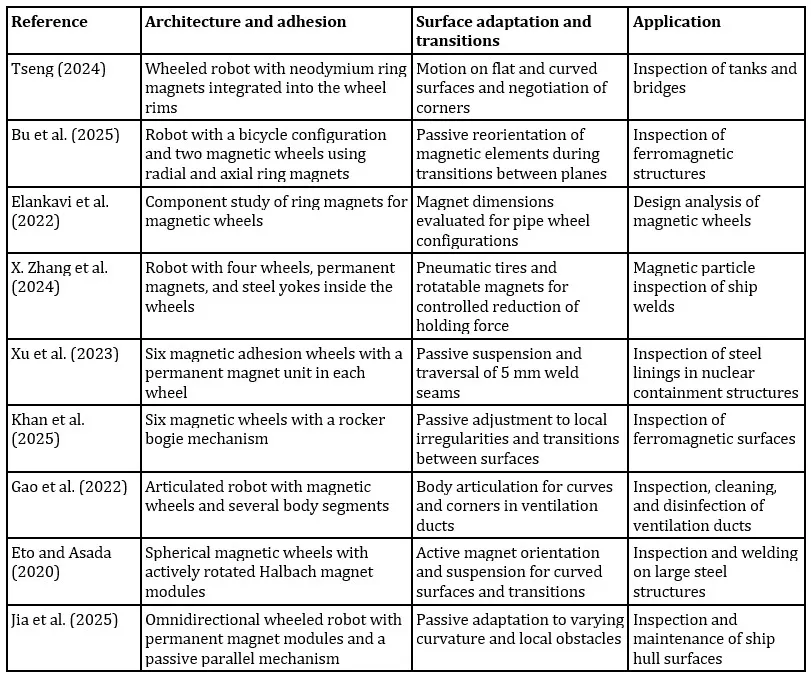
Tseng (2024) described a wheeled inspection robot for ferromagnetic structures such as tanks and bridges. Neodymium ring magnets are integrated into the wheel rims, and rubber covers increase friction. The robot is intended to move on flat and curved surfaces and negotiate corners while retaining a relatively simple architecture based on magnetic wheels.
Bu et al. (2025) developed BiMagBot, a robot with a bicycle configuration and two magnetic wheels designed for transitions between planes. The front wheel contains a radially magnetized ring magnet and a curved contact element that rotates the magnet passively when the robot approaches a corner. The rear wheel uses an axially magnetized ring magnet mounted with clearance so that it can align with the new surface. The transition is achieved through passive changes in magnetic orientation and does not require an additional actuator.
Elankavi et al. (2022) investigated ring magnets intended for magnetic wheels used in pipe robots. The study varied magnet thickness and inner diameter and evaluated the resulting adhesion using FEMM. The work provides design information for selecting ring magnet configurations rather than presenting a complete inspection platform.
Zhang et al. (2024) developed a robot with four wheels for magnetic particle inspection of ship welds. Each wheel contains several permanent magnets mounted on a steel yoke that directs magnetic flux toward the surface. Pneumatic tires increase friction and provide local compliance. The wheel assembly also allows the magnets to rotate so that the holding force can be reduced when the robot is removed from the surface.
Xu et al. (2023) developed NuBot, a robot with six magnetic adhesion wheels and passive suspension for inspection of steel linings in nuclear containment structures. Each wheel contains a permanent magnet unit. The passive suspension allows the wheel assemblies to adapt to changes in surface geometry and helps maintain contact with the inspected surface. Experiments reported stable locomotion at different wall inclinations, traversal of 5 mm weld seams, and a maximum payload of 3.6 kg.
Khan et al. (2025) presented a robot with six magnetic wheels and a rocker bogie mechanism. Cylindrical neodymium magnets are arranged inside the wheels and enclosed by steel elements that act as yokes. Flexible tires and the rocker bogie mechanism allow passive adjustment to local surface irregularities and help the platform traverse welds and transitions between surfaces.
Gao et al. (2022) proposed a robot with several articulated body segments and magnetic wheels for inspection, cleaning, and disinfection of ventilation ducts. Rectangular magnets are distributed around the wheel circumference. The articulated body changes its configuration as the robot passes through curves and corners in the duct.
Eto and Asada (2020) developed spherical magnetic wheels for movement on curved ferromagnetic surfaces. Each wheel contains a rotating magnet mechanism based on a Halbach array, which allows the direction of magnetic attraction to be adjusted relative to the contact surface. The wheels are connected to the robot body through a suspension mechanism that helps maintain contact on curved surfaces and small obstacles. This approach provides controlled adaptation but requires active orientation of the magnets.
Jia et al. (2025) proposed an omnidirectional wheeled robot with a passive parallel mechanism for ship hull surfaces. The mechanism compensates for height differences and changes in local surface angle while permanent magnet modules provide adhesion. The design combines omnidirectional wheel motion with passive chassis adaptation to surfaces with varying curvature and local obstacles.
Table 2 summarizes the reviewed magnetic wheel architectures.
Table 2. Comparison of magnetic wheel architectures
Robots with magnetic tracks
Tracked systems spread magnetic adhesion over a larger contact area than individual wheels. This can improve contact on uneven or curved surfaces, while passive links and compliant track mechanisms can help the robot adjust to changes in surface geometry.
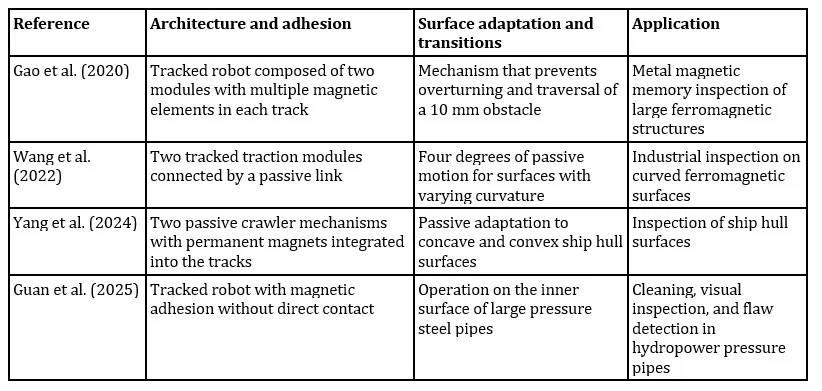
Gao et al. (2020) developed a tracked magnetic robot for inspection of large ferromagnetic structures using metal magnetic memory testing. The robot consists of two climbing modules connected by a mechanism that prevents overturning during obstacle traversal. Each module contains two track units with multiple magnetic elements. Experiments reported a payload of 10 kg on a vertical surface and traversal of a 10 mm obstacle.
Wang et al. (2022) developed a tracked robot for surfaces with varying curvature. Two traction modules are connected by a link that provides four degrees of passive motion, allowing the robot to adjust to changes in surface geometry while maintaining magnetic adhesion. The prototype carried a 36 kg payload on a vertical surface, showing the benefit of the large contact area provided by the tracks.
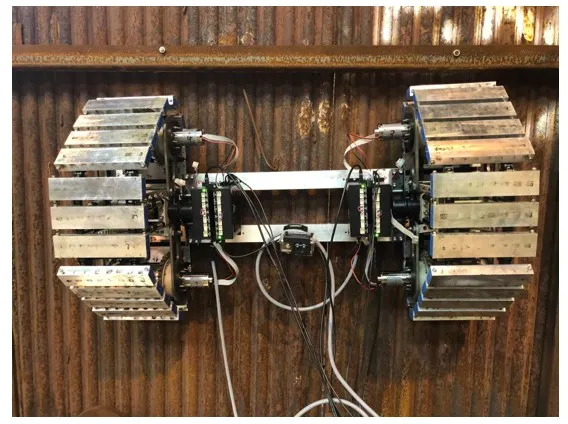
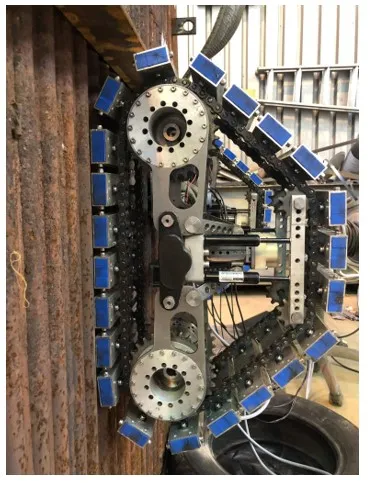
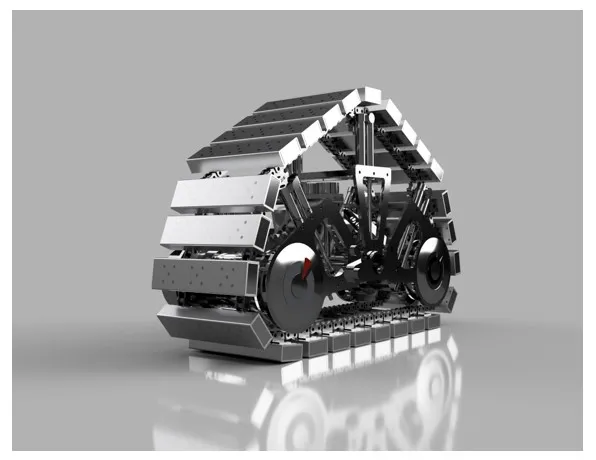
Figures 3 to 5 present an example of a tracked magnetic platform and its locomotion module. Figure 3 shows the complete platform on a vertical steel surface, while Figs. 4 and 5 show the track module and its mechanical arrangement in greater detail.
Fig. 3. Magnetic tracked platform operating on a vertical steel surface.
Fig. 4. Detail of a magnetic track module showing the distribution
of magnetic elements along the track.
Fig. 5. CAD model of a magnetic track module showing the drive assembly, frame, and contact elements.
Yang et al. (2024) developed a tracked robot for ship hull surfaces with varying curvature. The robot uses two passive crawler mechanisms connected by a central module. Multiple permanent magnets are integrated into each track, and the track geometry allows passive adaptation to concave and convex surfaces. The design is intended for ship inspection where surface curvature changes continuously.
Guan et al. (2025) presented a multifunctional tracked robot for inspection of pressure steel pipes in hydropower plants. The magnetic modules generate adhesion without direct contact with the inspected surface. The platform combines climbing with cleaning, visual inspection, and flaw detection and was tested on the inner surface of a pressure steel pipe.
Table 3 summarizes the reviewed magnetic track architectures.
Table 3. Comparison of magnetic track architectures
Legged and crawling magnetic robots
Legged and crawling robots move by repeatedly attaching and releasing separate magnetic contacts instead of relying on continuously rotating wheels or tracks. Because individual contacts can be repositioned during motion, these robots can adapt to large changes in surface orientation. This flexibility requires more complex coordination of attachment, detachment, and body movement.
Legged robots
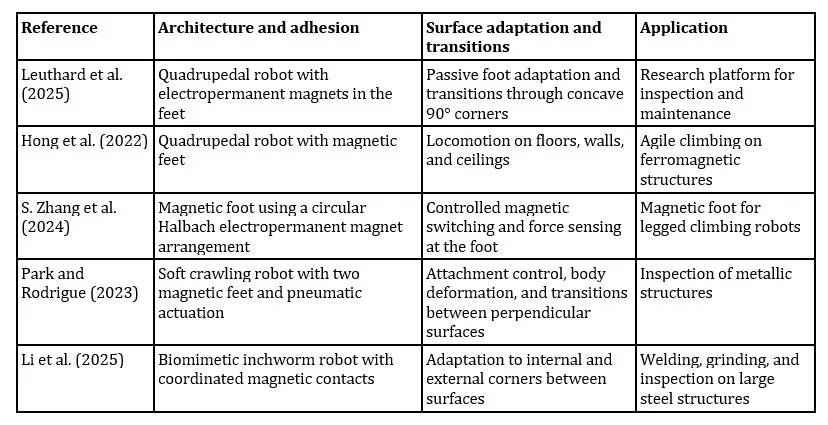
Leuthard et al. (2025) presented Magnecko, a quadrupedal robot with electropermanent magnets in its feet. Rubber rings pressed by springs increase friction, and a passive foot mechanism with three degrees of freedom adapts to local surface orientation. The robot uses coordinated stepping to move on floors, vertical walls, and overhead surfaces and can pass through concave 90° corners.
Hong et al. (2022) developed a quadrupedal robot capable of locomotion on ferromagnetic floors, walls, and ceilings. The study demonstrates agile movement across surfaces with different orientations and shows how legged locomotion can reposition magnetic contact points independently.
Zhang et al. (2024) focused on the magnetic foot and proposed an electropermanent magnetic module based on a circular Halbach arrangement. The foot integrates magnetic holding, a friction pad, and force sensing. The study evaluates holding force density, magnetic switching, and force measurement, which are important for controlled attachment and detachment in legged robots.
Crawling robots
Park and Rodrigue (2023) developed a soft climbing robot with two magnetic feet. Soft pneumatic actuators deform the body and control attachment and detachment of the feet. By alternating the attached foot and changing the body shape, the robot can crawl on horizontal and vertical surfaces and move between perpendicular surfaces.
Li et al. (2025) developed a biomimetic inchworm robot for operation on large ferromagnetic structures. The robot coordinates magnetic attachment with extension and contraction of the body and is designed to negotiate both internal and external corners between surfaces with different orientations. This provides an alternative to continuous wheel or track locomotion when large changes in surface orientation must be crossed.
Table 4 compares the legged and crawling systems discussed in Sections 4.1 and 4.2.
Table 4. Comparison of legged and crawling magnetic robots
Surface adaptation and transitions
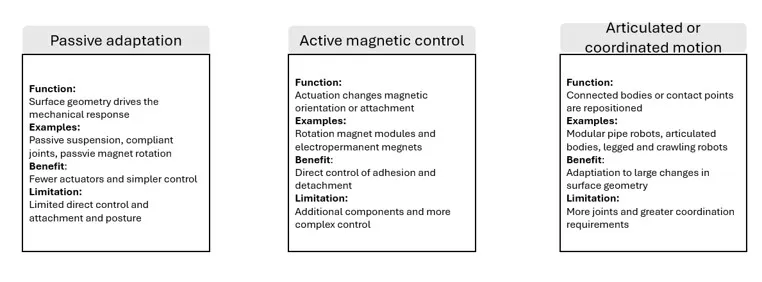
Moving from one surface orientation to another requires the robot to maintain adhesion while its contact points change position. The reviewed designs solve this problem in three main ways. Passive adaptation uses joints, suspensions, or magnetic elements that move in response to the surface geometry. Active magnetic control uses actuators or switchable magnetic devices to change the direction or magnitude of adhesion. Articulated, legged, and crawling robots reposition body sections or individual contact points to complete the transition. Some robots combine more than one of these approaches.
Passive adaptation allows the mechanism to adjust to the surface without a separate actuator for that motion. Bu et al. (2025), for example, use passive rotation of magnetic elements during transitions between planes. Xu et al. (2023), Khan et al. (2025), Jia et al. (2025), Wang et al. (2022), and Yang et al. (2024) use passive suspension, chassis mechanisms, or compliant connections to maintain contact on uneven surfaces or surfaces with changing curvature.
Active magnetic control changes the magnetic system through controlled actuation. Eto and Asada (2020) rotate magnet modules inside spherical wheels so that magnetic attraction remains directed toward the supporting surface. X. Zhang et al. (2024) rotate magnets inside the wheels to reduce the holding force during removal. In legged robots, electropermanent magnets provide another method for switching adhesion during each step.
Articulated and modular robots adapt by changing the relative position of connected body sections or contact points. Thung-Od et al. (2022) use passive joints between modules to maintain contact inside pipes and through elbows, while Gao et al. (2022) use an articulated body to negotiate curves and corners in ventilation ducts. Legged and crawling robots achieve a similar result by repositioning individual magnetic contacts in sequence. Surface transitions therefore depend on both the adhesion system and the mechanical freedom available to reposition the robot relative to the surface.
Figure 6 summarizes the main approaches to surface adaptation and transitions identified in the reviewed studies.
Fig. 6. Schematic comparison of passive adaptation, active magnetic control, and articulated or coordinated motion during surface transitions.
Discussion
The reviewed studies show a clear relationship between surface geometry, magnetic adhesion, and the choice of locomotion system. Wheeled robots appear most frequently in the reviewed studies and provide continuous motion with relatively simple mechanical construction. When magnets are integrated into the wheels, wheel geometry, friction, magnetic circuit design, and the method used to reduce adhesion during steering or removal must be considered together.
For surfaces that are mostly flat or have moderate curvature, wheeled platforms can provide a relatively simple solution, especially when tires or passive suspension accommodate local irregularities. Tracked robots spread adhesion over a larger contact area and can adapt more effectively to uneven or curved surfaces when combined with passive compliance. Legged and crawling robots allow individual contact points to be repositioned during motion, which is useful for large changes in orientation and transitions between surfaces. These capabilities generally require more joints, actuators, or coordination than simple wheeled platforms.
Another important design issue is the balance between adhesion and mobility. Stronger magnetic adhesion increases resistance to accidental detachment, but it can also make rolling, steering, and intentional removal more difficult. The reviewed designs address this problem using rotatable magnets, electropermanent magnets, compliant mechanisms, and sequential attachment of magnetic feet. Controlled detachment should therefore be considered together with the required holding force during design.
Direct numerical comparison is limited because the studies use different robot sizes, payloads, test surfaces, transition geometries, and performance measures. These differences make a single numerical ranking inappropriate. The choice of architecture should instead reflect the intended environment and task, including surface curvature, expected obstacles and transitions, payload, inspection equipment, required speed, and acceptable mechanical and control complexity.
Conclusions
This review compared magnetic climbing robots reported between 2020 and 2025 in terms of adhesion arrangement, locomotion architecture, and surface geometry. Wheeled systems are the most common in the reviewed studies and provide a relatively simple solution for continuous motion. Tracked systems distribute adhesion over a larger area and are well suited to surfaces with changing curvature, while legged and crawling robots provide greater freedom to reposition individual magnetic contacts during transitions.
Several design problems appear across all of these architectures. The robot must generate enough magnetic force to remain safely attached while still allowing efficient motion and deliberate detachment. It must also maintain contact on curved or uneven surfaces and move through corners or transitions without losing stability. The appropriate solution therefore depends on the geometry of the inspected structure, the required payload, and the inspection task.
Future studies would benefit from more consistent reporting of holding force, payload, speed, obstacle and transition capability, surface geometry, and test conditions. Such reporting would make quantitative comparison between architectures more reliable and would complement the qualitative design comparison presented in this review.
Taken together, the reviewed studies show that magnetic adhesion cannot be considered separately from locomotion and surface adaptation. The most appropriate architecture is the one in which these elements are matched to the geometry and operational requirements of the intended inspection task.
References
Bonar, B., Buratowski, T., Rosikowski, P., Pac, P. and Giergiel, M. (2024), “Magnetic safety equipment development for ship cleaning robot,” Communications of the IBIMA, 2024, Article 484764.
Bu, Y., Dun, L., Deng, Y., Jiang, B., Jiang, A. and Zhu, H. (2025), “Development of a bicycle-like magnetic-wheeled climbing robot with adaptive plane-transition capabilities,” Machines, 13, 167.
Elankavi, R.S., Dinakaran, D., Kuppan Chetty, R.M., Ramya, M.M. and Jose, J. (2022), “An investigation on magnetic characteristics of ring magnet for wheeled in-pipe and out-pipe robots,” Proceedings of the 3rd International Conference on Robotics Automation and Non-Destructive Evaluation (RANE 2022), CLAWAR Association Ltd, Chennai, India. doi:10.13180/RANE.2022.23.04.34.
Eto, H. and Asada, H.H. (2020), “Development of a wheeled wall-climbing robot with a shape-adaptive magnetic adhesion mechanism,” Proceedings of the 2020 IEEE International Conference on Robotics and Automation (ICRA), pp. 9329–9335.
Gao, F., Fan, J., Zhang, L., Jiang, J. and He, S. (2020), “Magnetic crawler climbing detection robot basing on metal magnetic memory testing technology,” Robotics and Autonomous Systems, 125, 103439. doi:10.1016/j.robot.2020.103439.
Gao, M., Huang, M., Tang, K., Lang, X. and Gao, J. (2022), “Design, analysis, and control of a multilink magnetic wheeled pipeline robot,” IEEE Access, 10, 67168–67180.
Guan, E., Cui, J., Zhao, Y. and Wang, Y. (2025), “A multifunctional magnetic climbing robot for pressure steel pipe inspections in hydropower plants,” Machines, 13(10), 951. doi:10.3390/machines13100951.
Hong, S., Um, Y., Park, J. and Park, H.-W. (2022), “Agile and versatile climbing on ferromagnetic surfaces with a quadrupedal robot,” Science Robotics, 7(73), eadd1017. doi:10.1126/scirobotics.add1017.
Jia, P., Zheng, T., Li, M., Zhang, M. and Huang, Z. (2025), “Design and analysis of wall-climbing robot with passive adaptive parallel mechanism,” Applied Ocean Research, 161, 104690. doi:10.1016/j.apor.2025.104690.
Khan, A., Ahmad, W. and Hussain, S. (2025), “Design and fabrication of wall-climbing robot using magnetic adhesion,” Engineering Proceedings, 111, 8.
Leuthard, S., Eugster, T., Faesch, N., Feingold, R., Flynn, C., Fritsche, M., Hürlimann, N., Morbach, E., Tischhauser, F., Müller, M., Montenegro, M., Schelbert, V., Chiu, J.-R., Arm, P. and Hutter, M. (2025), “Magnecko: Design and control of a quadrupedal magnetic climbing robot,” arXiv preprint arXiv:2504.13672, 18 April 2025.
Li, P., Wang, B., Zhang, L., Zhao, Y., Guan, E., Xu, Y., Ji, H., Li, P. and Zhao, Y. (2025), “Design and analysis of a biomimetic inchworm magnetic wall-climbing robot,” Journal of Field Robotics, 42(8), 4500–4520. doi:10.1002/rob.70016.
Liu, J., Yu, H., Mei, L. and Han, B. (2021), “Development of a new type of automatic magnetic particle inspection wall-climbing robot,” Advances in Mechanical Engineering, 13(9), 1–15.
Park, G. and Rodrigue, H. (2023), “Soft climbing robot with magnetic feet for multimodal locomotion,” Scientific Reports, 13, 8377.
Thung-Od, K., Kanjanawanishkul, K., Maneewarn, T., Sethaput, T. and Boonyaprapasorn, A. (2022), “An in-pipe inspection robot with permanent magnets and omnidirectional wheels: Design and implementation,” Applied Sciences, 12, 1226.
Tseng, A. (2024), “AI-powered magnetic inspection robot for advanced structural health monitoring of ferromagnetic structures,” International Journal of Scientific Engineering and Science, 8(9), 92–102.
Wang, Y., Zhang, X., Zhang, M., Sun, L. and Li, M. (2022), “Self-compliant track-type wall-climbing robot for variable curvature facade,” IEEE Access, 10, 51951–51963. doi:10.1109/ACCESS.2021.3068000.
Xu, H., Han, Y., He, M., Li, Y. and Guo, W. (2023), “NuBot: A magnetic adhesion robot with passive suspension to inspect the steel lining,” Chinese Journal of Mechanical Engineering, 36, 90. doi:10.1186/s10033-023-00905-6.
Yang, P., Sun, L. and Zhang, M. (2024), “Design and analysis of a passive adaptive wall-climbing robot on variable curvature ship facades,” Applied Ocean Research, 143, 103879. doi:10.1016/j.apor.2024.103879.
Zhang, S., Li, A., Tao, B., Hu, T., Mao, R., Yu, Q. and Ding, H. (2024), “Design of magnetic feet for climbing robot with novel circular Halbach net EPM structure,” IECON 2024 – 50th Annual Conference of the IEEE Industrial Electronics Society. doi:10.1109/IECON55916.2024.10905383.
Zhang, X., Zhang, M., Jiao, S., Sun, L. and Li, M. (2024), “Design and optimization of the wall climbing robot for magnetic particle detection of ship welds,” Journal of Marine Science and Engineering, 12, 610.