Jimsiok C. ASID, Norenna S. SARAHADIL, Hartini D. SARADI, Delfina A. AMPUNG, Fatima Haridja G. TAGAYAN, Hussam A. TAGAYAN, Zhiraida A. DAUD, Almina S. MUALL AM, Abdelsuhod S. ABDURAHMAN And Fatima Reiza J. HASSAN
College of Business Administration and Management, Sulu State College, Jolo, Sulu 7400, Philippines
Volume 2026,
Article ID 547317,
IBIMA Business Review,
15 pages,
DOI: https://doi.org/10.5171/2026.547317
Received date: 30 April 2026; Accepted date: 12 June 2026; Published date: 29 June 2026
Cite this Article as:
Jimsiok C. ASID, Norenna S. SARAHADIL, Hartini D. SARADI, Delfina A. AMPUNG, Fatima Haridja G. TAGAYAN, Hussam A. TAGAYAN, Zhiraida A. DAUD, Almina S. MUALL AM, Abdelsuhod S. ABDURAHMAN And Fatima Reiza J. HASSAN (2026)," Navigating Financial Volatility: Resilience and Livelihood Sustainability among Micro-Entrepreneurs in Jolo, Sulu, Philippines “, IBIMA Business Review, Vol. 2026 (2026), Article ID 547317, https://doi.org/10.5171/2026.547317
Financial volatility continues to threaten the sustainability of micro-enterprises by disrupting business continuity, income stability, and long-term livelihood security, particularly in resource-constrained communities. Despite increasing attention to entrepreneurial resilience, limited evidence explains how financial vulnerabilities, operational challenges, resilience strategies, and support mechanisms collectively influence livelihood sustainability in geographically isolated settings. This study explored the financial and operational challenges experienced by micro-entrepreneurs and examined the resilience strategies and support mechanisms that enabled them to sustain their livelihoods in Jolo, Sulu, Philippines. An exploratory qualitative research design was employed using semi-structured interviews with 20 purposively selected micro-entrepreneurs. Data were analyzed through reflexive thematic analysis to identify recurring patterns across participants’ experiences. The findings revealed that capital insecurity, income instability, market competition, managerial capability constraints, and resource coordination challenges threatened livelihood sustainability. Participants addressed these challenges through incremental market entry, structured financial monitoring, adaptive decision-making, prudent resource management, and support from mentors, entrepreneurial networks, and family members. The findings indicate that sustainable micro-entrepreneurial livelihoods are shaped by the interaction of financial discipline, adaptability, and socially embedded support systems. Strengthening financial preparedness, entrepreneurial capability, and accessible support networks may enhance business continuity and promote more sustainable livelihood outcomes in resource-constrained communities
Keywords: Financial Volatility, Entrepreneurial Resilience, Livelihood Sustainability, Micro-Entrepreneurship, Business Adaptation
Introduction
Micro-entrepreneurship serves as an important source of livelihood and economic participation, particularly in developing economies where formal employment opportunities remain limited. Beyond income generation, micro-enterprises contribute to livelihood security, community stability, and inclusive economic development. However, many micro-entrepreneurs operate under conditions of financial uncertainty characterized by limited capital, unstable income, and restricted access to financial protection mechanisms. These conditions threaten business continuity and livelihood sustainability, particularly in resource-constrained environments. As such, understanding how micro-entrepreneurs navigate financial vulnerabilities and sustain their enterprises has become an important area of inquiry within entrepreneurship and livelihood research. Sustainability-oriented approaches emphasize the importance of equipping individuals with practical skills that enable long-term adaptation to real-life economic and social challenge (Barrientos, 2025). Within this context, sustaining micro-enterprises extends beyond profit generation and encompasses the capacity to maintain consistent income, ensure work continuity, and support dignified living conditions. According to Suguna et al. (2024), entrepreneurial activity enhances economic participation and fosters resilience in underserved communities, while Morales (2021) emphasizes that micro and small enterprises serve as essential drivers of sustainable economic systems and employment generation.
Despite these contributions, micro-entrepreneurs frequently operate under persistent financial constraints and uncertain market conditions that threaten the sustainability of their livelihoods. Limited access to capital, unstable cash flows, and vulnerability to economic fluctuations intensify the challenges associated with maintaining business continuity. Senaya (2025) explain that financial instability often amplifies perceived risks and discourages proactive decision-making among entrepreneurs in emerging economies. In parallel, Martin and Jan (2024) highlight that early-stage entrepreneurs commonly encounter difficulty balancing operational costs with income generation, which places pressure on both business survival and personal well-being. These conditions reflect broader concerns within the domain of decent work, where income security and stability remain central to sustainable employment. Financial vulnerability is often accompanied by the need to develop adaptive coping strategies, as individuals facing economic constraints reorganize their resource management and decision-making processes to sustain continuity under uncertain conditions (Chavez, 2020).
Beyond financial vulnerabilities, operational challenges further complicate the ability of micro-entrepreneurs to sustain their enterprises. Many individuals enter business ownership with limited managerial experience, which creates difficulties in handling essential functions such as financial management, inventory control, and workforce supervision. Hasyim and Muhammad (2024) note that constrained resources often limit the capacity of small business owners to respond effectively to disruptions, while insufficient operational knowledge can heighten uncertainty and reduce confidence in decision-making. These constraints not only affect business performance but also influence the quality and sustainability of work experienced by entrepreneurs themselves, reinforcing the interconnected nature of economic sustainability and decent work.
In response to these vulnerabilities, micro-entrepreneurs adopt various resilience strategies that enable them to navigate uncertainty and sustain their livelihoods. Adaptive practices such as gradual market entry, strict financial monitoring, and flexible decision-making have been widely observed among small business owners facing resource limitations. Sott and Bender (2025) argue that adaptability and incremental growth approaches enhance survival capacity during periods of instability. Disruptions in income streams significantly affect livelihood stability, particularly when individuals depend on limited and inconsistent financial sources, thereby increasing exposure to both economic and psychological strain (Chavez et al., 2023). Social networks, mentorship, and community-based guidance further contribute to emotional stability and informed decision-making, which are essential for maintaining business continuity under pressure.
The intersection of financial vulnerability and resilience reflects a broader sustainable development concern, where sustaining livelihoods requires both economic viability and supportive social structures. Micro-entrepreneurial activities represent a form of self-generated employment that contributes to decent work, yet their sustainability remains contingent upon the ability to manage risks and access support systems. Siburian et al. (2026) explain that socio-cultural environments influence how individuals respond to uncertainty, shaping both their coping strategies and long-term business outcomes. Strengthening these adaptive capacities aligns with sustainable development priorities that emphasize inclusive economic participation and equitable opportunities for livelihood stability.
Existing research on micro-entrepreneurship has examined financial constraints, operational challenges, and entrepreneurial resilience as separate areas of inquiry. However, limited studies have explored how these factors interact simultaneously to influence livelihood sustainability in marginalized and conflict-affected communities. Existing literature has primarily emphasized economic indicators and structural constraints while providing limited attention to the lived experiences, psychological pressures, and socially embedded support systems that shape entrepreneurial resilience. Furthermore, empirical evidence from geographically isolated areas such as Jolo, Sulu remains scarce. Addressing this gap, the present study investigates how financial vulnerabilities, operational challenges, resilience strategies, and support mechanisms collectively shape the sustainability of micro-entrepreneurial livelihoods in Jolo, Sulu, Philippines. Specifically, the study aims to: (1) examine the financial vulnerabilities and operational challenges affecting livelihood sustainability among micro-entrepreneurs; and (2) explore the resilience strategies and support mechanisms that enable entrepreneurs to sustain business continuity under conditions of financial uncertainty.
Literature Review
Financial Instability in Micro-Enterprises
Financial instability remains a persistent condition shaping the sustainability of micro-enterprises, particularly within low-resource environments. Limited access to formal credit systems, irregular income streams, and exposure to volatile market conditions constrain the capacity of entrepreneurs to maintain stable operations. Parashar et al. (2024) emphasize that financial fragility heightens perceived business risk and discourages long-term planning, while Yang et al. (2023) note that small enterprises often depend on informal financing mechanisms that lack security and predictability. Maamor et al. (2025) argue that inconsistent revenue cycles intensify pressure on entrepreneurs to prioritize short-term survival over sustainable growth, which weakens overall economic resilience. In the Philippines, micro-entrepreneurs frequently rely on personal savings and informal lending, a condition that increases vulnerability to financial shocks and livelihood disruption. These conditions highlight how financial instability intersects where income insecurity undermines the continuity of decent work and equitable economic participation.
Entrepreneurial Livelihood and Decent Work
Micro-entrepreneurship functions as an alternative pathway to employment, particularly in regions where formal labor markets are limited or exclusionary. The concept of decent work extends beyond job availability and encompasses income stability, security, and dignity within work arrangements. Hailemicheal et al. (2025) explain that socio-economic environments influence how individuals pursue livelihood opportunities, shaping both access to resources and perceptions of work sustainability. Arbelo-Pérez et al. (2025) suggest that community norms and institutional conditions affect entrepreneurial motivation and long-term engagement in business activities. In developing economies such as the Philippines, self-employment through micro-enterprises often becomes a necessity rather than a choice, reflecting structural gaps in labor systems. Ma and Dunhill (2025) further indicate that livelihood sustainability is closely tied to the entrepreneur’s ability to maintain consistent income while managing personal and business responsibilities. Sustaining decent work through micro-enterprises requires not only economic viability but also supportive environments that enable individuals to endure uncertainty and maintain productive engagement.
Operational Constraints and Capability Gaps
Operational limitations present another layer of complexity in sustaining micro-enterprises, particularly among first-time entrepreneurs with limited managerial exposure (Hokmabadi et al., 2024). Challenges related to financial management, regulatory compliance, supply chain coordination, and workforce supervision often emerge during the early stages of business development. Resource constraints restrict the ability of entrepreneurs to develop structured operational systems, leading to inefficiencies and heightened uncertainty. Pahinga and Martin (2025) explain that gaps in institutional support and training can transform routine business functions into perceived threats, thereby affecting decision-making confidence. Small enterprises frequently struggle to integrate strategic planning due to limited technical knowledge and access to information. Michael (2024) adds that adaptive capability remains uneven across micro-enterprises, particularly in contexts where external support is minimal. In the Philippines, these operational gaps are often compounded by bureaucratic processes and limited access to formal business training, which further constrains sustainability.
Methodology
Research design
This study adopts an exploratory qualitative research design to investigate financial vulnerabilities and resilience strategies that influence the sustainability of micro-entrepreneurial livelihoods. An exploratory qualitative approach is particularly appropriate for capturing the depth and complexity of entrepreneurs’ lived experiences, including the financial, operational, and social dimensions that affect their business sustainability. Focusing on participants’ subjective narratives, this design provides a comprehensive understanding of how financial vulnerabilities, operational challenges, resilience strategies, and support mechanisms collectively influence the sustainability of micro-entrepreneurial livelihoods. It also facilitates an in-depth exploration of how these experiences shape business continuity under conditions of financial uncertainty. . To systematically interpret these narratives, reflexive thematic analysis is employed as the primary analytical framework, ensuring that recurring patterns of financial vulnerability, operational challenges, resilience strategies, and social sustainability practices are rigorously identified and analyzed.
Population and sampling
The target population for this study consisted of individuals who have started and are currently operating micro and small enterprises. These entrepreneurs were selected because they are most likely to experience financial and operational vulnerabilities, which directly affect the sustainability of their livelihoods and social well-being. The sampling frame was composed of entrepreneurs located within the municipality of Jolo, Sulu, Philippines, identified through local business directories, entrepreneur networks, and referrals. A purposive sampling technique was used to ensure that participants had direct and relevant experience with starting and managing a micro or small business.
To ensure the relevance and reliability of the data, sample selection was based on the following inclusion criteria: participants must be the primary founder or current owner-manager of a micro or small enterprise; the business must be actively operating within Jolo, Sulu, Philippines; and participants must have direct experience with the startup phase of their business to accurately recall financial and operational challenges, coping strategies, and resilience practices. A total of 20 participants were selected for the study. This sample size is appropriate for exploratory qualitative research, where 15–20 participants typically achieve data saturation. Saturation was assessed during data collection and analysis by monitoring the emergence of new codes and themes. After the eighteenth interview, no substantially new themes emerged from participants’ narratives. Two additional interviews were conducted to confirm thematic consistency and ensure that data saturation had been achieved. Diversity in gender, industry type, and background was considered to provide a comprehensive understanding of the financial vulnerabilities, resilience strategies, and social sustainability practices among different micro-entrepreneurs.
Research Instrument
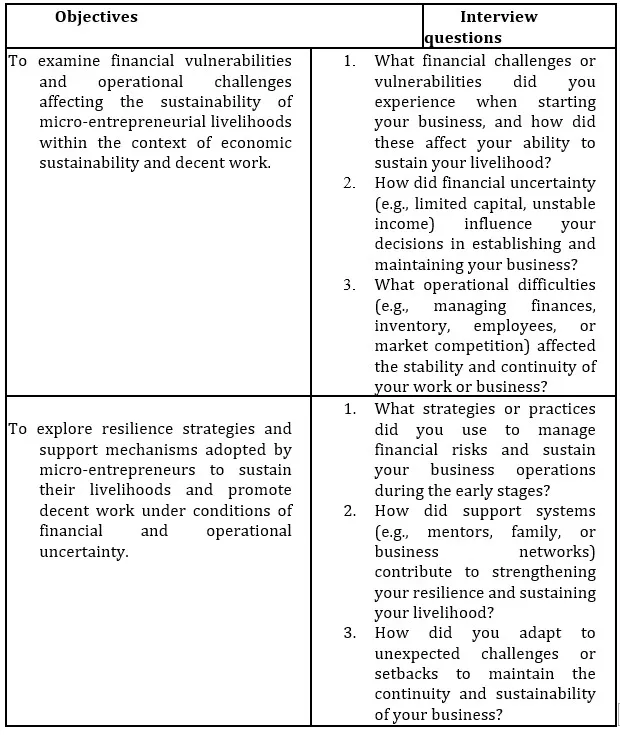
The research instrument was a semi-structured interview guide, designed to elicit in-depth responses aligned with the study’s objectives. The guide focused on understanding financial vulnerabilities, operational challenges, resilience strategies, support mechanisms, and the role of social sustainable practices in sustaining micro-entrepreneurial livelihoods. The questions encouraged participants to reflect on the ways in which financial uncertainty, operational difficulties, and social networks influenced their business continuity and contribution to decent work and social sustainability.
Table 1. Instrument of the study
Data Gathering Procedure
Before data collection, participants received an informed consent letter detailing the research objectives, scope, and ethical considerations. Face-to-face interviews were conducted using the semi-structured guide, allowing flexibility while ensuring consistency across sessions. With participants’ consent, interviews were audio-recorded and supplemented with notes to capture both verbal and non-verbal responses. All interviews were transcribed verbatim to support accurate and comprehensive reflexive thematic analysis.
Data Analysis
Data were analyzed using reflexive thematic analysis, which is well-suited for identifying, analyzing, and interpreting patterns or themes within qualitative data. This method enabled a detailed exploration of financial vulnerabilities, operational challenges, resilience strategies, and social sustainability practices among micro-entrepreneurs. Reflexive thematic analysis facilitated the identification of recurring themes related to financial risk management, adaptive strategies, support networks, and contributions to decent work and community well-being. Closely examining participants’ narratives, the study offers a nuanced understanding of how micro-entrepreneurs navigate uncertainties while promoting sustainable livelihoods within the context of economic, social, and operational sustainability.
Trustworthiness of the Study
To enhance the rigor and trustworthiness of the findings, the study adopted the criteria of credibility, transferability, dependability, and confirmability. Credibility was strengthened through prolonged engagement with participants and the use of verbatim transcription of interview data. Transferability was supported by providing detailed descriptions of the research context, participant characteristics, and study procedures. Dependability was established through consistent application of the interview protocol and systematic documentation of coding and theme development. Confirmability was promoted by maintaining reflexive notes during data analysis and ensuring that interpretations were grounded in participants’ narratives rather than researcher assumptions. These procedures enhanced the overall quality and trustworthiness of the qualitative findings.
Ethical Considerations
This study strictly adhered to ethical principles to ensure the protection of participants’ rights, welfare, and dignity throughout the research process. Prior to the interviews, participants were fully informed about the study’s objectives, and potential implications, and written consent was obtained to confirm their voluntary participation. Participants were assured of their right to withdraw from the study at any time without any negative consequences. To maintain confidentiality and privacy, all data were anonymized, and pseudonyms were used in transcripts and reporting; sensitive information about individual businesses or financial situations was handled with the utmost care and stored securely, accessible only to the researcher. Transparency and integrity were maintained by informing participants of how the findings would be used, including potential publications, while cultural sensitivity was observed by respecting local norms, values, and business practices in Jolo, Sulu, Philippines. These measures collectively ensured that the research upheld ethical standards while contributing to a deeper understanding of the financial and operational realities of micro-entrepreneurial livelihoods. Participation was entirely voluntary, and participants were informed of their right to withdraw at any stage of the research process without penalty. No identifying information was included in the reporting of findings. Digital recordings, transcripts, and research notes were securely stored and accessed only by the research team. The study complied with institutional ethical standards governing social science research involving human participants.
Results
Research Objective 1. To examine financial vulnerabilities and operational challenges affecting the sustainability of micro-entrepreneurial livelihoods within the context of economic sustainability and decent work.
Question No. 1. What financial challenges or vulnerabilities did you experience when starting your business, and how did these affect your ability to sustain your livelihood?
Capital Insecurity and Income Instability
Ten (10) respondents described persistent concerns regarding insufficient financial resources during the early stages of business establishment. Participants emphasized uncertainty regarding whether available capital would sustain operations until revenue streams became stable. Anxiety related to unpredictable income, delayed returns on investment, and the pressure to meet recurring expenses reflected exposure to economic vulnerability. Many participants depended on personal savings, which intensified apprehension regarding financial depletion and livelihood interruption. These conditions illustrate how fragile capital structures influence continuity of work and the sustainability of self-employment.
“I was terrified of running out of money before the business even had a chance to take off.”
“I wasn’t sure if I’d make enough money each month to cover expenses.”
Perceived Risk of Economic Loss and Livelihood Disruption
Ten (10) respondents expressed apprehension regarding potential business failure and its implications for financial security and social expectations. Participants associated possible failure with debt accumulation, loss of invested resources, and diminished confidence in sustaining self-employment. Emotional pressure emerged from expectations of family members and personal aspirations, reflecting the interconnected nature of financial stability and dignified work. Concerns regarding wasted investment and uncertain economic outcomes contributed to heightened sensitivity toward business risks.
“I worried that if the business failed, I’d disappoint my family and myself.”
“If the business failed, I would lose my investment and possibly end up in debt.”
Market Competition and Economic Sustainability Pressure
Five (5) respondents identified strong market competition as a condition affecting their capacity to secure stable income. Participants highlighted difficulties in establishing credibility in markets dominated by recognized enterprises with established consumer trust. Challenges related to pricing strategies, brand differentiation, and customer acquisition intensified concerns regarding long-term sustainability. Competitive pressure was perceived as a constraint influencing business survival and income continuity.
“What if my competitors are too strong, and I can’t keep up?”
“People already trust well-known brands. Why would they switch to mine?”
Question No. 2. How did financial uncertainty (e.g., limited capital, unstable income) influence your decisions in establishing and maintaining your business?
Influencing Business Entry Decisions
Ten (10) respondents indicated that limited financial readiness affected the timing of business establishment. Participants reported postponement of entrepreneurial engagement until sufficient savings were accumulated to reduce exposure to financial risk. Concern regarding inadequate capital reserves influenced decision-making processes related to investment commitment and operational continuity. Financial unpredictability constrained confidence in initiating livelihood activities that depend on stable resource allocation.
“I kept postponing my business because I was unsure if I had enough savings to sustain it.”
“I worried that I’d invest everything and still not have enough to keep the business going.”
Psychological Strain Associated with Financial Risk Exposure
Ten (10) respondents described mental tension arising from continuous financial decision-making during the early phase of business development. Participants experienced heightened cognitive pressure when allocating limited resources, perceiving each expenditure as a potential threat to business continuity. Financial uncertainty affected emotional stability and influenced persistence in entrepreneurial engagement. The narratives demonstrate that livelihood sustainability extends beyond financial capacity and includes psychological endurance under economic pressure.
“It kept me up at night, thinking about what would happen if the business didn’t take off. Every purchase and decision felt like a gamble.”
“I had to mentally prepare myself for the possibility of failure. It wasn’t just about money; it was about proving to myself that I could do this.”
Absence of Financial Safety Nets
Five (5) respondents reported the absence of contingency funds after allocating most financial resources to business operations. Participants described adopting strict spending discipline and minimizing personal consumption to preserve working capital. Limited financial buffers intensified exposure to economic shocks and reinforced cautious financial behavior. The findings demonstrate how restricted access to financial protection mechanisms affects both livelihood security and the stability of self-employment.
“Since I put all my savings into the business, I had no backup plan. If it failed, I had no emergency fund, which made every financial decision critical.”
“I had to give up a lot no vacations, no dining out, and no unnecessary expenses. Every penny went into the business.”
Question No. 3. What operational difficulties (e.g., managing finances, inventory, employees, or market competition) affected the stability and continuity of your work or business?
Managerial Capability Constraints in Early-Stage Enterprises
Ten (10) respondents reported limited familiarity with administrative and financial procedures required for business operations. Participants described difficulty managing taxation requirements, regulatory compliance, and financial documentation despite possessing technical competence related to their products or services. Insufficient exposure to entrepreneurial management contributed to uncertainty in maintaining operational stability and income continuity.
“I knew my craft well, but running a business was a whole different challenge. Things like accounting, taxes, and permits were overwhelming at first.”
“I had no prior experience in marketing or sales, and I worried about how I’d attract customers.”
Resource Coordination Challenges
Ten (10) respondents experienced difficulty maintaining balanced inventory levels while managing unpredictable consumer demand. Participants encountered challenges in identifying dependable suppliers and negotiating stable procurement conditions amidst price fluctuations. Inefficiencies in supply coordination created operational vulnerability affecting productivity and service consistency.
“I underestimated how hard it would be to maintain inventory without overstocking or running out of products.”
“Finding reliable suppliers and negotiating good deals was stressful, especially with fluctuating prices.”
Workforce Management and Financial Responsibility
Five (5) respondents expressed concern regarding their capacity to sustain employee compensation and maintain a stable working environment. Participants identified payroll obligations as a financial commitment requiring careful planning to prevent income disruption. Managing personnel expectations and maintaining productive workplace conditions required skills that participants were still developing.
“I was worried about hiring because payroll is a huge responsibility. What if I couldn’t afford to pay my staff consistently?”
“Managing people, setting expectations, and creating a good work environment were all new to me.”
Research Objective 2. To explore resilience strategies and support mechanisms adopted by micro-entrepreneurs to sustain their livelihoods and promote decent work under conditions of financial and operational uncertainty
Question No. 1. What strategies or practices did you use to manage financial risks and sustain your business operations during the early stages?
Incremental Market Entry as Risk Mitigation Strategy
Ten (10) respondents adopted gradual investment approaches to minimize financial exposure during the initial stages of enterprise development. Participants introduced limited product offerings to observe consumer response prior to expanding operational capacity. Controlled market engagement enabled participants to refine business strategies while preserving financial resources.
“Instead of jumping in full force, I started small with a limited product line and tested the market. This helped me understand customer demand without risking too much from the start.
“By starting small, I was able to test my assumptions about what customers wanted without committing large amounts of capital upfront.”
Knowledge Acquisition through Mentorship Networks
Five (5) respondents obtained practical insights from experienced entrepreneurs who provided guidance regarding business decision-making and risk management. Interaction with mentors supported informed judgment and strengthened confidence when addressing operational challenges. Shared experiences contributed to improved preparedness in navigating entrepreneurial uncertainty.
“I reached out to other small business owners and mentors who had been through the process. Their advice on common pitfalls and strategies for success was invaluable.”
“Mentors shared firsthand experiences, including mistakes they had made and how they overcame them.”
Structured Monitoring of Financial Flows
Ten (10) respondents implemented systematic monitoring of financial transactions to improve awareness of expenditure patterns and revenue stability. Maintaining financial records enabled participants to anticipate future resource requirements and adjust spending priorities. Financial monitoring contributed to improved decision discipline and reduced uncertainty regarding operational sustainability.
“I set up a simple system to track incoming and outgoing cash flow. This allowed me to see where money was going and helped me plan for future expenses more effectively.”
“Having a clear understanding of my cash flow gave me peace of mind, knowing I could make timely decisions about when to reinvest profits or hold off on certain expenses.”
Question No 2. How did support systems (e.g., mentors, family, or business networks) contribute to strengthening your resilience and sustaining your livelihood?
Experiential Guidance from Entrepreneurial Mentors
Ten (10) respondents emphasized the value of receiving direction from individuals with prior entrepreneurial experience. Mentors offered insights that improved participants’ capacity to address financial and operational difficulties. Exposure to experiential knowledge enhanced preparedness in managing uncertainties associated with sustaining self-employment.
“My mentor provided valuable insights and advice on handling both the emotional and financial challenges of entrepreneurship.”
“They offered practical tips on growing the business, and their encouragement kept me motivated during difficult times.”
Access to Informational and Economic Networks
Five (5) respondents described expanded opportunities emerging from connections introduced through mentorship relationships.
Access to suppliers, collaborators, and potential funding channels improved operational capacity and reduced uncertainty associated with resource acquisition. Network-based support enhanced participants’ ability to sustain business activities under resource constraints.
“Mentors and my network provided access to resources, such as funding opportunities, suppliers, and potential collaborators.”
“My mentor introduced me to important industry contacts, which opened up doors for partnerships, collaborations, and new business opportunities that I wouldn’t have had access to otherwise.”
Social Encouragement Supporting Work Continuity
Ten (10) respondents highlighted the motivational influence of family members and mentors in sustaining commitment to entrepreneurial activities. Encouragement strengthened persistence when participants encountered uncertainty or self-doubt. Emotional reinforcement contributed to maintaining focus on livelihood goals and sustaining engagement in productive work.
“Family and mentors encouraged me to stay focused on my goals, even when the path was unclear. Their belief in me helped me stay grounded and focus on what mattered most for the business.”
“Whenever I felt overwhelmed, my support network helped me break down the tasks at hand and stay focused on the bigger picture, reducing my fear of failure.”
Question No 3. How did you adapt to unexpected challenges or setbacks to maintain the continuity and sustainability of your business?
Adaptive Adjustment of Business Strategies
Ten (10) respondents demonstrated flexibility when confronting unexpected operational barriers. Participants modified product offerings and market approaches to maintain business continuity under changing conditions. Adaptive decision-making strengthened capacity to sustain income generation despite environmental uncertainty.
“Whether it was changing my product offering or adjusting my marketing approach, staying flexible helped me navigate through unexpected issues.”
“When the original plan didn’t work, I didn’t panic but instead looked for alternative solutions and adapted my strategy accordingly.”
Collective Learning through Peer and Mentor Interaction
Ten (10) respondents relied on shared experiences within entrepreneurial networks to obtain practical insights when facing difficulties. Exchanges with peers enhanced understanding of possible solutions and reduced isolation associated with business uncertainty. Interaction within support networks strengthened confidence in decision processes.
“When faced with challenges, I reached out to mentors who had been through similar situations.”
“Sharing experiences and discussing challenges with others who understood what I was going through provided comfort and practical advice.”
Financial Prudence in Response to Economic Disruptions
Five (5) respondents adopted conservative financial practices to maintain liquidity during periods of revenue fluctuation. Participants prioritized essential expenditures and strengthened emergency reserves to reduce exposure to financial instability. Careful allocation of resources enabled continuity of business operations despite unexpected financial constraints.
“I started saving more aggressively for emergencies and prioritized essential expenses to ensure I had enough runway to survive tough times.”
“When cash flow became tight, I delayed non-essential purchases and focused on maintaining liquidity, making sure I could cover payroll and basic operational costs first.”
Discussion
The findings indicate that sustaining micro-entrepreneurial livelihoods amid financial uncertainty requires more than access to financial resources alone. The experiences of participants demonstrate that livelihood sustainability is shaped by the interaction of financial discipline, adaptive decision-making, and socially embedded support systems. While financial instability remains a persistent challenge, micro-entrepreneurs actively employ resilience strategies that enable them to maintain business continuity despite resource limitations. These findings highlight that resilience is not solely an individual attribute but is strengthened through mentorship, family encouragement, and access to supportive entrepreneurial networks. Sustainable livelihood engagement is often influenced by socio-cultural integration and the ability of individuals to adapt to evolving economic environments (Ticao, 2026). The presence of capital insecurity and unpredictable revenue conditions demonstrates that early-stage enterprises operate within fragile financial structures that heighten exposure to livelihood disruption. This pattern reflects the argument of Tonatiuh and Ivone (2026) that micro-enterprises often emerge as adaptive economic responses in contexts where employment alternatives are limited. Income uncertainty influences entrepreneurs to adopt cautious financial behavior, prioritizing survival rather than expansion. Yulfajar et al. (2025) emphasize that unstable financial environments restrict continuity of self-employment and may weaken long-term economic participation, thereby affecting the broader objective of sustaining inclusive economic systems. They further reveals that perceived economic loss and fear of disappointing family expectations intensify psychological strain associated with entrepreneurial engagement. Emotional pressure arising from potential financial failure illustrates how livelihood sustainability extends beyond economic performance and encompasses personal responsibility and social expectations. Salih et al. (2024) explain that entrepreneurial decisions are shaped through socio-cultural influences that affect confidence in pursuing income-generating activities. The narratives indicate that uncertainty regarding business outcomes contributes to cautious investment behaviour, reflecting heightened sensitivity toward financial risk exposure. Mohd et al. (2024) indicate that perceived vulnerability often influences entrepreneurs to delay investment decisions, particularly when financial security is directly linked to household well-being.
Competitive pressure emerging from established enterprises further complicates livelihood sustainability, as participants expressed concern regarding consumer trust and market positioning. Difficulty entering competitive markets demonstrates how structural barriers affect the ability of micro-entrepreneurs to secure stable income opportunities. Park et al. (2025) explain that institutional and environmental conditions influence entrepreneurial persistence, particularly when individuals operate within resource-constrained contexts. In this situation, the challenge of building market credibility limits immediate income stability and increases the need for adaptive decision-making to maintain business continuity. Financial uncertainty was also found to influence the timing of entrepreneurial engagement, as several participants postponed business establishment until sufficient savings were accumulated. This behaviour reflects protective decision patterns aimed at reducing exposure to financial instability. Peng and Walid (2021) suggest that limited financial readiness often leads entrepreneurs to delay market entry, especially when perceived risk exceeds available economic protection. Psychological strain associated with continuous financial decision-making further illustrates the emotional dimension of livelihood sustainability, where cognitive pressure emerges from the responsibility to maintain stable income sources. Financial unpredictability may influence persistence levels and shape the manner in which entrepreneurs manage resource allocation.
The absence of financial safety nets observed in the findings demonstrates how entrepreneurs often operate without contingency protection mechanisms, intensifying vulnerability to unexpected disruptions. Participants described prioritizing strict expenditure monitoring and minimizing personal consumption to preserve working capital. Okeke et al. (2024) explain that constrained financial reserves often lead entrepreneurs to implement disciplined financial behaviour to maintain operational continuity. This condition reflects the interconnected nature of economic sustainability and decent work, where income security directly influences the stability of self-employment pathways. Additionally, Operational constraints identified in the findings highlight limited managerial familiarity with accounting procedures, regulatory compliance, and market positioning strategies. Such limitations demonstrate capability gaps that affect decision confidence during early business stages. YahiaMarzouk and Jin (2021) indicate that insufficient exposure to structured business processes may increase uncertainty in resource coordination and financial planning. Participants’ difficulty in managing supply chains and inventory further illustrates the complexity of maintaining productivity in small-scale enterprises operating with limited technical support. Furxhi (2021) emphasizes that operational unfamiliarity may transform routine administrative requirements into perceived threats that influence decision hesitation.
Concerns related to workforce management also illustrate the responsibility associated with sustaining decent work conditions, particularly when entrepreneurs assume accountability for employee compensation and workplace stability (Zhenjing et al., 2022). The need to maintain payroll continuity demonstrates how livelihood sustainability extends beyond individual income generation and includes responsibility toward others engaged in the enterprise. Small business owners often experience pressure to balance financial sustainability with workforce stability, especially when resources remain constrained. This responsibility reinforces the connection in micro-entrepreneurship, where sustaining employment opportunities contributes to inclusive economic participation. Resilience strategies identified in the findings demonstrate that incremental market entry supports risk reduction while allowing entrepreneurs to evaluate consumer demand without excessive financial exposure (Andrew & Mary, 2022). Structured financial monitoring further illustrates disciplined resource management, where entrepreneurs maintain awareness of income and expenditure patterns to prevent liquidity disruption.
Mentorship and network-based guidance emerged as important sources of experiential knowledge that improved confidence in navigating operational challenges. Interaction with experienced entrepreneurs enabled participants to access practical advice regarding risk management and strategic adjustments. Sheetal and Savitha (2024) emphasize that informational networks contribute to improved decision clarity, particularly when entrepreneurs encounter unfamiliar business conditions. Social encouragement from family members and mentors also contributed to emotional stability, reinforcing persistence in sustaining income-generating activities. Participants demonstrated willingness to modify product offerings and operational approaches to maintain income continuity. Findings demonstrate that sustaining micro-entrepreneurial livelihoods involves continuous interaction between financial discipline, adaptive decision-making, and socially embedded support systems. These elements collectively contribute to the promotion of decent work conditions and inclusive economic participation within resource-constrained environments. Integration of financial prudence, mentorship engagement, and strategic flexibility strengthens the capacity of micro-entrepreneurs to maintain livelihood continuity despite structural limitations. Such conditions reinforce the importance of strengthening support mechanisms that enable individuals to sustain dignified work and stable income opportunities across diverse socio-economic contexts.
Limitations of the Study
Several limitations should be considered when interpreting the findings of this study. First, the research was conducted exclusively among micro-entrepreneurs in Jolo, Sulu, which may limit the transferability of findings to other geographical contexts. Second, the study relied on self-reported experiences that may be influenced by recall bias or personal interpretation. Third, the qualitative design prioritizes depth of understanding rather than statistical generalization. Despite these limitations, the study provides valuable insights into the financial vulnerabilities and resilience strategies that shape livelihood sustainability among micro-entrepreneurs operating in resource-constrained environments.
Conclusion
The findings of this study demonstrate that resilience amid financial uncertainty is a defining characteristic of sustainable micro-entrepreneurial livelihoods in Jolo, Sulu, Philippines. Livelihood sustainability among emerging entrepreneurs is shaped by the interaction of financial discipline, adaptive decision-making, and socially grounded support mechanisms. Financial constraints are not merely economic limitations but conditions that influence confidence in pursuing enterprise continuity, shaping how entrepreneurs regulate expenditure, manage uncertainty, and sustain responsibility toward their households and employees. The presence of cautious financial behavior demonstrates a conscious effort to preserve stability despite limited capital protection, reflecting the broader pursuit of dignified work conditions within constrained economic environments. Entrepreneurial persistence appears anchored in the capacity to interpret uncertainty as a manageable condition rather than an absolute barrier. The tendency to adopt gradual expansion strategies illustrates an orientation toward long-term stability instead of immediate financial gain. Such perspective strengthens the alignment between livelihood continuity, as entrepreneurs attempt to sustain income-generating activities without compromising personal well-being or the welfare of those connected to the enterprise. The willingness to revise operational approaches further reflects a commitment to maintaining productivity while remaining responsive to environmental demands. The findings also imply that social interaction contributes to reinforcing confidence in decision-making processes. Guidance from experienced individuals and emotional reinforcement from immediate networks shape resilience by reducing the isolation often experienced during early enterprise formation. This relational dimension suggests that sustainable livelihood pathways are influenced not only by financial preparation but also by the presence of supportive environments that encourage responsible and ethical economic participation. Livelihood sustainability emerges as a continuous process of balancing financial responsibility, adaptive learning, and socially responsive decision-making. The interpretation of the findings indicates that strengthening financial preparedness and reinforcing supportive environments may contribute to more stable entrepreneurial engagement, fostering inclusive economic participation.
Acknowledgements
The author affirms that this study is an original work developed through independent academic effort and scholarly analysis. Any assistance received was limited to general academic guidance and technical support in formatting and organization. Language refinement tools were used solely to improve grammar, clarity, and coherence; however, all conceptualization, analysis, interpretation, and written content were entirely produced by the author. No part of the intellectual content was generated by artificial intelligence or external sources without proper attribution. The author maintains full responsibility for the integrity, originality, and accuracy of the study.
References
Adelusola, Michael. (2024). Sustainable Business Practices: Overcoming Barriers and Leveraging Enablers for Organizational Adoption.
Arbelo-Pérez, S., Ruiz-Rosa, I. and Gutiérrez-Taño, D. (2025), ‘The impact of institutional factors on entrepreneurial activity: A comparative analysis between peripheral and central regions’, Journal of Global Entrepreneurship Research, Vol. 15. Doi:10.1007/s40497-025-00450-7.
Barrientos, A.A. (2025), ‘Harnessing science teaching strategies for the least-exposed learners in science real-life settings’, Environment and Social Psychology, Vol. 10 No. 12, p. 3232. Doi:10.59429/esp.v10i12.3232.
Casibang, M. and Bilog, D. (2025), ‘A multiple case study on the environmental sustainability among micro enterprises in Cotabato City’, International Journal of Multidisciplinary Studies in Higher Education, Vol. 2, pp. 219–245. Doi:10.70847/662075.
Chavez, J.V., Del Prado, R. and Estoque, M. (2023), ‘Disrupted income of women educators during pandemic: Economic effects, adaptive strategies, and government recovery initiatives’, Journal of Infrastructure, Policy and Development, 7 No. 2, p. 1973.
Chavez, J.V. (2020). Academic and Health Insecurities of Indigent Students during Pandemic: Study on Adaptive Strategies under Learning Constraints. Journal of Multidisciplinary in Social Sciences. 16(3): 74-81
Conduah, A. and Naana, M. (2022), ‘Resilience and entrepreneurship: A systematic review’, F1000Research. Doi:10.12688/f1000research.75473.1.
Furxhi, G. (2021), ‘Employee’s resistance and organizational change factors’, European Journal of Business and Management Research, Vol. 6, pp. 30–32. Doi:10.24018/ejbmr.2021.6.2.759.
Hailemicheal, H.G., Senbeta, F., Negash, T.T. and Seyoum, A. (2025), ‘The influence of socio-economic variables on perception of protected area governance and outcomes: Insights from local communities and experts in Kafta-Sheraro National Park, Tigray, Northern Ethiopia’, Sustainable Environment, 11 No. 1. Doi:10.1080/27658511.2025.2498782.
Hasyim, H. and Bakri, M. (2024), ‘Challenges and strategies for small business survival’, The Journal of Business and Management Research, Vol. 6, pp. 80–90. Doi:10.55098/tjbmr.v6i2.660.
Hokmabadi, H., Rezvani, S.M.H.S. and de Matos, C.A. (2024), ‘Business resilience for small and medium enterprises and startups by digital transformation and the role of marketing capabilities—A systematic review’, Systems, Vol. 12 No. 6, p. 220. Doi:10.3390/systems12060220.
Kaluba, P. and Chasha, M. (2025), ‘Exploring the challenges of strategic plan implementation in small and medium enterprises (SMEs): Evidence from Lusaka CBD’, African Journal of Management and Business Research, 20, pp. 614–631. Doi:10.62154/ajmbr.2025.020.01041.
Lukes, M. and Zouhar, J. (2024), ‘Struggling financially but feeling good? Exploring the well-being of early-stage entrepreneurs’, Journal of Entrepreneurship in Emerging Economies, Vol. 17. Doi:10.1108/JEEE-12-2023-0508.
Maamor, H., Badrolhisam, N. and Munir, R. (2025), ‘Entrepreneurial resilience in SMEs: A bibliometric perspective’, Information Management and Business Review, Vol. 17, pp. 252–265. Doi:10.22610/imbr.v17i3(I).4701.
Mohd Shahren, N., Ayob, M. and Omar, S.N. (2024), ‘The influence of perceived risk on the performance of the entrepreneur’, Information Management and Business Review, Vol. 16 No. 3(I), pp. 328–338. Doi:10.22610/imbr.v16i3(I).3864.
Morales Pedraza, J. (2021), ‘The micro, small, and medium-sized enterprises and its role in the economic development of a country’, Business and Management Research, 10 No. 1, pp. 33–44.
Najera, T. and Juarez-Barco, I. (2026), ‘Beyond the residual view: A typology of micro enterprises based on growth orientation and ownership structure’, Cogent Business & Management, 13. Doi:10.1080/23311975.2026.2646357.
Okeke, N., Bakare, O. and Achumie, G. (2024), ‘Forecasting financial stability in SMEs: A comprehensive analysis of strategic budgeting and revenue management’, Open Access Research Journal of Multidisciplinary Studies, Vol. 8, pp. 139–149. Doi:10.53022/oarjms.2024.8.1.0055.
Parashar, N., Sharma, R., Sandhya, S. and Joshi, A. (2024), ‘Market volatility vs. economic growth: The role of cognitive bias’, Journal of Risk and Financial Management, 17 No. 11, p. 479. Doi:10.3390/jrfm17110479.
Park, H., Baek, M. and Lee, C. (2025), ‘The impact of institutional environment and innovativeness on early-stage entrepreneurial activities: The moderating effects of reciprocity’, Sustainability, Vol. 17, p. 437. Doi:10.3390/su17020437.
Peng, H. and Walid, L. (2022), ‘The effects of entrepreneurs’ perceived risks and perceived barriers on sustainable entrepreneurship in Algeria’s SMEs: The mediating role of government support’, Sustainability, Vol. 14 No. 17, p. 11067. Doi:10.3390/su141711067.
Salih, E., Mahmood, E., Mustafa, Z., Ado, S. and Ahmad, R. (2024), ‘The impact of socio-cultural factors on entrepreneurial failure in Soran City’, Review of Islamic Social Finance and Entrepreneurship, Vol. 3, pp. 105–120. Doi:10.20885/RISFE.vol3.iss2.art1.
Senaya, G. (2025), ‘Mitigating financial risks for entrepreneurs in emerging markets through financial literacy’, World Journal of Advanced Research and Reviews, Vol. 25, pp. 602–620. Doi:10.30574/wjarr.2025.25.1.0059.
Siburian, R., Weiser, V., Tapilatu, J. and Tapilatu, M. (2026), ‘Assessing adaptive capacity and sustainable livelihoods for climate resilience in Margorukun Village, West Papua’, BIO Web of Conferences, Vol. 213. Doi:10.1051/bioconf/202621301016.
Singh, S. and Basri, S. (2024), ‘Antecedents of entrepreneurial networking behavior and its impact on business performance: A systematic literature review’, F1000Research, Vol. 13, p. 794. Doi:10.12688/f1000research.150032.1.
Sott, M.K. and Bender, M.S. (2025), ‘The role of adaptive leadership in times of crisis: A systematic review and conceptual framework’, Merits, Vol. 5 No. 1, p. 2. Doi:10.3390/merits5010002.
Suguna, S., Sreenivasan, A., Logesh, R., Devarajan, M., Suresh, M., Almazyad, A., Xiong, G., Ali, I. and Wagdy, A. (2024), ‘Entrepreneurial education and its role in fostering sustainable communities’, Scientific Reports, Vol. 14. Doi:10.1038/s41598-024-57470-8.
Ticao, N.L. (2026), ‘From identity to integration: Motivational factors and the impact of the call center industry on Muslim-Filipinos in the Philippine BPO sector’, Environment and Social Psychology, Vol. 11 No. 1, p. 4301. Doi:10.59429/esp.v11i1.4301.
YahiaMarzouk, Y. and Jin, J. (2022), ‘The relationship between environmental scanning and organizational resilience: Roles of process innovation and environmental uncertainty’, Frontiers in Environmental Science, Vol. 10, p. 966474. Doi:10.3389/fenvs.2022.966474.
Yang, F., Ye, X., Huang, W. and Zhao, X. (2023), ‘The impacts on informal financing strategy of small and micro enterprises by interest rate risks and public health emergencies’, International Entrepreneurship and Management Journal, Vol. 19, pp. 1673–1705. Doi:10.1007/s11365-023-00872-3.
Yulfajar, A., Noor, G. and Putranto, R. (2025), ‘The impact of financial market instability on economic growth and long-term investment’, Advances in Economics & Financial Studies, 3, pp. 43–55. Doi:10.60079/aefs.v3i1.454.
Zhenjing, G., Chupradit, S., Ku, K.Y., Nassani, A.A. and Haffar, M. (2022), ‘Impact of employees’ workplace environment on employees’ performance: A multi-mediation model’, Frontiers in Public Health, 10, p. 890400. Doi:10.3389/fpubh.2022.890400.