Ioseb GABELAIA1, Tamari DOLIDZE2 and Natia VASADZE2
1 RISEBA University of Applied Sciences, Riga, Latvia
2Batumi State Maritime Academy, Batumi, Georgia
Volume 2026,
Article ID 124251,
Journal of Innovation and Business Best Practice,
13 pages,
DOI: doi.org/10.5171/2026.124251
Received date: 9 June 2026; Accepted date: 20 July 2026; Published date: 9 September 2026
Academic Editor: Nicoleta SIRGHI
Cite this Article as:
Ioseb GABELAIA, Tamari DOLIDZE and Natia VASADZE (2026)," AI-driven Innovation in English for Specific Purposes: Advancing Sustainable Pedagogy in Business and Legal English Education ", Journal of Innovation & Business Best Practice, Vol. 2026 (2026), Article ID 124251, DOI: https://doi.org/10.5171/2026.124251
As AI continues to change the educational ecosystem, its integration into language instruction creates new opportunities for sustainable, skills-based learning. This article explores the role of artificial intelligence (AI) tools in accelerating innovation in English for Specific Purposes (ESP), with special focus on Business and Legal English. The authors used a qualitative research methodology supported by a review of the existing literature, a case study, non-participant classroom observations, and semi-structured interviews. The authors observed six class sessions over four weeks, including three fully digital and three blended sessions. In addition, 51 semi-structured interviews were conducted with 12 instructors and 39 advanced-level ESP students. Additionally, this research was grounded in the Technological Pedagogical Content Knowledge (TPACK) framework, Transformative Learning Theory (TLT), and the Education for Sustainable Development (ESD) framework. The results offer practical insights relevant to digital and blended learning environments. The results suggest that AI not only personalizes learning and enhances learner autonomy but also supports the development of context-aware, ethically informed, and professionally relevant communicative competence. Moreover, AI-driven ESP may contribute to sustainable education by reducing learning disparities and expanding access to high-quality language instruction. This research contributes to the ongoing discourse on innovative pedagogy and the development of future-ready universities.
Keywords: AI Education, ESP, Business Education, Sustainable Education, Pedagogy, digital Literacy
Introduction
Artificial intelligence rapidly reshapes the education landscape, while educators and policymakers are wrestling with how to harness its full potential (Tomaskinova et al., 2025). The arrival of AI in education marks a revolutionary shift, ushering in an era in which personalized, adaptive learning becomes a reality (Strielkowski et al., 2025). AI continues to transform traditional teaching and learning across higher education. One impacted area has been English for Specific Purposes (ESP), a type of instruction in which language is tailored to specialized professional domains. This research was focused on Business and Legal English. Existing scholarship shows that AI tools were frequently used in ESP instruction, mainly for vocabulary development, business correspondence, legal terminology practice, and more.
Educational tools powered by AI can adjust content delivery, provide targeted resources, and suggest learning pathways that align with each student’s unique profile (Avalekar et al., 2025; Schön et al., 2025). Integrating AI into ESP creates a significant research gap, as there is limited research on how AI-driven tools can align with pedagogical frameworks in Business and Legal English. The current literature often discusses AI in general language learning but does not provide a focused analysis of its transformative role in professional language instruction.
Notably, interest in addressing AI in ESP arises from a high demand to develop domain-specific linguistic competencies that are technically accurate, ethically grounded, and globally applicable (Khine, 2024). Moreover, today, AI is widely used for personalized education. Thus, this pedagogical shift supports the SDGs, particularly those associated with inclusive education and lifelong learning. Adaptive learning technologies and AI contribute to achieving a sustainable future (Strielkowski et al., 2025; Yuan, 2024).
The aim of this research was to explore how AI-driven innovation within emerging technologies can improve pedagogical effectiveness while addressing educational sustainability. Additionally, the purpose was to address AI-driven instruments that transform business and legal English instruction. The authors used a qualitative research methodology. First, the literature on adaptive language platforms and generative AI instruments was explored in the context of professional English instruction. Next, to offer practical and applicable value, the authors observed six class sessions, three fully digital and three blended, over the course of four weeks. Lastly, 51 semi-structured interviews were conducted with twelve instructors and thirty-nine advanced-level ESP students. Additionally, Technological Pedagogical Content Knowledge (TPACK), Transformative Learning Theory (TLT), and Sustainable Development in Education (ESD) Framework offered a conceptual framework.
The results showed that AI not only personalizes learning and enhances learner autonomy but also improves context-aware, ethically informed, and globally relevant communicative competencies. This suggests that AI-augmented ESP supports sustainable education by reducing learning disparities. The thematic analysis showed five dominant themes. The strongest themes were AI as a tool for ESP innovation, followed by sustainable pedagogy and resource efficiency. This reveals that participants viewed AI not only as a technological tool but also as a strategic mechanism for transforming professional language education. This research offers further discourse on AI in ESP, advocating for curriculum redesign to equip learners with future-ready skills.
Literature Review
The emergence of adaptive learning is an evolutionary process that stems from centuries of efforts to improve education (Strielkowski et al., 2025). The educational experiences of learners have been transformed in recent years due to the use of data analytics and machine learning algorithms (Yekollu et al., 2024). These AI-driven tools offer personalized support, enhancing student engagement and improving learning outcomes (Singh, 2024). Accordingly, by automating routine tasks and providing on-demand assistance, they free up educators to focus on more advanced instructional activities (Schön et al., 2025; Avalekar et al., 2025). Thus, in this evolving landscape of higher education, the integration of Artificial Intelligence (AI) and learning analytics has emerged as a transformative force (Vashishth et al., 2024).
English for Specific Purposes, known as the acronym “ESP”, has been a distinct field of English Language Teaching (ELT) since the 1960s (Rahman, M., 2015). ESP is undeniably more challenging because it involves English terms and jargon in specific contexts (Rafiq et al., 2021). The argument about whether English for General Purposes (EGP) or English for Specific Purposes (ESP) should be taught in university courses has attracted the attention of language teachers (Trujeque-Moreno et al., 2021; Costa & Mastellotto, 2022).
Academic interest in integrating AI into ESP instruction has grown, especially as educational systems aim to satisfy the objectives of sustainable development and digital transformation (Strielkowski et al., 2025; Khine, 2024). Traditional educational techniques are characterized by their focus on specific knowledge domains and the accomplishment of singular educational tasks (Luo & Yang, 2024). Nevertheless, despite its increasing importance in globally interconnected professional contexts, the use of AI in domain-specific language instruction, such as Business and Legal English, is still a poorly studied field (Hyland, 2022; Gabelaia & Bagociunaite, 2022).
It is important to differentiate between various types of adaptive learning technologies, as they offer different functionalities and cater to diverse educational needs (Strielkowski et al., 2025). The Technological Pedagogical Content Knowledge (TPACK) framework provides a theoretical basis for understanding the intersection of technology, pedagogy, and content knowledge (Schmidt et al., 2009; Koehler & Mishra, 2009). TPACK has been instrumental in guiding the effective embedding of AI tools into language instruction, ensuring that technological innovation complements pedagogical strategies rather than disrupts them (Rosenberg & Koehler, 2015). Within the context of ESP, this framework supports aligning AI tools with specialized language instruction, thereby enhancing the development of communicative competence relevant to professional domains (Azizova, 2024; Oved & Alt, 2025).
As artificial intelligence (AI) becomes increasingly integrated into various fields, the need to enhance learners’ AI literacy is more urgent than ever (Garzón et al., 2025; Yang et al., 2025). Since the debut of AI in education (AIED), more than three decades ago, various AI approaches have been considered to foster innovative teaching and learning practices, presenting opportunities that would have otherwise been impossible to materialize (Giannakos et al., 2025). While these advances have the potential to enhance learning, they also raise significant questions about their implications for students’ cognitive development, particularly in critical thinking, problem-solving, and recall (Jose et al., 2025).
Concurrently, the Transformative Learning Theory (Mezirow, 1997; Stone & Duffy, 2015) highlights the importance of critical reflection and experiential learning for adult learners involved in professional language acquisition. AI-driven platforms, such as intelligent feedback systems and generative AI simulations, provide learners with opportunities to engage with real-world business and legal communication challenges in a safe, supervised setting, fostering the critical thinking and reflective dialogue required for transformative learning (Gaffas, 2024). Furthermore, UNESCO (2017) outlines the principles of Education for Sustainable Development (ESD), which promote fair access to high-quality education and lifelong learning opportunities. AI-augmented ESP instruction directly supports these goals by reducing learning disparities, providing personalized feedback, and fostering digital and ethical literacy (Garzón et al., 2025). Kopnina and Meijers (2014) also stress the importance of incorporating sustainability concepts into higher education, which aligns with the use of AI to develop professionals who are socially responsible and globally competent.
Developments in generative AI tools (e.g., GPT-based systems), automated writing assessors, and adaptive language platforms further promote the practical use of AI in ESP (Garzón et al., 2025; Jose et al., 2025). Through interactive case simulations and scenario-based learning, these technologies not only enhance language fluency but also make it easier to acquire important professional skills (Braun & Clarke, 2006; Yin, 2018). In conclusion, this research emphasizes the need for a pedagogical shift to integrate AI into ESP programs, particularly to improve domain-specific communication skills and advance sustainable teaching methods (Strielkowski et al., 2025). This method ensures that learners have future-focused skills that connect language competency with global, ethical, and professional awareness. Although AI holds transformative potential, its integration into education presents challenges, including the need to adapt to pedagogical models, develop new student competencies, overcome teacher resistance, and address ethical, social, and technical concerns (Garzón et al., 2025).
Research Methodology
In this research, the authors used a qualitative methodology to explore the integration of Artificial Intelligence tools into English for Specific Purposes (ESP), with a distinct focus on Business and Legal English instruction. The rich insights were obtained from the case study observation. This delivered insights into pedagogical practices, learner experiences, and the transformative capabilities of AI within professional language learning environments.
A case study methodology was used to explore how AI-driven applications impact teaching and learning outcomes in professional English instruction. This method fostered an in-depth, context-sensitive analysis of one classroom where AI instruments were actively used in digital and blended learning modalities. The case study method was particularly well-suited to uncovering the relationships between technology and pedagogy in real-world educational contexts (Yin, 2018). This case study was conducted in a senior-level ESP course at University A specializing in applied linguistics and digital education. The course integrated AI applications into its instructional design, including, first, Adaptive Language Platforms – for example, AI-based grammar and vocabulary builders; second, Intelligent Feedback Systems – for example, automated writing evaluators with personalized feedback; and lastly, generative AI Tools – for example, GPT-based case simulation writing for legal contracts and business correspondence.
The authors selected 51 participants using purposive sampling: 7 instructors (4 lead and 3 assistant) and 44 students actively engaged in the AI-integrated modules. Participants were also chosen based on their familiarity with traditional ESP instruction and the newer AI-enhanced teaching model. Data were collected using three qualitative techniques.
First, Non-participant Classroom Observation. The Authors observed six class sessions (three fully digital and three blended) over four weeks. The observational focus was on how AI applications were implemented in instructional activities, how learners interacted with AI tools, and the nature of feedback cycles.
Second, semi-structured Interviews. One-on-one interviews (25–30 minutes each) were conducted using a semi-structured interview. Participants provided informed consent, and anonymity was maintained throughout the research process. Pseudonyms were used in all reporting. The questions explored areas such as AI tool usability and learning effectiveness, perceived improvements in communication skills, ethical or contextual concerns, and alignment with professional learning objectives.
Instructional Materials. Selected instructional materials, student submissions, and AI-generated feedback reports were examined to triangulate results from observations and interviews.
The collected data were studied using thematic analysis (Braun & Clarke, 2006). Transcripts were initially coded using open coding, and themes were identified across three main dimensions, such as pedagogical impact, learner autonomy and engagement, and ethical and professional relevance. NVivo 14 software was used to systematically collect, organize, and categorize the qualitative data. Themes were then mapped to the study’s theoretical frameworks, including Technological Pedagogical Content Knowledge (TPACK), Transformative Learning Theory, and Sustainable Development in Education.
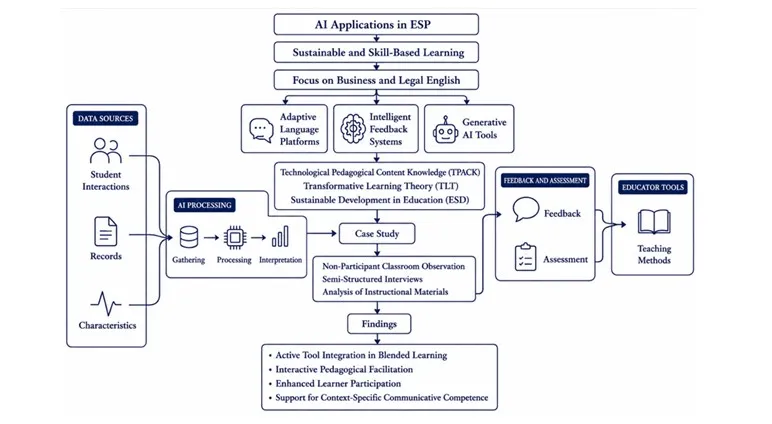
The authors used three theoretical frameworks that integrate well within AI-enhanced English for Specific Purposes (ESP), particularly in Business and Legal English.
TPACK endorses integrating technology into content-specific pedagogy, aligning with the use of AI tools in ESP instruction (Schmidt et al., 2009). TPACK communicates how instructors can offset disciplinary knowledge (legal/business English), AI-driven instruction (adaptive feedback), and relevant pedagogical strategies to improve domain-specific communicative competence.
Technology – AI platforms (adaptive systems, NLP, generative AI)
TLT highlights learner reflection, critical awareness, and a transformation in perspective, which are key outcomes when learners interact with intelligent systems and complex ethical/business/legal content (Stone & Duffy, 2015). TLT reveals ESP’s cognitive and ethical dimensions, where AI is used to improve learning efficiency and encourage critical thinking and real-world contextualization.
Cognitive Transformation – learners reconsider professional language use
Reflective Dialogue – improved through AI instruments offering feedback and context-based scenarios
Professional Identity – formed via realistic, AI-simulated environments
Sustainable Development in Education (ESD)
The ESD framework emphasizes equitable access, lifelong learning, and global competencies, all of which result from AI-augmented ESP education targets (Kopnina & Meijers, 2014). ESD helps achieve the more comprehensive educational sustainability goal of aligning AI-driven ESP instruction with SDGs (especially Goal 4: Quality Education).
Inclusivity – AI decreases access barriers and personalizes learning
Skill Development – focus on communicative, ethical, and digital literacy.
Lifelong Learning – ESP learners continue developing competencies relevant to global work environments.
Fig 1. Conceptual Framework (Developed by the Authors using Draw.io)
Research Findings
Case Study
The authors conducted a case study observation between January 11th and March 13th, 2025, to explore integrating artificial intelligence instruments in English for Specific Purposes (ESP) education. The observation was conducted at University A, a small, private, and internationally accredited university with a robust focus on applied linguistics, educational technology, and teacher training and development. Moreover, University A is known for its progressive adoption of digital transformation in HEI. The humanities and language studies faculty has an advanced Center for Language and Artificial Intelligence Pedagogy, which facilitates the responsible integration of AI instruments in language learning contexts.
The case focused on a senior-level ESP course offered within the university’s professional language program. This program prepares students for careers in international law, business consulting, or corporate communication, and more. The course integrates AI-based learning interventions to create and generate professional communication skills in authentic contexts.
Nonetheless, University A has enforced an institutional AI-in-Education Policy Framework stressing ethical, transparent, and pedagogically justified AI use. All AI-enhanced actions are subject to approval by the university’s Academic Technology Ethics (ATE) Committee. Faculty must disclose AI use in syllabi and equip students with critical literacy training to ensure that AI is treated as a co-creative agent rather than a passive solution. Furthermore, the university A’s digital infrastructure is purpose-built to support AI-enhanced instruction. It has an AI-Enhanced Language Learning Lab, a cloud-integrated Learning Management System (LMS) compatible with adaptive and generative platforms, and a Digital Pedagogy Support Unit that provides training on ethical AI use. Lastly, all enrolled students can access licensed tools.
Non-participant Classroom Observation
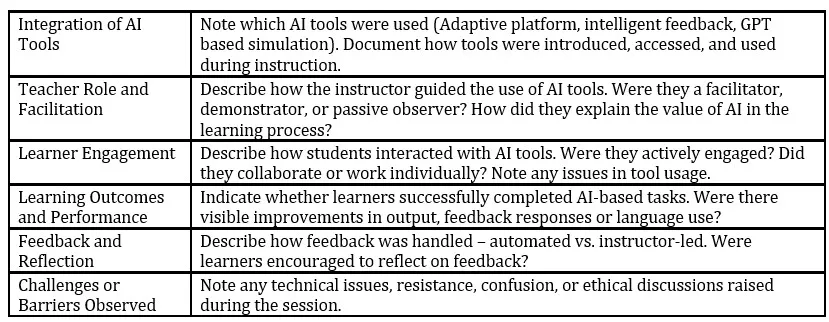
At first, the authors conducted non-participant classroom observation. The Authors observed six class sessions, three fully digital and three blended, over the course of four weeks. Table 3 shows the memo that was used for the observations. The focus was on how AI applications were implemented in instructional activities, how learners interacted with AI instruments, and the nature of feedback cycles.
Table 1: Non-Participant Classroom Observation Memo (Developed by the authors)
The classroom observation data demonstrated distinguishing patterns in AI tools’ use and pedagogical effectiveness across digital and blended modules. Comparative results are organized into four thematic categories: AI tool integration, instructor facilitation, learner engagement, and real-time feedback dynamics.
AI Tool Integration
The first category was AI tool integration. The results revealed that both teaching modules actively use AI applications; however, blended sessions displayed more active tool integration. In digital-only sessions, adaptive language platforms such as grammar/vocabulary scaffolds were primarily utilized during asynchronous pre-task activities. In contrast, blended sessions included all three AI categories, adaptive platforms, intelligent feedback systems, and GPT-based tools, into live, in-class simulations and collaborative drafting exercises.
Notably, the generative AI tools were more effectively used in blended teaching sessions, where instructors could instantly contextualize AI-generated results, clarify inaccuracies, and show reflective critique. In contrast, the results showed that reliance on asynchronous GPT use in digital sessions led to student misconceptions or over-reliance on system-generated templates without critical engagement.
Instructor Facilitation
The second category was instructor facilitation. Instructor roles differed extensively between modules. In digital sessions, instructors were primarily technological moderators who provided access to AI tools and asynchronous feedback. Hence, the lack of real-time scaffolding restricted spontaneous clarification and guided language negotiation opportunities.
Conversely, instructors were interactive facilitators in blended environments, often alternating between AI-generated feedback interpretation and contextual linguistic instruction. Their actions allowed immediate correction of AI misjudgments, such as tone in business correspondence, strengthening ethical mechanisms, and demonstrating higher-order cognitive engagement.
Learner Engagement
The third category was learner engagement. Learner participation was better in blended sessions, especially during GPT-based simulations of business meetings and legal negotiations. Moreover, students collaborated more actively, compared AI outputs, and engaged in peer-to-peer correction. In contrast, students in digital-only sessions showed more passive engagement. Students worked in isolation and relied on automated feedback systems without reflective dialogue.
Furthermore, student autonomy was more observable in blended sessions, where learners displayed critical awareness of AI-generated recommendations and modified their writing accordingly. Additionally, student responses were less biased in digital sessions.
Feedback Dynamics
The fourth category was feedback dynamics. AI-driven feedback was present in all sessions but operated differently across modules. Intelligent feedback systems offered instant corrections and writing scores in digital sessions, yet these exchanges were transactional. Feedback loops were shut quickly, with minimal proof of correction past surface-level edits and checks.
However, blended sessions offered better feedback cycles. Instructors taught students to interpret AI comments and refine texts using multiple drafts. For instance, students used GPT to generate legal clauses, critique together, and adjust results to serve context-specific communicative goals. These comparative results indicate that blended learning environments optimize the pedagogical value of AI tools in ESP instruction, especially by improving contextual feedback, maintaining critical engagement, and enabling communicative competence in professional environments.
Interview Results
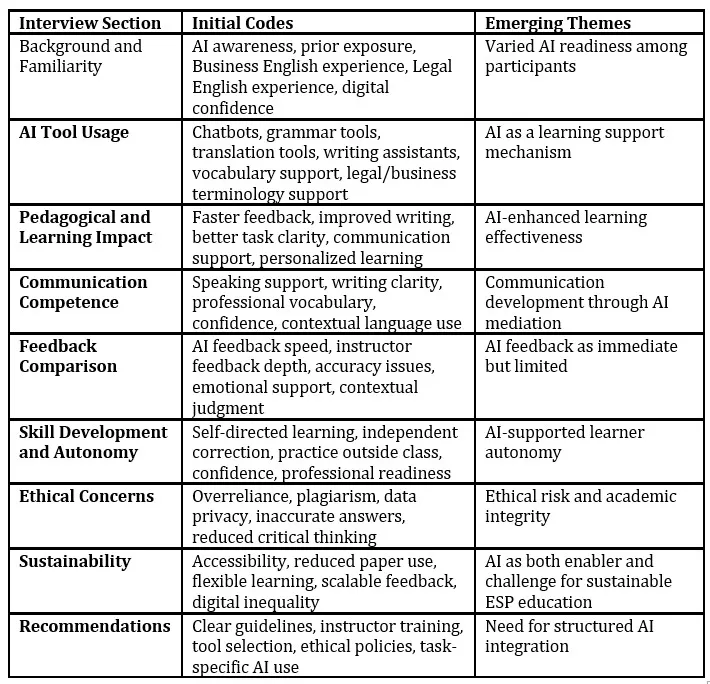
The authors selected 51 participants through purposive sampling, comprising 7 instructors and 44 students who were directly involved in AI-integrated modules. This sampling strategy was appropriate because the study required participants who had direct experience with AI-supported ESP learning activities. The instructor group included 4 lead instructors and 3 assistant instructors. This allowed for capturing both strategic pedagogical perspectives and practical classroom-level observations. The inclusion of 44 students strengthened the analysis by providing learner-based evidence on usability, engagement, autonomy, and perceived learning impact. The six sections of the interview guide were treated as main deductive coding categories. Within each category, open coding was used to identify recurring patterns in participant responses. These codes were then grouped into broader themes.
Table 2 presents the results of the semi-structured interviews. The results show that the participant structure suggests that both instructors and students had some level of exposure to AI, but their familiarity was likely uneven. Moreover, instructors may have approached AI from a pedagogical and assessment perspective, while students were more likely to view AI as a practical tool for completing assignments, improving writing, translating terminology, and receiving quick feedback. Participants may use AI frequently, but that frequency does not automatically indicate meaningful or ethical use.
Next, participants were asked to identify AI applications used in the course and explain how these tools were integrated into lessons or assignments. The results revealed that AI tools were likely used for grammar and writing correction, vocabulary development, clarification of business and legal terminology, translation support, feedback on written tasks, and interactive classroom activities. In these results, the fundamental analytical point is that AI was not treated as a replacement for instruction. Instead, it functioned as a supplementary pedagogical tool that supported ESP learning tasks. Hence, this distinction is significant because AI integration becomes educationally valuable.
Furthermore, participants were asked how AI affected learning outcomes and whether AI feedback was more useful than instructor feedback. The results revealed that AI tools likely helped students receive immediate correction, improve sentence structure, refine professional tone, and understand discipline-specific terminology. This is especially relevant in Business and Legal English, where accuracy, clarity, tone, and contextual appropriateness are essential. Nevertheless, AI feedback should be interpreted as fast but not always pedagogically complete.
Next, the participants responded to whether AI improves or diminishes communicative competence. The analysis suggests that AI can improve communicative competence when it is used for guided practice, vocabulary expansion, professional writing, role-play preparation, and language refinement. For example, in Business English, AI may support email writing, presentation preparation, negotiation language, and customer communication. In Legal English, it may support clarification of terminology, formal drafting, contract-related vocabulary, and preparation for case-based discussion.
One of the final questions was focused on skill development and autonomy. This indicates that the study explored whether AI helped participants become more independent in learning or teaching. The likely pattern is that students used AI tools to revise their work, practice independently, clarify difficult concepts, and improve confidence before submitting assignments or participating in class. Moreover, results reveal that autonomy is central to sustainable ESP learning. Learners in Business and Legal English need to continue developing professional communication skills beyond the classroom. AI can support this by giving students continuous access to practice, feedback, and examples.
Table 2: Coding Matrix and Emerging Themes (Developed by the Authors)
Discussions
This research explored the practical implications of AI integration in Business and Legal English teaching through non-participant classroom observations and semi-structured interviews. The results were analyzed in four categories: AI tool integration, instructor facilitation, learner engagement, and feedback dynamics. Insights from six observed class sessions demonstrated distinct contrasts in how AI tools were used across various learning conditions. Notably, only the blended sessions used all three categories of AI applications: adaptive tools, intelligent feedback systems, and generative AI tools. Moreover, blended sessions demonstrated exceptional AI integration, as instructors actively used GPT-generated content, corrected inaccuracies in real time, and linked results to targeted communication goals. Contrarily, the digital sessions showed limited GPT integration.
Students in these sessions frequently used generative tools asynchronously, without critical reflection or instructor moderation. Thus, this differentiation connects with existing research emphasizing the significance of instructional presence in AI integration (Koehler & Mishra, 2009). AI independently cannot transform learning; instead, the pedagogical strategy defines its educational value. Furthermore, instructors significantly impacted how AI tools impacted ESP learning. In digital settings, instructors offered access to AI systems but engaged minimally in their pedagogical performance. In contrast, in blended sessions, they served as pedagogical facilitators. Moreover, the interview data reinforced this difference. For instance, one of the respondents emphasized that AI allowed her to “tailor writing exercises based on student performance metrics,” but also expressed concern about “student over-reliance and AI accuracy.” Additionally, she warned that AI frequently produces “grammatically correct but contextually wrong suggestions.”
Observational results indicated that learner engagement was significantly more robust in blended sessions, where students experienced live simulations and peer critique. GPT-based approaches were used to simulate business negotiations or legal consultations. Students discussed the quality of AI outputs, applied edits, and collectively refined drafts, practices connected with transformative learning theory (Mezirow, 1997). Nonetheless, learners seemed to work in isolation in digital-only sessions, frequently accepting AI feedback passively. Interview reports verified this behavior. While students noted that GPT tools increased confidence, they also reported a lack of support in interpreting complex outputs.
Feedback mechanisms also varied between formats. Intelligent feedback systems offered surface-level evaluations in digital settings without facilitating iterative revision. Feedback cycles were closed quickly, with minimal evidence. In contrast, the blended format enabled transformative feedback cycles. Instructors guided students in accepting AI-generated feedback. The interviews mirrored this practice. Students noted progress in writing, tone control, and structural awareness. However, all students highlighted the need for instructor support in interpreting feedback.
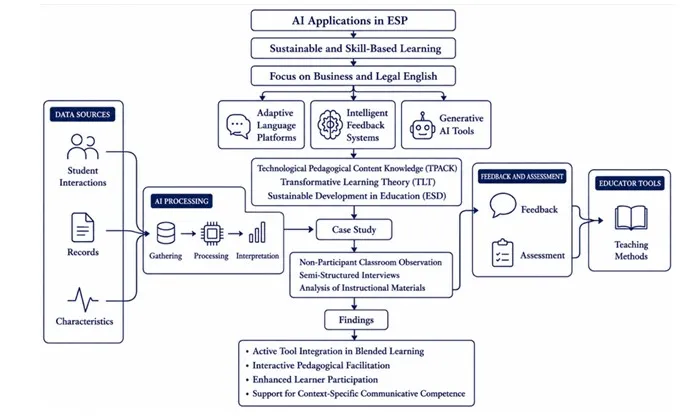
The results align with the Technological Pedagogical Content Knowledge (TPACK) model, underscoring that effective instructional technology must be integrated into pedagogically sound strategies. Instructors in blended sessions exemplified this integration more distinctly than those in digital-only environments. Moreover, from a Transformative Learning Theory (TLT) perspective, critical reflection and dialogue were more widespread in blended settings, where students re-evaluated AI results in light of professional norms and communicative goals. Finally, Education for Sustainable Development (ESD) and blended instruction were found to offer more equitable opportunities for AI-enhanced learning. Figure 2 shows the integration of the conceptual framework with the results, and offers overall guidance to the practitioners of how to use AI-driven tools in ESP.
Fig 2. Integrating ESP and Conceptual Framework (Developed by the Authors using Draw.io)
The authors, based on the results, propose implications for future practice that could improve the effectiveness of AI integration in ESP instruction:
Pedagogical Scaffolding. AI tools must be integrated within instructional frameworks. Educators should provide pre-task briefings, guided interpretation, and post-task reflections to help students contextualize AI outputs.
Prioritize Blended Learning for AI-rich environments. Blended formats offer an excellent way to integrate the scalability of AI tools with the feedback and real-time adjustments that human instructors provide. Invest in infrastructure for hybrid instruction.
Foster AI Literacy and Ethical Awareness. Faculty and students need AI literacy training, including on tool limitations, bias, authorship concerns, and data privacy. This is crucial for ethical and sustainable AI use in education.
Strengthen Faculty Development. Institutional policies should support educators through continuous professional development aligned with frameworks such as TPACK and the ESD goals.
Conclusion
This research explored the pedagogical integration of AI tools in English for Specific Purposes (ESP). The authors focused on Business and Legal English instruction. These insights were generated from classroom observation and semi-structured interviews with instructors and students. Furthermore, the results were validated using triangulation methods, involving all authors. The classroom observation results revealed the growing impact and need for AI in education. Moreover, they supported understanding how AI tools can support sustainable, skill-based language instruction across various professional domains. Furthermore, data showed distinctive patterns in AI tools’ use and pedagogical effectiveness across digital and blended formats.
The authors analyzed six sessions: three delivered entirely online and three in a blended format. The comparative results were categorized into four thematic sections: AI tool integration, instructor facilitation, learner engagement, and real-time feedback dynamics. Hence, these comparative insights indicate that blended learning environments modify the pedagogical value of AI tools in ESP instruction, fostering communicative competence in professional domains. Furthermore, semi-structured interview results indicated that AI tools help multiple pedagogical processes. For instance, instructors use them for teaching optimization, and students use them for skill exploration and practice. These data strengthen the need for guided AI integration.
The authors applied three theoretical frameworks. TPACK showed how instructors can balance disciplinary knowledge, legal/business English, AI-driven instruction, adaptive feedback, and relevant pedagogical strategies to improve domain-specific communicative competence. Furthermore, TLT complements ESP’s cognitive and ethical dimensions, where AI is used not just to improve learning efficiency but also to promote critical thinking and real-world contextualization. Lastly, ESD helps achieve the more comprehensive educational sustainability goal of aligning AI-driven ESP instruction with SDGs, especially Goal 4: Quality Education.
The results reveal that while AI technologies can improve the personalization, efficiency, and accessibility of ESP instruction, their pedagogical value depends on how they are integrated and mediated. Blended learning environments effectively supported deep engagement, collaborative reflection, and context-sensitive feedback. Instructors played a critical role as facilitators. On the other hand, students noted significant benefits in writing fluency, confidence, and exposure to realistic communicative scenarios. Nevertheless, challenges were noted in overreliance on automated feedback. These results reaffirm that AI tools should complement, not replace, human instruction, particularly in domains that demand high levels of pragmatic and ethical competence.
References
Avalekar, U. A., Mehta, V., Mishra, B. R., Prasanna, L., Rajlakshmi, P. V., Manjunath, T. C., & Selvakumar, P. (2025). The current advances in AI-driven education. Educational AI humanoid computing devices for cyber nomads, 173-196. DOI: 10.4018/979-8-3693-8985-0.ch008
Azizova, D. (2024). Instructing the English language with a focus on learners’ professional contexts: the significance of English for Specific Purposes (ESP) for Finance students. Nordic_Press, 3(0003).
Costa, F. G., & Mastellotto, L. (2022). The role of English for specific purposes (ESP) in supporting the linguistic dimension in English-medium instruction (EMI). CLIL JOURNAL OF INNOVATION AND RESEARCH IN PLURILINGUAL AND PLURICULTURAL, (5/2), 37-52.
Garzón, J., Patiño, E., & Marulanda, C. (2025). Systematic review of artificial intelligence in education: Trends, benefits, and challenges. Multimodal Technologies and Interaction, 9(8), 84. https://doi.org/10.3390/mti9080084
Gaffas, Z. M. (2024). Using social media platform X to enhance student medical English learning: an attempt based on design-based research (DBR) in a medical English for specific purposes (ESP) course. Asian-Pacific Journal of Second and Foreign Language Education, 9(1), 54. https://doi.org/10.1186/s40862-024-00281-1
Giannakos, M., Azevedo, R., Brusilovsky, P., Cukurova, M., Dimitriadis, Y., Hernandez-Leo, D., … & Rienties, B. (2025). The promise and challenges of generative AI in education. Behaviour & Information Technology, 44(11), 2518-2544. https://doi.org/10.1080/0144929X.2024.2394886
Gabelaia, I., & Bagociunaite, R. (2022, October). Sustaining Well-Being of Teachers in Higher Education. In International Conference on Reliability and Statistics in Transportation and Communication(pp. 462-472). Cham: Springer International Publishing.
Grady, J. S., Her, M., Moreno, G., Perez, C., & Yelinek, J. (2019). Emotions in storybooks: A comparison of storybooks that represent ethnic and racial groups in the United States. Psychology of Popular Media Culture, 8(3), 207–217.
Hyland, K. (2022). English for specific purposes: What is it and where is it taking us?. ESP Today-Journal of English for Specific Purposes at Tertiary Level, 10(2), 202-220. 10.18485/esptoday.2022.10.2.1
Jackson, L. M. (2019). The psychology of prejudice: From attitudes to social action (2nd ed.). American Psychological Association. https://doi.org/10.1037/0000168-000
Jose, B., Cherian, J., Verghis, A. M., Varghise, S. M., S, M., & Joseph, S. (2025). The cognitive paradox of AI in education: Between enhancement and erosion. Frontiers in psychology, 16, 1550621. https://doi.org/10.3389/fpsyg.2025.1550621
Khine, M. S. (2024). Ethics and the Future of Education in an AI-Driven World. In Artificial Intelligence in Education: A Machine-Generated Literature Overview (pp. 629-735). Singapore: Springer Nature Singapore. https://doi.org/10.1007/978-981-97-9350-1_6
Koehler, M. J., & Mishra, P. (2009). What is technological pedagogical content knowledge (TPACK)? Contemporary Issues in Technology and Teacher Education, 9(1), 60–70.
Kopnina, H., & Meijers, F. (2014). Education for sustainable development (ESD) exploring theoretical and practical challenges. International Journal of Sustainability in Higher Education, 15(2), 188-207. https://doi.org/10.1108/IJSHE-07-2012-0059
Luo, Y., & Yang, Y. (2024). Large language model and domain-specific model collaboration for smart education. Frontiers of Information Technology & Electronic Engineering, 25(3), 333-341. DOI: 1631/FITEE.2300747
Mezirow, J. (1997). Transformative learning: Theory to practice. New Directions for Adult and Continuing Education, 1997(74), 5–12. https://doi.org/10.1002/ace.7401
Oved, O., & Alt, D. (2025). Teachers’ technological pedagogical content knowledge (TPACK) as a precursor to their perceived adopting of educational AI tools for teaching purposes. Education and Information Technologies, 30(10), 14095-14121. DOI https://doi.org/10.1007/s10639-025-13371-5
Rahman, M. (2015). English for Specific Purposes (ESP): A Holistic Review. Universal Journal of Educational Research, 3(1), 24–31.
Rafiq, K. R. M., Hashim, H., & Yunus, M. M. (2021). Sustaining education with mobile learning for English for specific purposes (ESP): A systematic review (2012–2021). Sustainability, 13(17), 9768. https://doi.org/10.3390/su13179768
Rosenberg, J. M., & Koehler, M. J. (2015). Context and technological pedagogical content knowledge (TPACK): A systematic review. Journal of research on technology in education, 47(3), 186-210. https://doi.org/10.1080/15391523.2015.1052663
Sanchiz, M., Chevalier, A., & Amadieu, F. (2017). How do older and young adults start searching for information? Impact of age, domain knowledge and problem complexity on the different steps of information searching. Computers in Human Behavior, 72, 67–78. https://doi.org/10.1016/j.chb.2017.02.038
Schön, S., Brünner, B., Ebner, M., Edelsbrunner, S., Hohla-Sejkora, K., & Uhl, B. (2025). Early findings from pilots in AI-driven education: effects of AI-generated courses and videos on learning and teaching. In 2024 Yearbook Emerging Technologies in Learning (pp. 23-44). Cham: Springer Nature Switzerland. https://doi.org/10.1007/978-3-031-80388-8_2
Schmidt, D. A., Baran, E., Thompson, A. D., Mishra, P., Koehler, M. J., & Shin, T. S. (2009). Technological pedagogical content knowledge (TPACK) the development and validation of an assessment instrument for preservice teachers. Journal of research on Technology in Education, 42(2), 123-149. https://doi.org/10.1080/15391523.2009.10782544
Singh, A. (2024). The future of learning: AI-driven personalized education. Available at SSRN 5076438. Singh, Ajit, The Future of Learning: AI-Driven Personalized Education (December 28, 2024). http://dx.doi.org/10.2139/ssrn.5076438
Stone, G. A., & Duffy, L. N. (2015). Transformative learning theory: A systematic review of travel and tourism scholarship. Journal of Teaching in Travel & Tourism, 15(3), 204-224.https://doi.org/10.1080/15313220.2015.1059305
Strielkowski, W., Grebennikova, V., Lisovskiy, A., Rakhimova, G., & Vasileva, T. (2025). AI‐driven adaptive learning for sustainable educational transformation. Sustainable development, 33(2), 1921-1947. https://doi.org/10.1002/sd.3221
Tomaskinova, J., Scully, D., Ward, F., Dupont, S., & Tempermann, G. (2025). AI-DRIVEN EDUCATION: OPPORTUNITIES, RISKS, AND THE PATH FORWARD. In ICERI2025 Proceedings (pp. 8052-8059). doi: 10.21125/iceri.2025.2241
Trujeque-Moreno, E. E., Romero-Fernández, A., Esparragoza-Barragán, A., & Villa-Jaimes, C. J. (2021). Needs Analysis in the English for Specific Purposes (ESP) Approach: The Case of the Benemérita Universidad Autónoma de Puebla. Mextesol Journal, 45(2), n2.
Vashishth, T. K., Sharma, V., Sharma, K. K., Kumar, B., Panwar, R., & Chaudhary, S. (2024). AI-driven learning analytics for personalized feedback and assessment in higher education. In Using traditional design methods to enhance AI-driven decision making (pp. 206-230). IGI Global Scientific Publishing. DOI: 10.4018/979-8-3693-0639-0.ch009
Yang, Y., Zhang, Y., Sun, D., He, W., & Wei, Y. (2025). Navigating the landscape of AI literacy education: insights from a decade of research (2014–2024). Humanities and Social Sciences Communications, 12(1), 1-12.
Yekollu, R. K., Bhimraj Ghuge, T., Sunil Biradar, S., Haldikar, S. V., & Farook Mohideen Abdul Kader, O. (2024). AI-driven personalized learning paths: Enhancing education through adaptive systems. In International Conference on Smart data intelligence (pp. 507-517). Singapore: Springer Nature Singapore https://doi.org/10.1007/978-981-97-3191-6_38
Yin, R. K. (2018). Case study research and applications: Design and methods (6th ed.). SAGE Publications.
Yuan, L. (2024). Where does AI-driven Education, in the Chinese Context and Beyond, go next?. International Journal of Artificial Intelligence in Education, 34(1), 31-41. https://doi.org/10.1007/s40593-023-00341-6