Volume 2026,
Article ID 824449,
Journal of Marketing Research and Case Studies,
8 pages,
DOI: doi.org/10.5171/2026.824449
Received date: 4 June 2026; Accepted date: 25 June 2026; Published date: 7 September 2026
Academic Editor: Saida Marso
Cite this Article as:
Oumaima AMEZIANE and Hind BOUZEKRAOUI (2026), “ Unlocking Perceived Value in Sustainable Luxury Tourism: Key Drivers and Strategic Insights", Journal of Marketing Research and Case Studies, Vol. 2026 (2026), Article ID 824449,
DOI: https://doi.org/10.5171/2026.824449
The luxury tourism sector has advanced its sustainability strategies to better meet consumer expectations. Despite the integration of sustainability principles into luxury tourism and the increased interest in this topic in recent years, the literature remains fragmented on the factors that influence value creation and consumer behavior. This article proposes a conceptual framework to explain the value creation process in sustainable luxury tourism and its behavioral effects. This article employs a critical integrative review using the PRISMA 2020 methodology, focusing on luxury tourism, sustainability, and perceived value theory. Perceived value serves as a central variable linking the four key dimensions- customer experience, sustainability, digital transformation, and marketing- to consumers’ behavioral intentions. The results indicate that the construction of perceived value in the sustainable luxury tourism sector is correlated with and interconnected with sustainability practices, customer experience, digitalization, and strategic marketing. Moreover, perceived value is seen as an intermediate process that directly impacts behavioral intentions.
Internationally, luxury tourism is experiencing gradual growth driven by personalized, unique, and luxurious experiences (Kandampully et al., 2018; KO et al., 2019). In parallel, environmental and social demands are redefining specific consumer needs, requiring more ethical practices from industry stakeholders.
Sustainable luxury tourism is structured around the Sustainable Development Goals (SDGs), specifically SDG 12 (sustainable consumption and production) and SDG 13 (climate action) (Gossling et al., 2021). This growth is driven by the sector’s increasing digitalization, which is transforming relationships between tourism companies and customers (Buhalis et al., 2019).
Although there is significant interest in this topic, the literature appears fragmented and treats the determinants in a unidimensional way. Currently, most articles focus on a single dimension, such as customer experience (Harkison et al., 2018), sustainability (Font et al., 2021), digital transition (Leung et al., 2019), or marketing strategies (KO et al., 2019), in the absence of an integrated analysis of these factors.
This discontinuity limits understanding of tourist attitudes within a framework of increasing complexity and interconnectedness (Buhalis et al., 2019). Several studies also highlight the lack of robust empirical approaches and solid conceptual frameworks for understanding how perceived value is created in sustainable luxury tourism (Dolnicar, 2020; Gössling et al., 2021).
Consequently, this study focuses on a central question: to what extent do the determinants of sustainable luxury tourism jointly influence perceived value and customer behavior?
To better analyze this, the study is based on the following questions:
– What are the key variables that affect sustainable luxury tourism, based on the existing literature?
– How do these variables fit together within a coherent conceptual framework?
– How does perceived value affect customer behavior in the luxury tourism sector?
This study aims to propose a preliminary outline of a comprehensive conceptual framework for analyzing the determinants of sustainable luxury tourism and their strategic influences. This article is structured as follows. First, a literature review was conducted to synthesize work across methodological approaches, highlighting convergences, divergences, and gaps in the literature (Snyder, 2019; Linnenluecke et al., 2020) and emphasizing relevant theories, namely perceived value theory and the theory of planned behavior. Next, a methodology based on an integrative literature review was presented. Finally, the article concludes with a discussion of the results, emphasizing the theoretical and managerial implications and avenues for future research.
Literature Review
The Determinants of Luxury Tourism
Luxury tourism highlights several key determinants examined in relation to customer experience, digitalization, and marketing (Kandampully et al., 2018; Correia et al., 2020; McKinsey & Company, 2023). Multiple studies emphasize that customer experience is a key variable in the value proposition within the luxury tourism sector, relying on personalization, authenticity, and emotional engagement (Kandampully et al., 2018; Harkison et al., 2018). Consequently, various marketing articles validate the influence of inadequacy and communication on behavioral intentions, particularly when both variables are more important:
exclusivity and quality (Han et al., 2020; Ko et al., 2019). Finally, the digital transition appears to be a crucial element, enabling the improvement of customer experience and guiding travel choices through digital platforms and social networks (Neuhofer et al., 2015; Buhalis et al., 2019).
However, the literature reveals the heterogeneity and fragmentation of the determinants. Currently, published articles employ non-integrative methods, examining the influence of determinants separately. For example, some studies address the role of media in shaping tourists’ behavioral perceptions (Hudson et al., 2016; Leung et al., 2019). Other studies have focused solely on customer experience (Harkison et al., 2018). Furthermore, empirical work relies on either qualitative approaches with limited sample sizes or quantitative methods geared toward specific contexts. This divergence is exacerbated by a concentration on the luxury hotel sector, neglecting a broader perspective on luxury tourism (Seraphin et al., 2018).
Sustainable Luxury Tourism: A Strategic Balance between Opportunity and Empirical Constraints
Sustainability has emerged as a central benchmark in the luxury tourism sector, driven by growing customer expectations and rising environmental demands. Several recent articles show that adopting sustainable requirements positively impacts booking rates and enhances the value of the luxury tourism sector when these practices are shared credibly and transparently (Han et al., 2020; Font et al., 2017).
However, the literature indicates empirical limitations. First, most studies are conceptual or exploratory, lacking sufficient measurement indicators to assess the influence of sustainable practices (Font et al., 2017). Several articles highlight a persistent gap between designed marketing strategies and their implementation in resource-constrained environments.
Critical Synthesis: For a comprehensive understanding of the factors influencing sustainable Luxury Tourism
Although the literature on luxury tourism remains diverse and rich, a conceptual discontinuity persists: the three variables of customer experience, marketing, and digitalization have been treated separately from the consideration of sustainable development. Sustainable development is a strategic variable used to differentiate oneself, create value, and strengthen brand reputation with customers (Han et al., 2020; Font et al., 2017). In parallel, other traditional variables have been examined in studies, namely service quality, authenticity, and personalization, which impact consumer behavior (Kandampully et al., 2018; KO et al., 2019).
Currently, research focuses on customer experience, neglecting the influence of this strategic variable, while other studies incorporate sustainable practices without thoroughly examining consumer reactions to this new offering (Dolnicar, 2020). Furthermore, digitalization is still considered within a purely technological framework, with no link to sustainable practices or the notion of value.
Theoretical Framework
To better develop the conceptual framework, this article draws on two complementary theories that help explain and correlate the determinants of sustainable luxury tourism.
Perceived Value Theory
This theory remains relevant to our study. Consumer behavior is based on the overall evaluation of the benefits and costs associated with an offering (Zeithaml, 1988). In the context of luxury tourism, value extends beyond practical elements to include emotional, symbolic, and experiential aspects (Kandampully et al., 2018). Consequently, factors such as customer experience, sustainability, and digitalization can be considered generators of perceived value, directly influencing behavioral intentions.
Perceived Value in Sustainable Luxury Tourism
To better manage consumer behavior in the luxury tourism sector, perceived value is a central concept that shapes customer intentions through the interplay of experiential, social, and emotional dimensions. Quality and service personalization are the two variables tourists notice during their experiences. Indeed, the functional, individual, and social values of the customer experience enhance the bond between the customer and the luxury brand (Lu and AHN, 2022).
The creation of perceived value in the luxury tourism sector rests on several key factors. First, the customer experience is a necessary pillar, as customers seek a unique, personalized, and high-quality experience. Second, sustainability plays a significant role in enhancing the value of luxury offerings, given that customers are currently sensitive to environmental and social issues. Third, digital transformation enables the personalization of services and strategic interactivity among customers. Finally, marketing contributes positively to brand image and trust between customers and this sector.
Proposal of a Conceptual Framework:
Methodology
Research Method
This integrative review seeks to identify the main determinants of sustainable luxury tourism, highlight existing gaps in the field, and propose a draft integrated conceptual framework. This methodology ensures the reliability and validity of the research process while maintaining transparency and consistency (Snyder, 2019; Palmatier et al., 2018). It also helps mitigate potential biases through the selection and evaluation of relevant works (Linnenluecke et al., 2020; Siachou et al., 2021). To guarantee the robustness and credibility of the study, a review protocol was developed beforehand, including clearly defined search strategies and specific inclusion and exclusion criteria (Denyer & Tranfield, 2009; Haddaway et al., 2022).
Data Collection
First, the study used the Scopus database, widely regarded as one of the most important multidisciplinary databases in the social sciences (Donthu et al., 2020; Martín-Martín et al., 2018). Subsequently, following an exploratory analysis and drawing on suggestions from current literature reviews (Snyder, 2019; Maseda et al., 2021), keywords were identified and grouped into categories related to luxury tourism, sustainability, and consumer behavior.
A search equation was then developed by controlling for the presence of keywords in the titles, abstracts, and keywords of the selected articles (Siachou et al., 2021). According to academic standards, only peer-reviewed articles were selected because they were considered validated knowledge (Dinh & Calabrò, 2019; Paul & Benito, 2018).
Based on these inclusion and exclusion criteria, the preliminary study successfully identified a set of relevant articles. Subsequently, a detailed review of the selected articles was conducted to ensure their suitability for the research objective.
Finally, a detailed analysis of the selected articles was conducted. Key information, including objectives, methodologies, main results, and identified gaps, was extracted and summarized in an analysis table. This approach ensures a structured, comparative review of the literature and facilitates the identification of convergences, divergences, and research gaps (El Bairi et al., 2021).
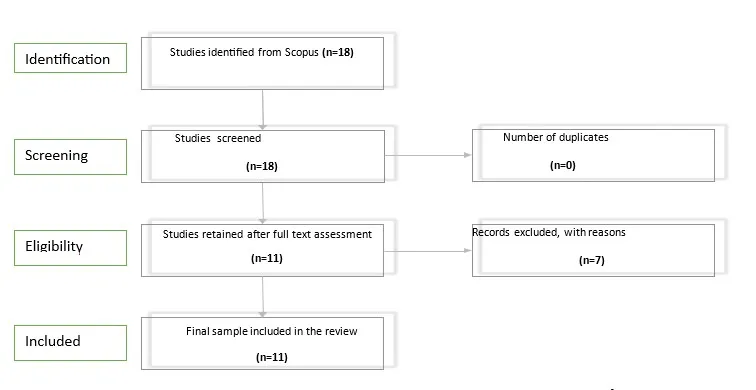
The choice of methodology is based on the PRISMA 2020 statement (Preferred Reporting Items for Systematic Reviews and Meta-Analyses), which aims to improve the transparency, accuracy, and comprehensiveness of systematic reviews (Page et al., 2021). The articles selected for processing and analysis are Scopus-indexed articles whose keywords are sustainable luxury tourism, customer experience, and digitalization. The number of articles was limited (n=18). This number does not seem methodologically low, as the topic is still recent in scientific research (Kunz et al., 2020; Zhao et al., 2023). The variables studied, namely sustainability, customer experience, and digitalization, were treated independently, which makes their combination little examined (Kapferer & Michaut-Denizeau, 2020; Kunz et al., 2020).
Our final corpus comprises the results of the analysis of 11 relevant articles that meet the inclusion and exclusion criteria (the date: from 2015 to 2026 – the date of appearance and evolution of the Sustainable Development Goals (SDGs) (United Nations (2015)), indexed in Scopus, peer-reviewed, and finally linked to the objectives of this article).
Flowchart of article selection process 1
Source: Authors
Data Coding and Clustering
Following the classification method proposed by Radu-Lefebvre et al. (2021), the selected articles underwent detailed analysis and coding across three major phases.
Thematic Classification of Results
Initially, we identified similarities across the research studies to extract shared trends (Cronin & George, 2023). This phase led to the development of descriptive themes that situated each article within key dimensions of sustainable luxury tourism, particularly customer experience, sustainability, digitalization, and marketing strategies.
Identification of Second-level Themes
Subsequently, the initial categories were consolidated into high-level themes, focusing on the existing links among the descriptive themes (Cronin & George, 2023). This phase facilitated the organization of the literature using broader analytical frameworks, thereby improving understanding of interactions among the key drivers of sustainable luxury tourism.
Integration into Integrative Themes
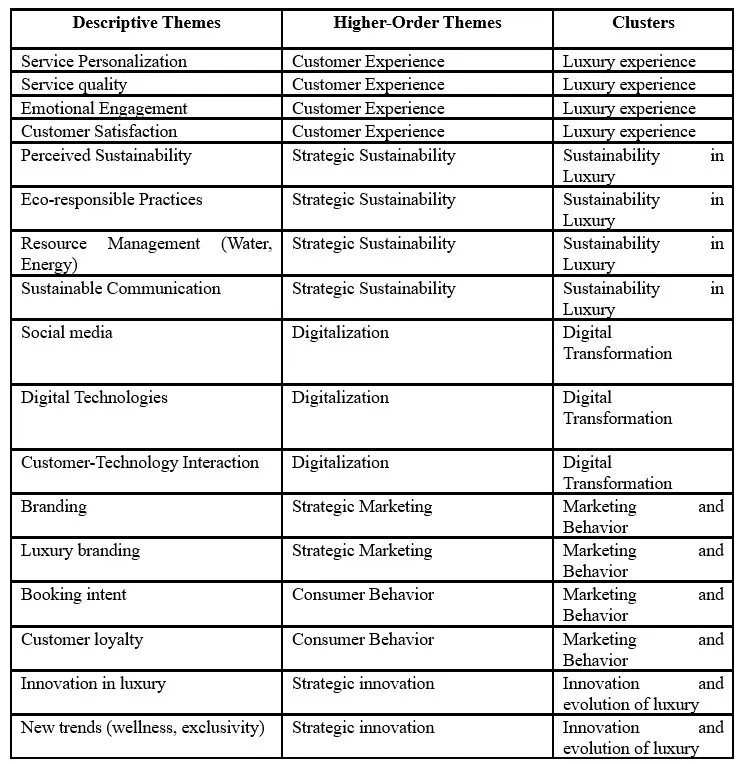
Finally, the second-level themes were incorporated into overarching dimensions, referred to as “integrative” themes, thereby establishing a coherent global perspective on the field under examination. This final organization provides an analysis that summarizes the drivers of sustainable luxury tourism, highlighting their interactions and contributions to value creation. The analysis table presents all identified topics in detail.
Table 1 Data coding and clustering 1
Source: Authors
This table helps clarify the perceived value of sustainable luxury tourism by identifying the key factors that shape consumer experience and behavior. The cluster analysis highlights that the customer experience plays a central role, driven by personalization, service quality, and customer satisfaction. Sustainable actions foster authentic and responsible sustainable luxury through effective resource management and sustainable communication. Digitalization remains a strategic pillar that facilitates engagement by strengthening social networks and leveraging digital technologies. Luxury branding promotes the development of a sustainable luxury experience. These clusters represent the key determinants of a loyal and competitive experience in the luxury tourism sector (Halpern & Mwesiumo, 2025; Sukma, Divinagracia & Munawar, 2025; Alhaddar & Kummitha, 2025; Birinci, Esenyel & Obeng, 2025; Hien & Luu, 2026).
Research Model Proposal
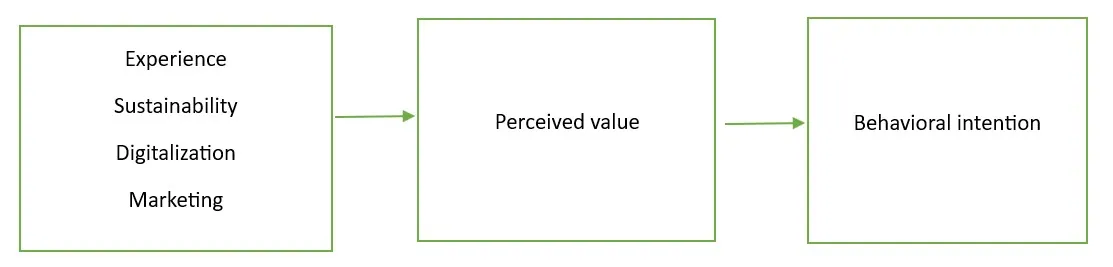
This research proposes a preliminary conceptual framework to explain the determinants of sustainable luxury tourism and their behavioral implications. To address the discontinuity identified in the literature, this model adopts an integrative approach that combines four key dimensions: customer experience, sustainability, digital transformation, and marketing mechanisms.
First, sustainable development influences value creation through eco-responsible practices and communication, emphasizing two crucial variables: trust and brand image (Han et al., 2019). Second, digitalization appears to be a catalyst that facilitates access to information, exchanges, and the co-creation of the tourism experience (Buhalis et al., 2019). Finally, marketing strategies, namely branding and communication, shape perceptions of behavioral intentions (KO et al., 2019).
This model is also based on perceived value theory, which presents the synergy among the four dimensions that influence perceived value. Perceived value serves as an intermediary in the perception of behavioral intentions, namely reservation and loyalty.
The draft model suggests that the factors of sustainable luxury tourism do not directly affect consumer behavior but instead operate through perceived value, which is an important variable for evaluating the customer experience in the sustainable luxury tourism sector. First, this applied perspective of sustainability enhances perception by reinforcing authenticity, trust, and ethical engagement with the offerings of this sector (Kenz et al., 2020). Next, personalization, positive emotions, and perceived high-quality service play a crucial role in creating value and satisfying customers. Finally, perceived value can be developed through digital factors that facilitate data interaction and access to information (Gretzel et al., 2020).
Fig 2: The determinants of sustainable tourism (By authors)
Conclusion
The objective of this study was to provide a comprehensive understanding of the factors influencing sustainable luxury tourism through an integrative literature review. Existing research has highlighted four main areas: customer experience, sustainable development, digitalization, and marketing strategies, underscoring the literature’s fragmentation. These variables have been examined in isolation, limiting understanding of value creation and consumer behavior in the luxury tourism sector. To address this gap, this research presents a draft conceptual model to analyze the determinants of sustainable luxury tourism and their strategic impacts. The model integrates determinants previously examined individually. Thus, it contributes to a better understanding of the complexity of tourist behavior at the intersection of experience, digitalization, and environmental demands.
The results demonstrate the need for luxury tourism stakeholders to adopt a clear vision that combines quality experiences, sustainability requirements, digitalization, and consistent communication. Value generation no longer depends on a single factor but on the integration of these diverse elements.
However, this study has some limitations. It is a conceptual study based on a literature review and requires empirical validation of the proposed relationships. Future studies could therefore test the model across various geographical settings and luxury tourism segments, while accounting for potential moderating variables such as individual consumer traits or cultural specificities.
References
Amatulli, C., De Angelis, M., & Stoppani, A. (2021). The appeal of sustainability in luxury hospitality: An investigation on the role of perceived integrity. Tourism Management. https://doi.org/10.1016/j.tourman.2020.104228
Angelini, A. (2023). Luxury tourism in sustainable accommodation: What can compromise the tourist experience? An analysis of glamping in Italy. Sinergie. https://doi.org/10.7433/S120.2023.02
Bayar, S., Kaya, B., & Altıntaş, V. (2025). From America to Anatolia: A perspective on oenotourism within the context of sustainable practices and applications. Millenium: Journal of Education, Technologies, and Health. https://doi.org/10.29352/mill0219e.41106
Birinci, H., Esenyel, I., & Obeng, H. A. (2025). Sustainable destination management in luxury tourism: Balancing economic development and environmental responsibility. Sustainability (Switzerland), 17. https://doi.org/10.3390/su17156815
Birke, J., & Keil, A. (2021). The touristic development of Sylt: The COVID-19 pandemic on concepts of sustainability. Geographische Rundschau.
Buhalis, D., & Sinarta, Y. (2019). Real-time co-creation and nowness service: Lessons from tourism and hospitality. Journal of Travel & Tourism Marketing, 36(5), 563–582.
Buhalis, D., Harwood, T., Bogicevic, V., Viglia, G., Beldona, S., & Hofacker, C. (2019). Technological disruptions in services: Lessons from tourism and hospitality. Journal of Service Management, 30(4), 484–506.
Chen, Z., Zhao, J., & Jin, C. (2025). Business intelligence for Industry 4.0: Predictive models for retail and distribution. International Journal of Retail & Distribution Management. https://doi.org/10.1108/IJRDM-02-2023-0101
Dolnicar, S. (2020). Designing for more environmentally friendly tourism. Annals of Tourism Research, 84, 102933.
Font, X., Garay, L., & Jones, S. (2017). Sustainability motivations and practices in small tourism enterprises in European protected areas. Journal of Cleaner Production, 137, 1439–1448.
Gladkikh, T., & Séraphin, H. (2023). Conclusion: What is the impact of luxury yachting on the well-being of consumers and relevant stakeholders? Worldwide Hospitality and Tourism Themes. https://doi.org/10.1108/WHATT-03-2023-0051
Gössling, S., Scott, D., & Hall, C. M. (2021). Pandemics, tourism and global change: A rapid assessment of COVID-19. Journal of Sustainable Tourism, 29(1), 1–20.
Harkison, T., Hemmington, N., Hyde, K. F., & Smith, K. (2018). The importance of hedonic consumption in luxury hospitality experiences. International Journal of Contemporary Hospitality Management, 30(1), 417–437.
Kandampully, J., Zhang, T., & Jaakkola, E. (2018). Customer experience management in hospitality: A literature synthesis, new understanding and research agenda. International Journal of Contemporary Hospitality Management, 30(1), 21–56.
Ko, E., Costello, J. P., & Taylor, C. R. (2019). What is a luxury brand? A new definition and review of the literature. Journal of Business Research, 99, 405–413.
Leung, D., Law, R., Van Hoof, H., & Buhalis, D. (2019). Social media in tourism and hospitality: A literature review. Journal of Travel & Tourism Marketing, 36(2), 209–226.
Linnenluecke, M. K., Marrone, M., & Singh, A. K. (2020). Conducting systematic literature reviews and bibliometric analyses. Australian Journal of Management, 45(2), 175–194.
Lopes, J. M., Gomes, S., Durão, M., & Pacheco, R. (2023). The holy grail of luxury tourism: A holistic bibliometric overview. Journal of Quality Assurance in Hospitality & Tourism. https://doi.org/10.1080/1528008X.2022.2089946
Manfreda, A., & Harkison, T. (2025). Beyond exchange: Decoding reciprocal hospitableness in luxury lodge experiences. Journal of Hospitality and Tourism Management. https://doi.org/10.1016/j.jhtm.2025.01.011
Page, M. J., McKenzie, J. E., Bossuyt, P. M., et al. (2021). The PRISMA 2020 statement: An updated guideline for reporting systematic reviews. BMJ, 372, n71.
Santos, V. R., Au-Yong-Oliveira, M., Sousa, M. J., & Costa, C. (2023). Luxury tourism from the traditional perspective to the sustainable trigger: Redefining new luxury tourism. Journal of Tourism and Development. https://doi.org/10.34624/rtd.v44i0.30909
Snyder, H. (2019). Literature review as a research methodology: An overview and guidelines. Journal of Business Research, 104, 333–339.
Romagosa, F., Dot, E., Mlakar, A., & Gorenak, M. (2025). Sustainability in European luxury tourism companies: An analysis of practices and managerial perspectives. Tourism Review. https://doi.org/10.1108/TR-03-2024-0193
Tarquini-Poli, A., & Klaus, P. (2025). Sailing into tranquility: The rise of slow yachting in luxury tourism. Tourism Planning & Development. https://doi.org/10.1080/21568316.2024.2410023
Tekken, V., & Kropp, J. P. (2015). Sustainable water management: Perspectives for tourism development in north-eastern Morocco. Tourism Management Perspectives. https://doi.org/10.1016/j.tmp.2015.09.001
Thirumaran, K., Jang, H., Pourabedin, Z., & Wood, J. (2021). The role of social media in the luxury tourism business: A research review and trajectory assessment. Sustainability (Switzerland), 13. https://doi.org/10.3390/su13031216
Yazici, K. (2024). Challenges of sustainable ecotourism and environmental impacts (Akdağmadeni case/Türkiye). Journal of Environmental Protection and Ecology.