Maria Isabel Barreiro RIBEIRO1, António Pedro Ribeiro FERNANDES2, Ana Isabel Ribeiro FERNANDES3, Isabel Maria LOPES4 and António José Gonçalves FERNANDES1
1CIMO, LA SusTEC, Instituto Politécnico de Bragança,
Campus de Santa Apolónia, Bragança, Portugal
2Escola Superior Agrária, Instituto Politécnico de Bragança,
Campus de Santa Apolónia, Bragança, Portugal
3Escola de Direito, Universidade do Minho,
Campus de Gualtar, Braga, Portugal
4Unidade de Pesquisa Aplicada em Gestão,
4Instituto Politécnico de Bragança, Campus de Santa Apolónia, Bragança, Portugal
Algoritmi, Universidade do Minho, Largo do Paço, Portugal
Volume 2026,
Article ID 726953,
Journal of Organizational Management Studies,
14 pages,
DOI: https://doi.org/10.5171/2026.726953
Received date: 22 April 2026; Accepted date: 24 June 2026; Published date: 20 July 2026
Academic Editor: Sonia Monteiro
Cite this Article as:
Maria Isabel Barreiro RIBEIRO, António Pedro Ribeiro FERNANDES, Ana Isabel Ribeiro FERNANDES, Isabel Maria LOPES and António José Gonçalves FERNANDES (2026)," Hindering Global Sustainability: A Systematic Literature Review on the Greenwashing Outcomes”, The Journal of Organizational Management Studies, Vol. 2026 (2026), Article ID 726953, https://doi.org/10.5171/2026.726953
Greenwashing refers to deceptive green marketing strategies used by companies and organizations to enhance their competitive edge and generate higher profits by appealing to environmentally conscious consumers. This practice arises when the actions of these entities do not align with the claims they make regarding their environmental performance. The primary objective of this research was to examine the implications of greenwashing practices. To achieve this objective, a systematic literature review was conducted in the Scopus database on August 21, 2023, following predefined criteria and the guidelines outlined in the Preferred Reporting Items for Systematic Reviews and Meta-Analyses (PRISMA) statement. Based on these selection criteria, 15 relevant documents were analyzed. Most of these were academic articles categorized into nine distinct thematic areas, highlighting the cross-disciplinary nature of greenwashing. The study’s findings revealed numerous consequences of greenwashing, affecting various stakeholders, including consumers, investors, partner companies, owners or shareholders, and society. Greenwashing was shown to generate confusion and misinformation, intensify consumer skepticism, alter purchasing decisions, reduce corporate profitability, and cause ethical damage by manipulating societal values towards excessive consumerism. Furthermore, it adversely impacts public well-being and societal interests, erodes trust in companies and organizations, obstructs efforts toward sustainable consumption, and contributes to a significant decline in consumer confidence.
Sustainability is a crucial concept that requires a fair balance among economic, environmental, and social dimensions (Kim & Selarl, 2023). However, sustainability, as an essential criterion for sustainable consumption, is often influenced by misinformation (Geissmar, Niemand, & Kraus, 2023).
Since the beginning of the environmental movement in the 1960s, concerns about pollution and environmental degradation have continued to increase (Szabo & Webster, 2021). Due to the increase in environmental problems and, consequently, greater public environmental awareness (Chen & Chang, 2012), pressure on companies to disclose their environmental performance and market sustainable products and services has increased (Kim and Lyon, 2015).
Being environmentally responsible can be a source of competitive advantage that attracts ecologically conscious consumers (Szabo & Webster, 2021; Inês, Diniz, & Moreira, 2023). In this context, companies that implement green marketing strategies that do not reflect their true environmental commitment may obtain undeserved economic and brand-image advantages (Boncinelli et al., 2023).
To ensure greater sustainability, governments, consumers, and organizations are becoming more aware of environmental problems and are increasingly pressuring companies to adopt appropriate practices (Pizzetti, Gatti, & Seele, 2021; Tseng et al., 2019). Furthermore, several studies indicate that consumers value responsible social practices over price when purchasing products (Mohr & Webb, 2005).
Currently, it is not enough for a brand to be merely functional or emotionally attractive. Consumers also expect companies to be socially responsible (Kotler, 2011). It appears that social issues such as forced labor, human trafficking, and child labor, among others, trigger a significant positive effect on consumer attitudes and the intention to purchase goods that meet social, economic, and environmental criteria throughout their life cycle and that offer sustainable value compared to other goods (Evans et al., 2017).
Consumers with a higher level of awareness and concern regarding social, economic, and environmental issues are those who respond more positively to socially responsible business practices, as these are those who most easily recognize the obligation to make socially responsible consumption decisions and expect companies to operate responsibly in addressing social, economic, and environmental issues (Lee, Lee, & Ma, 2018).
Consequently, these practices trigger greater demand for these products, which, in turn, increases sales volume and improves companies’ economic and financial performance (Tian, Wang, & Yang, 2011). In this sense, environmental concerns have led companies to develop and market “green” products and services to meet consumer needs and address their concerns. Typically, companies that publicize their efforts to implement socially responsible practices are considered trustworthy (Castaldo et al., 2009), and consumer trust fosters positive attitudes and purchase intentions toward the products these companies sell (Atkinson & Rosenthal, 2014).
Purchase intention and word of mouth are positive when consumers encounter surprising and sustainable product information (Szabo & Webster, 2021). However, suspicions arise that companies are trying to present a responsible, green image to consumers without making major changes (Darnall, Pointing & Vazquez-Brust, 2012). Some companies take actions that deceive their stakeholders through greenwashing (de Freitas Netto et al., 2020).
Greenwashing refers to a series of misleading communications that promote overly positive beliefs about the organization’s environmental performance (Lyon & Maxwell, 2011). A phenomenon that is, nowadays, more virulent than ever (Montgomery, Lyon, & Barg, 2023), and has become a hot topic over the last two decades, with impressive growth in publications driven by public interest (Gatti, Seele, & Rademacher, 2019).
The term greenwashing was first used in 1986 by the environmentalist and activist Jay Westervelt in a publication about hotel industry practices related to promoting the reuse of towels (Guo et al., 2018). Supposedly, a water-saving communication strategy with implicit actions revealing little environmental impact (Pearson, 2010), while in other areas the organization demonstrated little or no environmental concern. He noticed the large amount of trash he had found in other parts of the hotel and detected no visible signs of efforts to become more sustainable. Instead, the hotel was simply trying to cut costs by reducing towel washes while also presenting itself as environmentally friendly.
According to some scholars, greenwashing initially dealt exclusively with environmental issues. However, more recent literature also associates the term with social and economic issues (Seele & Gatti, 2017). The phenomenon of greenwashing has been accompanied by the growth of green markets (Majláth, 2017). In general, the literature describes the phenomenon as encompassing two behaviors simultaneously: (1) withholding the disclosure of negative information related to the company’s environmental performance and (2) exposing positive information, exaggerating its impact in terms of environmental performance (de Freitas Netto et al., 2020; Delmas & Burbano, 2011).
Research identified three characteristics associated with the greenwashing phenomenon: the use of vague or ambiguous information; the omission of information; and the use of false or incorrect information (Carlson, Grove, & Kangun, 1993). In the literature, greenwashing can be classified as declarative or executional (de Freitas Netto et al., 2020), depending on whether environmental practices are actually implemented. The first involves textual assumptions about the ecological benefits of a product or service that create a misleading environmental claim. The second refers to elements that evoke nature, such as images that use colors, sounds, or natural landscapes that can create false perceptions of the company’s greenness (Parguel, Benoit-Moreau, & Russell, 2015).
Companies may choose to withhold negative information about their environmental impact or disclose it only partially, and may even spread false positive information, hoping interested parties will punish poor environmental performance (Lyon & Maxwell, 2011). Therefore, it is considered a practice of disseminating false or misleading information about environmental strategies, objectives, motivations, and actions (Becker-Olsen & Potucek, 2013), with the intention of attracting ecologically conscious consumers (Samal & Bhalala, T2023), improving the image of the company and/or brand, and, in this way, increasing sales volume (Boncinelli et al., 2023).
Greenwashing occurs when companies claim to be sustainable while neglecting labor rights or selecting suppliers that pollute the environment (Pizzetti, Gatti, & Seele, 2021). Therefore, it refers to the strategies adopted by some producers/companies to convey ecological production methods through statements, green packaging, and images that evoke nature, without reflecting a genuine environmental commitment (Boncinelli et al., 2023). In other words, reality does not resemble or inadequately corresponds to the content of the shared messages.
Some companies invest in green marketing communications to be perceived as environmentally conscious, socially responsible, and concerned about the environmental impact of their actions. A practice of apparent efforts to protect the environment, suggesting that the company assumes the resulting costs when, actually, it makes a profit. Therefore, greenwashing is an organization’s deceptive use of green marketing or green arguments about the environmental impact of its products and practices, with the aim of shaping an overly positive public image and promoting its reputation (Marquis, Toffel, & Zhou, 2016).
To be considered a practice of greenwashing, a “green” message/communication must combine falsehood (element related to information) with an accusation of being misleading (element of external distortion), although greenwashing, which is a perception in the eyes of the observer, can be instrumental or deliberative on the sender’s side (Seele & Gatti, 2017). Intentionally misleading strategies can harm consumers’ attitude or purchase intention (Parguel, Benoît-Moreau, & Larceneux, 2011), as well as the confidence of investors (Pizzetti, Gatti, & Seele, 2021) and cooperating companies and organizations (King & Lenox, 2000), contributing to degradation, brand (Nguyen et al., 2019), ethics (Nyilasy, Gangadharbatla, & Paladino, 2014), profitability (Du, 2015), and the company’s market value (Chun & Giebelhausen, 2012).
In this context, this research contributes to the literature on the potential impact of greenwashing practices. This research is organized as follows. Section 1 introduces the topic. Section 2 explains the methodology used. Section 3 presents the results and discusses the consequences of greenwashing practices. Finally, the last section presents conclusions, limitations, and directions for future research.
Methodology
To prepare for this research, a structured/systematized review of the literature was conducted, following the criteria established by the Preferred Reporting Items for Systematic Reviews and Meta-Analyses (PRISMA) statement (Moher et al., 2009). This structure ensures transparency in the selection and analysis of included studies and enables other researchers to replicate the process. Also, it is an appropriate methodology for collecting large amounts of information (Rodgers et al., 2009) and for restricting the literature to a specific research question. In this particular research, the research question is: What are the consequences of the Greenwashing phenomenon?
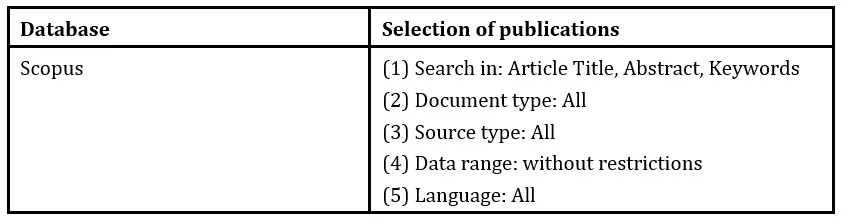
Data collection was conducted on August 21, 2023, using the Scopus database. The predefined eligibility criteria and the methodological approach are available in Table 1.
Table 1: Publications’ selection method and criteria
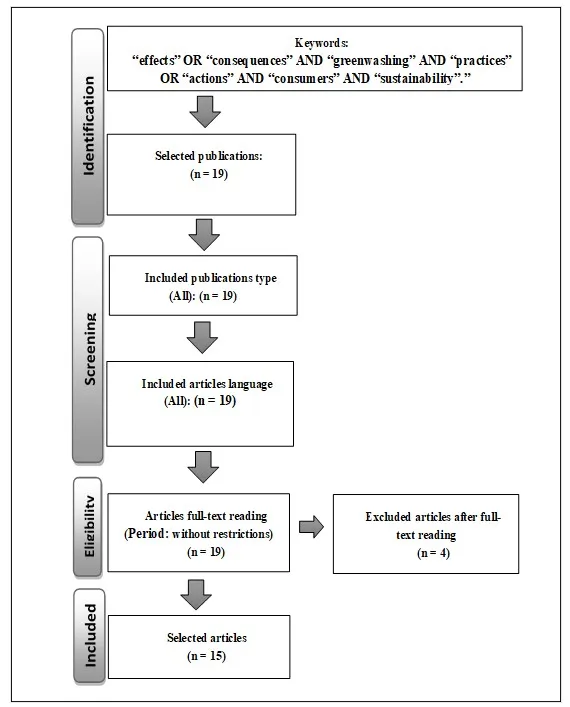
The search was carried out using article titles, abstracts, and keywords (Table 1), with the terms: “effects” OR “consequences” AND “greenwashing” AND “practices” OR “actions” AND “consumers” AND “sustainability”. At this stage, 19 academic documents were selected (Figure 1). After reading the full text, 4 documents were removed because they did not define and describe the phenomenon of greenwashing, nor did they portray its consequences. As shown in Figure 1, 15 documents were selected.
Fig 1. PRISMA flow diagram
Subsequently, a descriptive analysis of the data was carried out, namely, the evolution of the number of publications and number of citations, document type, number of publications by scientific area, number of publications by source title, and number of publications by country/territory. Finally, the sample publications were analyzed regarding the consequences of greenwashing practices.
Results and Discussion
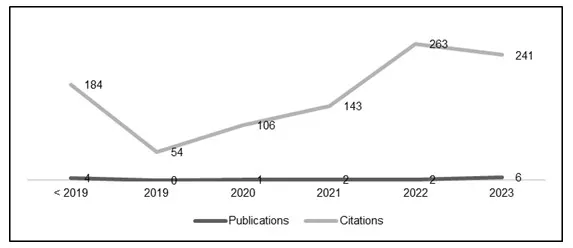
Figure 2 shows the progression of the number of studies and citations over time through August 21, 2023. Prior to 2019, there were only publications in 2011, 2012, 2015, and 2017, totaling 4 publications (one per year). No studies reporting the consequences of greenwashing were published in the Scopus database in 2019. In 2023, a maximum of 6 publications was recorded, although, given the date of the present research (August 21, 2023), a third of the year is missing. Regarding citations, the trend has been very positive since 2019, reaching a high of 263 in 2022.
Fig 2. Evolution of the number of publications and citations
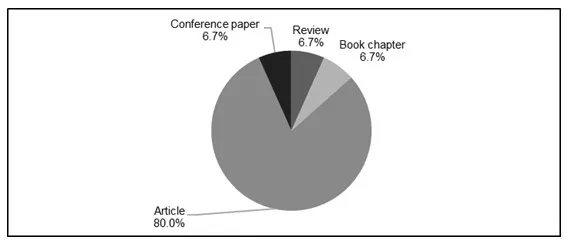
Figure 3 shows that, of the 15 documents selected for the review, the vast majority are articles (80.0%), with the remaining evenly distributed among book chapters (6.7%), reviews (6.7%), and conference papers (6.7%).
Fig 3. Document type
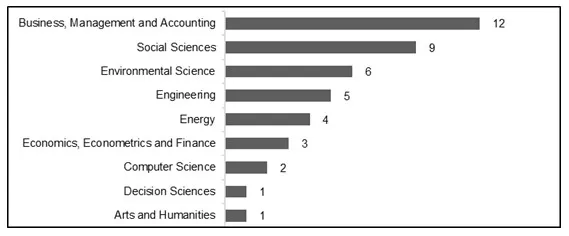
There are more publications in the scientific areas of Business, Management, and Accounting (12), Social Sciences (9), and Environmental Science (6), as shown in Figure 4. In smaller numbers, other very diverse and distinct scientific areas were considered, namely, Engineering (5), Energy (4), Economics, Econometrics and Finance (3), Arts and Humanities (1), Computer Science (1), and Decision Sciences (1). The presence of such diverse scientific areas is justified by the multidisciplinary nature of the greenwashing phenomenon (Yang et al., 2020).
Fig 4. Number of publications by scientific area
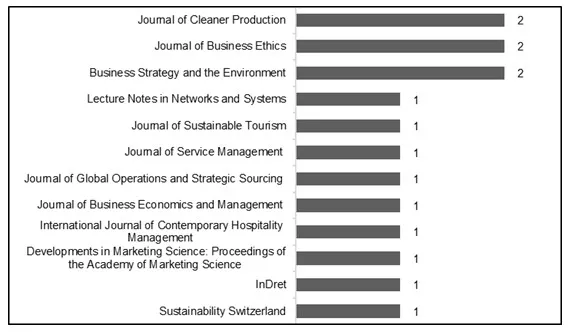
Figure 5 exhibits the journals in which the manuscripts were published. As shown, the three journals with the most studies on the consequences of Greenwashing are “Business Strategy and the Environment”, “Journal of Business Ethics”, and “Journal of Cleaner Production”. The 15 manuscripts analyzed were published in 12 journals.
Fig 5. Number of publications by source title
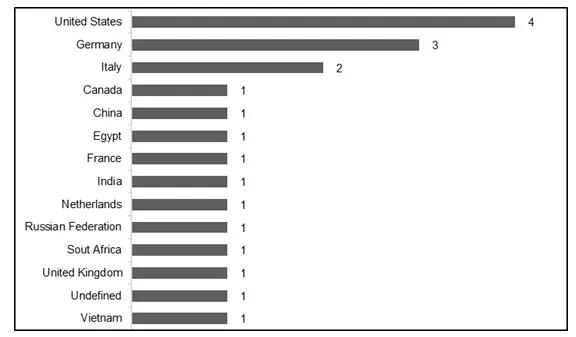
Most authors conducted their research in the West, specifically in the United States and in several European countries (Figure 6). The same results were obtained in a study that analyzed articles published on Web of Science, ScienceDirect, Springer, and Emerald Insight databases between 2000 and 2020 on the causes, taxonomy, and consequences of greenwashing behaviors (Rahman, Park, & Chi, 2015). The three countries that registered the highest number of publications were, in descending order, the United States (4), Germany (3), and Italy (2), as shown in Figure 6.
Fig 6. Number of publications by country/territory
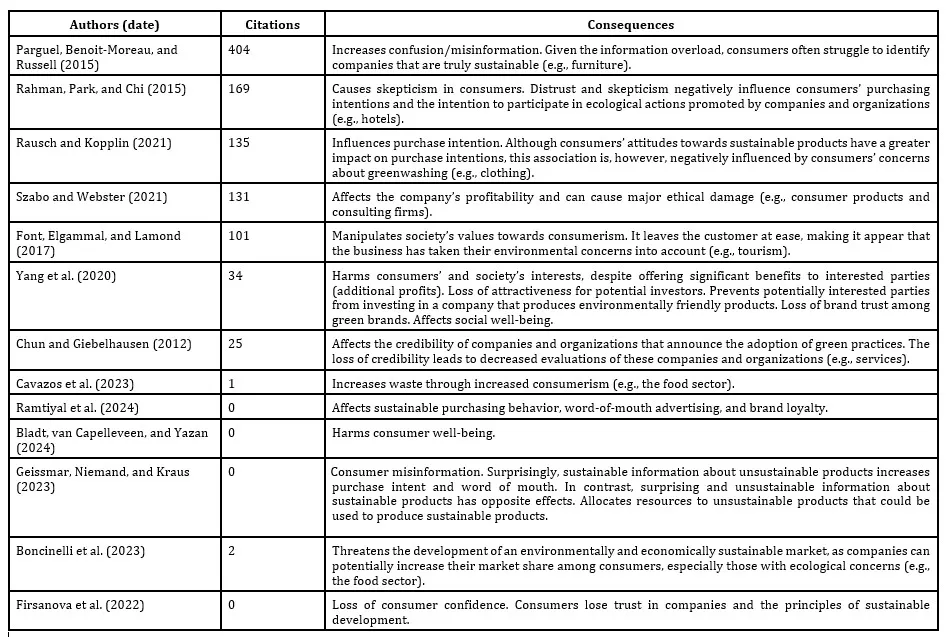
Table 2 presents the consequences of greenwashing practices identified in the analyzed manuscripts, organized in descending order of citations. Given the impact of greenwashing, its effects can be considered at four levels: consumers, investors, cooperating companies, and owners/shareholders. These results are consistent with the research conducted by Santos, Coelho, and Marques (2024) on greenwashing, which suggests that such practices harm consumers, brands, and organizations.
Table 2: Consequences of greenwashing portrayed in the analysed publications
At the consumer level, the phenomenon of greenwashing can result in consumer distrust and confusion (Geissmar, Niemand, & Kraus, 2023; Parguel, Benoit-Moreau, & Russell, 2015; Firsanova et al., 2022), which in turn generates skepticism (Rahman, Park, & Chi, 2015; Rausch & Kopplin, 2021). The practice of greenwashing leads to several problems, such as influencing and confusing consumers’ purchasing intentions (Martinez et al., 2020).
Rahman, Park, and Chi (2015) investigated consumer reactions to the greenwashing phenomenon in the accommodation industry. The results demonstrated that the hotels’ green initiatives generated consumer skepticism, which, in turn, negatively influenced consumers’ intention to participate in the linen reuse program and intention to revisit the hotel. Therefore, the authors concluded that skepticism negatively influences green purchasing intentions. Similar results had already been obtained in another research (Kwong & Balaji, 2016; Zhang et al., 2018). A study in the textile sector found that attitudes towards sustainable clothing have the greatest impact on purchase intention. However, this correlation is negatively influenced by consumers’ concerns about greenwashing (Rausch & Kopplin, 2021). As this phenomenon is increasingly common, consumers are becoming more skeptical of companies that take advantage of environmental trends (Nguyen et al., 2019). On the one hand, greenwashing changes consumers’ sustainable purchase intentions, making it difficult for them to evaluate products (Rausch & Kopplin, 2021; Gosselt, Rompay, & Haske, 2017). On the other hand, it alters the consumer-company/supplier relationship (Firsanova et al., 2021).
Greenwashing undermines favorable consumer perceptions about a company/organization, products, and/or services (Darke & Ritchie, 2007) when perceiving the difference between a company’s performance and its green advertising (Nyilasy, Gangadharbatla, & Paladino, 2014), and the consumer’s attitude towards the brand of sustainable products (Bladt, van Capelleveen, & Yazan, 2024). A brand’s greenwashing behavior also negatively affects consumers’ purchase intention for green products from other brands in the industry (Wang, Ma, & Bai, 2019).
Greenwashing significantly affects consumers’ brand attitude, green brand equity, purchase intention, and brand loyalty (Nguyen et al., 2019; Yang et al., 2020; Rahman, Park, & Chi, 2015; Rausch & Kopplin, 2021; Bladt, van Capelleveen, & Yazan, 2024; Zhang et al., 2018; Ramtiyal et al., 2024; Akturan, 2018) and leads to negative word of mouth (Leonidou & Skarmeas, 2017). Greenwashing impacts perceptions, skepticism, purchase intent, trust, and word of mouth (Santos, Coelho, & Marques, 2023). Furthermore, information overload can lead to confusion. Even the most conscious consumers can be attracted by misleading advertising.
In this sense, companies can, in the short and medium term, increase sales volume, attract conscious consumers, and increase consumerism (Font, Elgammal, & Lamond, 2017; Cavazos et al., 2023), thereby improving profitability. Greenwashing products can potentially increase market share against non-greenwashed products (Boncinelli et al., 2023). However, greenwashing poses a major threat and does not offer a true competitive advantage (De Jong et al., 2018). With these deceptive practices, the consumers end up not realizing the consequences of their purchasing behavior (Horiuchi et al., 2009) because, in reality, instead of resources being directed to the production of products and provision of sustainable services, they end up being allocated to production of unsustainable goods and services causing damage to the environment, consumer well-being and Society as a whole (Kim & Selar, 2023; Yang et al., 2020; Font, Elgammal, & Lamond, 2017), and sometimes a violation of existing laws or legal regulations can occur. Consequently, such actions may be subject to criminal, contractual, and/or administrative sanctions, putting the reputation of the companies that carry them out at risk (Kim & Selar, 2023).
The literature also suggests that investors are less likely to invest in companies that engage in greenwashing, preferring those that do not, even though the latter may reveal bad corporate behavior. Managers also show little willingness to collaborate with companies that resort to these deceptive practices (Yang et al., 2020). The phenomenon of greenwashing constitutes a threat to the development of an environmentally and economically sustainable market (Boncinelli et al., 2023; Jakubczak & Gotowska, 2020). In addition to deceiving consumers, greenwashing is considered an important barrier to the adoption of socially responsible practices (Leonidou & Skarmeas, 2017). Consumers lose trust in companies, their declared sustainability values, and the principles of sustainable development in general (Firsanova et al., 2022). The difficulty of distinguishing truth from falsehood in green advertising creates general skepticism among consumers. This skepticism makes it difficult for truly environmentally friendly companies to communicate their environmental contributions, which, in some cases, discourages the development of truly green products (Paço & Reis, 2012).
In summary, greenwashing is a major problem in the modern economy that deceives consumers, harms the environment, and companies (Bladt, van Capelleveen, & Yazan, 2023). In this context, responsible companies must not only promote new products to the market through sustainable marketing but also educate consumers to recognize unfair greenwashing practices by other manufacturers. By increasing consumers’ competence, companies cannot only reduce the negative effects of unfair product promotion practices but also help build trust among consumers (Firsanova et al., 2022).
Conclusion
In this research, a brief systematic literature review was conducted using the Scopus database. The work was developed in accordance with the PRISMA guidelines to examine the consequences of greenwashing practices.
In general, during the period under analysis, the number of published documents and citations has been increasing. Most of the documents were articles published in Western countries within the scope of Business, Management and Accounting, Social Sciences, and Environmental Science. These articles were published in journals such as “Business Strategy and the Environment”, “Journal of Business Ethics”, and “Journal of Cleaner Production”.
Due to its impact and scope, greenwashing is considered a social, economic, and environmental phenomenon with significant consequences for society, consumers, investors, cooperating companies, owners, and shareholders of companies and organizations. In fact, greenwashing increases confusion and misinformation, fosters consumer skepticism, influences purchase intentions, affects the company’s profitability, can cause significant ethical damage, manipulates society’s values towards consumerism, promotes waste, harms consumers’ well-being and society’s interests, undermines the credibility of companies and organizations, hinders sustainable purchasing behavior, and leads to a loss of consumer confidence.
In view of the above, companies and organizations should make every effort to ensure that their environmental performance aligns exactly with the green information disclosed, which must be clear and transparent. In fact, only then will sustainable development prevail.
This research has several limitations, including the reduced number of publications analyzed. For future research, it is recommended to include other databases to increase the number of publications analyzed. Still within the scope of future research, it would be interesting to develop procedures to analyze the consequences of greenwashing in specific sectors, such as textiles and food, which have evolved significantly at the expense of environmental degradation.
Acknowledgements
This work was supported by national funds through FCT/MCTES (PIDDAC): CIMO, UIDB/00690/2020 (DOI: 10.54499/UIDB/00690/2020) and UIDP/00690/2020 (DOI: 10.54499/UIDP/00690/2020); and SusTEC, LA/P/0007/2020 (DOI: 10.54499/LA/P/0007/2020).
UNIAG, R&D unit funded by the FCT, Portuguese Foundation for the Development of Science and Technology, Ministry of Science, Technology and Higher Education. Project n.o UIDB/04752/2020.
References
Akturan, U. (2018), ‘How does greenwashing affect green branding equity and purchase intention? An empirical research,’ Marketing Intelligence & Planning, 36, 809–824.
Atkinson, L. and Rosenthal, S. (2014), ‘Signaling the green sell: The influence of eco-label source, argument specificity, and product involvement on consumer trust,’ Journal of Advertising, 43 (1), 33–45.
Becker-Olsen, K. and Potucek, S. (2013), ‘Greenwashing,’ In: Idowu, S.O., Capaldi, N., Zu, L., Gupta, A.D. (eds), Encyclopedia of Corporate Social Responsibility, Berlin, Heidelberg: Springer, pp. 1318–1323.
Bladt, D., van Capelleveen, G., and Yazan, D.M. (2024), ‘The influence of greenwashing practices on brand attitude: A multidimensional consumer analysis in Germany,’ Business Strategy and the Environment, 33 (2), 597–625.
Boncinelli, F., Gerini, F., Piracci, G., Bellia, R., and Casini, L. (2023), ‘Effect of executional greenwashing on market share of food products: An empirical study on green-coloured packaging,’ Journal of Cleaner Production 391, 136258.
Carlson, L., Grove, S.J. and Kangun, N. (1993), ‘A Content Analysis of Environmental Advertising Claims: A Matrix Method Approach,’ Journal of Advertising, 22 (3), 27-39.
Castaldo, S., Perrini, F., Misani, N., and Tencati, A. (2009), ‘The Missing Link Between Corporate Social Responsibility and Consumer Trust: The Case of Fair Trade Products,’ Journal of Business Ethics, 84, 1-15.
Cavazos, R.L., Taylor, K., Eary, R.B., and Doty, S. (2023), ‘Institutional and Individual Effects of Greenwashing on Food Waste,’ Sustainability (Switzerland), 15 (1), 221.
Chen, Y. and Chang, C. (2012), ‘Enhance green purchase intentions,’ Management Decision, 50 (3), 502–520.
Chun, H.H. and Giebelhausen, M. (2012), ‘Reversing the green backlash in services: Credible competitors help large companies go green,’ Journal of Service Management, 23 (3), 400–415.
Darke, P.R. and Ritchie, R.J. (2007), ‘The defensive consumer: Advertising deception, defensive processing, and distrust,’ Journal of Marketing Research, 44 (1), 114–127.
Darnall, N., Pointing, C., and Vazquez-Brust, D. (2012), ‘Why consumers buy green,’ In: Vazquez-Brust, D. & Sarkis, J. (ed.) Green-Growth: Managing the Transition to Sustainable Capitalism, New York: Springer, pp. 287–308.
de Freitas Netto, S.V., Sobral, M., Ribeiro, A., and Soares, G. (2020), ‘Concepts and forms of greenwashing: a systematic review,’ Environmental Sciences Europe, 32 (19), 1–12.
De Jong, M. D. T., Harkink, K. M., and Barth, S. (2018), ‘Making Green Stuff? Effects of Corporate Greenwashing on Consumer,’. Journal of Business and Technical Communication, 32 (1), 77–112.
Delmas, M., and Burbano, V. (2011), ‘The drivers of greenwashing,’ California Management Review, 54 (1), 64–87.
Du, X.(2015), ‘How the market values greenwashing? Evidence from China,’ Journal of Business Ethics, 128 (3), 547–574.
Evans, S., Vladimirova, D., Holgado, M., van Fossen, K., Yang, M., Silva, E.A., and Barlow, C.Y. (2017), ‘Business model innovation for sustainability: Towards a unified perspective for creation of sustainable business models,’ Business Strategy and the Environment 26 (5), 597–608.
Firsanova, O.V., Baikov, V.G., Alekseeva, A.M., and Naumenko, N.V. (2022), ‘Sustainable Marketing: The Importance of Consumer Competence to Modelling the Rational Consumption,’ In: Trifonov, P., Charaeva, M. (eds.), Strategies and Trends in Organizational and Project Management, Cham: Springer, pp. 117–124.
Font, X., Elgammal, I., and Lamond, I. (2017), ‘Greenhushing: the deliberate under communicating of sustainability practices by tourism businesses,’ Journal of Sustainable Tourism, 25 (7), 1007–1023.
Gatti, L., Seele, P., and Rademacher, L. (2019), ‘Grey zone in – greenwash out. A review of greenwashing research and implications for the voluntary-mandatory transition of CSR,’ International Journal of Corporate Social Responsibility, 4 (1), 1–15.
Geissmar, J., Niemand, T. and Kraus, S. (2023), ‘Surprisingly unsustainable: How and when hindsight biases shape consumer evaluations of unsustainable and sustainable products,’ Business Strategy and the Environment, 32 (8), 5969–5991.
Gosselt, J.F., Rompay, T.V., and Haske, L. (2017), ‘Won’t get fooled again: The effects of internal and external CSR eco-labeling,’ Journal of Business Ethics, 2, 1–12.
Guo, R., Zhang, W., Wang, T., Li, C., and Tao, L. (2018), ‘Timely or considered? Brand trust repair strategies and mechanisms after greenwashing in China – from a legitimacy perspective,’ Industrial Marketing Management, 72, 127–137.
Horiuchi, R., Schuchard, R., Shea, L., and Townsend, S (2009), Understanding and preventing greenwash: A business guide, London: Futerra Sustainability Communications.
Inês, A., Diniz, A., and Moreira, A.C. (2023), ‘A review of greenwashing and supply chain management: Challenges ahead,’ Cleaner Environmental Systems, 11, 100136.
Jakubczak, A. and Gotowska, M. (2020), ‘Green consumerism vs. Greenwashing,’ European Research Studies Journal, XXIII (special 2), 167–181.
Kim, E. and Lyon, T. (2015), ‘Greenwash vs. Brownwash: exaggeration and undue modesty in corporate sustainability disclosure,’ Organization Science, 26 (3), 705–723.
Kim, H.E. and Selarl, A. (2023), ‘Greening Consumer Welfare: Towards a New Perspective on Consumer Protection,’ InDret, 569–588.
King, A.A. and Lenox, M.J. (2000), ‘Industry self-regulation without sanctions: The chemical industry’s responsible care program,’ Academy of Management Journal, 43, 698–716.
Kotler, P. (2011), ‘Reinventing Marketing to Manage the Environmental Imperative,’ Journal of Marketing, 75 (4), 132–135.
Kwong, G.S. and Balaji, M.S (2016), ‘Linking green skepticism to green purchase behavior,’ Journal of Cleaner Production, 131(10), 629–638.
Lee, H-H., Lee, M., and Ma, Y.J. (2018), ‘Consumer responses to company disclosure of socially responsible efforts,’ Fashion and Textiles, 5 (27), 1–16.
Leonidou, C.N. and Skarmeas, D. (2017), ‘Gray Shades of Green: Causes and Consequences of Green Skepticism,’ Journal of Business Ethics, 144, 401–415.
Lyon, T.P. and Maxwell, J.W. (2011), ‘Greenwash: corporate environmental disclosure under threat of audit,’ Journal of Economics and Management Strategy, 20 (1), 3–41.
Majláth, M. (2017), ‘The effect of greenwashing information on ad evaluation,’ European Journal of Sustainable Development, 6 (3), 92–104.
Marquis, C., Toffel, M.W., and Zhou, Y. (2016), ‘Scrutiny, norms, and selective disclosure: a global study of greenwashing,’ Organization Science, 27 (2), 483–504.
Martínez, M.P., Cremasco, C.P., Gabriel Filho, L.R.A., Braga Junior, S.S., Bednaski, A.V., Quevedo-Silva, F., Correa, C.M., da Silva, D., and Moura-Leite Padgett, R.C. (2020), ‘Fuzzy inference system to study the behavior of the green consumer facing the perception of greenwashing,’ Journal of Cleaner Production, 242, 116064.
Moher, D., Liberati, A., Tetzlaff, J. and Altman D.G. (2009), ‘The PRISMA Group: Preferred Reporting Items for Systematic Reviews and Meta-Analyses: The PRISMA Statement,’ PLoS Med, 6 (7), e1000097.
Mohr, L.A. and Webb, D.J. (2005), ‘The effects of corporate social responsibility and price on consumer responses,’ The Journal of Consumer Affairs, 39 (1), 121–147.
Montgomery, A.W., Lyon, T.P., and Barg, J. (2023), ‘No End in Sight? A Greenwash Review and Research Agenda,’ Organization & Environment, 37 (2), 221–256.
Nguyen, T.T.H., Yang, Z., Nguyen, N., Johnson, L.W., and Cao, T.K. (2019), ‘Greenwash and green purchase intention: The mediating role of green skepticism,’ Sustainability, 11, 2653.
Nyilasy, G., Gangadharbatla, H., and Paladino, A. (2014). ‘Perceived greenwashing: the interactive effects of green advertising and corporate environmental performance on consumer reactions,’ Journal of Business Ethics, 125 (4), 693–707.
Paço, A.M.F. and Reis, R. (2012), ‘Factors affecting skepticism towards green advertising,’ Journal of Advertising, 41 (4), 147–155.
Parguel, B., Benoît-Moreau, F., and Larceneux, F. (2011), ‘How Sustainability Ratings Might Deter ‘Greenwashing’: A Closer Look at Ethical Corporate Communication,’ Journal of Business Ethics, 102 (1), 15–28.
Parguel, B., Benoit-Moreau, F., and Russell, C.A. (2015), ‘Can evoking nature in advertising mislead consumers? The power of ‘executional greenwashing,’ International Journal of Advertising, 34 (1), 107–134.
Pearson, J. (2010), ‘Turning point. Are we doing the right thing? Leadership and prioritisation for public benefit,’ Journal of Corporate Citizenship, 37, 37–40.
Pizzetti, M., Gatti, L., and Seele, P. (2021), ‘Firms Talk, suppliers walk: Analyzing the locus of greenwashing in the blame game and introducing ‘vicarious greenwashing’,’ Journal of Business Ethics, 170 (1), 21–38.
Rahman, I., Park, J., and Chi, C.G.-Q. (2015), ‘Consequences of “greenwashing”: Consumers’ reactions to hotels’ green initiatives,’ International Journal of Contemporary Hospitality Management, 27 (6), 1054–1081.
Ramtiyal, B., Garg, P., Johari, S., Rathore, A. P.S., and Thakrey, A. (2024), ‘Investigating the effects of corporate social responsibility on sustainable consumer purchase behavior,’ Journal of Global Operations and Strategic Sourcing, 17 (3), 1–27.
Rausch, T.M. and Kopplin, C.S. (2021), ‘Bridge the gap: Consumers’ purchase intention and behavior regarding sustainable clothing,’ Journal of Cleaner Production, 278, 123882.
Rodgers, M., Sowden, A., Petticrew, M., Arai, L., Roberts, H., Britten, N., and Popay, J. (2009), ‘Testing methodological guidance on the conduct of narrative synthesis in systematic reviews effectiveness of interventions to promote smoke alarm ownership and function,’ Evaluation, 15 (1), 49–73.
Samal, S. and Bhalala, T. (2023), ‘An Awareness towards Greenwashing of Product and its Impact on Consumers’ Buying Behaviour in Surat City,’ International Journal of Engineering and Management Research, 13 (2), 94–98.
Santos, C., Coelho, A., and Marques, A. (2024), ‘A systematic literature review on greenwashing and its relationship to stakeholders: state of art and future research agenda,’ Management Review Quarterly, 74 (7), 1397–1421.
Seele, P. and Gatti, L. (2017), ‘Greenwashing Revisited: In Search of a Typology and Accusation-Based Definition Incorporating Legitimacy Strategies,’ Business and Strategy the Environment, 26, 239–252.
Szabo, S. and Webster, J. (2021), ‘Perceived Greenwashing: The Effects of Green Marketing on Environmental and Product Perceptions,’ Journal of Business Ethics, 171 (4), 719–739.
Tian, Z., Wang, R., and Yang, W. (2011), ‘Consumer responses to corporate social responsibility (CSR) in China,’ Journal of Business Ethics, 101 (2), 197–212.
Tseng, M.L., Islam, M.S., Karia, N., Fauzi, F.A., and Afrin, S. (2019), ‘A literature review on green supply chain management: trends and future challenges,’ Resources, Conservation & Recycling, 141, 145–162.
Wang, H., Ma, B., and Bai, R. (2019), ‘The spillover effect of greenwashing behaviours: An experimental approach,’ Marketing Intelligence & Planning, 38 (3), 283–295.
Yang, Z., Nguyen, T.T.H., Nguyen, H.N., Nguyen, T.T.N., and Cao, T.T. (2020), ‘Greenwashing behaviours: Causes, taxonomy and consequences based on a systematic literature review,’ Journal of Business Economics and Management, 21 (5), 1486–1507.
Zhang, L., Li, D., Cao, C., and Huang, S. (2018), ‘The influence of greenwashing perception on green purchasing intentions: the mediating role of green word-of-mouth and moderating role of green concern,’ Journal of Cleaner Production, 187, 740–750.